On this page
- Departments (1)
-
Text (5)
-
Untitled Article
-
Untitled Article
-
„ ' ' ^jf^fltiir^ "^a*****:***** .-*
-

Untitled Article
-
Untitled Article
Note: This text has been automatically extracted via Optical Character Recognition (OCR) software. The text has not been manually corrected and should not be relied on to be an accurate representation of the item.
-
-
Transcript
-
Note: This text has been automatically extracted via Optical Character Recognition (OCR) software. The text has not been manually corrected and should not be relied on to be an accurate representation of the item.
Additionally, when viewing full transcripts, extracted text may not be in the same order as the original document.
Untitled Article
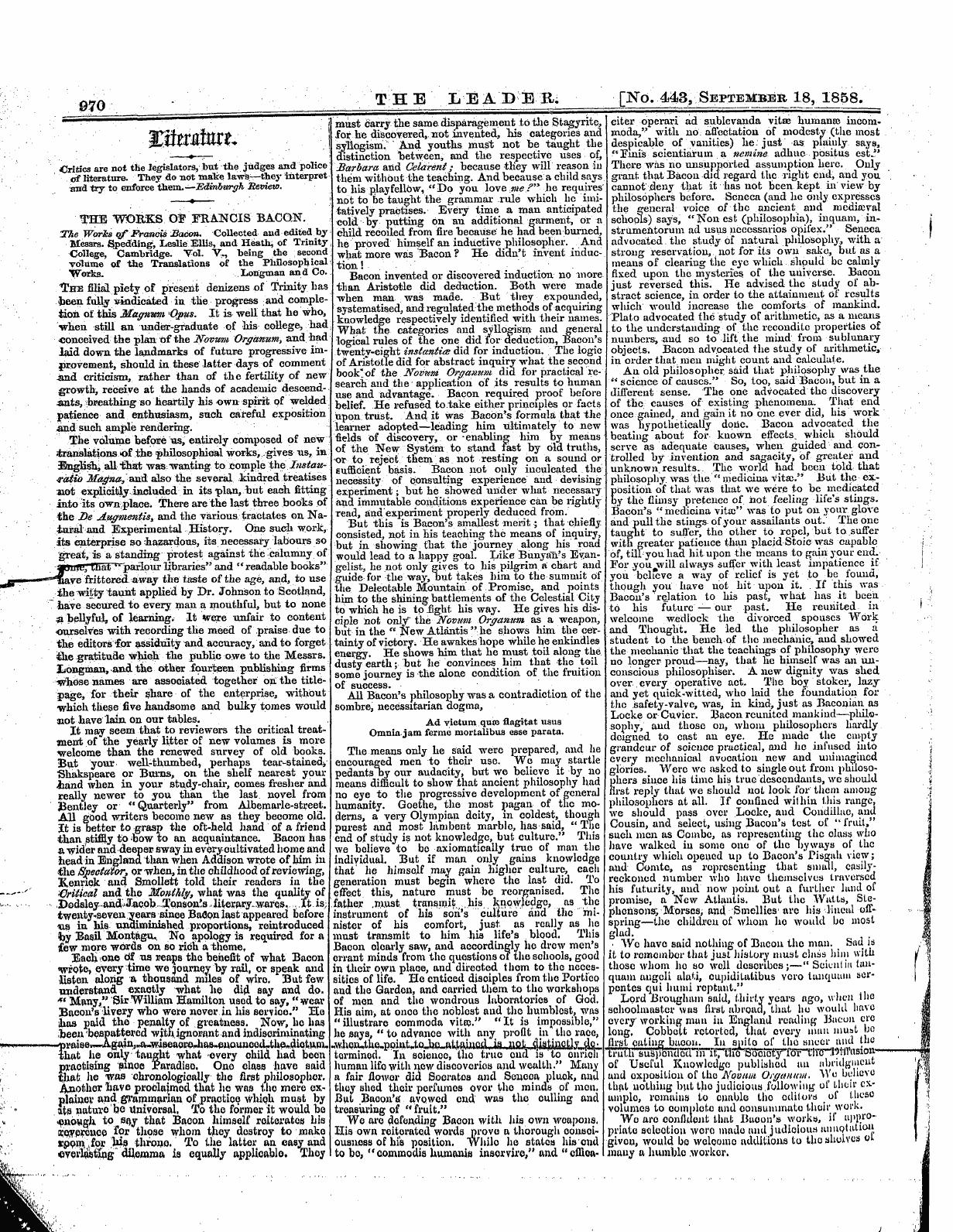
THE WORKS OF FRANCIS BACQN . The Works qf Francis Bacon . Collected and edited by Messrs . Spedaing , Leslie Ellis , and Heath , of Trinity College , Cambridge . Vol . V ., being the second volume of the Translations of the Philosophical Wotks . Longman and Co . ^ hd filial piety of present denizens of Trinity has been fully vindicated in the progress and completion ot this Magnwai Opus . It is well that he who ,
when still an under-graduate of his college * had ¦ conceived the plan of the Novum Orgamim , and had laid down the landmarks of future progressive improvement , should in these latter days of comment and criticism , rather than of the fertility of new growth , receive at the hands of academic descendants , breathing so heartily his own spirit of welded patience and enthusiasm , such careful exposition and such ample rendering .
must carry the same disparagement to the Stagyrite , for he discovered , not invented , his categories and syllogism . And youths must not be taught the distinction between and the respective uses of , Barbara arid Celarent ; because they will reason in them without the teaching . And because a child says to his playfellow , " Do you love me ? " he requires not to be taught the grammar rule which lie imitatively practises . Every time a man anticipated cold by putting on an additional garment , or a child recoiled from fire because he had been burned , he proved himself an inductive philosopher . And what more was Bacon ? He didn't invent induction !
Bacon invented or discovered induction no more than Aristotle did deduction . Both were made when man was made . But they expounded , systematised , and regulated the methods of acquiring knowledge respectively identified with their names . What the categories and syllogism and general logical rules of the one did for deduction , Bacon ' s twenty-eight instantits did for induction . The logic of Aristotle did for abstract inquiry what the second book" of the Nomtni Ort / anu-m did for practical research and the application of its results to human use and advantage . Bacon required proof before
belief . He refused to take either principles or facts upon trust . And it was Bacon ' s formula that the learner adopted—leading him ultimately to new fields of discovery , or enabling him by means of the New System to stand fast by old truths , or to reject them as not resting on a sound or sufficient basis . Bacon not only inculcated the necessity of consulting experience and devising experiment ; but he showed under what necessary and immutable conditions experience can be rightly read , and experiment properly deduced from .
But tins is Bacon ' s smallest merit ; that chiefly consisted , not in his teaching the means of inquiry , but in showing that the journey along his road would lead to a happy goal . Like Bunyan ' s Ev . angelist , he not only gives to his pilgrim a chart and guide for the way , but takes him to the summit of the Delectable Mountain of Promise , and points him to the shining battlements of the Celestial City to which he is to . fight his way . He gives his
disciple not only" the Novum Organum as a weapon , but in the " New Atlantis "he shows him the certainty of victory ^ He awakes hope while he enkindles energy . He shows him that he must toil along the dusty earth ; but he convinces him that the toil some journey is the alone condition of the fruition of success . All Bacon ' s p hilosophy was a contradiction of the sombre , necessitarian dogma ,
Ad vietum quce flagitat usus Omnia jam ferme mortalibus esse parata . The means only he said were prepared , and he encouraged men to their use . Wo may startle pedants dv out audacity , but we believe it by no means difficult to show that ancient philosophy had no eye to the progressive development of general humanity . Goethe , the most pagan of tfio moderns , a very Olympian deity , m coldest , though purest and most lambent marble , has said , " The end of study is not knowledge , but culture . " This we believe to be axiomatically true of man the individual . But if man only gains knowledge that he himself may gain higher culture , each
generation must begin where the last did . To effect this , nature must be reorganised . The father . must transmit his knowledge , as the instrument of his son ' s culture and the minister of his comfort , just , as really as ho must transmit to him his Hfe ' s blood . This Bacon clearly saw , and accordingly ho drew men ' s errant minds from the questions of the schools , good in their own plaoe , and directed them to the necessities of life . He enticed disciples from the Portico and the Garden , and carried them to the workshops of men and the wondrous laboratories of God . His aim , at once the noblost and the humblest , was " illustrare commoda vita ? . " "It is impossible , " he says , " to advanoe with any profit in the race , urlinn i \\ n rsrwinf in \\ n nftniiiorl 1 H nnf . fllHt . innll V flft .
tqrmined . In soienoo , the true onrl is to onrioh human life with now disoovorios and wealth . " Many a fair flower did Sooratoa and Seneca pluck , ana they shed their perfumes ovor tho minds of mon . But Baoon ' tf avowed end , was tho culling and treasuring of " fruit . " We are defending Bacon with Jus own woapons . His own reiterated words prove a thorough consciousness of his position . While he stales his ond to bo , " commodia Uumanis insorvire , " and "
effioa-The volume before us , entirely composed of new translations of the philosophical works , . gives us , in Bnglishi all tliat was wanting to eomple the Instau-< ratio Magna , and also the several kindred treatises mot explicitly- included in its plan , but each fitting into its own place . There are the last three books of the De Augmeniis , and the various tractates on Natural and Experimental History . One such , work , its enterprise so hazardous , its necessary labours so great , is a standing protest against the calumny of 4 R 3 UIU , that '' parlour libraries" and " readable books "
liave frittered away the taste of the age , and , to use the witty taunt applied by Dr . Johnson to Scotland , liave secured to every man a mouthful , but to none ^ bellyful , of learning . It were unfair to content ourselves with recording the meed of praise due to the editors for assiduity and accuracy , and to forget $ h . e gratitude which the public owe to the Messrs . Longman , and the other fourteen publishing firms mrhose names are associated together on the titlepage , for their share of the enterprise , without which these five handsome and bulky tomes would
aiot have lain on our tables . It may seem that to reviewers the critical treattnent of the yearly litter of new volumes is more welcome than the renewed survey of old books . But your well-thumbed , perhaps tear-stained ; , "Shakspeare or Bums , on the shelf nearest your hand when in your study-chair , comes fresher and jceally newer to you than the last novel from jBentley or * Quarterly" from Albemarle-styeet All gPod writers become new as they become old . It is better to grasp the oft-held hand of a friend
than stiffly to bow to an acquaintance . Bacon has « , -wider and deeper sway in every cultivated home and head in England than when Addison wrote of him in the Spectator , or when , in the childhood of reviewing , Kenrick and Smollett told their readers in the 'Critical and , the Monthly , what was the quality of Doclsleyand ,. ^ acpb ftpnson ' s , Jiterary . warqs , , It is twenty-seven years since Ba < Spn last appeared before us in his unaiminished proportions , rcintroduced 4 > y Basil Montagu . No applpgy is required fora few more words on so rich a theme ,
Each one df us reaps tho benefit of what Bacon < wrpte , every time we journey by rail , or speak and listen along a thousand miles of wire . But few understand exactly what he did say and do . ** Many / ' Sir William Hamilton used to say , " wear JJacou ' s livery who were never in his service . " Ho lias paid the penalty of greatness . Now , ho has been bespattered with , ignorant and indisoriminating T raieeiw ! k . gain 3 Wa . wiseaoroJI » as-eijouncQd ? . tUe ^ diot , ViPi
that he only taught what every child had been practising since Paradise , One class have said tliafe lie was chronplpgioally the first philosopher . Another have problajtmod that lie was the mere explainer and grammarian Of praotioe whiph must by ats natm-e be Universal , To tho former it would be enough to say that Bacon himself reiterates his flfe ^ rpjeence for thos e whom t | hoy destroy to make 1 : 99 m , for his throne . To the latter an easy and evei'lftsting dilemma ia equally applioablo . They
Untitled Article
eiter operari ad sublevanda vitae humante incornmoda , " with no affectation of modesty ( the most despicable of vanities ) he : just as plainly says , " Finis scientiarum a nemine adliuc positus est . " There was no unsupported assumption here . Only grant that Bacon dm regard the right end , and you cannot . deny that it has not been kept in view by philosophers before . Seneca ( and he only expresses the general voice of the ancient and mediaeval
schools ) says , " Non est ( philosophia ) , inquam , lnstrumentorum ad usus necessarios Opifex . " Seneca advocated , the study of natural philosophy , with a strong reservation , not for its own sake , but as a means of clearing the e 3 * e which should be calmly fixed upon the mysteries of the universe . Bacon just reversed this . He advised the stud y of abstract science , in order to the attainment of results which would increase the comforts of mankind .
Plato advocated the study of arithmetic , as a means to the understanding of the recondite properties of numbers , and so to lift . the mind from sublunary objects . Bacon advocated the study of arithmetic , in order that men might count and calculate . An old philosopher said that philosophy was the " science of causes . " So , too , said Bacon , but in a different sense . The one advocated the discovery of the causes of existing p henomena . That end once gained , and gain it no one ever did , his work was Tiypothetically done . Bacon advocated the beating about for known effects , which should serve as adequate causes , when guided and controlled by invention and sagacity , of greater and unknown results . The world had been told , that
philosophy , was the " medicina vitse . " But the exposition of that was that we were to be medicated by the flimsy pretence of iiot feeling life ' s stings . Bacon ' s " medicina vita ; " was to put oil your glove and pull the stings of your assailants out . The one taught to suffer , the other to repel , but to suffer with greater patience than placid Stoic was capable of , till you had hit upon the means to gain your end . For you will always suffer with least impatience if you believe a way of relief is yet to be found , though you have not hit upon it . . If this was Bacon ' s relation to his past , what has it been to his future — our past . He reunited in welcome wedlock the divorced spouses Work and Thought . He led the philosopher as a student to the bench of the mechanic , and showed
the mechanic that the teachings of philosophy were no longer proud—nay , that he himself was an unconscious pliilosophiser . A new dignity was shed over every operative act . The boy stoker , lazy and yet quick-witted , Avho laid the foundation for the safety-valve , was , in kind , just as Baconian as Locke or Cuvier . Bacon reunited mankind—philosophy , and those on , whom philosophers hardly deigned to cast an eye . He made the empty grandeur of science practical , and ho infused into every mechanical avocation new and unimagincd glories . Were we asked to single out from philosophers since his time his true descendants , we should
first reply that we should not look lor them among philosophers at all . If confined within this range , we should pass over Locke , and Condilkc , and Cousin , and select , using Bacon ' s test of " fruit , " such men as Combe , as representing the oluss who have walked in some one of the byways of the country which opened up to Bacon ' s Pisgali view ; and Comtc , as representing that small , easilyreckoned number who have themselves traversed his futurity , and now point out a further lund of promise , a New Atlantis . But the Watts , Stephchsons , Morses , and Smellies are his lineul offspring—the children of whom ho would bo most clad .
¦ Wo have said nothing of Bacon tho man . Sad is it to remember that just history must class him with those whom ho so well dcsorlbcs;— " Scicnl in tunquam augcli alaU , oupiditatibus voro lanqutim serpontes qui humi roptant . " Lprd Brougham said , thirty years ago , when tlio schoolmaster was first abroad , that ho would , have every working man iu England reading Bueun ere long , Cobbott retorted , that every imm must bo first eating baoon . In spito of tho sneer and the ¦ i \ Viif i ; £ 'ji'll ! TO'WIW 1 ^ iVSf" 41 W ^ WnirA'f 7 ? wrAli » " ^ Vrtw 1 0 WVlTsiOtt
of Useful Knowledge published an nbridgment and oxpobitlon of tho Novum OrgauuM . Wo believe that nothing but tho judicious following of their cs .-umplo , remains to enable tho oditorei of these volumes to coinploto und oonsummato their work . Wo arc confident that Bacon ' s works , if uj » P . f ° " priato selection woro made und judioious anupUiUon givon , would bo woloomo acUUtiona to tho ahulves o \ many a humblo workor .
„ ' ' ^Jf^Fltiir^ "^A*****:***** .-*
K 8 tx $ fottt +
Untitled Article
¦ ¦ ¦ ¦ , ¦ — ¦ ? — ¦ — . ¦ ' ' ¦ Critics are not the legislators , but the judges and police of literature . They do not t oalfe laws—they interpret and try toi enforce them . — ~ Edinburgh Review .
Untitled Article
070 Till lElBIR ; [ No . 4 * 4 * 3 , September 1 . 8 ,. 1858 .
-
-
Citation
-
Leader (1850-1860), Sept. 18, 1858, page 970, in the Nineteenth-Century Serials Edition (2008; 2018) ncse.ac.uk/periodicals/l/issues/vm2-ncseproduct2260/page/18/
-