
On this page
-
Text (3)
-

Untitled Article
-
Untitled Article
-

Untitled Article
Note: This text has been automatically extracted via Optical Character Recognition (OCR) software. The text has not been manually corrected and should not be relied on to be an accurate representation of the item.
-
-
Transcript
-
Note: This text has been automatically extracted via Optical Character Recognition (OCR) software. The text has not been manually corrected and should not be relied on to be an accurate representation of the item.
Additionally, when viewing full transcripts, extracted text may not be in the same order as the original document.
Untitled Article
bv freedom , from which is bora knowledge and still / the parents of cheapness . Though we cannot expect that free trade should be speediW allowed in % rance , we are confident that it must in a time , short in proportion as population is multiplied and communication betwixt -the different parts ^ of the earth increases , become the rule there , and in all other countries- . . As some of our contemporaries are very impatient in this matter , and scold and sneer at the French for backwardness , we may call attention to our own tariff . It is now upwards of sixteen years since a declining revenue , a dwindling trade , and ^ adiscontented people compelled a Conservative Minister , who hadfrom 1815 to 1 S 42 zealously upheld the
products of our neighbour we levy duties that niay be fairly classed with his duties on our iron and our coaL The amount may be somewhat less , the principle and the jealous apprehensive spirit which dictate them are just the same . It is supposed to be politic to favour the produce of our colonies and of our own soil by discriminating duties , and , in spite of experience , we continue tp maintain such duties . As they now exist they were settled , but not originally imposed , by a Ministry composed of professing free traders ; and we can but think that in voluntarily lending themselves to the continuance ot such solecisms they were more reprehensible than the self-seeking and avowed protectionist iron-masters of Trance . Be the fault whose it may , the
continuance on our statute-book of upwards pi threescore distinct customs duties levied for protection does not entitle us to complain very much of the French for still continuing absurd protective duties . They have been , let it be remembered ^ the prey of successive revolutions , while we have been able tranquilly to work out commercial improvements . Accordingly , we have gone far ahead ot them , and we should encourage them to go forward by perfecting what we have so successfully begun .
, , corn-laws , to commence commercial reform . Sir Robert Peel then professed to be converted to free ^ trade principles ^ and now , at the end of sixteen years , after the reforming Whigs have been many successive years in office , in what condition is our tariff ? Customs duties levied on such articles as sup-ar , tea , and tobacco , which we cannot produce , and which do not come into competition with articles grown at home , are barely defensible . But , besides such duties , we levy a number of duties on articles which come directly into competition with articles grown or produced at home ; they are duties levied in a protective spirit , and make a discrimination generally between the produce of our colonies and other countries .
Thus , for the benefit of our landowners , duties are still maintained of Is . per quarter on all kinds of grain ; of 4 £ per cwt . on flour , rice , arrowroot , tapioca , sago , and similar artiples ( on macaroni Is . per cwt . ) , which come into competition with their cereals ; of 5 s < per cwt . on butter , and 2 s . 6 d . per cwt . on cheese , which are shown to be anti-free-trade duties , by only 2 s . 6 d . being levied on butter from the colonies , of which just 4346 cwts . were imported in 1856 , and only Is . 6 d . levied on cheese from the colonies , of which exactly 244 cwts . were imported from them in the same year ; of 8 d . and 4 d .
per cubic foot on eggs * as they are foreign or colonial produce , though -none come from the colonies except from the Channel Islands ; of 3 d . or 2 d . per bushel on apples ( dried apples , Is . ) , on grapes 2 d- > while walnuts , pears , plums , onions , &c , all pay toll , which enhances unfairly in proportion the price to the consumer of the homegrown commodities . So hops pay a oustouis duty of 2 / . 5 s . per cwt ., while the excise on home grown is about 19 s ., giving the landowner a benefit on the price of 1 / . 6 s . per cwt . While ornamental and hard woods which we do not admitted freethe wood and timber admitted iree ci
erow are , grow are , me wuuu uuu um » which are grown here are subject to considerable duties , varying on the different kinds , arid generally double on foreign woods as against colonial . Foreign tallow , too , pays a duty of Is . 6 d . per cwt ., and colonial Id . All these are protective duties , still levied in behalf of the landowners , who so lpng safe , like the pld man of the sea , on the national industry . They keep up rent at the expense of the consumer ; while we boast of our free trade and sneer at those who protect their irPn-masters against competition with ours . Nor are the manufacturers unprotected by duties .
On window glass and sheet glass and on candles customs duties aro still levied , though the excise duties on these articles have with great advantage been abolished . Clocks and watches , manufactures of caoutchouc , of cotton , pf silk , of linen , of woollen , of goat's-hahy of leather , of copper , &c , aro all subjept , tp protecting . duties * , win ]? .... the ., raw , materials are admitted free . Sc laco , network , baskets , bopks , straw hats , porcelain , embroideries , artificial flowers , cpatcd brass , oilclpth , paper-hangings , toys , vinegar , aro subject to such duties which , withcut yielding any sum pf impprtanoo tp the revenue , impede trade and bestpw cpuntcraoting benefits , as
is supposed , on the manufacturing classos for tho laxos levied on them in behoof pf the landed interest . JFor bpth the oonsumer is taxed . There arc two other articles tp which we must call special attention . To the bonoftt pf tho groat monopolist brewers of the metropplia and pthor b rowers wo le vy , duty pf no , leBa th i ftir T . fip _ fl ^ d-nn-iiQi ! niffHWino , and 2 s . 10 ^ a . pn ooloninl wino ; and for the benefit pf pur distillers wo levy a duty pn foreign spirits pvor and abpvo tho sum they pay lor exoise dutios of 7 s . per gallpn . The oustpms autoes ore 15 s . pn foreign spirits , the exoiso duties on tho homo made aro 8 s . That this qxcess is a preteqtivo duty is plain from tho oustpms duty loviod on oolpnial rum being only Sa . 3 d . per gallpn . Tims , on those two great
Untitled Article
SALT FOE CHINA . There is in England a Chamber of Commerce , composed of Cheshire and Worcestershire salt-proprietors , and formed specially for the extension and protection of their own peculiar trade . It appears that this trading body has recently presented a memorial to our Government , " respectfully entreatixi ° - that free admission of British salt be made a stimulation in our future dealings with the Chinese authorities . " ¦ ¦ . . „ ,
salt enough and to spare . Nor has there been any complaint among them as to its quality ; for our personal observations do not agree with the statement in the memorial that the salt in use is " an impure and deleterious article . " - There is no doubt that our British salt is superior , and , if introduced , would greatly , improve the . quality of this necessary of life in China ; but have the salt merchants of Great Britain sufficient reason for impeaching the traders in China as dealing in an article that is both "impure and deleterious ?"••; . Tliere is no doubt , as the Cheshire memorial states , that the sale of salt in the FloweryHLiand is put under " a fiscal system . " The whole departlock and ¦ arid
ment is under Government key ; : , m proof of the importance which the Executive attaches to the salt trade , it is enough to point out that the directors of the monopoly are officers Pi high rank , appointed under the supreme Government ; that , in connexion with the department , there is a numerous and expensive establishment throughout the country ; that the duty on salt forms a considerable branch of the public revenue ; that the trade is let out to merchants , reputed among the most respectable and wealthy ; that the laws which regulate the traffic are very specific , as well as rigorous ; and that those who violate them are subject to heavy penalties . . must be to
The monopoly , therefore , important the native Government . Yet , with all this array of restrictions or measures to promote arid protect the trade , what do we find ? Every now and then we read complaints written ; out by " Salt Commissioners , ' to the effect * that " we find salt but no merchants to conduct the sale of it ; " tf there is some hindrance to the consumption of salt prepared by Government ; " and " something hinders the Government salt from finding a market among the people . " And the same Chinese documents , in seeking out the cause of this falling off , trace it principally to " the smuggling of salt that is pnvatelv made" . , Under the circumstances which we have sought faithfullto representit is not likely that there is
y , to come from China a demand or a cry for salt that will tempt the Cheshire and Worcestershire vendors thither ; we cannot see either that the salt proprietors of Great Britain will be able to send it a distance of 17 , 000 miles and produce it at a lower price than tlie Chinese farmers or smugglers , who doubtless would reduce their charges on the prospect of a frees trade in the article ; nor is there any prospect whatever of the Chinese Government renouncing so fruitful a source pf revenue ; and with our hearty detestation of cliques , cabals , and monopolies in any shape , we question very much the propriet y of the Cheshire and Worcestershire Chamber of Commerce seeking Government influence to interfere with a native monopoly of salt , about w . hioh we knpw so little . ¦
How glad we should be to see " free admission of British salt intp China" as well as pf every pther article ; it would be beneficial to commerce in both countries $ but , upon matters so serious to people here , and to the people there too , why not , at so important an era as the present , speak out for the purpose of giving informatipn P We have done so —with every mark of respect to tlie Chamber of Commerce in Cheshire and Worcestershire .
It is with no little surprise , however , that we find a body of merchants , professedly united for the extension of their special trade , so dilatory in making their claims known—if they have any . On perusing their document , the first thought was , "Why , in the name of common sense , put off pressing these claims , not only till eighteen months after the British embassy had left England , but till that embassy was leaving tlie Pei-ho , and just when the final treaty with China—having been signed , sealed , and verified by the several parties at jPekin—was bein # brought to England for confirmation by our gracious Queen T Is this ' a fair sample of vigilance , alacrity , or promptness in the commercial Chambers of Great Britain P We think not . Or is it an exception in the case only of the Salt Chamber of Cheshire , &c . ? At least , so it appears . "
Further , on examining said memorial , it suggested a few other inquiries . How has the demand for salt in China been hitherto supplied ? What kind of article is it that is in use among the natives there ? Is it not good enough and ample enough for all their wants P Is the salt trade a Government monopoly let out to native merchants alone ? and if so , is that trade of such a character that the salt , proprietors of Cheshire , &c , should seek the aid of foreign diplomacy to stop it or break it up P Without vouching to follow these queries in soquence or to answer them fully and satisfactorily , we shall attempt to lay before our readers what we know tp bo facts cennected with the salt trade in China .
Of ccurse , among the Chinese , salt is a great necessary of life—an essential in cooking , pickling , preserving , eating , sacrificing , &c , &c . ; and , while they , aro . most economical , n > ,. its use ,. there .. must bo an enormous consumption of it , so that we cannot rely upon any calculation of the amount annually used by this " hive of nations . " It is true the Cheshire and Worcestershire salt farmers vonturo to affirm that from one tp two million tons aro consumed per annum in China , but what is that to 300 , 000 , 000 of people , as assumed in tho petition—not tp say 420 , 000 , 000 , as
shown by the census made in 1842 P To meet the largo demand fpr this article , China has up to tho presont hour had tp look to her own resources . Sc , sailing alpng hor cpasts , ypu observe ^ iiuJiewslandSjJiPJGtluanaVo ^^ mouths pf hor principal rivers , salt pans and salt stacks , prpduood by the ovappratipn pf soa water ; and , travelling into tho interior , Pile meets with salt depots , salt springs , and , in the prpvinoe of 8 ze-ohuon , salt pits , which ( judging from what wo road ) , if properly wprked , might ; load to real and extensive salt mlnos . As far as wo knpw , then , tho overgrown population of that empire has hitherto had , and still has ,
Untitled Article
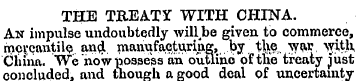
THE TREATY WITH CHINA . An impulse undpubtedly willjbe given tp commerce , mercantile and , . manufaotu , ring , by the war \ yitlv China . We how possess an outline of the treaty just concluded , and though a good deal of uncertainty must be felt as to the precise terms and possible effects cf spine pf tho articles of tho treaty , enpugli is visible to satisfy us that a new and an almost illimitable outlet for our manufactures is suddenly and successfully opened up to . the trading interests pf this empire . Wero we disposed tp grumble , wo should ask why mpro was npt obtained . While wo were dictating terms , surel y wo might have added a few move articles that weuld have nad the effect pf clearing up opmmoroial dpubts and remeving well jU ^ rfltaftdl . AQn ^^ was tho passpprt system introduced uup a China treaty P- —this poouhar element pf opntinental oivihsatien— -the benefits pf whioh we are so praotioally impressed with that we have just , esoaP ° * a " positive estrangement from a faithful ally w 1 consequence of the aggravated pressure of ty ° Af * P 0 l J system . May wendt find in this matter the trace pf some European influence P The crafty , yet immovable Chinaman would surely never of himself have
Untitled Article
TT - ~ -- ^^ m
-
-
Citation
-
Leader (1850-1860), Sept. 18, 1858, page 977, in the Nineteenth-Century Serials Edition (2008; 2018) ncse.ac.uk/periodicals/l/issues/vm2-ncseproduct2260/page/25/
-