On this page
- Departments (1)
-
Text (4)
-
Untitled Article
-
Untitled Article
-
Untitled Article
-
LITERATURE, SCIENCE, ART, &c.
Note: This text has been automatically extracted via Optical Character Recognition (OCR) software. The text has not been manually corrected and should not be relied on to be an accurate representation of the item.
-
-
Transcript
-
Note: This text has been automatically extracted via Optical Character Recognition (OCR) software. The text has not been manually corrected and should not be relied on to be an accurate representation of the item.
Additionally, when viewing full transcripts, extracted text may not be in the same order as the original document.
Untitled Article
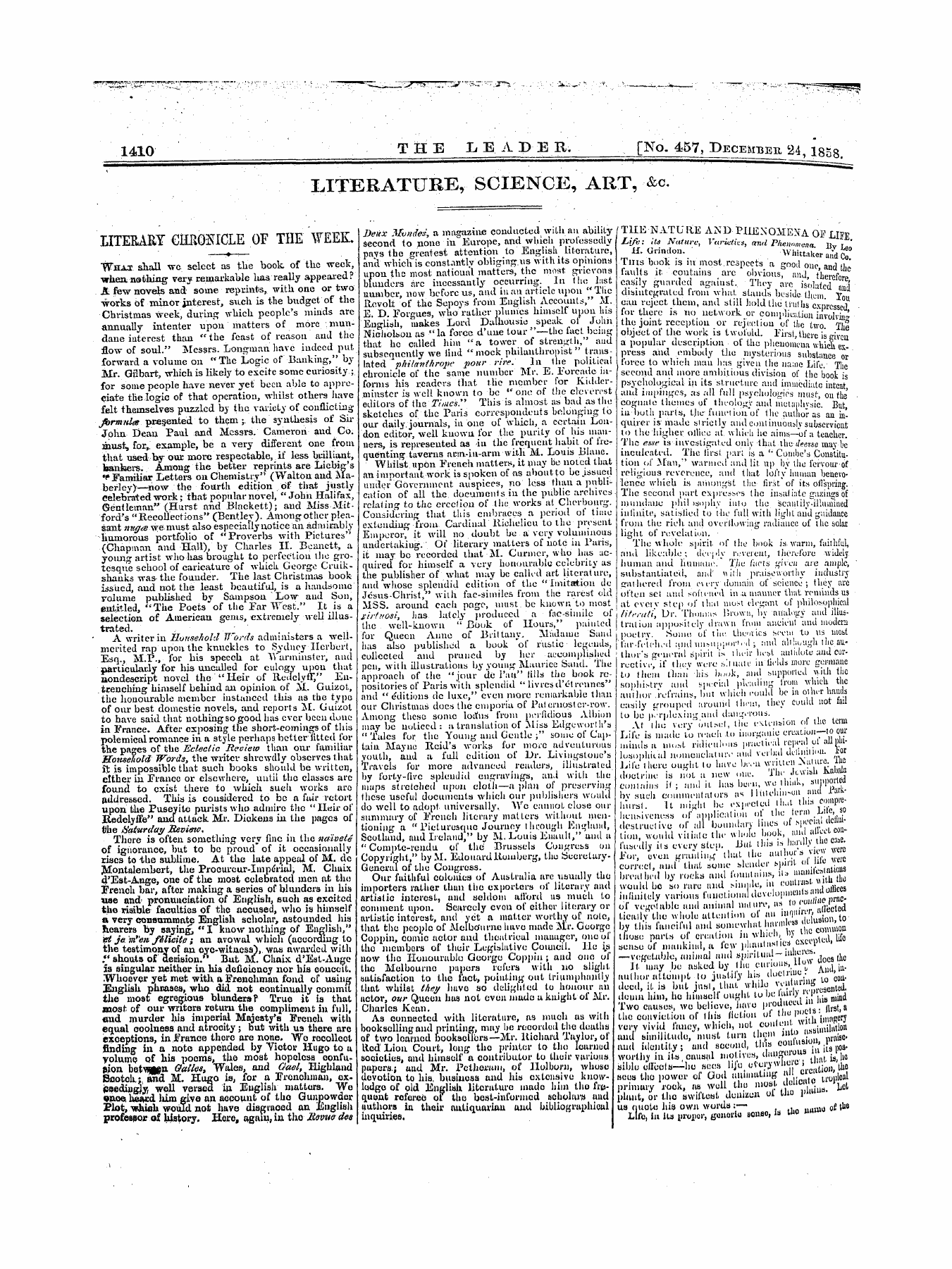
Whax shall we select as the book of the week , when , nothing very remarkable lias really appealed ? JL few novels and some reprints , with one or two works of minor interest , such is the budget of the Christinas week , during which people ' s minds are annually intenter upon matters of more mundane interest than " the feast of reason and the flow of soul . " Messrs . Longman have indeed put forward a volume on " The Logic of Banking , " by
Mr . Gilbart , which is likely to excite some curiosity ; for some people have never yet been able to appreciate the logic of that operation , whilst others have felt themselves puzzled by the variety of conflicting Jbrmula . presented to them ; , the synthesis of Sir John Dean Paul and Messrs . Cameron and Co . Biust , for ,, example , be a very different one from that used by our . more respectable , if less brilliant , tankers . Among the better reprints are liiebig ' s "t Familiar Letters on Chemistry" ( Walton and Maberlev)—now the fourth edition of that justly Celebrated work : that popular novel , " John Halifax ,
Gentleman" ( Hurst and Blackett ); and Miss Mit ford's "Recollections" ( Bentley ) . Among other pleasant nug& we must also especially notice an admirably humorous portfolio of " Proverbs with Pictures " ( Chapman and Hall ) , by Charles II . Bennett , a young artist who has brought to perfection the grotesque school of caricature of which . George Cruikshauks was the founder . The last Christmas book issued , and not the least beautiful , is a handsome volume published by Sampson Low and Son , entitled , " The Poets of the Par West . " It is a selection of American gems , extremely well illustrated .
A writer in Household Words administers a wellmerited rap upon the knuckles to Sydney Herbert , Esq ., M . P ., for his speech at Wanninster , and particularly for his uncalled for eulogy upon that nondescript novel the " Heir of Rcuclyff , " Entrenching himself behind an opinion of M ,. Guizot , the honourable member instanced this as the type of our best domestic novels , and reports M . Guizot to have said that nothing so good has ever been done in France . After exposing the short-comings of this polemical romance in a style perhaps better fitted for the pao-es of the Eclectic Reoiew than our familiar
Household Words , the writer shrewdly observes that fit is impossible that such books should be written , either in France or elsewhere , until the classes arc found to exist there to which such works arc addressed . This is considered to be a fair retort upon the Puseyito purists who admire the "Heir of Redclyffe" and attack Mr . Dickens in the pages of the Hqturday Review , There is often something very fine in the naivete of ignorance , but to be proud " of it occasionally rises to the sublime . At the late appeal of M . de Montalembert , the Procureur-Impe ' ria ] , M . Chaix
4 'Est-A . nge , one of tlie most celebrated men at tins French bar , after making a series of blunders in his tiae and 1 pronunciation of English , such as excited the risible faculties of the accused , who is himself a very consummate English scholar , astounded his hearers by saying ,, " I know nothing of English , " et je . m * en . filicite ; an avowal which ( according to the testimony of an eyd-witness ) , was awarded with V shouts of decision . But M . Chaix d'Est-Augc is singular neither in his deficiency nor his conceit . Whoever yet met with a Frenchman fond of using English phrases , who did not continually commit the most egregious blunders P True it is that
Deux Mvndes ' , a magazine conducted with an ability second to none in Europe , and which ' professedly pays the greatest attention to English Literature , ami which " is constantly obliging . us with its opinions upon the most natioua ' l matters , the most grievons blunders arc incessantly occurring . In the last number , now before us , and in an article upon "The Revolt of the Sepoys from English Accounts , " M . his
E . D . Forgues , who rather plumes himself upon English makes Lord Dalhbusio speak ot John Nicholson as ¦ " la force d ' une tour " —the fact being that he called him " a tower of strength , " and subsequently we iind " mock philanthropist" trans - lated philanthrope pour rire . In the political chronicle of the same number Mr . E . Forcade informs his readers that the member for Kidderminster is well known to be " one of the cleverest editors of the ' Tiuics . " This is almost as bad as the
sketches of the Paris correspondents belonging to our daily , journals , in one of which , a certain London editor , well kuowii for the purity of his manners , is represented as iu the frequent habit of frequenting taverns acm-iu-arm with M . Louis Blanc . Whilst upon French matters , it may be noted that an important work is spoken of as about to be . issued under Government auspices , no less than a publication of all the documents in the public archives relating to the erection of tlie works at Cherbourg . Considering that this embraces a period of time ex . tend . uur Irom Cardinal Richelieu to the- present
Emperor , it will no . doubt be a very voluminous undertaking . Of literary matters of note in Paris , it may be recorded that M . dinner , who has acquired for himself a very honourable celebrity as the publisher of what may be called art literature , and whose splendid edition of the " Imitation de Jesus-Christ , " with fac-similes from tlie rarest old MSS . around cacli page , must . be known to most xirtnosi , has lately produced a fac-simile of the well-known " Book of Hours , " painted for Queen Anne of Brittany . Madame Sand has also published a book of rustic legends ,
collected and pruned by her . accomplished pen , with illustrations by young Maurice Sand . The approach of the " jour dc l ' au" ( ills the book repositories of Paris with splendid " livrcsd ' etronncs " and " editions dc luxe , " even more remarkable than our Christmas does the emporia of Paternoster-row . Among these , some loitns from perfidious Albion may be noticed : a translation of Miss Edge-worth ' s " Talcs for the Young and Gentle ; " some of Captain May no Reid ' s works for more adventurous
youth , aud a full edition of Dr . Livingstone's Travels for more advanced readers , illustrated by forty-five splendid engravings , ani wilh the maps stretched upon cloth—a plan of preservm" - these useful documents which our publishers Would do well to adopt universally . We cannot close our summary of French literary matters without mentioning a " Picturesque Journey through England , Scotland , aud Ireland , " by M . Louis Enault , " and a " Coniptc-i'cudu of the Brussels Congress on Copyright , " byM . EdouardRomberg , thu Socrotary-General of the Congress .
Our fuithful colonies of Australia are usually the importers rather than the exporters of literary and artistic interest , and seldom afford us much t . o comment upon . Scarcely cvon of cither literary or artistic interest , and yet a matter worthy of note , that the people of Melbourne have made Mr . George Coppin , comic actor aud theatrical manager , one of the members of their Legislative Council . Ho \ s now the Honourable George Coppiu ; and one of the Melbourne papers refers with no blight aati&faction to the fact , pointing out triumphantly that whilst they Iiavo so delighted to honour an actor , our Queen has not eveu made a knight of Air . Charles Kcun .
As connected with literature , as much as with bookselling aud printing , may bo recorded the deaths of two loamed booksellers—Mr . Richard Taylor , ot Hod' Lion Court , long tho printer to tho Ioarnud societies , and himself a contributor to their various papers . ; and Mr . l ' otlieiuuu , of Holboni , whose devotion to his , business and his extensive knowlodge of old English literature made him tho frequent referee of the best-informed scholiirw and authors in their antiquarian , and bibliographical inquiries .
THE NATURE AND PHENOMENA OP LIFE Lifis : Its Nature , Varieties , and Phenomena 1 W r ' H . GvimJon . Wlnttaker and Jo ! Tins book is m most . respects a good one , and th * . laults if . contains arc obvious , and , therefore easily giKirclcd against . They are isolated ai 5 disintegrated from what , stands beside them Ton can reject them , and still hold the truths expressed for there is no network or conipliuilioii involving the joint reception or rejection of the two TJie object of the work is twofold . First , there iseivcu a popular description of the phenomena which express and . embody the mysterious substance or
force to winch man h : is given the name Life . Tlie second and "more ambitious division of the book is psychological in its structure and immediate intent and impinges , as all full ' psychologies must , on the cognate themes of theology aud meianh ysic . But , in both parts , the function of tlie author as an inquirer is made strictly and continuousl y subservient to tlie higher olliee at which he aims—uf a teacher . The esse isinvestigated only that the deessc may be inculcated . The first p : irt is a ' Combe ' s Constitution of Man , " warmed and lit . up by the fervour of religious reverence , and that loftv human
benevolence win eh is amongst the . first of its offspring . The second part expresses the insatiate gaziiigs ' of mundiiue phil ¦ wphy inio the scanlily—illumined ' iiilinitO ) ¦ salislied to t-he full with light and guidance from tlie rich , anil overflowing radiance of the solar light of revelation . The whole spirit of the book is . warm , faithful , anil likeable ; deepl y reverent ., therefore widely human and Ininiiuu-. T / ie . facts given are ample , substantiated , ami m it It praiseworthy industry eathereil from c \ irv domain of science : they arc
often set ami soft curd in a manner that l-onmids us at oveiv step of thai most elegant of philosophical literati , Dr . Thomas Brown , by niiaWy and illustration appositely drawn from ancient and modem poetry . Some of tin- theovics seem to us most far-fetch .-. ! : iml ¦ uuMipjior ' .-. 1 ; aud although the author ' s scurr ' nl spirit is their best antidote and corrective , ' if thc . v were . situate in ' fields wore germane to them than ' his bwok , ami supported with the soplii > trv and special pleading from winch the author . ivfrains , but which eould be m ovher haiuls easily irmupcd around ih .-m , they cuuld not tail
to be perplexing ami dangerous . At ilm very outset , the eMen . ion of the term Life is made to reach to inorganic creation—to our inimlsu must ridiculous practical repeal ut alll > lulosophkal nomenclature ami verbal dclimui'ii . * ot Life there ought , Iu have W .-u written -Nature , doctrine is . ml a new « me . The Jcwwh KaWa contains if ; and il , has born , we tlm . k , simpoiM bv such commentators as 1 luicluu-on ami i a £ - hurst . It infill bo expected . hat \\ m cmnpiehensiveness of ' app lication of the term Li C J destructive of all boundary hues of . smTiai deh iiestruciive 01 an ijomiu . n > i . m ^ - ( -
tion , would vitiate the whole book am a 1 ca confuscdly i . s every step . JJul tins is iK . r . lly . iho cm . For , Lven granting that the author s v cum correct , uuil " that some slender bj >» rit « i . . ^ ™ J b . valhe . l by rocks and fountains U . "'""''^ T would be so rare and sinmle , iu ' ° » » f ^ X ° infinitely various funetional dovflo ,. n . c » lH nd « jUW of ve ^ luble and animal nature , as toc o , itfj piM ticallvthc whole attention of nu » 'n «» f / * K by this fanciful and somewhat Imnn « . ^ ^ those purlM of creatjon in which , lij w »¦ ^ sense of mankind , a few ] . hnutastiw cui pHii , MW > I * PV > Vy * | MI « IIMll III !) »« ¦ w ¦ - | f . ll (
—v i&io » worthy in it » oaub . il motives , dimg oioub n « ible cfleclb—he bocb m . rtW " W * JS to Houii the power of God uiuiuuting aII JJ ) ical primary rock , « b well tho inoBt J ^ ^ ^ plmit , or tho tiwiftoHt denizen ol tho piuuw . ua quote his own words : — . 0 oi tUo Life , iu Us jiropor , gonorlo soneo , u U » o »»«•
most of our writers return the compliment in full , « ud murder his imperial Majesty ' s French with equal coolness and atrocity ; but with ua there are exceptions , in France there are none . Wo recollect finding in a note appended by Yictor Hugo to a volume of Ms poems , tho most hopeless oonfu ^ pjon bet'VMK 11 GaHes > "Wales , and Gael , Highland Scotch , ; , and M . Hugo ia , for a Frenchman , ox-( BB « di » gJy , well versed in Euglish matters . We poei how : d him give an account of tho Gunpowder Plot , -which would not huve disgtuoed an Lnghah professor of history . Hore , agniu , in the liovuo des
Untitled Article
1410 THE LEADER . [ No . 457 , December 24 , ig , ^ g ^ - ^ \ i ~ —
Untitled Article
LITEHART eiOlO ^ ICLE OF THE WEEK .
Literature, Science, Art, &C.
LITERATURE , SCIENCE , ART , &c .
-
-
Citation
-
Leader (1850-1860), Dec. 24, 1858, page 1410, in the Nineteenth-Century Serials Edition (2008; 2018) ncse.ac.uk/periodicals/l/issues/vm2-ncseproduct2274/page/10/
-