On this page
-
Text (3)
-

Untitled Article
-

Untitled Article
-

Untitled Article
Note: This text has been automatically extracted via Optical Character Recognition (OCR) software. The text has not been manually corrected and should not be relied on to be an accurate representation of the item.
-
-
Transcript
-
Note: This text has been automatically extracted via Optical Character Recognition (OCR) software. The text has not been manually corrected and should not be relied on to be an accurate representation of the item.
Additionally, when viewing full transcripts, extracted text may not be in the same order as the original document.
Untitled Article
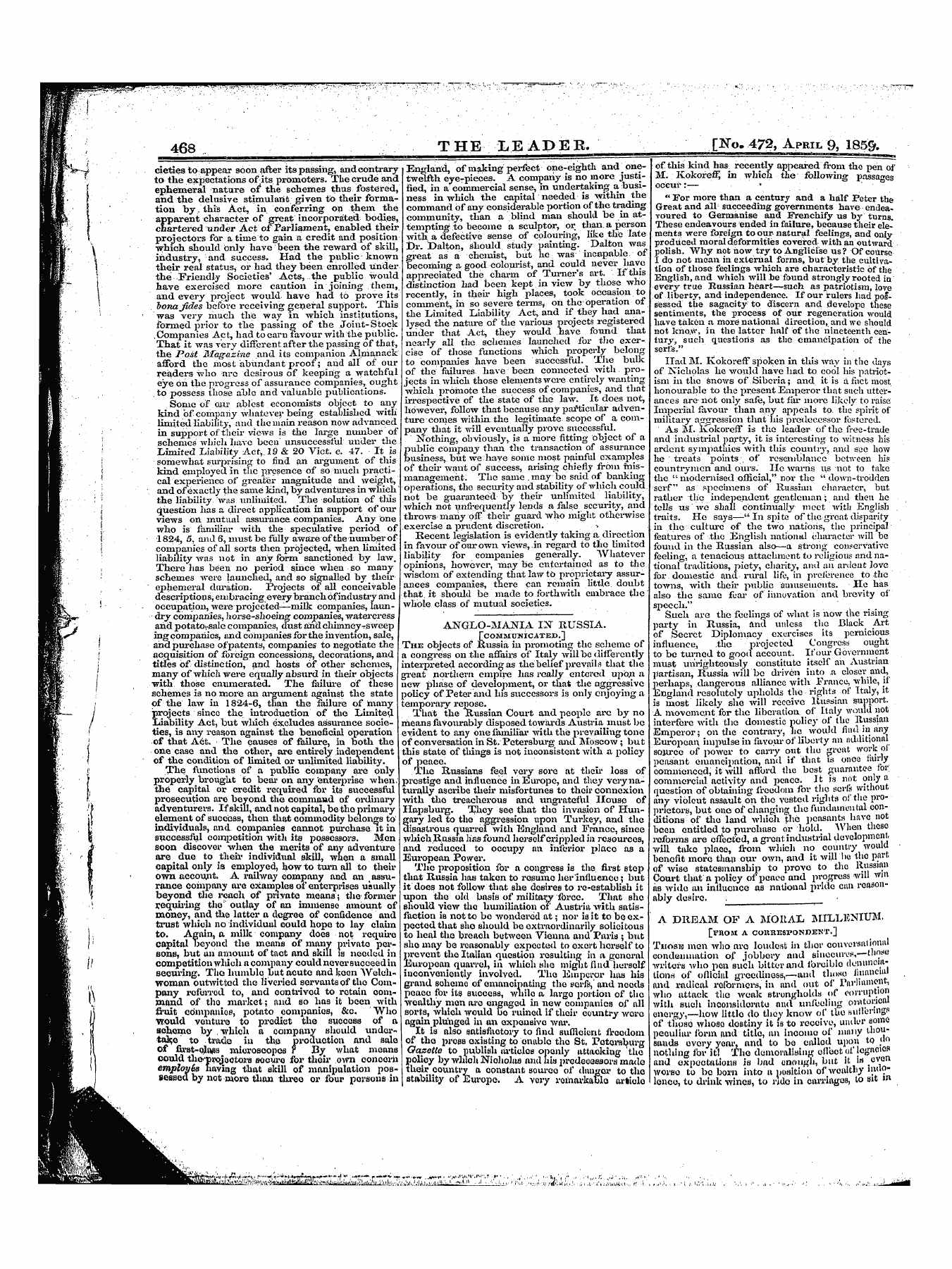
cieties to appear soon after its passing , and contrary to the expectations of its promoters . The crude and ephemeral nature of the schemes thus fostered , and the delusive stimulant given to their formation by . this Act , in conferring on them the apparent character of great incorporated bodies , chartered under Act of Parliament , enabled their projectors for a time to gain a credit and position which should only have been the reward of skill , industry , and success . Had the public known their real status , or had they been enrolled under the Friendly Societies' Acts , the public would
have exercised more caution in joining them , and every project would have had . to prove its bona fides before receiving general support . This was -very much the way in which institutions , formed prior to the passing ^ of the Joint-Stock Companies Act , had to earn favour with the public . That it was very different , after the passing of that , the Post Magazine and its companion Almanack afford the most " abundant proof ; and all of our readers who are desirous of keeping a watchful eye on the progress of assurance companies , ought to possess those able and valuable publications .
Some of our ablest economists object to any kind of company whatever being established with limited liability , ¦ ¦ and the main reason now advanced in support of their views is the large number of schemes which have been unsuccessful under the Limited Liability Act , 19 & 20 Viet . c . 47 . It is somewhat surprising to find an argument of this kind employed in the presence of so much practical experience of greater magnitude and weight , and of exactly the same kind , by adventures in which the liability was unlimited . The solution of this ( Question has a direct application in support of our views on mutual assurance companies . Any One who is familiar with the speculative period of 1824 , 5 , and 6 , must be fully aware of the number of
companies of all sorts then projected , when limited liability was not in any form sanctioned by law . There lias been no period since when so many schemes were launched , and so signalled by their ephemeral duration . Projects of all conceivable descriptions , embracing every branch of industry and occupation , were projected—milk companies , laundry companies , horse-shoeing companies , watercress and potatOi-sale companies , dust and chimney-sweep ing companies , and companies for the invention , sale , and purchase of patents , companies to negotiate the acquisition of foreign concessions , decorations , and titles of distinction , and hosts of other schemes , many of which were equally absurd in their objects ¦ with those enumerated . The failure of these
schemes is no more an argument against the state of the law in 1824-6 , than the failure of many projects since the introduction of the Limited Inability Act , but which excludes assurance societies , is any reason against the beneficial operation of that A 6 t . The causes of failure , in both the one case and the other , are entirely independent of the condition of limited or unlimited liability . The functions of a public company are only properly brought to bear on any enterprise when the capital or credit required for its successful prosecution are beyond the command of ordinary adventurers . If skill , and not capital , be the primary element of success , then that commodity belongs to
individuals , and companies cannot purchase it in successful competition with its possessors . Men soon discover when the merits of any adventure are due to their individual skill , when a small capital only is employed , how to turn all to their own account . A railway company and an assurance company are examples of enterprises usually beyond the reach of private means ? the former requiring the" outlay of an immense amount of money , and tho latter a degree of confidence and trust which no individual could hope to lay claim to . Again , a milk company does not require capital beyond the means of many private
persons , hut an amount of tact and skill is needed in competition which a company could never succeed in securing . Tho humblq but acute and keen Welchwoman outwitted tho liveried servants of the Company referred to , and oontrivod to retain command of tho market ; and so has ifc been with fruit companies , potato companies , &o . Who would venture to predict the success of a scheme by which a company should undertake to trade in the production and sale of first-qla * ia microscopes ? By what means could tho > 'pvojoctora secure for their own concern employ ^ having that skill of man ipulation possessed by not move than three or four persons in
England , of making perfect one-eighth and _ onetwelfth eye-pieces . A company is no more justified , in a commercial sense , in undertaking a business in which the cap ital needed is within the command of any considerable portion of the trading community , than a blind man should be in attempting to become a sculptor , or than , a person with a defective sense of colouring , like the late Dr . Dalton , should study painting . Dalton was great as a chemist , but he was incapable , of becoming a good colourist , and could never have appreciated the charm of Turner ' s art . If this distinction had been kept in view by those who
recently , in their high places , took occasion to comment , in so severe terms , on the operation of the Limited Liability Act , and if they had ana ^ lysed the nature of the various projects registered under that Act , they would have found that nearly all the schemes launched for the . exercise of those functions which properly belong to companies have been successful . The bulk of the failures have been connected with . pro-r jects in which those elements were entirely wanting which promote the success of companies , and that irrespective of the state of the law . It does not , adv
howev , follow that because any particular enture comes within , the legitimate scope of a company that it TV-ill eventually prove successful . Nothing , obviously , is a more fitting object of a public company than the transaction of assurance business , but we have some most painful examples of their want of success , arising chiefly from inismanagement . The same may be said of banking o ] ieratioris , the security and stability of which could not be guaranteed by their unlimited liability , which not unfrequently lends a false security , and throws many off their guard who ' might otherwise exercise a prudent discretion . >
Recent legislation is evidently taking a direction in favour of our own views , in regard to the limited liability for companies generally . Whatever opinions , however , may be entertained as to the wisdom of extending that law to proprietary assurances companies , there can remain little doubt that it should be made to forthwith embrace the whole class of mutual societies .
Untitled Article
ANGLO-MANIA IN RUSSIA . [ communicated . ] The objects of Russia in promoting the scheme of a congress on the affairs of Italy will be differently interpreted according as the belief prevails that the great northern empire has really entered upon a new phase of development , or that the aggressive policy of Peter and his successors is only enjoying a temporary repose . That the Russian Court and people arc by no means favourably disposed towards Austria must be evident to any one familiar with the prevailing tone of conversation in St . Petersburg and Moscow ; but this state of tilings is not inconsistent with a policy of peace . The Russians feel very sore at their loss of prestige and influence in Europe , and they very naturally ascribe their misfortunes to their connexion with the treacherous and ungrateful House of Hapsburg . T . hey gee that the invasion of Hungary led to the aggression upon Turkey , and the disastrous quarrel with England and France , since which Russia lias found herself crippled in resources , and reduced to occupy an inferior placo as a European Power . The proposition for a congress is the first step that Russia has taken to resume her influence ; but it does not follow that she desires to re-establish it upon the old basis of military ibrce . That she should view tho humiliation or Austria with satisfaction is not to bo wondered at ; nor is it to be expected that slio should be extraordinarily solicitous
to heal tho breach between Vienna and Paris ; but she may be reasonably expected to exert herself to prevent tho Italian question resulting in a goncral European quarrel , in which hIio might ( hid hersel f , inconveniently involved . The Emperor has his grand scheme of emancipating the sorft , and neocls peace for its success , while a largo portion of the wealthy men are engaged in new companies of all sorts , which would bo ruined if thoir country wore again plunged in an expensive war . Ifc is also satisfactory to find sufficient freedom of tho press existing to enable tho St . Petersburg Gasetta to publish orticlos openly attacking the polioy by which Nioholas and his predecessors made their country a constant sourco of danger to the stability of Europe . A yovy remarkable article
of this kind has recently appeared from the pen oi M . Kokoreff , in which the following passages occur : — * " For more than a century and a half Peter the Great and all succeeding governments have endeavoured to Germanise and Frenchify us by turnsi These endeavours ended in failure , because their elements were foreign to our natural feelings , and only produced moral deformities covered with an outward polish . Why not how try to Anglicise us ? Of course I do not mean in external forms , but by the
cultivation of those feelings which are characteristic of the English , and which "will be found strongly rooted in every true Russian heart—such as patriotism , love of liberty , and independence . If our rulers had possessed the sagacity to discern and develope these sentiments , the process of our regeneration would have taken a more national direction , and we should not kno . W , in the latter half of the nineteenth century , such questions as the emancipation of the serfs . "
Had M . Kokoreff spoken in tliis way in the days of Nicholas he would have had to cool his patriotism in the snows of Siberia ; and it is a fact most honourable to the present Emperor that such utterances are not only safe , but far more likely to raise Imperial favour than any appeals to the spirit of military aggression that his predecessor fostered . As M . ivokorefF is the leader of the free-trade and industrial party , it is interesting to witness his ardent sympathies with tins country , and see how ¦
he treats points , of resemblance between his countrymen and ours . He warns us not to take the " -modernised .-official , " nor the " -down-trodden serf" as specimens of Russian character , but rather the independent gentleman ; and then he tells us we shall continually meet with English traits . He says— " In spite of the groat disparity in ' . the-culture of the two nations , the principal features of the English national character will be found in the Russian also—a stronsr conservative
feeling , a tenacious attachment to religious and national traditions , piety , charity , and an ardent love for domestic and rural life , in preference to the towns , with their public amusements . He has also the same fear of innovation ' and brevity of speech . " Such are the feelings of what is now the rising party in Russia , and unless the Black Art of Secret Diplomacy exercises its pernicious influence , the projected Congress ought to be turned to good account . If our Government must unrighteously constitute itself an Austrian partisan , Russia will be driven into a closer and , whileif
perhaps , dangerous alliance with France , - , England resolutely upholds the rights of Italy , it is mos t likely she will receive Russian support . A movement for the liberation of Italy would not interfere with the domestic policy of the Russian Emperor ; on the contrary , he would find-m any European impulse in favour of liberty an additional source of power to carry out the great work oi peasant emancipation , and if that is once fairly commenced , it will aflbrd tho best guarantee tor commercial activity and peace . It is not only a question of obtaining freedom for the serfs without any violent assault on the vested rights of the proprietors , but one of changing the fundamental conditions of the land which the peasants have not those
been entitled to purchase or hold . When reforms are effected , a grout industrial development will take place , from which no country would benefit more than our own , and it will bo tho part of wise statesmanship to prove to the Kussian Court that a policy of peace and progress will win hs wide an iniluence as national prido can reasonably desire . . ^^
Untitled Article
A DREAM OF A MOltAL MILLENIUM . [ fROM A COttltESrONPENT . ] Those men who nro loudest in thor conversational condemnation of jobbery and sinociuw , —f'rwo writers who pen such bittoy and forcible donuncintionH of ofHciiil greediness , —and thewo- iumne 11 " and radical reformers , ' in and out of rnrhaniont , who attack the weak strongholds of corruption with such inconsiderate and unfeeling oratorical energy , — -how little do they know of tlio Biillerings of tlioso whoso destiny it is to receive , under some peculiar form and title , an Inoomo of ninny thousands cvory year , and to bo called upon to <«» nothing for itl Tho dainorali » intf ottbot of lognoiof and expectations is bad onongh , but it is . o ^ " worso to bo born into a position of wealthy nuiolence , to drink wines , to ndo in carriages , to sit in
Untitled Article
438 THE LEADER . [ Ko . 472 , April 9 , 1859 .
-
-
Citation
-
Leader (1850-1860), April 9, 1859, page 468, in the Nineteenth-Century Serials Edition (2008; 2018) ncse.ac.uk/periodicals/l/issues/vm2-ncseproduct2289/page/20/
-