
On this page
-
Departments (1)
-
Text (3)
-
Untitled Article
-

(vjv OtfY * Ja nmrt jMiHtJJL i s? ri (3> ^L ¦
-

Untitled Article
Note: This text has been automatically extracted via Optical Character Recognition (OCR) software. The text has not been manually corrected and should not be relied on to be an accurate representation of the item.
-
-
Transcript
-
Note: This text has been automatically extracted via Optical Character Recognition (OCR) software. The text has not been manually corrected and should not be relied on to be an accurate representation of the item.
Additionally, when viewing full transcripts, extracted text may not be in the same order as the original document.
Untitled Article
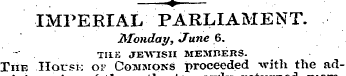
¦ ¦ " ? ¦ IMPERIAL PARLIAMENT . Monday , June 6 . ' - ' . TI 1 K JEWISH MEMBERS . The IIou . sk of Commons proceeded with the administration of tlie oaths to newly returned members . Baron Rothschild having presented himself at the table , and declined on conscientious grounds to take the oath with , the customary affirmation , " the true faith of a Christian , " was directed-to withdraw while the House tobk the question into consideration . —Lord John . liuSSEix then moved , in pursuance
of the" standing order" established in the last session with the viev of carrying out the Act passed in 1858 , a resolution to the effect that during the continuance of the present Parliament any member of the Jewish persuasion who might be duly elected , should be allowed to omit from the oath the words to which he entertained a conscientious objection . — Mr . Newdega ' tk resisted the resolution , arid exhorted the house to maintain its character as an exclusively Christian legislature . After a few Svords in reply from Lord J . lirssEix , the resolution was put and carried without a division .
Baron Rothschild was then recalled and sworn in according to tlie appointed formula , as were subsequently MrT Alderman Salomons and Baron Meyer Rothschild . Tuesday , June ? . - OPENING OF PARLIAMENT . Her Majesty formally opened Parliament in state this day in person . The Queen was accompanied by the " Prince Consort , and there was a very large assemblage of both Houses and of spectators . The royal party ¦ ' arrived , at Westminster at half past two , and the Commons having been summoned to the House of Lords , Her Majesty delivered this following speech : — - My Lords , ind Gentlemen ,
I avail myself with satisfaction , in the present anxious state of public affairs , of . the advice of my Parliament , which I have summoned to meet with the least possible delay . I . have directed that papers shall be laid before you , from whidi you will learn how earnest and unceasing have been my endeavours to preserve the peace of Europe . Those endeavours have unhappily failed ; and ¦ war has been declared between France and Sardinia on one side , and Austria on the other . Receiving assurances of friendship from both the contending parties , I intend to maintain between them a strict and impartial neutrality ; and I hope , with God ' s assistance , to preserve to my people the blessing of continued peace .
Considering , however , the present state of Europe , I have deemed it necessary to the security , of my dominions and the honour of my crown to increase my naval forces to an amount exceeding that which has been sanctioned by Parliament . I rely with confidence on your cordial concurrence in this precautionary measure of defensive policy . The King of the two Sicilies having announced to me the death of the King his father , and his own accession , I have thought fit , in concert with the Emperor of tho Trench , to renew my diplomatic intercourse with tlie Court of Naples , which had been suspended during the late reign . All my otlteT foreign relations continue on a perfectly satisfactory footing .
had notlieard any reference to any paragraph in the lioyal bpeech . He had heard much nonsense of the efforts made by the Government to influence the late elections . In regard to Ireland they had heard tlie denial of Lord Eglintoun , and he for himself denied as strongly that any compact existed between him and Cardinal Wiseman . Proceeding . to-the charges of Sir J . Graham , he showed that the increase of the billeting money was in accordance with the" recommendation of a ' Parliamentary committee at the . beginning of the year , " if he could see any chance of a strong Government he would gladly lay down the responsibility he had assumed , but , considering the state of foreign affairs , he ' thought it was his duty to his Sovereign still to
remain at his post . He had accepted office w . the intention of appealing to the country in case of a defeat in the House of Commons . lie denied the analogy-which had been drawn between the prorogations of 1841 and 1859 ; and , although he must admit the Government were in a minoritv , at the same time he was convinced that no Government could be formed so strong and united as the one in office . In allowing tlie forbearance which had been exercised in foreign affairs by the Opposition , he thought their abstinence on other subjects had boon as much due to their discretion as to their justice or moderation . The dissolution was not to discover whether the country approved the Reform Bill , but whether it approved the mode
of proceeding adopted by its opponents . Whatever our feelings on the present struggle in Italy , we wer 6 bound by treaties not to give way to them . He thought this war had been undertaken , on-false pretences , at the instance of Sardinia , bat neither on one side nor the other was there any ground for quarrel which might not have been arranged by diplomacy . It was for this country to maintain a strict neutrality between all parties . 13 ut the position of a neutral was most delicate and difficult , and it would be madness in a statesman , however sincerely desirous of neutrality , not adequately to provide for the defence of the country , as the only neutrality to be respected must be an armed neutrality . He entertained no fear of any
proxiduring the present session , on a subject at once so difficult and so extensive , I trust that at the commencement of the next . sessioh your earnest attention will be given to a question of which an early and satisfactory settlement would be greatly to the public advantage . I feel assured that you will enter with zeal and diligence on the discharge of your-parliamentary duties , and I pray that the result of your deliberations may tend to secure to the country the continuance of peace abroad and progressive improvement at home . At the termination of the speech , the Queen retired with the usual formalities .
THE A 1 > DKESS . In the House of Lords the address in reply to the speech from tlie throne was moved by the Earl > f Powis , and seconded by Lord Liffokix—Earl 3 nAKvrLLE regretted that , in spite of the result of he elections , it was the intention of the Ministry i •> carry on the Government with a minority . One o " the principal errors of the Conservative party y ns that it endeavoured to please everybody . Her J iijesty ' s Government had asserted that they had n opinion at all on the Reform question , but would be obliged for the guidance of the House of Commons . Passing to the suspicions which had been incurred by the Government during the Irish
elections , he thought it would have been better to make concessions to the Roman Catholics at a time when no political movements were , going forward . It gave him much pleasure to hear that our foreign relations were in a favourable condition ; but he could not help regretting that no effort had been made to induce Russia , to co-operate , with us to preserve the peace of Europe . The subject , however , required greater skill and greater firmness than her Majesty ' s Government had yet shown . It was not his intention to move any amendment to the Address * The Government had appealed to the country , and the result of that appeal would be declared in the other House . —Lord Malmesbury stated his intention of
laying before tlie House the whole of the correspondence , relating to the war and to the efforts which had been made : by the Government to secure peace . He would riot in the absence of papers go fuTther into this matter , and referred Lord Granville to the Italian papers of 1848 , requesting him to compare them to those of 1859 , when he should , lie thought , have no reason to fear the attacks which Lord Granvillle was going to make upon him — Lord Hoavdex stated it as his opinion , that if France established herself in Italy , this country would be ultimately drawn into the war ., He had reason to believe that some agreement had been concluded between France and Russia within tlie last
mate invasion , but when he saw" the increasing avmamerits of other nations it became tlie duty of the Government to place the navy of the country on a strong footing . In the present state of tilings lie believed no demand for the defence of the- kingdom would be refused by tlie House of Commons . If it should be proved that her Majesty ' s Government does not possess the confidence of the country , and that another party does , he could only sny that he should lay down with greater pleasure than he had taken up the responsibility of office . Should , however , as he expected , a contrary decision be arrived at , he hailed with pleasure the promise of Lord Granville that no factious opposition would be offered to the Government of the country .
three weeks . —Lord . Nobmanbyunveiled tlie intrigues of Sardinia and France , and especially of Russia , in extending her influence in the Mediterranean Sen . Condemning the sympathy which Lord Palmekston had expressedfor the Italians , he concluded by exhorting the Government to resist any attempt at universal domination . —Lord Carlisle was glad to observe the unanimity among the leading statesmen to adhere strictly to neutrality , and drew the attention of tlie House to the strange coalition which had taken place between the Roman Catholics and the Conservatives . —Lord Eglintoun contradicted the reports in th « newspapers of some compact between hhnseli and Cardinal Wiseman . In the most unequivocal
Their lordships adjourned at half-past eleven . In the House of Commons , on re-asscnibling in the evening , the Address , in reply to tlie Speech from the Throne , was moved by Mr . A . Egkhton , and seconded by Sir J . Ei . 1 'iu > 'stoke .-Tlie Marquis of Hartington then proposed his amendment , in the shape of an additional clause to be appended to the Address , declaring that the present Ministry did not Dossess the confidence of that House . —The lhc
amendment was seconded by Mr . Hanbuiiy . — Chancellor of tho Exchequer said he found no fault with the course taken by Lord Hartington ami his friends , but he denied that there was any nnulogy between the present case and that of 1841 . It was of groat advantage that it shoxild be known whether the advisers of the Crown possessed the confidence of the House . It was desirable that this question should be decided without delay , and ho hoped the House would be able to divide that night . He proceeded to discuss the grounds assigned for the- vote lamue
manner he denied that any understanding had lieon come to between the Roman Catholic party and tlie Irish Government . —Lord Brougham thought that hostilities had been begun without a shadow of pretence , except the false pretence of favouring , the cause of liberty . The origin of this war was due to Sardinia , It was an old maxim of a Roman judge , when he could not discover tho author of a crime to ask the question cuibono ? For whose profit ? and he wished to apply this test to tho present war—Who gains by it ? No one was moroeugerthan himself to see the Austrians driven from Italy , but not merely to hand them over from one master to another . Such a course , guaranteed as these provinces voro to Austria by treaty , would bo nothing but plunder . To disregard such a right to possessions woxild be
of want of confidence . Ho insisted that the of tho Government measures in the last Parliament was not a fair ground upon which to rest such a vote in the present . He justified tho dissolution * and congratulated Lord Hartington upon his having abstained from repeating certain trash which , no said , had , during the recess , been tho subjoct ot c'largcs againstthe Government out of doors . Upon this heau Mr . Disraeli spoko in terms of severo reprehension of tho allegations inado by Sir J . Graham at Carlisle , to which ho gavo an Indignant donlul . 1 » c supposed compact with the ««" " 9 r ^ iLn utt erly repudiated . Tho manner in whioli pur foreign negotiations had boon conducted wus another ground for tho voto of want of confidonco $ but he contended that it was neither just nor conibrmiiblo o thn nriintJoo of rho House to docldo this miofltion m wbi
contrary to the soundest principles of intemanational law . If Xombardy , however , could bo erected into an independent kingdom , it would be a positive benefit to Austria by the certain rolief it would afford to her finances . Wo had no reason , he thought , to distrust tho Emperor of tho French , yot , considering his position , wo ought to lie , not mistrustful , but on our guard . To inuroaso our navy , and to establish and stimulate the enrolling of volunteer riflo corps in every part of the country , would bo tho best moans for gaining that object . — Lord KLLKNuoKouan cprdlally concurred with Lord Brougham , and said that what wub wanted in tho present crisis was a strong Government . Ho exprosBed his conviction that this result had not boon gaiiied by tho dissolution . —Lord Dkimvy said Unit although tho dobatp had boon highly important , ho
thoabaonco of tho necessary doaumonts . 1 Ho ground tor tho voto ' wits tho failure of tlio "f ™" " of reform proposed by the Oovorninont , ¦ nnct ¦ tlieu insufficiency to doal with tho quostion ol 1 " >•'»" montary Reform . Ho oonipnrod that muiiHuro wm the lust bill upon this subjoot introduced by i < oi' »
Gentlemen or the House of Commons , The estimates for the year , for which provision lias not been made by the late Parliament , will be immediately laid before you , together with such supplementary estimates as present circumstances render indispensably necessary for the public . service . . My Lottr > 8 and Gentlemen , I have directed a bill to be preparod for giving effect , so far ae tlie aid of Parliament may be required , to certain suggestions of the commissioners -whom I-had appointed to inquire into the best mode of efficiently manning tho royal navy j and to
I recommend tliis important subject your urnmediate attention . Measures of logal and social improvement , tho progreas of which , in the lute Parliament , was necessarily interrupted by the dissolution , will again bo brought under your consideration . I should with pleasure give my sanction to any weH-considerod measure for tho amendment of the laws which roguliito the representation of my people in Parliament , and should you Ifo of opinion < t lint tho necessity of giving your immediate attention to measures ot urgency relating to the defence and financial condition of tho opuntry will not leave you sufficient timo lor logialatlng with duo deliberation ,
(Vjv Otfy * Ja Nmrt Jmihtjjl I S? Ri (3≫ ^L ¦
Ipnty Jpj ^ s .
Untitled Article
712 THE LEADER . [ News and
-
-
Citation
-
Leader (1850-1860), June 11, 1859, page 712, in the Nineteenth-Century Serials Edition (2008; 2018) ncse.ac.uk/periodicals/l/issues/vm2-ncseproduct2298/page/4/
-