
On this page
-
Text (5)
-
Untitled Article
-

Untitled Article
-

Untitled Article
-

Untitled Article
-

Untitled Article
Note: This text has been automatically extracted via Optical Character Recognition (OCR) software. The text has not been manually corrected and should not be relied on to be an accurate representation of the item.
-
-
Transcript
-
Note: This text has been automatically extracted via Optical Character Recognition (OCR) software. The text has not been manually corrected and should not be relied on to be an accurate representation of the item.
Additionally, when viewing full transcripts, extracted text may not be in the same order as the original document.
Untitled Article
in intelligence , art and learning ; and in England , in or about the time of . Elizabeth , were hi g hly educated as sctiolars . This . produced a reaction . During the age of chivalry , learning had been neglected ; but when men turned to pacific objects , woman varied her attraction . The personal charms that captivated the knight clad in arniour and ignorance , were vainly essayed upon the accomplished scholar or philosopher . Women , accordingly took to mental culture , and ' seined at proficiency in learning / " Theological disputation
was a fashion of the day ; they preached'in public , maintained controversies , published theses , filled the clairs of law and philosophy , harangued the Popes in Latin , wrote Greek , and read Hebrew ; nuns lecame poetesses , women of quality divines , and young damsels , with eyes in tears and in sof t and moving eloquence , beseeched Christian princes to rescue the Holy Land from the infidels . The ancient languages were esteemed an indispensable acquisition : they were taught both to men and women , and who , not content with Latin only , read the Old Testament in Hebrew and the New in
Greek . " But this stem phase of study was not calculated to last . It appealed to the intellect , not to the heart ; and the latter is woman ' s kingdom . " Tie ! , erudite Erasmus , " accordingly , " doubted whetLer learning and study were suitable feminine accomplishments . The Tudor age practically illustrated the tendency of the proposition . " So strong was the reaction that in another generation , hardlj a woman could be found in Europe , who could dictate a tolerable letter in her own tongue , or spell it correctly .
Women ,: both in French salons and English drawing-brooms , have since acquired literary eminence ; but they have for the most part been content with flie more light arid eloquent departments of knowledge . In treating of English women in the eighteenth century , Mr . Wade has given undue prominence to Dr . Johnson , and encumbered his pages with matter that might well have been spared . It is true , that he apologises for it ; but ,
with "the man in the play , we hate apologies ; we prefer the course of conduct that needs none ; but authors Ore fallible , and Mr . Wade is a voluminous one , and too frequently yields to the art of bookmaking , in which he is an adept . The present book is not sufficiently brilliant for the subject . Nor is it profund , where it ought to have been . The subjects of monogamy , polygamy and divorce are superficially treated . Here the philosophy of these topics should have been fearlessly interpreted and enforced .
Untitled Article
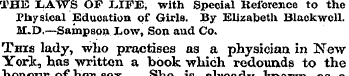
THE LAWS OP LIFE , with Special Reference to the Physical Education of Girls . By Elizabeth Blaokwell . M . D . —Sampson JLow , Son aud Co . This lady , who practises as a physician in New York , has written a book which redounds to the honour of her sex . She is already known as a poetess ; but here she appears as a scientific lecturer , and as a physiologist . Every word in the present little volume bears the impress of wisdom and truth . It is with especial reference to her own . sex that the lectures have been written ; and by them they ought to be studied with the utmost
care . Hero is a learned sister , who will have nothing to do with weakness and frivolity ; who has studied medicine , who has trod the hospitals and the schools , who has furnished her mind With all that belongs to the masculine intellect , who speaks with authority , and who is authorised by tine laws of her country to teaoh and heal those ¦ who may need instruction or medical help . The age , in this lady ' s opinion , is nrucli tod logical and intellectual ; and the laws of life suffer
martyr violates this law , and by this violation ranks as a prophet . ; He is before , his time , and suffers . ' " We feel , " says she , " tile penalty of its violation as we stand before that noble pic t ure , ' The Martyrdom of Huss . ' Why does the noble martyr kneel there chained and vanquished ? Why were the voices of Wicklif ^ of Jerome , hitshed and forgotten , while Luther ' s rang through the world , and every country still feels the throb of his heroic heart ? Men as truthful , as impatient of sham , as he was , more beautiful in Christian life , had been lost to the world , for the right moment had not come . The divine order of
development must be obeyed ; the age was not ripe for Wicklifi ^ therefore he failed ; the age was ripe for Luther , therefore . he succeeded . This reflection , carried as far it would go , would lead to many considerations both religious and philosophical , that might open Aip new veins of thought ; at any rate lead to new interpretations of old dogmas . We must , however , remain with our authoress . She recognises a Method of Growth , ah order not to be violated with impunity . . Of man ' s double nature , there are three distinct periods in the development : the period of growth and preparation , the period of
maturity and active use , and lastly the period of decline and incapacity . However , a difference obtains between mind and body . The specific needs ~ of each predominate at different periods of the human life . At a certain age the body ceases to grow— -it has reached its standard . To this the mind by no means conforms . The cessation of the body ' s growth does not mark the completion of the growth of the mind . A practical lesson not to be neglected is implied . Physiology teaches that two organs do not act with equal energy at the same time . While the stomach digests the brain shojild rest , and the muscles be in abeyance . In the same way , the sovereignty of
the body should be established before that of the soul is attempted . The one prepares for and is the continent of the la . ttei \ During youth , therefore , the development of the body in strength and beauty pught to be the first care . Such is the main doctrine of Miss BlackwelTs ' book ; and she consistently advocates the claims of the body with all a physician ' s love for it , and with all a poet ' s eloquence . The young in particular will do well to consult these pages . They will find the truth told , though delicately yet firmly ; and by observing its precepts they will preserve both their health , and their virtue . Let the knowledge contained in this little book be practically applied , and it will be converted into power .
from the mental bias . We pay too little attention to the welfare of the material organisation . Former ages having made the fatal mistake of attributing sin to the body , instead of to a corrupt heart , we continue to despise it , to neglect its separate life . The healthy body is an aid to virtue . Miss Black--well hopes to call attention to the physical education of the young , and to describe the means by -which thb preeent degeneracy ( for suoh she insists doos really exist ) may be cheoked , and a steady progress made in the improvement of tho condition of the race . '
The laws of , lifo are her professed theme . The foundation of all is tho law of exercise . Movemont ancl existence are inseparable . The next is tho law of order in exercise . This out authoress illustrates by moral instances as well as physical . I lieso strike at least with especial novelty . The
Untitled Article
THE HISTORY OF PROGRESS INGREAT BRITAIN . By Robert Kemp Philp . With numerous Illustrations , by W . Newman , C . Melville , J . Gilbert , II . C . Magulre , & < j . —Houlston and Wrig-ht , Qni-y twenty generations ago our Celtic ancestors were yet barbarous , owing what cultivation they possessed to the Roman rule and polity , by which they were first subjected , then protected . Now the greatness of England reveals itself as a ' necessit y for the safety of Europe , the dissolution of which would involve the disruption , as it wore , of the civilised world . Under a variety of heads , Mr . Philp has shown , step by stop , how this
condition has been attained ; through what difficulties , and in spite of what prejudices ; and looking to the future from what " has been , " dares to speculate on what " is yet to be . " His sketches are various , and occupy a goodly volume , yet each is brief , and traverses a wide space of time with exemplary celerity . The author is conscious of their quality , and justifies it by comparison . " As a railway , " says he , " practically reduces space ; as a telescope brings distant objects near ; and as a microscope reveals the unseen . ! so a faithful historical sketch condenses into one focus tho events
Carriages ; Water Conveyances , Domestis Architecture , Shipping , Navigation , and Geogrnplucal Dis " covery . In all , he traces the degrees by which we hav « ascended to the height of comfort and luxury that we now enjoy . The most interesting of these essays is perhaps that which relates to English architecture . It contains some amusing ' particulars . On the first introduction of chimneys for instance , there were great prejudices against them . Thejsopular apprehension . of the ill eTFect * of change from the rough and ready to' the more convenient , is continually repeating itself . All improvement is objected to by the unrefined as a tendency to the luxurious , and to bo content with poverty and ignorance is the religious creed of the
idle and superstitious ; so diflicult Is it to raise the prejudiced vulgar above ' mere animal wants . Even monarchs were opposed to tlie needful extension of the metropolis . Elizabeth and James ivere alike in this ; and there arc yet persons who see only evil in the growth of building in suburban districts . The greatness of Britain expands beyond tlie appreciation of its inhabitants . ' It is only the few and instructed that apply the stimuli ! .-and direct the effort ; the mass is not ¦ willing ly stirred . But the leaven of ' education has been applied ; the results are already perceptible ; and ere long the reproach just expressed , -wo hope and believe , will cease to be true of the English ju-ople .
of ages , and enables us in imagination to reach the very poles of time , and to explore the antipodes of social conditions , We , " he continues , " who can breakfast in Edinburgh aud sup in London , have in these brief recitals boon carried back to a period when Scotland and Ireland wore unknown to England , and when the Roman general * would only venture upon expeditions or discovery in North Britian , in the summer time . " These few words describe the scope and style of tho essays that compose this masterly volume . Mr . PiiUp treats the history of progress in England under eight heads—Agriculture , Roads ,
Untitled Article
A PANORAMA OP THE NEW WORLD . -ByKiiiahan Cornwallis . In 2 vols .- —T . C . Newby . A book written in a style of levity little likely to beget confidence in tlie writer . His first experiences-in Australia , he tells . up , wore his worst . One thing he found , that the game of lite at Melbourne ' was no idle work . At Melbourne , too , there was no public gambling , and , :-: j .. ve among men of the higher order at after-dinner , play , but little money changed hands at the ctird-table . ' At San Francisco it was different . Our traveller
became acquainted with a man who had shot another on one occasion , at San Francisco , for an attempt to cheat him at ' . cards . Ko notice was taken of the proceeding beyond burying the dead man . There is a tale or two of bush-rangers , stirring enough . Highway robberies , on the'gold escort are also described . But in all this , -what is there new ? Pictures from the gold diggings , too , abound , but they lead to no reflexion . The conduct of the squatters towards the natives was abominable ; they slaughtered nnd poisoned the blacks for sport ox avarice . Two or three episodes of aboriginal life have more interest or novelty .
Some romantic narratives are introduced , in which the writer shows a considerable amount oi pathos . A sketch or two of the Chinese immigrants is not without merit . In the year 1855 , Mr . Cornwallis lef t the colony of Melbourne by steamer for Sydney , which he again letl for Valparaiso , where , aflor a stormy -voyage , he arrived . Wo then follow the traveller from plnce to plsico , on which he bestows some very fair descriptions , nnd in particular in relation to Peru . I lore is variety enough , and company enough ; and wo rim behove tho author when lie records that he " never appreit in
ciated 'The Pleasures of Solitude ' till ho rent I tho secluded garden nooks of tho island oi Toboga . It was " , ho says , " refreshing , after the bustling din of Australia nnd I ho frivolity and gaiety of Bouth America . " He seems to have been pleased with the pictures of Now ^ ork . onci to have found in tlioAmoriean 3 Ju . i t Inequalities of which he most approved . Here tho BmaU interest that the book possesses ccusc-i altogether . Tho author has , hpwevor , written works oi woro value ; particularly one rolutivo to Jnpnn . we succeeds best in exploring now fields . In tiie argument of tho volumes before us he has been fatally anticipated .
Untitled Article
Europe ' s Woo and England ' s Duty , by £ "f ^ Clio . liilhitflmm Wilson . The author ' s opinion ia , tluvt tho present war was inevitable ; it is ivn evil , however , which iMigiona should avoid . It is tho duty of England , unless directly assailed , " to take no part in it . nor heart is . neither fully with ITranco nor with Austria ! and whero she cannot altogether givo lior heart , sno ought not to lend her hand for tho torriblo business of war . " Howover , wo detest Austria more timti wo distrust Franco j and cherish « a deep mid lively tenderness for Sardinia . " Our author has yet a reason in reserve . It is tills : " Imperial Jfranco is more suited , for tho stern business of cuUlug tuo
Untitled Article
_ 774 THE LEADER , ^ JJ J ggRAiir
-
-
Citation
-
Leader (1850-1860), June 25, 1859, page 774, in the Nineteenth-Century Serials Edition (2008; 2018) ncse.ac.uk/periodicals/l/issues/vm2-ncseproduct2300/page/18/
-