
On this page
-
Text (3)
-
Untitled Article
-

Untitled Article
-

Untitled Article
Note: This text has been automatically extracted via Optical Character Recognition (OCR) software. The text has not been manually corrected and should not be relied on to be an accurate representation of the item.
-
-
Transcript
-
Note: This text has been automatically extracted via Optical Character Recognition (OCR) software. The text has not been manually corrected and should not be relied on to be an accurate representation of the item.
Additionally, when viewing full transcripts, extracted text may not be in the same order as the original document.
Untitled Article
other hand , although much like them , thejrdid not exactly coincide witSh known forms of poisoning . Many chemists believe that in all cases of poispning by arsenic that substances can be found in the body , although it may be in quantities so minute as to demand the greatest care and skill for its elimination . This theory may or may not be true , but in the present state of science there is some room for doubt when it is not detected in some of the tissues ;
supply a number of important questions upon which the opinion of the most eminent chemists and physiologists should be sought without delay , as it is discreditable to a civilised country that its medical jurisprudence should be a clumsy guesswork , lagging behind that perversion of science which makes it the minister of crime .
Thus it may be stated that the scientific _ evidence did not positively prove that any poisoning had taken place , but it lef t a strong probability to be corroborated or rebutted by other faots . Under these circumstances we may imagine the jury asking themselves whether the prisoner had a motive for the crime of which he was accused , and the probability of such an incentive was plain . He had committed a bigamy with the deceased which , if she lived , was not likely to remain undiscovered . By her death he might escape the consequence of this-crime , and would , if he induced her to make a will in his favour , come into possession of a sum equal to about twelve years' purchase of her annual income : Another question
which the jury would put to themselves would be , whether the prisoner was a likely man to do such , a deed . First ; , they knew he had committed the grave criine of bigamy ; next , they had proof of the falsehood of his excuse of poverty for not employing a nurse . Then they must have been shocked at the exclusion of even the sister of the deceased on the alleged ground . of her . critical : state , although the prisoner thought it fit for the introduction of a strange lawyer on a Sunday , to make a will for his own benefit , which she was persuaded to sign in her maiden name . ' : There was also the evidence of the landlady , to the effect that , during the illness , ' . he had never allowed the room to be thoroughly
cleaned , although , as a medical man , he must have known the sanitary importance of such a step . Another strange group of facts was , that he administered everything himself ; that no portions . of food were allowed to leave the room ; that what- > ever he gave the deceased was followed by vomiting and evacuations ; and that , when he was removed , similar articles , given by other persons , had no such effect . With these , and other circumstances before them the jury would not have been warranted in arriving at any other conclusion than that which their verdict expressed ; but while public justice may be satisfied with the result , there are many things of a practical and scientific nature that cannot be viewed with
approbation . In the first place our judicial system mokes no adequate arrangement for the collection and preparation of scientific evidence . In this , as in most other cases , there was no proof that an accurate method had been observed in preserving the various matters destined for analysis . In these cases the quantity of poison likely to be found is often so small as to render it necessary that extreme care should be taken to place all the evidentiary materials in vessels adapted to their safe conservation , and which are not only ordinarily , but ohemically clean .
It is also very unsatisfactory that the analytical investigation should be committed to a single man , however eminent he may be . Some analyses are so easy as to leave little room for mistake , while others are so difficult as to require the agreement of at least two . independent experimenters before the result should be deemed sufficientl y certain . We are also much in want at additional physiological information on the action of small repeated doses of mineral and other poisons on the system , especially when combined or alternated in a dexterous manner , As matters now stand , medical evidence in criminal trials is a scandal to the profession , and the outer public wonders first at the
discrepancies of treatment and opinion , and then at the recklessness with whiob doctors who have not seen a complicated case hazard the most confident assertions as to its precise nature , and this in opposition to the views and declarations of other doctors who did see it , and possess a higher reputation than their own . "Wo have in London three wealthy naedical bodies ™ tha College of Physicians , the 0 o £ - «^ pf . Burgeons , « w * d the Apothecaries' Company , witt it is not too much to ask that they should qRPpint a scientific commission , and collect informawon upon . points that are frequently in dispute , ^« mu ^ t xe mS ! n m untoss subjected to rigorous investigation . Palmer's case and that of Sraethuret
Untitled Article
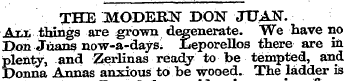
THE MODERN DON JUAN . Aiii things are grown degenerate . We have no Don Juans now-a-daysl Leporellos there are in plenty , and Zerlinas ready to be tempted , and Donna Annas anxious to be wooed . The ladder is against the wall , and the maiden is peeping from behind the curtain , but there is no conquering hero to mount to victory . After all , it is no good complaining of the age , for no complaints will alter it . If you cannot get gold , you must put up with silver , even though the silver be Brummagem silver , with more alloy than metal ; so in default of a real genuine Don Juan , such as we dreamt of and worshipped in our younger days , we must put up with his Brummagem representative , of whose fame and exploits we are about to tell . .
fronted by his two indignant wives , and arrested by their order on a charge of bigamy . He tried expostulation , and endearment , and self-hurniliation , but all in vain . The sight of each rival wife steeled the other ' s heart . Mrs . Hayes even deprived him of a watoh which had belonged to the late dear departed Mr . Hayes , and had been placed upon Sloper ' s unworthy breast . The charge was entered , and the poor victim of too general a passion for the fair sex is committed for bigamy . We own that for him , as -the last fallen representative of the Don Juan race , we feel a kind of pity , more so , certainly , than we entertain for the matronly and middle-aged Clarissas who fell victims to his acts .
The name of our hero is William Sloper . There ; is a general uncertainty , in which Mr . _ Sloper shares , as to the name or position of his male parent , as the ancestral Sloper may have been any thing from a king to a costermonger . His son , with praiseworthy moderation ^ decided that he must have been a peer , and a shipowner . For the credit of the shipping and aristocratic interests we trust that the surmise was correct . After giving birth to this infant scion of the aristocracy , his mother became the wife of a bottle ^ merchant , which we suppose is the euphemistic designation of Under ices unfa
a marine-store dealer . ausp so - vourable to true gentility , the young Sloper idea wasiaught to shoot . " JBonsang" however * as Gil Bias says , " nepeutpoint mentir ; " and Sloper wa 3 true to his aristocratic instincts . Personal appearances , as well as the circumstances of his position , were against his ambitious aspirations . . His frame was puny and ill-shaped . ; his features were not distinguished ; his general aspect was shabbygenteel ; and the growth of his hairjr appendages was not exuberant . A great mind rises superior to difficulties , and in the little body of Sloper there resided a mind of real greatness . As soon
as he had reached the years of discretion he prepared himself for a career of conquest . Having an objection to the systems of purchase or advancement by interest in the army , he refused to accede to either , and suspicio motu , bestowed upon himself his own commission of Captain in the Guards . He cultivated a moustache , which , though fluffy , had a military appearance . He committed some pages of the peerage to memory and then he felt himself equal $ o any emergency . As yet , but a small portion of the Don Giovanni-Sloper career is laid open to us . Hqw many hearts he won ; how many hands he sought he broke
and obtained ; how many promises ; are things unknown to us . It is only the crisis of his fate with which we are acquainted . On the 5 th of July , 1858 , he led to the hymenial altar a softhearted widow of the name of Dawson , captivated by his military air , and the reputed wealth of his shipowning kindred . He took this lady , at her own expense , on a bridal tour to Hull and Jersey * induced her to go before him into Lincolnshire , and then left her , without even the conooling in- ^ timation whether she was to consider herself a wife , or a widow , or a friend . Not twelve months had passed before he again entered into the bonds of matrimony with another inconsolable widow , a Mrs . Hayes . This lady was . seduced by the stories of his aristocratic circle , to which she was to be introduced , and the assertion that ho was the son
of Lord Denbigh , the descendant of the Hapsburgs , the Count of the Holy Roman Empire . On the other hand , she had not the consolation even of a honeymoon and a trip to Hull . Her deceit " ful spouse used to stop out all night , to go away on a Saturday with a new suit of clothes and to return in rags on Monday , and generally to neglect his duties as a man and a husband . During one of these protracted absences , Mrs . Hayes applied , to Mr . Norton about redress for her connubial injuries , tfho report o " f the fruitless application appeared in the papers ,, and caught the eyes of Mrs . tDawson , who immediately came up to town to claim her truant spouse . When at last poor Sloper sneaked home to Mrs . Hayes' house , with three half-penco in his pocket , he was con-
Untitled Article
ROUTINE ROUTED . One striking consequence of the great French revolution was to make a clear stage for merit . The most energetic men and men of the greatest talent reached the highest places . From the conduct of the several powers of Europe , and perhaps from unavoidable necessity , war was then the most important business of society , and for inauy years engrossed all the highest talent . The most skilful general of France , in consequence , became the head of the State and the master of Europe . All the Governments of Europe , including our ovra Government , were driven out of their routine by that revolution and its success .
They went no further than they eotild help . It is their nature to adhere to old practices . They act by inherited rules , and they continued in their old tracts as long as possible , and returned to them to keep on them as soon as possible . . Nothing drives them out of their customary ways but some political convulsion which they continually invite by obstinate adherence to ancient -wrongs . When Bonaparte lost his balance by his extraordinary success and destroyed his own power they had no other ambition than to restore their old routine , and maintain it .
The change in France , in 1830 , immediately led to a system of government so much like their own that alarm , after the first flurry , speedily died away , and they settled down quietly with Louis Philippe in their old methods . In 1848 they -were again disturbed , but had some hopes as soon as the Emperor seemed to be one of tuem that things would again go on as before . He , however—to whom the republican outbreak , which he did not prepare , only gave the opportunity of displaying
his energy and acquiring the power of the iirst Emperor—has undeceived them . He has slowly matured his strength ; he has made war and he has made peace , after his own fashion ; he has attained ^ his own , not avowed , ends , and has destroyed the routine diplomacy of Europe , as the first Emperor destroyed its routine system of war . In Austria , in Rome , throughout Germany , wherever it was least expected yet most wanted , political reform has obviously become indispensable , and routine is everywk . ei ' routed . with hmul
Acoording to her wont , England , er - titudinous eyes and ears open , caught the curliest signs of the coming change . She had , previously to 1789 , opened some paths to merit . She had had her revolution , partial as it was . Her Me could and did expand , to some extent , according to its own nature . In commerce , in politics , in colonisation , within certain limits , her people were free to oxert themselves , and men of a comparatively humble origin , like Chatham , and Washington , and Burke , fought their way to tho really highest , if not nominally tho highest , places in society , So she alone , though driven out oi' many old customs by the revolution , was not upset by it , and took advantage of Bonaparte ' s ruin to holp old
routine back to his throno throughout Europe . Her ministers did what they could to establish and maintain him here , but individual talont etooa in the way , and if there arose no man of genius to represent some strong national feelings , several individuate sprung from the people—suclv as Gobbett , O'Oonnel , JPeel—attained great eminence , and influenced the march of the nation . Our Government , however , has always clone what it could to keep in the old traoks , and was in no degree prepared for the changes which have onsuea since 1848 . The continued suooess of tho Emperor since then has rather alarmed than taught it . « makes a sham of getting rid of routine , and uoos not . All the old plans ^ y whioli a seotion of the people is secured in the possession of all tho power and wealth of tho State arc rigidly adhered to ,
Untitled Article
9 $ 6 THE LE AIDE & [ jfto . 492 . Aug . 27 , 185 $ . ,,
-
-
Citation
-
Leader (1850-1860), Aug. 27, 1859, page 986, in the Nineteenth-Century Serials Edition (2008; 2018) ncse.ac.uk/periodicals/l/issues/vm2-ncseproduct2309/page/14/
-