
On this page
-
Text (3)
-
THE HAPPY FAMILY
-
POLITICS AND NATURAL HISTORY
-

Untitled Article
Note: This text has been automatically extracted via Optical Character Recognition (OCR) software. The text has not been manually corrected and should not be relied on to be an accurate representation of the item.
-
-
Transcript
-
Note: This text has been automatically extracted via Optical Character Recognition (OCR) software. The text has not been manually corrected and should not be relied on to be an accurate representation of the item.
Additionally, when viewing full transcripts, extracted text may not be in the same order as the original document.
Untitled Article
though fliere is a pretence , by ^ xanun ^ tio ^ schemes Sd Stherwise , to make way for merit . Tins is a Spable sham because it makes all talent aubor ^ - £ ate to examiners , who are themselves poor creatures of old routine . Already it is found this wtf aot answer ; it will not arid does not , andL cannot supply us with men to cope with the Emperor in iZownwalk ; and the nation , keepmg . ite eye onlus Sphering power , his immense material resourc e ^ and his Rowing ascendancy over his countrymen ^ continually alarmed for its present and its future safety Old routine stiU stands m our way , and though routed successively , he impedes our march by tfe vivid love which the great and increasing multitude of office-holders bears him .
As the rule Ministers have no other thought than to imitate the energetic man who has fought his way to power in France . But their imitation js confined to the form ,, not the substance , of his conduct . He adapts himself , and bases his power on adapting himself , to the French nation , He grows in strength because he grows in popularity . The bulk of the French is with him . The few republicans who are still opposed to him , and the navtiznns of the Bourbons , are dwindling into
insignificance . There is not one of the former who has any influence over his countrymen . Lamartine does not oppose the Emperor , victor Hugo , perhaps the most distinguished of his opponents- ^ a partizan of the elder Bourbons , a Royalist pdet ^—was never ^ like Beranger , the poet of the people . From his Breton mother he derived at once his genius and his incapacity to be a popular leader . He can have no influence . The Emperor , then , increases in power by uniting all France to himself . .
Our Government cannot and will not imitate Mm in this respect . It persists in governing by party . It maintains old coercion and old exclu- ; sions . ' It does not imitate him in adapting itself to the people . It is still composed of the old exclusive aristocracy . Even when it admits a lower class man it is only to maintain the system which was good a century ago . Chatham was as much , superior to the courtiers of the Bourbons as Louis Napoleon is to our ministers . It is hot good now , but our ministers persist in chaining , by aristocratic routine , the life which can only expand with freedom . More freedom is what the nation wants . Ministers will only give it more regulations . Routine routed abroad must be effectually routed at home , or we shall miss the energy and need the talents which are given only by freedom .
The Happy Family
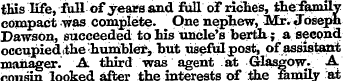
this Kfe , full of years and full of riches , thefamily compact was complete . One nephew , Mr * Joseph Dawson , succeeded to his uncle ' s berth . ; a second occupied the hunibleTj but useful post , of assistant manager . A third was agent at Glasgow . A cousin looked after the interests of the family at Liverpool , and a brother ' of die late manager was the Iiondon representative of the Stainton and Dawson brotherhood . The Carron Company , it is needless to say , was an eminently profitable concern . Neither rats—nor Dawsons- —stick to a sinking shi p * As the value of the business became more and more apparent , and the family , interest beca and tne and
me more more Compact ,, gr conception seems to have entered Mr . Joseph Dawson ' s mind of ousting all the other , partners out of the business , and turning the ^ Carron Company , not only in name , but , in fact , into the family firm of Dawson , Stainton and Co . According to unfriendly statements , this conception was worked out continuously and successfully for a quarter of a century . Every means was resorted to to depreciate the value of the property in the eyes of those shareholders who were not within the charmed circle . The debts were overstated , and the assets under valued ; the partnership was debited with breakages and losses that never
occurred , and credited with only portions of the monies received . False balance sheets were prepared by one member of the fainily , cashed by another , and audited by a third . No stranger was allowed to purchase shares in the Company , but on the other hand the manager was always ready to buy up the interests of any existing shareholder for a consideration . No investigation of the accounts was allowed , and the monies which ought to have been divided among the Company were directed into the private accounts of the fauiily . So things went on , till at last Mr . Joseph . EiawSon was gathered to his -fathers , and Mr . William This
Dawson reigned in his stead . gentleman may have " known Joseph and his works , " but : he certainl y did not appreciate them . His virtuous indignation against his ^ " enemies " and " greedy partners , " as he designated the non-family shareholders in the Company , was so strong , that he forgot the 4 ictates of prudence . The fact that " union is strength" was lost si ^ ht of . Jealousies arose between the Staintons and Dawsons . Mr . William Dawson accused Mr . Henry Stainton of defrauding the . company . The accusation appears to have been just . During Mr . Stainton ' s lifetime he handed over 96 , 000 ? . to the company , and on his death shortly afterwards his executors compromised
the claim from the company on his estate by a payment of 220 , 000 ; . Alas , the triumph of the Dawsons was shortlived and suicidal ! If Peter robs Paul , and Paul robs Peter , there is a strong antecedent probability that Peter and Paul together rob the rest of the Apostles . Acting on this assumption , the exoteric shareholders of the Carron Company have impeached the integrity of the whole esoteric management of the Staintons and Dawsons . What the truth of these statements may be we cannot tell , but believing , as we ore bound , that the principle of the family is the basis of our social system , we trust that the Dawson and Stainton may , like the directors of the Western Bank of Scotland , come off soatheless and stainless .
THE HAPPY FAMILY . % t is a blessed thing for brethren tp dwell together in unity . There is no rule without an exception . If the united brethren are leagued together to defraud the public , it maybe questioned whether the continuance of this fraternal unity is a cause for thankfulness . There is a somewhat worldlier saying , in which , for our part , we are disposed to place some iniplioit confidence . When thieves fall out , honest men come by their rights . Mr . William Dawson quarrelled with Mr . Henry Stainton , and the shareholders of the Carron Iron Company came by their dividends . We . note the coincidence , but do not pveterid to quote the
instance as an illustration of our theory . At present we only know one side of the case . It is possible that the clan of Dawson ' s and Staintpns may prove to- have been modern Reohabites , in their uprightness as well in their family affeotion —in fact a sort of plebeian " Greys" andpresbyterian " Elliotts . " It is equally possible , and somewhat more probable , that the other shareholders in the Carron Company may prove to be—what shall we say P- —well , very like the managers . It seems that some eighty-six years ago the Carron Iron Ooinnanv made its appearance in the
commercial world . Scotland was the land of its birth . Falkirk was its dwelling-place , and the Stainton family were its sponsors , parents and guardians . Tho company was virtually a partneriuip , and one of the partners , a Mr . Joseph Stainton , was the manager of tho oonoern . It is one consolation , at any rate , to learn that there can be no question about Mr . Stainton ' s spiritual orthodoxy . So amply did he provide for those of »| s own household , that not even the faintest suspicion of scepticism can attach to his revered , memory . Every post connected with the management of the company was filled up by some soion of $ he Stainton race , so that when at last , after forty years of management , Mr . Stainton departed
Politics And Natural History
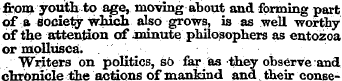
from youth to age , moving about and forming part of a society which also grows , is as -well worthy of the attention of aninute philosophers as entozoa or mollusca . . Writers on politics , so far as they observe and chronicle the actions of mankind and their consequences , are in truth natural historians , and as much worthy of public honour as writers oh the simia and the coleoptera . ^ Natural historians cannot impale an individual of the species and
examine him by the -microscope , and may therefore not find that certainty in the study of man which they find in the study of bisects . In that branch ofpolitics r however , called political economy , regular laws are supposed to prevail . Adam Smith is by no . means the-first writer who treated politics as a part of natural history , ; it was so treated before Aristotle , jand it might surprise us that so little has yet been done to render it accurate and acceptable to the multitude , were it not for two circumstances to which we shall advert .
The first is , that the very attempt to treat man and society as natural objects , seems to strike at the root of all organised political power- —which , being founded on the supposition that society is naturally chaotic , and not regulated , like communities of bees and ants , by natural laws or unerring instincts- —any person who pretends to detect such laws and natural orderly government , is regarded as the opponent of civic and religious authority , and of those who believe in it and are dependent on it : he is therefore , as the rule , cried down . This circumstance has prevented men of "talent from engaging in the study of the natural history of society with the same ardour and freedom as they have engaged in the study of mathematics and geology . ' ¦ ¦ ¦ . .
. ; The second is , that society being always in a state of developement , it required to be a considerable degree advanced before the natural laws which govern it could be the subject of observation like the perfectly formed and fully comprehended communities of ants and bees . Of a single individual , or a single family , there could be . no social science , and it was therefore only as society was much developed in modern times that a it ia
science of society became possible . Now Eossible , and now inquiries into society should ave an interest , for scientific men at least , equal to that of zoology or entomology . . As an illustration , lot us advert to the great principle of division of labour , and then the reader can judge whether politics and politicians , in the enlarged and best sense , be not as worthy of honour as comparative anatomy and c omparative
anatomists . Labour , the activity set in motion by the necessity to provide subsistence or preserve life , is the parent of all wealth . Without it , life would not continue , and society would not be possible . We have learned , from experience , that as society enlarges , the labour of each and every individual is not required to procure subsistence for all . An increasing proportion of the activity which this necessity sets on motion , becomes , in the progress of society , superfluous , and can be advantageously directed to other objects . One of the circumstances which bring about this change , and create this superfluity , is known by the name of division of labour . In fact , it is two or more individuals agreeing or combining , instinctively , tacitly , or otherwise , to help one another , or do different parts of the Bame necessary work . Division of labour , then , is clearly born pf socety . It is an ^ possibility for one so e «^ S ± J ^ ^
POLITICS AND NATURAL HISTORY . A qruat deal has of late been written about the utility of natural history , and a great deal done to render it popular . In doing this some of our periodicals have disparaged our ordinary political itcrature to hold up observations on the length of life , on tho fossU structure of the earth , on tadpoles , e chini , &c , as more expressly worthy of the attention of the young and the reflecting . We have not the least intention , politicians though we bo , of discouraging in turn such special studies , wo know they all ten 4 to dignify man , but we oan tarm
see as muoh to study ana admire m tue -yara , or the locomotive workshop , as on the sea . shore or in the region of . glaciers , or in the strata of the earth Every part of nature which the eye can scan , or the ear loam its music , is full of wonders . The life , however , which reveals itself to us only in a . change of form , like the growing tree , is not so interesting as that which both changes its town and ohanges its place , » nd reveals to us the existenoe of a double activity . We must say , therefore , hat man , having this double activity , growing
re ^ tromef ; To ^ ** ** thatitTaSocial necessity . It extends " - »"" £ increases , and is a beautiful provision for easily sunDlvinff all the wtmts of wan as population i&eases—a matter of infinite importance m relation to that theory which , seeing muoh misery result froman incrSse of people under our present imperfect politiool organisation , has concluded that S increase of population carries with it no compS » Sn , and £ a perpetual source of degradation ¦ * DivK' of labour , necessary to its suoce ' ss , and rv soiree . of continual improvement in P ™ **™ power , has an obvious natural ongm . The man Cot suckle the child , bathe can provide for the mother when she cannot provide for horsolf . To the sexes , then , nature dictates different tasks ; and in tho difference of sex—tho human race bqmg created , male and female , in about equal propor-
Untitled Article
^ «»¦» W 27 . ISiEO THE l ^ APER 987
-
-
Citation
-
Leader (1850-1860), Aug. 27, 1859, page 987, in the Nineteenth-Century Serials Edition (2008; 2018) ncse.ac.uk/periodicals/l/issues/vm2-ncseproduct2309/page/15/
-