On this page
-
Text (2)
-

Untitled Article
-

Untitled Article
Note: This text has been automatically extracted via Optical Character Recognition (OCR) software. The text has not been manually corrected and should not be relied on to be an accurate representation of the item.
-
-
Transcript
-
Note: This text has been automatically extracted via Optical Character Recognition (OCR) software. The text has not been manually corrected and should not be relied on to be an accurate representation of the item.
Additionally, when viewing full transcripts, extracted text may not be in the same order as the original document.
Untitled Article
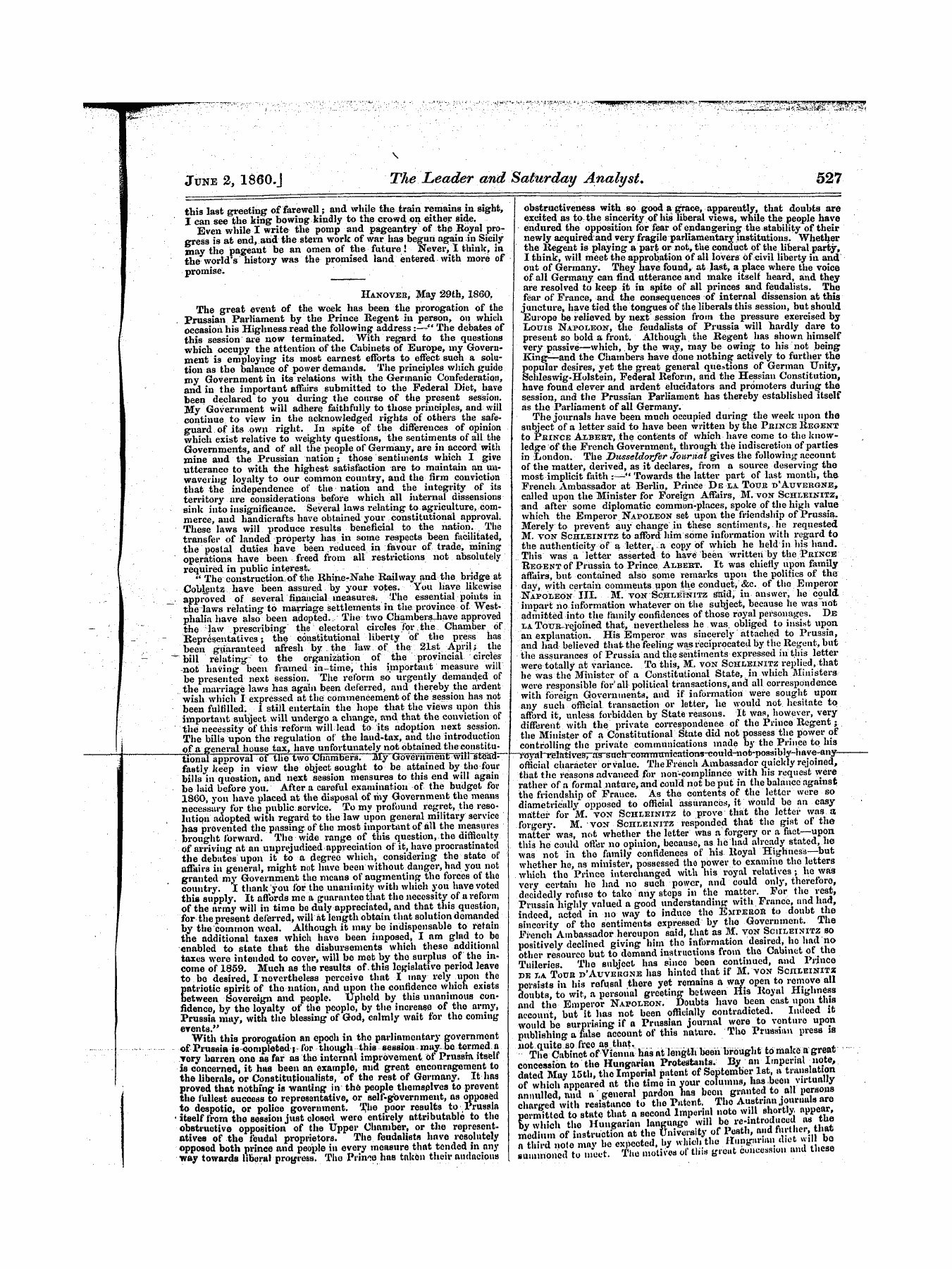
June 2 , 1860 . J The Leader arid Saturday Analyst . 527
Untitled Article
this last greeting of farewell ; and while the train remains in sight , I can see the king bowing kindly to the crowd . 011 either side . Even while I write the pomp and pageantry of the Royal progress is at end , and the stern work of war has begun again in Sicily may the pageant be an omen of the future ! Never , I think , in the world ' s history was the promised land entered with more of promise .
Untitled Article
Hanover , May 29 th , I 860 , The great event of the week has been the prorogation of the Prussian Parliament by the Prince Regent in person , on which occasion his Highness read the following address : — <¦ " The debates of this session are now terminated . With regard to the questions which occupy the attention of the Cabinets of Europe , my Government is employing its' most earnest efforts to effect such a solution as the balance of power demands . The principles which guide my Government in its relations with the Germanic Confederation , and in the important affairs submitted to the Federal Diet , have been declared to you during the course of the present session . My Government will adhere faithfully to those principles , and will continue to view in the acknowledged rights of others the
safeguard of its own right . In spite of the differences of opinion which exist relative to weighty questions , the sentiments of all the Governments , and of all the people of Germany , are in accord with mine and the Prussian nation ; those sentiments which I give utterance to with the highest satisfaction are to maintain an unwavering loyalty to our common country , and the firm conviction that the independence of the nation and the integrity of its territory are considerations before which all internal dissensions sink into insignificance . Several laws relating to agriculture , commerce , and handicrafts have obtained your constitutional approval . These laws will produce results beneficial to the nation . The transfer of landed property has in some respects been facilitated , the postal duties have been reduced in favour of trade , mining " operations have been freed from all restrictions not absolutely required in public interest . __ ___ _ ,...., , and the at
obstruct ! veness with so good a grace , apparently , that doubts are excited as to the sincerity of his liberal views , while the people have endured the opposition for fear of endangering the stability of their newly acquired and very fragile parliamentary institutions . Whether the Regent is playing a part or not , the conduct of the liberal party , I think , will meet the approbation of all lovers of rcivil liberty in and out of Germany . They have found , at last , a place where the voice of all Germany can find utterance and make itself heard , and they are resolved to keep it in spite of all princes and feudalists . The fear of France , and the consequences of internal dissension at this
juncture , have tied the tongues of the liberals this session , but should Europe be relieved by next session from the pressure exercised by Louis Napoleon , the feudalists of Prussia will hardly dare to present so bold a front . Although the Regent has shown himself very passive—which , by the way , maybe owing to his not being King—and the Chambers have done nothing actively to further the popular desires , yet the great general questions of German Unity , Schleswig-Holstein , Federal Reform , and the Hessian Constitution , have found clever and ardent elucidators and promoters during the session , and the Prussian Parliament has thereby established itself
as the Parliament of all Germany . The journals have been much occupied during the week upon the subject of a letter said to have been written by the Prince Regent to Prince Albert , the contents of which have come to the knowledge of the French Government , through the indiscretion of parties in London . The Dusseldorfer Journal gives the following account of the matter , derived , as it declares , from a source deserving the most implicit faith : — " Towards the latter part of last month , the French Ambassador at Berlin , Prince De 11 Tour d'Auvergne , called upon the Minister for Foreign Affairs , M . von Schleinitz , and after some diplomatic common-places , spoke of the high value which the Emperor Napoleon set upon the friendship of Prussia . he sted
Merely to prevent any change in these sentiments , reque M . von Schleinitz to afford him some information with regard to the authenticity of a letter , a copy of which he held in his hand . This was a letter asserted to have been written by the PrInce Regent of Prussia to Prince Albert . It was chiefly upon family affairs , but contained also some remarks upon the politics of the day , with certain comments upon _ ie conduct , &c . of the Emperor Napoleon III . M . von Schleinitz said , in- answer , he could impart no information whatever oil the subject , because he was riot admitted into the family confidences of those royal personages . De la TouR ^ rejoihed th at , nevertheless he was obliged to insist upon an explanation . His Emperor was sincerely attached to Prussia ,
and had- believed that the feeling was reciprocated by the Regent , but the assurances of Prussia and the sentiments expressed in this letter were totally at variance . To this , M , von Schleinitz replied , that he was the Minister of a Constitutional State , in which Ministers were responsible for ' all political transactions , and all correspondence with foreign Governments , and if information were sought upon any such official transaction or letter , he would not hesitate to afford it , unless forbidden by State reasons . It was , however , very different with the private correspondence of the Prince Regent y the Minister of a Constitutional State did not possess the power ot controlling the private communications made by the Prince to Ins
¦ nroyal-relativetnrT ^ official character orvalue . TheFrench Ambassador quickly rejoined , that the reasons advanced for non-compliance with his request were rather of a formal nature , and could not be put in the balance against the friendship of France . As the contents of the letter were so diametrically opposed to official assurances , it would be an easy matter for ' M . von Schleinitz to prove that the letter was a forgery . M . von Schleinitz responded that the gist of the matter was , not whether the letter was a forgery or a fact—upon this he could offer no opinion , because , as he ha d already stated , he was not in the family confidences of his Royal Highness—but whether ha . as minister , possessed the power to examine tho letters
which tho Prince interchanged with his royal relatives ; he was very certain he had no such power , and could only , therefore , decidedly refuse to take any steps in the matter . For the rest , Prussia highly valued a good understanding with France , and had , indeed , acted in no way to induce tho Emperor to doubt the sincerity of tho sentiments expressed by the Government . The French Ambassador hereupon said , that as M . von Schleinitz so positively declined giving him tho information desired , ho had no other resource but to demand instructions from the Cabinet of the Tuileries . Tho subject has sinco been continued , and 1 rjnee de la Tour d'Auverone has hinted that if M . von Schleinitx persists in his refusal there yet remains a way open to remove all mgiiuow
doubts , to wit , a personal greeting between nu iwyui and the Emperor Napoleon . Doubts have been cast upon this account , but it has not been officially contradicted . Indeed it would bo surprising if a Prussian journal were to venture upon publishing a false account of this nature . Tho Prusaum press is ^ Oib ^^ concession to the Hungarian Protestants . By an Imperial note , dated May 15 th , the Imperial patent of September 1 st a trans ation of which appeared at tl . e time in your columns , ^ ' ^ yjJjS annulled , n id a general pardon has beon granted to all persons charged with resistance to ^ the Patent . Tho Austrian journals are peSted to state that a second Imperial note w 11 shortly , appear KShiih tho Hungarian language' will be re-mtroduced as the auei
med urn of instruction at the University of Pestli , ana n . u . « j Hh rd note may be expected , by which the . H'W'r . J " 'J' ^ J " ^ summoned to moot . The motives of tins grout concession and these
* ' The construction of the Rhine-Nahe Railway bridge Coblentz have been assured by your votes . You have likewise approved of several financial measures . The essential points in thelaws relating to marriage settlements in the province of Westphalia have also been adopted . The two GhamberaJiave approved the law prescribing the electoral circles for the Chamber of Representatives ; the constitutional liberty of the press has been guaranteed afresh by tjhe law of the 21 st April ; the bill relating- to the organization of the provincial circles not having been framed in-time , this important measure will be presented next session . The reform so urgently demanded of the marriage laws has again been deferred , and thereby the ardent wish which I expressed at the commencement of the session has not been fulfilled . 1 still entertain the hope that the views upon this important subject will undergo a change , and that the conviction of the necessity of this reform will lead to its adoption next session . and tlie introduction
The bills upon the regulation of the land-tax , of a ¦ general house tax , have unfortunately not obtained the constitutional approval of the two Chambers . My " Government will stSSd ^ fastly keep in view the object sought to be attained by _ the four bills in question , and next session measures to this end will again be hud before you . After a careful examination of the budget for 1860 , you have placed at the disposal of my Government the means necessary for the public service . To my profound regret , the resolution adopted with regard to the law upon general military service has prevented the passing of the most important of all the measures brought forward . The wide range of this question , the difficulty of arriving at an unprejudiced appreciation of it , have procrastinated the state of
the debates upon it to a degree which , considering affairs in general , might not have been without danger , bad you not granted my Government the means of augmenting the forces of the country . I thank you for the unanimity with which you have voted this supply . It affords me a guarantee that the necessity of a reform of the army will in time be duly appreciated , and that this question , for the present deferred , will ht length obtain that solution demanded by the common weal . Although it may be indispensable to retain the additional taxes which have been imposed , I am glad to be enabled to state that the disbursements which these additional taxes were intended to cover , will be meb by the surplus of the income of 1859 . Much as the results of . this legislative period leave
to bo desired , I nevertheless perceivo that I may rely _ upon the patriotic spirit of the nation , and upon the confidence which exists between Sovereign and people . Upheld by this unanimous confidence , by tho loyalty of the people , by the increase of tho army , Prussia may , with the blessing of God , calmly wait for tho coming © rents . " With this prorogation an epoch in the parliamentary government of Prussia is completed j for though this session may bo termed a very barren one as far as the internal improvement of Prussia itself is concerned , it has been on example , and great enconragement to the liberals , or Constitutionalists , of the rest of Germany . It has proved that nothing is wanting in the people themselves to prevent the fullest success to representative , Or self-government , as opposed to despotic , or police government . T , he poor results to Prussia itself from tho session just closed were entirely attributable to the
obstructive opposition of the Upper Chamber , or the represent , atives of the feudal proprietors . The feudalists have resolutely opposed both prince and people in every measure that tended in any way towards liberal proirro 6 » . Tho Prinoo has token their audacious
-
-
Citation
-
Leader (1850-1860), June 2, 1860, page 527, in the Nineteenth-Century Serials Edition (2008; 2018) ncse.ac.uk/periodicals/l/issues/vm2-ncseproduct2350/page/19/
-