On this page
-
Text (1)
-
Untitled Article
Note: This text has been automatically extracted via Optical Character Recognition (OCR) software. The text has not been manually corrected and should not be relied on to be an accurate representation of the item.
-
-
Transcript
-
Note: This text has been automatically extracted via Optical Character Recognition (OCR) software. The text has not been manually corrected and should not be relied on to be an accurate representation of the item.
Additionally, when viewing full transcripts, extracted text may not be in the same order as the original document.
Untitled Article
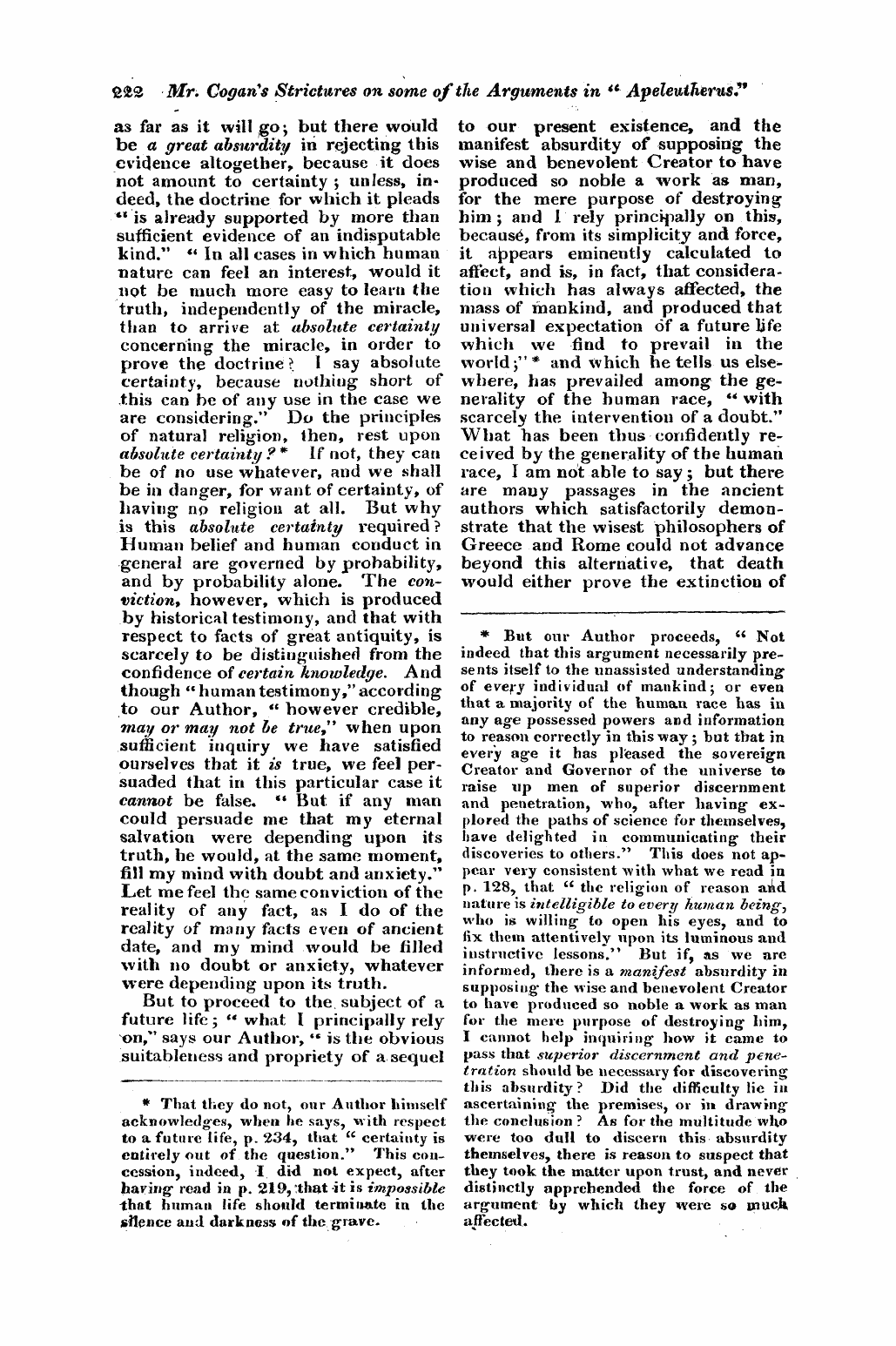
as far as it will go * but there would be a great absurdity in rejecting this evidence altogether , because it does not amount to certainty ; unless , indeed , the doctrine for which it pleads ' * is already supported by more than sufficient evidence of an indisputable kind . " " In all cases in which human
nature can feel an interest , would it not be much more easy to learn the truth , independently of the miracle , than to arrive at absolute certainty concerning the miracle , in order to prove the doctrine ? 1 say absolute certainty , because nothing short of this can be of any use in the case we are consider in sr . " " Do the principles are considering . Do the principles
of natural religion , then , rest upon absolute certainty ? * If not , they can be of no use whatever , and we shall be in danger , for want of certainty , of having np religion at all . But why is this absolute certainty required ? Human belief and human conduct in general are governed by probability , and by probability alone . The conviction , however , which is produced by historical testimony , and that with
respect to facts of great antiquity , is scarcely to be distinguished from the confidence of certain knowledge . And though " human testimony , " according to our Author , " however credible , may or may not he true , " when upon
sufficient inquiry we have satisfied ourselves that it is true , we feel persuaded that in this particular case it cannot be false . ** But if any man could persuade me that my eternal salvation were depending upon its truth , he would , at the same moment ,
fill my mind with doubt and anxiety . " Let me feel the same conviction of the reality of any fact , as I do of the reality of many facts even of ancient date , and my mind would be filled
with no doubt or anxiety , whatever were depending upon its truth . But to proceed to the subject of a future life ; " what I principally rely wi , says our Author , is the obvious suitableness and propriety of a sequel
* That they do not , our Author himself acknowledges , when he says , vrith respect to a future life , p . 234 , that " certainty is entirely out of the question . " This concession , indeed , I did not expect , after baring * read in p . 219 , : th « ttit is impossible that human life should terminate in the » Me « ce and darkness of the grave-
Untitled Article
to our present existence , and the manifest absurdity of supposing the wise and benevolent Creator to have produced so noble a work as man , for the mere purpose of destroying him ; and 1 rely principally on this ,
because , from its simplicity and force , it appears eminently calculated to affect , and is , in fact , that consideration which has always affected , the mass of mankind , and produced that universal expectation of a future life which we find to prevail in the world ; " * and which he tells us else * VI ^—* » IVi ft U >»*^ . « 11 AJI AV / A Jl « . AVX b V 1 Jl U m ^* fc ^ ^ S * VT ^
where , has prevailed among the ge * nerality of the human race , " with scarcely the intervention of a doubt . " What has been thus confidently received by the generality of the human race , I am not able to say ; but there are many passages in the ancient authors which satisfactorilv
demonstrate that the wisest philosophers of Greece and Rome could not advance beyond this alternative , that death would either prove the extinction of
* But our Author proceeds , u Not indeed that this argument necessarily presents itself to the unassisted understand ing * of every individual of mankind ; or even that a majority of the human race has in any age possessed powers and information to reason correctly in this way ; hut that in every age it has pleased the sovereign Creator and Governor of the universe to
raise up men of superior discernment and penetration , who , after having explored the paths of science for themselves , have delighted in communicating their discoveries to others . " This does not appear very consistent with what we read in p . 128 , that u the religion of reason and
nature is intelligible to every human beings who is willing to open his eyes , and to fin them attentively upon its luminous and instructive lessons . * ' But if , as we are informed , there is a manifest absurdity in supposing the wise and henevolent Creator to have produced so noble a work as man
for the mere purpose of destroying him , I cannot help inquiring how it came to pass that superior discernment and penetration should be necessary for discovering tliis absurdity ? Did the difficulty He in ascertaining the premises , or in drawing the conclusion ? As for the multitude who
were too dull to discern this absurdity themselves , there is reason to suspect that they took the matter upon trust , and nevtir distinctly apprehended the force of the argument by which they were so much affected .
Untitled Article
£$ 2 Mr . Cogan ' s Strictures on some of the Arguments in Apeleutherns"
-
-
Citation
-
Monthly Repository (1806-1838) and Unitarian Chronicle (1832-1833), April 2, 1819, page 222, in the Nineteenth-Century Serials Edition (2008; 2018) ncse.ac.uk/periodicals/mruc/issues/vm2-ncseproduct1771/page/10/
-