On this page
-
Text (1)
-
Untitled Article
Note: This text has been automatically extracted via Optical Character Recognition (OCR) software. The text has not been manually corrected and should not be relied on to be an accurate representation of the item.
-
-
Transcript
-
Note: This text has been automatically extracted via Optical Character Recognition (OCR) software. The text has not been manually corrected and should not be relied on to be an accurate representation of the item.
Additionally, when viewing full transcripts, extracted text may not be in the same order as the original document.
Untitled Article
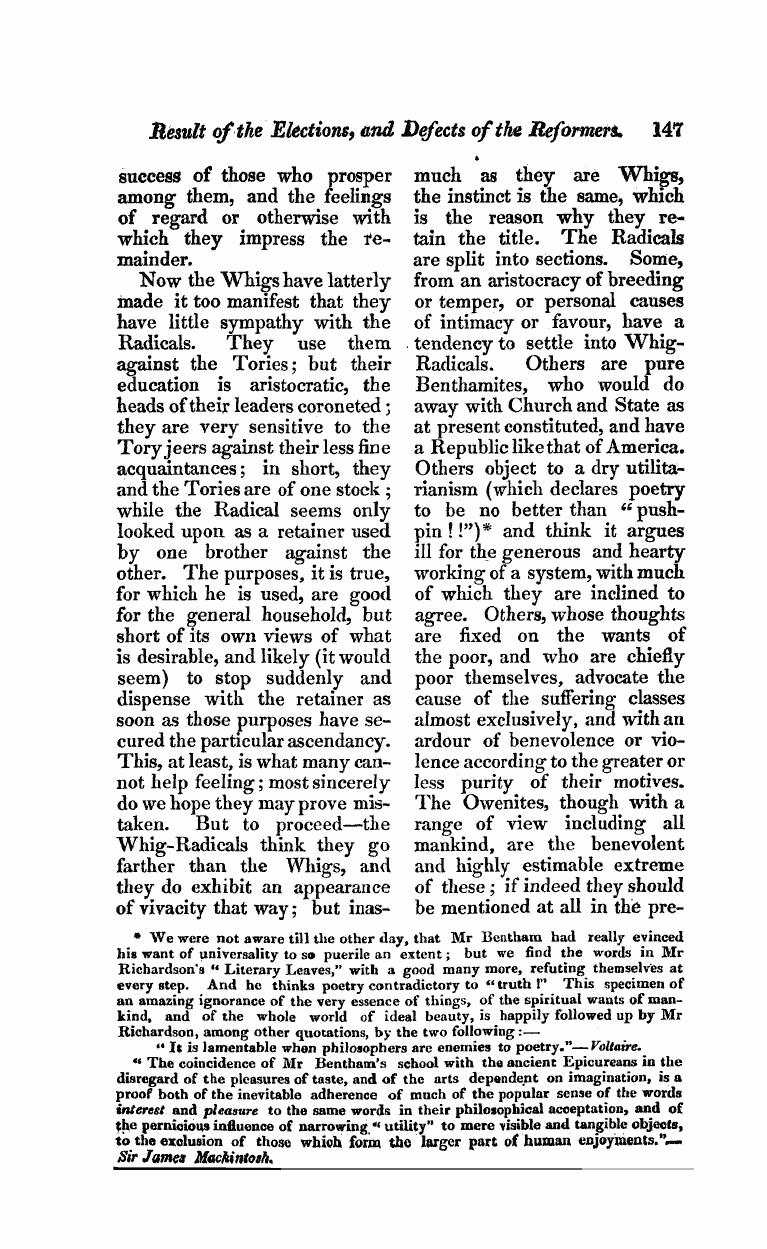
success of those who prosper among them , and the feelings of regard or otherwise with which they impress the remainder . Now the Whigs have latterly made it too manifest that they
have little sympathy with the Radicals . They use them against the Tories ; but their education is aristocratic , the heads of their leaders coroneted ; they are very sensitive to the Tory jeers against their less fine
acquaintances ; in short , they and the Tories are of one stock ; while the Radical seems only looked upon as a retainer used by one brother against the other . The purposes , it is true , for which he is used , are good for the general household , but short of its own views of what
is desirable , and likely ( it would seem ) to stop suddenly and dispense with the retainer as soon as those purposes have secured the particular ascendancy . This , at least , is what many cannot help feeling ; most sincerely do we hope they may prove mistaken . But to proceed—the Whig-Radicals think they go farther than the Whigs , and they do exhibit an appearance of vivacity that way ; but
inas-• We were not aware till the other day , that Mr Bentham had really evinced his want of universality to s « puerile an extent ; but we find the words in Mr Richardson ' s " Literary Leaves , " with a good many more , refuting themselves at every step . And he thinks poetry contradictory to " truth ! " This specimen of an amazing ignorance of the very essence of things , of the spiritual wants of mankind , and of the whole world of ideal beauty , is happily followed up by Mr Richardson , among other quotations , by the two following : — " It is lamentable when philosophers are enemies to poetry . "— Voltaire . ' < The coincidence of Mr Bentham ' s school with the ancient Epicureans in the disregard of the pleasures of taste , and of the arts dependent on imagination , is a proof both of the inevitable adherence of much of the popular sense of the words interest and pleasure to the same words in their philosophical acceptation , and of the pernicious influence of narrowing / 1 utility" to mere visible and tangible objects , to the exclusion of those which form the larger part of human enjoyments . "*—Sir James Mackintosh *
Untitled Article
much as they are Whigs , the instinct is the same * which is the reason why they retain the title . The Radicals are split into sections . Some , from an aristocracy of breeding or temper , or personal causes
of intimacy or favour , have a tendency to settle into Whig-Radicals . Others are pure Benthamites , who would do away with Church and State as at present constituted , and have a Republic like that of America , Others object to a dry
utilitarianism ( which declares poetry to be no better than " pushpin ! ! " )* and think it argues ill for the generous and hearty working of a system , with much of which they are inclined to agree . Others , whose thoughts are fixed on the wants of
the poor , and who are chiefly poor themselves , advocate the cause of the suffering classes almost exclusively , and with an ardour of benevolence or violence according to the greater or less purity of their motives . The Owenites , though with a range of view including all mankind , are the benevolent and highly estimable extreme of these ; if indeed they should be mentioned at all in thi £ pre-
Untitled Article
Result of the Elections , and Defects of the Reformers . 147
-
-
Citation
-
Monthly Repository (1806-1838) and Unitarian Chronicle (1832-1833), Sept. 1, 1837, page 147, in the Nineteenth-Century Serials Edition (2008; 2018) ncse.ac.uk/periodicals/mruc/issues/vm2-ncseproduct1835/page/3/
-
