On this page
-
Text (1)
-
Untitled Article
Note: This text has been automatically extracted via Optical Character Recognition (OCR) software. The text has not been manually corrected and should not be relied on to be an accurate representation of the item.
-
-
Transcript
-
Note: This text has been automatically extracted via Optical Character Recognition (OCR) software. The text has not been manually corrected and should not be relied on to be an accurate representation of the item.
Additionally, when viewing full transcripts, extracted text may not be in the same order as the original document.
Untitled Article
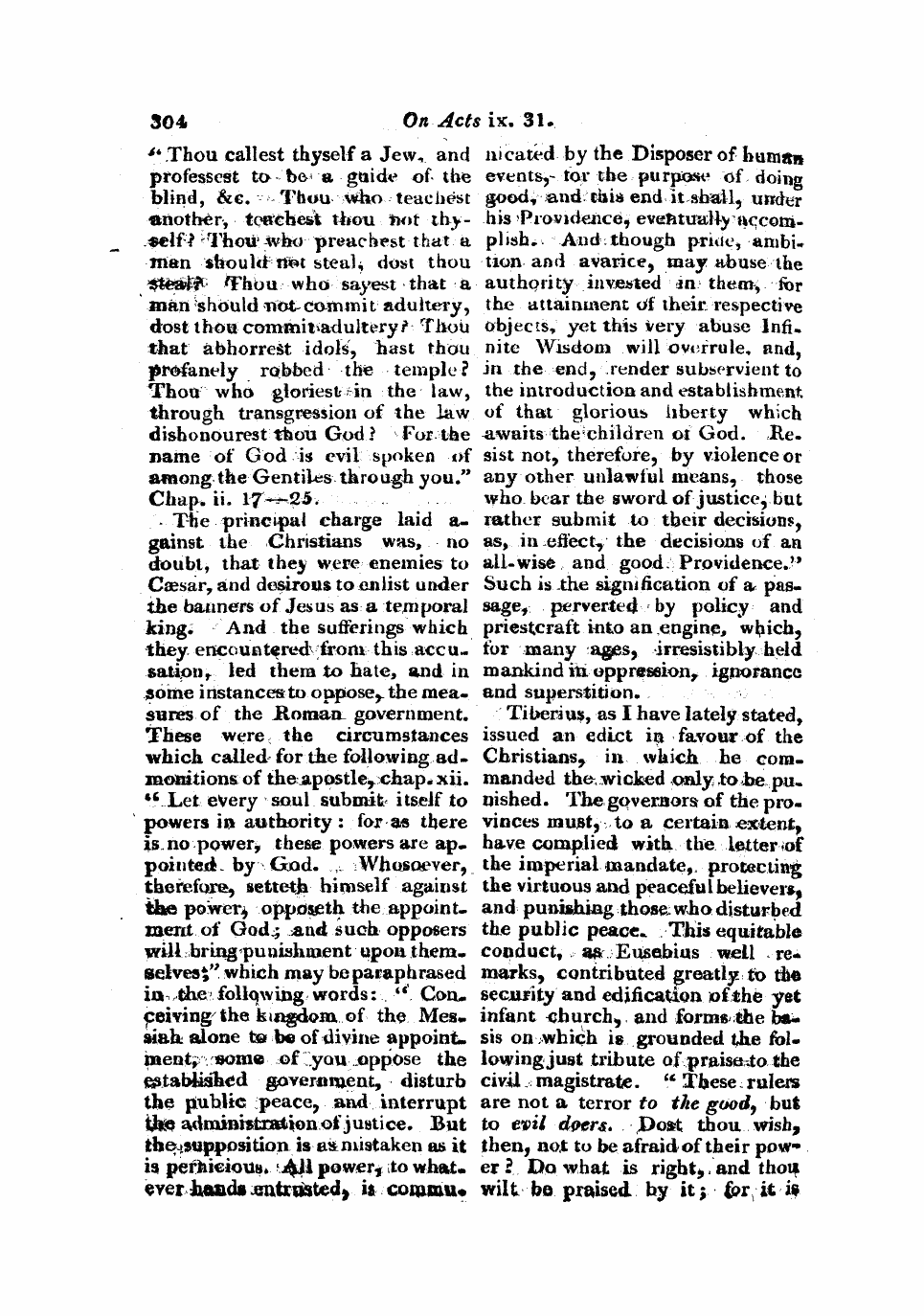
f * Thou callest thyself a Jew-, and professest to b < y a g&ide of the blind , &e . Thou who teacbest 4 fciiotfa £ i \ toachest xhou nut . iby-« elf ? Th < m who preachest that a man shoulcf ti ^ t steal * dos t thou
J $ * fea $ ? * Fhbu who sayest that a man should tiM-commit adultery , dostlhOtf cotnmit ^ adultery f Tlioii that abhorrent idols , liast thou profanely robbed the temple ? Thou who gloriest' -in the law , through transgression of the law dishonourest th'oa God ? For the
name of God is evil spoken of among the Gentiles through you /* Chap * ti . 17 ^ -25 , - The principal charge laid against the Christians was , no doubt , that they were enemies to Caesar , and desirous to enlist under
the banners of Jesus as a temporal king ; And the sufferings which they encountered fcorti this accusation , led them to bate , and in some instances to oppose ^ the measures of the Roraaa government . These were the circumstances
which called for the following admonitions of the apostle r chap , xii . •? Let every saul submit itself to powers in authority : tor as there is no pQwer ^ these powers are
appointed , by God . , Whosoever , therefore , setteth himself against tike power ,, opposeth the appoint , merit of God ; and such opposers will bring puuiahment upon them * selves ^ " which may be paraphrased
iu the following words : " Con * ceiving the ktagdom of the Messiah , alone to be of divine appoint * ment , some of you .. oppose the ^ itaWiahcd goveriiment , disturb
the public peace , and interrupt Urn ^ Iminbtration ot juatice . But the-supposition is as mistaken as it is perhicious * 4 J 1 powe ^ to what * ^ ye r hand * . untrwted ii coiumu *
Untitled Article
nicated by the Disposer of human events ,- tor the purpjost 1 of doing good , and cii is end it shail ^ u » der his Providence ^ evefctua % accoraplish , Aaid though prkiey ambi-r
lion and avarice , may abuse the authprity invjested in them ^ for the attainment < rf their respective Objects , yet this very abuse Infinite Wisdom will ovcifrule , and , in the end , render subservient to the iniroduction and establishment
ot that glorious liberty which awaits the ^ ehildren oi God . Re . sist not , therefore , by violence or any other unlawful means , those who bear the sword of justice ^ but rather submit to tbeir decisions , as , in effect ^ the decisions of an
all-wise and good . Providence . ?* Such is . the signification of a pas * sage , perver $ e 4 by policy and priestcraft into an engine , wriich , for many ages , irresistibly held mankind in oppression , ignorance and superstition .
Tiberius , as I have lately stated , issued an edict in favour of the Christians , in which he commanded the ; jwicked o « ly . to he , punished . The governors of the provinces must , to a certain extenU
have complied with the letter * of the imperial mandate , protecting the virtuous and peaceful believer * , and punishing those ; who disturbed the public peace . This equitable conduct , as Eusebius well re *
marks , contributed greatly to the security and edification of the yet infant church , and forms the basis on which is grounded the following just tribute of praise . to the
civil magistrate . u These rulers are not a terror to the goody but to evil doers . Dost thou wish , then , not to be afraid of their pow » ex I Do what is right ,, and thou wilt bo praised by it ; fc > r it i *
Untitled Article
304 On Acts ix . 3 K
-
-
Citation
-
Monthly Repository (1806-1838) and Unitarian Chronicle (1832-1833), June 2, 1810, page 304, in the Nineteenth-Century Serials Edition (2008; 2018) ncse.ac.uk/periodicals/mruc/issues/vm2-ncseproduct2405/page/32/
-
