On this page
-
Text (1)
-
Untitled Article
Note: This text has been automatically extracted via Optical Character Recognition (OCR) software. The text has not been manually corrected and should not be relied on to be an accurate representation of the item.
-
-
Transcript
-
Note: This text has been automatically extracted via Optical Character Recognition (OCR) software. The text has not been manually corrected and should not be relied on to be an accurate representation of the item.
Additionally, when viewing full transcripts, extracted text may not be in the same order as the original document.
Untitled Article
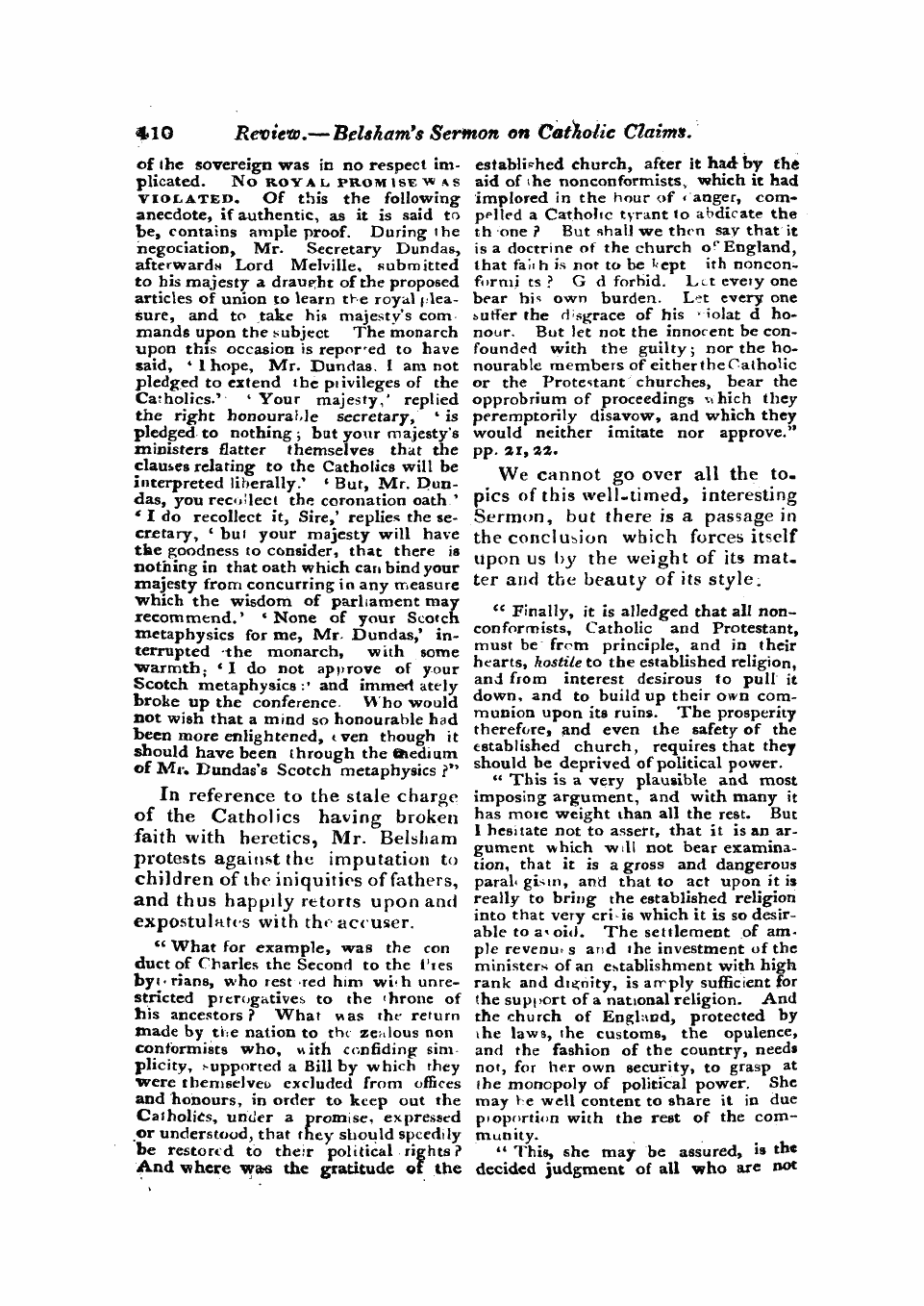
of the sovereign was in no respect implicated . No ROY A L , PROM 1 SE TW AS violated . Of this the following anecdote , if authentic , as it is said to be , contains ample proof . During the negociation , Mr . Secretary Dundas , afterwards Lord Melville , submitted to his majesty a draught of the proposed articles of union to learn the royal pleasure , and to take his majesty ' s com mauds upon the subject The monarch
mm . m upon this occasion is repor ed to have said , 4 1 hope , Mr . Dundas , I am not pledged to extend the piivileges of the Catholics . ' ' Your majesty / replied the right honourable secretary , * is pledged to nothing ; but your majesty ' s ministers flatter themselves that the
clauses relating to the Catholics will be interpreted liberally . * « But , Mr . Dundas , you recollect the coronation oath ' * I do recollect it , Sire , ' replies the secretary , ' bui your majesty will have tfee goodness to consider , that there is nothing in that oath which can bind your majesty from concurring in any measure Which the wisdom of parliament may
recommend . ' * None of your Scotch metaphysics for me , Mr . Dundas , ' interrupted -the monarch , with some vrarmth ; ' I do not approve of your Scotch metaphysics : * and immed ately broke up the conference . Who would not wish that a mind so honourable had been more enlightened , tven though it should have been through the friedium of Af r , Dundas ' s Scotch metaphysics ?*'
In reference to the stale charge of the Catholics having broken faith with heretics , Mr . Belsliam protests against the imputation to children of the iniquities of fathers , and thus happily retorts upon and expostulates with th «" -accuser .
" What for example , -was the con duct of Charles the Second to the fies by < nans , who rest red him wi » h unrestricted prerogatives to the ' hronc of his ancestors ? What was the return made by ti ; e nation to the zealous non conformists who , with confiding simplicity , supported a Bill by which they were themselves excluded from offices
and honours , in order to keep out the Caiholies , under a promise , expressed or understood , that rney should speedily be restored to the ? r political rights ? And where was the gratitude of the
Untitled Article
established church , after it had by the aid of ihe nonconformists , which it had implored in the hour of * anger , compelled a Catholic tyrant to abdicate the
th one ? But shall we then say that it is a doctrine of the church o England , that fairh is not to be kept ith nonconformj ts ? G d forbid . Let every one bear his own burden . Let every one *> utFer the d-sgrace of his * iolat d honour . But let not the innocent be confounded with the guilty ; nor the honourable members of either the CathoHc
or the Protestant churches , bear the opprobrium of proceedings which they peremptorily disavow , and which they would neither imitate nor approve . " pp . 21 , 7 , 2 . We cannot go over all the top ics of this well-timed , interesting Sermon , but there is a passage in the conclusion which forces itself
upon us by the weight of its matter and the beauty of its style . cc Finally , it is ailedged that all nonconformists , Catholic and Protestant , must be from principle , and in their hearts , hostile to the established religion .
and from interest desirous to pull it down , and to build up their own communion upon its ruins . The prosperity therefore , and even the safety of the established church , requires that they should be deprived of political power .
" This is a very plausible and most imposing argument , and with many it has moic weight than all the rest . But 1 hesitate not to assert , that it is an argument which will not bear
examination , that it is a gross and dangerous paral < gism , and that to act upon it is really to bring the established religion into that very cri-is which it is so desirable toa < oi < J . The settlement of
ample revenuo s and the investment of the ministers of an establishment with high rank and dignity , is arrply sufficient for the support of a national religion . And the church of England , protected by
ihe laws , the customs , the opulence , and the fashion of the country , needs not , for her own security , to grasp at { he monopoly of political power . She may he well content to share it in due p » oportion with the rest of the
community . 44 This , she may be assured , is * decided judgment of all who axe not
Untitled Article
* 10 Reoieto ' . —Belsham ' s Sermon on Catholic Claims .
-
-
Citation
-
Monthly Repository (1806-1838) and Unitarian Chronicle (1832-1833), June 2, 1813, page 410, in the Nineteenth-Century Serials Edition (2008; 2018) ncse.ac.uk/periodicals/mruc/issues/vm2-ncseproduct2429/page/54/
-