On this page
-
Text (1)
-
Untitled Article
Note: This text has been automatically extracted via Optical Character Recognition (OCR) software. The text has not been manually corrected and should not be relied on to be an accurate representation of the item.
-
-
Transcript
-
Note: This text has been automatically extracted via Optical Character Recognition (OCR) software. The text has not been manually corrected and should not be relied on to be an accurate representation of the item.
Additionally, when viewing full transcripts, extracted text may not be in the same order as the original document.
Untitled Article
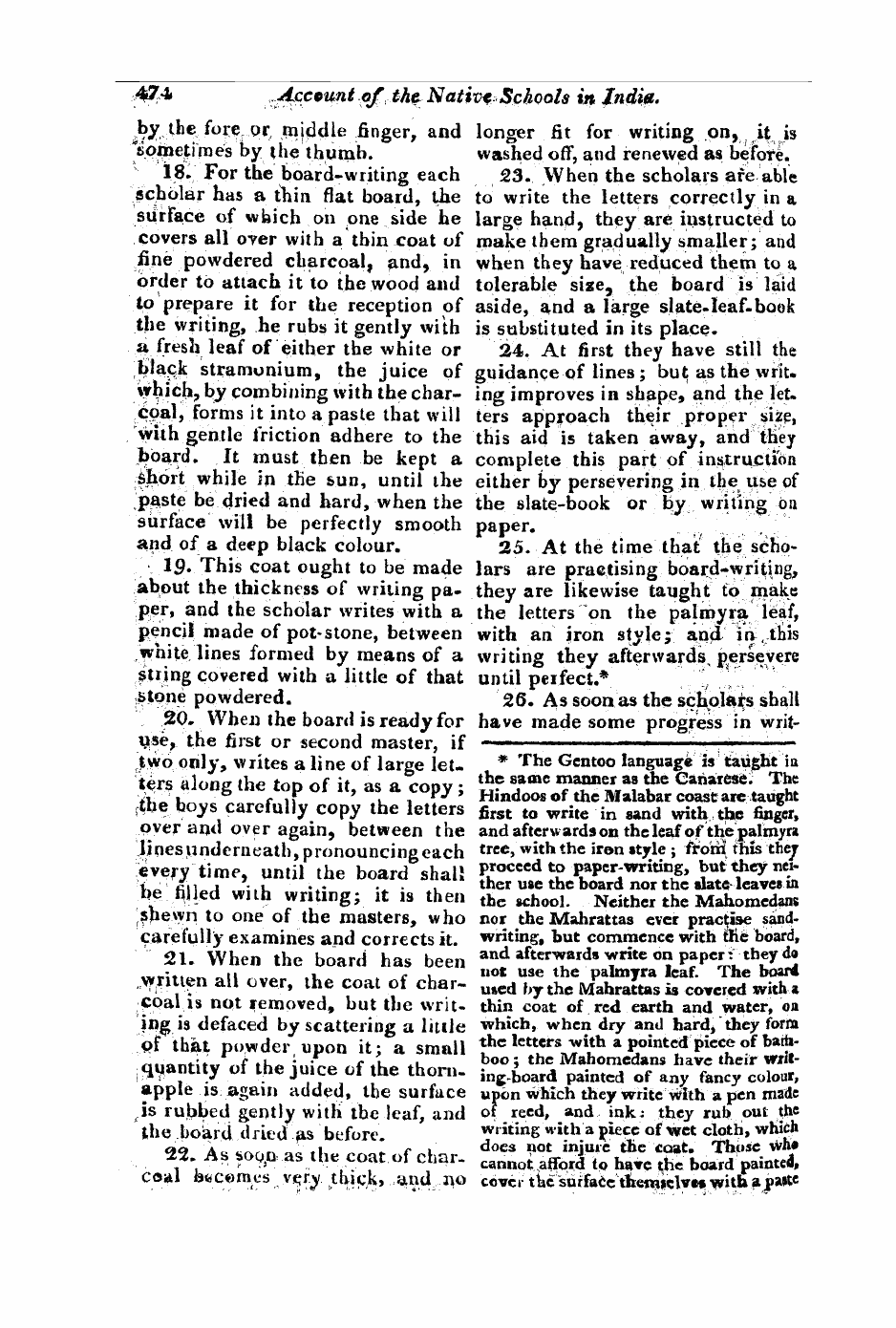
b y the foire or , iniddie finger , and " sometimes by the . ' thumb .
1 . 8 .. For the board-writing each scholar has a thin flat board , the surface of wbich on one side he covers all over with a thin coat of fine powdered charcoal , and , in order to attach it to the wood and to prepare it for the reception of the writing , he rubs it gently with
a fresh leaf of either the white or black stramonium , the juice of vhica , by combining with the charcoal , forms it into a . paste that will with gentle friction adhere to the board . It must then be kept a &hbrt while in tKe sun , until the be
p ^ ste dried hard , when the surface will be perfectly smooth and of a deep black colour . 19 . This coat ought to be made about the thickness of writing paper , and the scholar writes with a
pencil made of pot-stone , between white lines formed by means of a String covered with a little of that stpne powdered . 20 * When the board is ready for
lise , the first or second master , if tyto only , writes a line of large let . Uts along the top of it , as a copy ; the boys carefully copy the letters over and over again , between the lines underneath , pronouncing each
every time , until the board shall be filled with writing ; it is . then ftfiewn to one of the masters , who carefully examines and corrects it . 2 U When the board has been written all over , the coat of charcoal is not lemoved , but the writ *
mf * 13 defaced by scattering a little < pf that powder upon it ; a small cjiiantity of the juice of the thorn , apple is again added , the surface is rubbed gentl y with the leaf , and the board dried as before .
22 . As soQia as the coat of charcoal fe ^ cemes vcjrv thick , ami no
Untitled Article
longer fit for writing on , it is washed off , and renewed as befofe .
23 . When the scholars are able to write the letters correctly in a large hand ) they ar 6 instructed to make them gradually smaller ; and when they have reduced thern to a tolerable size the board is laid aside , and a large slate-leaf-book is substituted in its place *
24 . At first they have still the guidance of lines ; but as the writ . ing improves in shape , and the let * ters approach their pfop ^ r sizp , this aid is taken away , and they complete this part of instruction either by persevering in the use of the slate-book or by writing ba
P P - .,- > . < 25 . At the time that the scholars are practising boai * d-writing , they are likewise taught to make the letters on the palmyra leaf ,
with an iron style ; a , n < l ici c this writing they afterwards , p ^ erseVere until peifect . * 26 . As soon as the scholftrs shall have made some progress in
writ-* The Gentoo language is taught la the same manner as die Canarese . The Hindoos of the Malabar coast are taught first to write in sand with the finger , and afterwards on the leaf of the palmyra tree , with the iron style ; ffori ^ this thej proceed to paper-writing , hut they neither use the board nor the slate leave * in
the school . Neither the Mahomedans nor the Mahrattas ever practise sandwriting , but commence with the board , and afterwards write on paper : they do not use the palmyra leaf . The board used by the Mahrattas is covered with a thin coat of red earth and water * on
which , when dry and hard , they form the letters -with a pointed piece of bathboo ; the Mahornedans have their writing-board painted of any fancy colour , upon which they write with a pen made of reed , and ink * they rub out } k writing with a piece of wet cloth , which does not injure the coat . Those wh # cannot aff o rd " to have tfcc board painted , cover the surface them * clv §» with a patfc
Untitled Article
474 * Account <* f th $ Natix * ; Schools in India .
-
-
Citation
-
Monthly Repository (1806-1838) and Unitarian Chronicle (1832-1833), Aug. 2, 1814, page 474, in the Nineteenth-Century Serials Edition (2008; 2018) ncse.ac.uk/periodicals/mruc/issues/vm2-ncseproduct2443/page/26/
-