On this page
-
Text (1)
-
Untitled Article
Note: This text has been automatically extracted via Optical Character Recognition (OCR) software. The text has not been manually corrected and should not be relied on to be an accurate representation of the item.
-
-
Transcript
-
Note: This text has been automatically extracted via Optical Character Recognition (OCR) software. The text has not been manually corrected and should not be relied on to be an accurate representation of the item.
Additionally, when viewing full transcripts, extracted text may not be in the same order as the original document.
Untitled Article
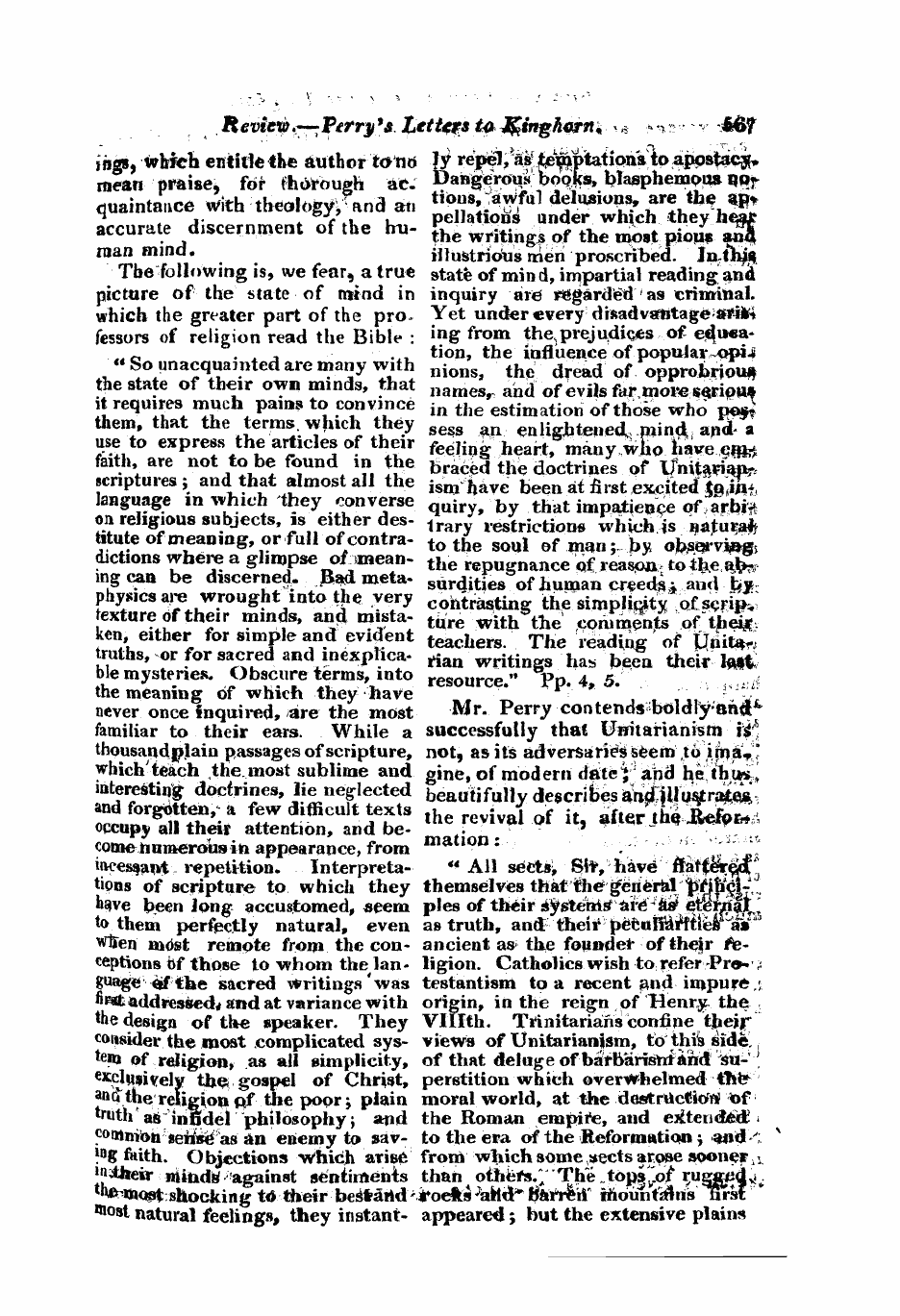
ings , which entitle the author to no mean praisej for fhdfrbugh ae . quaintauce with tb ^ ologyy and ati accurate discernment of the human mind .
The following is , we fear ^ a true picture of the state of mind in which the greater part of the pro * fessors of religion read the Bible : " So unacquainted are many with
the state of their own minds , that it requires much pains to convince them , that the terms , which they use to express the articles of their faith , are not to be found in the
scriptures ; and that almost all the language in which they converse on religious subjects , is either destitute of meaning , or full of contradictions where a glimpse of iraean * ing can be discerned . Bad metaphysics are wrought into the very
texture of their minds , and mistaken , either for simple and evicfent truths , or for sacred and inexplicable mysteries . Obscure terms , into the meaning of which they have never once inquired , are the mdst familiar to their ears . While a
thousand plain passages of scripture , which' teach the . most sublime and interesting- doctrines , lie neg-lected and forgotten , a few difficult texts occupy all their attention , and
becomeiinmerausin appearance , from iocessani repetition . Interpretations of scripture to which they h $ ve been Jong accustomed , seem to them perfectly natural , even wfteii mdst remote from the
conceptions tof those to whom thejanpaffe Stfthe sacred Writings ' was first addressed * and at variance with toe design of the speaker . They consider the naost complicated systenj of religion , as all simplicity , exclusi vely tb ^ gospel of Christ , &
authereligion # f the poor ; plain truth as infidel philosophy ; and ? 0 Mnfoh : * ettte as an enemy to sav-!» g faith . Objections Which arise jnaheir minds against aenrtiments t ! *> roost shocking to their bt ^ arid m natural feelings , they instant-
Untitled Article
li repel , as temptations to apostaey ^ jSaiagemus books , blasphemous q $ f tions , awful delusions , are the | pt ¦ LI ~ £ ^^^
* pellations under which they he $£ the writings of the most pious a « a illustrious men proscribed . Jnthig state of min d , impartial reading and inquiry arid regarded as criminal . Yet under every dfsadvsttitage i &f iift of
ing from the . prejudio ^ s education , the influence of popular opi-p nions , the dread of opprobrious names , and of evils far more $ aripu ^ in the estimation of those who po $ ? caoo nn An li / vrif ^ m Arl inrk -i KkAl nnn . 4 JV&
ouoo 1 ^ 4 ViAJAgAM' ^ Mv-M ^ -M ** My »»; < ftj | ~ m fe ^ iiqg heart , many . who have eiu ^ braced the doctrines of iTnitairi a ^ v ism have been at first excited fQint quiry , by that impatience of arbil trary restrictions which is imtura ^
to the soul of man ;^ by ob ^ orvwgi the repugnance q £ reaspxn toifee ^^ r surdities of human cr ^ ec ^ ^ and feji cohtrasting the simpli c ity pt s ^^ i ^ tiire with the comnaenjts of ip&gx teachers . The rea , ding of Unit ^ ^ Han writings has been their taife resource . " Pp . 4 , 5 . -....- ¦ > . 4 *< * a
Mr . Perry contends boldlyaniil ^ successfully that Unitarianism i ^ not , as its ^ vei ^ ttrf' ^^ e iD ^ fbyi ^ a ^ gine , of modern d ^ tb ^ ^ nd l \ e th . ^ beautifully describes aad iUu ^ trateis , the revival of it , ^ ft ^ r Jhi Jl ^ fo rmation : - ¦ ¦ ,. ¦ -. /;¦ - ,.: ^ -. ' -v ^ . ^ ^
" All s € f < ± s > 3 < f , have ftatf ^ r af * themselves thatfhe gferi ^ rtil mMf ., pies of their ^ steaii ^ ^ iife W 0 tMl ^ as truth , an 4 theitf p ^ fettMWti e 4 Sl a % ancient as * tl ^ e fo | i » d el" of thej r / teligion . Catholics wish to fefer -Pr «* ^ testantisitl to a recent and impure origin , in the reign of Henr ^ the Vlllth , Tiinitariaiis confine their views of Unitarianism , to this sidel ( of that deluge of batbaristtf And 'isii- '¦{ perstition which overwhelmed € h&
moral world , at the desfcrtictlitftf tof the Roman empire , and eiiteiid ^ d to the era of the Refoi mtttion ; ^ 3 id > froni which some , * $ cts aroae sooner . thaii othiifs ^ The top i ' o ^ ^ ugs ^ d ^ itodk * ^ ahil * ftffrftr fiiount ^ iis IS rsI appeared ; but the extensive plains
Untitled Article
Review * ~ P £ try V LetUrs t& J £ inghorn < ., 5 * n :- r > 46 f
-
-
Citation
-
Monthly Repository (1806-1838) and Unitarian Chronicle (1832-1833), Sept. 2, 1814, page 567, in the Nineteenth-Century Serials Edition (2008; 2018) ncse.ac.uk/periodicals/mruc/issues/vm2-ncseproduct2444/page/43/
-
