On this page
- Departments (1)
-
Text (3)
-
Untitled Article
-
REVIEW. " Still pleased to praise, yet not afraid to blame."—Pore.
-
Untitled Article
Note: This text has been automatically extracted via Optical Character Recognition (OCR) software. The text has not been manually corrected and should not be relied on to be an accurate representation of the item.
-
-
Transcript
-
Note: This text has been automatically extracted via Optical Character Recognition (OCR) software. The text has not been manually corrected and should not be relied on to be an accurate representation of the item.
Additionally, when viewing full transcripts, extracted text may not be in the same order as the original document.
Untitled Article
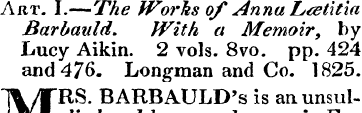
Art . I . —The Works of Anna Ltetitia Barbauld . With a Memoir , by Lucy Aikin . 2 vols . 8 vo . pp . 424 and 476 . Longman and Co . 1825 . MRS . BARBAULD's is an unsullied and honoured name in
English literature . She took a high rank amongst our writers the moment she appeared before the public , and from this she never descended . It was her rare felicity to excel equally in verse and prose . The republic of letters justly appreciated her talents and taste ,
and she maintained a due respect for the world and for herself , and sent forth no hasty composition , nor lent her name to any publication unworthy of her high reputation . * Her friends and admirers were wont to regret that her exhibitions as an author were like
an gel-visits , " few and far between ;" but they may now derive pleasure from the reflection that she did enough to establish a lasting- fame , and that nearly all her productions are classical . " The small bulk of the writings of
Mrs . Bai'baulu , compared with the long course of years during which she exercised the pen , is a sufficient proof that she offered to the public none but the happiest inspirations of her muse , and not even these till they had received all the polish of which she judged them susceptible . To a friend who had expressed his surprise at not . finding inserted in her volume a poem which he had admired in
(manuscript , she well and characteristically replied , 1 had rather it should be asked of twenty pieces why they are not here , than of one why it is . " —Mem . pp . lix .
lx-In the best sense of the word , Mrs Barbauld is & popular writer . She is not known to all readers , but she is unknown to none that have any pretensions to taste and refinement . Her beautiful and unequalled " Hymns in prose for Children" are in use in almost every establishment for early education that is conducted upon true moral and religious principles ; some of her minor poems are to be found in most collections for youth ; and * Perhaps y one exception may be made to tliis statement .
Untitled Article
several of her devotional pieces are inserted in all the Selections of Psalms and Hymns which are used by the congregations of liberal Dissenters . With a sound and vigorous understanding " , Mrs . Barbauld united an exquisite perception of the right and true in character and conduct , a richly
cultivated mind , and a playful but chaste imagination . She had formed herself as a writer upon a pure En . g-lish model . She was not ashamed to admire Addison , Pope and Dryden ; she equalled the two first in their terseness and elegance , and she sometimes reminds us of the fervid genius of the last .
Of Mrs . Barbauld , more than of almost any other writer , it may be said in praise , that her fine character appears in all her works . She is not only a moral writer—all her writings have a direct moral tendency . Her muse was consecrated to piety , and
very many are there who have been bettered while they have been delighted with her verses . What Lord Lyttleton said , with truth upon the whole , of Thomson , may be said , mutatis mutandis , with perfect truth of her , that her works contained
No line which , dying-, she could wish to blot . The " Memoir" of her aunt by Miss Aikin is a well-drawn description of her life , which ran in an even tenour . It is interesting , not so much from a succession and variety of incidents as from the impression of her
own character and genius which Mrs . Barbauld stamped upon every scene and every circle with which she was connected . The biographer with judgment and taste abstains from eulogistic epithets , though she cannot wholly check ( who could have wished her to check ?) the flowing ™ of natural
affection and friendship . We were favoured in our number for March , ( pp . 185 , 186 , ) with a sketch of Mrs . Barbauld ' s lifc , w believe from the same pen which has traced the " Memoir" before ns , to that obituary account there V 6 litl" - ' that is historical to be added . ^
Review. " Still Pleased To Praise, Yet Not Afraid To Blame."—Pore.
REVIEW . " Still pleased to praise , yet not afraid to blame . "—Pore .
Untitled Article
( 484
-
-
Citation
-
Monthly Repository (1806-1838) and Unitarian Chronicle (1832-1833), Aug. 2, 1825, page 484, in the Nineteenth-Century Serials Edition (2008; 2018) ncse.ac.uk/periodicals/mruc/issues/vm2-ncseproduct2539/page/30/
-