On this page
-
Text (1)
-
Untitled Article
Note: This text has been automatically extracted via Optical Character Recognition (OCR) software. The text has not been manually corrected and should not be relied on to be an accurate representation of the item.
-
-
Transcript
-
Note: This text has been automatically extracted via Optical Character Recognition (OCR) software. The text has not been manually corrected and should not be relied on to be an accurate representation of the item.
Additionally, when viewing full transcripts, extracted text may not be in the same order as the original document.
Untitled Article
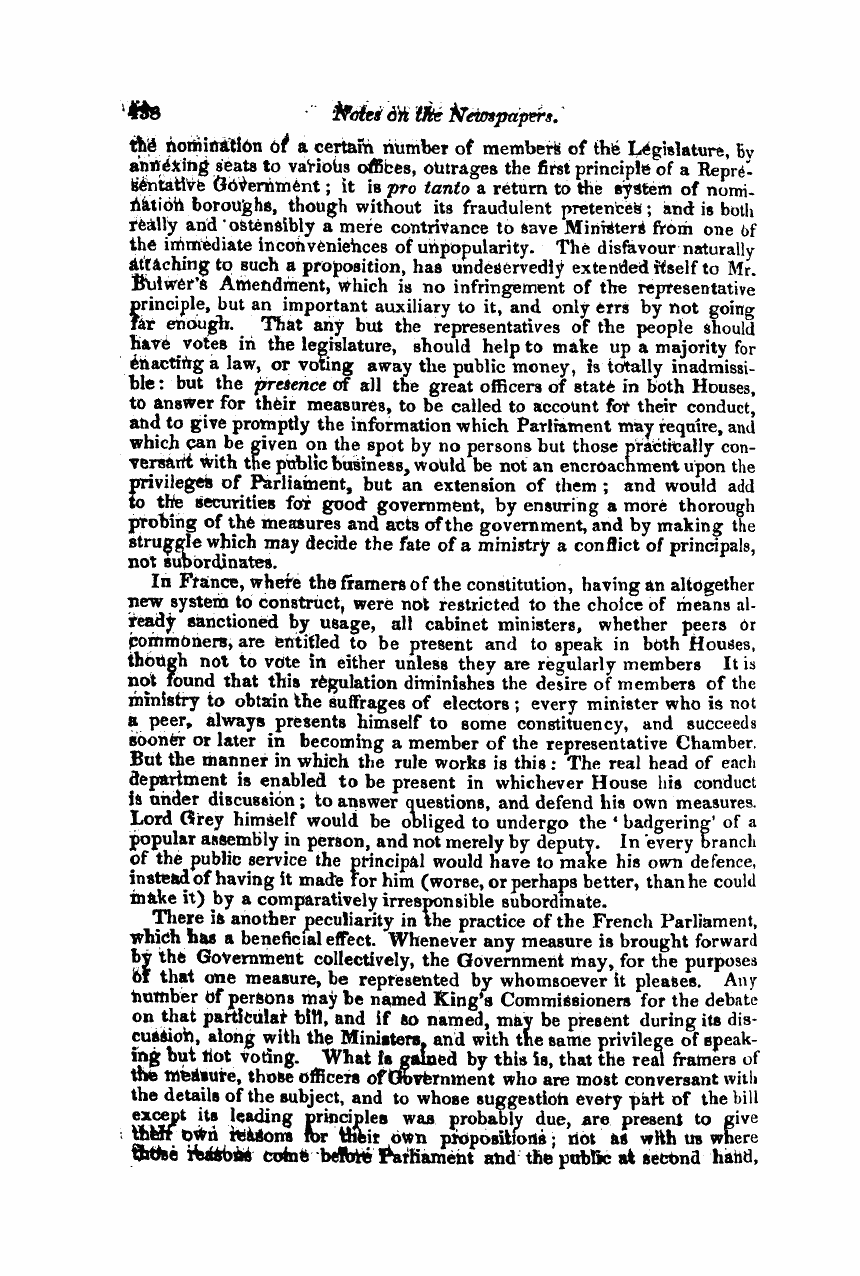
tJte noriiitfitton tt a certain ritimber of memberfc of thfe legislature , Bv atfflf&ifig s ' eats to vaVioiis offibes , outrages the first principle of a Bepre * . fcetitettve Government ; it is pro tanto a return to the system of nomi-Aitioh boroujghs , though without its fraudulent pretences ; and is both feally and' ostensibly a mere contrivance to save Minister * from one 6 f
the irnnrrediate inconveniences of unpopularity . The disfavour naturally ^ achin g to such a proposition , has undeservedly extended itself to Mr . Btilvrer ' s Amendment , which is no infringement of the representative princi p le , but an important auxiliary to it , and only errs by not going far enough . That any but the representatives of the people should Have votes in the legislature , should hel p to make up a majority for enacting a law , or voting away the public money , is totally inadmissible : but the pretence of all the great officers of state in both Houses , to answer for their measures , to be called to account fot their conduct , and to give protnptly the information which Parliament may require , and which can be given on the spot by no persons but those nratctitally con-Tersarit with the ptfolic business , would be not an encroachment upon the
privileges of Parliament , but an extension of them ; and would add to the securities fot good government , by ensuring a more thorough jtirobihg of the measures and acts of the government , and by making the struggle which may decide the fate of a ministry a conflict of principals , not subordinates . In Ffance , whefre thd framers of the constitution , having an altogether xiew system to construct , were not restricted to the choice of means alteady sanctioned by usage , all cabinet ministers , whether peers 6 r
pommoners , are entitled to be present and to speak in both Houses , ^ 8 ^ no * * ° \ * rt either unless they are regularly members It is » ot found that this regulation diminishes the desire of members of the ministry to obtain the suffrages of electors ; every minister who is not * Peer » always presents himself to some constituency , and succeeds sooner or later in becoming a member of the representative Chamber . But the manner in which the rule works is this : The real head of each
department is enabled to be present in whichever House his conduct is under discussion ; to answer questions , and defend his own measures . Lord Grey himself would be obliged to undergo the * badgering of a popular assembly in person , and not merely by deputy . In " every branch of the public service the principal would have to make his own defence , instead of having it made for him ( worse , or perhaps better , than he could infcke it ) by a comparatively irresponsible subordinate . There is another peculiarity in the practice of the French Parliament , which has a beneficial effect . Whenever any measure is brought forward by the Government collectively , the Government rhay , for the purposes of thai one measure , be represented by whomsoever it pleases . Any tmtnber of per&ons may Ibe named King ' s Commissioners for the debate on that pattitiila * blM , and if so named , may be present during its discussiori , along with the Ministers , and with the same privilege of speaking but Hot voting . What isgalned by this is , that the real frarners of thte ftfeature , thofce officers of Gbvernttient who are most conversant with the details of the subject , and to whose suggestioh every paft of the hill
J * ce pt its leading principles was probably due , are present to give «|™ fc ]*™ toarion * for tifeit 6 tm pioposilforts ; riot a * wfth tis where tfctfce iWibAii cob * bdbte ParKameht atid the public at sefcbnd hand ,
Untitled Article
WB $ Kfoi 6 ' fi We freitnpapers /
-
-
Citation
-
Monthly Repository (1806-1838) and Unitarian Chronicle (1832-1833), June 2, 1834, page 438, in the Nineteenth-Century Serials Edition (2008; 2018) ncse.ac.uk/periodicals/mruc/issues/vm2-ncseproduct2634/page/56/
-
