On this page
-
Departments (3)
-
Text (16)
-

Untitled Article
-

Untitled Article
-

Untitled Article
-

Untitled Article
-

Untitled Article
-

Untitled Article
-

Untitled Article
-
Untitled Article
-
Untitled Article
-

THE NORTHERN STAR. SATURDAY, MAY 2, 1840.
-
Untitled Article
-
Untitled Article
-

Untitled Article
-

¦¦ LEEDS AND WEST-HIDING NEWS.
-

TO READERS AND CORRESPONDENTS.
-

Untitled Article
Note: This text has been automatically extracted via Optical Character Recognition (OCR) software. The text has not been manually corrected and should not be relied on to be an accurate representation of the item.
-
-
Transcript
-
Note: This text has been automatically extracted via Optical Character Recognition (OCR) software. The text has not been manually corrected and should not be relied on to be an accurate representation of the item.
Additionally, when viewing full transcripts, extracted text may not be in the same order as the original document.
Untitled Article
BISHOP AUCKLAND ABSTWBNCE SOCD 2 TY . TO tHB EDITOR OP TH » WJKTHERH STAB . Sf rv ' V ^ PilIE 51 ) » "" lBii | y W * ° * !¦* »«*> ¦ which Inad shewnme , I found a letter signed ' " Geo . ¦^ Sf i ^ . ? appean U SeCK ^ J to the Bishop AucMs ^ T <^ Abstinence Socitty . It is in reply to a l et ** from George Binns . late of this place ; and as it Vfcches upon & topic -which I conceive to be of imps ™* at the present time , I irffl fed obliged by ttypemusflon to make * few observations on the 5 J **» on in dispute betweea George IMxon and George fctT ^ RTi ^ i ^^ A ^ Tl * U X a % y ^ v a nnMrTr «««>^^ . ___
As I am not a regular mder of the Star , I have net Been the letter of George Binns ; but forming my opinion of his probable conduct , partly from an intimate knowledge of his general chsxacter , and Also from thestatemeats made by George Dixon , I feel constrained to say that I think the latter has , on this occasiom , permitted prejudice to \ rarp his j * dgment , and to cause Mm to set in opposition , not only to Ihe cathelie principles of tbe Awkl&nd Society , but also to tbe golden rule to-which he * H « des . It is stated tbat " the meetag -was convened for the Vicar of St . Oswald ' s , Durham . " This eaanot surely
mean that it was for the Vicar ' s edification alone : if the Vicar be tot a member of the Society , nor one practising tbe principle of tafcal abstinence , the meeting "was sorely sec called for him , nor could tbe people be called together to witaess the Vicar ' s conversion . Are we , the * , to understand that the meeting was called to Aaer the Vicar "either as Chairman or as an ordinary speaker- plead 4 he cause of temperance ? If the Vicar acted in the foraier capacity , it yn& Ms duty . being the « iected servant of the meeting , not of the Committee , to hear all -who -were willing and able to support tbe cause for -which the nett-ng- was assembkd .
If the meeting , from a previous knowledge of the eharacttr of any speaier , -would not hear him , then it "would hare been tbe Chairman's duty to have intimated this to him ; but before doing so , -care should hare been taken that no injustice -was done the individual , "by prejudice being -excited against him . The circumstance of holding certain political opinions -was not to "be takes as a conclusive proof that those opinions -wrill "be advocated in defiance © f the tbjecta for -which the sneering was held . In a Society ¦ oempesed of persons of ' all opinions on Te&gkm and politics , " it is not -unfair to expect tliat € * efc VKgaber will be permitted to exercise his right of -pleading the < a « 9 e ; and if so , he -will naturally eiiongb ¦ select such illustrations as seem to him most
approprate and writing . Thus tbe friend to Dsmestk ¦ Economy "will dwell on the pecuniary and domestic advantages of temperance ; the professor of religion "will , in addition to this , -dwell on the spiritual < iegradation of the drunkard ; ie will quote such passages of scripture as may be calculated to make an impression on the hearts of those who are keenly susceptible to religious impression *^ the physician -wdli speak ¦ of tbe effects of intemperance on the physical frame ; Ijow it enervates it He will expose the ineCcacies of alcoholic liquer , as an article for nutriment , a beverage , and a medicine . ; each one will dwell not only on "tbe general advantages of temperance , but also more particularly on those parts , on which , from the peculiar uatwe of their studies and acquirements ^ they may be "best qualified to speak wish effect
The friend to domestic economy may case very little "for peculiar religious tenets ; he may be what in those times js called a good moral man—a moral philosopher . The religious advocate will consider the religious aspect < rf- the question , as transcending all the other parts in importance ; the physician may be very sound in his professional views , but lie vasj be a latitudinarian in religious pmciple ; but , nevertheless , neither . » lyect tc ^ advocate the same cause ; they are each satisfied that their own view of the question is sound , and that tfce -cause is worthy theii support on that ground alsne , and all regard it of the greatest importance "to ft * the principle introduced and practised , caring little to enquire what view of the question it was that brought each additional member into tbe fold . Now
18 thews to be no room for the politicise , " a character who , in the estimation of the working people , is a very important -one . ; who , perhaps , more than any other of the class of advocates to which I fcave alluded , possesses the confidence and esteem ef the people . I « ay nothing about the merit of his opinions , they may be sound or nnsonad , hk agitation may be useful , or it aay be pernicious ; just as the religious professors ' theologies ! © pinions may be orthodox , er heterodox , — it mattes not , tbe question is , -does he possess the -eonfiaeow « f a portion , —a large portion of the people 7 If so , it will be a pity if tbat power cannot be 3 &ade available tot some useful purpose . It can be to . Bow ? By acting an the catholic principles of the Auckland Society , espedaHy by bain * careful not to
proscribe a man and deprive him of his rights as a member , and his duty as a man , because he may be an " open and avowed advocate of tbe principles of a -ciass . " Bui lei G * or ^ e Dixoa a nd the Aockland Committee examine their own hearts and ascertain ¦ whether their prejudice is equal against all extreme politicians . ? Did George Dixon ever know -a Terj , » bigk church Tory , one who think * tbe Reform Bill t revolutionary measure , and the imprisonment tad punishment of John Thorogood a vfery t ^ it eaw act ; did ever George Dixon know the -aid of any such man rejected ? Ah . ' no . I fear if George IHxon will examine his own heart , he , will find 'fiat it if only when the opinions are on the other side , wbedi&e-syapatfcies are with the mane * thai the aid
, « f t » pdatidaa is objected to- "Let us reason to-¦ gethes . " W 6 sld ft be deemed objectioaablfc fox the Vicar of Stf Oswald ' s , or any Churchman , to say bow moch * ettee it was to we a cleanly , well-ordered family repairing to the parish church oa a Sabbath morning , t&sn to see them is filth and Tags , and the father drink in the pot-house . ' This sentiment would be ¦ eatiraskstieaUy applauded . Substitute / or Chnrch a ¦ Chartist meeting , and a general sentiment of disappro bation would be manifested , by weak-minded brethren . Why is this ? Has sot tbe Chartist tbe same rights as the Church ran ? If it were wrong in the latter to speak of his place of assembly , it cannot be m » re so for the former to talk of his . I regret to see a little of the -spirit of a sneerer exhibited in George Dixon's letter .
He s » y » " there is a wide difference between the politics of a private individual following some useful trade or professioa , and the politics of a man like George Binas . " This is unworthy * f George Dixon—this is not the spirit to reclaim a brother if erring ) , nor to imctaee bis followers to act more wisely . Wbat George Boms ' * present profession may be I do not exactly know , bat from my knowledge of George Binns ' s character , I ¦ do not believe that he will take any other than honest and honourable means of earning a livelihood . George Bum * is the son ot highly respectable parents , both deeeaaed ; they were members of the Society of Friends , and carried on an extensive drapery business in Sunderlaad ; George Binns was also a member " of the same Society until two or three years ago , when conscientiously ¦ changing kis views , he withdrew from the Society ,
publicly declaring tbe change hi * sentimeats had undergone , and withdrawing honourably from it , rather than for "fear of man ,- conceal whalhe believed to be true and hypocritically conform to what he believed to be wrong . He has hitherto borne an unexceptionable moral character , and was exceedingly useful here , and at Wakefield iwhere he some time resided ) in promoting the glorious cause of abstinence . I can affirm , with truth , that wlen George Binns ceased to take an active part in the society here , it was materially injured by the loss of his « xertioas . I understand that George Binns is now endeavouring to earn a livelihood as a NewB Agent , and giving all hi * leisure time , and the benefit of his splendid talents , in making known the sufferings and wrongs , and pleading the rights of the poor . Whether his profession be useful is a question which is satisfactorily answered by those who pay for what he sells .
When George Dixon addresses a very , young man like George Binns , be should speak as a father would to one who is fatheriets , George Oixoa sbews , that in himself he has tbe capacity and the will to say some very bitter things against those who , in many casts , ignorantly deal in liquid poison . If George Binns were to speak of the aristocjacy a * plunderers , the clergy as hypocrites , and the middle classes aa unfeeling and selfish , George Dixon would probably PTflaim , this was very intemperate language r bot how- Inconsistent and" short-« 5 « bted we sometimes are , is proved by George Dixon speaking of *• Poison vendors , who gloat on human sufferine , and woo poor their pestiferous streams on society . " Trusting that these friendly , though free observations will induce George Dixon and the Auckland Committee to bear before they condemn , and when condemning to remember their own party ,
I am thy friend , A Member of the Sunderlaxd Total ABSTI . VE . VCE SOC 1 ETT . 4 th Mo . 27 th day , 1840 .
Untitled Article
THE BOUNDARY QUESTION . [ XXTRACT OP X LETTEB FROM AS AitKEICtS " CUIZBS , DECEIVED BT THE LAST PACKET . } Out people begin to think we n » y have a war wiw Great Britain , on acoount of the Worth-eastern boundary , md I begin to have some BUHnvinn ttweif . ^^ ^ * **!? no P **» eooe wk «» I reflect on the weakness « f < mr Gevenaaent in goffering a question to be raised . *? out rt , and I have never believed the British S'Se ^ tSsK * " ^ *" ** { WmdMtam The tteaty bonndary is inconvenient to them , and ttey raiaed the question in the hope of chanriDTh bj * long negoeiation , ending in a Mmpromi 4 ; ba our Government ought to have said at once , "The »** £ » Jy P *™ , /* controversy ; if you will bay the temtory of Maine , we will Ude it toy ©? - if yon most on it as a natter of right , you must fight fer it . " Soch , I wn sore , woolfhlv e been my answer . J
But the ques&on has been entertained from Ad-¦ inistration to Administration , and the British Government have persuaded sons of their own people , and , it say be , themselves , that they really have a just ewatvieorBBigt oar territory , ~
Untitled Article
A similar game is now playing relative t » the agreement of last year , made with the view of preserving peace in » he disputed territory . By that agreement , both parties were to withdraw all troops from it ; but the state of Maine expressly reserved the power to keep np a posse there , armed or unarmed , for the purpose of preventing trespasses upon the timber , stipulating that she would not disturb New Brunswick in the possession of the Madawaska settlement , or interrupt the communication carried on through the territory between the British provinces . How Las the agreement been executed ! Maine withdrew her troops ; the British authorities didnot . There is not , ana has not been , since the prompt
withdrawal by Maine , a soldier of the "United States , or of the State of Maine , in the whole territory , while a force of British regulars has been steadily maintained there , and barracks built for the accommodation . The British minister himself admits that the troops axe there , have been once relieved , and have kad their barracks repaired . After withdrawing their troops , Maine kept up an armed posse to repress trespassers , as she had expressly reserved the right to do . This posse consisted of about fifty men . Learning that trespassers were cutting timber upon Fish River , which empties into the St . John ' s , about twenty miles above the Madawaska , the agent sent about twenty-five men
te drive them off . This they effected , and returned to their station oh the Aroostook . Learning that the trespassers had returned , the party were again sent to drive them off , and to erect a boom across Fish River . This was accomplished , and a small block-house , built at the boom to protect the party , and any other party which it might be found necessary to station there to defend the boom against the timber thieves . In the mean time that portion of the posse remaining upon the Aroostook , was attacked by about fifty armed mes , headed by one of her Majesty ' s militia captains , and but fer a blockhouse they had erected ior coaafort and seenrity , would probably have been drkeu off . if not massacred .
That the number of men employed by Maine was no greater than the emergency required , is proved by the force which actually appeared iu battle array to drive them off ; that the blockhouses were necessary fer their protection against sudden attacks is proved by the fact , that when detachments of the posse were out for the purpose of chasing off trespassers , the remainder were attacked by a superior force . Maine has not molested . the Madawaska settlement , or interfered with the communication . Not a man of her posse has be « n beyond the St . John ' s River , algiough they had a right to roam over every miie , mile of the disputed territory in quest of trespassers .
Keeping up regular troops themselves on the territory , by tbe agreement , they had no right to do , the British Government complain because Maine keeps up an armed posse , which she expressly reserved the right to do . Building or repairing barracks for their regular ta < oop 8 , unlawfully maintained , contrary to right and agreement , they complain of Maine on account « f the erection of blockhouses necessary to the comfort and protectien of the posse , which is there both by right and agreement . Not a movement of the posse has taken place which was aot notoriously for the suppression and prevenof trespasses ; yet the British Government , hiving actually taken military possession of a portion of the couatry themselves , compl ain and protest that these movements indicate a design , on the part of Maine , to take such possession . And , under this allegation , they threaten to send more troops there to enlarge the scope of their own violations , under pretences as frivolous and false as could be invented by the most unprincipled government on earth .
There seems to be a design , under pretence of this agreement and violations on our part , to make farther encroachments , to retain military possession of all the disputed territory north of the St . John ' s , and-even the valley of tnat river . If bo . it cannot suoeeed . If this game be continued , Maine will , in fact , do that -which she is bow falsely charged with doing , end she tcill be backed £ y the nation . Surely , man has never exhibited a higher degree of folly and crime than he would by precipitating these two nations into a war upon such a question ; for there never have been two nations who could do
each -ether , in many respects , more harm . But what can the United States do ! Can they suffer themselves to be insulted and bullied , charged with violating their agreements , by a nation in the flagrant act of committing the same crime , and see their territory wrested from them amidst this insult and contumely , without an effort to maintain their rights and tfaeir honour ! We shall suffer on the ocean and on the coast , in oar industry and our trade ; but we shall Boon clear
our northern frontier of a troublesome neighbour . There is a great change there on our side sine * 1813 , as the British government would seon learn . In addition to tne certain loss of Canada , Great Britain would al&o suffer in her industry and her trade , and what would she gain ! She woald gain nothing , and we should only gain what we do not want . Such would be tie result of the destruction of life , and the miseries of millions , which would be tbe effects of an insensate war between these nations .
Untitled Article
MR . O'CONNOR . In other portions of our pap er , we have inserted two accounts^—one from our own correspondent , and the other from the Morning Advertiser , of the proceedings in the Queen ' s Bench , hist Monday , in reference to Mr . O'Connor . Out readers will
perceive , that in consequence of severe illness , the judgment was postponed till next Monday , when the fiat of the Whigs is positively to go forth . We shall , of course , give a full report of the proceedings in our next . If at all able , Mr . O'Connor will , doubtless , tell a story in mitigation of punishment , which ought to make the agent of the factionsthe public prosecutor—hide his bead for shame .
Untitled Article
THE FAMILIES OF THE IMPRISONED CHARTISTS . We cannot too often or too strongly urge upon the people the imperious duty of taking care that all those families whose props have been removed from them , on account of their exertions for tbe public weal and the advance of liberty should be , as far as practicable , Becured from suffering . In some cases this may be done without much , if any , inconvenience to any body . Where , for instance , the wife of any patriot thus suffering can carry on any kind of business , it is the duty of all Chartists to deal with them and to employ them , in preference to others . They should also use every means for drawing to them the support of all who are not ttf-disposed .
Our present paper contains an appeal from Mr . R . J . Richardson on behalf of his family . We hope it will be well responded to . Few men have deserved better of the public than Mr . Richardson , and few have seen lees evidence of the publio sympathy . Tbe Secretwy to his Defence Fund , writes us , that the money received for his defence is only £ 3 10 s ^ -while Mr . Richaxdson ' s expenses have been nearly ( en times that amount .
Untitled Article
THE LAST TRICK OF THE TEMPTER . On our first page , we give in the Bhape of a letter from £ > AMEL O'Coirrau . to Messrs Warren and Nightingale , tw » working men of Manchester , as pretty a specimen of blarney" as it has been our lot to meet with for many a day . Daniel is a clever man in his way ; no man better understands , or knowB better how to practice , the whole art and mystery of cajolery . To the native shrewdness of an Irishman , he has saperadded the keen , glancing ,
penetration of a lawyer , and the wily , oily , smoothness —the external speciouBnesa—of a cold-blooded , calculating , and dissembling politician , in a more eminent degree than most other men . Hence is he well fitted for the sustentation of Whig power and influence ; eminently calculated to do the work of those who , in the meanness of their souls , prefer to seek and to support ascendancy by that " shabby " fraud which promises safety as an accompaniment for contempt , rather than by that bold-fronted villany , which , carrying its title on its brow , might startle its doomed victims at the first glance and put them on their guard against its advances . From the successful sally of the Devil against man in Paradise to the last " move" of his most
Untitled Article
faithful follower and representative in Ireland , the great maxim of the vicious , Becking tofcubduethe virtuous , has been to spare their own resources by practising delusion on their victims , ' and so causing them to operate their own enthralment . This is the great secret of O'Connell ' s popularity in Ireland . The smooth-tongued , arch deceiver , well-schooled in the maneuvers of his far-famed sable prototype , has practised constantly the first lesson of his master . . ¦
As the Devil improved to his advantage the supposed privation and imaginary wrong which fretted the primeval pair , and , by offering them a remedy , purchased their help to the accomplishment of his design , so Daniel has , for years , made merchandise of the many great and real grievances of Ireland . He described , dilated on , and affected to deplore the evils of his country , till the simple-hearted people believed him .
He blamied them for all the ills they bore , And they " loVd him that he did pity them . " Hence , as the calculating demon knew , the transition to confidence was most easy . He pointed out a thousand schemes whereby the evils of misgovernment should be corrected , and " Justice" secured to Ireland . They followed unsuspectingly his wake , and each was carried to the calculated point ; that
is to say , just so far as it might serve the interests of Daniel , and then some obstacle , no matter whether long expected or nnlooked for , prevented its completion : i t was thrown aside , and Daniel mounted some new hobby-horse , caparisoned with " Justice , " but strongly bitted , while the gaping crowd , st ill following , halloo " Justice and O'Con-NELL ' . "
Thus has this political limb of Satan cajoled the Irish through his whole career ; thus does he still cajole a large portion of his most short-sighted countrymen , who cannot , even by experience , learn as each successive hobby is dismounted and turned out tognasj that the wily rider feaa so "managed " him , that all his prancing , kicking , and curvetting served but to blind their eyes with dust , and while it still kept Daniel in the saddle , strode not a Bingle inch towards the panacea for their wrongs—the " Justice for Ireland , " which should eaHse her sons and daughters to throw off the chains and appendages of slavery .
The arch hypocrite has made several unsuccessful efforts to play the same game here ; but experience has made us wise . He has hitherto been unsuccessful , and will now be so ; though this last effort we allow to be a " clever" piece of cunning knavery . Barefaced falsehood and unmasked tyranny are , in themselves , so ugly and forbidding tbat they seldom show their visages . It is only when enveloped by the stolen garb of truth , and covered by the mask of liberty , th » t they dare sally forth up « n their
plundering expeditions . The robe of truth , however , fits ill the recreant limbs of an impostor , be he never so we ll practised . The keen-eyed observations of the English people soon discovered divers rents through which the vile carcase was made manifest , despite its noble covering ; and , hence , though they are ready to admit the truth and justice and propriety of all O'Connell ' s wailings for the factory babes , and all his Iamentati 6 ns for the unenfranchised " slave class , " his THOUSAND POUNDS' sale of factory children will render valueless his present " slave-class" stock-in-trade .
The English art far less tame-spirited than the Irish . O'Connkll may play with Repeal" in Ireland—he may sell and re-Bell it a hundred times , and even leave it as a valuable inheritance to his heir ; but he will not do so with the " slave-class" in England . They have been once bitten—once betrayed by him ; they have had one Thousand Pounds' worth of bis patriotism , and they like not the bargain half well enough to think of purchasing again at the same market .
But even if the caitiff ' s character had been unknown , there i 5 enough of spacious sothingness and evident deceptive , emoothe-totagued villany , even in this document , to put tbe aen , of England on their guard against its author and las coadjutors . Our poli tical constitution" has beeft so long , so . folly , and so closely analized , studied , and iavsetigated by the w slave-class" of England , that its diseases are well known to them . They are fiuniliar , Hot only with the functionary symptoms , but with the grand organic seat of all its maladies . They know the
remedy , and he must be a quack , more clever than O'CoNNEix , who 'da persuade them to take any other than the proper one . As a patient , conscious of disease , never contradicts a right description of his symptoms , the " slave-class" of England perfectly admit the justice of O'Connell ' s statement , " That there are great Bufferings and many privations endured by the British operative classes ; great toil for insufficient wages ; great industry and great intelligence , without adequate employment or remuneration ; the pressure of burthens , heavy to all , but
crushing to ruin the humbler and poorer classes ; that these and multitudinous other evils are suffered and becoming permanent , in a manner too plain to admit of oontradiction , and too manifest to be denied , even by the most audacious of the masterclass . " They admit , too , because they know and feel it , that " the great source of all the mischief , the degradation , the oppression of the intelligent and active British operatives , consists in the defects of our political institutions . " They know that u the operatives belong to a slave-class ; that they are totally
unrepresented ; that they have no votes—no choice of , or controul over , the framers of our laws—the men to whom is committed the care of ameliorating our institutions , and who , being uninfluenced by the operative classes , are quite at liberty to oonsult the sinister interests of the master-class , who have votes , and by whom they are elected . " They are perfectly aware that" tbe master-class impose the taxes , and participate largely in what may well be called public plunder ; that the slave-class are the principal producers of wealth , and consumers of taxed articles ,
and that the slave-class , therefore , pay , either directly or indirectly , the far greater part of tbe taxes . " They are " thoroughly convinced that all tbe political evils that afflict this country flow from the want of aa adequate representation in ihe House of -Commons , from that House not being the organ of public sentiment . " They know aU these things as well as the most artful and the most eloquent of
Mr . O'Connell ' s statements can cause them to know them . They feel where the shoe pinches , and they know , also , that the * nly efficient remedy is to enlarge it just where , and so much , as it is too little . However much , therefore , they may applaud the sagacity of Mr . O * Connell , in having found out their political disease , we greatly question if the " Blave-class" of England will much admire the remedy he recommends .
He magniloquises on the " reproach , " tbe "disgrace "—the " cruel mockery "—the " unbearable insult to the common sense of the English people , " that four-fifths of them should be a slave-class " M iniquitously deprived of all right—all power—all representation ! " H « calls upon the " slave-class" to " arise" and "fling them from their fetters "—to " stand up as men " " entitled and determined to be free V And how are they to achieve their freedom ! How are they to get rid of these fetters which they are to fling from them ? By extending the right of voting to the four-fifths who are now excluded from
it ? 0 no ; any effort to obtain this he deems " worse than idle " !! u All that need be said about the w franchise is , that the f « anchisb must extend *• to ths Operatives as well as the Middle Class . " And he implores them to combine to work out this prindpk" !! ! What " principle" ! Does he suppose that the plain men of Yorkshire and Lancashire are such dolts , that they can be mystified so easily \\ What " principle " is developed ia thie famous panacea for tbe evils endured by the working class ! The " principle " of saying nothing about the franchise , save that it must " extend to the operatives as well as the middle-class !"
Untitled Article
Why , is the man a fool , or does he think those to whom he writes to be fools ! Does he not see , or does he suppose them incapable of seeing , that this would be to say nothing about the franchise at all ; because if this were said , and if tniB were all that was said upon the subject , the answer would at once be , " . the franchise does extend to the operatives as well as to the middle class ; for many operatives in large towns pay £ 10 rent , and therefore can now vote '' ¦ ... - ¦ . '¦¦¦ ¦
To what purpose , then , does Mr . O'Connwj . deplore the " slavers" of four-fifths of the British population , through their exclusion from the franchise , if they are to say nothing about the franchise , and if to obtain it " would be worse than idle to attempt ? " Why ajl his patriotic bluster about "flinging off fetters "— " standing up like men "and "determined to be free ! " How contemptible is this blarney when contemplated in the light of truth 1
What , then , is the object of O'Connell in this specious and Jesuitical address ! A slight attention to another portion of his letter , coupled with a knowledge of his character and circumstances , will soon decide that point . O'Connell is a tool in the hands of the Whig division of the master-class , or rather , perhaps , he is an ally of that section of •* public plunderers , " they working for him , and he for them alternately . The Reform Bill , which was carried by the last popular delusion that ever was , or can be practised in this country , was intended by the Whigs to rivet them to place , to power , and
emolument ; they discover in its workings that their calculation was erroneous , and they are anxious to to amend the reckoning ; O'Connell admits that "the Reform Act has proved a total failure ;" they think that if the ten-pounders were invested with the ballot , they would be able to fence better with the Tories than they now can ; the major portion of them being cotton lords or money lords , find the Corn Laws a bore to their individual interests , and are anxious , therefore , to have them repealed : they know that without the
working classes , they are as powerless as they are worthless ; O'Connell admits that" without the assistance of the operative classes all hope of further Reform must be abandoned ; " and , therefore , as a true Whig , O'Connell tries to persuade the operative classes , through the medium of Messrs . Warren and Nightingale , to join him and their Whig friends in a crusade for the Ballot , the Repeal of the Corn Laws , and as great an extension of the Sufrageasis practicable ! which will , of course , prove to be just no extension at all .
Well-schooled as Daniel is , we advise him to school himself yet better before he again attempts to cheat and betray the English , They will watch him too closely . O'Connell policy will thrive badly on British soil . O'Connell is not alone in this emulation of his Satanic father . We last week intimated that a portion of the " Repeal" crew were seeking to lead the people on a wild-goose chase after an " extension" of the Suffrage—yoking them , at the same time , to the " Repeal" car , that they might drag it to its gaol . We alluded to a movement of this clique in Leicester—seeking to ally the people to their falling fortunes ; since then preparations have been
made for similar movements in several places , but we know the spirit of the people too well to believe that any one of them will be successful . They will not be again humbugged . The " four-fifths "—the " Blave-class "—tracing their evils to the lack of representation , will insist on the removal of the cause , as the only remedy for their political disease ; they will teach Mr . O'Connell and his whole crew of money-mongering coadjutors and adherents , that it is " practicable" to extend the Suffrage to the whole " slave-class , " and that this is the only measure of " practicability" to which they will pay attention . Universal Suffrage , and no less , will enable the members of the " slave-class" to " fling off their fetters , " and " stand up like men . "
Untitled Article
think of a Bill to compel the Hindoos to erect Christian temples , for the purpose of destroying the religion of Hindostan t—or to make the Jews build houses hi which Judaism should be denounced as the high road to damnation ! Yet this is what will be done , if the publio money be voted for the extension of Church accommodation . Dissenters and Catholics , Jews , Turks , Infidels , and Heretics , will be compelled to pay , and the edifices which their money has contributed to raise will echo and re-echo with denunciations against them .
But this must not be . Those who want the Church to be at the top of the tree must pay for it . Let the people be true to themselves : let them determine that their civil and religious liberties shall be respected , and to this end let them resolve themselves to respect them . Above all , let them never rest till they obtain a Parliament which really cares for their interests ; which being elected equally by all , shall legislate equally for all .
Untitled Article
EQUALIZATION OF PROPERTY . Truth is said to lie at the bottom of a well , and might probably sometimes be seen , were not the waters above her so continually thickened and nturfdied by interest , prejudice , and calumny . The principles of a party , however based on justice ; will inevitably be misrepresented by their adversaries , who having , it may be , not a shadow of verity on their own side , seekto blacken and abuse every proposition advanced by the other . Perhaps no more vile falsehood was ever invented than that laid to the charge of the Chartists , asserting that they require a spoliation and division of property . The hireling
press has denounced us for this assnmed doctrine in the most barefaced manner ; even Judges have been found to lay it down aa the most prominent of our tenets . Thus it was with the Agrarian laws , or laws respecting land , at ancieat Borne ; The nobility thea raised a erf against the . innovators and spoliators , as they termed them ; and in these modern times many believe that the Agrarian laws were for the purpose of taking all tbe estates of the wealthy , and dividing them in equal shares among the people . There never was a greater fallacy , as a word of explanation will point out . The vast acquisitions made by
the Romans werd either formed into extensive national lots ( as public property ) , or divided into small lots among the poorer classes . The profits of these large domains were monopolised by the Patricians , who rented them from the state ; the smaller lots were assigned to the Plebeians , subject to a tax called tribute , but not to rent . An Agrarian law was a proposal to make an assignment of portions of the public lands to the people , and to limit the quantity of nationa l land that should be fanned by any particular Patrician . There could be no injustice in this , as the property of the land was absolutely fixed in the state .
The lands held by the Patricians being of great extent , were principally used for pasturage ; the smaller lots assigned to the Plebeians , were , of necessity , devoted to agriculture . Hence arose the , first cause of hostility between the two orders . Thus it is with the people of Great Britain at the present day . They desire the lands , which are held in trust for the good of the State , to be so applied and cultivated , as to produce the greatest amount of good to the greatest number . They do not desire to take an acre from the rightful owner . No , no ! They have too much respect for the sacred rights of
property : they do not wish its destruction ; and hence it is they desire those beneficial changes which may restore the whole of the landed interest throughout thecountry to its proper and most prosperous condition . They respect the property of the rich , and oulyaskin return some respect for the property oi the poor , which Is , labour . They desire to live , but cannot do so wider the present system ; they naturally exclaim against the mode of leasing , which prevents the hjnd from b ^ ing cultivated to its ntmost , precludes many from the enjoyment of its
fruits , who otherwise could easily and properly obtain them , and even diminishes the rental of the landlord . They justly ^ urmnr , when they see vast tracts of country devoted to pasturage , which not only dispenses with their labour , but produces scarcity and dearness in the necessaries of existence They merely ask for the old mode of dividing and leasing lands in small portions , so that the same measure , which now supports one , nay support hundreds ; they only desire that property may be directed to its most beneficial mse , both as regards the landlord and the tenant .
That labour is the foundation of all property is acknowledged by every one ; and that it should be respected , and recompensed , and regarded as more valuable than vast estates , follows as a natural consequence . Honest John Locke supports us by his authority , and has plainly proved , in his " Treatise upon Government , " that the labourer is entitled to his hire—namely , a portion of the fruits of the earth , which are produced by his exertions .
We have thought it necessary to make these remarks , in order to dispel , in some measure , the lying absurdities which have been propagated against us . We trust that before long the people will be in a condition to convert this noble theory into beneficial practice ; for most assuredly , when the laws are made by Universal Suffrage , as ere long they mnst be , though no one will be robbed of the property which he has now acquired , means will be
taken to prevent the future acquisition and accumulation , in individual hands , of large heaps of wealth and property by the oppression and starvation of the people . The " clauses" know this , and hence the bitterness of their animosity against the people , whom they perceive to be rising to their due station in society ; hence their anxiety to put down the Charter agitation ; and hence the lying absurdities about equalizing property which they have so industriously propagated ,
Untitled Article
THE PUNfSHMENT OF DEATH . It baa been justly remarked , that with all our pretensions to civilization . and to the possession of fine sympathies and Christian principles , we have by far the most sanguinary and inhuman penal code of any nation calling itself Christian . We are glad to find that this subject is to be brought under th * notice of Parliament ; leave having been granted for the introduction of a Bill for the Abolition of the Punishment of Death , in all cases except murder . We think the measure does not go far enough . If man be not deterred from shedding his brother ' s blood by other motives , the utmost certainty that the
gallows would follow a conviction will fail as a preventive measure . The villain who makes up his mind , from almost any cause , to deprive his fellow of life , is generally reckless in reference to his own ; or , if not , he reasons that the evidence stay be inconclusive—the crime may be coupled with a doubt as to the identity of the murderer—or a thousand things may cause hesitation in the minds of the Jury—and , under all these circumstances , he calculates on an acquittal as almost certain . He . at all events , gains his immediate purpose ; its consequences may be , as he wishes them ; under any possible view of the case , they axe contingent , and come the worst that
can come , < * It ie but death that comes at last . " Such is tho fallacious reasoning , when the manslayer reasons at all , by which he deadens his moral sensibilities ; and we therefore think that the punishment of death , if it be proper to be dispensed with in all other cases , ought also to be dispensed with in this . Some other punishment might be substituted , which , while it marked the strong sense of morat detestation in which the crime is held , would also be of a remedial and corrective nature . We are glad that the subject of our minimum bloody , and anti-Christian penal laws is to be brought under the notice of the legislature not because we are such fools to expect any good
Untitled Article
from that quarter , but because we conceive that it will be the means of calling public attention to a rtbject not suficieotly understood ^ and which has it * && share in tbe' ptodnction of national demoralisatkdi and a fearfol catalogue of crimes . We cheerfully admit that lately some most beneficial changes have been niad > , in some points , in connection with our criminal and penal jurisprudence Still we are far behind the nations of the Continent , and it in high time that the inefficiency of the exiting institutions should be pointed out , and jpve pllte to a more sound and healthy state of things . The legitimate end , of all punishment is taken td be the
repression of crime , and the correction of the of . fender . This , we think , will not be disputed . U an early and semi-barbareus state of society , it a » y be necessary in some , perhaps in many , eases to divide those objects , and to sacrifice the latter for the attainment of the former . The correction of an individual , it must be confessed , is a matter of minor importance when put in comparison with the repression of crimes by which the very foundations of social order are liable to be broken np ; and if some are so vicious that nothing leas than the greatest possible human evil , the deprivation of life , will se * cure , against their lawless violence , the rights , or even the very lives of their fellow citizens , then lift must be taken ; their blood is upon their own heads , and ihe community is guiltless both before God and
man . ¦ - . . ¦ . , r But the case is widely different when society be- ( comes more advanced—when even the most abao- I f doned has something for wnich he wishes to live , ' ¥ and from which he dreads a separation . Then , a I milder spirit should begin to pervade the laws ; and ' rthe daring criminal should be made to ftel that i perseverance'in % vicious career will entail upon ;; him a punishment worse than death . He should v | know—not that he m ^ f , but ttat he musi-whe * . J * such a crime asunder is once brought home to him , 4 bewAaffrromsJlliiat rende ^ Biife . desirable ; notb t
y sudden suspension of th ^ or gans of life , but by » \ H living death—» continued consciousness of misery r -a state of mental anguish and suffering , i * ' . * which no friendrr eye shall soothe his loneliness ; V \ no kind hand minister to his wants ]; and from 4 which he can have no chance—not even the > possibility—of an escape while life endures , ex- N cept through the gate of sincere repentance and f long-tried amendment . J&rit this door of hope should never be closed against even the most wicked and incorrigible . This star of promise should never be hidden from his view . '
For the prevention of crime , let it be certain thai its , detection must consign the-delinquent to along and severe exclusion from friends , associates , relatives , and home . Let his labour be toilsome ; and let a portion of it be devoted to the comfort of those whom be haa injured . Let his food , keV homely , but not-scanty or inhutricious , like oui present most wretched prison diet . Let him feel a 4 every turn his outcast and deplorable conditioai But here let the punishment , as it relates to tbt > repression of crime , terminate . Let not despair b # the inmate of his cell ; let not hopeless endurance
be the companion of bis solitude . Let it , on the contrary , be remembered that he is still * link i » the social chain—that he may still become a usefiil member of society ; and , if we really desire to be considered a Christian nation , let it be recognised , even in our penal code , that he is an immortal being , to whom while God imparts that freedom by which the evil may be rejected , and the good chosen , it is our duty to place ; him . at the greatest possible distance from aU the motives , incentives , and temptations to evil , and at the same time to bring within to
hi » reach , and encourage ^ him use , all that may foster the Iea 3 t desire of a return to the paths of rectitude , and the possession of all that is really and truly good . For this purpose , every convicted criminal should be placed under a wise and well- ' regulated system of moral | r 4 ining , and as he ad- * vances he should be } edj t £ &i that he is risiig ia \ the scale of exiatence ^ -that his crimes had reduced him from a man to a beast ; so would he feel a well founded assuranoe that his abandonment of then would issue in his restoration to the standard of * man . ' " ; ' ¦ f " ' . ¦ , . -:: ¦¦
Untitled Article
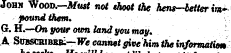
John Wood . —Must not shoot the hew-betler impound them . G . H . —On your own land you may . A ScbsCbibmu— We cantut give him the information he seek * . Me will be most likely , to get it fnm the Belgian Consul , at Hull . Anacreon . —We shall be glad to receive his promised contribution of Chartism from the poet . Of course tee shall use our own judgment in theorder of insertion ; but we cannot have too much valuable matter . Farrow , Boston . —Paid £ 1 too much . Y . T . —iVo .
Thb 6 s . noticed for the General Defence Fund , from Warrington , teas sent by the Cordwaiiien Society . The Correspondence of the London Committee for procuring the pardon of Frost , Will iams , ant Jones came too late for this week : it shall appear next week . The Address op thb Edinburgh Chartists next week .
MRS . FROST AND OTHERS . ; . ... ¦ ¦¦ ¦ . s , 4 . From Dunfermltne , per Dr . Ireland If The District . Sub-Association of the Operative Boot and Shoemakers , Gorbals , Glasgow , perJ . Crosbies ... 2 6 FromDwIley W < riSmtih \ CWknham 2 $ From the Working Men ' s Association , Northampton .., ... ... ... 2 6 From the Working Men ' s Association , . Plymouth ... ... ... i # y 2 6 Ulverstone , per J ^ Worthington ... 9 From the Edinburgh Charter Association ....... . . £ ... " .,, ' v 5 f
FROST'S DEFENCE FUND . ¦ t . s . d . From rork , per Ti T * P . ... " ... 5 6 GENERAL DEFJENCE FUND . ¦ - ¦ ¦ ' ¦¦ ¦ ¦ : ¦ ... . ¦ ¦ ¦ . - .- 8 . O \ Pr « mYork , perT . T . P . ...... 5 0 From Edinburgh , collected by JtDuncan ... ... ... ... ... « t
ViNCENT'S , PEFiENiCE , FUND . s . d . From Edinburgh , collected by J . Duncan ... ... ... ... ... i g Mr . Shackleton will perceive that we have inserted iheparagraph concerning theCo-operativeSociety Thenotice respecting the Easter Afonday meeting tcould \ we think , be of but little interest to our readers now . <
Untitled Article
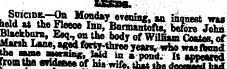
IESSC . ¦ ¦ ¦ : - ¦¦¦ u S ^^^ SrSP M <» day evening , an inquest waj Blackburn , Esq-onthe body ofwSamCMrtetof $ ? tl £ D ! £ ^ i * £ P ? t **» & *» iaSmS ^ s ¥ ^^^^ ^ ssf& oeen in a deeposdins way to aome time , tiuran ¦*•»; ** ° >*»• any suspicion that h ? WouldSy violent hands oa himself ; * h « wenTUTbeHfc ten !^ £ lW % -MsK- ^^ te 5 h-SlS on Monday Bwrmng , at aoon after four , she fomS >» a ** K » m out , having locked the door and thwwn li * iWWS ; * ma fwa * > b ^ deB eribed , at six o ' clock , by a man who mnmw t » « m > at the of
a Jr ^ Wd side the pond , * wWc ? there was not more than four fret oTwaW lit Jory returned a verdict of " Found drowned . " ^ . IbumaoMKr ^ K Friday week , a man named * fr *? Sfcapkgley , . "as fined £ » and cost * , on the information of Messrs . James andChadTte having embenkd woollen materials in his posses sion . The same officers hare since been emabled to aeize an extraordinary large quantity of similar materials , in the hands of four or five other persons , whose cases stand over for farther hearing . Their efforts to put a stop to a ruinous and disgraceful practice , deserve the thanks of the manufacturing community , for it is not too much to say , that they have bee > i enabled to strike such a blow at the system as wfll for ever prevent its being carried to the extent to which it has for some years prevailed .
The Northern Star. Saturday, May 2, 1840.
THE NORTHERN STAR . SATURDAY , MAY 2 , 1840 .
Untitled Article
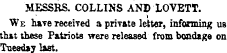
MESSRS . COLLINS AND LOVETT . We have received a private letter , informing us that these Patriots were released from bondage on Tuesday last . _
Untitled Article
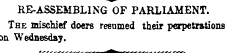
RE-ASSEMBLING OF PARLIAMENT . Tbe mischief doers resumed their perpetrations on Wednesday .
Untitled Article
GRANT FOR THE BUILDING OF NEW CHURCHES . The greedy cormorants who fatten upon publio plunder , not content with the spoil already in their possession , are endeavouring to get another slice from the people ' s loaf , under the pretence of providing for the supply of their spiritual wants . The Right Reverend the Bishops , and all the true sons of old Mother Church , have discovered that the only and all-sufficient cure for every disorder in the nation , is to be found in the extension of Church accommodation ; and , consequently , intend to call upon the pious representatives of bricks and mortar for a grant of the public money , to aid in this new scheme of national improvement .
To say that we are surprised at this unblushing attempt at swindling , would not be true ; for we know the blind and bloated aristocracy , and the middle class moneymongere , too well to be surprised at any act which it may please them to perpetrate . But we shall be surprised if the people allow this precious purpose to succeed . ¦ Just let us look at the position which the Established Church holds , and basholden for three centuries ; and let us ask what are her claims , thus , time after time , to put her hand into the public purse and appropriate huge sums of the people ' s money to her own purposes , without their consent or controuL
At the time of the Reformation , the land was covered with the temples which Catholic liberality and munificence had reared for supplying the religious wants of the population . At that time , many of them were levelled to the ground , as was the case in London , where two churches , a chapel , and a cloister , besides three episcopal houses and a charnelhouse , were demolished to make way for the erection of the palace of the Lord Protector Somerset . Others had the lead removed from the
roofs , aad were then left to ruin and decay , as was the case with Kirkstall and other abbeys . York , which once boasted of thirty-two churches , has , under the care of its Protestant masters , only twentyfour , and one of the most beautiful of them was nearly doomed to destruction a few years since to make room for a new market , and was , we are informed , only preserved on account of its exquisite beauty . The same system was pursued in all parts of England .
To supply the spiritual warita of "the population , the Dissenters , amid persecution and despotism of no ordinary kind , filled the country with their various meeting houses , and became at last so powerful as to be able to put the muzzle on the rampant establishment , and the Act of Toleration was extorted by the voice of publio opinion , which could no longer be either withstood or despised . ,
We heard not a word about an increase of church accommodation , while the penal code was in full and blessed operation . But when the people have got so far out of the dutches of religious bigotry and tyranny as to have the legal right to worship God according to the dictates of their own consciences , and when those consciences lead them to the chapel in preference to the church , then , it is discovered that more church room is wanted , ( the existing church * not being half full ) , and the Dissenters , who have to build their own chapels and support their own ministers , are to be further taxed for the purpose of aiding their opponents to empty their chapels , and revive the penal laws as effectually and as speedily as possible .
Now we have no objection to as much church room being provided as Churchmen think necessary ; but we do protest against any grant of public money for any such purpose . The Chnrch has already more wealth than any other Church in Christendom Let some of that wealth be appropriated to the erection of new churches . But as the effect of these new churches is intended to be the overthrow of the Dissenters , we say that it is -too bad" to ask them to furnish the arms by which their own house is to . be battered down . What would any body
¦¦ Leeds And West-Hiding News.
¦¦ LEEDS AND WEST-HIDING NEWS .
To Readers And Correspondents.
TO READERS AND CORRESPONDENTS .
Untitled Article
4 THB N 0 RTHERN STAR . ' r ^ kr : ^^^ _ . ¦ . - . ¦ ¦• ' ' . ( " ™^ " ^^^ - ; ' - ' ¦ ¦
-
-
Citation
-
Northern Star (1837-1852), May 2, 1840, page 4, in the Nineteenth-Century Serials Edition (2008; 2018) ncse.ac.uk/periodicals/ns/issues/king-y1kbzq92ze2682/page/4/
-