
On this page
-
Departments (1)
-
Text (10)
-

ft«« 16, 1850. THE NORTHERN STAR. ' , «
-

MONIES RECEIVED For ?iie Week Exdixg Thu...
-

A SjEJERJSXEXDEJfTOF PoiiCBIIAS -iBSCOSB...
-
![MINSTER LOVEL. YT The £°]! owing petitio...](/static/media/periodicals/101-NS2-1850-02-16-PG001-SINGLE/Ar00506S_g0MdXqA.png)
MINSTER LOVEL. YT The £°]! owing petitio...
-
TO THE MEMBERS OP THE LATE METROPOLITAN ...
-

Tiik Army.—It is suggested that the redu...
-

DEPUTATION TO LORD JOHN RUSSELL ON THE P...
-

$oKc$,
-

"WORSHIP- STREET.—Extraordinary. Applica...
-

Austrian Impudence.—Tho Vienna • paper, ...
Note: This text has been automatically extracted via Optical Character Recognition (OCR) software. The text has not been manually corrected and should not be relied on to be an accurate representation of the item.
-
-
Transcript
-
Note: This text has been automatically extracted via Optical Character Recognition (OCR) software. The text has not been manually corrected and should not be relied on to be an accurate representation of the item.
Additionally, when viewing full transcripts, extracted text may not be in the same order as the original document.
Parliamentary Review. Work Has Been Alre...
unstained the opinion we have alread y expressed as to the timidity of ihe Government , and their fear of grappling with episcopal domination in that Commission . Ostensibl y , the new Estates Commission is to consist of three Commissioners--two paid , and one unpaid—butoneofthepaid Commissioners is to be appointed by the Archbishop of Canterbury the unpaid member ofthe Board will no doubt he selected from the superior ranks of Churchmen , and thus the single lay Commissioner will be completely swamped by the influence of the Bishops .
Apropos of this matter , considerable excitement prevailed in the Lower House , hy the proposal to appoint a committee for the purpose * of examining into the truth of Mr Honsmx ' s charge against Lord J . Rtjssem , and Sir George Gkey , of wilful and delink rate deception . That inveterate meddler and busybody , Mr . Roebuck— who has constituted himself censor of his fellow members , and guardian of the character of the Ministry and who never seems so happy as when he is either in hot water himself , or getting some body else into it—brought Mr . Hqrsmak ' s
letter formall y before the House . 3 Ir . Bons-MA 5 J declared , that he was read y to justif y his charges before a committee , and gave notice accordingl y , On the following evening , however , before the motion was put , Lord Ashley , the successor of Mr . Eoebdck , in the representation of Bath , played the part of peacemaker , in contradistinction ' to the quarrelsomeness of his predecessor . He struck in as amicus curia ; , and prevailed upon both parties to make mutual concessions and explanations , by which the affair terminated without the appointment of a committee . That Mr . Hoesmax was essentiallv correct in his
allegations , and perfectlyjustified in making them , we think no one who has paid the sli g htest attention to the case can doubt . Ministers must have been conscious that it was so , or they would not have allowed so grave and serious an imputation against their honour and integrity to drop in the manner it did ; they prudently acted upon the old maxim in such cases , " The least said is soonest mended . " The " honourable member for Sheffield , " also contrived to achieve " a bad eminence "
in the case of the Ceylon inquiry . The independent members of the committee , whom it was proposed to re-appoint almost without exception , declared that from the course pursued by the Government , they were hopeless of obtaining either an impartial investigation of the charges against Lord Toiuiixgtox , or a just verdict on the case . Government , b y a succession of base intri gues and subterfuges , were evidently determined to carry a foregone conclusion , and to whitewash their guilty officer and relative . Mr . Roebuck thereupon started up , and , after making an attack upon thememherswhohadthus expressed themselves , gave utterance to sentiments , with reference to Colonial Government , which are sufficient to
destroy for ever any reputation he may have heretofore possessed for liberality of opinion . According to him , the will of Lord Tobrixgtox was quite good enough law for the people of Ceylon ; and the people who complained of the arbitrary , cruel , and lawless manner iu which property had been confiscated , and lives taken , were mere paltry , pitiful popularityhunters . Mr . Hume , with great justice and honest warmth , declared that he had never heard , in that House , a speech more tyrannical . The people of Sheffield will do well to watch the course of their wasp ish and unstable representative , who seems to be a sort of Parliamentary 3 ralay , and , in his frenzy for fig hting , " runs a-mucir , and tilts at all he meets ''
A vain attempt to disclose the iniquitous system by which Government officials pack Irish j uries , and poison tlie fountain of justice at its source , in that unhappy country—has been made b y Mr . Sadleik . His detail of the manner in which the Grown Solicitor proceeded to protect the Government , through Major CAJisnos , against the claim of a person for damages done to his property , reflected the utmost discredit npon that official and his employers . Mr . Hatchell—the new Irish Solicitor-General—made his maiden speech in defence of the injustice . He has the reputation of being a clever man , but anything more
wretched m the shape of a speech we never heard in our lives . Perhaps the consciousness that his case was indefensible , helped to coafose JJim . A more blundering , roundabout oration was never blurted out—and , after all , the explanation essentiall y " substantiated Mr . S-ADLEHfs allegations . It is no wonder the Irish people have so little respect for the law , when they see how partiall y it is administered . To "the event of the Session we have full y adverted iu a separate article . The policy of the Miaistry , with respect to the Colonies , will constitute a prominent feature , and occupy a large portion of the time of Parliament . Other topics we must leave till next week .
Ft«« 16, 1850. The Northern Star. ' , «
ft «« 16 , 1850 . THE NORTHERN STAR . ' , «
Monies Received For ?Iie Week Exdixg Thu...
MONIES RECEIVED For ? iie Week Exdixg Thursday , Fedeuakt 14 , 1650 . FOB COSTS OF MACNAMARA ' S ACTIONReceived by W . Ri » eb James Lowe , Sheffield , Is . '> Irvine , Scotland , per J . Youll , It , ; Four Bricklayers , Lon don , 4 s . ; Chorley , per H . Xorris , 4 s . 5 tL ; J . 1 J . jlasscy Longskht , near Manchester , Is . ; S . Sheldon , Longsight , near Manchester . Is . ; X . Goacli , Longsisht , near Manchester , Cd . : S . Meadowcroft , Longsi » ht , near Manchester , Cd . ; M . Bradbury , Lfngsislit , near " Manchester , Cd ., a
. Friend , Loiigsfcht , near Manchester , Cd . ; a few Il .-mdloom TVeavers , English Dam-side , Carlisle , per J . ITKenzie , 9 s . Gd . z HohnSrlh peril . Marsden , 14 s . ; Huclsnall , Torkard , per J . Sweet . 3 s . ; a f < w Readers of die Star , Jiar & Incb , per W . Melville , fis . lid . ; Halifax , Female Chartists , per Jane Walker , 5 p . J . Griffitiis , Xewtown , Montgomeryshire , 2 s . Cd . ; J . Lei : * , Ercok-street , Manchester , is . ; J . Taylor , Stow Frorost , 3 s . ; Sunderland , per W . Grin-Son , 3 s . Sd . ; J . Cook , Shincliae Collierv , 3 s . ; Miss II . Canteto , i ' rwpwt . Isle of Wight , Gd . ; J ~ Canteto , Jun ., Newport , Isle of Wight , Cd .
FOR THE AGITATION OF THE CHARTER . Received by W . IIidek . —Gainsborough Chartists , per W . Xidiolson , Gs . Sd . ; Bristol , per C . Clark , 2 s . Gd . ; M . -Dawson , Whittvorth . near Rochdale . Cd . ; J . Fielden , Wkit-^ rortli , near Rochdale , 5 d Received at Land Oefkte . — Collected at John-street , It . Is . ; Whittingtonand Cat , 9 s . OEST DUE TO THE PRINTER . Be / elvea'b yW . Hides—Glasgow , per D . Sherrington , s . Gd . DEBT DUE TO MR . NiXON . ' Received at Land Office . —J . Cook and W . Parkin-Shiaclifli CoIJierv , cd . ; Halifax . Female Chartists , jier dane Walter , 3 . « .: John Grifims . teuton . Montuomcrv . shire , 2 s . Sd . ; J . Leigh , Manchester , Is . J . Cook , ShuicIIfie Colliery , 3 d . FOR WIDOWS OF THE LATE MESSRS . WILLIAMS AND SHARP . Received hy w , Rujeb . —J . Canteto , Xewport , Isle of TOgfet , !! -.
MRS . M ' DOUALL , Received hy W . Rideb . —Brighton , Suhscribed at the ArUchf & efc-n , i = er T . llarvev , 4 s . Cd . ; Ship Inn , Binning . ham . per J . Xewrhouse , 3 s . ; jE _ Todd , West Auckland , Gel . TO EXEMPT PRISONERS FROM OAKUM PICKING . Received by w . Rideb . —Mr . Carlow , London , 4 d . ; Mr . Hams , London , 4 d . ; Mr . Lewis , London , 4 d . ; West-end Boot and Shoemakers , ineetins at the Two Chairmen , ^^ ° 5 T ' slteet ' 1 * r Messrs . Dickens and Smith , 5 s . ; E . 7 ^ « *^ Anddand , Co .- —Received by Jons Aisoxr—G . W . M . ficyEeJds , E . Mi ., uis . 3 G . W ., Cd . FOR WIVES AND FAMILIES OF VICTIMS . Received by W . Rideb . —Mr . Osborae , Leicester , 1 c . S . Gahiaman , iuniridge V . VUs , cd . ; West-end Boot aiid ' Shoemakers . meut ; ajj at the Two Cliairmen . Wardourstreet . per-Messr ? , . Barkens and Smith , 5 a . ; Cripiilecate localitv , 2 G , GtWen-lana , per Mr . Hampton 7 s .
NATfONAJ . VICTIM FUJJD . Seeeived by Jons Asxorr , Secretary . —Riskig Snn , Calieoder-jard , j « r Sir . Scatter , lis .: South Leadoh Hal ) , psr . Hr . Hoberts , Is . -Sid . ; Mr . Hider , as per Star , 13 s . 6 u . ; aJEiirfld at John-street , per ITr . Vernon , Is .
A Sjejerjsxexdejftof Poiicbiias -Ibscosb...
A SjEJERJSXEXDEJfTOF PoiiCBIIAS -iBSCOSBEB from "Wellington , Shropshire . Ifis name is Baxter , and he wai suddenly missed on ihe 23 rd ult , and his "Whereabouts has not jet been discovered , although hand-bills hove been circulated throughout the Is ngdom Tpith a view to his apprehension . It is repined that Lis defalcations are heavy . A IVosDEEFut Ccee of jut Ebc « iox os toe Pace ur Squowai ' s Olvtmot . —The editor of the Gcsxszr Sex published in his paper" lately a most extraordinary enre which he witnessed by ihe use of Holloway's Ointment , in toe case of a child whose & ce was entirely covered with g £ ans , bet by Ms recomznsnjation the parents of the child tried this invaluable remeuj , and in the space of one fgeek , to the astonishment of ererf one , the face was perfectly free from any blotch or mart This ointment is peculiarl y adapted for the cure of Irax ns , scalds , scurvy , aoo _ every variety of skin diseases ; also for old iTOtwae , aatffiia , cancers ., bad hmsis and sore legs . 1
A Sjejerjsxexdejftof Poiicbiias -Ibscosb...
THE LMD COMPANY AND TBE "NOTTIvr HAM JOURNAL . " , W * "<*
-COURT OF EXCHEQUER-TRBRSDiT . I ' fiB . U . _ O ' CONNOR V . BRAD 8 HAW . This was an action brought by Mr Fearima O'Connor M . P for NottinglL ,, JJE" fi ^ jj pnetorof the Aotongham Journal , to recover com . pensation in damages , for a libel reflecting upon his character , which was published in the shape of a hand-bill , and circulated about the town . Mr . Sergeant Wilkins , and Messrs . Hatherton and Prentice , appeared for the plaintiff , and Mr . Roebuck , M . P ., Mr . Keating , and Mr . Bagley , for the defendant .
Mr . Sergeant " Wilkins , in opening the case , said the announcement , that he appeared for Mr . Feargus O'Connor , Member of Parliament for Nottingham , would be quite sufficient to satisfy the jury that it behoved a gentleman of his position to be jealous of his reputation , and to take care that he lost no influence in society which he ought to possess by the misrepresentations of malicious persons . Mr . O'Connor would fain have been spared the necessity of coming before them ; for it formed no part of his happiness to be engaged in litigation or m strife , and much as he felt himself called upon to combat many accepted notions in the political world , he would have been spared the necessity of vindicating , on the present occasion , his character , unsullied as it seemed to him , and as he was sure
would appear to them when they had heard the facts of the case , from a libel which attributed to him some of the worst motives which could influence the conduct of any man—a libel which could be actuated b y no desire to benefit the public , but which appeared to him ( Mr . Wilkins ) to be actuated by a wish to harass and annoy Mr . O'Connor . The man who exposed abuses wherever he found them , who encouraged good and condemned oppression and tyranny , was a benefactor to the public ; but there was a vast difference between him a"d the slanderer who wounds to give pain , and is the first , if he possibly can , to prevent the healing of the wound he makes . Now the libel which he would read would show that the writer of it was actuated by two of the meanest motives which could possibly
characterise the conduct of any man ; in the first place , he appeared to have a love of pelf , his object being by the publication of the libel to increase the circulation of the newspaper of which he was the proprietor ; and in the next he wished to vent his spleen on Mr . O'Connor because he happened to * entertain political notions different to his own , which , in the eyes of a small man , was a sufficient cause to give expression to his hatred . However they ( the jury ) might differ from Mr . O'Connor in his political views , he was satisfied they would not allow any prejudice to enter their minds in respect of them , but would judge of the case with strict ,
impartial , and unbounded justice . He should simp ] v content himself by proving the libel , and would leave the defendant to prove the p lea of justification which he had put upon the record , and he trusted that the investigation -would set Mr . O' Connor right with the world , and put an end to the slander , hatred , and abuse which parties had directed against him . If the other side should have the temerity to attempt to justify this slander , he should show that few men were more maligned and misrepresented than Mr . O'Connor , and he would then have no fear as to the result of their verdict . The libel was in the following terms : —•
" The subscribers of the National Land Company and the admirers of Feargus O'Connor , Esq ., M . P . for . Nottingham , who has weedlcd the people of England out of £ 100 , 900 . with wliieh he has bought estates aud conveyed them to his own use and benefit , and all who are desirous to witness the final overthrow of this great political impostor , should order the Kotibigham Journal , in which hU excessive honesty in connexion with the Land Plan has been , and will continue to be . fearlessly exposed . The Xoltivgham Journal is the largest newspaper allowed liv law , and is the'best vehicle in this county or neighbourhoud for advertisements , business information , and general news . Delivered everywhere early every Friday morning . Price only 4 Jd ; per annum , in advance , 18 s , ; credit 20 s . "
Now if ever libel were rendered undignified by the mode in which it was put forward—if ever patriotism was wrapped up in dirty paper—here was a specimen . —( A laugh . ) It was nothing more than a libel to render Mr . O Connorobnoxious to a great many people in the country , and to increase the sale of " the largest paper allowed by law , price fotirpence-halfpenny , " by accusing him of robbing a number of poor people of £ 100 , 000 , and applying it to his own use and benefit . The Learned Counsel concluded hy challenging the defendant ' s Counsel to prove this charge if they dared . The necessary proof of the publication ofthe libel was then gone into .
Mr . Roebuck tnen addressed the jury on the part of the defendant , and after a few preliminary observations , asked them to consider for what the present case had been brought into a court of justice ? Ills Learned Friend had said that it was to defend the character of a gentleman of hi gh station , who at the present moment was so jealous of his honour , and possessed of such nice feeling , that he had occasion to come forward to vindicate himself and his character from an atrocious charge and a malignant venting of spleen , hatred , and malice ; and yet all he proved was the publication of the libel . This was a strange proceeding for a gentleman of such high honour , as he called himself ; but as to his high honour they were left entirel y in the dark . They had simply " Feargus 0 ' Connor , Esq ., M . P ., on the one hand , and the imputation of " political imposter " on the other , and he took credit to himself , for a character so free from blame and so unimpeachable , that he simply laid the libel
before them , and said , " consider my harassed feeling , and reinstate me in that position which I have a right to hold . " Now he ( Mr . Roebuck ) did not mean to leave him in that position . The defendant in this case was not the real defendant , but the injured persons who had been deprived of their money by Mr . O'Connor . They said , aud he would justify the charge , that he had wheedled a large number of poor mechanics out of their hard earnings upon false representations , and had painted pictures of happiness to their imaginations which ho must have krown to be false . The plaintiff must have been aware at the time that the small pittance which he obtained from their industry under feigned promises was the worst species of imposture thatcould be devised . He had not fulfilled one of his promises to those whose money he had wheedled to the extent of £ 100 , 000 , hut had boai ; ht estates with the money , and converted them to his own use . He had been in the habit of
addressing inflammatory tirades to the people , and calling them his children . This nauseous and repulsive mode of proceeding had been given publicity to through the columns ofthe newspaper of which he was the proprietor . In those addresses he professed himself to bo in possession of a grand scheme for the amelioration of mankind , but it often happened that these schemes turned out instead for the personal benefit of tte persons who established them . The defendant in this action had charged the p lanthT merel y with buying estates for his own use and benefit with the money of other people , and this accusation he was prepared to prove . In one of the plaintiffs addresses when introducing this scheme , he said that he was ashamed of the condition of the people , and in order to remedy this state of things lie proposed that by a small subscription from each member of his association , the subscribers should all become proprietors of land .
A certain quantity of this land was to be allotted to each subscriber , on such terms as to enable him to become a small freeholder , and to live in contentment and happiness . In order , further , to induce the people to join his society he went to the manufacturing towns , where vast populations were employed for many hours during the day in labour , and who by reason of their ignorance of the country were most likely to be worked upon , and he told them that scenes of rural bliss , and an actual paradise awaited them if they would enrol themselves members of the society . 7 Ie described in g lowing terms the beauties of the country , the tranquil homesteads , the lowing cattle , the slumbering pigs , the glorious harvest prospects , and other scenes of contentment and plenty , which were likely to make an impression on the minds of a population long accustomed to factory atmosphere . The Learned Counsel then proceeded to read extracts from several of the addresses of Mr . O'Connor
published in the JXbrtfiem Star . He had been enabled during the progress of his wheedling , from 1845 down to the present time to enrol 70 , 000 subscribers who were to pay £ 2 12 s . for every two acres of land , and in return they were to have a cottage , £ 15 in money , and capital to purchase the necessary stock . The 70 , 000 persons were to have their allotments in the course of five or six years ; but according to Mr . O'Connor ' s own showing , it would have taken 300 years to effect that object . Iu fact , no one had been made a freeholder of land which had been purchased by the money ofthe subscribers but Mr . O'Connor himself , who had caused every estate to be conveyed iu his own name . But of the whole number of persons who had been induced to invest their money in the scheme , only a very few ha <' been put upon the land , and the only advantage thev had gained was , that they hadte nav a lar ^ r rW t .
thanif they had hired it elsewhere . Six different estates had been purchased , tbe whole of them by the proceeds of the subscribers' money All the legal rights aud control were vested in Mr O'Connor . Mr . Sergeant Wilkins had slated , that thejury had nothing to do with the politics of Mr . O Connor ; that this was a transaction between man and man , and that Mr . O'Cbiinor appeared before the court as an honest and upright man . He ( Mr . Roebuck ) , however , charged him vjth dishonesty in making promises which he knew never could he fulfilled , and which by his conduct ' he clearly showed never would he fulfilled . Mr O ' Connor was in the habit of addressing the work-ing-people . jn tho most extraordinary language . He called them "Fustian jackets , " " you with blistered hands and unshorn chins , " " old guards , " « fcc , and when addressing tlie printers and others connected wit ]) the publication of news *
A Sjejerjsxexdejftof Poiicbiias -Ibscosb...
papers , the principles of which were adverse to his own , he called them "dastardly ruffians , " " cripples , " and other vile epithets . He would prove that tho scheme -was an illegal one , in point of fact a mere lottery , which ought not to have been registered . The plan of the Land Society having entirely failed , tenants to the number of 227 had been served with notice of ejectment by Mr . O'Connor ' s solicitor , because they had become unable to pay the rent for the last two years after they had been removed from their homes at a distant part of the country . In conclusion the learned gentleman expressed a hope that the result of this trial would be triumphant to his client , and that the exposure of the scheme consequent
upon it would for the future prevent any more money being extracted from the pockets o ' f the class who had been termed " blistered hands " and " fustian jackets , " and that proof would be given to the world that this man was what the defendant had called him—an impostor whohad wheedled poor and defenceless men of their earnings . lie would call witnesses before them whose evidence would establish the truth of all the allegations he had made , and if the jury were satisfied of their trustworthiness ! they would , he was sure , feel no hesitation in promptly returning their verdict in favour of the defendant , It was admitted that the plaintiff is the sole proprietor of the Aorthem Star newspaper , and the extracts referred to in the speech ofthe defendant ' s counsel , were first put in and read , The printed rules ofthe National Land Company wero also read .
The reading of these documents occupied the court for nearly two hours . The AssisTANi-REaisTiuR of Joint Stock Companies was then sworn , and produced the various documents registered at that office . The company was never completely registered , but was provisionally registered in October , 1846 , and the provisional registration was renewed and continued , until the registrar refused to renew it on the ground that the company was illegal . — Cross-examined : There was a mandamus applied for in the Queen ' s Bench against the ltcgistrar of Joint Stock Companies for refusing to registrar the Land Company , and that proceeding is now depending . There is no deed of settlement registered . A deed of settlement , signed by 10 , 000 or 12 , 000 persons , would cause a large outlay for stamps . No deed of settlement was ever lodged that I knew of . I never saw one . I must have known of it if there
had been one . Mr . Serjeant Wilkins . said , the draught had been taken , but it had been sent back for engrossment . Jons Hudson . —I lived in Leicester . I was a frame-work knitter . My wages were from 12 s . to 14 s . a-week . I had a wife and two children . My wife used to earn 5 s ., Cs „ or 7 s ., a-weck . One of my children was employed at 2 s . 6 d . a-week . That would make about 20 s . a-week that we earned . I left Leicester because I thought I had bean a lucky member of the Land Company , in being drawn in the Land Company as an allottee . I paid £ 2 ] 2 s . I was a "two acre man . " I went to Snig ' s-end , Gloucestershire . I know Mr . O'Connor , whom I saw before I left Leicester . I said " I called to ask
if I should go to Snig ' s-end , which was about to be located . ' He Said " Yes , " and I went . I received £ 5 . to carry us to Snig ' s-end . I was much delighted at the first sight of that place , but I soon found out that I had been deceived . O' Connor had promised that the land would be cultivated properly , and that we should find it quite a paradise . I worked the land as longvas I had money , but before Christmas I was obliged to go to another place to work to earn support . O ' Connor deceived me . He did not put anything in the land as he had promised but potatoes . My boy and I worked from light to dark sometimes . I received a second £ 5 after I reached Snig ' sEnd . I never received any more . I was to
have had another £ 5 , and a further £ 5 per acre after I had been there six months . That was the promise of O'Connor in his letters . I have never been able to live upon the produce of the land . 1 never received any lease or conveyance of this land . I met the plaintiff in Glocester in 1848 . I was one of the three who were deputed to obtain the payment of the additional £ 5 and the £ 10 for barley and others . O'Connor said , they must have seen by the Star that they were short £ 30 this week , and he had not received any money from Manchester for nine weeks , and so he could not give us any money . We told him that many of them had sold their allotments , as they could not live , and he said that they were wrong , and he would have made soup of his shoe sole before he would have
done so . I have paid no rent , nor were any of us to pay what is called rent ; but O'Connor told us we were to pay i per cent , on the outlay as a rent « charge . He charged me £ 810 s . a year for my 2 acres . Cross-examined : Half an acre was planted . I think there was many a yard of land where there was no potato put in . There was nothing else but potatoes planted on my land for me . I planted Swede turnips , these costSd . or 9 d .: and half a bag of pota toes , which cost me 3 s . Cd . There is half an acre still unoccupied . I received the second £ 5 about
a month after I got there . I had no barley given to me , but some of us half an acre , some more , and -ome less . I have never paid any rent at Snig ' s End , for I had enough to do to pay tho rates—3 s . 0 d . a quarter poor rate . There are 400 balloted who ought to have had their allotments , but who have not . There were about 1 , 100 of us in Leicester . —By Tiik Ciiikf Baron : There were 82 or 83 cottages at Snig ' s End , hut they were not all occupied . Some of the people had gone away as they could not live .
John Dewhikst . —I lived in Leicester formerly , where I kept a school . I called on tbe plaintiff in 1947 in consequence of his having stated in the Star that persons could have land at 4 per cent , on the outlay . I took him £ 390 and he gave me credit for £ 400 . That was to buy eight acres of land at Snig ' s End . I have paid him other sums , butthosisums he appropriated to himself . The p laintifl wrote me a letter , dated the 31 st of July , 1848 , in answer to some I had written to him . This is an answer to my letter ofthe 25 th of the same month , requesting that my £ 390 should berefurned to me , with £ 100 for my bargain , and compensation for my crops , as my legal adviser told me my tenure was too insecure . The answer to my letter stated that
he should not made any allowance and margin to the quibbles of a laywer . Iliad four acres , with a farm house , and I am still in possession of that quantity , as well as of two acres more hind . I paid £ 390 f or the eight acres , four for myself and four for a friend , who had not the means to pay for himself . I have had neither lease nor conveyance , but I have a paper from the plaintiff . I have been living on that land . I have since seen tho plantiff . I did not know that there was any mortgage on this property until after I took possession . I have had conversation with the plantiff , who told me that I should have the conveyance , but I have not yet had it . —Cross-examined : In the first instance I agreed to take eight acres . I was not to pay £ 100 an acre ,
but £ i 5 . When I spoke ofthe mortgagee tbe plaintiff offered to go with me to him , hut I did not go . The plaintiff offered to guarantee me against the mortgagee . The p laintiff has offered to return me the money , with interest , if I would give up the farm , but there was more due to me than he oftcred me , and my legal adviser said the plaintiff would pay me £ 500 , but I claim more than £ 616 from him . —Re-examined : I purchased two of the " four acre" certificates from two of the others , and the plaintiff had guaranteed that they were worth £ 100 each . I sold one of them and received £ 10 deposit , and when I saw what had appeared in tho Star I p laced them in the hands of the plaintiff . Alexaxoer Cr . ELA . VD . —I was a hand-loom weaver
in Scotland . Sometimes my wages have been £ 1 Is . a week , and sometimes 10 s . and 12 s . I had two sons who at times could cam as much as myself . There have been' only four balloted for inGlasgow . There were several hundred members of the company in Glasgow . Sometimes as much as £ 45 a week , was sent to the Company—to the Star . I have not paid any rent , nor was it understood that we were to pay rent , but only a rentcharge of four per cent , per annum on the outlay . I have received altogether . £ 13 . There are rules which say the directors may keep back money for cultivation , and from me they kept back £ 7 10 s . When I saw it in June it could not be planted . I have dug 1 § 0 square yards in a day . Some lands will allow of 300 or 400 square yards being dug in tho same time . I had three acres , and they were all ploughed , with only half an acre of potatoes , when 1 went . There had not
been any manure in it , and therefore for tho one ploughing and the half acre of potatoes they charged me £ 7 10 s . ' The disease seized the potatoes , so that they never came to maturity . I planted three parts with potatoes , Swedes and turnips . Last vear my wife dug and planted a quarter of an acre with wheat , and this year in consequence we have been able to have in an acre of wheat . I have been compelled to go and work to obtain the moans 01 my family ' s living . I got work through the influence of three of the directors on " one of the Company ' s estates . I am living at Snig ' s End 1 J . 0 W . We have had a very hard time of it . I Infvc not app lied for the conveyance directly . We have had bread sometimes , and at others we have not beeus able to get any . I have toiled with my son the whole day . —Cross-examined : I let an acre of my land last year for £ 3 , and , as far as I could , I cultivated the other two acres . I sowed some _ in
beans , peas , Swedes , and as I was so late in coming in I could not do more with it . I always at Glasgow lived better than at Snig ' s End . W . Colson . —I was a slater at Derby . I earned as journeyman 24 s . a week . I am forty years old . After that I used to earn between £ 2 and £ 3 a week about three parts of the year . Mr . Sergeant Wilkins submitted that what these m ! t ^ had earned did not arise upon the pleadings . Mr Latino contended that they did ; for what thev a Hewn ' was that « m consequence of the false represenfatior ... of Mr . O'Connor these men had tn . en Seed to leave ^» eir employment for the pur-P 0 * 8 rfWtTto ^ ^' . ^?^ '
A Sjejerjsxexdejftof Poiicbiias -Ibscosb...
found they had been deceived by those representations . : ' - . " ; * ¦ The Chief Babok thought these questions did not arise . Upon the Wue . The question of affluence or penury in respect of these persons could not arise on the proceedings . The examination of this witness was then resumed , it was in its main features similar to that of tho preceding witnesses . At the end of this evidence the Lord Chief Baron adjourned tho case till eleven o clock on Friday morning . The Court was densely crowded throughout the
Minster Lovel. Yt The £°]! Owing Petitio...
MINSTER LOVEL . YT £° ]! owing petition was presented to the House of Commons b y Mr . Henley , on Thursday , February 14 th : — To the Right Honourable the Commons or the Unitnd KINGDOM OF GltEAT UlUTAlS AND IBELAND IS PARLIAMENT ASSEMBLED . The humble petition of the undersigned occupants upon an estate at Minster tovel , in the county of Oxford , alleged to have been purchased by Feargus O ' Connor , Esq ., on behalf of tho National Land nJ 3 r * That your petitioners have become located upon small allotments of Land of tho said Company , under a guarantee by the rules thereof , that such holdings should be conveyed to them as freehold property , subject to a rent charge or specified rate of interest upon the capital expended thereon and remaining unpaid .
That your petitioners have paid various sums of money on account ofthe purchase ofthe said estate . That your petitioners have , since their allocation , invested in the cultivation and improvements of their holdini { 3 , various sums of money , the savings of their industry , together with the labour of themselves and families for nearly two years . That your petitioners , during their experience of two seasons , have found that the advantages represented by the said Feargus O'Connor , the chief promoter ofthe said National Land Company , cannot be realised ; that they have been unable to obtain from their holdings a sufficiency ofthe commonest necessaries of life , and have also
been utterly unable to pay the interest of the capital remaining unpaid , and due to the said Company , notwithstanding which , tlie said Feargus O'Connor requires your petitioners to pay rent to him . That your petitioners have expressed their willingness to pay all demands due to the said Company in the forms required by the rules thereof , as soon as their adverse circumstances would permit , upon having a proper conveyaneeof their several allotments or holdings ; but the said Feargus O'Connor has demanded that rents should be immediately paid to him , as landlord or individual owner of the property , and has also threatened , through the medium of his solicitor , to force your petitioners to become his ¦
tenants , That your petitioners , from the various estimates of the cost of their cottages previously given by the said Feargus O'Connor , and also from the estimates given by practical builders , believe that the amount of £ 100 , charged thereon by the said Feargus O'Connor , is full one-third above the cost or real value thereof . That your petitioners have been served with notices of ejectment , at the instigation of the said Feargus O'Connor , he having used therein the names of the trustees of the mortgagee , and also served such notices of ejectment without their knowled ge or consent . That your petitioners are informed , and believe , that the costs and expenses of defending the said ejectments would amount to a very large sum of money , and most probably involve your petitioners in ruin . . That your petitioners have been informed , and believe , that a Committee of your Honourable House has investigated the affairs of the said National Land Company , and have reported that the same is illegal , and that , therefore , your petitioners are unable to obtain any redress , except through the medium of your Honourable House .
Your petinoners , then fore , humbly pray your Honourable House to be graciously pleased to investigate and adjust the affairs of the said Company in such a manner as to your Honourable House shall seem meet . And your petitioners , as in duty bound , will over pray . John Gathard , Thomas Holland , Benjamin Jackson , John Clarke , Miles Ashworth , Charles Wilkins , John Smart , Henry Grimshaw , Thomas Kirk , Edmund Tibbies , George Johnson , William Smith , Alonso Dunford , John Jackson , Thomas Bclstead , Ann Price , Sus . nnah Johnson , James Knight , Evan Henry Griinfiliaw , Aaron Rose , Eli Coolen , William Wiggins , Nathaniel Hornby . Elizabeth Goodwill , Charles E . . Hill . James EeatOe , William Bottrill , William Xcale , Benjamin Chapman , Thomas Gilbert , John Morgan , Edward Young , William Parish , John Horn , John Bradshaw , Charles Price , James Taprel Gimblett , - Charles Arnold , William Squires . IJavid I'hipps .
To The Members Op The Late Metropolitan ...
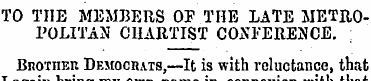
TO THE MEMBERS OP THE LATE METROPOLITAN CHARTIST CONFERENCE . : Bno'rnEn Democrats , —It is with reluctance , that I again bring my own name in connexion with that of Mr . Clark , under the notice ofthe readers of the Star generally , and yourselves in particular . Constrained by a sense of duty and self-respect , to resign my office as a member ofthe Provisional Committee of the National Charter Association , I would have preferred to have followed the example sot by Mr . Kydd , who some days a « jo sent in his resignation to the committee , had not that body decided on its incompetency to receive the resignation of its members , when on a previous occasion Mr . Kydd tendered his resignation . I therefore publicly apprise you of the fact , that I am no longer an associate of , nor will I bo associated with * ' Thomas Clark , Provisional Secretary to the National Charter Association . "
In the eyes of all men of common sense , and common feeling , the course , I am now taking must find ample justification in the correspondence which has appeared in the Northern Star . If any think otherwise , surely they too will be satisfied with this procedure on my part , when informed that Mr . Clark has re-published the letter which appeared from his pen in tho Star of February the 2 nd , in the shape of a pamphlet , from the title page of which I extract the following : —
Also a Letter Condemnatory of PRIVATE ASSASSINATION , AS eecommended by M . G . ' J . HARNEY . Br Tikmas Clark ; Provisional Secretary to the National Charter Association . Published by SamualBoosham , 114 , High Holborn , London . Leaving the Land members ( lam a paid up fouracre shareholder ) to hrin / r Mr . Clark to book for transforming the National Land Company ' s servant into a publisher , and the National Land Company ' s office into a publishing shop for the dissemination of his assassin-like hbels , —I appeal to you , as
Chartists , whether you are satisfied with your "Provisional Secretary" doing his little best to make the National Charter Association a party to his infamous calumnies ? I ask whether in self-respect I could take any other course than that of resigning my post as a member of the Committee ? Understand , I am no deserter from the Chartist movement . Two or three weeks ago I subscribed a contribution of One Pound to the funds of the new association . Public meetings called to advance Chartism I shall—as far as I can find time—attend and take part in ; and any other aid in my power I shall be happy to give for the promotion of the democratic c . 'iuse .
I have made this letter as brief as possible , wishing to avoid further comment t " » this journal , on Mr . Clark ' s proceedings . If need be , I can have recourse to another medium , through which to settle accounts with that gentleman . I am , Brother Democrats , Yours faithfully , Feb . 14 th , 1350 . G . JULIAN BARNEY .
Tiik Army.—It Is Suggested That The Redu...
Tiik Army . —It is suggested that the reduction in thear my will take p lace in the following manner : — 20 th , 30 th , 42 nd , 44 th , 45 th , 50 th , 07 th , 09 th , 70 th , 2 nd battalion 'Rifle Brigade , to bo reduced from 1 , 200 men to 1 , 000 men , and to bo made into one battalion . The officers liable to be reduced will ' . be continued on full pay until vacancies may occur in their respective regiments . The men to bo discharged will be permitted , if they prefer it , to settle in the colonies . Tho Oth regiment is also to be reduced to one battalion of 750 men . The 11 th , ( 38 th , and 65 th regiments , now in New South Wales and New Zealand ( as it is not intended to send them on to India ) , will be reduced from 1 , 000 men to 750 ; and those to he discharged may become settlers , if they prefer it to returning homo . The depots of all the sing le battalions abroad in the colonies are to be reduced to the extent of about twenty men each . The above reduction to take place from the 1 st of April . —6 % ? be .
Tub JfoitTUEUN " Witai / b and Seal FisiiEny . — The vessels destined for this perilous trade from the port of Hull are now being fitted out . The smaller vessels—tho scalers—are in an advanced state , and will probably bc . ready for sea in a week or two . If the Government have any intention of offering rewards to the crew of the fish ing-ahips who may exert themselves in the search for Sir J . Franklin and his party , the sooner publicity iti given to their intentions the better , as the communication of it to the crews , at this early period , might be productive of the happiest results , in inducing intelligent men to join the ships , and the commanders to provide themselves with scientific instruments or h ydrographic illustrations , in order to more efficiently prosecute the search . —Hull Advertiser .
Income and 1 'boi ' eiitv Tax . —It may not be generally known , that by the income tax 5 and 0 Vict ., every parish or township is liable to make good any loss occasioned to tho revenue by the default or failure of the collector to pay over the monies he has received . An instance of this kind has just occurred at "Mary port , where a supplementary assessment has been made , levied , and collected upon the inhabitants , in consequence o the collector having misappropriated some of tho moniea received by him . ExTRAonDiNAiiY Changk of Foutuxh . —Within the past week an authentic legal announcement has been made to Thomas Strickland , carpet-weaver , livin g in Caroline-street ; Kendal , that he is heirat-law to the estates of Miss Burns , of- Cringlemire , near Bouth , who died recently at Cheltenham . The value of the estate is stated at £ 14 , 000 . The fortunate successor to this property hag hitherto been in poQi' giycunistaiaceB ,
Deputation To Lord John Russell On The P...
DEPUTATION TO LORD JOHN RUSSELL ON THE PAPER DUTIES . On Tuegday a deputation of gentlemen , representing paper ' makers , publishers , and printers , in England and Scotland , had an interview with Lord John Russell , in Downing-street . Amongst those present were Mr . Charles Cowan , M . P . ; Mr . T . B . Crompton , of Farnworth , Lancashire ; Mr . Baldwin , of Sherbourne Mill , Birming ham ; Mr . Thomas t Yrigley , of Bury , Lancashire ; Mr . James Durham , and Mr . Henry " . Bruce , Edinburgshire ; Mr . Robert Chambers , of Edinburgh ; Mr . Charles Knight , and Mr . W . S . Orr , of London . The deputation was accompanied by Mr . Hume , M . P ., and by Mr . Scholefield and Mr . Blair , the members respectively for Birming ham and Bolton .
Mr . CowAN introduced tho deputation , and made a few general observations . Mr . Ckompion said : M y lord , I can assure you , with great sincerity , that I have come hither with much reluctance . I have been impelled by what I feel to be the necessity of the case . I have been upwards of forty years an extensive manufacturer ot paper , and during all that period I have never known the branch of industry in question so unremunerative as it is now . I will endeavour , as
concisely as I can , to explain to your lordship some oi the more palpable causes and reasons for this state of things , and I will point out the gross inconsistencies which exist , and of which we are obliged to complain . 1 st . Is it reasonable that a raw material of a most worthless character—I mean the very refuse which is created from cotton and linen , in the process of manufacturing these substances into cloth—should bear the impost of a duty of 600 per cent , upon its cost price , when made into paper , whilst the cotton manufacturers have succeeded in
removing a tax of only five-sixths of one penny per lb . upon cotton imported into this country , the government having been satisfied that that very small proportion—certainly not more than five per cent . upon its value—was prejudicial to the interests of the country ? I ask again ; How can it be justified that the very refuse of the same articles should be burdened with a tax of 600 per cent , upon thenvalue ? Now , my lord , I will endeavour to bring under your notice some of tho numerous hardships to which paper manufacturers have been obliged to submit in consequence of the arbitrary and inconsistent operation of the excise . Here are specimens of numerous articles brought into the market as substitutes for paper , and , in
appearance , so identically the same with that article that even I , my lord , without marking them , could not distinguish between the real commodity and its imitation , and I will defy any other man to select the one from the other . ( Here the hon . gentleman produced a number of specimens of what appeared to be paper of various qualities . ) Now , at the mere caprice of the officers of excise , the real or the fictitious production is pronounced to be paper . One hundred per cent , is accordinglylevied upon the cost value of the one , while the other goes free , and it may be interesting to your lordship , and to the public at lar <* c , to know why . The bare assertion of the fact , indeed , would scarcely be credible without the corroboration of
detail . By a decision of the Board of Excise , in order to constitute paper , the material must have been pulverised and worked in water . It occurred to a manufacturer to take advantage of this official definition . He erected premises , and constructed machinery for the purpose of fabricating the very same material in a dry state . He succeeded , and challenged the Board of Excise to seize the goods , which , according to their authoritative description , could not be paper . A seizure was made ; but a compromise took place . The manufacturer was allowed to proceed for a given time , on the distinct understanding that , after its expiration , he should discontinue his process , or subject his product to tho same duty with that paid upon the paper
manufactured in the usual way . I believe it was discontinued accordingly ; hut it was subsequently revived , and is at this moment carried on—the goods being sold under tho name of feit , extensively substituted for paper , and distinguishable from that manufacture by no perceptible difference except by being slightly darker in colour . Of another extreme hardship I have personally experienced the severe pressure . About two years ago a general order was issued from the Board of Excise to the effect that paper to be made into papier mach ' e should ho exempted from duty provided the papeiwcre manufactured on the premises on which the papier macho manufacture was carried on , but not otherwise . Now , observe the operation of this . 1 was under the necessity of either allowing the
papier macfie manufacturer to come to my premises , or of erecting paper-making machinery on his , or , finally , © fallowing my self to bo superseded in his supply . Finding myself thus situated , I memorialised the Board of Excise , as well as the Lords Commissioners of the Privy Council for the Affairs of Trade , as did also my customer ( one of the most respectable and extensive manufacturers of papier mache in tho kingdom ;) but neither of us could succeed in obtaining permission for me to send our paper under permit , giving notice to tho officer of Excise to that effect , so as to be allowed a
drawback . This is but ono of a thousand of the vexatious and unjust impositions inevitably resulting from the existence of the duty , and the consequent Excise regulations . As there are several other gentlemen desirous of addressing your lordship , I must conclude by observing that tho immoral tendency of this tax is such that I fear it is encouraging the most iniquitous practices , and rap idi y breaking down the probity of the manufacturer in this trade . For we see daily in the market paper sold at prices at which no honest trader can produce it , trammelled as he is by this most oppressive and obnoxious law .
Mr .. James Baldwin , from Birmingham , saidlord , I had the honour about a year and a half ago of addressing a letter to your lordship on these uujust excise laws , and the answer I got from , your lordship was that you would take the matter into your serious consideration . I now come with this deputation to offer a few additional reasons for their abolition . I perceive that your lordship ' s government is aware that the excise laws are becoming exceedingly obnoxious , for I observe you now call all the excise offices " inlandVeycnue offices . ' This convinces me that your lordship is aware of the feeling of tho country on this matter . Now , my lord , a few of tho additional reasons are these , that I find that Birmingham , the town I come from ,
according to its population , uses more paper in wrapping and re-wrapping its manufactured goods than almost any other in the kingdom ; and to show how this acts , before I left home I called on a few of tho merchants and manufacturers , such , for instance , as Messrs . Scholefield , Messrs . Van wart and Co ., Ilarrolds . 'Mr , W . Winfield , J . Palmer , and others . In ono of these houses I found that nearly twentytons of wrapping paper , paying £ 15 per ton , had been used in a year , the manufacturers of those goods having used thirty tons previously in making the same goods ; tlie merchant dealing with them used thirty tons additional for tho same goods ; so that , reckoning thirty per cent , put on in America , this paper duty alone made a difference of nearly £ 1 , 000 per annum in the dealings of ono house . Under such circumstances , how was ifc possible the English merchant and manufacturer could compete withVthe foreign merchant and manufacturer who
did * -not pay duty en the paper in which their goods we * e packed ? ( Mr . Baldwin here showed to his lordship some scraps of button boards , out of which blanks for the insides of Florentine buttons had been cut , and in which there is a great waste made , though duty is paid on all . Thus , in the case of the very low-priced small buttons , tlie duty alone raises the price oi the buttons nonrly ten per cent , is put . ) I ask your lordship how it is possible for us to- compete with the foreigner . And then again I would ask your lordship to loek at its effects on education . My lord , I do hope , as you cannot say now you ennnot spare the money , that you will relieve the country of < his unni'fc and improper tax Before I sit down , allow me just to say that , in exporting the commoner kind of paper , tho trouble and expense we are put to in packing for exports amounts to from twelve to fifteen per cent ,, while to send the same paper to Australia the carriage docs not amount to more than about five percent ;
Mr . Durham adverted to the circumstance ' , that the excise duties proved a bar to tlie applications of science in this branch of manufacture , and illustrated this by observing that beautiful papers of certain descriptions , such has papers hangings , & c , have been made in France from straw ( several samples of straw paper having been laid on , the table by Mr . Cowan , ) and tho wonder of course is , how such an article manufactured in France cannot b . c also done in England , where there is so much skill , enterprise , and capital . He said the excise duty must be field chargeable with this marvellous state of things . The French maker has . no duty ' or excise regulations to interfere with"his experiments ; tho English maker has , and tho matter works . thussuppose amakcrdeterminesttfexperimenton 50 tons , of straw at 40 s . per ton , ?' . c * £ 100 ; now the risk , in this case , of failure in producing a good article
is to the extent of £ 100 , besides workmanship . Now , suppose a loss of 20 , 30 , or 40 per sent ., as the case may be on an articlo sold in the market held to be inferior or imperfect ( as all experiments and discoveries are of course very imperfect and uncertain at first , ) this . is of course a loss , hut not to such an extent as . to be serious , but such as might be comtemplatcd by any manufacturer in making experiments , with the hope of ultimate benefit ; but , on the other , hand , it is quite ^ manifest that if , in addition to the-. prico of the raw material of tho o 0 tons } there bo also the duty of £ 15 per ton , or 750 on that quantity , the risk then is no longer on £ 100 and on workmanship , but on £ 850 andjworkmanship , in the case supposed—a very different matter indeed , and such as mig ht involve ruinous risk and loss . Such a fearfully increased risk prevents any . prudent man attempting experiments or following up discoveries ; and , in fact , ono party - who did weofc a muTih England to » ake paper from straw ,
Deputation To Lord John Russell On The P...
after sacrificing a large capital m the attempt , has ceased to work , and retired from the trade altogether ; and there is no likelihood of any other party making such attempts whilst the enormous load ofthe excise duties exists . Mr . Chambers said , the pressure of the paper duty upon the business of publishing is chietl y felt in the most popular class of publications—those addressed to the great body of the people . On a newspaper of large circulation it is very heavy . I know a provincial journal which shows great enterprise , and upon it ' the paper duty is about £ 009 per annum , which would be a profit failing all other . On cheap literary journals , I can speak mov * definitely . There was one called a Miscellany of Tracts ,
which my brother and I published . It met a large sale , and , I believe , was in the way of doing some good amongst tho humbler classes . It returned , however , so slight a profit that we gave it up , while selling to the extent of 80 , 000 copies . On the whole amount of this work printed the duty was £ 0 , 220 . Now , this would have been a very ample profit in itself , though a mere shade upon each copy . The amount of duty paid for our publications per annum is , at an average , close upon £ 3 , 000 , which must be considered as a great burden on what it is , to all intents and purposes , a branch of the educational means of the country . In a cheap publication , the value of paper may be set down at nearly one-fourth of the selling price , and considerably above one-third of the price to the retailer . This
is in the case of the publisher who acts with all possible advantages in his favour , such as paying ; ready money for every article , and acting as his own printer and binder . From these data the severity of tho burden on popular publications may be estimated . Were the paper duty removed , the existing publications might , in some oases , be reduced in price ; in others the public would derive a benefit from a superior paper being used , and a better literature presented . In all subsequent works the prico would , of course , he struck at the lowered rate . I fully believe that , with paper at a reducedprice , we could bring out many now works of importance to the public which we could not now with an y nrudence attempt .
Mr . C . Knight would not detain his lordship by adding anything to the general argument which had been urged by Mr . Chambers , as to the discouragement of popular literature by the existence uf the duty on paper . He would confine his observations to one point . The paper tax operated injuriously against all literature , but more especially so in the case of cheap publications for which high-priced skill authorship was paid . Ifc had . been able to show that the duty had been a positive burden upon the Penny Cyclopadia to ihe extent of £ 16 , 500 . That work was undertaken under the auspices of his lordship himself , amongst other eminent persons ; but the cost had been borne by Mr . Knight . It had never been remunerative ; for the cost was largely increased by the natural
operation of the tax upon the price of paper . This was an example of the peculiar burden of ihe tax upon the higher kind of literary labour , compelled to compete with low-priced authorship in tiio race of cheapness . Mr . Knight believed that the great mass of publications were tending to cheapnessthe good as well as the bad . He believed that books for the few were fast going out of demand , and further , that the many would ultimately pay tho proper rewards of good writers as well , if not better , than under the present system of a limited demand . But , - with the paper duty , the profits of a publisher employing the best authors to produce cheap books were so curtailed by the burden of the tax upon the large amount of paper used for such books that tho higher class of literature was deprived of in
proper encouragement . The remarks of the deputation were followed up by a short hut lucid and forcible address from Mr . Hume , on the social , moral / and commerce ' ' question involved in the subject ; after which th- > gentlemen , who had been received with the greatest courtesy by his lordship withdrew .
$Okc$,
$ oKc $ ,
"Worship- Street.—Extraordinary. Applica...
"WORSHIP- STREET . —Extraordinary . Application . —A gentleman , whose name did not transpire , but who described himself as a surgeon resi-iing at Ixworth , in Suffolk , applied to Mr . Hammill for . his advice and assistance under the following remarkable circumstances : —The applicant state-i that about a month since he was a passenger in one of the trains from Bury , upon the Eastern Counties Railway , accompanied b Captain Lloyd , a friend of his , when , upon reaching Mark's ley , the next station bevond Colchester , an elegantly crossed woman , who had an infant with her , entered the carriage with a tottering step , and apparently in a state of extreme illness ond debility , and explained to them that she had been previously travelling in
a first-class carriage , where she was quite .-done , but that , feeling greatly indisposed , sho had been induced to change hcr p lace for one in another carriage , where there were other passengers , lie ( the applicant ) introduced himself to her as a surgeon , and tendered his professional services if slie required them , but the lady declined his offer on the ground that her illness was solely attributable to her being unaccustomed to the fatigue of travelling , and she appeared to have rallied considerably by tho time the train reached the Shoreditch terminus , when lie again offered his services , but she told him that they wore quite unnecessary , as her carriage and servant oug ht to be waiting for her oii ' . side , and requested him to take charge of the chi ld for a
few minutes , while she ascertained whethrr they had arrived . The lady then hastily descended the stops leading from the platform , leaving with him . and the captain her child and a small trunk , which be at the time supposed contained her lugg .-iiie , but after waiting for more than an hour , the lady did not again make her appearance ; and from that time to the present he had neither seen nor heard anything of her . "'' Aftcrmaking numerous inquiries in the hope o £ gsf ivg-sbme trace of her , but uuavailingly , he conveyed tho infant , which was a female child two months old , to tho house of a private friend of his in town , and on taking off its clothes they discovered , attached to the inside of thr dress , a letter containing two £ 10 notes , and conveying a
brief intimation that tho infant was tho offspring of persons of the hig hest respectability , who would continue to contribute all that was requisite to ensure its comfort and proper maintenance , upon being addressed by advertisement in the public papers to that effect , and that tho little tLarge would be ultimately reclaimed by its . parents . The infant had ever since remained , under the care of the friends with whom he had ^ first placed it ; but lie had since received several letters upon the subject , one of which was from another private friend of his , who was most ' anxious' to * adopt the child , and in proof of his being actuated by anything but a mercenar y feeling , he SVaf . desirous that the money which had bcen - ' 'l ? ffebh . its account for
should be deposited in some s ^ ngsrbank its future-benefit . , This benevole nfcjg ^ ojjri ' , however , he was restrained from accedingj & in ^ ctmsequence of a second communication , hf ^ gmrea ' ched him from some gentleman -in DeV ;^«^ -who . made a peremptory claim of tfte chi # § p ! sDv $ he property attached to it , alleging that lft ? # a S ; emppwer « d . to do so by its mother , although he hroduced nothing satisfactory in anthenticationjof his assumed authority , and threatened him , in' % . event of his refusal to accede to the demand ^; adopt lega l proceedings against him for its * fcnncdiate restoration . Under these circumstances , he was totally-at a loss how to act , as his only object was to relieve himself of the responsibility so singularly imposed upon him in a manner which would bo jointly conducive to his 0 W 11 Safety and the interests of the infant , and he was therefore induced to come to this court to obtain tho op inion of the magistrate as to the
most advisable course to be pursued . The applicant described the contents of the box which accompanied the infant as exclusive ! ^ consisting of wearing apparel of a tasty and expensive description , and adapted for a female child , and having expressed his conviction that ihe infant ' s mother was a married woman , from the circumstance of llOticing ' a wedding ring upon her finger , and that a portion of the clothing , thoug h still in excellent condition ,- was slightly worn " in various places , added , that he had been subject to great expense , trouble , and annoyance , from the unpleasant position in which he had been placed , and had been compelled to come up expressly to town , leaving hia
patients in the country wholly unattended to , that he might he put in the way of adopting some measure by which this , to him harrassing affair , might tbe brought to a satisfactory conclusion . —Mr . Hammill said , that it was certainly a Very singular arid'unusual application , and ho regretted exceedingl y that ho coujd not render the gentleman any effectual assistance ;> fc-ho would suggest that the best course for the app licant to pursue would-be to place the infant w the hands ot ^ ofte « « tto parish in whose distr ict it had been abandoned ; and they ,-he had no -doubt , would take such steps as woiild release him from ; all further responsibility , and very probably lead . to . the discovery ot the person Jr j il aKiI 1 ta rho AT atrnnrtnuB caie
. « » . „ . . « . nnvp who had abandoned tne . cnuji to me m o ^ ungera in such ah unnatural manner , — The applicant thanked the mag istrate for his advice , and quitted tho court .
Austrian Impudence.—Tho Vienna • Paper, ...
Austrian Impudence . —Tho Vienna paper , tho Llovd , of the 3 rd inst ., asserts that an Austrian fleet is preparing to sail for Greece , to oppose the proceedings of Sir William Tarker and the Eng lish squadron . . . Sleep—The poet Young says- ' Sleep is great Nature ' s second course—the balm of hurt minds . ' Johnson says' It is the parenthesis of human woe . ' Sleep being thus an ? predated by mankind , how desirous ought we to bo th « all should tranquilly enjoy ' sweet repose , ' the general obstruction to which is thought an unhealthy etion of the liver or other viscera . A little attention to the ' joung disease , ' by having recourse to a mild aperient , oltcn produces ihe most salutary effect and for mch piirpo Franipton ' s Pill of Heal th- stands prominent in public opinion . . - ^
-
-
Citation
-
Northern Star (1837-1852), Feb. 16, 1850, page 5, in the Nineteenth-Century Serials Edition (2008; 2018) ncse.ac.uk/periodicals/ns/issues/ns2_16021850/page/5/
-