On this page
-
Departments (1)
-
Text (6)
-

' ' ' ' OF LAUD 1 ;f rgg? * 6,184?r .;. ...
-
r^gg EVILS LAUD MONOPOLY. 1 rgx jDrroa c...
-

Colonial ana Joaian
-
BRITISH AMERICA. r rom Canada we have la...
-
Fai»e Weights ansMeasures.—A.Bad Joke.— ...
-
THE EXPLOSION. ON- , ' BOARD THE CRICKET...
Note: This text has been automatically extracted via Optical Character Recognition (OCR) software. The text has not been manually corrected and should not be relied on to be an accurate representation of the item.
-
-
Transcript
-
Note: This text has been automatically extracted via Optical Character Recognition (OCR) software. The text has not been manually corrected and should not be relied on to be an accurate representation of the item.
Additionally, when viewing full transcripts, extracted text may not be in the same order as the original document.
Lanarkshire. Ano Thbr Detbrmined Attempt...
; - ; i- ; -f ^* .. - ¦ > ¦¦ , IRELAND . - ¦ := : -f ; ¦ ¦ [ ' ¦ ( Oonttmiedfrom the sixth page . ) ' ¦ ' <'>¦< ¦ ¦ •¦>"¦ y STATE OP THE COUNTRY . The Limerich Chronicle gives . the particulars ofa very gross and unmanly outrage . Some time since a Walsh , residing near Limerick , in Clare count y ; was attacked , and an attempt , fortunately unsuccessful , was made on his life . On last Thursday morning his son waariding to school in Limerick , when an unmanly scoundrel assailed him , threatened hi * life , and cursed the ruffians who had suffered his father to escape . Tho little fellow rode off to the next police - station , brought the police on the track of his assailant , and succeeded in having him
arrested and lodged in gaol . There has been a rescue of cattle seized at the Dingle , for the poor and Temporary Relief Rates ; twenty-six cows which had been taken were driven away from the bailff * . What is strange . ' says the-Limerick'Chronicle , 'is ! that the rescue was led by the shopkeepers of the town . ' The guardians of Nenagh Union , elected six relieving officers , five of whom stood to some guardian in the relation of son , brother , or nephew . A fter this job was done , the five disinterested guardians resigned—The price of meat has fallen in the provinces , the recent fall of rain having had this effect .
DISTRESS OF THB PE 0 PIB —RELIEF DEPOTS . The government relief system having been generally brou » ht to a close , some of ber Majesty's steam vessels are employed in removing the stores remaining at the depots along the coast . In various districts of the south-west severe distress still prevails , and unless the new poor law shall be putinto effectual operation , and employment upon a large scale provided for the able-bodied , the approaching winter will be one of terrible suffering amongst the poor . The government has determined to retain some of tho principal depots , where the available food is to be stored , in order to be prepared with some machinery tor relief , should circumstances render it absolutely necessary , in remote districts , during the winter months ^
- The poor law guardians at Galwav owe nearly * 7 , 000 ; they have struck a rate of £ 5 , 000 and upwards , and there is an outstanding arrear of the former rate amounting to £ 3000 OF course they have nocash in the treasurer ' s hands , and consequently all their supplies are had on credit . They find theroselvesin difficulties . DrPhelan , assistant poor-law commissioner , stated some days since , that he knew nearly one hundred other unions throughout Ireland in a similar position , and suggests to them a plain cause why they are so , and a plain remedy . The
unions having no funds in bank arc obliged to purchase supplies on credit , and to pay exorbitant prices . In this way they arc always in debt and difficulty , and the burden on the union is ultimately greater ; for whereas'the cost of maintenance of a pauper in Dublin does not exceed Is . 91 . per week , in Galway . it reaches 2 s . 84 d . per week . The remedy , of course , is to lay on a rate , which , after making every allowance for non-payments and inevitable arrears , will leave a surplus , and enable the guardians to start with a capital .
' . KEPKAL ASSOCIATION , At the usual weekly meeting of the association . James Fegan , Esq ., M . P ., presided . Mr John O'Conkkll commenced the business of the day by handing in £ 40 from the congregated trades of the City of Limeriok , as an 'evidenced their devotion to theprinciples and teachings of their departed leader . ' The lion , gentleman then adverted atsome length to tho affairs Of Italy , and expressed his regret that Ireland had not a domestic : legislature , which would not hesitate for a momentin espousing the cause of Pius IX . The . Rev . Mr . CooniiAN expressed his opinion that the people of Ireland should demand from the government whether Ihey might not be permitted to make a demonstration in favour of his Holiness . If
they were so permitted , he had . no doubt but an army of 60 , 000 men could at once bo raised to S ^ ht under the standard of independence in Italy , and protect the Sovereign Pontiff in his glorious career against oppression aad tyranny . Mr P . S . BoriBB , W . P ., addressed the meeting at some length . Notwithstanding the abundant harvest with which Providence had blessed tho country , there was every reason to apprehend that the labouring population woulel be in a worse position during the ensuing winter than they were at the same period last year . Henceforth they would have nothing to depend upon but the wages they were likely to receive for their labour from the landlords and tenants
of Ireland , and those classes were so overwhelmed with difficulties that it was impossible they could gi \; c employment to such extent as wouldprevent famine and pestilence . Such being the position of the country .-he ( Mr Butler ) would appeal to common sense whether it was . reasonable to enforce the repayment of the advances made by England during the last session of Parliament . He woulel suggest to the government the expediency of placing that debt in abeyance . Iu saying so , he should not be understood as wishing to repudiate the liability . On the contrary , he felt conviuceel that Ireland would feel extreme gratification in discharging her liabilities when Providence enabled her to do sv
Mr John O'Conxem . subsequently addressed the meeting at considerable length . At the conclusion of the preccedings-the rent for the week was announced to be £ 07 19 j . 2 d .
IBISII FISHEMES . The Gahvay Mercury says :-' The infatuation that has come over the Claddsgh people , cannot be accounted for on any reasonable principle . ' A fortnight ago , they appeared prepared to proceed on the herring fishery , and yet in the middle of September—an unprecedented circumstance in Galway —not a boat has put to sea . There must bo no sympathy felt for such persons ; and if distress and destitution come upon them , they will have themselves alone to blame . Some excuse or other is sure to ho put forward ; one day it I lows too fresh , another itis too calm for the take offish . These men will call upon the inhabitants during the coming season for assistance , but who will be anxious to relieve those who , having the means , want the disposition to assist themselves V
BARBAROUS MOItDER . The following appears in the Ballinashe Star : — ' One ofthe most horrible murders we have ever heard of , and of a description which is very rare in our county , was perpetrated on Tuesday night in the neigbbourhood of Mount Bellew . It appears that ns a man named Patrick CosteHo , a driver in the employment of Mr James Cuffe , ef Esker , was returning from { that town , to the pjtty sessions of which he bad a numbor of persons summoned for trespass , & c , that day , he was waylaid by a party of men , who literally smashed his head to atoms , an inquest was held by Mr W . Kenny , coroner , which commenced oa Thursday , and was adjourned ' to the next day . Dr Fitzgerald , R . M ., and Mr Brereton , were in attendance . J A most respectable jury were
sworn , who riturned a verdict of Wilful Murder against persons unknown . Tkrwigh the activity of Mr Ikmvd Commins and the police , four men have been arrested on suspicion of having ' committed this atrocious act . They have been committed td prison " . ' This unfortunate CosteHo was driver and woodranger to Mr Cuffi , and one of the persons arrested occupied the same situation before CosteHo got it . This barbarous murder seems to have been perpetrated by striking their wretched victim with stones . His chin was broken , his teeth knocked out , and literally scattered on the road , and his car was cut in two , his nose was also'brqkcn , and his head dreadfully fractured '
SBUMVELUXCB .-Mr Richard Boarke the successor of Mr Moore O'Forrall in the representation of Kildare , was recently entertained at dinner by a body of his father ' s tenantry , and on returning thanks for his health being given thus admonished his hearers : — , . , . , Much has been and will be said of tbe prosperity of Irelimd ; the sentiment Is daily spoken of in erery meet , ing , and toasted at every dinner—various measures are proposed—various laws recommended to carry out this great work . But , it is too often forgotten that the increase of theprosperity of Ireland rests mainly with the people themselves . Capital is wanted—capital is called for . Capital is , ou all hands , agreed to be the means whereby Ireland is to be saved ; hut this capital is onl ;
to be attained by the increase of our own resources . Theprosperity of Ireland is only to bo attained by your own strong arms . Every man who improves his form , who takes an increase of produce from bis land , adds his share to the wealth of his country—adds his pebble to tho cairn of Erin ' s improvement , is a friend to Ireland . We are able to help ourselves ; we will no longer be dependent on , the precarious assistance received from other lands ; and we will never rest until every sod in Ireland brings forth abundantly—till every inch ol ground is in its highest and fullest state of bearing . You have set the example of a change of manners for Ireland you have vindicated tbe principle of
self-reVionce , I am confident that jour cximple will bo followed , and that in a short time we shall have annngst us more industry and escrtion , less politics and mort ploughing , less argument and more action , less want and more reason , less debating and more doing . Every penny you make , every successful transaction that you embark in , adds to the common store of healthful pro spevlty . Legislation may follow improvement—may confirm and reward your labours , but it cannot commence the good work . You must begin , you yourself must lay tho foundation of tho fortress of your country's safety . Legislation must and will strengthen the outworks ; aud you know this now , you have showed to the world in your actions the high value you set ou these pvin .
ciples . A Modest Proposal . —An enthusiastic gentleman in the Freeman ' s Journal proposes as a ' subscripti'm for Mr O'Connell ' s family—a bagatelle of £ 100 000 . Tito task he says , ' is as easy as it is pleating . Every person who chooses to provo his love of countrv , and his gratitude to the successor of tho purest patriot and greatest champion of freedom that Ireland ever produced , can do so at an imperceptible loss . If SO united contribute a pound , or if 1 in 80 give but a pound , £ 100 , 000 would be raised by tbe Irish people . Two aids are requisite ; but these two arc always foremost when the voice of their country calls—the Clergy and tho press . ' Whetl it i * remembered that the subscriptions' for a monument to Daniel O'Con-Hcll himself have not yet reached £ 3 Q 0 , the gathering
Lanarkshire. Ano Thbr Detbrmined Attempt...
of -a ¦• •• ' plnnr * for . his sons , though itmav be ex tremely « pleasingVto the imaginatien of Mr Amicus PalnaiB by no means so very 'easy ; ' . ¦
' ' ' ' Of Laud 1 ;F Rgg? * 6,184?R .;. ...
' ' ' ' OF ; f rgg ? * , 184 ? r . ; . . .. _ ,:. • ¦ . tWsWWBgwiy . gititt - - .. ; .:.. 7
R^Gg Evils Laud Monopoly. 1 Rgx Jdrroa C...
r ^ gg EVILS LAUD MONOPOLY . 1 rgx jDrroa cf thx bobibkbs suit ., J -It is usn- ^ y Md as a maito ^ cMed alike S ^ od sense and policy , to take idvantage of * 3 *\ tgson of prosperity Iq xrAa preparations for tfjtf ' riods of adversity ; to make hay , in fact , | f ^\ L t the sua shines , and prepare in summer for SjSp roacbes of winter . B » 1 BaS unfortunately , this timely providence is , iJ ifc most of us , a lip-maxim only : in action it -1 df-1 d ead letter , and we leave it to the most insig-J jJ -jjjjjt animals and insects to work , whilst we , titb ' fjtb our superior wisdom , admire but will not jsJ tiMttte them .
J 2 v Even Max , however , must surely learn from exjjrieifsrience ; we have been taught during the last two jflrsjfl-s a fearful lesson on the iniufficiency of the ^ seleent modes of proceeding , both with regard to ^ leg islature , and onr private industry . We have senaan England almost prostrate at tbe feet of other » ti « ations , crond . ing tothemfora morsel of bread ; ire Ve have seen those manufactures which have been jar l jor boast , almost rejected , glutting our own mar kets jd 5 , and refused in our neighbours '; we have found pnspnselves compelled to support a sister-nation from Ae Ae hard- earned scanty wages of our own labourers , their own food has been
^ i' ^ ilst procured only at fjmfemi ne prices ; and if we are capable of gathering « ia « isdom from the experience ot the past , every man , jv , jv , and every woman in England , must , ere this 1 & % pe learnt the utter fallacy of the doctrine that jsrj $ sr manufactures can command corn from other huJ buds—that it is safe , or expedient , or even possible , to to continue a system by which our own land cannot ie je made to produce food for the people born on it . ] Bnt to suppose that such a state of things was pi per designed by Heaven , is a monstrous blasphemy ; ft ftd never yet created a being without creating food jo : jjriis support ! In the scorching plains ofthe III East—among the glaciers of Iceland—from pole to
j dctbere are the means in nature for bread enough tod to spare , if man does but take the proper meth od for producing it . And is rich and fertile England alone exempt from the general rule ? Is she only to produce a population to starve and die prejaatarely ? Is our peasantry to lose its bold manlijes from lack of nouriiure , and are English parents tabling children forth for whom they cannot earn lsread ? The thought is monstrous I "Would tbat jt were not also horribly true ! The events of many jeirs past have revealed the fact in all its naked ' deformity ; the statistics of the last two years esjerially , have elicited facts which , if rightly viewed , mil discover the cause of this crying evil , and , in ^ covering , lead us to its annihilation . The facts to which 1 more particularly allude r _ _
, st . That under the present mode of culture Eng land does not produce sufficient food for her pop ulation . 2 nd . That a Free Trade with other countries , and irepe al of the Corn Laws , are not effectual provigons against famine . 3 rd . " That our market , and all other markets are overstocked with our manufactures , and tbat this is a daily increasing evil ; tbat Ibis glut in the manufactures , though felt most acutely by factory labourers , has the direct and indiiect effect of injuria the whole community .
4 th . That crime is greatly on the increase ,, in spte of all that has been attempted for the prevention of crime ; and that crimes affecting human Bit—suicide , and murders , by poison especially—fill every day , ihe columns of our papers . Whence it Eimpossible to avoid arguing a growing recklessiess of existence , in the minds of the community . These are grave and alarming facts , and it bclores all who wish well to their country , to inquire tthence these evils spring , and how they may be irerted .
It may be said that the first of these tasks is easys 3 so it may be , like most things , when the clue is g iven . But it appears Jo me that our political eco-HEfflsts have either reasoned from wrong data , or contented themselves with the superficial appearance si things , and neglected to dig below it . It is , indeed , an acknowledged fact , to which none w 3 subscribe more readily than myself , that Engkntlj as it is at present cultivated , does not produce iina sufficient for the cultivation of its people . Here is ground on which all parties meet : but I , for one , on go no further in their good company . They scribe this deficiency—first , to a perpetually increasing surplus population ; secondly , and as a corollary to the-first , tbat the land is not capable of baring a greatly increased crop to meet the increasing necessities of the people .
To remedy these evils , they would draft off every year to foreign shores , numbers of onr surplus population ; and for the remainder , they would'beg the charity of our continental neighbours , and entreat of tbem the food we ourselves ( according to their showing ) cannot grow . Xow these remedies are , in fact , worse than lis disease . They do not cure the evils they profess to cure , and they create others of equal magnitude . We have now made trial of these quack prescriptions—we have tested their exact no-value , and every thinking man must have discovered by this time , that something else must be advanced—some more jod'ciojs measures adopted to create plenty through the laud , and make its people that which they ought to be—iis glory and its wealth .
Admitting , with the political economists , that England is , at present , not sufficiently productive , I assume that the fault lies in our own defective mode oi culture , not in the sterility of the soil ; and this granted , -we dare the utterance of that which our trcald-be statesmen shrinkfrom assertinr , namelythat our defective mode of culture is the inevitable result of the monopoly of land by large capitalists !^ Nature has formed immutable laws for the government of her subjects ; laws which cannot be violated by individuals or classes , without injuring the whole community ; all her decrees
harmonise with « ch other ; all are based on the principle of general prosperity , and the happiness of sanimd at large . Jvaiure dictates , ' In the sweat cf thy brow shait thou eat bread ; ' and she adds , ' In all labour there is profit ; ' but we have violated her decrees , and read her maxims thus : 'In fhesneat of thy brow , shall others eat bread—in the labour of the many , is the profit cf the few . ' And , as m ' ght bs expected from such cross-reading , we are left with Joe fruits of our own folly on our head . A few roll in luxury ; and the remainder in hunger , in nakedness , in brutal ignorance , and soul-debasing crime , staik through the land .
Yet if we would follow the dictates of reason and comaon sense , we might rapidly alter our national position ; and , it is because I have , of late , seen a hope of this happy progression , tbat I have been led to address yon on tbe subject . Tbe National Laxb Company appears to me to open out to the English labourer a prospect of national prosperity from which he has been long excluded . 1 have carefully studied the subject , and
viewed it , asf I believe , in all its bearings , and feel coirrinced that the project contains the germs of a new and a better order cf things , not for one class , or one individual , but for all , from the highest to the lowest ! An improved peasantry—prosperous , in ' elageat , contented ; flourishing manufacturers ^ a government composed of enlightened , patriotic , practical Eta—all these blessings exist in that new order of things of which the Xastkjxal Land Company is the foretaste .
* W & at great events from trivial causes spring J ' A fahbitss Helen elopes—and a ten years' war , Kith all ite bloodshed and anarchy , are the results ! a few robbers and outlaws congregate , and lo 1 an eia pire is founded ! An old man carves hieroglyphics on the bark of a tree—and the printing press 19 esta blished , and knowledge is spread over the astonished world . An apple falls , and the secret laws ° f Mature are reseated ! h it then too much to hope that from this small gaming we may look for great results ? That in * different system of internal government , in a tlea i promising mode of cultivation of our land—in doping the resources of this fertile island , we ^ y find a remedy for those evils which have so tonstaatlv threatened to overwhelm us ?
That labour raav vet be wealth , and the labourer % nnd profit in ' his toil—that the manufacturer ^ y find * daily inrreaiiag home market for his | ° ods , and no longer depend on our foreign relations ? ^ experiment is at least worth the trial , for in **« prt-s ; ut state the people cannot long remain . Uar eisantty must be arrested in their onward process towards pauperism—for difficult indeed will it ° * to raise tbem when once that lowest point is ** " *" ' . We way prevent , —to cure is nlmost impos-? ; a nation ' s prosperity , like a womatj ' shonour , M ^ Ver to be regained . * Pity may mourn , but notratore ; A ' cation'falls to rise no more' J
R^Gg Evils Laud Monopoly. 1 Rgx Jdrroa C...
. . . But to the ^ peculiar benefits , of the LandPlan . to the moral and' physical condition of the people , I will , with your permission , devote a few words next week , Meantime , I bail it as an omen of a brighter day , when white-robed peace and smiling plenty shall be inmates in the humblest dwellings . When the Psoras shall have their due wei ght in the consideration of the legislature , and be to themselves that which they in truth are to others—the spring an . iS UrC 8 of weaWlandcontentment . a ifD ™ a *™ m ** flourish and may fade , A breath may make them , ai a breath hath made ; But » bold peasantry , their country ' s pride , . When once destroyed can never be supplied . ' lam , Sir , Faithfully yours , Philodemos .
Colonial Ana Joaian
Colonial ana Joaian
British America. R Rom Canada We Have La...
BRITISH AMERICA . r rom Canada we have late but interesting advice ? . There is no political news . The Montreal Transcript says — The subject of emigration , and tbe sickness which the great influx of destitute aad diseased emigrants from tbe mother country has caused , is almost the only one of general interest , and we are sorry to say that although he disease which has caused so much alarm throughout the whole country , is confined in a great degree to emigrants , aad to those having connection with them either as religious and medical attendants , or nurses , or to those who have incautiously or for the sake of gain admitted them to their dwellings—still with these it has suffered but little diminution . Tbe crops throughout Canada , with but very few exceptions , promise well ; all fears of anything like a failure are now over . *
CAPE OF GOOD HOPE . Tier Majestv ' s 16 gun sloop Pilot ; Commander George K . Wilson , arrived at Plymouth on Mondav . Nothing of importance had transpired subsequent to the repulse ofthe English forces by the Kaffirs on the loth of June , when Lieutenant Russell , of the 45 th Regiment , was " killed . The Governor , Sir Henry Pottinger , was on the frontier . It was reported that the Boers , near Port Natal , were preparing to rise against the Colonial Government .
FRANCE . It is quite evident from the Paris journals that the internal affairs of France are not in a situation more satisfactory to the government than the external relations of the country . Rumours of new ' scandals ' are every moment propagated , and , whethpr well or ill-founded , produced a very lamentable effect npon tbe public mind , already excited hy proved instances of corruption . Tbe Opposition dinners sot op iii tbe departments are also causing something like alarm to the government . In anticipation , it is supposed , of a necessity for testing the competency of * the detached forts' to keep Paris in < -heck , the supplyie ? of those fortresses with warlike stores of all kinds —cannons and mortars only excepted—was actively pursued .
fhe march of reform in Italy , and the amnesty permitting the return of General Espartero to Spain , are not at all palatable to the French government . Abd-el-Eader has made himself master of Taza . an important town in the Emperor of Morocco ' s dominions , and according to the latest accounts , was marchine towards Fez . The Commerce states that the intervention of France in Morocco , against Abd-el-Kader , was resolved at a Cabinet Council held on Saturday .
Another Cabinet Council washeld ' atrStCloud on Mondav . at which all the ministers were present . The subjects of consideration were understood to be the affairs of Soain and Italy . Queen Christina and the Duke of Rianzares arrived at the chateau at an early hour , and had a long conference with the King and M . Guizot previous to the assemblv oi the ministers . The recall of the Duke de Glucksberg is definitively settled . The gloomy accounts received from all quarters , both as to political and financial affairs , is the cause of considerable uneasiness in Pari ? , and the funds and public stocks have suffered consequently a considerable decline .
SPAIN . We announced in our town edition of last week the recall of Espartero . The Madrid journals of the 5 th and Cth are filled with accounts of the manifestations , of joy with which the amnesty and royal ordonnances were received by the population . Crowds of persons thronged the streets , shouting * Long live Espvtero ! ' Long live our constitutional Queen !' The Queen herself , on proceedingon horseback from the palace to the Prado , was surrounded by the crowd and received with the londest acclamations . In the evening various parts of the city were " illuminated .
The Queen drove to tbe bull fight iu the afternoon of theotb . Incompliance with tbe hsndo of the authorities no cries were uttered on the Q . ueen ' s passage , but on her entering the circus her Majesty was cheered with the utmost enthusiasm . General Narvaez had also repaired to the bull-fieht , but the gibes and jeers of the spectators compelled him to make a hasty retreat before the entrance of the Queen . Letters from Madrid of the 8 th report the death ofthe famous cabecilla Don Fernando Gomez called the Ebanista , and the destruction of bis small band
near Lugo , by Captain Mendoza . The rebel chief was discovered in the loft ofa house nearOpacio . Tbe grange was surrounded by the soldiery , and he was invited to give himself up , his life having been guaranteed . He scorned the proposal , which his experience had tausht him would not be obse-ved , issued out of his hiding place , discharged his blunderbuss , and was killed by the soldiers . A Bayonne letter ofthe 9 th instant mentions that a sanguinary encounter bad lately taken place at Targa , a small village in the north of Catalonia , in which a detachment ofthe Queen's troops had been routed and put to the sword by the insurgents .
PORTUGAL . Letters from Lisbon and Oporto contain further accounts of military and Cabralist ruffianism . The office of the AW < wia ^ newspaper , published in Oporto bad been invaded by a body of soldiers of the 3 rd regiment of Artillery , who desfroyedfthe type , presses and other property . " The people connected with the Actional attempted to defend themselves , on which the armed force interfered , and dragged away the editor , printers and all the persons connected with the paper to prison ! Terror reigns in Oporto ; the fruit of Lord Palreerston ' s policy ! By later intelligence we learn * that the Miguelite chiefs , comprising nearly the whole of the nobility , have resolved fo support the democratic party at the forthcoming election .
The news from Angola is of an extraordinary decription . and most painful : it would appear that the Torres Vedras prisoners , vict ' ms ' to the barbarous revenge ofthe Queen , had been treated with brutal severity , and that the Count of Bomfin , the prisoner of roost importance , together with his two sons , had been separated from their companions in exile , and sent off to the noxious and horriVe locality of Mossamedas on the coast south of Loanda , where , however , they d = d not remain long , for the inhabitants , uniting with th . 3 small military force there , effected a revolution , and gave liberty to the captives , and the Queen ' s governor and some four or five others were in their turn placed under restraint , while the t oliticai prisoners , in all forty-threeembarked onbonrd
, a small Portuguese war-vessel at nnchor there , with the intention of escaping to St Helena . Before , however , their preparations for departure were quite completed , Count Bomfin , with a chivalrous feeling , released the governor , with his three or four companions , npon parole ; and basely was the indulgence taken advantage of , for immediately following there appeared off the coast theEndish cruwer tbe Flying Fish , Commander Dyke . The governor immediately communicated with Captain Dyke , who made an attack npon the little Portugese vessel with armed boats , and captured her and the unfortunate noblemen and gentlemen on board , and then taking fresh
instructions from the governor , transferred them to his own vessel , and delivered them over to tbe governor of Loanda . Count Bemfin before being delivered op to tbe dungeons of Loanda , presented a paper to Captain Dyke , indignantly protesting , on behalf of himself and fellow captives , against this flagrant outrage , demanding the authority for the act , and claiming the protection of the British flag ; the remonstrance being sneered at , the count , a general officer , aad a peer of Portugal , was immediately given up to the authorities to be confined in an African prison . The account has been received with general indignation ,
Horrible barbarities are taking place in all parts of Portugal . Twoeommeriiial travellers . Frenchmen , were stopped by four ofthe Queen ' s troops and robbed ; erne of the unfortunate Frenchmen was shot dead , and the other shocking !? wounded .
r SWITZERLAND . Letters from Berne of the 9 th inst . announce , thaton tint day the Federal Diet resolved to adjourn to the 18 th of October , bv a majority of 12 and LH ii -f ama - Jh f President next communicated to the assembly despatches from the Governmenta of Zus , Untcrwalden Friburg , and Valais . * fS ° 4 i ?* r l Kc f ]? t of tbe fc " « f «> e Diet of ebeSOrh of Jul , andt ! : e llthof August , relative to the Sonderbund ; and in which they give their entire adhe « on to the protest entered into bv their deputies , and reserved all the rights of their rc « pectivestates .
ITALY . Bomb . —A letter from tbe capital says : — The alliance between thi Pope and tbe King of Piedmoot may be considered certain . It is to be hoped that 8 similar arrangement will be entered into with Tuscany , if . Coroboli lef t for Florence for that object . Austria has already been authorised by the Dukes of Modena and Lucca to occupy their d- minions . Ihe same concession has been demanded fer Tuscany , Naples , which dreads the arrival tf theEoglUh fli ,. t , and has been inritedby thePops to naiteirlth him , hesitates ,
British America. R Rom Canada We Have La...
and seems nevertheless to iodine towards us . -Here we are r < ady to meet every contingency , and proceed , if ne « cessary , to extremities . J , ; ,. ' , -,.- - ¦ . .- r . -: - . r ,:.- . The organisation ofthe civic guard . ' at Rome appears to be actively , proceeded with . - .-, The citizens of Rimini have followed the noble example of these of Bologua , Ferrara , and Forli , in offering their lives and possessions to his holiness , for conserving the independence of the Roman see and its territorial integrity .. Tbe anniversary of the amnesty was celebrated on the ? th and 8 th . The / eto commenced by a
demonstration in honour of Leopold , Grand Duke of Tuscany , and of Charles Albert , King of Sardinia . The Prince of Cahino ( sen of Lucien Bonaparte ) , with his son , and Dr Masi , one of the editors of the Contemperanco . all in the uniform of officers of the national guard , preceded by persons carrying torches , and followed by some thousands of the people , went in procession to to the Palazzo di Firenze , the residence ef the Tuscan minister , crying , 'Long live Leopold , ' ' Honour to Tuscany , ' ' Long live the Civic Guard . ' The minister presented himself on the balcony , and replied , by shouting' Long live Pius IX . and the Civic Guard . ' He then addressed them
in the following words : — I am very sensible of this spontaneous and unanimous declaration in favour of my august sovereign , the Grand Duke Leopold the Second , aud I shall not fail to communicate to his Royal Highness tbe sentiments of this important assemblage . The Prince of Canino immediately cried , 'Long live Italy . ' Tbe cry was caught up and repeated with the utmost enthusiasm by the whole assembly . The crowd then defiled off in the same order to the residence ef the Sardinian minister . When they had reached it . loud cries were raised of' Long live
Charles Albert , ' 'Long live the ally of Pius IX . ' The Independence of Italy . ' The hotel was immediatelv lighted up . The Sardinian minister presented ^ himself , waving a white handkerchief . in token of acknowledgment , for it would have been impossible for his voice to be heard by the vast multitude , who raised incessant cries of ' Long live the league « . f Italian state ? , ' while the band struck up the hymn of Pius IX . Before the termination of the hymn there was a general cry of a casa , a coon , and the crowd quietly dispersed .
On the Sih there was a grand fete at the Piazza del Popoli , where tbe statue of Pius IX . was raised . Two thousand national guards were drawn out upon the Place . It would be impossib ' e to describe the enthusiasm , of the multitude when ' . Pius IX . presented himself . It amounted to perfect frenzy . He was hailed by repeated cries of' Long live tho President of the Italian League . ' Toscany . —A letter from Leghorn , of the 5 th , addressed to the Nouvelliste of Marseilles , says— ' A grand solemnity veterday caused great emotion among all our people ; enthusiasm was at its height ; hope aud happiness were expressed by . every face . The town of Leghorn' feted the authorisation to forth a Tuscan National Guard , which has just been accorded by our sovereign . More than ten thousand men were assembled under the national flag , surrounding busts ef Fins IX ., and of Leopold II . Bauds of music , escorted
by torches , traversed the town to an advanced hour of the night . It is impossible to give you an idea of tbe cries of joy which arose from all parts among the crowds which circulated along the streets , or of the manifestations of all kinds of which this popular iete was the subject . All'the ' windows were illuminated and decked out . This political revelation is , without contradiction , one of tbe most extraordinary pages cf our history , as it has not been stained by a drop of blood . On the Sth of this mouth there is to be a renewal of the popular fete , in which all the ladies , dressed in . white , and wearing the national colours , are to take part . The Grand Duke of Tuscany has received ia solemn audience M , Corbelli , as Legato Extraordinary sent by the Pope . The audience lasted two hours . Immediately after the Grand Duke assembled the Council , to which he went accompanied hy his first Minister , Councillor Compini .
. The popular celebration appointed for the Sth , at Leghorn , was not confined to that city . The occasion was seized for like demonstrations elsewhere . At that city , at Pisa , and Sienna , but more especially at Genoa , the manifestation assumed a . most imposing character . At the latter city the people assembled in vast numbers , displaying the flags of Rome and Sardinia , and paraded the streets with cries in favour of Pius IX ., Charles Albert ,, tke array , and the independence of Italy . The cortege included the members of the families most distinguished among the Genoese noblesse , mingled with the mass of the people .
Letters from Leghorn , ofthe 9 th say , that since the Lucchese affair tbe exciteinenc has only increased . The celebration appointed for the Sth took place without disturbance . The inhabitants of Pisa , availing themselves of the railway , poured into Leghorn . The troops issued from their quarters and fraternising with the people assumed the Italian tri-colonr corkade . A Te Deum was sung in the cathedral from the high altar , from which the clergy blessed the national iltg , the multitude being on their knees . A Te Deum was afterwards celebrated in honour of tho Pope and the Grand Duke Leopold II . A statue of the grand duke was eshibite damidst the acclamations ot tbe people , and inspiriting and patriotic speeches delivered .
Sardiku . —The National states that a report was prevalent at Turin on the 4 th inst . tbat the . King had received the reply of the Cabinet of Vienna to his declaration in favour of the independence of the Roman States . Austria is said to have declared in that note that she was determined not to tolerate the establishment of national guards in Italy . It is further asserted that the King ot Sardinia in his reply maintained his right and that of the Pope to defend themselves as best they could . At Turin there has taken place the most important demonstration of all . The King having reviewed the garrison , and having placed himself ( in the usual way ) at a particular point , the troops defiled before him . On passing bis Majesty , one regiment , the Riflemen of the Alps , added to the usual cry of' Long live the King , ' these emphatic and significant words—* Long live Pius IX , Long live Italy ; ' which was taken up and echoed by every regiment on the ground .
An agricultural association is at present holding its sittings at Casa ] , In the course of the discussions , which were very warm and animated , a letter was read from Charles Albert to M . de Castagneto , in which his . Majesty says that if Austria docs not give satisfaction to the Pope , he will himself declare a war of independence , aad call upon all Italy to unite in driving the Austrians across the Alps , This declaration produced a profound sensation . An address was immediately drawn up , to which in a few hours many hundred signatures were attached . It prays for tbe formation of a national guard , ' to defend the town , while the army marches against the enemy . '
the REvurnox IX ICCCA . The Journal des D & ats gives the following account of tbe events at Lucca , briefly noticed in our last : — Our readers hare been informed , that in consequence of an entente caused by some arrests , the Duke of Lucca issued on the 1 st of SvpUmber a proclamation , promising reforms , and manifesting his intention to enter the path of progress for tbe welfare of his people . The formation ofthe national guard was announced as decided upon . On returning te Uassa , it seems , the dake changed his mind , declaring that the promises had been violently ex . torted from him . Jlassa is a town in the duchy of Modena , sot far Lucca . This sudden change in the inten . tions of the Dake caused the greatest discontentment .
The inhabitants of Lucca rose en masse , and formsd a civic guard themselves . A numerous deputation , headed by the Marqiis Mazzarosa , vrbo recently resigned his post of president of the Council of State , proceeded to Massa to request the duke to return to his states . . The duke replied by a decree establishing a regency , with M . Mazzarosa as president ; but the council of ministers refused to sanction it , and entreated the duke to return . The agitation meantime Increased ; and , to compel him to return , it was already proposed to seize his revenue , and place his palace under sequestration . Streams of people kept pouring into Lucca from all quarters , and each train from Fisa and Leghorn brought hundreds more . A band of women paraded the streets , carrying the Pontifical colours to encourage the men . All govern
ment had ceased , when suddenly , at three iu the afttrno . n , the dake made his appearance , accompanied by th- ! hereditary prince , and iras received with marked approbation . The privileged journal of Lecca says : — ' Our adored Sovereign , with bis Royal Highness the Hereditary Prince , are at the present moment entering Lucca . Tbe populace assembled in great numbers , carrying the national colours , in the Great Square , where they saluted their Sovereign , and at the hotel of tho commandant of tbe place , where the Italian flag had been hoistei ) , the . 'multitude shouted with a frenzied enthusiasm , Oar correspondent adds that the hereditary duke was very much opposed to reform , but that his wife , the sister of the Duke of Bordeaux , reminded bim of what had happened seventeen years ago to her own family , ar . d advised him to yield , which he did . '
Tne Lucca Journnlofihe 4 th , contains the inscription ofthe festivities which took place there , in consequence ofthe last Ducal manifesto . The people went in procession to meet the seven young men who ? e arrest had been the immediate cause of the effervescence of the preceding days . The Luchese , Tuscan , Pontifical , and national banners were displayed ; in the evening military music paraded the streets by torchlight , and a brilliant illumination took place . The bells rang , and the cries of' Lona live Carlo-Lodivico , Pius IX ., and the Civic Guard ! , were load and frequent . The Capitular Vicar of Luccaisraedanoticeofa religious ceremony in the Cathedra ) , to celebrate the happy event .
THB IVSORRECrrOKB I . V NAW . ES AND SICILT . . The NouveUiste , of Marseilles , publishes the following correspondent fromltaly : — Messina , Srpt . You have beard , no doubt , of the in-urrectiou which has filled our city with bloodshed . The people having broken out into revolt , took possession of the principal military Stations , and then directed tl ' ieirattacks against the citadel ; but the artillery inakiiuj great rarages amongst the insurgents , tbey were obliged to r . t re , the troeps in garrison at the same time chai V "' $ ova up-.-n
British America. R Rom Canada We Have La...
w ^ fflte ^^ city . 1 , ! s wWoh 8 urrouna , ne h * h ? 2 Ja m „ , lfa 0 B « e «« temptation was at its mlfeinected „ ° . em , fnt limiIar tothat at Messina was MtT ! 2 SjS ? w , itPu «™» Mai « P «« - to ™ S ln Calabria was dally increasing . menoedXit « , P ° o / the insurgents , , who com-Me « iu . ThP . rT tha » a » e time as that at tint ™ % T 6 been m 08 t snc « 88 ful . It is stated haV / folL ^ t 0 Wna ' and awe especially Cosenza , . t « Jdi „ ! m eB ? meeMn , P le - Positiveintelligenceis wnhl „» I P v ° - We are not aware what steps ™ ° I' Wiment . Different bodies of to Weily . " * V 6 been Mnt with the Swatestipeed ( ^ ^ ^ of the 25 thult . inthe Gazette
, Within the last few days suicides have increased in a Kigntful manner , among the Swiss treops . Iothesingle night of Saturday three Swiss sentinels , placed iu the vicinity ofthe Bourbon Museum , committed suicide , in the space ofa quarter of an hour , by discharging their muskets in their mouths . This year five other Swiss aoldiers were condemned to be shot , and all underwent execution with sangfroid , and even in expressing their pleasure to die . Others have committed acts efiasub . ordination expressly to incur the capital penalty ; but this being known , they were condemned to the galleys for life . They complained bitterly of this , and said that they had failed in their object . The disgust of life which seems to exist among the Swiss troops of our garrison is attributed to the animadversion to which-they are sub . jectedby the people of Naples ; which has taken hatred against all foreigners , and especially the Austrians , under wbich denomination it Comprises all Germans without any exception .
DIBTUltBAXCES IS 10 MBAM > Y . A letter from Milan of the 9 th inst :, in the Conetitutionncl says : — After 33 years of pence and tranquility , Milan has at length had its : agitation . The following are'fiome details of a disturbance which took pluctf here last night . The popular / ctes and illuminations for the reception of tbe new archbishop , Mons ' gnor Kotnilli , could not take place on the Sth , on account of the badness of the weather , and were put off tillycstt rday . The people assenu bled in the Piazza Fontana , crying , 'Longlive Romilli 1 ' ' Long live Pitis IX' . ' when suddenly between 500 and 60 S persons came from the Porta' Tessine in martial order , shouting — 'Italy-for ever J'and singing in loud chorus Rossini's byah to Pius IX , Tho police immediately sent a company of mounted gendarmes to'disperse the thousands of people gathered in the equare and no one can depict the scene of confusion that ensued , Tbe 500
or 600 of the populace kept their ground , and resisted the armed force , shouting— ' Down with the police ! Down with the Austrians ! ' The riot soon became so serious that the new archbishop went down into the square , accompanied by M , ' Greppi , the municipal counsellor , and harangued the people , M . Greppi also addressing them as friends and comrades . ' The rioters removed from the square , but re-assembled in another , place . All the patrols ofthe police and the troops were assailed , disarmed , and insulted , by having their faces spit upon , amidst cries of ' Down with tbe Germans ! ' There was also another movement in the Campo Santo , and in the twinkling of ah eye the policemen , gendarmes , and troops were compelled to give way to the ' superior force of the populace . At a later hour further reinforcements came tip , and ty four iutho momtuRorderwasnearlyrestored . But we apprehend there will be renewed disturbances this evening . '• ¦'•'
Letters from Parma represent the excitement in that duchy to be extreme , and say that the Count de Bombelles , at one of the last meetings of tbe council of state , declared that a general amnesty and the liberation of the state prisoners were the on ! y means of putting a term to the fermentation which followed the celebration of the election of Pius IXi The majority of the council was of a contrary opinion , and the count quitted the meeting in anger . - A letter from Cremona of the 2 ad , in the Nicrem . . berg Correspondent , states that some disturbance had taken place in that town , in Padua , and in Brescia . No particulars are given * except that at Cremona , the public . having demanded at the theatre that the orchestra should play the hyrari ofPius IX ., the police opposed it , and a riot ensued ; The armed force was at last sent for to clear the house . "
GREECE . Tbe suppression of Griziotti ' s insurrection is confirmed by the Athens papers , and the accident which led to it is thus told by the Athens Courritr : — On the 13 th alt . / as Griziotti was inspecting tbe trenches , under a fire Of artillery , a spent ball carried off tho wrist of his left arm . Thus crippled , deprived of all medical assistance , and feeling the impossibility of prolonging his resistance , Im engoged his men to assist in covering his retreat and retire immediately to their homes , lie was carried on a litter to Koumi , after the stump of his arm had been plunged into boiling pitch to
stop the hemorrhage . This painful operation was endured with singular sang fraid by this veteran general , now . nearly a septuagenarian . Arrived at Koumi on the 20 th , he embarked in a schooner with sixty-seven men , among whom Colonel Scourtaniotti and Major Gervas were distinguished . They set sail for Scio , where , aecording to the report ofa merchant captain , Griziotti arrived before the steamer Otho and the schooner Nautilus , sent iu pursuit of him , could roaeh him . In the meantime , General GardiMotis , informed by a prisoner on the 19 th of the accident which had happened to Griziotti , marched bis troops into the entrenched camp ofthe insurgents , who , after a sharp fusillade , dispersed ,
PERSIA . Accounts have been received from Persia , by way ofTrebizonde , ofa very serious nature . An insurrection had broken out among the troopi encamped round Teheran , and the authorities , in older to put down this formidable movement , were forced to yield everything demanded by the insurgents . One of the first demands Ttas with respect to their pay , which had been In arrears for a considerable time . This and the other demands of the soldiers having been granted , tranquillity was restored .
THB WAR Il » THE CAUCASUS . Correspondence from Constantinople of the 2 S ; h says , that the news from the . Caucasus continues to be highly favourable to Schamyl , and that there can be no doubt of his having obtained signal advantages over the Russians this year .
UNITED STATES AND MEXICO . The Royal mail steam-ship Cambria , Captain Judkins , ariived in the Mersay at noon on Monday , after one of the quickest runs across the Atlantic on record . The nest IIokso of Representatives will contain a majority of Whis ; s . By the elections thus far the Whigs have 113 and the Democrats 94 members . Elections . nreyettotake place for 21 members only , and should these result according to the last Congressional election—tbat is to say , in the choice of 17 Democrats and 4 Whigs—the Whig majo ity will nevertheless be six in a full house .
There- is a story going the round of the American press , to the effect that a seaman had been forcibly taken at sea , from the Boston ship Brookline , by hor Britannic Majesty's steam frigate Columbia . We hope the statement will prove to be incorrect , as a few such occurrences would infallibly lead to a war . Fires have been frequent in the largo cities within the last few days . In New York two firemen have been killed by the falling of walls ; and in Philadelphia , at tho burniag of an extensive sugar-house , two estimable men were killed , and seven dangerously wounded .
Accounts from Mexico down to the 15 th ult ., have been received . Parcdcs had returned to Mexico from his exile , having been landed from the British steamer , and set off for the interior before the American authorities could stop him . The Teviot reached Vera Cruz , with Paredes , on the Mill -ult ., and the American journals , which are involved in complete perplexity as to tho piobaWe result of this new feature in political affairs , seem disposed to charge the commander with aiding the chief to deceive the American authorities . ' -.. ¦ ¦ ' ... ' , General Scott had not yet marched on the capital . The Americans were suffering considerable Joss from the attacks of guerillas .
Fai»E Weights Ansmeasures.—A.Bad Joke.— ...
Fai » e Weights ansMeasures . —A . Bad Joke . — Mr J . Hughos . a highly-respectable fish-salesman in Billingsgate-marlsct , was summoned . by Mr Harvard , oae of tho inspectors of weights and measures , for having a beam and scale unjust to the extent of Jib . on his premises . Turner , the inspector ' s assistant , proved tho case . The deficiency was caused by a piece of string having a weight at each end being affixed to tbo bar which busptnded the buyer ' s scale . The defendant did not deny that tho weights had been found as stated , but thpy had not been there for more than a minute . His' next-door neighbour , a tradesman who would scorn anything like contem
fraud , popped them on , as a mere joke , never . plating the serious consequences that might ensue , Mr Alderman Copelaud said it was a very bad joke for the defendant . Was the neighbour present ? The guilty party , understood to be Mr Fleming Hewell , stood forward and admitted playing off the joke on the defendant ' s scales . Mr Alderman Copcland : Then you ought to pay the fine , Mr Hewell : And so I will , your worship . Mr Alderman Oopeland : Then pay 5 s . to our poor-box , and the summons is dismissed . Mr Hewell pulled out his purso and paid the donation , evidently delighted with tbe idea of saving tbe reputation cf tbe mistaken offender .
Bath ; -Flowkr Snow . —The fifth exhibition of the Bath Horticultural Society , and the last for the season , at Sydney Gardens , was unanimously admitted to be very good , and tho fruit attracted , likewise , ereat attention and admiration . The upper part of the chief stand was decorated with some bne specimens of-fuschiasand balsams ; and the side stands displayed some vines in pots and in full bearing beneath one of which appeared a splendid basket of artificial flowers ( ' so cunningly devised as to defy the closest inspection ') sent by Miss Germainc , and which was highly commended for ito beauty . The numer ous prizes were distributed into classes , for nurserymen , amateurs , and . cottagers . Among tho successful amateur competitors wro Colonel ililcs , the Rer . Rhodes , Major Pickwick , Major Pavi ? , & e .
The Explosion. On- , ' Board The Cricket...
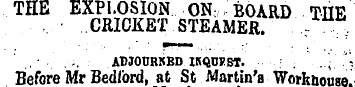
THE EXPLOSION . ON- , ' BOARD THE CRICKET STEAMER . ; . ADJOURKBD IKQnF . BT . . ¦ .. ; . ' . % Before Mr Bedford , at St Martin ' s Worknouse , by adjournment from Monday week , on the bodies of those killed by the above catastrophe . ; Mr M . Chambers , Q . C .. attended on behalf of tho proprietors of the boat : Mr Jameson behalf ofthe Messrs Joyce , the constructors of the vessel and machinery ; and Mr M'lntyre on the part of , the relatives of the deceased John Buckley .
Japhet Edwards , of 6 , Perseverance-place , Rudcliffehighway , stoker , said , in the latter end of June , 1816 , he joined the Cricket as stoker . Remained about six weeks . In the beginning of April last joined again , and remained about a month . That was the last time he was employed in her . Occasionally be drove the engine a journey or two in the absence of tho . engineer , Thomas Claike was engineer in the beginning of April last , After Clarke had been there soma few days the beat lost speed very much . There was a great escape of steam from the trunnions , through Clarke ' s neglect , by the packing not being properly attended to . There were frequent complaints made by . the captain of decrease of speed . At that time Clark tied down both tbo safety valves , hy tieing a piece of spun-yarn from the
lever of tbe valves outside the weight , which was then brought down iu front of the boiler and . attaebed to two spike nails drove in the beam . The string was so tight that when fastened down it was impossible / or the valves to act . Saw the valves in that condition almost continually for upwards of a fortnight . Occasionally tho valves were Jet loose on tho boat coming alongside of the pier , but never when under weigh . Has frequently let tbem go on coming alongside the pier : whan Clarke's back was turned . Clarke always made them fast again the moment he heard the steam going off . and would rebuke witness for lotting them go . Witness frequently spoke to him about it . Told him tbat he had better mind what he was about , or that something would occur . Said to him on one occasion , My life is as sweet
as yours , and though you are fool hardy I am not ; ' and Clarke at once replied , 'My life Is as sweet as yours , mind yoar own business . ' The engines would often get hot . Never saw them get hot except when the valves were tied down or beforeCkrke came on board ,: Never saw them get hot at other times excf pt when the boat had been waiting four or five hours alongside of a pier in foggy weather , with the steam up . The engines would get so hot when the valves were tied donn , that tbey would not condense tbe steam . Witness spoke to the captain repeatedly about it . On one sceasion tbe captain asked him what he thought would happen , and witness said the probable consequence would be ,: that every one ou board would be blown up and killed . On Friday . when Clarke was called on board tbe Bee , an
engineer , named Buttress , came down in bis place , and on seeing the valves tied dowu ho ran over with both his hands stretched out , and unloosed both of them . One Sunday in April two of Clarltc-s friends came oa board , and brought gin with them , Witness , brought another pint o ? ( tin down for them , and Clarke became intoxicated . Witness lot off tho steam and sleekened the fires , and went above . Be heard the steam stop blowing off , and on , going down saw the valves tied . Spoke to Clarke about it . and went and untied the valves . Clarke made them fast again , and told witness to mind his own business . There were 400 persons on board at the time , the bontbeing alongside ihe Adelpbipier . Witness shortly after heard a noise in the boiler ,
as if the plates were stretching , or . giving , and again spoke to Clarke , but without effect , and then went up and spoke to . the captain ofthe danger . There was asteam gauge onboard . Their usual force of going was forty degrees , but when tho valves were tied down the mercury would rise to 44 degrees , and then tbe mercury would get mixed with water and steam , and become confused ,. 60 that no one could tell at what height the gauge was . Never heard what pressure the engine was i ntended to bear , but no doubt that fact was made known to the engineer . As soon as the gauge got up tt > 10 pounds on the square inch the satcty . valves would rise « p and let the steam blow off , unless a pressure were put upon them .
By .-. the jury : l am not certain whether I ever saw the valves rise at thirty . six pounds . I have nothing more to add , except that I have seen Clarke place a fire bar , 'weiRhing about 141 bs . across the levers of the valves , and he would then regulate the pressure by moving that backwards and forwards . When he brought it nearer the end of tho lever there was more pressure . This iras done when the valves wero tied . There was no ill-will between him and Clarke , except that we often had words about the tying down of the valves . Clarke would say , ' Mind your own business ; I must make tbo boat go , and the only way to do that is
to keep tho steam on . ' When I complain-jd to the captain , he told the superintendent . On the Saturday After the occurrence that I hove spoken of on Sunday , I was discharged . I went' to Mr Smith to know the cause of my beirrj discharged . MrSmith soid it was in consequence of the oration Ifmadeon the Sunday before . X said I thought I ought to be commended , instead of being blamed for that , and he said that in consequence of the leud tone in which I spoke to the captain , a gveat ' many persons had left tho bo it . What I said to the captain on the Sunday was , ' If you allow these practices to be carried on by Clarke , sooner or later you will have an accident . '
By Mr James ; When I fhst went on board the Cricket , the boiler and machinery were entirely new . The Coroner : How do you know that ?—Witness : 1 hare sufficient experience to know now machinery . I know that Kent was in the employ of Messrs Jo » ce , and was sent on board on the first working of the engines , [ The witness was here banded a model ofthe top part of the safety valve and a plan of the engine , ar . d explained the mods in which the valve worked , ] The effect of tying down the valve was to create an unfair pressure on tho boilers , and if continued for a long time would wear tbem away . leakage would happen from the package cot being attended to , independent of any defect in the boiler . The leakage of the steam at the trunnions wauld not be at all caused by unsoundness ef tbe boiler .
In reply to Mr M- 'Intyro , tho wi : nass stated that Clarke said to him , ' I do not care a d—n abottt either ifr Joyce or Mr JJeecham . I am put here to make the boat go , and go she must . ' The speed of the boat was increased by tbo tying ; of the valve for a few revolutions , until the engine got hot , and there was lime then lost in cooling it . Several passengers by the Cricket here deposed as to seeing thovalves ^ tied down , and to the danger accruing therefrom . Mr Henry Craice , of 11 , Adam-street , Adelphi , surveyor , examined : I was oh board the Cricket boat at the time of tho explosion . Thero was no escape of steam during the time I was on board . I was on board from four to five minutes before the explosion took place . The boat was attached to tho pier and was afloat at the time .
By } f . v James : I consider that a steamer should not be five minutes at a pier without the steam being let off . I was in the habit of going almost daily by the company ' s boats . Tho boat was just after arriving , and the passengers were coming on shore as I went down to get on board . . .. „ * . ' William Warren , , Diaua-placa , ^ ew-road , engineer , examined : Is employed in the King ' s College workshop . Has been often on board the Cricket , and noticed the safety valves . The first time he noticed them was about ' the middle of April last . On arriving at the Londonbridge pier , he remained on hoard with the intention of returning in the boat to the Adelphi . After a minute or two ho observed that there was no steam escaping , and he then looked into the steam box , and discovered a piece of spun yarn attached to the lever of tbe safety valve . It was tied as near the end farthest from the fulcrum as it could be . Went immediately dowii into the engine room . Saw a man stoking there , but riobody else . On looking
round he saw two ropes attached , one to each valve . There was one valve to each boiler tied . Both the ropes were fiscd to the beam , but whether by nails or staples be could not say . He teuched the rapes arid found them tremendously tight , Tbey wero very tight indeed , and they operated in this way , that the safety valve was no safety valve at all with them . He made an observation to tbe man that was stoking , who said , ' Oh , tbat is nothing . ' Ho replied , 'Oh , ain ' t it . ' He immediately went up and got to the furthest part of tbe boat . Was on board again about tbe end of the same month , and he thi'n found tho valves at liberty , and the steam blew off ivhen tbey got to tbe pier . Was on beard again on the Wednesday or / Thursday before she blew up . Found that both the valves were fastened down then as on the first occasion , Did not go below then , and got . off the boat ns soon as he could . A person doing so often gets into scrapes , and thero is danger of a working man losing hit employment in consequence .
By Mr M In tyre : If the spring valves were not fastened ilown the steam would have escaped from them when the other valves were tied down on the steamer arriving at the pier . Thewitnessbsgged to add that bis opinion was , that the boiler burst from pressure , and not from shortness of water . He considered it was impossible to construct a boiler so thick that it would not burst without a safetyvalve . Mr John D . Smlth ^ of Bedford-square , distiller , was then examined with regard to the ownership ofthe boat ; He stated that the boat was the joint property of himself , Mr William Corry , of Verulom . buildings , Gray . s inn-Iftne , Mr Alderman Thompson , and Mr William Formal ) , of the iron works , London-brlelge . Tbe Crieket boot and macliineiy were built by Mr Joyce , by contract , in 1845 . his vi
Has been constantly on board , hoping by presence keep every thing in order , and tbat those on board did thcui duty . Never heard anything about the safety-valve being tied until tho quarrel between tho stoker and tbs engineer , which they had board of In the evidence . Was in the habit of going below , but did not notice ho valves tied . It was barely possible tbat suck : a thing might have tenmd without his seeing It , as he could not imasine that such a thing would bo attempted , and did . not look for it He had lost one of his eyes during the past vear and could not since then see as well as previously , but still ho thinks ho would have noticed such a thing i £ it had been done . The engineers have tbe power of choosing tli e ' r own Btoka ' . a & il » 8 supposed thst they are bsst able to judge ofthe capabilities of the men . The mar . who made the complaint had not at the time the
-
-
Citation
-
Northern Star (1837-1852), Sept. 18, 1847, page 7, in the Nineteenth-Century Serials Edition (2008; 2018) ncse.ac.uk/periodicals/ns/issues/ns2_18091847/page/7/
-