On this page
-
Departments (1)
-
Text (14)
-

October Id, 1850, -- __ ^ THE N ORTHS R,...
-
MONIES RECEIVED Fob tub "Webk Endiso Thu...
-

Imperial Sarftamenf
-
HOUSE OF LORDS. -Tuesday being the day t...
-
THE BRUTAL CASE OF MANSLAUGHTER BY A POL...
-
THE ROUTE Of MR. ERNEST JONES. Ernest Jo...
-
ADJOURNED MEETING OF THE CONFERENCE OF D...
-
THE PROPOSED CONFERENCE AT MANCHESTER. T...
-
It is proposed that the monument to the ...
-

% pWNOlL OF THE NATIONAL CHARtfEll LEAGU...
-
^BftM Post-office. —A Treasury warrant a...
-
NATIONAL ASSOCIATION OF UNITED TRADES. T...
-
KinDEnMiKisTEn, October 10th.:—A public ...
-
FMooiNo in ™b AMEmcAN Navt^-2 lashes wor...
Note: This text has been automatically extracted via Optical Character Recognition (OCR) software. The text has not been manually corrected and should not be relied on to be an accurate representation of the item.
-
-
Transcript
-
Note: This text has been automatically extracted via Optical Character Recognition (OCR) software. The text has not been manually corrected and should not be relied on to be an accurate representation of the item.
Additionally, when viewing full transcripts, extracted text may not be in the same order as the original document.
Protectionist Prospects. At The Few Prot...
At various other meetings the Landlords and leg islative mouthpieces of the country party havechangedtheirtone , and instead of preaching the oselessness of exertion with Free Trade prices , repeated , like parrots , the homilies of the Free Trade Journals . Mr . ° o ^ , _ Bright , nor the Economist could not hare l * en more earnest in their eulogies onthe virtues of thoroug h draining , deep plough-^ rieiitifDlmanSre andahundanceof capital 2 Cur . Lord SrAAW , the leader of the party in the House of Lords , made a speech at Bury characterised by his
accus-. , tomed eloquence , the tone of -which was anything hut despondent ; and , though he was aware of the apparent inconsistency of such advice with the views habitually inculcated by its organs , justified himself by asserting that the Bury district was an exception to the country in general , and that , though his advice was applicable there , it was not so generally- Above all , the silence of Mr . Diskaeu , and his continued absence from any of these demonstrations , indicates that the Protectionists are disorganised , and have no definitive or matured policy for the future .
What is the cause of this 1 It is not , we can answer for it , because the tenant farmers are more reconciled to the Free Trade regime . They are , on the contrary , more than ever convinced that it will be impossible for them to make heth ends meet , with the low prices which it is now certain will rule in this country . Much nonsense is written and talked by the Free Traders , as to increased production making up for diminished p rices ; but Arming is not like cotton spinning , or calico printing . You cannot raise the average pro-• duction of an acre from three to four quarters
of corn without a very large outlay of capital and labour . Tou cannot get more than one crop from the same field in less than four or five years , according to the nature ofthe soil ; and y ou require to make a constant outlay , in order to keep your Land in heart . "When a mill , or print shop , is once stocked with its appropriate machinery , there is , pracically , no limit to the quantity of yarn or pieces it can produce , except the state of the market , and the obstruction to working twenty-four hours every day of the year , winter and summer , prevented by the Factory Act . Even in an exceptional case , ¦ with which -we are acquainted , and in which
the present occupier of the farm is reaping the advantage of a large capital invested in permanent improvements by his predecessors , present prices are not remunerative . The Land has been within the last ten years increased in productiveness from two to fire quarters of wheat per acre . The present occupier , with the exception of a very slight improved rental , has had nothing to pay for the capital which has caused this large increase , and we can vouch for the farm being managed with as much scientific knowledge and liberality as is to be found anywhere in the country . Yet , it does not pay . What must be the condition of the majority of farmers who have no such advantages ?
Uo * the cessation of the cry for Protection is not caused by any immediate improvement or prospective prosperity among the actual cultivators of the soil . It arises , we suspect , from the convictions ofthe landlords , that it -will not do further to suit their political purposes , by crying out " ruin , " any longer . The farmers may take them at their word , and demand such reductions in rent and taxation as will be commensurate with the
reduction in the price of the crops they rear . That would be doubly inconvenient , it would cut down the patrimonial rent-roll , and curtail political patronage at the same time . The landlords are wise in their generation , and have resolved to leave off crying " wolf , " A movement for equitable rents has changed their tune . Whether their tenants will listen io them , and believe them , is another question . We believe that Free Trade is but the " . beginning of the end , '' and that it will bring about an inevitable revolution in the system of land tenure in this country . It is impossible
that so huge a monopoly as that which now exists in the soil should continue to oppress ] and pauperise a whole people . There is nothing more certain than that comfort , independence , and morality , go hand-in-hand with a general distribution of land among the bulk of any population ; and that squalor , slavery , and -vice , prevail where a few indivduals have appropriated the original g ift of the Creator to all men . If Free Trade , by directing attention to these questions , by rendering the
perpetuation of the great land robbery more and more difficult , should help to hasten a revolution which would give the people their own back again , it will effect more good than its promoters ever dreamt of , and lead to those social changes in the condition of the masses which are decreed by them as the dreams of a benevolent , but distempered brain . One thing is certain , we can never revert to Protection . In the history of nations retrogression is synonymous with destruction— Onward is the word !
October Id, 1850, -- __ ^ The N Orths R,...
October Id , 1850 , -- __ ^ THE N ORTHS R , w " « t a B 5
Monies Received Fob Tub "Webk Endiso Thu...
MONIES RECEIVED Fob tub "Webk Endiso Thursday , October 17 ih , 1850 . roK THE TODINGUP OF THE 1 MB COMPANY . Received at Land Office . —S . > elles 6 d—J . Criston Gd—A- M'Cabe 6 d—W . Sowerby 6 d— W ; Elliott 6 d—C . Wilson 6 d—D . HopMnslsGd . THE HONESTY FUND . Received by W . Bideb . —J . Smith , 2 Tew Swindon-3 s . AGITATION FOR THE CHARTER . Becelred T > y Jons Absott . — Exeter , per T . Carlisle 3 s—3 . Cameron and Friends , Hulmels 8 d-Mr . J ., Westmor land Picfceringls—Emmett ' s Brigade , per J . Blake 4 s . — 21 r . J . T . Fairweather , Arbroath Is .
FOR THE HUNGARIAN AND POLISH REFUGEES . Received by W . Rider . —A Young Socialist Chartist , Edinburgh Is—J . Smith , Sew Swindon 2 s—J . Goodhall and an Old Radical , Leeds Is—Nottingham , per 3 , Sweet 23 s Accrington , per P . Wilshaw 6 s—Manchester , per T . OrmesherlSs—Two Chartists , Crewe Is—From Worcester —C . AppsIs—H . Merrick 2 s—W . Watldns Is—W . Horton 6 d-J . Harding 6 d—G . Cramp Gd—J . Cooks , Sbiocliffe Col liery 3 d—T . Lewis Hagland , per T . C . Ingram Is—Mrs . TurnbuUls .
DEFENCE FUND . Received by W . Rider . —Todmorden , perli . Barker 1 / TRACT FUND . Received by Jons Anxorr . —Mr . J . T . Fairweather , Arbroath Is . FOR TYPEFOUNDERS . Beeeived by Jons Abxott . —A few Tailors , Jermynatreet , per T . Waterfield Is . THE CASE OF THOMAS JONES . Kecdved by W . Bjdfb . —Paisley , per P . Cameron 212 s 8 d —Oxford , per "W " , Drewett 14 s . Received by Jons Anyone—West End Womens * Men , per A . Hanible 21—Glasgow , collected after an appeal by Mr . Ernest Jones , per D , Pan ! 41 Us Gd—Mr . Kider , as per Star 2 J 16 s 8 d—K . Montf ornery , Alexa ndria Gd-IL JI'Farlane , Alexandra 3 d—S . [ organ , per J . lirvson Is—Mr . KeMe , perC . Young Is—Sfwtei Beds , per Mr . Harney Is .
Imperial Sarftamenf
Imperial Sarftamenf
House Of Lords. -Tuesday Being The Day T...
HOUSE OF LORDS . -Tuesday being the day to whichPariiament stood prorogued , her Majesty ' s Commission was issued for the purpose of a further prorogation , pro forma , until Thursday , the 14 th ofthe ensuing month .
The Brutal Case Of Manslaughter By A Pol...
THE BRUTAL CASE OF MANSLAUGHTER BY A POLICEMAN . On Monday evening a most important meeting of 3 > laate « s was held at the Victory Tavern , Edgeware-road , to take into consideration the circum . Stances under which James Geary , a-member o ' that body , Lad met his death , and for the purpose of Obtaining redress for the same . The circumstances hive already been detailed in our Police Report , and a verdict of Manslaughter returned by the jury
against Sergeant Bushel . The meeting was addressed by Messrs . T . Rouse , J . Sand , and T . Ballard . The occasional vile and intemperate conduct of the police was strongly commented upon , and some happy allusions were made to the monument which that meeting would erect to tbe memory of Sir Hubert FeeL It was announced tbat upwards of ill had been collected for the object of the meeting , which was adjourned until Saturday next .
The Route Of Mr. Ernest Jones. Ernest Jo...
THE ROUTE Of MR . ERNEST JONES . Ernest Jones will attend the open-air meeting in Campfield , Manchester , on Sunday the 20 th inst ., and in the evening address the people in the Institute . Hanley , Monday , 21 st . Coventry , Tuesday , the 22 nd . Brother Chartists . —I am unavoidably obliged to decline the many invitations I have
received since leaving Scotland , from the Democrats of Lancashire , lorkshire , and the Midland ; and , as I have now visited and lectured at 50 large towns in England and Scotland , in as many consecutive days , notwithstanding a serious illness which befel me on the route , I am sure that those localities which I have heen obliged to omit on the way , will not accuse me of any intentional neglect of their summons .
As I shall , however , have the honour of being with my friends at Halifax on the 4 th and 6 th of November , I shall be happy on that occasion , to revisit Leeds and Sheffield , pursuant to the invitations received , as also my Derbyshire friends at Holbrook Moor , and to fulfil my promise in reference to Hudderafield and Barnsley . The experience of my tour I will postpone making public until my return to London , since there are several important features and changes in our democratic movement , some of them rife with the greatest danger to our Proletarian classes , on which I am desirous of enlarging more than I can at the present time .
Alas ! the people have ever been their own worst enemies—they have ever played into the hands of their oppressors—they have ever been beguiled by a specious theory , and whec the substance was almost within their grasp , have been deluded into hunting after a shadow ; so they are beginning to do once more !—once more to divide into two great hostile factions . Nothing but a ri g ht direction of their energies is needed to ensure success—oh J may the sp irit of truth , and the dictates of common sense , find entrance in their hearts . I purpose addressing you at length on my return to town , and remain Tour faithful Servant , Ernest Jones .
Adjourned Meeting Of The Conference Of D...
ADJOURNED MEETING OF THE CONFERENCE OF DELEGATES FOR EFFECTING AN IUNION AMONG DIFFERENT CLASSES OF REFORMERS , JOHN STREET , TOTTENHAM COURT ROAD . At the adjourned Conference on Sunday afternoon , Mr . G . J . Holyoake having been called to the chair , tbe roll was called , and twenty-four delegates answered to their names . The minutes of the previous meeting having been confirmed , tbe Chairman stated he had received a letter from Mr . Thornton Hunt , of the Leader newspaper , who was unavoidably absent .
Mr . Habney drew the attention oi the Conference to a report of a meeting of the London Organisation of Trades , which appeared in the Morning Herald , in which report they expressed their entire dissent from the proceedings of that Conference , and thought that if the report was correct their delegates could not , with propriety , continue to sit in that body ; he moved that the report be read . Mr . Suute seconded tbe motion , which was opposed by Mr . Stallwood and others , on tbe ground that they could not notice mere reports . The motion was ultimately carried , and the report read by Mr . Harney , who gave it as his opinion that , although the Conference might receive them as a deputation expressing the views of their body , yet , after their decided dissent from the main principle of their Union , that of a fusion of all parties into one great party , he did not see how they could consistently act as delegates .
Mr . Pattib thought they had a right still to continue their invitation to them . Mr . Delafobcb , as secretary to the Trades' body , explained tbat they did not entirely dissent from the proceedings of the Conference ; the report in the Herald was in many of its features incorrect . The body he represented was opposed to a fusion , and in favour of a Federal Union ; he did intend to give notice of rescinding the motion for a fusion of all parties , which had been passed at the previous meeting . Mr . Bate spoke to a similar effect . Mr . FcsSELt , thought they could not now rescind the motion alluded to .
Mr . Brisck thought that in the present state of the proceedings no delegate could presume to say whether his body would agree to their propositions ; it was therefore their place to finish their business and lay the result before those whom they represented . Mr . Ferdisasdo , as one of the Trades delegates , had voted for the fusion ; he believed it could be I effected without injury to their Trades'
movement . Mr . "Wheeler thought the Trades' body could not be considered as one of the contracting parties , unless they were prepared to merge their organisation and their funds into the union ; but they might still retain their seats , not as Trades' delegates , bnt as private individuals , possessing the confidence of their respective bodies . The Chairman gave it as his opinion that no delegates could legitimately sit who were determined to oppose the decision ofthe majority ofthe Conference ; but as the delegates denied the truth of the report , they might still retain their seats , it depending upon their own delicacy of feeling as to what share they took in the business of tho
meeting . ... Mr . Bates . —If this Conference adopts a plan superior to what I consider our own to be , I shall decidedly advise my body to adopt the best . Mr . Rogers could not agree with what had fallen from the Chairman ; he was decidedly opposed to the fusion , but his body might be of a different opinion to himself . Mr . Harney believed the matter had better rest . The person who sent such an incorrect report to the press was the chief party to be blamed . Mr . Holyoake , as chairman , could not allow the subject to drop without contradicting a statement in the Herald . Mr . "Wilson was made to say that
he could not act with the Conference , because they had struck out the words " legal and peaceable , " and were in favour of violent measures . In giving the casting vote upon that subject , he had only refused to make a profession of faith , he would equally have refused to make a declaration of faith of an opposite character . He trusted tbat contradiction of the report in the Herald would be given to the world . The discussion then commenced on the article in last week ' s programme , entitled " Declaration of Principles . "
Mr . Leko moved , and Mr . Pettie seconded , its adoption , as follows , —" That all mankind are brethren , and are born with an equality of rights . " Mr . Gbassby objected to it ; he had never possessed any rights , how then was he born with them ? Mr . Holyoake thought this clause better omitted ; the aim and end of all civilisation was to acquire these rights ; they were placing that at the commencement which was ,, in reality , the end . Mr . Hooper moved , and Mr . Bates seconded , the omission of the clause .
Mr . Peitie , Mr . Stallwood , and Mr . Leno , supported the motion . Mr . Le Blond moved , and Mr . Grassby seconded , that the clause be embodied with the ensuing clause , and stand thus , — " That all mankind are brethren , : md are born with an equality of rights to enjoy tbe earth with all the native raw material on , and beneath its surface , its seas and rivers , and the atmosphere surrounding it , which are , naturally , the common property of the whole human race . " Mr . Harney supported the original motion .
Mr . Broxterrb 0 Brien moved , and Mr . Wheeler seconded , the following amendment , — " That all mankind are born with equal rights to the free exercise of all their faculties—physical , moral and intellectual , and the free use of all the riches of t he creation , including the land and the raw materials of wealth . " Mr . O'Brien showed , that all despotism began by depriving the people of the blessings of creation , and that the monopoly of the land and other raw materials le J to the enslavement of all the faculties of man . their motion
Messrs . Leno and Pettie -withdrew in favour of that of Mr . LeBlond , which was . carried by a majority of six votes , fifteen being recorded for Mr . Le Blond ' s , and nine for Mr . 0 Brien s . Measures demanded of da Government .- * ' Manhood Suffrage , with the necessary adjuncts thereto , as embodied in the People ' s Charter . " This clause having been moved and seconded by Mesrs . Bezer and Godwin , . Mr Stallwood moved , as an amendment , Ine substitution of the ' word « Universal , ' for Manhood . Mr . Stallwood also proposed , in addition , " That various other measures , such as a graduated property tax , law of partnership , & c , should stand as things to be obtained by means of the Charter , and not as separate demands on the government , as they I ? 8 ^ 0 d in the Programme . " Mr . Rogers seconded the motion .
a long letter from Mr . T . Hunt was then read , explaining his views . •» He was opposed to all petty sectional movements , he had no idea of catching any set of Reformers , and thereby rendering their movement an ambiguous one ; he wished to see such
Adjourned Meeting Of The Conference Of D...
an alliance as should absorb all otne * . Ti ' . and make them subservient to it Whilst struggling for great results , they might still show the people that they were practical earnest ReformV . » an < { keep their friends in good hopes , by attacking a 11 the prominently-felt evils of the day , such as exct >' . ; sive taxation , want of industrial security , improved legislation for the aged and destitute ; they would thus absorb all the agitating power in the community . " The writer then went into the details of a plan of organisation to effect these ends . Considerable discussion arose respecting the propriety of confining the discussion to the first clause . Mr . Pettie said , that as a delegate from the Fraternal Democrats , he represented many who entertained Socialist opinions , and if they meant to strike out all the principles proposed in committee by that body , or render them subservient to the Charter , he should have no further faith in the Conference .
Mr . Blair was of opinion , that if tho Socialists did not believe the Charter to be the means to the end , that any union with them would prove us & lcss . Mr . Milne was surprised to hear the argument advanced by Mr . Pettie ; he knew nothing of party ; he did not come there to represent a party , but for the purpose of forming an union , which would destroy all parties . If they got political power they would speedily get all else that they contended for ; but , if they continued split up into sects , they would experience the same fate which their brethren were then experiencing in France . Mr . Bezer could not support Mr . Stallwood s motion . He had not suffered for a name , but for a
principle ; a name that was incorrect was none the better for being old , and he did not think the delegates would be caught in Mr . Stallwoods' ladies trap . Mr . Harney did not like abandoning the word universal . He was for stating all the principles of the Charter by name , and not under the denomination of adjuncts . He concluded , by moving the following amendment , — "Universal Manhood Suffrage , with the necessary adjuncts therero , as embodied in the People ' s Charter ; to wit , Tote by Ballot , Annual Parliaments , Equal Electoral Districts , No Property Qualification , and Payment of Members , as the most efficient means of obtaining the following necessary reforms . Mr . Fussell seconded the motion .
Mr . Walter Cooper agreed , that they would never get either Socialism or any large system of association , until they obtained the Charter ; but , if they did not retain some of the principles of the Social body , as primary objects , they would think that the Conference was only a trap to catch silly Socialists , and drag them into the excesses of the past . Mr . Holyoake explained , they had ho more business to parade their peace doctrine , than they had to parade Fleet-street with a label on their backs , that they would knock any man down who insulted them . Mr . Pettie briefly explained .
Mr . Bates moved , and Mr . Le Blond seconded , the following : — - " Universal Suffrage , with the necessary adjuncts thereto , as embodied in the People ' s Charter , as the most efficient means of obtaining and securing the following necessary reforms . " Mr . O'Brien , in an able speech , advocated the propriety of confining themselves for the Charter in their demand upon Government , and all uniting in one great union for that object . He concluded by moving a resolution to that effect , which was seconded by Mr . M ' Neil , but afterwards withdraws . Atter a few words from Mr . Milne , the vote was taken with the following result : —Mr . Harney's motion , 14 ; Mr . Bates's motion , 8 ; Mr . Stallwood's motion , 4 ; original clause , 7 ; consequently Mr . Harney ' s amendment on the original clause was adopted .
Mr . Bejer moved , and Mr . Pettie seconded : — " That Mr . Williams , the member for Lambeth , be invited to attend the Conference . " Motion lost . Mr . Milne brought forward the question of Expenditure , which was referred to the Committee , and the Conference adjourned until the ensuing Sunday afternoon . The room was excessively crowded during the whole period of its sitting , and the interest taken in its deliberations seems unabated .
The Proposed Conference At Manchester. T...
THE PROPOSED CONFERENCE AT MANCHESTER . TO THE EDITOR OF THE NORTHERN STAB . Stockport , October 12 th . Sir , —I perceive by Mr . O'Connor ' s letter of yesterday that he calls upon the country to express its opinion in reference to a projected Conference to be held in Manchester at the earliest possible period , and I trust that you will allow me , through the means ofthe Star , to express my approval of the said Conference , which , I think , has been too long delayed ; for if ever there was a time when the Chartists should confer together this is the time—a
time of calmness and thought . We are upon the threshold of a change—a commercial change , which , I fear , will bring misery the most intense—wretchedness the most forlorn , —and a state of things altogether unparalleled iu the history of panics ; this evil all can see and fear , but hesitate to acknowledge . I think that a Conference is highly necessary , in order that the Chartist body may know what course to pursue should another ' 42 occur , and not suffer governmental prosecutions , and receive censure from the Trades for
interference in the " wages question as hitherto . We all feel convinced that the effect of Sir Robert Peel ' s death will manifest itself in the ensuing session of Parliament , which will no doubt end in a dissolution , and bring Lord John ' s ministry to an end ; and we ought to know what course to pursue in the next general election . But , above all , a Conference is necessary to examine and discuss the motives , principles , objects , and intentions , of the so-called Democratic Conference recently held in London , for there seems to be a desire for centralisation , a wish to make the provinces bow to the decision of a London committee . This London Conference pompously announces that it is about to amalgamate all sections of Reformers into one entire body ; it imposes this very difficult task upon itself , without
knowing whether the provinces are prepared to stamp with their approval , this particular union , which says , that twenty-eight gentlemen shall put forth their mandates , striking out a line of policy , and the provinces must obey . The strongholds of Democracy—tbe industrial hives of Yorkshire and Lancashire must have neither hand , act , nor part in the matter , —this is not what I understand by Democracy . This association in embryo is to break asunder the chains of serfdom , and set mankind at liberty , and what are the means by which this is to be accomplished ? Manhood suffrage , and the adjuncts of the Charter . Why , sir , there is an association especially organised for this purpose ; it has been in existence for years ; it has withstood the storm of persecution directed against it by the
government ; it has stood amidst the rums of rival associations , brought into existence for its overthrow , and shall we desert this association ? leave a reality for a shadow ; that which we have for something promised ? Shall we , by breaking up the Chartist movement , successfully accomplish that which the united energies of the government , the press , spies , open foes , and false friends , could never do ? Shall we so far be our own enemies ? I trust not , at least . If we are to have a fresh beginning we will have a vote in the matter ; we will not say that our adherence to the Charter was folly and madness , and leave it for the purpose of taking another document containing the same creed , and say , we are the intelligent portion of society . I am old enough to remember the universal burst of
indignation against that part of the Birmingham Conference which supported Sturge's manhood suffrage and its adjuncts , and the applause given to the Bradford delegates who supported the Charter , name and all . I ask , were we right in refusing the proposition of Mr . Sturge ? and if so , can we be still right if we act differently now to what we did then ? I am aware that there is an addition in the present offer , which says we are to have "free access to the land , a good law of partnership , an efficient poor law , freedom of speech , and national education , " all very proper questions , and those on which the people require some information . But here I again pause to ask , if we cannot get the Charter by itself , how shall we accomplish the Charter and the other things attached ? This is a problem I cannot solve . It is an established opinion that we shall never obtain political or social reform untilthe people are in possession of the franchise . If this be true , why do not all work for this one
point ? And how can any class of reformers better show their honesty than in joining an association which has the mark of the nation ' s approval as a guarantee for its success ? It is unreasonable to desire a numerous body like the Chartists to leave their movement , and join a few , who imagine that we are wrong , and yet acknowledge our principles to be correct . Let them g ive their reasons for not joining the Chartist Association before they ask the Chartists to become members of their new organisation . Sir , from the above you will p erceive that I am not quite satisfied with the new move , and I think that a Conference would have some influence upon this point . I am desirous that all Democrats should be united , but I should not like an union at the expense of those who have suffered in the Chartist cause . The name of the Charter is gall and wormwood to both Whig and Tory , and I will do my best to keep it alive until it is brought to a successful issue . Yours respectfully , James Williams .
It Is Proposed That The Monument To The ...
It is proposed that the monument to the late Duke of Cambridge shall be an asylum for tho destitute .
% Pwnoll Of The National Chartfell Leagu...
% pWNOlL OF THE NATIONAL CHARtfEll LEAGUE TO THE CHAR . TISTS OF THE UNITED KINGDOM .
Gen tlemen . —We have refrained for sometime past from active interference in the proceedings of organisations for Chartist purposes , because a notion existed iu some minds , tnat the policy upon which our slender association is based was opposed to the full developement of an intense desire which was said to exist in the country for a more " veritable " kind of Chartism than that of which we are the humble exponents . We felt that if this really were the case , that those who held themselves to be fit and authorised persons to call out this latent feeling in the popular mind ,
ought to have full time and scope to accomplish what they fancied was their peculiar mission ; and tbe result has shown that they were in error , both with respect to the feeling abroad , and of their own capacity to evoke its slumbering power ; and finding themselves in the presence of unqualified failure , as a last resource , they now propose an amalgamation of-Chartism and Socialism ; that is , a union of the assumed " veritable" Chartist Society with the remnant of the communistic party . It is against this step that we take upon ourselves to address you , under a strong impression that you will never sanction such a
on . We understand the People's Charter to be simply a plan of representative government , having for its basis an electoral body , embracing the entire male adult population of the country ; and as such is onl y a . means of obtaining and preserving popular legislative . authority , therefore , to annex to it any other ism or theory would be to involve a second belief , by no means consequent upon the first-. The , Charter is a definite object , and alone may be sought for by various parties for different ends . Some " ' want national secular educationsome nationalisation of . landed property—some direct texation—some separation of church and state —some altered currency , and various other things ;
all of these may unite for the Charter , " pure and simple , " each hoping by its accomplishment to obtain his own particular desire ; but if " social rights" are to be added , those who cannot agree with this vague term will be debarred from entering into the motley confederacy , and Chartism , which is now regarded as a means of altering and purifying our political system , would then be treated as an attempt to destroy the institution of private property itself ; and thus would its moral influence be dissipated and the number of its opponents increased . Again , the two objects — political reform and " social rights" — are embraced by two distinct parties , each one naturally attaching preponderating importance to its own conviction and a struggle for its supremacy
must , inevitably , be the result of any such combination , were it for the present consummated . All who are acquainted with the leading Socialists of this country are aware how little they care for political reform ; and that with them , such a change as that proposed in the Charter , is viewed as a matter of minor importance when contrasted with what they aim at themselves . Without expressing any opinion for , or against , the policy , of the Owenite party , respecting what we are about to state , we nevertheless name it , as a fact , that during the time when they held an influential position in the country , as an organised body , they gave tho most unequivocal expression to their contempt of political change , —nay , more , it is also a
fact , that democracy itself formed no part of their Social plans ; and that Socialism , as propounded by Mr . Owen , and adopted by the party , did not either contemplate or embody democracy . It will be advisable , then , for the Chartists to weigh well what they are about before they barter that strength required for their own purposes , by union with parties whose , conscientious disregard of democratic reform would make them but lukewarm allies . A result of such a union would also be the assumption of superiority by one of the parties . Already , in fact , has this last feature manifested itself , as from the published reports of what has transpired , it is recorded that a self-sufficient orator remarked— "He was aware ofthe numerical strength
of . tho Chartists , but would they not be benefited by the aid of the advanced mind of the Socialists ?" This , to say the least of it , showed a pretty " advanced " state of modesty on the part of its no donbt learned and gifted author . But the whole object of the union on the one side is thus fully stated : You have the " numbers" the new allies , the " mind : " and hence the bargain is thought to be a good one ; but the matter for you to reflect , upon is , whether this " advanced" mind would be employed in propagating tho political creed ofthe Charter , or the economic and atheistical views of the Socialists ? About this there can be no doubt ; the " advanced " mind would necessarily and-unavoidably be devoted to its own more immediate designs , while the mere political feature would receive its cold support , the Charter would then have to stand sponsor for the irrelevant opinions
upon every subject . Another reason why amalgamation with the Socialists would be in the highest degree injurious to the People ' s Charter , is the fact that for a series of years the Socialists have made war upon the religious opinions of the people , of every sect and creed , and that nearly every man who has represented them upon the platform has appeared publicly as the avowed enemy of all religions . We are not venturing to reflect in the slightest upon those who thought proper to do so , as they followed their convictions in this matter , which they had a perfect right to do ; but when it is considered that the millions of all classes , whose aid is indispensable to the enactment of the Charter , are irrevocably attached to religion as accepted in the country generally , it will be seen how far the champions of Atheism are likely to promote the cause of democracy among such people .
We by no means undervalue the " social rights " of the people , but we are averse to having an object io indefinite attached to the plain and simple political purpose of the Charter . Who can define what social rights are ? Tho opinions ofthe Social Reformers , par excellence , themselves , are as variable upon them as their conceptions upon any other question . We have no other definition than that contained in emasculated . editions of French Communism , and which have been retailed , ad nauseam , under the name of " Organisation of Labour ; " but these expositions have left the question where it was found by the expositors ; and we are committed to the company of the plagiarized authors , to reconcile our difficulties as best we can . We know that tho system of Mr . Owen is perfect , as a system , whatever it may be otherwise ; and , therefore , he is not included in the imperfect or retailing elucidators .
Under these circumstances , we have accepted the proposition of Mr . O'Connor for a Conference of Chartists , to be held at Manchester , at a time to be named by tho Chartists of that town ; and wo have no doubt that , under the management of the council there , arrangements will be made to secure for Chartist opinion a fair and intelligent representation . We strongly advise you to act upon the suggestion of Mr . O'Connor in this matter , as we are prepared ourselves to do . ¦ We have always concurred with him in his opposition to an union of any other ism , creed , or belief , with the People ' s Charter , and we have now but to repeat tho strong conviction which we entertain against the proposed step , and equally recommend you to discountenance the attempt , We are , gentlemen , respectfully , E . Nobbs , R . Side , W . Allnutt , W . Dixon ; P . M'Gratii , President ; T . Clark , Secretary . ^ BftM
^Bftm Post-Office. —A Treasury Warrant A...
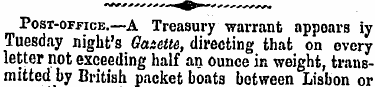
Post-office . —A Treasury warrant appears iy Tuesday night ' s Gatette , directing that on every letter not exceeding half an ounce in weight , transmitted by British packet boats between Lisbon or any other port in Portugal and Madeira , the Canary Isles , tho Capo de Terde Isles , Brazil , Buenos Ayros , or Monto Video , or between tho Capo de Verde Isles and the Canary Isles , Madeira , Brazil , Buenos Ayres , or Monte Video ( without in any case passing through the United Kingdom ) , there shall bo charged and paid in lieu of any rates of postage now payable thereon a rate of postage of one shilling . And further directing that on every , letter transmitted , as is mentioned in this warrant , exceeding half an ounce in weight , there shall bo charged and paid progressional and additional rates of postage as follows ( that is to say ) : —On . every letter exceeding half an ounce in weight , and not exceeding one ounce in weight , two rates of postage ; on every letter exceeding one onnce , and not exceeding two ounces in weight ; four rates of postage ; on every letter exceeding two ouncesand not
ex-, ceeding three ounces in weight , six rates of postage ; and on every letter exceeding three ounces , and not exceeding four ounces in weight , eight rates of postage ; and for every ounce in weight above tho weight of four ounces there shall bo charged and taken two additional rates of postage , and every traction of an ounce above the weight of four ounces shall be charged as one additional ounce , and each progressive and additional rate chargeable under this clause shall be estimated and charged at tho sum which any such letter would be charged with under this warrant , if not exceeding half an ounce in weight .
Ai Hoyxe ' s print works , Manchester , among other contrivances to lessen labour , there is an inclined plane from the upper stories to tho ground floor , down which the little urchins of boys come rattling at dinner time with the rapidity of light-Ping *
National Association Of United Trades. T...
NATIONAL ASSOCIATION OF UNITED TRADES . T . S . Duncombb , Esq ., M . P ., President . Established 18 i 5 K •" hat justitia . " "IF It were possible for tho working classes , by combining among themselves , to raise , or keep up the general tlh ^ g not to be punished , but to be welcomed and rejoiced at _ . j Stuabt Mm .
We regret to find that an expression in our last week s article has led to some misconception among a portion of- our members , We somewhat incautiousl y observed , " The strike may be said to be terminated . " Prom which it has been inferred , in soma quarters , that the necessity for & continuance of the extra levy no longer existed . We sincerel y regret its continuance for a single week ; but we feel assured that our members would severely censure the Central Committee if they withdrew from this contest until a complete and perfect victory had been ohtained . The
most strenuous exertions are being made to procure employment for the men who have been thrown upon the funds of the Association , and the committee have the best grounded hopes that this will he accomplished in a short time . We shall then , at once , relieve our members and friends from this somewhat protracted tax , as the balance due from a few—and we are happy to say , a very few bodies—will form a sufficient fund for such further steps as may be found necessary to influence Mr . E . Perry and his nonconforming friends to concede to our very moderate demands .
We have also been informed , that this crafty personage , with that ' singular duplicity and utter contempt for truth and fair dealing , which has marked his character throughout this disagreeable affair , has been communicating with one of our members in Birmingham , who formerly worked for him , stating " that the strike had terminated , and that all matters were amicabl y arranged , and that he now wanted a few good and steady workmen . " It would give us great satisfaction if Mr . Perry would enable us to endorse this statement . But , he must have known at the time he was telling , or causing to . be told , a deliberate untruth .
To counteract this artful dodge , the Tin Plate Workers' Society have issued the following cautionary hand bill , which has heen extensively circulated through the trade , —
CAUTION TO THE TIN-PLATE WORKERS OP GREAT BRITAIN AND IRELAND . Gentlemen , —In July " last . Edward Perry , Tin-plate Worker and Manufacturer , of Wolverhampton , issued bills and advertised in the newspapers for good and steady workmen at good wages , and a liberal allowance as a & ontti to entice men to his establishment , in order to beat down the already low wages paid at his manufactory . It may be necessary to inform you that during the last fifteen weeks a strike has been going on in this town to compel Messrs . Edward Perry , Richard and Georee Perrv .
Feamcomb , and Thurston , to pay the same price which has been and is being paid by the other manufacturers , and which is fifteen per cent , higher than Perry ' s . The strike upon those four firms has been conducted in a manner highly creditable to our society , the men on strike , and to the National Association of United Trades ( of which T . S . Buncombe , E > q . . M . P . is presidenWOffices , 259 , Tottenhaua-court-road , London . ) During the -nhole period the members belonging to them have been supported at the rate of 12 s . Gd . per ween , with a regularity hitherto unknown in the history of trades' movements . '
In addition to those who are members ofthe Association there is n portion who are not eligible to its funds , which the trade of Wolverhampton has to support . Still , through Mr . E . Perry ' s cunning , and the plausible tale he has told , he has succeeded in inducing some to come to his shop , who have proved worthless , and are now in the deepest distress . They received their bonus and got hired to w . 'i-k at whatever price he would give them . Now they cannot get a living , and some of them have not received any wages for three weeks . This is their position , and now he desires to entrap others by his false promises as he has done them . His liberal allowance consists in advancing two or three pounds , and then deducting it as fast as they earn it !
The trade have been credibly informed that he is again trjing to seduce men who hold situations in factories and shops in various parts of the country ; but we hope tha * secretaries , officers , and workmen will aot lend themselves to assist E . P . in serving himself to the injury of the men and the trade in general . -. Fellow Workmen ;! , We beseech you to prevent , as far as possible , lcgallv , tramps and others coming to this town , and ns soon as it is over you shall be informed of the fact . Remember the words of Nelson , " England expects every man to do his duty . " Signed , by Order of the Trade , Red Cow Inn , Pudley-street , Hv . Rvn-LASDS , Sec . Wolverhampton , Oct . 10 .
That these desperate and unprincipled eiforts to reduce the wages of labour , are injurious to the best interests of the . country is , we believe , generally admitted by all thinking people , except , perhaps , by that class of politicians known as the " Manchester School . " If it is true that low wages are nationall y beneficial , let the principle be carried out to its utmost limit . Bring down the wages of the British labourer to the Irish standard , and what becomes of that large and important class—the retail dealers of our cities , towns , and villages ?
If there is a class of men whose interests are more deepl y and intimately blended with the wages question than another , it is surely this latter class . The difference between fifteen shillings and twenty shillings is really of scarcely so much importance to any individual of five thousand , engaged in the mechanical and other handicrafts , of such a town as Wolverhampton , as the important difference between the weekly outlay of £ 5 , 000 and £ 3 , 750 , divided between ,, perhaps , thirty , forty , or perhaps , fifty retail dealers . If we divide this
difference , £ 1 , 250 , between the latter number , we shall discover , that by the ingenious alchymy of the Perry school , each of these fifty dealers are mulcted of the weekly profits which would accrue to them upon the receipt over tho counter of £ 25 ; and we think it would bo a very poor consolation to either of the five thousand men , who are thus robbed of their £ 5 , or to the fifty individuals who are deprived of , perhaps , a weekly £ 5 , to he told that their losses had contributed to fcuild up a splendid fortune for some half dozen Perrys . We believe this to be a faithful illustration of
the cheap production and low-wages dodge . And we rejoice to learn , that a number of respectable and influential tradesmen in Wolverhampton , take this view of the , question . We aro not surprised to find , •¦* that a very strong opinion has been elicited in * favour of our Wolverhampton members , for certainly , never were a body of working people so completely in the ri ght , or a set of unprinci pled capitalists more thoroughly or disgracefully in the wrong .
In order to concentrate , and give a more potent embodiment to this powerful agent , it has been-decided on to convene a public meeting of the inhabitants . The Theatre Royal has been engaged for next Tuesday evening , and we expect that so strong an expression of public indignation will he evoked , that even the obdurate Perry will be softened into a more amiable spirit . Several influential inhabitants and tradesmen , have kindly co-operated in the undertaking , and have proffered their aid and talents for the occasion . A
mixed committee of working men and these gentlemen , have heen appointed to conduct the arrangements , and some very important resolutions have been prepared , which , together with a report of the meeting , wo hope to present to our readers next week . "We look upon , this alliance between two classes whose interests are so closely connected , as a most important and favourable event , undone which we shall always strenuously support . Whether upon political , social , or moral considerations , wo know of nothing so eminently desirable as a defensive alliance between two classes , alike the prey and slaves of the two gigantic monopolies—power and
money . We are pleased to see that gulf of pride and prejudice , which has hitherto divided these two important portions of society , being gradually bridged over . We are proud to have witnessed our fellow workmen educating themselves up to a higher standard . The cheap press and the cheap lectures , have powerfully contributed to this end , the sneers of the leading jouvual to the contrary , ^ withstanding ; m <
National Association Of United Trades. T...
' ~~ , v "uid , we hail with the hi ghest on the flther h » Monces ^ j , come m satisfaction * , those ev « . ~ - -n - ^ ; 800 . frequentl y unolT MH notice , Of ft ftinuij _ . . sition on the part of what is tisiiall y ' iem $ the middle classes , to' Co-operate with , to aid and promote the well-b ^ g of their poorer brethren . Yes , it is good dM fitting that there should be an alliance between the producers and distributors of the nation's wealth . They are both useful labourers in the vineyard , and shouM be the first , and largest partakers of its fruits . The destruction of th »
one will he hut the precursor to the downfall ofthe other . Low wages will accomplish this . It has accomplished it in Ireland , where , except in the few larger cities and towns , there is literally no middle class ; . unless , indeed , agents , bailiffs , process-servers , and drivers , may be so called . And to this condition , unless this cheap mania is met by a stern and determined defiance , must this country rapidly descend . Of what earthly importance , or value , in a national sense , are the thousands of famishing , pauperised victims , to the abominable Sweating Boxes and Jew Slaughter-houses of London
and' our large provincial cities and towns ? In what manner does their unrequited labour contribute to the wealth or greatness of the nation ? Their labour has undergone Mr . Perry ' s cheapening process , and there they are , broken down in body , mind , and morals , candidates for admission to the pauper bastiles , the gaols , and the hulks . If this mad mania for the " cheap and nasty , " is not resolutel y opposed , these Hndsons of trade will involve both the middle and working classes in one common ruin as effectually as that king of swindlers would have reduced the railwayproprietary , if a timely check had not been given to his infamous career . This system , combined with the rapid introduction and
monopoly of machinery , which makes the idlers which the others feed on , is making a fearful inroad upon the rights of labour . We are no enemies to the introduction of machinery , hut we have an imprescriptible vested ri ght in our labour , and that right ought not to be destroyed by any agency without . compensation to the sufferer . We are greatly mistaken , if a multitude of precedents may not be found in support of this principle . It is true , that a man may he called upon to part with his possessions for the public good , but public justice awards him compensation , His labour is the poor man ' s freehold , and he has nomore right to be deprived of it , without compensation , even for the public good , than the rich man has to be deprived of his houses or lands .
But we fear that justice is not likely to he done to labour upon this point , by any legislature , or by any party .- Labour must do itself justice . And here labour , nationally associated , presents itself as the first indispensable requisite , before even the first step can be taken to work out our emancipation . With our present imperfect union we are kept in constant conflict with a powerful and uncompromising foe . Wo successfully beat him down in one form to-day to encounter him in some other shape to-morrow .. While the great master evil , the cause and source of ail our misery , an over-gorged labour market , although removeahle almost without any
sacrifice , remains by us , unheeded , uncared for . We are told , sometimes , of the difficulty and the impracticability ofthe working class effecingthrs or any other good for themselves . That they must look to others for their deliverance to the Jupiters of power—we dispute it . We know nothing of difficulties but as things thrown in our way to be overcome . We know nothing can be impracticable on a large seale which has a thousand : times heen proved practicable upon a small one ; and as for these Jupiters , to whom we are advised to look up to extricate us from the slough -we are in , we fear that as long as they are so largely partakers in the spoils which the jackall capitalists rob us off , they are very unlikely to interfere in our behalf .
The fact is , these objections are mere bugbears , conjured up by some of the most dangerous enemies of the working classes , though frequently of their own order , and high in their confidence . The only great difficulties in the way are their personal prejudices , and their jealousies , and want of confidence in each others honesty of purpose ; and these are just of that class of difficulties which this- Association was called into existence to overcome , ft
is our mission . We have -laid siege to this mighty citadel of prejudices and jealousies We have been patiently undermining this redoubtable fortress ; and when these tedious , but indispensable preliminary operations are sufficiently advanced , we shall he-prepared to assume the glorious , though somewhat dangerous honour of mounting the > breach , and with gallant daring possessing ourselves of the strong hold of the enemy . But to descend from our aerial fli ght . We look , forward to this meeting at Wolverhamptonj and to one which the Committee have arranged shall be
held in Birmingham on the following ( Wednesday ) ' evening , with great interest . We believe they will have a great influence upon the issue of this contest , and contribute greatly to the advantage of our movement .. The question upon which the inhabitants of Wolverhampton will he requested to give a verdict , is , whether it is just , or conducive to the public interests , thatthe wages of labour should be unnecessarily and arbitrarily reduced , merely for the purpose of administering to the avaricious propensities of two or three extortionate individuals ?
We shall await that verdict with perfect confidence . William Pbbb , Secretary .
Kindenmikisten, October 10th.:—A Public ...
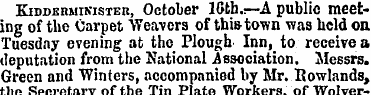
KinDEnMiKisTEn , October 10 th .: —A public meeting ofthe Carpet Weavers of this town was held on Tuesday evening at the Plough Inn , to receive a deputation from the National . Association . Messrs . Green and Winters , accompanied by Mr . Eowlands , the Secretary ofthe Tin Plate Workers , of Wolverhampton , were present , and were well received by a numerous gathering' ofthe Carpet Weavers . Upon the chair being taken ,, and the objects of the meeting explained , Mr . Green was called upon , and entered into a lengthened history of the rise and progress of tho National Association of United Trades , showing the difficulties it had surmounted , and the immense benefits it bad been enabled to
confer upon those bodies who were connected with it . The interesting narrative was listened to with deep attention , and evidently made a strong impression upon those present . Tho speaker was greeted with loud applause . Mr . Winters followed ' , and gave a " plain unvarnished talc , " of tho Wolverhampton strike irom its commencement , showing in vivid colours tho conduct of Mr . E . Perry throughout the proceedings , his sincerity , and his unscrupulous , efforts to force men to sign his detested bonds . A strong ieelins ; of indignation was called fosih as tho speaker proceeded ,, and , at the termination ofthe address , the room rising again with shouts of deep and powerful indignation , at the heartless conduct of this Prince of Tyrants .
Mr . Rowlands , of Wolverhampton followed Miv Winters , and corroborated , from his own personal knowledge , the tacts which had been adduced . The Chairman made a few remarks , when tho following resolutions wore unanimously adopted . " That the meeting having heard the principles of the Kational Association explained , consider a union of our trade with thai body is calculated to benefit us . We therefore- sesolve to stand firm to that union , and to recommend every working man to follow our , example , whether of our trade or any other , and it is further resolved , tbat we highly approve of the proceedings of tho Central Committee , and their determination to defend the case of the Wolverhampton Tin Plate workers against the dishonest and oppressive conduct OT tkeir employers , 3 nd ^ e resoJvo to cont . nue our payments , to enable them to obtain their desirea object . " Moved by Mr . Henry »*?" , - - conded by Mr . Jacob Bill . It was tto rMjJ - "Thata copy ofthis resolution . be forwarded for insertion In the Northern Star .
Fmooino In ™B Amemcan Navt^-2 Lashes Wor...
FMooiNo in ™ b AMEmcAN Navt ^ -2 lashes wore administered on board the United g ^ = 3 oop-of-war Albany , which lately arrived at . Boston after a cruise of about twenty-one months . She was commanded by Victory M , RaadQlph .-. flfew fork Tribune , _
-
-
Citation
-
Northern Star (1837-1852), Oct. 19, 1850, page 5, in the Nineteenth-Century Serials Edition (2008; 2018) ncse.ac.uk/periodicals/ns/issues/ns2_19101850/page/5/
-