On this page
-
Departments (1)
-
Text (5)
-

" ' THE POLICY OF A GENERAL June 23, 184...
-

THE POLICY OF A GENERAL AMNESTY, g (From...
-

E0TAL PoLTTEcnxic Ixstitdtiox. —Mr. Russ...
-

ftngtrfca Uarltament
-

- MONDAY , June 18. /t HOUSE OF LORDS.—T...
Note: This text has been automatically extracted via Optical Character Recognition (OCR) software. The text has not been manually corrected and should not be relied on to be an accurate representation of the item.
-
-
Transcript
-
Note: This text has been automatically extracted via Optical Character Recognition (OCR) software. The text has not been manually corrected and should not be relied on to be an accurate representation of the item.
Additionally, when viewing full transcripts, extracted text may not be in the same order as the original document.
" ' The Policy Of A General June 23, 184...
' June 23 , 1849 . " - THE NORTHERN STAB . 7
The Policy Of A General Amnesty, G (From...
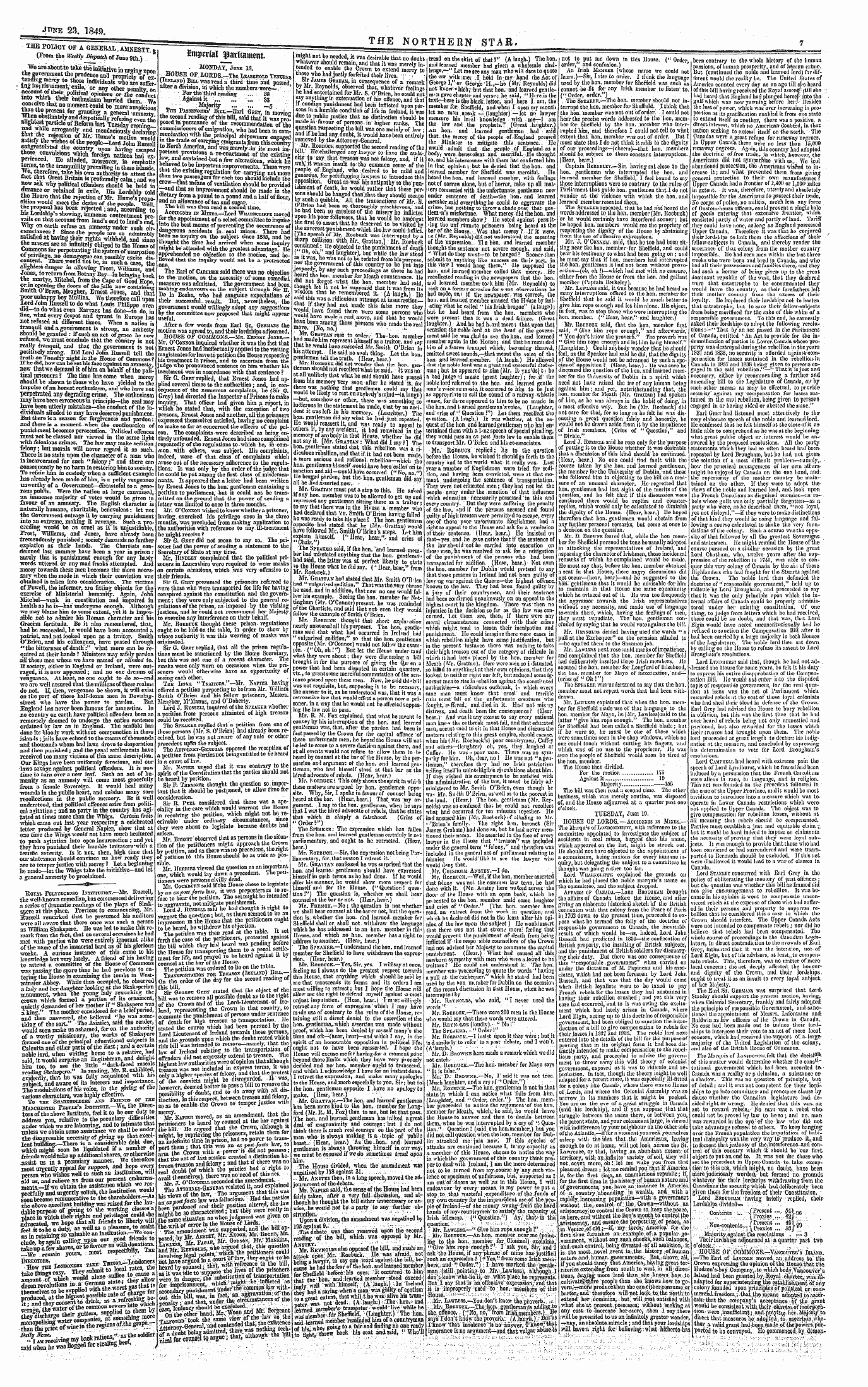
'THE POLICY OF A GENERAL AMNESTY , g ( From the Weekly Dispatch of June 9 th . ) We are about to take initiative in m-crincr Bpon the government . theprudence and propriety of S tendirg mercy to those indi TidnalOTS > -Sl £ " ingimirmnment . exil or any other peSfon into vvhich their enthusiasm hurried then £ ffiff- ? " ^ r fent C 0 HW * e ie Si 6 ious *^ n tbe present for granting a general amnS When obsti nately and despotically refusing ™; + if * S ? S ? ^ £ ? t -2 ? "W ^ -- ??* mendaciously dedarV Satisfy the wishes ofthe people—Lord John Russell congratulated _ the country % inon ^ rin " f ?^ had . n - ^^ i ^ ,..:
™ r ? mZ ^ -ons ^ hich foreign nations W penenced . He alluded , moreover , in emphatic tS ^ S , ? ^ fl ™^ Prevailing in these islands fw + w 5 ^ j $ ? l -J ™ authority to attest the lact that Great Bntam is profoundly calm : and we now ask wh y political offenders should be held in durance or retained in exile . Dis Lordship told the Home that the rejection of Mr . Hume ' s proposition would meet the desire of the people Well cheproposalhas heen rejected ; and , according to his Lordship s showing , immense contentment prc-Taus on that account from land ' s end to land ' s end Why on earth refuse an amnestv under such ch-1 « S a fi : - Sinc * he P e le so admirably satisfied at having their rights withheld , and since the
masses are so infinitely obliged to the House of Commons for perpetuating the system of usurpation Ot pnvilege ^ no demagogue can possibly excite discontent There . wouldnotbe , in such a case , the slightest danger in allowing Frost , Williams , and Jones , to return from Botany Bay—inbrin « ono- back the martyr , Mitchel , from the Cape of Gk ? od Hope Or _ m opening the doors of the jails now containin g Smith O Bvien , Meagher , Ernest Jones , and that Toorunhappy boy Mullins . T 7 e therefore call upon lord John Russell to do what Louis Fhihppe even -did—to do what even Ifarvaez has done—to do in fine , what every despot and tyrant in Europe lias not refused at different times . When a nation is tranquil and a government is strong , an amnestv
snouldI be "ranted : if such an act of grace be now refused , we must conclude that the country is not really tranquil , and that the government is not positively strong . Did Lord John Russell tell the truth on Tuesday night in the House of Commons ? 3 f he did , how can he set his face against an amnestv * now thatvre demand it of him on behalf ofthe poli tical prisoners ? The time has come when mercy should he shown to those who have yielded to the impulse of an honest enthusiasm , and who have not perpetrated any degrading crime . The enthusiasm may have been erroneous in principle—the zeal may have been utterly mistaken—the conduct of the individuals alluded to may have deserved punishment . But there is a season for forgiveness and pardon :
and there is a moment when the continuation of punishment becomes persecution . Political offences -must not be classed nor viewed in the same li ght - ¦ frith felonious crimes . The law may make seditfon felony ; hut morals -will never regard it as sueb . There is no stain upon the character of a man who 13 incarcerated for such "felony ; " and there can consequently be no harm in restoring him to society . To retain him in custody when a sufficient example has alread y been made of him , is a petty vengeance Unworthy of a Government—distasteful to a generous public . Were the nation at large canvassed , an immense majority of - rotes would he given in
favour of an amnesty . Tbe English character is naturally humane , charitable , benevolent : let not the Government outrage it by carrying punishment into an extreme , mating it revenge . Such-a proceeding would be as cruel as if is unjustifiable . Trost , "Williams , and Jones , have already been tremendously punished ; society demands no further expiation at their hands . The Chartists condemned last summer have been a year in prison : surely this is punishment enough for any hasty words uttered or any mad freaks attempted . And mercy towards these men becomes the more necessary when tbe mode in which their conviction was
ootained is taken into consideration . The victims of Powell , the informer , are fitting objects for the exercise of Ministerial humanity . Again , John Mitehel—weak in constitution and impaired iu health as he is—has undergone enough . Although we may blame him to some extent , yet it is impossible not to admire his Roman character and his Grecian fortitude . Be it also remembered , that , had he succeeded , he would have been accounted a patriot , and not looked upon as a traitor . Smith O Brien , and his colleagues , have passed through "the bitterness of death : " what more can be required at their bands ? Ministers may safely pardon all these men whom we have named or alluded to .
If society , either in England or Ireland , were outraged , it is now appeased ; and no one dreams of vengeance . At least , no one o ug ht to do so—and we are well assured that the millions of these realms do not . If , then , vengeance be shown , ifc will exist on the part of those half-dozen men in Dovniingstreefc who have the power to pardom But Eng land has never been famous for amnesties . In no country on earth have political offenders been so remorsely " doomed to undergo the entire sentence ordainedby law as in England . The scaffold has done its bloody work without compunction in these islands ; jails have echoed to the moans of thousands and thousands whom bad laws drove to desperation and then punished ; and the penal settlements have received too many victims of this same description . Our Kings have been uniforml y ferocious , and our laws savage against political offenders . It is now
time to turn over a new leaf . Such an act of humanity as an amnesty will come most gracefully -from a . female Sovereign . It would heal many -wounds in the public heart , and subdue many sore recollections in the public memory . Be it well iznderstoo J , that political offences arise from political agitation ; and no partv in the country has agitated at times more than the Whigs . Certain facts -which came out List year respecting a celebrated letter produced by General Napier , show that at one time the Whigs would not have much hesitated to push agitation into open insurrection ; and yet thev have punished their humble imitators-with a terrific severity . Is it not , then , high time that our statesmen should convince ns how ready they are to temper justice with mercy ? Let a beginning 7 > e made—let the Whigs take the initiative—and let a general amnesty be proclaimed .
E0tal Polttecnxic Ixstitdtiox. —Mr. Russ...
E 0 TAL PoLTTEcnxic Ixstitdtiox . —Mr . Russell , the well-known comedian , bas commenced delivering a series of dramatic readings of the plays of Shakspere at this place . Previous to commencing , Mr . llnsscll l-emarked that he presumed his auditors were all aware that there once was such a person as William . Shakspere . lie was led to make this remark from the fact , that on several occasions he had met with parties who were entirely ignorant alike ofthe name ofthe immortal bard as of his glorious ¦ works . A curious instance of this came to his inowledgc but very lately . A friend of his having to attend a committee of the House of Commons was passing the spare time he had previous to enterin" - the House in examining the tombs in "Westminster Abbey- "While thus occupied , he observed a ladr and her daughter looking at the Skakspcrian
monument , when the young lady rem .-mur . g uncrown which formed a portion of its ornament , ouictly demanded of her mother if " Shakspere was a kin" The mother considered lor a brief period , and then answered , she believed "he was something of the sort . " The Asiatics , said the reader , would soon make us ashamed , for on the authority of a woitbv missionary , the works of Shakspere formed oneof the principal educational subjects in Calcutta and other parts of the East ; and a certain noble iord , when writing home to a relative , had said , it would surprise an Englishman , and delight lum too , to see the little " dark-faced rascals reading Shakspere . " In reading , Mr . It . exhibited , evidently that he was fully acquainted with his suhiect / and aware of its interest and importance . The modulations of his voice , id the giving ofthe various characters , was hig hly effective .
To THE ShAKEHOEOEKS ASJ > FMESBS OF THE 3 L \ xcnESTEK Peopie ' s Lxstitcie . —We , the Directors of the above Institute , feel it to be our duty to address you , relative to tbe pecuniary difficulties under which we are labouring , and to intimate tnat unless we obtain some assistance we shall be under the disagreeable necessity of g iving up that excellent buflding . —There is a considerable debt due , which might soon be liquidated if a number ol friends would take up additional shares , or otherwise assist OS in a pecuniary manner . TYe therefore ™ nrtnrwnflv anneal for support , and hope every
person who wishes well to such an »» W « J «^™| aid ns , and relieve us from our present embarrasments-Ifwe obtain the assistance which we res--pSyaM urgently - **<* . * ¦ T ^ rs ^ As ioon become remunerative to the shareholders . —As the above excellent building was raised for the laudable ouroose of giving to the working classes a S % WShthl 4 ^ in ^ v ^ wm l ^ ncated . we hope that all friends to liberty will fST & TdntyV as well as a p leasure , to assist f ^ m rSto- ' SO valuable an institnt . on . -VVe , cwi- S oS * DrsECioBS . , . „„„ , __ .. tmxcs -. "Londoners How IB ! LosDosERs - - ^ . , ™& rates , the take things ea ^ y . ** U ^ %£ _ f to cause a amount of which , would alone smncc ¦ --. — . - - *—j « t i « na in a German state , " » j , . -
Sebverto ^ Wp lied ^ ftSff SK * ^ produced , at the ^^ i ^ £$ ^ belt ; ^^ J ^^ il __^ JiSS lo . J ^ Se ^ cS ^ ^^ - ^ s ^& ^ Dail y Hews . ' t „„ i- «« nns" astihe soldier 4 ^ re cm ^ my tocUations , said when he was flogged for stealuv . oce
Ftngtrfca Uarltament
ftngtrfca Uarltament
- Monday , June 18. /T House Of Lords.—T...
- MONDAY , June 18 . / t HOUSE OF LORDS . —The Leasehold Tenches I Ihelaxd ) Bni was read a third time and passed alter a division , hi which tbe numbers were— ' Porthe'third reading ... - 38 Against it ... ... ... 33 _ . ' . Majority ... ... —g The Passengers' Bill—Earl Gret , in movintr tbe second reading of this bill , said that it was nr < £ posed in pursuance of the recommendation ofthe commissioners of emigration , who had been in communication with the princi pal shi engaged
powners f n Sf ^ A ** " * " $ ? - -g ««> tsfrom this country to ^ orth America , and was merel y in its most important provisions a re-enactment of the existing S' ^ f" ta ^ ed -but a few alterations ,, which he believed to be important improvements .. These were that the existing regulation for carrying not more tnan two passengers for each ton should include the CrCW J ? iT atmean 9 ofventilation shouldbeprovided —and that an improvement should be made in the dietary from a pound to a pound and a half of flour , and an allowance of tea and sugar . The bill -was then read a second time .
Accidents in Mixes . —Lord "Wiiarncliffe moved for tbe appointment of a select committee to inquire into the best means of preventing the occurrence of dangerous accidents in coal mines . ; There had heen no inquiry on the subject since 1835 , and he thought the time had arrived when some inquiry might be attended with the greatest advantage . He apprehended no objection to the motion , and believed that the inquiry would not be a protracted one .
The Earl of Carlisle said there was no objection to the motion , as the necessity of some remedial measure was admitted . The government had been making endeavours on the subject through Sir H . De la Beche , who had sanguine expectations of then- successful , result . But ,. nevertheless , the government would willingly adopt any suggestions by the committee now proposed that might appear useful . . - ¦ -- ; After a few words from Earl St . Germans the
motion was agreed to , and their lordships adjourned . HOUSE OF COMMONS . —Mr . Ernest Jones . — Mr . O'Connor inquired whether it was the fact that Ernest Jones had ineffectually applied to the visiting magistratesfor leaveto petition the House respecting his treatment in prison , and to ascertain from tbe judge who pronounced sentence on him whether his treatment was in accordance with that sentence ? Sir G . Gre replied , that Ernest Jones had applied several times to tbe authorities ; and , in consequence of the numerous complaints , he ( Sir G . Grey ) had directed the Inspector of Prisons to make inquiry . That officer had given him a , report , in which he stated that , with the exception of two persons , Ernest Jones and another , all the prisoners
expressed themselves satisfied , having no complaint to make so far as concerned the officers of the prison . The complaints were described as being entirely unfounded . Ernest Jones bad since complained repeatedly of the regulations to - which he , in common , with others , was subject . Eis complaints , indeed , were of that , class of complaints which arose out ofthe necessary adherence to the regulations . It was only by the order of the judge that he could be put among the first class of . misdemeanants . It appeared that a letter had been written by Ernest Jones to tbe bon ; gentleman containing a petition to parliament , but it could not be transmitted on the ground that the power of sending a letter was limited to once in three months .
Mi * : O Conxok wished to know whether a prisoner , having , exercised his privilege once in the three months , was precluded from making application to tbe authorities with reference to any ill-treatment he might receive ? Sir G . Gjiex did not mean to say so . The prisoner had the power of sending a statement to the Secretary of State at any time . Mr . Hindlet complained that the political prisoners in Lancashire were required to wc * vr masks on certain occasions , which was very offensive to their friends .
Sir G . Gbet presumed the prisoners referred to were those who were transported for life for having conspired against the constitution and the government ; they were only subjected to the general regulations ofthe prison , as imposed by the visiting justices , and he could not recommend her Majesty to exercise any interference on their behalf . Mr . Roebuck thought these prison regulations ought to be laid on the table , in order to show by wlfose authority it was this wearing of masks was orisiinatcd . Sir G . Grey replied , that all tbe prison regulations must be sanctioned by the Home Secretary , but this was not one o a recent character . The masks were only worn on occasions when the prisoners would otherwise have an opportunity of seeinsr each other .
Thk Irish " Traitors . "—Mr . Xapieh having ofil-rcd a petition purporting to be from Mr . William Smith O'Brien and his fellow prisoners , Messrs . Meagher , M'Manus , and O'Doherty . Lord J . Russell inquired ofthe Speaker whether a petition from persons attainted of high treason could be received . The Speaker replied that a petition from one of those persons ( Mr . S . O'Brien ) had already been received , but be was not aware of any rule or other precedent upon tbe subject . The Attorney-General opposed the reception of a petition from parties not being entitled to be heard in a court of law . _ Mr . Napier urged that it was contrary to the spirit ofthe Constitution that the parties should not be heard by petition . , . ' Sir P . - Thesiger thoug ht the question so important that it should be postponed , to allow time for
consideration . Sir R . Peel considered that there was a speciality in the case which would warrant the House in receiving the petition , which mig ht not be receivable under ordinary circumstances , smce they were about to legislate because doubts had arisen . . ,, ., Mr Bright observed that as persons in the situation of the petitioners might approach the Crown bv petition , and as there was no precedent , the right of petition td this House should be as wide as possible . . ¦ ¦"' . ' .
Mr Herries viewed tbe question as an important one , which would lay down a precedent . The petitioners were persons civilly dead . , Mr Cockbcrn said if the House chose to legislate bYancxjTostfaetoLiw , it was preposterous to refuse to hear the petition . The actmightbe intended to asgravatc , not mitigate punishment Lord J . Russeix said he had thought it right to surest the question ; but , as there seemed to be an impression in the House that the petitioners ought to be heard , be withdrew his objection . The petition was then read at the table . It set forth the case of tbe petitioners , protested against Scbil which tbcv had heard was pend ing before the House for transporting them to a pena settlement for life , and prayed to be heard against it by counsel at the bar of the House . _ The petition was ordered to he on the tabic .
Transportation for Treason ( Ireland ) Bill .-On the order of tbe day for the second reading of th George Grey stated that the object of the Mil was to remove all possible doubt as to the right of the Crown and of tbe Lord-Lieutenant- of Ireland representing the Crown m that country , to commute the punishment of persons under sentence Of death for hi g h treason to transportation He stated the course which had been pursued by the Lord Lieutenant of Ireland towards these persons , and the "rounds upon which the doubt rested which this bill was intended to remove—namely , that the law of Ireland relating to the transportation ^ of offenders did not expressly extend to treason The hi-rhest law authorities were of opinion thatalthough treason was not included in express terms , it was SSvani-hcr species of felony , and that the protest
of the convicts might he disregarded , it was , however , deemed bettor to pass a % ill to remove the possibility of doubt , and to do away w itha lI dis-Imction , \ n this respect , between treason and felony , so as to enable the Crown to temper justice with m 2 vATiER moved , as an amendment , that the petitioners be heard by counsel at the bar again the bill . He argued that the Crown , althoug h it mi < mt , by reprieving the prisoners , retain them for anlndefinUe time in p rison , hadno power to transport them ; that this was an ex post facto law , to arm the -Crown with a power it did not possess ; rhatthe act of last session created a distinction betS ^ treason andfelony ; and that if there was no rea ? doubt ( of which the parties had £ right to avail themselves ) , there was no need of this act . Mr J O'CoxxEix seconded the amendment . : The Atioiunet-Genebal resisted it , ^ nd exn amed ,. „ Af thp law The argument that this was X ^ i /« 2 S " wasmllncifus , Hadthe-tes ^ . rf nardoned and their position altered , the -law
i « £ rh > hp so ch aracterised ; but tney were « .. « , ... Esmne & £ & as when judgment was given on ihe writ ' of error in the House of Xords . . ,,. * The amendment was supported , and the bill op' a wlilr Anstet , Mr . Keooh , Mr . Roche , Mr . posed , ; by ^ , A Nsi ^ , ^ . Mr ; Monsell , ^^ - t ^ oSs who argued that , this question and Mr . ^ S ^ hfch'the petitioners could myolvmg legal P ° -f ^ of . & w , they might -to be Dot have , argued m a court , ^ „ heard by ^ . « 4 i lives 0 f the prisoners ^ - ^ --S ^ 'rt ^ S tiition of . trM 8 pWtibii SbS punishment underthe common law withseconoarjj" »^ . ^ .. . j ^ aggravation . of the out this bill , was , in lact , di . ^ B , ., „ -,, .,.
penalty ; and that , unuer ^ ue ^» - » - ~ -- " -- , --^ S ^ i'S ^ oipij-gS ^ S ^ S ^ Pg M ^ mnm
- Monday , June 18. /T House Of Lords.—T...
might not be needed , it was desirable that no doubt whatever should remain , and that it was merely intenoed to enable the Crown to extend mercy to those who had justly forfeited their lives , r / - . Sir James Graham , in consequence of a remark by Mr Reynolds , observed that , whatever feelings he had entertained for Mi-: S . O'Brien , he could not say anything in extenuation of his offence , and that if condign punishment had been inflicted upon persons m a humble condition of life in Ireland , it was due to public justice that no distinction should be made in favour of persons in higher ranks . The Question respecting the bill was one mainly of law ; and ifhe had any doubt , it would have been entirely removed by the Attorney-General . / -Mr . Roebuck supported the second reading ofthe -
bill . Hechallenged any lawyer to have the audacity to say that treason was not felony , and , if it was ; it was an insult to the common sense of the people of : England , who desired to be mild and generous , for pettifogging lawyers to introduce this opposition . Great as was" his antipathy to the punishment of death , he would rather that these persons should be hanged than that they should escape by such a quibble . All the transactions of Mr .-S . 1 ? S i . been so thoroughly mischievous , and he bad been so careless of the misery he inflictec upon his poor followers , that he would be amongst the first to assert that he deserved to be visited by the severest punishment which the Jaw could inflict . U he speech of Mr . Roebuck was interrupted by a sharp collision with . Mi-.. Grattan . ] Mr . Roebuck continued : He objected to the punishment of death
I un , on and laughter ) , but while the law stood as it was , he was not to be twisted from his purpose nor the government of this country to be put into jeopard y , by any such proceedings as those he had heard the hen . member for Meath countenance . He did not forget what the hon . " member had said though let it not be supposed that it was from its wisdom that he remembered it , ( A laugh , ) He said this was a ridiculous attempt at insurrectionthat if they had not made this false move they would , have found there were some persons who wouia have made a real move , and that he would nave been among those persons who made the real move . ( 2 Jb , no . ) ¦ . ¦* - L n ^™ \ ??™ r se *<> ° . < Jer . - The-hon . member iiaa made him represent himself as a traitor , and w that he would have suceeded Mr . Smith O'Brien in his attempt . lie said no s » ch thing . Let the hon gentleman tell the truth . ( Hear , hea--. ) ;
Mr . Roebuck did hot wonder that the hon . gentleman should not recollectwhat he said . It wasno at all unlikely that what he said should have passed trom his memory very soon after he stated it . for there was nothing that gentleman could say that would be likely to rest on anybody ' s mind- ! a tough' ) —but , somehow or other , there wis something so ludicrous in the statement he made , that by an accident it was left in his memory . ( Laughter . ) The hon . gentleman did say what he hid just repeated . lie would reassert it , and wa * ready to appeal to otuers if , by any accident , it had remained in the memory of anybody in that House , whether " he did not say it . [ Mr . GnATTAN : What did I say ?] The hon . gentleman stated chat this rebellion was a ridiculous rebellion , and that if it had not been made a more serious and rational rebellion—which the lion , gentleman himself . voukl have been called on to sanction and aid—would have occur .-ed ( " No , no " ) lie besged pard « n , but the hon . gentleman did say all he Iwd asserted now .
• e GR A , rtAN must put a stop to this . He asked if any hon . member was to be allowed to get up and represent any gentleman sitting there as a traitor ; to say that there was in the Hnuse a membe" who had declared that Mr . Smith O'Brien liavin ^ failed he was ready to take his place ? The hon . gentleman opposite had stated-that he ( Mr . Grattan ) would have followed Mr . Smith O'Brien ' s steps . L » t him « £ l , , \ iB , seIf - (¦ " Ueaiy hear , " , and cries of " Chair . " ) . The S p eaker said , if the hon . " and learned member had misstated anything that the hon . gentlemahad said , the latter was at perfect liberty to state ! o the House what he did say . (• - Hear , hear , " from Mr . Roebuek . )
Mr . Grattan had stated that Mr . Smith O'B ien had " vulgarised sedition . " That was the very phrase he used , and in addition , that now no one would follow his exam ple . Seeing the hon . memher for Nottingham ( Mr . O'Connor ) present , he was reminded ofthe Chartists , and said that not-even they would follow the example of Smith O'Brien . Mr . Roebuck thought that short exploration nearly answered all his purposes . The hon . gentleman said that what had occurred in Ireluid had " vulgarised sedition , " so that the lion , gentleman opposite ( Mr . O'Connor ) would not follow the example . ( " Oh , oh ! " ) But let the flousfl under tand what they were about ; they were disnissing a bill brought in for the purpose of giving the Qiven a power that had been disputed in certain quarters , viz ., to grantsome merciful commutation ofthe
senience passed upon these men . Now , he said thN bill was not requisite , but , supposing it to bs ncessary , the answer to it , as he understood was , that it was a retroactive law that would aft ' -ct a person now a prisoner , in a way that he would not he affected supposing the law not to pass . Mr . R . . M . Fox explained , that what he meant to convey by his interruption of the hon . and learned gentleman was , that , after the pardon had heen in fact passed by the Crown for ihe capital offence of these unfortunate men , he hoped the House will not be led to come to a severe decision against them , and at all events would not refu ? e to allow them to bill card by counsel at the har ofthe House , b y the persuasion ami argument of the hon . and learned gentleman , who had himself stood at that bar as the hired advocate of rebels . ( Hear , hrar . )
Mr . R oebuck : i'his only shows the spirit in whi-h these matters are argued by hon . gentlemen opposite . Why , Sir , I spoke in favour of counsel being heard at the bar . ( Hear , hear . ) That was my argument . I say to the hon . gentleman , when he says that I was the hired advocate of rebtls , that he states that which is simply a falsehood . ( Cries of •' Order ! " ) The Speaker : The expression which has fallen from the hon . and learned gentleman certainly is nut parliamentary , and ought to be retracted . " ( Hear , hear . ) Mr . Roebuck . —Sir , tbe expression not being Parliamentary , for . that reason I retract it .
Mr . Graita-s confessed he was surprised that the hon . and learner gentleman should have expressed himstlf in such terms as he had done . If he would alter his manner , he would show more resper-t for himself and for the House . (*' Question ! question ! " ) The question is , whether we shall hear counsel at the bar or not . ( Hear , hear . ) Mr . French . —No ; the question is not whether we shall hear counsel at the barer hot , but the question is . whether the hon . and learned member for Sheffield shall or shall not , withdraw the language which be has addressed to an hon . member iii thii House , and which no h ;> n . member has a right to address to another . ( Hear , hear . ) " The Speaker . —I understand the hon . and learned member for Sheffield to have withdrawn ths expression . ( Hear , hear . )
Mr . Roebdck . —Yes , Sir , yes . I will say at once , feeling as I always do the greatest respect towards this House , that anything which should be said by me that transcends its forms and its orders I am most willing to retract ; but I hope the House will allow me the right to defend myself against a most unjust imputation . ^ ( Hear , hear . ) Imostwillinsly retract any form of expression' which I may have nude use of contrary to the rules of tVe House , retaining still a direct denial to the assertion of the hon . gentleman , which assertion was made without
proof , which has been denied by myself many ' s the time and oft —( hear , hear )—and which I say , in the spirit of an honourable opposition in political life , ought not to have been reasserted . I hope the House will excuse me for having-for a moment gone beyond those limits which they have very pioperly decided and no'hon . member ought to transcend , and which I . acknowledge I have for ah instant done . I retract the expression , and make- many apologies to the House , and . morb especially to ' ybu , Sir ; but to ; tbe hon . gentleman opposite I . have no apology to make , ( llear , "hear . ) '" - " -. '
Mr . Grattan . —Ihe hon . and learned gentleman has been more kind to the hon . member for Longford ( Mr . R . M , Fox ) than to me , but let that pass . The hon . and learned gentleman has lalked a great deal of magnanimity and courage ; but I do not think there is much real courage on the part of the man who is always making it a -topic of public boast .- ( Hear , hear . ) As the-hon . and learned gentleman is always throwing . himself in our way , we miist be excused if we do sometimes tread upon him . The . House divided , when the amendment was negatived by 178 against 31 . : ,: :. - Mr . ANSTETthen , in a long speech , moved the adjournment of the debate . : - - Mr . Napier said , fee sense of the House had been fairly taken , after a very full discussion , and although he thought the bill either unnecessary or unwise , " he would not be a party to any further ob-¦ ¦¦¦ ¦ ¦¦¦ ¦
struction , ' •; - ; - ' '"'; .... TJpon a division , the amendment was negatived by 195 against 9 .: / : : - \ ¦ ; " . , The debate was then renewed upon the second reading of the bill , which : was opposed by Mr . Mr Re ynolds also opposed the bill , and made an attack upon : Mr . ^ Roebuck . He was afraid , not heih * a lawyer , to say one wordagamst . tlie bill , because he had thefear of thehon . and learned member :
^ Sheffield before : his eyes ; It occurred to him ; that the hon . and rlearned member - stood exceedinirlv well With : himself . ( A laugh . ) , Jn Ireland thev had a saying-when a man-was guilty of egotism to a zreat extent , that wbil .-i . be was ; dive his tram-SKas not uead . ( Alaugfc ) : ^ be : horn , and lparhed member ' s-trumpeter-would ¦; hve-whdehe wSSmfc & Sheffield . /( Laughter : ) " The : hon . in'fl ilrhed member reminded him of a countryman nf r , ' ; B' who . Koine to a faii- and finding no one ready to ^ SreV S ick his coat indsaid ,. » Who'll
- Monday , June 18. /T House Of Lords.—T...
tread on the skirt of that ? " ( A laugh . ) The hon . and learned member had given a wholesale challenge , —• Let me see any man who will dare to quote the aw with i me ; ; I hold in-my : hand ike Act of George I , " or George il .,-he ( Mr ; Reynolds ) did not k « ow " hichjhut that hon . and learnedgentlem--n gave clmpter and verse ; he said , . " H < re is the text—here is the black , letter , and here I am , the member for Sheffield , and when I open my mouth let . no man speak— ( laushter ) — let no lawyer measure his -lesal khowle " dge with . me—I am the law and the prophets . '' ( Great laughter . ) An hon . and learned gentleman had said that , the mercy of the people of England pressed the Minisrer to mitigate thia . sentence .. He
would admit that the people . of England as a body , were benevolent and merciful . He thought SO , aijd his intercourse with them hail confirmed him in that opinion ; but be denied that the lion , and learned member for Sheffield was merciful . He heard the hon . and learned member , with feelings not of sorrow alone , but of horror , rake up all matiers connected with the unfortunate gentleman now under sentence of death—the lion , and learned member said everything he could to aggravate the crime , but nothing to throw a shade over , that gentlem < n ' s misfortune . What mercy did the hon . and learned members show ? He voted against permitting the unf rtunate prisoners being heard at tbe bar of the House . Was that mercy ? If it were ,
\ . e ( Mr . Reynolds ) did not understand the meaning of the expression . The hon . and learned member thought the sentence not severe enough , and said , ' What do they w ; mt—to be banged ? Sooner-than submit to anything like success on th < -ir part , in this view I would hang them . " He supposed the hon . and learned member called that mercy . He recollected rending in the newspapers that the hon . and learned member took him ( Mr . Keynolds ) to task on a fornur oci-asion for s ,-me observations he had made , an 1 . if the newspaper , was correct , the hon . and learned member amused the House by imiating what he called " his Irish brogue" ( alaugh ); but he had heard from the hon . members who were present that it was a dead failure . ( Great laughter . ) And he had h , ard more ; that upon that occasion the noble lord at the head of the government said he was tlad to see thehon . and learned
member again in the House ; and that lie reminded him of a frozen trumpet which , hec- > mhig thamd , emitted sweet sounds , —that meant the voice of the hon . and learned . member . ( A lau » h . ) He allowed 1 hat the noble lord was a great and successful stat « sman ; but he appeared to him ( Mr . It-yno'ds ) t » be a bad judge of music ( great laughter ); for-.. if' the noble lord referred to the lion , and learned gentle man s voice as music , it occurred to him to be just as appropriate to call the sound of a railway whistle music , for tlvre appeared to him to be no music in the hon . and 1-arued gentleman ' s voice . ( Laughter , and cries of '' Question ! " ) Let them recollect the question . ( Alaugh . ) It was whether , at the request of the hon , and learned gentleman who had entertained them with a l- < nz speech of special pleading , they would pass an ex post facto law to enable them to transport . Mr . O'Brien and his co-associates .
Mr . Roebuck replied : As to the question before the House , he wished it should go forth to the country and to the world what it really was . Last year a number of Englishmen were tried for sedition , and having been convicted , were at that moment . undergoing the sentence of transportation . They were not educated men ; they had not led the people away under the sanction ' of that influence which education necessarily possessed'in this and every country . But they were suffering the penalty of the law , * nd if the persons accused and found guilty ; of high treason were permitted to escape , every oneof those pnor un'orlunate Englishmen had a right to appeal to the House and ask for a remission ot their sentence . ( Hear , hear . ) lie insisted on
that- yes . and he gave notire that if the sentence of the law slumld not be carried into execution on thos ' men , lie was resolved to ask for a mitigation of the punishment of the persons who had been transported for sedition . ( Hear , hear . ) Not even the hon . member for Dublin would pretend to say that those persons in Ireland had hot been guilty of levying war against the Quesm—the highest offence ! , known to ihe law . They had been found guilty by a jury of their counirymen , and their sentence had been confirmed unanimously on an appeal to the hi ghest c- 'iirt in the kingdom . There was then no injustice in the decision so far as the law was concerned . Let them see , then , if there were any
moral circumstances connected w ; th their crime which might tend to lessen their inculpation and punishment . He could imagine there were cases in which rebellion might have some justification , but in the present instance there was nothing to take their high treason out of the category of ridicule in which it had been placed by the lion , member for Meath ( Mr . Grattan ) . Here were men so infatuated , so blfcd to any thins ? but their own opinions , that they looked to neither right nor left , but seduced some ignorant men to rise in rebellion against the constituted authorities—a ridiculous outbreak , i-i which every sane man must know that cruel' and terrible ruin miist fall on the unfortunate creatures who
fought , suffered , and died in it . Had not mis-ry distress , and death been the consequence ? ( Hear , hear . ) And was it any excuse to say every rational man kne * the outbreak must fail , and that educated men , accust- 'med to sit iu that House and discuss the matters 1 elating to this great empire , should escape , when his ( Mr . Roebuck ' s ) poor countrymen , CuffVy and others —( laughter ) oh , yes , they ; laughed at Cuffey . He was ' « poor man . There was no sympaiiy for him . Oh , dear , no I He was not " agentleman , " therefore thy had no Irish patriotism veiling itselfin unintelligible ej iculations about him . If they wished his countrymen to be satisfied with the administration of the law , it must befairlv
administered to Mr . Smith 0 Bnen , even though he wai Mr . Smith O'Brien , as wellas to the poorest in the land . ( Hear . ) The hon . gentleman ( Mr . - Reynolds ) was so confused that ' he could not recollect what had occurred for ten minutes together . He had accused him ( Mr . Roebuck ) if aliuding to -Mr . ' ¦ 'Bi'ien ' s family . The right hon . baronet ( Sir James Graham ) had done so , buthe had never mentioned their . nama . He asserted in the face of every lawyer in the House that " treason' ' was included under the general term " felony , " and 'hi-refore was included in the general act of parliament relating to felonies He wouid'like to see the lawyer who would ilmy that . Mr . Ciusiioi . il Anstey . —I do .
Mr . Rokbuck . —Well , if the lion , member asserted that felony was not the common law term , he had done with it . ( Mr-Anstey here walked across the floor of t !> e House with an open book , which he pr > sented to the hon . member amid some laughter and cries of " Order . " ( The hon . memher here read , an'extract from the work in question , and . wh xh . lie declaied did not in the least alter his opinion of the law upon the subject ) He would assort that there was not that strong mora : feeling that
would prevent the punishment or death from being inflicted if ihe respo sible counsellors of the Crown had not advised her Majesty ; to commute the capital lunis-hment . ( Hear . ) - What had caused all this newborn sympathy with men who w # re a . lowed t-, > be traitors ? He could not understand it . The hon . member wa « proceeding to quote thu words "' having a pull at the exchequer , " which he stated had been used by the hon number for Dublin on the occasion of the recent discussion in that House , when he was interrupted by - .
Mr . Reynolds , who said , " I never used the words "• ¦ ' - - Mr . Roebuck . —There were 200 men in the House who would say that the ^ c words were uttered . Mr . Hevn ' . 'LDS ( loudlv ) .- •• Nu !" The Speaker .- " Order ! " _ ,. Mr . Roebuck . —J insist upon it they were ; but it is d soulei ly' to refer ' to a past debate , and I won t . ( A hmgh . ) ' ¦ ¦ - ' - ' - . - •'¦ - ¦ ' ¦ : - v ; ' ... ,. - ' Mr . D . Browne here made a remark which we did not . catch . -. . Mr . Roebuck . —The hen . member for Mayo says "It is false . "
'Mri'D . - Browne . —No , ' I ' said it was not true . ( Much laushter , and a e rv-of ' - ¦ Order . '')• : Mr . Roebuck . —The hon . gentleman is not in . that s ' tatein which I-can notice . what falls from him . ( Laughfer ,: and "Order , order . '') The hon . member proceeded to notice the argument'of the hon . meniberfor Meath , " which , he said , -ho would leave the House to answer and then to decide betv-een them , when he was interrupted by a cry of " Question . " Question ! ( said the horn member , ) but you did not call question when the hon . member for Dublin attacked me , just nowi If-this species ' of attacks are continued because I , inmy capacity as a member of this House , choose to notice tbe way in which the government of this country think proper to deal with Ireland ; I am the more determined not to be turned from my . course b y any such violence or specimen of unfairness , but , supported as I
am out ' of . 'doors as well as In this House , I will endeavour by every means , inmy power to put a stop to that . wasteful expenditure of the-funds of niy own country for the improvident use of the peo- ; p leof Ireland—of the money wrung-from the hardi hands of my--countryme ' n to satisfy the . rapacity . of Irish idleness . ¦; ' ( "Question . " ) Ay ,- . that ' is the question . ' ,, " -. ' . ' ' . " -: ¦ - ¦ : ' > '¦ ¦¦ j > ' ¦' ¦ : _ ' ¦ ¦ : ¦'¦' . ;¦ ::: :...,:: ¦ 1 Mr . Lawless . — " Give him rope . enough V ' .- , -. , . ; Mr . Roebuck . —An hon . member near me ( pointing to the hon .. member . for . Cloiimel ) exclaims , "Give him rope enough !"• I ask you / Sir , anu I ask the House , if any phrase of mine has " justified such'an expression ?• (*« Yes ; " from' somo'Irisn memhei'siiand ' ! Order . " ) : I . have ( marked the } gentleman , ( still-pointing . to , Mr . ^ . Lawless ) , althoug ' h . 1 doti'trkribw : who he . is , or what place he repvesehts ^ But I say that'is ' an ^ offensive " expressiori ; -andI that it . is-improperly ' used 'tb hon ,- * niehibors ' of this H 6 use .-- ' '' ' — " »^ - --i v . ' ::: ; :. ' ;) v . ; j ¦•¦¦¦ ; n :. r ;
. ' , Mr . Lawless . —Jou . don't know the . proverb ., -a . ; ,: . Mi-. Roebuck . —The hon . gentlemansis adding to the . offence . - .- ( : ' 3 f 6 ,. no " , " ^ roni IrishmembersO ^ He . s « aysTdon t ' 'kno ^ v'ta " e ; p ' rovei b . V ' ' (^ I know tbat lrisolence i 3 ho answer , I- know tbat ignorance is no argument—and that vulg ar ab ' Useiis
- Monday , June 18. /T House Of Lords.—T...
not to put me down in this House . ( " Order order , " and confusion . ) ' An Irish Member ( whose name we could not learn . )—Sir , I rise to order . I think the language used by the hon . member for Sheffield was such as cannot be fit for any Irish member to listen" to . ( "Order , order . " ) . The S peaker . —The lion , member shouhl not interrupt the hon . member for Sheffield . I think that thehon , member was not out of order . I could not hear the precise words addressed to the " lion , meniberfor Sheffield by the hon . member who
interrupted him , and therefore I could not tell to what extent that : hon . member . was out of order . But I must state that I do not think it adds to the dignity of our proceedings —( cheers)—that hon . members should be subject to these constant interruptions . ( Hear , hoar . ) .. ' ... - . . ¦ Captain Berkeley . —Sir , having sat close to the hon . gentleman who interrupted . the . hon . and learned member for Sheffield , I feel bound to say those interruptions were so contrary to thc . rules of Parliament that guide hon . gentlemen that I do not wonder at the violence with which the hon . and learned member resented them .
Ihe Speaker repeated , that he had not heard the words addressed to the hon . member ( Mr . Roebuck ) or he would certainly have interfered sooner ; but he hoped hon . members would see the propriety of respecting the dignity of the House by abstaining from the use of offensive expressions . Mr . J . O'Co . nxkll said , that he too had been sitting near the hon . member- for Sheffield , and could bear his testimony to what had been going on ; and he must say that if hon . members ha ' d interrupted the hon . gentleman it had not been without provocation—( ob , oh !)—which had met with no censure , cither from tho House or from the hon . and gallant member ( Captain Berkeley ) . Mr . Lawless said , it was because he had heard so many interruptions offered to the hon . member for Sheffield that , he said It would be much better to g ive him rope enough and let him alone . Ilis object , in fact , was to stop those who wore interrupting the
hon . member . ( "Hear , hoar , " and laughter . ) Mr . Roebuck said , that the hon . member first said , " Give him rope enough , " and afterwards , " You don't know the proverb . " Tho proverb was "Give him rope enough and let him hang himself . " ( Laughter . ) Could anybody wonder that he should feel , as the Speaker had said he did , that the dignity of the House would not be advanced by such a species . of opposition ? ( Hoar , hear . ) - He was sure he discussed the question ofthe hon . and learned member for the University of Dublin in a spirit which need not have raised the ire of any human being against him ; and yet , notwithstanding that , the hon . mcmbcrfor Meath ( Mr . Grattan ) had spoken of him , as he was always'in the habit of doing , in a most offensive way . But he ( Mr . Roebuek ) did not care for that , for so long as he felt he . was discussing a great question fairly and honestly , lie would not be drawn aside from it by the impatience of Irish members . ( Cries of "Question , " and "Divide . "
Lord J . Russell said he rose only for the purpose of putting it to the House whether it was desirable that a discussion of this kind should be continued . ( Hear , hear . ) Ho one could find fault with the course taken by tbe hon . and learned gentleman , the member for the University of Dublin , and those who followed him in objecting to the bill as a measure of an unusual character . Ho regretted that hon . gentlemen had lost si g ht of the merits of the question , and he felt that if this discussion were continued there would bo replies and counterreplies , which would only be calculated to diminish the dignity of the House . - ( Hear , hear . ) He hoped therefore that hon . gentlemen would abstain from any further personal remarks , but come at once to a decision on the question .
Mr . J > . Bp . owxe feared that , while the hon member for Sheffield pursued the tons lie usually adopted in attacking the representatives of Ireland , and aspersing the character of Irishmen , those incidental remarks of which he complained would be made . He must say that , before the hon . member obtained a seat in that House , these angrj discussions did not occur —( hear , hear )—and he suggested to the lion , gentleman that it would bo advisable for him to maintain in that House the same equanimity which he evinced out of it . He was too frequently tho aggressor towards the Irish representatives without any necessity , and made use of language towards them , which , having tho feelings of men , they must repudiate . The hon . gentleman concluded by saying that he would vote against the bill .
Mr . Heynolbs denied having used the words " a pull at the Exchequer" on the occasion alluded to —he applied them to the Shannon job . ' . Mr . Lawless next rose amid marks of impatience , and complained that the hon . member for Shefhx-ld had deliberately insulted three Irish members . Ho accused the hon . member for Longford of falsehood , the lion , member lor Mayo of intoxication , and—( criesof "Oh ! " ) The Speaker was understood to say that the hon . member must not repeat words that had been withdrawn .
Mr . Lawless explained that when tho hon . member for Sheffield made use of that language to tho hon . member for Mayo , he ( Mr . Lawless ) said to the latter " give him rope enough . " The hon . member for Sheffield had been called a Sheffield blade ; but if he were so , he must be one of those which were sometimes seen in the shop windows , which no one could touch without cutting his fingers , and which was of no use to the proprietor . ' lie was sure the people of Sheffield would soon be tired of the hon . member . The House then divided . For the motion 175 Against it ....... 19 'Majority ..... 150 The bill was then read a second time . The other business , which was merely routine , was disposed of , and the House adjourned at a quarter past one o ' clock . TUESDAY , Juxf . 10 .
HOUSE OF LORDS . —Accidents is Mines . — The Marqu's of Londonderry , with reference to the committee appointed to investigate the subject of accidents in coal mines , begged that his name , which appeared on the list , mi g ht bo struck out . He should not have objected to the appointment of a commission , being anxious for every humane inquiry , but delegating the subject to a committee he thought was going rather too far . . Lord YVuakxcliffe explained the grounds on which ho had p laced the noble marquis ' s name on the committee , and the subject dropped .
Atfaiks of Canada . —Lord Brougham brought the affairs of Canada before the lloiise , and alter giving an elaborate historical sketch of the British connexion with that colony from the Peace of Paris in 1702 down to the present time , proceeded to expose what he termed the folly of the doctrine of responsible government in Canada , the inevitable result of which would be—as , indeed , Lord John Russell had predicted in 1839—the confiscation of British property , the insulting of British subjects , and tho punishment of British soldiers for discharging their duty . But there was one consequence of this " responsible government" when carried on under the dictation of M . Papineau and his associates , which had not been foreseen by Lord John
Russell , and that was that the day would come when British loyalists wore to be taxed to pay French rebels for the losses thoy had sustained iu having their rebellion crushed ; and yet this very case had occurred , and to it was owing the excitement which had lately arisen in Canada , where Lord Elgin , acting , up to this doctrine of responsible rovermuuut , had been obliged to sanction the . iutro-Suction of a bill to give compensation to rebels for their losses . in 1837 and 1 S 3 S , The noble ' lord next entered into the details ofthe bill for tho purpose of proving that in its original form it ' had been distinctly intended to-make compensation , to the rebellious : party , and proceeded to advise the government to throw away this wild theory of colonial
government , exposed as it was to ridicule and reprobation . In fact , though the ' theory . . might bo well adapted for a parent state , it was especially ill-fitted for a colony like Canad ;> , where there was no House of'Lords , and where the Colonial Assembly was so narrow in its numbers , that - it ' mig ht be packed . You are on the eve of a great struggle in Canada ( said his lordship ) , ' and if you . suppose'that that struggle between the races there , or between you , the parent state , and your colonics at large , is viewed with indifference by your neig hbour on the other side ofthe Atlantic , —if for a moment yourock yourselves asleep . with the idea that : the Americans , having enough to do at home , will not look across the St . Lawrence , or that , having . an abundant extent ; of territory , with an infinite - variety of soil , they will not-, covet more , oh :. 'let me wako you ; from that p leasant dream ; let me remind yoiv that if America is , for the first time , an unambitious republic ; if ,
for the first time in the history of human natui-e and I of governments , you- have an instance in America of . a country abounding in wealth , and with a rapidly increasing populatioh—with a government -without the ' : control of ; . tho ; . Crown—without an aristocracy : to control the Crown to ,. keeptiie . peaco ,, as hcre . -and . without the lion ' s mouth to . control the aristocracy , and ensure the perpetuity ; of pe ' acq , as in Venice . of old . ;—if , my . lords , ' America for the first time furnishes an-example ; of ; a popular government , without any . suchchecks , 8 uo . h-halan . pes , ; ' a ' mt-suoh control , being divested-of all ambition , it ia the most . jiovel event in . the history ;; of human nature : and , human , governments : . - But ,-above ; all ; if you should fancy that America ,.. haying great , tor- * - ritories [ extending from south to west . in . . all ; db-ections , fhayj ^ " more [ land than she 1 knows' how . to . cultivate & more people than she / knows how to govern , rrmore producathan sho can-either . consume or barter ; : and therefore will not look-to : the north to
extend her : dominion , but . Will : rest . satisfied with what she at present rposscsses ; without ' seeking at any cost ; to'Increase : her store ; : then : I say there will be presented tous an infinitely greater wonder ) —nay , an absolute miracle ; and that your lordships will havea right for ! believing : what hitherto has
- Monday , June 18. /T House Of Lords.—T...
been contrary to the whole history of the human passions , of human prosperity , and ofh & man crime . But ( continued the noble and learned lord ) far different would the reality be . The United States of America counted every day as an age till sl'O heard of this bill having received the Royal assent / jtill sho had heard-that England had plunged herser into the gulf which was now yawning before her . - Besides the lust of power , which was ever increasing in proportion as its gratification enabled it from one state to extend itself to another , there was a positive , a direct interest , which no American doubted , in that nation seeking to extend itself on ihe north . Tho Canadas were a great refuge for runaway negroes . In Upper Canada there were no less than 15 , 000
runaway negroes . Again , this country Sad adopted the doctrine 01 free trade , in which , ' lunrovcr , the Americans did Jiot sympathise with us . Wo had abandoned protection , the Americans wisftsd to increase it ; and what , prevented them fron * giving reneral protection to their own manufasluros ? Upper Canada had a frontier of 3 , 400 or 1 , 50 c ? miles in extent . It was , therefore , utterly and absolutely impossible-for the Americans to protect their trade , IS ' o corps of police , no militia , mush less any ferce of Custom-house officers , could prevent a single bale of goods entering that extensive frontier , whfoh consisted partly of water and partly of land . Tarrtf they could have none , as long as England possessed Upper Canada . Therefore k was thai he conjured
their lordships to knit them the nftuctkuis of their fellow-subjects in Canada , and thereby render the severance of that colony from the . mother country impossible ., lie had seen men within the last three weeks who were born and bred in Canada , and who had all their possessions and families theiej-and they had such a horror of being g iven ; up to tho great dominant republic of the west , flint they declared were that catastrophe to be consummated they would leave the country , as their forefathers left their mother country Irom the excess of their loyalty . He implored their lordships not to hasten that catastrophe , but- to save their fellow-subjects from being sacrificed for the sake of this- whim of a responsible government . To this end , ho earnestly
asked their lordships to adopt the following resolutions : — " Time by an act passed in the Parliament of Canada , entitled ' An Act to provide for the indemnification of parties in Lower ., Canada whose property was destroyed during the rebellion in tho years 1837 and 1838 , no security is afforded against compensation for losses sustained in the rebellion- in Canada in 1837 and 1838 being given to persons engaged in the said rebellion . "— " That it is just ami necessary , either by recommending a fuVthoi' and amending bill to tiie Legislature of Canada , oir by such other means as may be effectual , to provide security " against any compensation for losses sustained in the said rebellion , being given to persons engaged in or having aided or abetted the same . "
Earl GiH-y had listened most attentively to the very elaborate speech of the noble and learned lord , lie confessed that he felt himself at the close of it aslittle able to comprehend as ho was at the beginning what great public object or . interest would be answered by the proposed resolutions . All the party statements which they had so often heard had beenrepeated by Lord Brougham , but ho had not given the solution of a most difficult problem—namely ,, how the practical management of her own affairs might bo enjoyed by Canada on the one hand , and the superiority of the mother country he maintained 011 the other . If they wore to adopt the views of the noble and learned lord , and . look upon the French Canadians as disguised enemies—as
rebels whoso guilt was only partially forgotten—as a party who were , as he described them , " " not loyal , yet not disloyal , "—if they were to make distinctions of that kiiid . tlicy would be using language and following a course calculated to shake the very foundations ofthe colony . Siicii a course was the opposite of that followed * by all the greatest Sovereigns and statesmen . Ho mi g ht remind the House ofthe course pursued on a similar occasion by the great Lord Chatham , who , twelve years after the suppression of the rebellion in 17-1-5 , was able to conquer this very colony of Canada by the nil of those Highlanders who had fought- for the Stuarts against
the Crown . The . ' noble lord then defended the doctrine of " responsible government , " held up to ridicule by Lord Brougham , and proceeded to say that it was the only principle upon which the internal aftiiirs of Canada could be properly . administered ' under her existing constitution . Of one thing , to judge from letters which he had received , there could be no doubt , and that was , that Lord Elgin would have acted unconstitutionally had ho refused to sanction the Compensation Bill after it had been carried by a largo majority in both Houses ofthe Legislature . Tho noble ' lord then sat down by calling 011 the House to refuse its assent to Lord Brougham ' s resolutions .
Lord Lyndhurst said that , though he had not addressed tho House for some years , ho felt it his duty to express his entire disapprobation ofthe Compensation Bill . Ho would not enter into the disputed topic of responsible government , for the real question at issue was the act of Parliament which rewarded rebels at tho cost of those loyal colonists who had shed their blood in defence of the Crown . Earl Grey had advised the House to bury rebellion in oblivion , but this was the first time that he had ever hoard of rebels being not only amnestied and pardoned , but also rewarded for the losses which their treason had brought upon them . The noble lord proceeded at great length to declare his indignation at the . measure , and concluded by expressing his determination to vote for Lord Brougham ' s resolutions .
Lord Campbell had heard with extreme pain the speech of Lord Lyndhurst , which he feared had been induced by a persuasion that the French Canadianswere aliens in race , in language , and in religion . This act was founded on tho precedent followed in tho case ofthe Upper Province , and it would be most invidious to introduce into a measure which was tooperate in Lower Canada restrictions which werenot applied to Upper Canada . The object was to give compensation for rebellion losses , ' without at all meaning that rebels should be compensated . Parties must establish a just and equitable claim * , ; but it would be-hard indeed to impose on claimants tho necessity of proving that they were loyal subjects . It was enough to provide that those who had been convicted or had surrendered and were transported to Bermuda should bo excluded . If this act were disallowed it would lead to a war of classes in Canada .
Lord Stanley concurred with Earl Grey in the policy of obliterating the memory of past offences ; but the question was whether this bill as framed did not g ivo encouragement to rebellion . It was because in his opinion it went to compensate unconvicted rebels at the expense of those who had suffered in their persons and property to suppress rebellion that he considered this a case in which the Crown should interfere . The Upper Canada Acts were not intended to compensate rebels ; nor did he believe that rebels had been compensated . The whole course of proceedings in the Canadian Legislature , iu direct contradiction to the avowals of Earl Gre y , intimated that it was the intention , not- of
Lord Elg in , but of his advisers , at least ,. to compensate rebels . This , therefore , was no matter of morelocal concern ; the act deeply affected , the honouranil dignity of the Crown , and their lordships , oug ht to treat it as an insult to every loyal subject : of her Majesty . The Earl St . Germans was surprised that Lord-Stanley should support the present motion , having , when Colonial Secretary , frankly and fairly adopted the principle of responsible Government , and sanctioned the appointment of Messrs * Lafontaiuc and Baldwin as law officers of the Crown in Canada , aS ' o case had been made out to induce theis- lordships to interpose their vote to au act of mere local concern , which had . received the-support of a large majority of the United Legislation of the- colony , anil also of the British House of Commons ..
The Marquis of Lansoow . ne . felt that the decisi ^ of this matter would determine whether the cons 11 " tutional government which had been accorded to . Canada was a reality or a delusion , a substance or ? a shadow . This was no question of principle , but of detail ; and it was not competent for their loiul--ships to go into committee * - and pronounce clause by clause whether the Canadian legislature had- decided right or wrong . He denied that this was . au act to reward rebels ; . - No man-was a rebel who could not be . provod b y . law to bo so ; and no > man was rewarded in the eye-of the law who did- nob take advantage refused to others . To keep hanging
over the French population the imputation : of habitual disloyalty was the very way to ' produce , it ,, and to foment that jealousy of thc-intcrference . and control of this country which it should be our first object to put an end to . It , was not ibi- those who set the precedent in Up ' pe-j- Canada to . take exception to this act , which might , no doubt , have been Hiore judiciously wordeo ; but foraied ho , grounds whatever for their lor & hips withdrawing from the Canadians ^ the security which had deliberately been given them for the freedom of their Constitution . Lord Brougham having briefly replied , their Lordships divided ^ ' .:
- Content' -, : - ' - / I '^ sent ... . . 54 V g . contents ... jp ^ - e g _ , ^ j-.. . . ! . Non-contents ... { S ^ S ' "" ' ' JHT O : - . : ; .: ¦ : ; -, ;\ 1 . 10 X 1 CS ... OoJ ;;_ - -. Majority , against the resolutions ' . —3 . ' Theii-lordships adjourned at a Quarter past two o ' clock . ; . ; ... -.-.- , : , > .,--. ' . . ., " . " . . ' , . _ ' , .., ' ' .-: HOUSE . OF . CQMMO ^ S . ^ YXscouver ' s ' Iouxd . —The Earl . of Lincoln moved , au ; address id the Crown expressing the opinion , of the : Housethat . the , Hudson ' s-bay .. Company ,, t . o whiph bod yVa ^ eouver ' a Island . had ; been grantcd-byiUoyal charter ,, was IUadapted for sivperintending'the ' establisbiiaerii of any colony founded upon principles of pphtieal or cornmereial freedom . ; , thatthe means , adopted to ascertain' that the company ' s " acceptance . - Of ttioVgrant would beconsisten . t . withtheir obav ^ erofincorpora tion : were ( insufficient } . randprayisig . her . Majesty to direct that measures be ; adopteu ] to , ascertain . whether a valid grant had beeVrsade 0 f thepowers ' - ' pu rported to he convoyed . Ho commence !!; by iJejuQu-,: v' ^ 'T v .-. - . v . ^ ¦<' ;;¦ : . ; .: = - .-.. - ¦ » .- .,. : i-- : oi : J ,- >;; ' - l )' . r .- ; . - /\
-
-
Citation
-
Northern Star (1837-1852), June 23, 1849, page 7, in the Nineteenth-Century Serials Edition (2008; 2018) ncse.ac.uk/periodicals/ns/issues/ns2_23061849/page/7/
-