On this page
-
Departments (1)
-
Text (6)
-

4 THE NORTHERN STAR ' ^^ jfr*.'
-

: : _ SHIPPING 2*£WS. __ . Fatal Sbtjpwe...
-

Suicide asd Attempted Muedeein Beumoxdse...
-

THE NORTHERN STAR SATURDAY, JANUARY 55, 1845.
-

O'CONNELL , THE POPE, AND CIVIL LIBERTY....
-

AGRICULTURE AND" INCENDIARISM," The ques...
Note: This text has been automatically extracted via Optical Character Recognition (OCR) software. The text has not been manually corrected and should not be relied on to be an accurate representation of the item.
-
-
Transcript
-
Note: This text has been automatically extracted via Optical Character Recognition (OCR) software. The text has not been manually corrected and should not be relied on to be an accurate representation of the item.
Additionally, when viewing full transcripts, extracted text may not be in the same order as the original document.
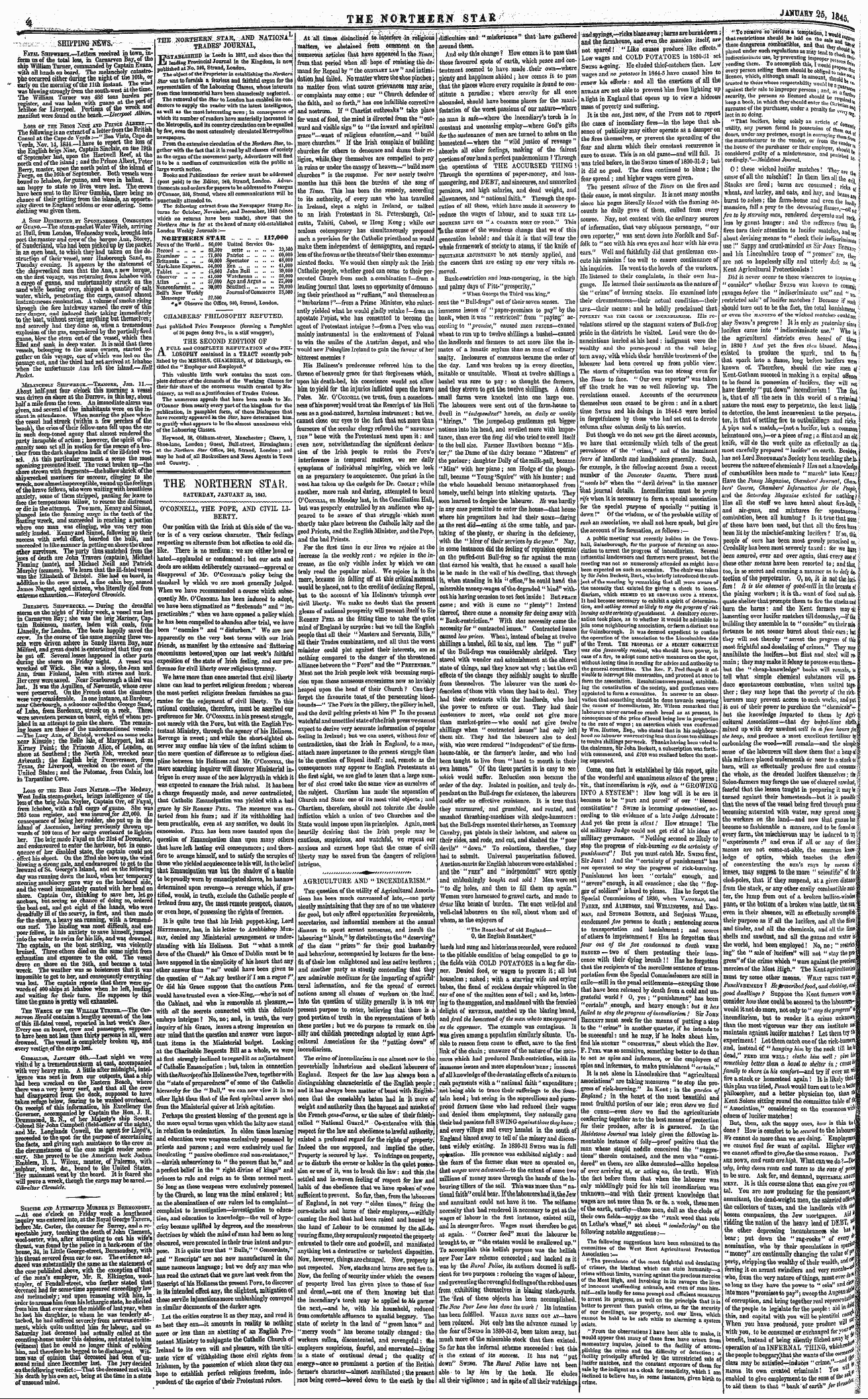
4 The Northern Star ' ^^ Jfr*.'
4 THE NORTHERN STAR ' ^^ jfr * . '
: : _ Shipping 2*£Ws. __ . Fatal Sbtjpwe...
: _ SHIPPING 2 * £ WS . __ Fatal Sbtjpwekcs . —Letters received in town , inform ns of the total loss , in Carnarvon Bay , of the ship William Turner , commanded by Captain Evans , with all hands on board . The melancholy catastrophe occurred either during the night of theioth , or early on the morning ofthe 11 th instant . The wind was ' blowing strongly from the south-west at tie time . The William Turner was 488 tons burden per register , and was laden with guano at the port 01 Ichiboefor Liverpool Portions ofthe *»« _! , Ml manifest were found on the beach . —Liverpool Anion .
Loss of the 3 mos Nine asd PnracE £ * £ " : - The followmgisan extractof aletter fromtte Bri ^ Consul at thl Cape dc Verds :- " Boa Vista ,. Cape de Yerds , Nov . 14 , 1844 . -Ihave to . report the lossi of the English brigs Nine , Captam Smclair ontne ljth of September last , upon the Hartwell Reef , at the north end ofthe island ; and the Prince Albert , Peter Berry master , upon the north point of the island of Fue » o , on the 16 th of September . Both vessels were bound to Ichaboe , for guano , and were in ballast . I am happy to state no lives were lost . The crews have been sent to the River Gambia , there being no chance of their getting from the islands , an opportunity direct to England seldom or ever offering . Some clothing was given them .
A Ship Destroyed , by Spontaneous Combustios of Gcaxo . —The steam-packet Water Witch , aniving at Hull , from London , Wednesday week , brought into port the master and crew of the barque Ann , Storey , of Sunderland , who had been picked up by thepacket in an open boat , to which they had taken on the destruction of their Tcssel , near Hasborongh Sand , on Tuesday evening . It appears by the statement of the sMpwreeked men that the Ann , a new barque , on the first voyage , was returning from Ichaboe with a cargo of guano , and lurfortnnatdy struck on the sand while beating over , shipped a quantity of salt
-water , which , penetrating the cargo , caused almost instantaneous combustion . A volume of smoke rising throug h me fore hatchway warned the crew of this : n < hv ( bww , and induced their taking immediately to the boat , without saving anything but themselves ; and scarcely had they done so , when a tremendous explosion ofthe gas , engendered by the partially fired guano , blew the stem out of the vessel , which then filled and sank in deep water . It is said that three vessels , belonging to the same owners , started together on this voyage , one of which was lost on the passage out , and the third had not arrived at Ichaboe vrken the unfortunate Ann left the island . —Hull
Packet . MEWScnotr Shipwreck . —Tkamore , Jan . 11 . — About lialf-past four o ' clock this moniinp : a vessel ¦ was driven on shore at the Burrow , in this bay , about naif a mile from the town . An immediate alarm was given , and several ofthe inhabitants were on the instant i n attendance . "When Hearing the place where thercssel had struck ( within a few perches of the beach ) , the cries of their fellow-men fell upon the ear in such deep-toned agony that almost rendered the party incapable of action ; however , the spirit of humanity soon set all in motion for the rescue ofa brolierfitimlhedarksluipeless hulk of the ill-fated vessel . At this particular moment a scene the most agonizing presenteditsclf . The vessel broken up—the shore strewn with fragments—thehollow shriek ofthe shipwrecked mariners for succour , clinging to the ¦ wreck , nowalmostimperceptible , woundup thefeelings
ofthe brave fellows , who were waiting with breathless anxiety , some of tkeni stripped , panting for leave to face the tempestuous billow , to rescue the distressed or die in the attempt . Two men , Kenny arid Sinnot , plunged into the foaming surge iu the teeth of the Boating wreck , and succeeded in ranching a portion where one man was clinging , who was very soon safely landed . Kenny and Sinnot , following up their success with awful effort , hoarded the hulk , and succeeded in like manner in getting on shore the three « flier survivors . Tho party thus snatched from the jaws of death are John Travers ( captain ) , Michael Fleming ( mate ) , and Michael Neil ! and Patrick Murphy ( seamen ) . We learn that the ill-fated vessel was the Elizabeth of Bristol . She had on board , in addition io the crew saved , a fine cabin boy , named James 3 Jagent , aged sixteen , who literally died from extreme exhaustion . —Waterford ChronicU .
Dreadful Shipwhecks . —Duruig the dreadful storm on the night of Friday week , a vessel was lost in Carnarvon Bay she was the brig Mariner , Captain Robinson , master , laden with coals , from Llanelly , for London . The boats happily saved the crew . In the course of the same morning three vessels were driven ashore in Sandy Haven Bay , near Milford , and great doubt Is entertained that they can be got off . Several losses happened in other parts during the storm on Friday night . A vessel was wrecked off Wick . She was a sloop , the Jean and Ann , from Finland , laden with staves and bark . Eercrewvreresaved . Near Scarborough a third was Jost . It was the Aquillon , of Newcastle , whose crew
• were preserved . On the French coast the disasters wens very considerable . In one instance , at Bardeur , near Cherbourgh , a schooner called the George Sand , of Lubo , from Bordeaux , struck on a rock . There were seventeen persons on hoard , eight of whom perished in an attempt to gain the shore . The remaining losses are those of the undermentioned vessels : —The Lucy . Ann , of Bristol , wrecked on some rocks near Kinsale ; the Belle Mo , of Maryport , lost at Eirney Point ; the Princess Alice , of London , on shore at Southend ; the 2 Jorth Esk , wrecked near Arbroath ; the English brig Perseverance , from Texas , for Liverpool , wrecked on the coast of the United States ; and the Potomac , . from Calais , lost in Tarpauline Cove .
Loss or the Brig Jobs Natmih . —The Medway , West India steam-packet , brings intelligence ofthe loss of the brig John Naylor , Captain Orr , off Fayal , frorii Ichaboe , with a full cargo of guano . She was 263 tons register , and wasinsured . for £ 2 , 000 . In consequence of losing her rudder , she put up in the island of Ascension , having previously thrown upwards of 100 tons of her cargo overboard to lighten her . The brig made Fayal on the 21 st of December , and endeavoured to enter the harbour , but in consequence of her disabled state , the captain could not . effect his object . On the 22 nd she bore up , the wind blowing a strong gale , and endeavoured to get to the leeward of St . George ' s Island , and on the following day was running down the land , when her temporary steering macliinery gave way on the Larboard side , and the vessel immediately canted with her head on
shore . Captain Orr , thinking to save her , let go anchors , but seeing no chance of doing so , ordered the boat out . and got eight ol the hands , who were dreadfully ill of the scurvy , in first , and then made for the shore , a heavy sea nrnning , with a tremendous surf . The landing was most difficult , and one poor fellow , in his anxiety tosave himself , jumped into the water to swim for his life , and was drowned . The captain , on the boat striking , was violently bruised . Three others died on the same night from exhaustion and exposure to the cold . The vessel drove on shore on the 24 th , and became a total wreck . The weather was so boisterous that it was impossible to get to her , and consequently everything was lost . The captain reports that there were upwards of 400 ships at Ichaboe when . he left , loading and waiting for their turn . He supposes by this tmie the guano is pretty well exhausted .
Tee Wreck of the William Turneb . —The Carnarvon Herald contains a lengthjr account of the loss of this ill-fated vessel , reported in last -week ' s Star . Every one on board , crew and passengers , supposed to have been not less than thirty persons in all , were drowned . The vessel is completely broken up , and every vestigc . of the cargo lost , Gibraltar , Jashart 6 th . —Last night we were TMtidbvatremendousstorm at east , accompanied with very heavy rain . A little after midnight , Inteligence was sent in from our outposts , that a ship lad been wrecked on the Eastern Beach , where there was a very heavy surf , and that all the crew had disanneared from the deck , supposed to have
taken refuge below , fearing to be washed overboard . On receipt of this information , Ms Excellency the Governor , accompanied by Captain the Hon . J . R . Brummond , R . S ., of her Majesty ' s ship Scout ; Colonel Sir John Campbell ( field-officer ofthe night ) , and Mr . longlande Cowefl , the agent for Lloyd ' s , proceeded to the spot for the purpose of ascertaining the facts , and giving such assistance to the crew as the circumstances of the case might render necessary . She proved to be the American bark Joshua Emblem , D . L . Wilcox , master , of Palermo , with sulphur , wines , & c ., hound to the United States . Her mainmast went by the hoard . It is feared she will prove a wreck , though the . cargo may be saved . — Gibraltar Chronicle .
Suicide Asd Attempted Muedeein Beumoxdse...
Suicide asd Attempted Muedeein Beumoxdsey . —At one o ' clock on Friday week a lengthened inquiry was entered into , atthe Royal George Tavern , Wore ' llr . Carter , the coroner for Surrey , and a respectable jury , touching the death of John Clement , wool-sorter , who , after attempting to cut his wife ' s throat , was found by the police in a back-room of the house , 34 , in Little George-street , Bennondsey , with his throat severed from ear to ear . The evidence adduced was substantially the same as the statement of the case published above , with the exception of that of the man s employer , Mr . R . Elkington , woolstapler , of Fendall-street , who further stated that low
deceased had for some-time appeared exceedingly and melancholy ; " and upon reasoning with him , in order to arouse him from hislethargic state , heelicited from him that ever since the middle of lastyear , when he lost his daughter , to whom he was tenderly attached , he had suffered severely from nervous excitement , which quite unfitted him for labour , and on Saturday last deceased had actually called at the counting-house under this delusion , and stated to him ( witness ) that he could no longer think of robbing lim , and therefore he begged to be discharged . 'Witness vras of opinion that deceased had been of unsound mind since December last . The jury decided -onthefoflowmgverdict : —That the deceased met with his death by his own act , being at the time in a stat « of unsound mind .
Suicide Asd Attempted Muedeein Beumoxdse...
THE NORTHERN STAR , AND NATIONA TRADES' JOURNAL , , EST ABLISHED in Leeds in 1837 , and since then thej leading Provincial Journal in the Kingdom , is now published at So . " S 40 , Strand , London . The object of the Proprietor in establishing the Northern Star was to furnish a fearless and faithful organ for the representation of the Labouring Classes , whose interests from time immemorial have been shamelessly neglected . ; The removal of the Star to London has enabled its conductors to supply the reader with the latest iutelb ' gence , as well as the most interesting news ; in consequence of which its number of readers have materially increased in the Metropolis , and its country cumulation can be equalled by few , even the most extensively circulated Metropolitan newspapers .
From the extensive circulation of the Northern Star , together with the feet that it is read by all classes of society as the organ ofthe movement party , Advertisers will find it to be a medium of communication with the public at large worth notice . Boohs and Publications for review must be addressed ( post paid ) to the Editor , 340 , Strand , London . Advertisements and orders for papers to be addressed to Feargus O'Connor , 340 , Strand , where all communications will be punctually attended to . The following extract from the Xewspaper Stamp Returns for October , November , and December , 1848 ( since which no returns have been made ) , show that the Northern Star is far at the head of many old-established London Weekly Journals : —
NORTHERN STAR 117 , 000 JJews ofthe World .. 86 , 000 United Sen-ice Ga-Itecord .. .. .. .. 83 , 500 zette .. .. .. .. Ii ) , o 0 b Examiner . 71 , 000 Patriot 60 , 000 Britannia .. .. .. 66 , 000 . Spectator .. .. .. 48 , 000 Mark-lane Express .. 54 , 000 . Era 41 , 000 Tablet 45 , 000 John Bull 39 , 000 Observer .. .. .. 41 , 000 Watchman 33 , 000 Atlas " .. .. .. .. 37 , 000 Age and Argus .. .. 22 , 500 Nonconformist ., .. 30 , 000 Sentinel 20 , 000 Bell ' s New Weekly Journal of Commerce 13 , 500 Messenger .. .. 22 , 500 # ** Observe the Office , 340 , Strand , London .
CHAMBERS' PHILOSOPHY REFUTED . Just published Price Fourpence ( forming a Pamphlet of 56 pages demy 8 vo ., in a stiff wrapper ) ,
THE SECOND EDITION OF AFUIL and COMPLETE KEFUTATION of the PHIi LOSOPHY contained in a TRACT recently published by the MESSRS . CH AMBERS , of Edinburgh , entitled the "Employer and Employed . " This valuable little work contains the most complete defence of the demands of the Working Classes for their fair share of the enormous wealth created by Machinery , as weU as a justification of Trades Unions . The numerous appeals that have been made to Mr . O'Connor from nearly every part of the kingdom for the publication , in pamphlet form , of those Dialogues that hare recently-appeared ja the Star , have determined him to gratif y -what appears to be the almost unanimous wish of the Labouring Classes .
Heywood , 58 , Oldham-street , Manchester ; Cleave , 1 , Shoe-lane , London ; Guest , Bull-street , Birmingham ; at the northern Star Office , 340 , Strand , London ; and may be had of all Booksellers and News Agents in Town and Country .
The Northern Star Saturday, January 55, 1845.
THE NORTHERN STAR SATURDAY , JANUARY 55 , 1845 .
O'Connell , The Pope, And Civil Liberty....
O'CONNELL , THE POPE , AND CIVIL LIBERTY . Our position with the Irish at this side of the water is of a very curious character . Their feelings respecting ns alternate from hot affection to cold dislike . There is no medium : wc are either loved or hated—applauded or condemned : but our acts and deeds are seldom deliberately canvassed—approval or disapproval of Mr . O'CossBii ' s policy being the standard by which we are most generally judged .
When we have recommended a course which subsequently Mr . O'Conxell has been induced to adopt , we have been stigmatized as " firebrands " and " inipracticables ; " when we have opposed a policy which he has been compelled to abandon after trial , we have been " enemies" and " disturbers . " We are now apparently on the ' very best terms with our Irish Mends , as manifest by the extensive and flattering encomiums bestowedjipon our last week ' s faithful exposition of the state of Irish feeling , and our preference for civil liberty over religious tyranny .
We have more than once asserted that civil liberty alone can lead to perfect religious freedom ; whereas the most perfect religious freedom furnishes no guai rantee for the enjoyment of civil liberty . To this rational conclusion , tuercfore , must be ascribed our preference for Mr . O'Connell inhis present struggle , not merely with the Pope , but with the English Protestant Ministry , through the agency of his Holiness . Revenge is sweet ; and while the short-si g hted observer may confine his view of the infant schism to the mere question of difference as to religious discipline between his Holiness and Mr . O'Connell , the more searching inquirer will discover Ministerial intrigue in every maze of the new labyrynth in which it was expected to ensnare the Irish mind . It has been
a charge frequently made , and never contradicted ; that Catholic Emancipation was yielded with a bad grace by Sir Robert Peel . The measure was extorted from his fears ; and if Its withholding had been practicable , even at any sacrifice , we doubt its concession . Peel has been more taunted upon the question of Emancipation than upon many others that have left lasting evil consequences ; and therefore to avenge himself , and to satisfy the scruples of those who yielded acquiescence to his will , in the belief that Emancipation was bat the shadow of a bauble to beproudly worn by emancipated slaves , he hasnow determined upon revenge—a revenge which , if graT tiiied , would , in truth , exclude the Catholic people of Ireland from any , the most remote prospect , chance , or even hope , of possessing the rights of freemen . .
It is quite true that his Irish puppet-king , Lord HEixESBDHr , has , in his letter to Archbishop Murkjut , denied any Ministerial arrangement or understanding with his Holiness . But " what a meek dove ofthe Church" his Grace of Dublin must be to have supposed in the simplicity of his heart that any other answer than " no" would have been given to the question of " Ask my brother if I am a rogue ?" Or did his Grace suppose that the cautious Peel would have trusted even a vice-King , —whois not of the Cabinet , and who is removable at pleasure , — with aU the secrets connected with this delicate
embryo intrigue ? No , no ; and , in truth , the very inquiry of his Grace , leaves a strong impression on out mind that the question and answer were important items in the Ministerial budget . Looking at the Charitable Bequests Bill as a whole , we were at first stronglymclmedtoregarditasanjiristalment of Catholic Emancipation ; but , taken in connection with the 5 c * m >« ofhisHolinessthePoPE , together with the " state of preparedness" of some ofthe Catholic hierarchy for the " Bull , " we can now view it in no other li g ht than that of the first spiritual arrow shot from the Ministerial quiver at Irish agitation .
Perhaps the greatest blessing of the present age is the more equal terms upon which the laity now stand in relation to ecclesiastics . In olden times learning and education were weapons exclusively possessed by priests and parsons ; and were exclusively used for inculcating " passive obedience and non-resistance , " —slavish subserviency to " the powers that be , " and a perfect belief in the " right divine of kings" and princes to rule and reign as to them seemed meet . So long as those weapons were exclusively possessed by the Church , so long was the mind enslaved ; but as the abominations of our rulers led to
complaintcomplaint to investigation—investigation to education , and education to knowledge—the veil of hypocrisy became uplifted by degrees , and the monstrous , doctrines by which the mind of man had been so long obscured , were presented in their true intent and purpose . It is quite true that "Bulls , " " Concordats , " and " Rescripts" are not now manufactured in the same nauseous language ; but we defy any man who has read the extract that we gave last week from the Rescript of his Holiness the present Po p e , to discover in its intended effect any , the slightest , mitigation of those servile injunctions more unblushingly conveyed in similar documents of the darker ages .
Let the critics construe it as they may , and read it as best they can—it amounts in reality to nothing more or less than an abetting of an English Protestant Ministry to subjugate the Catholic Church of Ireland to its own wm and pleasure , with the ultimate View Of Withholding those civil rig hts from Irishmen , by the possession of which alone they can hope to establish perfect religious freedom , independent of the caprice of their Protestant rulers .
O'Connell , The Pope, And Civil Liberty....
At . all times disinclined to interfere in religious matters , we abstained from comment on the numerous articles that have appeared in the Times ' ; from that period when all hope of resisting the demand for Repeal by " the ordinary law " and intimidation had failed . No matter where the shoe pinches ; no matter from what source grievances may atise , or complaints may . come ; our " Church defender of the faith , and so forth , " has one infallible corrective and nostrum . If '' Chartist outbreaks" take place for want of food , the mind is directed from the " outward and visible sign" to " the inward- and spiritual grace "—want of religious education , —and "build more churches . " If the Irish complain of building
churches for others to denounce and damn their religion , while . they themselves are compelled to pray in ruins or under the canopy of heaven— "build more churches " is the response . For now nearly twelve months has this been the burden of the song of the Times . This has been the remedy , according to its authority , of every ... man who has travelled in Ireland , slept a night in Ireland , or talked to an Irish Protestant in St . Pctersburgh , Calcutta , Tahiti , Cabool , or Hong Kong ; while our zealous cotemporary has simultaneously proposed such a provision for the Catholic priesthood as would make them independent of demagopes , and regardless ofthe frowns or the threats of their then
excommunicated nocks . We would then simply ask the Irish Catholic people , whether good can come to their persecuted Church from such a combination ?—from a leading journal that loses no opportunity of denouncing their priesthood as " ruffians , " and themselves as "barbarians ?"—from a Prime Minister , who reluctantly yielded what he . would gladly retake ?—from an apostate Papist , who has consented to become the agent of Protestant intrigue ?—froiria Pope who was mainly instrumental in the enslavement , of Poland to win the smiles of the Austrian despot , and who would now Polandize Ireland to gain the favour of her bitterest enemies ?
His Holiness ' s predecessor referred him to the throne of heavenly grace for that forgiveness which , upon his death-bed , his conscience would not allow Mm to yield for the injuries inflicted upon the brave Poles . Mr . O'Connell ( we trust , from a consciousness of his power ) would tro at the Rescript of his Holi ness as a good-natured , harmless instrument ; but we . cannot close our eyes to the fact that not more than fourscore of the secular clergy refused the " bbtokma tion " bone with the Protestant meat upon it : and even now , notwithstanding the significant
declaration of the Irish people to resist the Pope ' s interference in temporal matters , we see daily symptoms of individual misgiving , which we look on as preparatory to acquiescence . One priest in the west has taken up the cudgels for Dr . Crollt ; while another , more rash and daring , attempted to beard O'Connell , on Monday last , in the Conciliation Hall , but was properly controlled by an audience who appeared to be aware of that struggle which must shortly take place between the Catholic laity and the good Priests , and the English Minister , and the Pope , and the bad Priests .
For the first time in our lives we rejoice at the increase in the weekly rent ; we rejoice in the increase , as the only visible index by which we can truly read the popular mind . TVe rejoice in it the more , because its falling off at this critical moment would be placed , not to the credit of declining Repeal , but to the account of his Holiness ' s triumph over civil liberty . We make no doubt that the present g leam of national prosperity will present itself to Sir Robert Peel as the fitting time to take the quiet mind of Eng land by surprise : but we tell the English people that all their " Masters and Servants , Bills , "
all their Trades combinations , and all that the worst minister could p lot against their interests , are as nothing compared to the danger of the threatened alliance between the "Po e" and the " Pretender . " Must not the Irish people look with becoming suspicion upon those nauseous encomiums now so lavishly heaped upon the head of their Church ? Can they forget the favourite toast , of the persecuting bloodhounds— " The Pope in the pillory , the pillory in hell , and the devil pelting priests at him ? " In the present watchful and unsettled state of thclrish press we cannot expect to derive very accurate information of popular feeling in Ireland ; but we can assert , without fear of contradiction , that the Irish in England , to a man ,
attach more importance to the present struggle than to the question of Repeal itself : and , remote as the consequences may appear to English Protestants at the first sight , we are glad to learn that a large number of that creed take the same view as ourselves of the subject . Chartism has made the separation of Church and State one of its most vital objects ; and Chartism , therefore , should not tolerate the double infliction which a union of two Churches and the State would impose upon its princip les . Again , most heartily desiring that the Irish people may be cautious , suspicious , and watchful , we repeat our anxious and earnest hope that the cause of civil liberty may be saved from the dangers of religious intrigue .
Agriculture And" Incendiarism," The Ques...
AGRICULTURE AND" INCENDIARISM , " The question of the utility of Agricultural Associations has been much canvassed of late , —one party stoutly maintaining that they are of no use whatever for good , but only afford opportunities for presidents , secretaries , and influential members at the annual dinners to spout arrant nonsense , and insult the labouring " hinds , " by distributing to the " deserving ' . ' of the class " prizes "' for their good husbandry and behaviour , accompanied by lectures for the
benefit of their less enlightened and less active brethren ; and another party as stoutly contending that they are admirable mediums for the imparting of agricultural information , and for the spread of correct notions among all classes of workers bri ; the land : Into the question of utility generally it is not our preserit purpose to enter , believing that / there is a good portion of truth in the representations of both these parties ; but we do purpose to remark on the silly and childish proceedings adopted by . some Agricultural Associations for the V putting down" of incendiarism .
The crime of incendiarism is one almost new to the proverbially industrious and obedient labourers of England . Respect for the law has always been a distmguishing characteristic of the English people ; and it has always been matter of boast with Englishmen that the constable ' s baton had in it more of weight and authority than the bayonet and musket of the French gens-t farme , or the sabre of their 'falsely * called " National Guard . " Go-extensive with this respect for the law and obedience to lawful authority ] existed a profound regard for the rights of property . Indeed the one supposed , and implied the other .
Property is secured by law . ; To infringe on property or to disturb the owner or holder in the quiet possession or use of it , was to break the law : arid this , the settled and in-woven feeliig of respect for law and habit of due obedience that we have spoken of were sufficient to prevent . So far , then , from the labourers of England , in not very " olden times , " firing the corn-stacks and barns of their employers , —wilfully causing the food that had been raised and housed by the hand of Labour to be consumed by the all-devouring flame , they scrupulously respected theproperty entrusted to their care and goodwill , and manifested anything but a destructive or turbulent disposition . Now , however , things are changed . Now , property is
not respected . Now , stacksand bams are setfire to . Now , the feeling of security under which the owners of property lived has given place to those of fear and dread , —not one of them knowing but that the incendiary ' s torch may be applied to his gamer the next , —and he , with his household , reduced from comfortable affluence to squalid beggary . The state of society in the land of " greenlanes" and " merry woods" has become totally changed : the workers sullen , discontented , and revengeful : the employers suspicions , fearful , and enervated— -living in a state of continual dread ; the quality of energy .-once so prominent a portion of the British farmer ' s character—almost annihilated ; the present race being cowed—bowed down to the earth by the
difficulties and- " misfortunes" that hate gathered around them . And why this change ? How comes it to pass that those favoured spots of earth , which peace and contentment seemed to have made . their own—where plenty and happiness abided ; how comes it to pass that the places where every requisite is found to constitute a paradise ; where security for all once abounded , should have become places for the manifestation of the worst passions of our nature—where no man is safe—where the incendiary ' s torch is in constant and unceasing emp loy-where God ' s gifts for the sustenance of men are turned to ashes on the homestead—where the " wild justice of revenge " absorbs all other feelings , making of the fairest
portions of our land a perfect pandemonium ? Through the operations of THE ACCURSED THING ! Throug h the operations of paper-money , and loanmongering , and DEBT , and sinecures , and unmerited pensions , and high salaries , and dead weight , and allowances , and " national faith . Through the operation of all these , which have made it necessary to reduce the wages of labour , and to make the labourers LIVE OJ ) " A COARSER SORT OP FOOD . " This Tsthe cause of the wondrous change that we of this generation behold ; and this it is that will tear the whole framework of society to atoms , if the knife of equitable adjustmest be not sternly applied , and the cancers that are eating up our very vitals removed .
Bank-restriction and loan-mongering , in the high and palmy days of Pitt- " prosperity , " When George the Third was king , " sent the " Bull-frogs" out of their seven senses . The immense issues of " paper-promises to pay" by the bank , when it was " restricted" from " paying " according to " promise , " caused niou p iuces—caused wheat to ran up to twelve shillings a bushel—caused
the landlords and larmers to act more like the inmates of a lunatic asylum than as men of ordinary sanity . Inclosures of commons became the order of the day . Land was broken up in every direction , suitable or unsuitable . Wheat at twelve shillings a bushel was sure to pay : so thought the farmers , and they strove to get the twelve shillings , A dozen small farms were knocked into one large one . The labourers were sent out of the farm-house to
dwell in "independent" hovels , on daily or iveekly " hiring ? . " The jumped-up gentleman got bigger notions into his head , and swelled more with importance , than ever the frog did who tried to swell itself to the bull size . Fanner Hawthorn became " Mister ; " the Dame ofthe dairy became "Mistress" of the parlour ; daughter Dolly of the milk-pail , became "Miss" with her piano ; son Hodge of the ploughtail , became "Young'Squire" with his hunter ; and the whole household became metamorphosed from homely , useful beings into stinking upstarts . . - They soon learned to despise the labourer . He was hardly
in any case permitted to enter the house—that house where his progenitors had had their home—faring as the rest did—eating . atthe same table , and partaking of the plenty , or sharing in the deficiency , with the " hirer of their services by the year . " Nay , in some instances did the feeling of repulsion operate on the puffed-out Bull-frog so far against the man that earned his wealth , that he caused a small hole to be made in the wall of his dwelling , that through it , when standing in his " office , " he could hand the miserable money-wages ofthe degraded " hind" without his having occasion to set foot inside ! But p eace
came ; and with it came no " plenty" ! Instead thereof , there came a necessity for doing away with " Bank-restriction . " With that necessity came the necessity for " contracted issues . " Contracted issues caused low prices . Wheab , instead of being at twelve shillings a bushel , fell to six , and less . The " puff ' of the Bull-frogs was considerably abridged . They stared with wonder and astonishment at the altered state of things , asd they knew not why ; but the evil effects of the change they selfishly sought to shuffle from themselves . The labourer was the most defenceless of those with whom they had to deal . They had their contracts with the' landlords , who had
the power to enforce or oust . They had theii customers to meet , who could not give more than market-price—who could not give twelve shillings when " contracted issues" had only left them six . They had the labourers also to deal with , who were rendered "independent" of tiiefarmhouse-table , or the farmer ' s larder , and who had been taught to live from "hand to mouth in their own homes . " Of the three parties it is easy to see which would suffer . Reduction soon became the order of the day . Isolated in position , and truly dependant on the Bull-frogs for existence , the labourers could offer no effective resistance . It is true that
Agriculture And" Incendiarism," The Ques...
they murmured , and grumbled , and routed , and smashed thrashing-machines with sledge-hammers : but the Bull-frogs mounted their horses , as Yeomanry Cavalry ; put p istols in their holsters , and sabres on their sides , and rode , and cut , and slashed the " poor devils" " down . " To reductions , therefore , they had to submit . Universal pauperization followed . Auction-marts for English labourers were established ; andtlie '" rEEE" and "independent" were openly and unblushingly bought and sold . ' Men were set "to dig holes , and then to fill them up again . Women were harnessed to gravel carts , and made to draw like beasts of burden , The once well-fed and well-clad labourers on the soil , about whom and of whom , as the enjoyers of
"The Roast-beef of old England—O , the English Roast-beef , " bards had sung and historians recorded , were reduced to the pitiable condition of being compelled to go to the fields with COLD POTATOES in a bag for dinner . Denied food , or wages to procure it ; all but houseless ; naked ; with a starving wife and crying babes , the fiend of reckless despair whispered in the ear of one of the smitten sons of toil ; and he , listening to the suggestion , and maddened with the frenzied delight of iievenoe , snatched up the blazing brand , and fired the homestead of the man who to him appeared
as the oppressor . The example was contagious . It ¦ was given among a population similarly situate . Unable to reason from cause to effect , save to the first link of the chain ; unaware of the nature ' of the measures which had produced Bank-restriction , with its immense issues and more stupendous ' debt ; innocent of all knowledge of the devastating effects ofa return to cash payments with a " national faith " expenditure ; hot being able to trace their sufferings to the'fountain head ; but seeing in the supercilious and purseproud farmers those who had reduced iheir wages and denied them employment , they naturally gave
their bad passions full SWING against those they knew ; and every village and every hamlet in the south of England blazed away to tell of the misery and discontent widely existing . Li 1830-31 Swing was in full operation . His presence was exhibited ni ghtly : and the fears of the fanner class were so operated on , Qt & i wages were advanced—to the extent of some two millions of money more through the hands of the labouring tillers of the soil . This was more than " national faith" could bear . If the labourers had it , the Jew and annuitant could not have it too . The selfsame necessity that had rendered it necessary to get atthe
wages of labour in the first instance , existed still , and in stronger force . Wages must therefore be got at again . " Coarser food" must the labourer be brought to , or "the estates would be swallowed up . " To accomplish this hellish purpose was the hellish new Poor Law scheme ; concocted ; and backed as it was by the Sural Police , its authors deemed it sufficient for two purposes : reducing the wages of labour , andpreventingtherevengfulfeelingsoftherobbedones from - exhibiting themselves in blazing stack-yards .
¦ The'first'of-these objects has been accomplished . ¦ The New . Poor Law has done its tvork ! Its intention has been fulfilled . Wages have been got at—have been reduced . Not only has the advance caused by the fear of Swing in 1830-31-2 , been taken away , but mueh more of the miserable stock that then existed . So far has the infernal scheme succeeded : hit this is the extent of its success . It has not " put down" Swim The Rural Police have not been able - to lay Mm by the heels . He eludes all their vigilance ; and in spite of all their watchings
Agriculture And" Incendiarism," The Ques...
andspymgs , —ricks blawawayjoams are burntdown ; and the farmhouse , and even the mansion itself , are not spared ! "Like causes produce like effects . " Low wages and COLD POTATOES in 1830-01 set Swing a-going . He eluded thief-catchers then . Low writes and no potatoes in 1844-5 have caused him to renew-his' efforts : and all the exertions of all the rurals are not able to prevent him from lighting up a light in England that opens up to view a hideous mass of poverty and suffering .
It is the cue , just now , ofthe Press not to report the cases of incendiary fires—in the hope that absence of publicity may either operate as a damper on the fires themselves , or prevent the spreading of the fear and alarm which their constant recurrence is sure to cause . This is an old game—and will fail . It was tried before , in the Swing times of 183041-2 ; but it did no good . The fires continued to blaze ; the fear spread ; and higher wages were given . The present silence of the Times on the fires and their cause , is most singular . It is not many months since his pages literally biased with the flaming
accounts he daily gave of them , culled from every source . Nay , not content with the ordinary sources of information , that very ubiquous personage , " our own reporter , " was sent down into Norfolk and Suffolk to " see with his own eyes and hear with his own ears . " Well and faithfully did that gentleman execute his mission ! too well to ensure continuance of his inquiries . lie went to the hovels of the workers . He listened to their complaints , in their own language . He learned their sentiments o » the nature of the " crime" of burning stacks . He examined into their circumstances—their actual condition—their
life—their means : and he boldly proclaimed that POVERTY WAS THE CAUSE OF IXCEXDIARIS 5 I . His l'Cvelations stirred up the stagnant waters of Bull-frog pride in the districts he visited . Loud were the denunciations hurled at his head : iudignfint were the wealthy and the purse-proud at the veil being torn away , with which their horrible treatment of the labourer had been covered up from public view . ' The storm of vitupertation was too strong even for the Times to face . " Our own reporter " , was taken off the track he was so well following up . The revelations ceased . Accounts of the occurrences themselves soon ceased to be given : and in a short time Swing and his doings in 1844-5 w , ere buried in forgetfulncss by those who had set out to devote column after cokrnin <&* # » to his service .
But though we do not now get the direct accounts , we have that occasionally which tells of the great prevalence of the " crime , " and of the imminent fears of landlords and landholders generally . Such , for example , is the following account from a recent number of the Boncaster Gaxette . There must " needs be" when the " devil drives" in the manner ihat journal details . Incendiarism must be pretty rife when it is necessary to form a special association for the special purpose of specially " putting it down ' . " Of the wisdom , or of the probable utility of such an association , we shall not here speak , but give the account of its formation , as follows : —
A public meeting- was recently holden in the TownhaU , Gainsborough , for the purpose of forming an association to arrest the progress of inemidiarism . Several influential landowners and farmers were present , but the meeting was not so numerously attended as might have been expected on such an occasion . The chair was taken by Sir John Beckett , Bart ., who briefl y introduced the subject of the meeting by remarking that all were aware of the necessity that existed for giving a check to incendiarism , Which SEEMED TO BE GROWING INTO A SYSTEM . It had become necessary to exhibit a spirit of determination , and nothing seemed so likely to stop the progress of risk burning as the certainty of punishment , A desultory '
conversation took place , as to whether it would be advisable to join some neighbouring association , or form a distinct one for Gainsborough . It was deemed expedient to confine the operation of the association to the Lincolnshire side of the Trent . The fbofosal of a secret committee was also favourably received , who should have power , in case of a fire , to adopt some active measures on the spot , without losing time in sending for advice and authority to the general committee . The Rev . P . Peel thought it advisable to interrupt this conversation , and proceed at once to form the association . Resolutions were passed , establishing the constitution of the society , and gentlemen were
appointed to form a committee . In answer to an observation that something should be done towards removing the causes of incendiarism , Mr . Wilson remarked that labourers never earned so much bread as at present , in consequence ofthe price of bread being low in proportion to the rate of wages ; an assertion which was confirmed by Wm . Hutton , Esq ., who stated that in his neighbourhood no labourer wasreceiving less than from ten shillings totwelve ' shillingspei'week . Thanks having been voted td the chairman , Sir John Beckett , a subscription was forth : with commenced , and £ 700 was realised before the meeting separated .
Come , one fact is established by this report , spite ofthe wonderful and unanimous silence of the press ; viz ., that incendiarism is rife , and is "GROWING INTO A SYSTEM "! How long will it be ere it becomes to be " part and parcel" of our " blessed constitution" ? Swisg is becoming systematised , according to the evidence of a late Jud ge Advocate ! And yet the press is silent ! How strange ! The old military Judge could not get rid of his ideas of military governance . " Nothing seemed so likely to stop the progress of rick-burning as the certainty of punishment" ! But you must catch Mr . Swing first , Sir John ! And the " certainty of punishment" has
not operated to stay the progress of rick-burning . Punishment ' has been " certain" enough , and " severe" enough , in all conscience ; else the " flogger of soldiers" ishard to please . Has he forgot the Special Commissions of 1830 , when Vauohan , and Parke ,, and Alderson , and Wellington , and Desman , and Sturoes Bourne , and Serjeant Wilde , condemned five persons to death ; sentencing scores to transportation and banishment ; arid scores of others'to imprisonment ? Has he forgotten that four out of the five condemned to death were hanged —two of them protesting their innocence with their dying breath !! Has he forgotten
that the recipients of the merciless sentence of transportation from the Special Commissioners are still in exile—still in the penal settlements—excepting those that have been released by death from a cold and ungrateful world ? . " O , yes ; " punishment '' has been " certain" . enough , and heavy enough : ' but it has failed to slay the progress of incendiarism ! Sir John Beckett must seek for the means of putting a stop to the " crime" in another quarter , if he intends to be successful : and he may , if he look * about him , find his secret " committee , " about which the Rev . F . Peel was so sensitive , something better to do than to act as spies and informers , or the employers of
spies and informers , to make punishment " certain . " It is not alone in Lincolnshire that " agricultural associations" are taking measures "to stop the progress of rick-burning . " In Kent ; in the garden of England ; in the heart of the most beautiful and most fruitful portion of our isle ; even there we find the curse—even there we find the agriculturists conferring together as to the best means of protection for their produce , after it is garnered . In the Maidstone Journal was lately given the following lamentable instance of folly—proof positive that the
man whose stupid noddle conceived the " suggestions" therein contained , and the men who " considered" on them , are alike demented—alike hopeless of ever arriving at , or acting on , the truth . With the fact before them that when the labourer was only middlingly paid for his toil incendiarism was unknown—and with their present knowledge that wages are not more than 7 s . or 8 s . a week , these men ofthe earth , earthy—these men , dull as the clods of their own fields—sappy . as the " rank weed that rots on Lethe ' s wharf , " set about " c < misdering » on the following notable suggestions ;—
The following suggestions have been submitted to the committee of the West Kent Agricultural Protection Association : — ; "The prevalence of the most frightful and desolating of crime * , the blackest which can stain humanity—a crime without limits , warring against the precious mercies of the Most High , and involving in its ravages the lives of innocent unoffending animals , and even of man himself—calls loudly for some prompt and efficiint measures to arrest its progress , as well on the principle that it is better to prevent than punish crime , as for the security of our dwellings , our property , and our' lives , which cannot he held to he safe while so alarming a system exists .
"From the observations I have been able to make it would appear that many of these fir « s have arisen from momentary ; impulse , joined to the facility of accora pUshing the crime and the difficulty of detection- a facility principall y afforded by the unrestricted sale of lucifer matches , and the constant exposure of them for sale by the indigent as a cloak for mendioity , which I am inclined to believe has , in some instances , given birth to crime .
Agriculture And" Incendiarism," The Ques...
"To remove so " serious a temptation , I w 6 u . i ^ that restrictions should be laid on the sole and 8 **' these dangerous combustibles , and that thersh tt " * placed under such regulations as may terid to ch t ** indiscriminate use , by preventing improper pou * - ' !> vending them . To accomplish this , I would w ^ ^ every person selling them should be obli ged to - ^ " ^ t licence , which , although small in amount , shoulflt " " trusted to those whose respectabUH y . would lie i •• t % against their sale to ' improper persons ; and , aVn f ^ " ** security , the persons so licensed shoul d be requ' ? r keep a hook , in which they should enter the Christ * ^ surname ofthe purchaser , under a penalty for ' tvo *' '' 4 lectin so doing . r ' « E . "That Inciters , being solely an article of Oi utility , any person found in possession of them ^ doors , under any pretence , except in convc ^ m ; : th emf ** the manufacturer to the vendor , or from the ve „ i ^ the house of the purchaser or their employer , shoal i *" t 0 considered guilty of a misdemeanor , and p ' musi , J ^ cordingly . "—Maidstone Journal . , 1 c -
O ! these wicked lucifer matches ! They arc t ) cwtwe . of allthe mischief ! In them lies all the c
Did it never occur to these wiseacres to inquire or " consider" whether Swi . vo was known to commit ravages before the " indiscriminate use" and " 1 ) Jls restricted sale" of lucifer matches ? Because if j . should turn out to be the fact , tire total banishment or even the jiAsejxa ofthe wiekod matches could nnstay Swing ' s progress ! It is only as yesterday since lucifers came into " indiscriminate use . " Who ht the agricultural districts even heard of th ^ in 1830 ? And yet the fires thai blazed . Mean existed to produce the spark , and to fan
that spark into a flame , long before lucifers we « known of . Therefore , should the wise men of Kent-Gotham succeed in making it a capital offenct to be found in possession of-lucifers , ' they will n { have thereby '' put down " incendiarism ! The fan is , that of all the acts in this world of a criming nature the most easy to perpetrate , the least liable to detection , the least inconvenient to the perpetrv tor , is that of setting fire to outbuildings and rick A pipe and a match , —( not a- lucifer , but a common brimstoncd one , )—or a piece of rag ; a flint and an old knife , will do the work quite as effectual ! v as the
most carefully prepared " lucifer" on earth . Besidej has not Lord Bnovoaui ' s Society been teaching the la . bourers the nature of chemicals ? Has not a knowled ge of combustibles been made to " march" into Kent ? Have the Fenny Magazine , Chambers' Journal , Chain , bers' Course , Chambers' Information for the PeopU and the Saturday Magazine existed for nothing \ Has all the stuff we have heard about fire-ball ) and air-guns , and mixtures fo :. - spontaneouj combustion , been all humbug ? Is it true that none of these have been used , but that all the fires have been lit by tlic mischief-making lucifers ? If so , thi
people of ours has been most grossly practised on . Credulity has been most severel y taxed : for we Jijt ( been assured , over and over again , that every one tf those other means have been resorted to ; and that too , in so secret and cunning a manner as to defy detection ofthe perpetrator , 0 , no , it is not the Iuti fers . ' It is the absence of good-will in the breast * < if the pining workers ; it is tho want of food and adequate shelter that prompts them to fire the stacks and burn the barns : and the Kent farmers may sit lamenting over lucifer matches tilldoomsdav , —if tlit
building they assemble in to " consider" on their mi * fortunes be not sooner burnt about their ears ; but they will not thereby " arrest the progress of this most frightful and desolating of crimes . " They maj annihilate the lucifers—but flint and . steel will remain ; they may make it felony to possess even thesebut the " cheap-knowledge" books will remain , to tell what simple chemical substances will produce tpontaneous combustion , when united together ; they may hope that the poverty of the rickbnrners may prevent access to such works , and put it out of their power to purchase the " chemicals "—
but the knowledge imparted to them by Agr > cultural Associations—that dry bufrit-iime sbife mixed up with dry sawdust will in a few hours jin the heap , and produce a most excellent fertilizer b j carbonizing the wood—will . ' remain—and the simp le sense of the labourers will show , them that a heap of this mixture placed underneath or near to a stack or barn , will as effectually produce fire and consume the whole , as the dreaded lucifers themselves ; tit Solon-farmers may forego the use of charred sawdust , fearful that the lesson taught in preparing it may be turned against their homesteads—but it is possible that the news of the vessel being fired through pant becoming saturated with water , may spread among the workers on the land—and now that guauo ha become so fashionable a manure , and to be fonnd on
every farm , the mwchievous may be induced to ui 1 " experiments : " and even if all or any of these J means are not come-at-able , the common know * ledge of optics , which teaches the effect ! fe of concentrating the sun ' s rays by means d \ lenses , may suggest to the more " . scientific" of tbtf clod-poles , that if they suspend , at a given distance from the stack , or any other easily combustible mat ter , the lump from out of a broken bullion-wimta | pane , or the bottom of a broken wine bottle , the ml even in their absence , will as effectually accomp
lishtheir purpose as if all the lucifers , and all the flintil and tinder , and all the chemicals , and all the limeshells and sawdust , and all the guano and water ill the world , had been employed ! No , no ; " rcstricij ing" the " sale of lucifers" will not " stay the prfti gress " of the crime which " wars against the precious mercies of the Most High . " The Kent agriculturiatta must try some other means . What thisictuetoi | Punch ' s KEMEDT ? Hefirescribcdfood , and clothing , ad ' i good dwellings ? Suppose the Kent fanners weretl consider fioiu ikm could be secured to the laboutenr J would it not do more , not only to " stay theprogres t" « i incendiarism , but to render it a crime unknown ,
than the most vigorous war they can institute anil maintain against lucifer matches ? Let them try tog experiment ! Lettheiri . catch one of the rick-burncr ?! and , instead of " hanging him by the neck till hebl dead , " peed him well ; clothe hhn well : give Ml somethin g better than a hovtlto shelter in ; caMtffj family to share in his comfort—and try if ever he ^ 1 fire a stack or homestead again ! It is likely that *! this plan was tried , Punch would turn out to be abetW § philosopher , - " and a better physician too , than m Kent Solons sitting round the committee table of m " Association , " considering on the enormousvr $ edness of lucifer matches ! ..- " .-. ¦ iH
But , then , ask the sappy ones , how is this tot done ? How is comfort to be secured to the labours We cannot do more than we are doing . " Employme J we cannot find for want of capital . Higher wa ^ we cannot afford to give , fbr the same reason . Pric * are nowx , and rents are high . What can we do ?—B ** why , bring dawn rents and taxes to the rate of p W to be sure . Ask for , and demand , equitable ami * ment . It is this course alone that can give you cap tal . You are now producing for the pensioner , !* annuitant , the dead-weight men , the salaried office ? the collectors of taxes : and the landlords with M
, bosom companions , the Jew mortgagees . Aid ! ridding the nation of the heavy load of DEBT , the other depressing incumbrance * she 1 « W * bear ; put down the " rag-rooks" of every * nomination , who by their specidations in s ^ " money " , are continually changing the value of P * perty , stripping the wealthy of their wealth , and tfjj ferring it on arrant swindlers and very rascals—^ who , from the very nature of things , must ever ( to | so long as they have the power to " coin" and C * § late mere "riwmiMift t > nv " : & w / w > the Aiweanst * *
of conniption , ' and bring together real » 'ePrese Iltll | of the people to legislate for the people : aid in , M this , and capital with you will be plentiful e " ^ j || When you have produced , your produce tfiJ' ^ ii with yon ,, to be consumed or exchanged for you' ^ || benefit , instead of being silently filched away W M operation of an INFERNAL THING , whichre ^ the people to beggary ^ that the wants ofthe ^ 0 M class may be satisfied ~ induces " " crime , "—^ . $ m HANG . B its own cwatM ; criminals ! You « , . ^ enabled to give employment to the sons of the 5 , . | to aid them to that " bank ' of earth "/«» - ' "" 1
-
-
Citation
-
Northern Star (1837-1852), Jan. 25, 1845, page 4, in the Nineteenth-Century Serials Edition (2008; 2018) ncse.ac.uk/periodicals/ns/issues/ns2_25011845/page/4/
-