
On this page
-
Departments (1)
-
Text (8)
-

t _26 1852. THE STAR OF FREEDOM. y
-

LAW INTELLIGENCE. MISTRESS OF COLONElTsi...
-
BIRTHS AND DEATHS.-STATE OF HEALTH IN TH...
-

The Fokbion Tbabb of the Poar of Losdon....
-

ACCIDENTS AND CASUALTIES. Melancholy Occ...
-

STATISTICS OF THE WEEK Soap. —Some retur...
-

Smwrtal fyftrlfemmt
-
MONDAY, Jukb 21. HOUSE OF LORDS.— The Co...
Note: This text has been automatically extracted via Optical Character Recognition (OCR) software. The text has not been manually corrected and should not be relied on to be an accurate representation of the item.
-
-
Transcript
-
Note: This text has been automatically extracted via Optical Character Recognition (OCR) software. The text has not been manually corrected and should not be relied on to be an accurate representation of the item.
Additionally, when viewing full transcripts, extracted text may not be in the same order as the original document.
Mr. W. Newton And The Tower Hamlets Elec...
^ tnervant to Mr . Reynolds 1844 . and Ynrcraw * **> firmed the evidence of the last witness . ^ S geobob Haoheld , examined by . Sergeant ®* « a I am acquainted with Dr . Achilli , who , on ^ 'Jf Tnlv was oppointed Italian theol ogical teacher , V ®* t llib of December arrived to take up his a P-? nt Before his arrival a person named Crozn had ^! ir' !! n 5 ations against two priests—one named Leonini ' ¦ ? - Mher Saccares—members of the college , and pro-? J ^ Protestants . Crozzi was called on to state the nature - * :-. , *! o » ation 3 against these priests : ^« % i Wnjass .-What were they ? . £ _«& —One of the two Leonini was charged with -ff committed adultery in the honse with a Maltese Vf * " A servant ofthe lady had brought letters frequently ; # ( jj 0 U 5 e . The other was accused of sleeping out of ' ¦ ' -rM = e and having frequent connexion with prostitutes . ¦ uiese uieu iu iuuui ui iuu jui t
i'li bad Uvea wnu < wnj < ^? 1 same year . The priests denied the charge , and the £ «' a ; for " tbe time held not to be proved . : J TneK « f - Aiexasmb Watt , formerly clerical secretary fv » M alta College , the Earl of " Shaftesbury , and Dr . ' - ' . via . corroborated the evidence of the preceding wit-^ 3 B ! £ tHabbis , an ordinary-looking servant-maid , living . Ssnsinston , said . —In 1850 , about two years ago , I was * " j bv Dr . Achilli , who was living in JTorthumberland--rtK S rand ' De had J k * 611 a nouso in ShaftesburysseEt , Pimlico , and he engaged me to take charge of it . rrtci in the morning about eleven o'clock , and found Mr . i ^ lisii making carpets for the drawing-room . Dr . l ^ il'i arrived shortly after in a cab . He told me to put v hou'e t ° rights , and to make the best of it , as the things f * l not all come . I saw about dinner , and Dr Achilli was ? aDd oflt of the kitchen all day . There was no blind to JTjfciie ticn window , sol took the table-cover , and with Ita forks was hanging it np .
1 tfTlin .- ) . nnnA « n ^ 41 . 1 .. 2 ' rorssSL . —What happened then s Jewess . —Be took very improper liberties with me . Tiere was no one in the house but ourselves , for CasteUmi ui rone away . He put his hand round my waist , and rtjfd have done so in other places , but I prevented him . i ^ ensation . ) ( rvi £ i . — Did he do anything else ? Witness .-He kissed me , and I got away from him into _ back kitchen , when he followed mo and told me what ifiadbeea through when abroad ; that he had suffered Smooths' imprisonment . He then again made attempts arat hisarms round my neck and waist and to Kiss me . Awards he went out . and came home about twelve ^ k , sleeping nest room to me , but nothing took place , fcmade several attempts to take liberties with me , kissing •» when I was not aware of it , before his wife came home . r-old Castellini of it , and also my aunt , Mrs . Cadogan . i « s tint nrosenfc when mv uncle saw Dr . AchiUl . » r .
i jm did not take any further liberties with me after ms rijeame back . I never spoke of it to her . The next -sroing after going there Dr . Achilli asked me how I liked ; r bed , and if I wished for a bedfellow ? I left before the 3 ath was out . Jjse Legge , rather a country-looking gi «» said , —1 was v ihe service of Dr . Achilli about saven or eight months , vileft it about ten months ago . I was servant of all -ai . He lived at Ho . 3 , Shaftesbarj-crescent . CotsSEL . — Did he take any familiarities with you ? Witness- Yes , about two months after I went there . Cotssiiu—What did he do ? fitness . —I gave notice to leave , and he asked me to
sfj which I did . He had kissed me two or three times [ are then . A day or two after he took liberties with me h mr mistress ' s bedroom . He had connexion with me jae ' rinn oace , but I can't say how often . Oocssa . —Ton became in the family way ? Titness . —Ics . I stayed four months after that , and vja I took another situation . Igavenotfce three times , j : ; mistress asked mo to stay , and then at last she gave H notice . She gave me a very good character . I could ' 3 stop in mv place , beinir ill , and was confined on the 5 th 55 iivember , * The child died , and I for a long time had
fe smallpox . I saw Dr . Achilli about two weeks before ] vis confined , but was not more than a minute or two ijsiing to him . He gave me nothing , and I did not men-3 the subject to him . While at Dr . Achilli ' fl there was jjitleman named Augostini , who lived there . Wsel . —Did he also have connexion with you ? Witness . —Yes . It was not known to Dr . Achilli . Beas the trial came on I had been living with my sister , Ss . Losan . Dr . Achilli came there , not to see me , but a iird oi his who lodged in the honse . This was after the y . ; to dead . I spoke to him at my sister ' s once or
?* e . tasEt . —Did he say anything to you about coming 2 i ! Witness . —I told him that I was subpoenaed , and he said , "Had no occasion to go . " I told him a week afterwards aa , and he said that "I was to shut the door in the face S ^ oa who came to subpoena me . " My sister said , "I isiiell the truth if I went . " I have not spoken to him ra ? . Tie Soliciiok-Gexekal . —When was it that Mrs . Achilli sud fault with yoa for your conduct with men ? Witnes . —She never found fault with me . I had a sad to see me , and one sight after a party she came 3 ; n and found a man with me in the back kitchen .
The Souciiok-Gesehal . —Was he not put thereto consilium ? tfimess . —No ; he did not want to he seen , and he went 3-a . ( Laughter . ) Ifce Soucnoa-GESEBAi . —How many men came to see 3 while yoa were in Dr . Achilli ' s service ? Witness . —I am not obliged to answer that question . Slighter . } I used to have a young man calling to see ^ and there was another . ( Much laughter . ) lie Solicttob-Gesekal . — That is four that yoa had con' aJoawith ? Witness . —I never told you that the two friends who 22 e to see me had anything improper to do with me i'agbter . ) BsSoucrxoR-GsxEKAi . —Doyon know the father of your
• aiess . —Xo Sir . Mrs . Achilli found fault about the ^ 1 man who came to see me , bnt no other , and she sfsaw anoihing wrong with me . I never said anything sj mistress about Dr . Achilli taking improper liberties ' 3 me . & A . Cocsbcbs . —You say yoa can't tell who was the 5 a of the child 1 % ess . —I could sot swear it . & A . Cockbtjes . —Why ? ^ isass . —Because I inew Mr . . Augustini , Sri . Cockbchx . —Had any one else ? ^ ess ( after a pause ) . —I would not like to swear who * & jather of the child . Mr . Augustini had connexion ' 3 tna soon after I went to service , and before Dr .
^ £ ih Wood , a girl nineteen years old , and living with greets at Windsor , said , I was in the service of Dr ^ 4 having been recommended to him by Madame ^ at , the head of a charitable institution at Windsor . ^ at into his employment the year before last , and was ^ tim for seven months . fesau—Did Dr . Achilli take any liberties with you ? * 2 SEss . -Yes , about a fortnight after I went . I went ^ to clean his bedroom out . Mrs . Achilli waa gone ^ hr . ic hill i cam e in . He fo llowed me several time s ^ fte room , and tried to put his hands round my ^> bnt 1 walked away . ^ Bu , —Did anything interrupt him ? s ^* "" * a knock came to the door , and he ran NSUffs and commenced writing . It was my mistress , xeinniea ior
. ;~ m ner parasol , laughter . ) My mis-* i ? ent 0 ]] C again , and I returned to the bedroom to * jt Then he came again and tried to kiss me . I ^ away and began to cry , when I said 1 would write -5 B ! a . _ Whatdidhesay ? ¦ JJea . —That I would be a very naughty girl to do so . > pter . ) ^ sa . —He gave you a book ? . x & s . —Yes , a religious book . The title of it was , 5 ^ 8 to Jesus . " ( Sensation . ) A fortnight after I was 'iSpsiairs , and he called me to his dressing-room and : lhad not dusted the table . Mrs . Achilli was out . ' I ^ sd for the duster and knelt down to dust the table , ^ taeanwhile , be bolted the door . jsSEL . —What didhe do ?
> S 33 . —He took me by the shoulders and threw me on > . ^ jEi , _ What did you do ? . > ass . _ l tried to get away with all my might , but ^ st , j ^ u—D id he have connexion with you ? ^ . - _ y . i'Jsu—Was it with or against your will ? r- --3 . —Against , and I said I would leave his service . t ?^« ~ But you did not ? Vo- * .-So . I stayed five months after . ( Laughter . ) £ 2 Unmix .-- Were you seduced before ? > : —Yes , but my father and mother did not know
J > , " » beix . —Bow long before going to the House of );^ a yoa been seduced ? ' . ^• ¦ "About sis months . ^ """b e 1 ! - —Was it only one person that yon had K - fc Hiy with ? ; ^ rX : only one . ^ Jj FoaEms , living at Great Smith-sfreet , West-% * •» 1 onee liT « d with a Miss Lambert , at So . 3 , . ^ Sreet , Pall-mall I lived with her from IBiS &' ^ "member Dr . Achilli being there in 18 i 7 . t ^~" TY he attempt to take liberties with yon ? * £ ?• 2 ^ ° ut six months after he came . As ¦ - ¦ - »§ things on the bible he threw his arms round
Sfc j , ^ w he ay anJthing ? r-tt ^ r 6 *! ted me to confess to him . ( Laughter . ) ^ -VrSelso on that occasion , for I jumped away "i-i " another occasion he had a map on the table , >^ W point out the way to a certain street in * j iis ' Lr 1 leant over the table for that purpose he / " ^ ctlr ? a 2 Mnst me . I said nothing , bnt came > . 3 ... .-? - '*> tfi acE 5 « IlAMEio , a solicitor , said , —1 went ' ? Vjh ' jm' lte e ? idence to be produced in this trial . ^ tar !? and aronfitt to the Assessor of the Court : >^ r a >? 7 of the judgment of that Court on £ * * - * . D- r-• s ^ iaiil i 1 ^ 1 8 ta ted that the copy of judgment was ¦ V ^^ aTv hfiL ^ fesstj thm rea ° iand was m effect ttat » ^ Uat ti' a ? d after a matBre examination , it had 1 ^ E evei ^ i AcUiUi had been guilty of carnal con' % ? ' ° a ann ^ lromen m tte convent at Viterbo , and * 0 * oaen ? woman there ; that he had carnally at Ca Pau , and that be bnA made ayoung
Mr. W. Newton And The Tower Hamlets Elec...
person at Naples a mother . The holy Inquisitors deprived him of all ecclesiastical functions for ever , and sentenced hun to be sent to a certain convent for three years . The Rev . W . Xicholls , a Dominican , monk , proved that tbe vows of the order were obedience , poverty , and chastity . Chastity was cot taken as a double vow by priests , but they undertook the obligation of perpetual celibacy , which was tantamount thereto . The counsel of Dr . Achilli bavin j ; intimated that evidence for tha public utility of the libel , if true , would be dispensed with by them , Sir A . Cockbuhn intimated that the case on behalf of Dr . Sewman was closed , and , Ii being nearly half-past eight o'clock , the Court adjourned till the next day . The Court-room was crowded almost to suffocation throughout the day .
THIRD DAY , WEnsKsnAT . The defendant ' s case having been concluded on Tesday , the prosecutor ' s counsel proceeded to call witnesses in contradiction of the evidence produced by the defendant . Dr . Acbilu was the first witness called . —He is a plainfeatured middle-sized man , about fifty years of age , and his face is strongly Italian . His dark sunken eyes flashed fire as he listened and replied to the questions put . This was particularly the case when he was cross-: xamined by Sir Alexander Cockburn on the more material points of the libel , and especially when he was confronted by tbe Italian women who have sworn that he debauched tbem . The effect produced by these meetings was quite dramatic , the poor women eyeing their alleged seducer with half timid , yet Steady glances , while he , his faoe overcome for the moment with a slight pallor , turned upon them looks that seemed to pierce through them .
Examined by the Attorney-General , he said : Neither in the month of February , 1 S 31 , nor at any other tirao did I ever know a person named Elena Yaleate . - While I was at Yiterbo , I never robbed of her honour any young woman at all : I knew a family at Yiterbo of the name of Gentili . There are two families there of the name of Gentili—two brothers . At that time tbe only woman of the name of Gentili was the wife of Count V . Giulio Gentili . Neither of the families lived in the country . I did not pass my country month in 1831 with , the family of Gentil ' . It was my custom in the month of October to pass my time at the country house of my friends or relations . These families were there—Zelli , Christofori , and Tekeschi . I believe I passed the month with two , if not all three . I do not know of any country house of the Gentili . In neither of these three families there waa a servant girl with
whom I went out to any place . I never went with any servant girl to a place where tho two Gentilis were shooting . I do not know that woman . ( Elena Yalente , now Ginstini , was here brought into court , and confronted with the witness . ) I never saw her . ( The woman appeared to turn pale . ) I never had intercourse with that woman in the world . I have never had any connexion with that woman in the house of the Manchorini or anywhere else . I never gave her , or any other woman , a pocket-handkerchief and three sausages . Sausages I never gave to any one , for I never had any . Perhaps a handkerchief I may have given to some old woman ; I do not know . ( The woman was removed from court . ) I do know a person of the name of Rosa di AUessandris , a nun , a relative of mine , of St . Bernardino , in Yiterbo . I was never found guilty of having debauched , seduced , and robbed of her' honour , Rosa di
AUessandris . The one of whom I have apokeu is older than I am in age . With her I could not commit any sin , because she is shut in a nunnery . I sever was found guilty of having debauched , seduced , and robbed of her honour a woman of that name . I know of no other woman of that name except my relative . I never had carnal connexion with Rosa di AUessandris , in the sacristy of the church at Gradi , or anywhere else . I never gave any money to the father of Rosa di Allessandria as hush money . I think I was a child of five or six when the father of Rosa di AUessandris died . In the month of July , 1834 , I did not debauch , seduce , and carnally know a woman whose name is unknown , and who was chaste before . ( Laughter . ) In 18 M I was on my tour with the Provincial . In 18351 was not at Monte Fiasconi , nor at Yiterbo , nor do I know Yincenza Guerra . I was at Capua in 1835 , occupied
preaching morning and evening . I resided in the house ofthe Cardinal Archbishop . I resided all that time under the eyes of the archbishop . I did not in that year or at any other time , have any connexion with any woman who was chaste and unmarried . ( The witness Principe , now Balisano , was here brought into court . ) In 1840 I was living at Naples as a secular priest . I have never seen that woman . This istheveryfirsttimelhaveseen her . I know this paper very well . The filling up in writing is mine . This was an institution for an image of St . Pietro Martyro to collect money . I did not collect the money , but there was one specially charged to do it . Persons came to write their names , but they did not come into the sacristy ; they stayed at the door . I never had connexion with that woman in the sacristy , or in any rooms off the sacristy , or anywhere . I do not remember walking in a procession when the mother
of Princepe spoke to me . I was never before the police when any charge was made against me by the parents of Principe . Garamoni ' s mother-in law lived next door to mo at Corfu . I never committed adultery with Garamoni ' s wife . I remember a fact that happened . One night I was passing before the house of the wife of Garamoni . She was at the door and called me , asking me to answer certain questions . She began to ask these questions , when we were surprised by her husband . The questions were put again but not finished . I believe she meant to ask me if I had heard any noise in her house on the previous night : and I believe she alluded to certain screams or cries that in fact I had heard . Before the questions were finished Garamoni came np . He began very furiously to inveigh against his wife . I was at the door of the house . It appears to me that he pushed me inside the house . Certain it is I made a step within the door
. That is the only occasion I was ever in the house . I never met her in any place . When I was at Corfu I had two parsons in my service , Coriboni and his wife . I never committed any indecency with Coribom ' s wife . I recollect that Mr . Reynolds , after an event that happened between us , did speak to me relative to the persons in my service . I had in friendship and charitably given some slight reproof to Mr . Reynolds because he was in the habit , at that time , of drinking a little too much in the evening and being drunk . ( Laughter . ) Coriboni lived with his wife in the house with me . They had a child . Coriboni ' s wife never slept with me . She never dined with me . I came to this country with my wife . I was lodging when in England , in 1847 , at No ; 3 , St . James ' sstreet , at the house of Miss Lambert . I never took any liberties with the servant of Miss Lambert . The second time , I was living at No . 20 , Northumberland-street ; in Shaftsbury-crescent , ! had a servant named Harriet , I think . I never conducted myself indecently to Harriet Harris . I
never attempted to seduce Harriet Harris . I think I had a servant named Jane Legge . I had two of the name of Jane . One followed Harriet Harris . That Jane lived about six months or so , but I do not recollect exactly . I never had criminal intercourse with her . I never behaved indecently to her , nor did I ever attempt to seduce her . I remember Sarah , who came from the House of Mercy , at Windsor . I never had criminal intercourse with her , nor attempted it . 2 never made any confession to the Inquisition of having had carnal intercourse with any women at Yiterbo or elsewhere . { The paper which purported to have come from the Office of nquisition , and which had been put in on Tuesday , was here shown to the witness . ] I have read this paper over . I know of so proceeding ia which those charges were brought to my notice . I remained at Yiterbo , with ' occasional absence , till 1833 . During that time I have not had any intercourse with any woman , according to the accusation . I had not intercourse with many others . Sir A . E . Cockbbbs . —Have you had connexion with other women .
Dr . Achu-ll—I decline to answer on account of my privilege . I never had any intercourse with any woman in the sacristy at Gradi , nor in any house contiguous to the sacristy , nor in any other room belonging to the church There was not a single word of gossip against me when I left Viterbo . There was not , in 1834 , a charge made against me of having attempted the virtue of a woman in Cardinal Velzi ' s house . Sir A . E . Cockburn asked the witness bow he got funds for this prosecution ? Dr . Achillt . —I hope the providence of God will provide me with funds through some friends . They do not exist as yet . I expect to get funds through some friends who I hope will have the kindness to engage for this need of mine . lord Campbeii . —Are we to inquire into this matter ? Sir A . E . Cockbbbs . —It is only to show that funds are not wanting .
Lord Campbell , —As far as I can see , funds are not wanting on either side . ( Laughter . ) Dr . Achilli . —I have not said of the monks at Yiterbo that they were profligates . Among them there are some good and bad . I believe some of them were loose in their lives in regard to women . 1 swear I never had carnal knowledge of that young woman ( Principe . ) I never saw the mother before . ( She stood forward . ) That woman and her husband certainly never called me out of a procession and charged me with debauching their daughter . Sir A . ^ Cockburn , — Were you not ordered to spend three years at Nazali , and had you not the police with yon ? Dr . Achuxi . — I went of my own accord , and there were
police with me . ( Laughter . ) There is a religious house tnere , but not of strict observance . I went because I was acquainted with some of the monks , who themselves had invited me . I went about iu the neighbourhood . I went to Sazali to collect myself . ( Laughter . ) Sir A . Cockbdbn . —You succeeded in collecting yourself in afortnight , and then you took yourself off ? ( Laughter . ) Sir A . Cockburn . —You went from Aneona to Corfu ? Dr . Achilu . —Yes , I lived there some months before I took up my residence next to the house of Garamoni ' s wife . It was about the middle of the time of my staying there that the interview I have 'stated happened . I might have known Garamoni before , but I doubt it , for I had no regard for him . ( Laughter . ) I employed him as a tailor . I knew he was not living with his wife . Everybody in Corfu
knew it . Sir A . Cockbobs . — What hour was it when this surprise by the husband took place ? Dr . Achiixi . —I do not know exactly , but it was not my habit to go home much before eleven o ' clock at night . It might have been later ; I cannot speak to a quarter of an Sir A Cockbckj . — Were you in tbe dress of a priest ? Dr . Achilu . —So , I wore a cloak , and the woman had no time to say what she wanted . The husband did not seize me . He might have pushed against me . He had no quarrel with me : .. ... .
Sir A . Cocebobs . — But he charged hu wife with impio per intercourse with you ? Dr . AcHiLH .-That was his usual habit .
Mr. W. Newton And The Tower Hamlets Elec...
Sir A . Cockbobs ;—What was his habit ? Dr . Achilu . —To be a man of great incivility . ( Laughter . ) 1 don't recollect his words , but I think they were " Worthless woman ,-1 have caught you . " I did not run away , for my house was close by . The people in the street did not stop me as I was running away . I have got Madame Garamoni here , and you will have the pleasure of seeing her . ( Laughter . ) I have not got Madame Carraboni here . I became acquainted with Madame Carraboni in the summer of ! Si 8 , at Corfu . She was not singularly dressed , or lightly covered , but on the contrary , dressed very modestly . I engaged the woman Harriet Harris while living in Northumberland-street , Strand . Madame Arohilli was then absent , but came to town two or threo days after . A person named Castelien was employed in the house at tho time , and she remained there till late in the evening . I never took any liberties with either her or Jane Legge . Witnesses were then called who deposed that Dr . Achilli had been highly esteemed and respected in Italy .
Marianne Crisafh . — I am the wife of Garamoni , carrying on the business of a tailor at Corfu . I remember Dr . Achilli living next door to roe at Corfu . I was at that time living with my mother . My husband was not living in tho house with me . I recollect speaking one night to Dr . Achilli as he was passing my house . My husband had used violence to me some few nights before , I recollect perfectly well I wished to call the gentleman because my mother pointed him out to me , and said probably that he , being a neighbour , had heard the quarrel between mvself
and a lady the friend of my husband . I said to my mother I would wait till the evening and ask him . In the evening I placed myself at the window for the purpose of calling him , and as I was going down stairs to speak to him it happened that my husband and Dr . Achilli rushed in together . I wished to call Dr . Achilli that he might be a witness in my favour , but I did not know him . I should like very much that my husband were here , but he has run away . My husband rushed up stairs and said many things that he ought not to have said , Dr . Achilli was never in my house before . Sir A . Cockburn . —Did your husband say , " Worthless woman , I have canght you .
Witness . —He tormented me , and tho whole of that night he went about telling every one that he had caught me with this gentleman . ( Laughter . ) Two persons passed at the time , and my husband said to them , " See , I have caught my wife with that gentleman . " My husband held Dr . Achilli against the wall and insulted him in various
ways . Sir A . Cockbdrn .-How did be get loose ? Witness . —I don ' t know , for I was up stairs . I did not come down to the door . I could not come . I was at the window . My mother is a laundress , and I was staying with her and my brothers before I married . My mother has some landed property . Mrs . Achilli , an English lady , who has been brought up m Italy , but speaks her own language well , and is young and rather comely in appearance , said—I was married at Rome in 1849 . I met my husband in Paris after
bis escape from the Inquisition . I took a house in Shaftesbury-crescent , and had a servant named Harriet Harris , who was with me three months . I found the kitchen very dirty , and she said it was not a usual thing for English ladies to . go there . I said I was not English ; I have not the custom of the English ladies , and I will come when I like . She then gave me notice , but wanted to stay at the end of the month . I , however , would not allow her to stay . Jane Legge was also in my service . I came home one night at eleven o'clock , and found a young man in the back kitchen , and I ordered her to leave next day . This concluded the evidence for the prosecution , and it being half . past six o ' clock the court adjourned .
FOURTH DAY .-Thursdat , Sir A . E . Cockbdbn addressed the jury in reply to the evidence adduced on the part of the plaintiff . He said nothing that had been brought forward on the part of Dr , Achilli , . would shake the testimony of the witnesses for the defence . He said , he felt from the first , that in this case , he ; had great disadvantages to contend with . They had before them , two great champions of opposite Churches , both of whom had been converted from tbe faith which they originally professed , and who endeavoured to prove the excellence of the church to which they now belonged . LordCAMPBBLi observed that the learned counsel engaged in the defence "had conducted it with great ability and propriety , but he wished to offer a suggestion to them in order to promote the ends of justice , viz ., that as the charges alleged in the pleas amounted to twenty-three , in number they should be left severally to the jury , who should state whether they believed they had or had not been proved . Sir A . E . Cockbubn said he thought'that would be the better course to adopt .
The Aitomjby General intimated his assent to the proposal of the learned judge , The court then adjourned for a quarter of an hour , On the return of the learned judge and the iury , The Attorney Gbnbsal replied on the whole case , going at considerable length into each of the charges contained in the libel , and concluded an able and eloquentjaddress shortly after five o ' clock . ( Continued in our eighth page . )
T _26 1852. The Star Of Freedom. Y
t 1852 . THE STAR OF FREEDOM . y
Law Intelligence. Mistress Of Coloneltsi...
LAW INTELLIGENCE . MISTRESS OF COLONElTsiBTHORP'S KITCHENPLAYING AT " ALL-EQURS" AND DRINKING GIN WITH THE FOOTMAN .
STAUKORB t > . SIBTH 0 RP . —ACTION FOR LIBEL . This was an action brought in the Exchequer Court by Mary Staunore against Colonel Sibthorp , M . P . —It appeared that plaintiff was a cook in the defendant ' s household , and sought to recover damages for a libel , which she alleged the defendant bad uttered against her , in consequence of which * she was unable to procure a situation . Plaintiff had been ten months in defendant ' s service , when , in consequence of some disagreement , she left , and applied to Colonel Sibthorp for a character . Defendant said , "Yes , yes , " and left immediately in his carriage . Two persons were called , and proved that they had written to the defendant on the -subject of the plaintiff ' s character , having already engaged her , subject to receiving a satisfactory character from the defendant concerning her . Defendant had stated that the
plaintiff was not of sober habits , and did not preserve that order in the Kitchen which was necessary—beyond that no complaint was made of her . Plaintiff now stated that her medical man bad ordered her to take brandy and water or gin and water , but she denied that she was in the habit of taking either to excess . —On cross-examination plaintiff admitted that she had played at " all-fours" and drank gin with the footman iu the kitchen . She also admitted bringing in spirits from the City , and having had repeated visits from friends about dinner time . —Defendant had pleaded a justification . —On the conclusion of the case for the plaintiff , Mr . E . James , for the defendant , submitted that no case of malice had been made out , and that the plaintiff must be nonsuited . —The Lord Chief Baron was of the same opinion . —The plaintiff was nonsuited accordingly .
COMPENSATION FOR [ ACCIDENT ON A RAILWAY REYNOLDS AUD WIFE V . THE GRKAT NORTHERN RAILWAY COMPANY . This was an action brought in the same court to recover damages for an accident which plaintiff alleged to have been caused through the negligence of the defendant's servants . — This action arose from the same accident which gave rise to the case of «« Housdon v . the Great Northern Railway Company , " tried in tbis court , and reported ia this journal . —It appeared that the plaintiff was a keeper of a small shop at Hitchin , in Herts , of which her husband was the freeholder . On the 8 th of September , 1851 , the plaintiff was a passenger in an Exhibition excursion train coming to London from Leeds . On emerging from the Hornsey Wood
tunnel , the train came in contact with anothnr train before it , and by the collision two of the plaintiff ' s ribs were broken , and she sustained injuries in her leg which have left her with a " club foot . " She was taken to the Free Hospital in Gray ' s-inn-lane , where she remained for seven weeks , and continued as an out patient for a fortnight longer . She had been suffering from illness thronght the winter , and an invalid for a considerable time ; and finally on the 11 th of the present month , took the advice of two eminent medical men , who gave it as their opinion that the plaintiff could only recover the permanent use of her leg by undergoing a delicate operation , which would involve an expense of from . £ 100 to £ 200 , and incapacitate her from using her leg for six or twelve months . —Mr . Bouvil ) , on
the part of the defendants , submitted that the company had done all that could reasonably be expected from them . They had offered the plaintiff the sum of £ 200 , which the learned counsel submitted was sufficient compensation for a woman of fifty years of age , in a very humble condition of life , and who had not been shown to have lost anything in point of money by the accident . He contended also that the subsequent ill effects ofthe accident were the resultof the plaintiffs own negligence in not attending to the advice of tbe medical men at tbe Hospital , who had sot been called in evidence by Mr . James , because tbey would have given opinions unfavourable to the plaintiff ' s claim . —Tbe Lord Chief Baton having summed up , the jury retired for a short time , and returned a verdict for the plaintiff , damages £ 420 .
Births And Deaths.-State Of Health In Th...
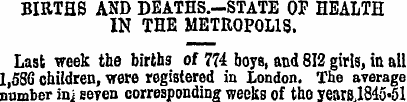
BIRTHS AND DEATHS .-STATE OF HEALTH IN THE METROPOLIS . Last week the births of 774 boys , and 812 girls , in all 1 , 586 children , were registered in London . The average number in ^ seven corresponding weeks of tho yearB , 1845-5 l was 1 , 314 . The official report says : —The number of deaths registered in the metropolitan districts in the week ending last Saturday is nearly the same as in the preceding week , and amounts to 903 . In the ten weeks corresponding to last week of the years 1842-51 the average number was 880 , whioh with a correction for increase of population , becomes 968 . The mortality now returned is , therefore , less than the estimated amount by 05 .
The Fokbion Tbabb Of The Poar Of Losdon....
The Fokbion Tbabb of the Poar of Losdon . —It aj « pears from a return to parliament that in 1841 tbe num " ber of British vessels whioh had entered the port of London engaged in the foreign trade was 4 , 016 sailing and 626 steamers , and in 10 years—in 1851 , the number was 5 , 190 sailing and 1 , 403 steamers ; while of foreign vessels there were in 1841 , 1 , 227 sailing and 72 steamers , and last year the number had lnereased to 3 , 474 sailing and 274 steam vessels .
The Fokbion Tbabb Of The Poar Of Losdon....
IRELAND . The outcry raised on the subject of the proclamation against Roman Catholic processions has by this time found a voice in the whole of the Irish Roman Catholic press , the weekly papers being of course the loudest in their protests against it . The '' Freeman , " " Tablet , " and "Nation , " denounce the proclamation as the commencement of a new reigti of persecution , and describe it as thc most direct attack on the liberty of Roman Catholics that has yet been made . The " Tablet" sums up a long array of cases in which Catholic precessions of a religious nature had taken place out of doors in England within the last twenty years , without any attempt having been made to interfere with them , and argues that no special cause could be shown wbj any measures should have been adopted against them at the present moment .
, The Rev . Mr . Maguire , P . P .. of Ennismaesamt parish , has been arrested , by an order from the Commander-in-Chief , for having married some Protestant soldiers to Roman Catholic females . The rev . gentleman gave in bail to stand his trial at the ensuing assizes for Donegal . Government has offered a reward of £ 100 for the arrest of the person or persons who murdered Daniel Trehy , a carrier , in the county of Waterford , on the 7 th inst . William Smith O'Brien's brother , in a letter to the " Evening Mail , " has expressed his indignation at the imputation contained in the government answer to the memorial " that vanity was the motive of his brother ' s conduct . "
A VOICE FROM CALIFORNIA . Under this head the "Nation , " of last Saturday , has a letter from R . H . Ryan , one of the proscribed of ' 48 , from which we take the following extracts : — " The valleys of this country teem with luxuriance and verdure , produce the richest crops , and those triennally . The soil is rich beyond description in places . The climate is almost an eternal spring—no frosts ever are felt . A few showers in the season of winter , which sometimes fall incessantly by weeks refresh the parched earth and bring forth shrubs and flowers and every description of vegetation in abundance . Whether the emigrant be a farmer , a labourer , a mechanic , or craftsman , he is sure to meet with a better reward here for his services than ever could be had
in any part of the world , of course there are some occupations that are not much required here , owing to the fact of tbe importation from the Old States of vast quantities of boots , shoes , " clothing , & c . Therefore , tailors and shoemakers are not in such request as carpenters , masons , smiths , & c , but the hard-fisted miner seems to have the beat chance of success : he , by his toil , can accumulate a fortune in a short period of time . Three guineas ia an ordinary value for one of those red-shirted miners to make in a day ' s toil : sometimes iu chance spots it is not unusual to collect from fifty to one hundred dollars .
" I am glad to perceive that the Democratic principle , so necessary to the development of the universal principle of freedom , is gradually taking hold of the public mind in Europe , particularly in our own land . This revolution is a revolution of principle , of progress , of mind , with it must necessarily come that for which you have so long contended , freedom of speech , freedom of worship , popular rights , destruction of classes , abolition of class legislation , and tbe development of latent resources , so consequent upon the development of mind . " _________
Accidents And Casualties. Melancholy Occ...
ACCIDENTS AND CASUALTIES . Melancholy Occurrence . —An accident of a most distressing nature occurred at Southerndown , near Bridgend , last week . The two sons of Mr . W . H . Morgan , were , it seems , ia the habit of bathing and swimming their horses in the sea every afternoon when the weather was favourable to such exercise , ; and on the fatal evening they were washing their horses in the sea , when the younger son ' s ( Charles ' s ) pony became uneasy at being buffetted with the waves which were breaking roughly about him , there having been a fresh gale ; and such was the force of the water that the poor little boy lost all command of his horse , fell from its back , and was quickly engulphed in tbe boiling element . His brother Wintle , who was on another horse ,
upon witnessing the occurrence , with unhesitating resolution , dashed into the sea and swam to hia aid . He quic ly seized the struggling boy , who , in the agony of terror , clutched him with irresistible tenacity , clung around his neck , and altogether impeded Wintle in his endeavours to use his arms . They were both out of their depth . Wintle struggled desperately to save himself and his brother , but the clinging of the poor boy proved fatal to both , for the elder brother became exhausted , and both sank into a watery grave in tbe position above mentioned , What increases its harrowing interest is the mournful fact that Mr . Morgan was a spectator of his sons' death struggles , but could render them no assistance .
Melancholy Accident . —A melancholy accident occurred ou Friday afternoon , at Hammersmith , to Mr . George Kirkwood Curme , a medical student , of King's College , London , by which he was drowned . On that afternoon there was a race among the members of the King ' s College Boat Club , to which Mr . Curme belonged , and a match , which was then going on , was being followed by a " four . oar , " in which tbe deceased , with five others , were seated . The water was rough and the wind high , and just as they passed the bridge at Hammersmith they reached some very
rough water , where the wind met the stream ; the result was that the boat shipped two waves , and was filled , and commenced sinking . The whole party then got into tbe water and endeavoured to make for the shore . Three who could swim easily saved themselves ; two who could not swim were picked up with some difficulty ; but Mr . Curme sank and was never seen alive again . Every search was made for him by the swimmers in vain , and bis body was ultimately recovered with drags half an hour after the accident occurred .
Fatal Railway Accidents . —It is onr melancholy duty to record two fatal accidents on the railway , occurring within a few hours of each other . As the half-past eight train up was approaching Port Glasgow station , a seaman , named Alex . M'Farlane , was about to cross the line in order to take his position on the proper side to enter the eight o ' clock down train from Glasgow . Tbe engine was quite close to him before he set out , but as it had almost come to a standstill there appeared to be no danger in the experiment , but be unfortunately stumbled or missed his footing , and was struck by the buffer and knocked down , when the wheels passed over both his legs a little mder the knee . The unfortunate man was at once conveyed to Greenock ,
and taken to theiufirmwy , but the injuries he received were so severe that he died in about twenty minutes after he was admitted . The other accident occurred on the same line at a quarter before eight the previous evening , near Paisley , to a labourer of the name of John M'Gonigall , who was engaged on one of the trucks attached to the ballast engine . From some cause or other he lost his balance , and fell over , just as the engine had almost become stationary , and two of the wheels of the truck passed over his neck , decapitating him , and of course killing him on the spot . So little impetus had . the engine and trucks , that the resistance offered by the uuhappy man ' s body brought the train to a stand , only two of the wheels having passed over him .
Statistics Of The Week Soap. —Some Retur...
STATISTICS OF THE WEEK Soap . —Some returns relating to soap have been printed in a parliamentary paper . In England and Scotland , in the year ended tho 5 th of January last , there were 1 , 827 , 183 lbs . of silioated soap made , and 184 , 725 , 265 lbs . of other hard soap , and 19 , 025 , 051 lbs . of soft soap . There were 317 licensed soapmakers—152 in England , 24 in Scotland , and 141 in Ireland , Policb . —There have been printed , in a parliamentary paper , some returns relating to the police in England and Ireland . This is a reprint of a return to the House of Lords made a few days ago , and noticed in the " Times . "
The constabulary of Ireland consists of 12 , 321 persons , including reddent magistrates , and the total charge for the same is £ 549 , 782 19 s . The charge for the year , ending tbe 31 st of March last , for the Dublin metropolitan police force , was £ 60 , 580 6 g . 5 d . The total charge for the metropolitan police in ; England , of 5 , 025 persons , for one year , is £ 318 , 587 3 s . Id , ' ' The Lboion of HonouB .-Ifc appears from the last returns that the members of the order of the Legion of Honour consist of 70 grand crosses , 307 grand officers , 986 commanders , 4 , 691 officers , and 36 , 937 chevaliers : in all 42 , 801 members .
Tub Abmj , Nayt , & 0 .-A parliamentary return ( obtained by Mr . Hume ) has been printed in relation to the Army , Navy , Ordnance , and Miscellaneous services from 1848-9 to 18523 . Ia 1818-9 , the total sums vS InmZ for the several services mentioned were £ 22 880 658 for 1849 . 50 , £ 21 , 072 , 745 ; for 1860-1 , £ 20 , 746 , 941 1 for 1 S 51-2 , £ W , 7 i 6 , 9 il ; and for 1852-3 , ^ 20 , 445 , 851 , The total of the British army is 132 , 434-30 , 497 borne on the Indian establishment , and 101 , 937 voted for the establishroent in Great Britain . The number of men voted for the Navy in the present year is 39 , 000 , and for the Ordnance 15 , 582 . The Irish Tbadb-a parliamentary paper has been issued showing that in 1841 there were 1 , 200 sailing and 14 o steam vessels engaged in tbe Irish trade that entered m the port of London ; and in 185 1 there wero 290 sailing and 302 steam vessels entered as ' . engaged in the Irish trade .
The « dtLEBKATBD" Marblb Abch . -a return to parliament has been printed giving some information respecting the •» celebrated" Marble Arch . It appears that £ 11 , 000 was voted as applicable to the removal and re-building The sum expended in taking down the arch was £ 02616 s .. ing £ 6 , 600 Is . 8 d , out of the vote as applicable to the improvementof the area in front of Buckingham Palace , in &&?«' of" *' .. ^ u waB fended under the vote £ 5 , 17215 s . 3 d ., and a further sum of £ 2 , 3415 s . 4 d ., making in the whole sum expended £ 11098 lis ., independent ol which there was an expenditure of £ 2 , 28310 s . not submitted to parliament . There is £ 50 , 000 still applicable to the improvement and enlargement of Buckingham Palace , aiisiDgfroitt the sale of the Hoyal Pavilion at Brighton .
Smwrtal Fyftrlfemmt
Smwrtal fyftrlfemmt
Monday, Jukb 21. House Of Lords.— The Co...
MONDAY , Jukb 21 . HOUSE OF LORDS . — The Cou . vrr Courts Extbksiom Bill . —After some discussion this bill was agreed to . The Case op Mr . Mathbk . —Lord Beau-MOST brought forward thc case of Mr . Mather , and , after entering into tho whole of the circumstances , censured tho Foreign Secretary for want of firmness in tho ulterior negotiations , out admitted he was right in holding Tuscany responsible tor thu injury instead of Austria . We had no right to recognise Austria in Tuscany . He maintained that so long ? 7 ° Present state of things continued in Italy , and so mng as that country was occupied by Austrian forces , so S n ^ , - curretlQe 8 » f this kind be taking plaoo . All nnnoW "" . ? connected with central Italy were in an Ti .. ^ . ; „ . os , tl 0 n - Unfortunately it had been the policy
the Rom ? n « rT 0 urft 8 ° every kind of misgovornment in contmt ™ fS „ S M" , ' wJer that they mi ' S S : unaTOurably with Lombardy . They lad urged ? i Jc f t ?? 0 f P »™» . Moa - ena , and Tuscany , to adopt systems hostile to civil and religious liberty ; and had even gone so ftp „ to threaten whutTittlo good existed in tho last , under tbo laws of Leopold II . TbSi atI emote on the part of Austria had been assisted bV what was cTed the clerical party , who acting upon thofoUTe'fe 5 fiK sovereigns , bad brought affairs into such « state m would almost justify a general rising of the people of central Italy both against their sovereigns and their foreign atliet by whom those states were occupied . Perhaps indeed , Detore long suah a rising would become inevitable . In conclusion , he moved for the production of tho instructions to sir H . Bulwcr in which the nature of the redress demanded was explained . Tho Earl of Maljiksbury , while condemning the outrar a as altogether inexcusable , disputed the allegation of Lord ituseil
£ . - that it involved the honour of England . Ho detended his own course in recommending pecuniary compensation , on the ground that the case was one of personal injury , and stated that Sir H . Bulwer had been directed to re-open tbe negotiations , and either to obtain an acknowleogment from the Tuscan government of its responsibility or quit Florence . ^?» 9 4 MPBSlL h ° ld that Mr . Scarlett had been fully lh w d m conclu < iing tho arrangement he had mado with tno Tuscan government , and urged tho vagueness of the instructions on which he had acted as the ground of
justifi-The Earl of Abbrdbes was of opinion that tbe demand lor redress might fairly have been mado cither upon Austria or tusoany , but that Lord Malmesbury had done right ia regarding the case as one of mere personal injury , to be compensated pecuniarily by Tuscany . TJ . 1 > l ? . DBRBr 8 aaredf , llly 'tttho responsibility c ! A < oru Malmesbury . In tho course of a rambling speech , he declared that the cutting down the consular flags would ™ 7 . ? r « i ?? tion * insult » but that tUe cuttingdowaa pnyate Englishman could not bo regarded as such 1 Ho said that the offender only could be , and had been , tried by tne Austrian authortios , but admitted that these authorities approved of the offence . Tuscany was bound to punish the offender , but Tuscany was so fettered by a secret treaty that thoy could not so act . Mr . Scarlett had on his own responsibility waived this essential point of the caso , and it was under these circumstances that Sir II . Bulwer had oeen directed to re-open tho question . further
Some conversation ensued , and there being an withdraw producUon of tile despatch , the motion was Tho Militia Bill was read a third time and passed , and tho house adjourned at a quarter past twelve . HOUSE OF COM . MONS . -At tho morning sitting the Poor Law Board Continuance Bill and the Metropolis Water Supply Bill ware read a third time and passed , fflrm d Se th 0 Motro P olitan Buriil 19 BiU *« At tho evening sitting , The Aiiotoiby-Oeskrai ,, in answer to Mr . Hardcastle , explained that he had been induced to recommend the acceptance of £ 2 , 000 for tho £ 7 , 000 due to the Brentwood bchool , by the late head master . T T ?^ w Casb op Mr * ¦ M ™ * .- ~ Lord Stanley , in reply to Lord p . Stuart , stated that there was reason to believe that Mr . Murray's life would be saved , and that Sir H . Bulwer and Mr . Moore were engaged in obtaining informs tion to enable government to satisfy themselves as to his guilt or innocence .
The Council on Bbucation . —Lord J . Russell , on the motion for considering the report of tho Consolidated Fund Appropriation Bill , called attention to the recent minuto ofthe Education Committee , altering the management clauses in respect to church schools . Having described the origin of the grant—the extension of its benefits to dissenters—the differences which had arisen on tho subject of management , and the attempts recently made by a portion of the clergy to place the control ofthe secular instruction m tho church schools wholly in the hands of the parochial
clergy—complained that the present government , immediately on their entering office , should havo interfered with a system with which Dissenters as well as tho great body of the members of the church , clerical and lay , were satisfied . The present constitution of the managing body recognised the lay element of the church , but the effect of the minute would be to deprive that element of its due influence , and to lower the condition of the schoolmaster , by Placing him altogether in the power of the clergyman . Whether right or wrong , division and dissension had been , if not caused , aggravated by the minuto .
Mr . Secretary Walpolb said the object ofthe minute waa to give to the established church that power and that influence which parliament had originally intended . Originally the grant was left to tho management of voluntary bodies , but in 1839 , when it waa proposed to transfer that management to tho Privy Council , in consequence of tho stir made m the church tho proposal was withdrawn . An understanding was then come to between the Privy Council and the government that no interference would be attempted either in the discipline or internal management . In 1846 the management clauses were first introduced ; put forward at suggestions or recommendations , but drawn up in such a manner that unless the church acquiesced in them they were not to partake of the grant . The whola principle contended for was that the church should have
the power of constituting their schools in their own way , aa others who participated in the government grant . The policy intended by tho relaxation ofthe clauses was to diminish the differences in the church , and to put an end to those divisions in the National Society which had existed ever since 1846 , and in that respect already it had been eminently successful . The management clauses had been made a sort of watchword of party religion , and the change now proposed would put an end to strife and jealousies , and by allaying differences give free course to that best element ofthe church ' s strength , union . The minute was defended by Mr . Gladstone , and Mr . W . Miles , and condemned by Sir H . Verney , Mr . Hume , Mr . J . A . Smith , Mr . P . Sorope , Mr . Slaney , and Mr . Evans , and the conversation dropped .
The Attohnev-Gbneral withdrew for the present session his bill for the abolition of the grand juries in the metropohtan districts . The Patent Law Amendment Bill passed through com . mittoe . D The Crime and Outrage ( Ireland ) Bill passed through committee . The BncumberedE 8 tateB ( Ireland ) Billalsopassed through committee . The third reading of the Disabilities Repeal Bill was opposed by Mr , Newdegato and supported by Mr . Rouudell Palmer , who explained that Lord Lyndhurst was its author , and the uselessneas of the penalties the existing law imposed on persons voting in the House of Commons without taking the oaths , which was the case the bill was intended to meet .
. Sir W . P . "Wood , Mr . Anstey , and Mr . Hudson , also speke in support of the bill . ,-Mr : Secretary Walpolk would oppose the bill if he looked upon it as Sir W . P . Weod did , as an instalment towards the removal of those disabilities which prevented Jews sitting in parliament , but believing the penalties it sought to repeal were unnecessary for the maintenance of tfl existing law , he supported it . Mr . Nbwdboatb having withdrawn his opposition , the bill passed . The other orders of tbe day having been postponed or forwarded a stage , the house adjourned at half-past two o ' clock .
TUESDAY , June 22 . HOUSE OF LOHDS .-KBW Zealand Govebshbot Bai — This bill was read a second time , after some discussion , and some other business having been disposed of , the house adjourned . HOUSE OF COMMONS .-TsBMiLiWA .-At the moming sitting , the Militia Ballots suspension Bill and the Militia Pay Bill wore read a third time , and passed , after an interchange of explanations regarding matters of military defence , between Sir De Lacy Evans , the Secretary at Wa / andMr . Walpole . J «» ar , Thb CoLOJ ) iBs .-On the order for the third reading of tha D ? und ( Appropriation ) BUI , 5 ° Mr . Bebnal called the attention of the government acaia to the state of Jamaica , aa shown by a letter dated khflfa * 3
of May , and inquired whether there was any hope of aid being shortly afforded to that suffering colony Sir J . Pamhoios repeated the pledge he had given upon a recent occasion , that he would lose no time in annW his serious and anxious attention to the subject . Mr . numoaModtheatteHHonofthotigbt hon , gentle , man ( Sir J . Pakington ) to the petition which had been presented from tho Legislative Council of-New South Wales . It was a protest and a remonstrance on the part of tha former Legislative Council against tho conduct of the British government towards that colony . That protest wag afterwards adopted by the new Legislative Council , As to the facts stated in it , he ( Mr . Hume ) could bear witness to their accuracy ; and he would exhort tbe government not to let the experience of former days pass by . Let them
recollect tho population of that colony , and yield to their reasonable requests . They asked no more . If nothing should be done by the government before the new patliv ment , be should feel it his duty to bring the matter befora the house . The second subject whioh he wished to notica regarded the state of the Ionian Islands . All he had now to state upon that aubjeot was , that every act of which wa complained of Louis Napoleon towards the French hti been committed by the government in the Ionian Islands and that the only difference between the two cases was that the French people ; were satisfied , and the Ionian ueonli were disgusted . What were the cruelties that had bemx practiced ? As an instance he would mention the ease r » f * member of the present parliament of those island * Hi was dragged irom his home , and transported taiimSi bareisland , there to linger iu cW ™ andXwifatUbtl gentleman was undergoing the greatesa SRJ ? E , eS island under the governor ofthDlonjao lsianSirM 18
-
-
Citation
-
Northern Star (1837-1852), June 26, 1852, page 7, in the Nineteenth-Century Serials Edition (2008; 2018) ncse.ac.uk/periodicals/ns/issues/ns2_26061852/page/7/
-