On this page
-
Text (3)
-

Did that dayto actio concert with Mr Cox...
-
Tbe jury ia that case acquitted. Hardy. ...
-
became.visibly, moved, snd for the; firs...
Note: This text has been automatically extracted via Optical Character Recognition (OCR) software. The text has not been manually corrected and should not be relied on to be an accurate representation of the item.
-
-
Transcript
-
Note: This text has been automatically extracted via Optical Character Recognition (OCR) software. The text has not been manually corrected and should not be relied on to be an accurate representation of the item.
Additionally, when viewing full transcripts, extracted text may not be in the same order as the original document.
Did That Dayto Actio Concert With Mr Cox...
~ ¦ ¦ ' I I !
Tbe Jury Ia That Case Acquitted. Hardy. ...
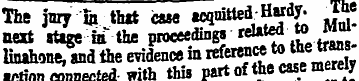
Tbe jury ia that case acquitted . Hardy . The next att _^ e tf the _proceeding related tt Mul linahone ? ind the evidence in _referenca _^ _^ the tonstttion _ejected with this part of he casern eg touched _upott the attempt made by the pnsonerto Scape _arreat . They _had the witnesses _TOtan _Kansand O'Sullivan , swearing _n _™** 1 _** _tteSactiou connected with this part ofthe case , Ind it was somewhat shignlar that not a sing le witness _^ m _MnffiMhone wasprodaced to _-rfove any pftrt _« fthe case . Notaninhabitant , not a shopkeeper , was prodHced—and the evidence given related merely to the marching of the people , and the visit to the police barrack . It was very remarkable tbat the priest
of the parish was not produced ; a priest or two appeared upon the scene now and again and then dtsappeared . The chapel bell rung , and one would suppose that his reverence would have been attracted by its tones , and could have given evidence of the transaction ; but not one of them was brought forward . The evidence of police constables was very msatitfactory . When * the revolution began , there were twenty persons present . The police constable next reported Mr William S . O'Brien as saying 'that all vacancies would be filled « p by Irishmen , '
and he did not think the jury would be of opinion that that sentence amounted to high treason ; for what did it mean more than this—that when there was an Irish administration in this country , all situations and vacancies should be filled up by Irish men ? A very bad and criminal saying , no doubt . Take the entire speech , and what wa 3 there in it from beginning to end to indicate a treasonable in : tent in the mind of the speaker ? What , let him ask , was there in it , infect , about any particular { ona of Government , or about the Queen , or the Bouse of Peers , or whether there should be a
monarchy or republic in Ireland , or its connexion with England iu the sense in which be had always contended for it ? Nothing ! It was perfectly plain that it was a mere , personal object which he ( r O'B . ) sought to attain from first to last . The sgle topic which pressed upon bis mind was this' I am apprehensive of arrest , and will you ( to the people ) suffer me to be arrested ? ' to * which they _repfied that they would not . He ( Mr W . ) never , in aU his experience , knew of an instance where a speech of this kind was held to be proof of a treasonable intent in the mind of Mr O'Brien ; and further , in connexion with this speech , it was important to remark that it was followed by no act of
violence , outbreak , instigation to outbreak , ' or inter * ierenee with property whatever . Then came the evidence of the policeman Sullivan , who deposed to the number of people who had assembled at Mullinahone . Now , it was remarkable tbat the statement of this vritness , ; that there were 5 , 000 persons in the town on that occasion , was not confirmed by any of the other witnesses . He ( Mr W . ) did not , however , seek to impute to this witness a wilful disregard of his oatb , but he was entitled to conclude from his evidence that when a man was found to exaggerate the truth in any one particular , it was scarcely possible that he would hot have done so in other respects also . He next came to deal with the
afiair at the police barracks at Mullinahone in connexion - with which the Attorney General had observed that Mr O'Brien was bent upon a bloody revolution . . Now , a man who was bent on the accom plishment of a bloody revolution , must be bold and daring , and prepared to attempt mighty enterprises ; and it was not to be supposed that he could attain bis ends by soft , and civil speeches—the evidence showed that Mr O'Brien had a large number of men with him at' Mullinahone , forming a force amply sufficient to effect the purpose he . was accused by the . Attorney . General of-having contemplated in Mnllinahone . In-fact , the Attorney General alleged that because he ( Mr O'Brien ) had had a sufficient force to effect a treasonable purpose at Mullinahone , tbe jury must believe tbat the treasonable intent ta
effect it existed in bis mind , even though he made no attempt whatever to accomplish his purpose . But he ( Mr Whiteside ) was convinced that the jury , viewing the whole of his client's conduct throughout the transaction , would arrive at the opinion that there was no ground whatever for the allegation of the Attorney General—for the fact tbat Mr O'Brien having had sufficient force to employ successfully against the police , yet did not make use of it for that purpose , ought to convince them of bis innocence , or at least induce them to place but little relian t * upon the misreported speeches wbich bad been forced into the case , for the manifest purpose of strengthening a case which without them was felt by the crown itself not to be altogether complete . It was then sworn that when Mr O'Brien came to
the police barrack he bad a military-looking cap _mpon his head . Bnt what was the fact ; of the matter ? It was this , that he wore upon his head one of the caps worn b y . the members ofthe' 82 Club , similar to that worn by the late _Daniel O'Connell , who had en one occasion remarked that he intended to have himself crowned at Tara , and yet was not prosecuted by the Attorney General of that day . It was _deposed that in the course of the conversation which took place between Mr O'Brien and the police In the barrack-room at Mullinahone , the former observed to the latter , * Follow me to Callan , and I will place you under pay , ' adding , ' I am abont to attack a barrack where there are 500
police . ' Now he ( Mr Whiteside ) did not place the slightest credit upoa the last of these expressions , and he would give evidence of the most complete character to contradict it . What poKce barrack in the whole country contained so many as 500 men ? Not a single one ; acd this expression the policeman who- gave the evidence must have known perfectly well to have been a pure fiction . In fact , the largest number of constables in any police barrack in Ireland did not exceed forty or fifty men ; and it was rational to suppose that this bravado could never have taken place , inasmuch as it was notiu the slightest degree calculated to create a successful impression npon the persons to
whom it was supposed to have been addressed in consequence of its intrinsic _absurdity . ' Mr O'Brien then said he should give them an honr to consider —and if within that hour they did not agree to give their arms np , he would be back and take them . _The first inquiry , then , for the jury was—did the police remain there , or did they go away ? But as the jary would , no doubt , recollect , they remained four hours packing up their furniture , and the conquering revolutionist—the man who waa to seize the kingdom—forgot to come back and seize the -muskets . - But the police did more—they marched fifteen miles to Cashel , but were not molested in the slightest degree—and that was the levying war
againBt her Majesty ! It was a clear convincing proof , said the Attorney General , of bis being guilty of high treasom , because he levied war against the sovereign of these realms . When Mr O'Brien went to the police barrack the men were unarmed , and the witnesses examined described the two persons who accompanied him as being armed—one bearing a double-barrelled gun , and the other a fowlingpiece , while the prisoner himself had three pistolsone in his hand _, and the other two in his breast . But they did not molest the police ; they remained just two minutes , and lo !—that was levying war against her Majesty !—that was a proceeding which
put Queen Victoria ' s crown in imminent jeopardy 1 ( A laugh . ) He ( Mr Whiteside ) wonld ask the jury , could they generally believe that tbat circumstance was a proof of the commission of an overt act of high treason ? It was , they should bear in mind , one of the most important features in the case up to that point ; there was nothing done before it but mere talk ; and would they believe that that most extraordinary and nnaccomitable visit of two minutes to a police office at Mullinahone waa a clear overt act of levying war against the Sovereign of the realm ? They must recollect that marching in arms was nothing , except it was meant to commit an act of
treason , for if it were so all the Orangemen of the north would be brought np for trial at the next assizes . One of the jurors asked the witness who deposed to this visit a question about the pike one of them carried , when be trailed it , and placed the sharp point of it on the ground , and tbat was one of the proofs given of an intention to levy war . That was not the way they levied war in France , to which Ms learned friend alluded with so much horror—that was not the way they acted when they wanted to revolutionise and overturn a throne—they did not turn the points of their pike 3 to the ground . ( A laugh . ) He ( Mr Whiteside ) was also indebted to a juror for another most important
circumstancenamely-that which referred to the flag . There was , _inpointoflaw , no opposition whatever to the carrying of a flag . He mi ght himself walk out in the street , and put up a flag , if he chose to do so and it was brought into this case because the allegation was that it proved a levying of war . In order to prove a treasonable actin carrying a flag , there must be evidence of marching in military fashion , and with a flag ; but what occurred in . the present _instance ? Unfortunately all the innocent circumstances of Mr O'Brien ' s conduct in this tranSn like his visit to the Bound Tower at Kilkenny we converted into proofs of his evil purposes ; but it tarned _ort according to what the witness said , that it was a Scotch shawj , ( A . laugh . ) ss * '
Tbe Jury Ia That Case Acquitted. Hardy. ...
Attorney _General . —I did not aay there was a flag . I said tbere was a sash . Mr Whiteside . —Yes , it was such a sash as Commodore or Commander _M'Cormack , of Ballingarry might wear . ( Alaugh . ) But what was that sash or flag , or whatever the Attorney General might wish to call it ? Why that , said to be hostile tothe Queen , was a Scotch shawl , such as that which gentlemen ofteH wear —( a laugh )—that innocent fact or circumstance was tortured and perverted , to give what would otherwise be ah innocent blameless act a _guiliy meaning and complexion , which , of itself , it could not bear . A juror then asked another question , as to how Mr O'Brien procured the arms . But the fact was , that Mr O'Brien left town without
dagger , powder , or ball in his portmanteau ; for were tbey in it , no doubt they would have been discovered in the _lime-kikn Mr O'Brien wished to have a guard to protect him from arrest , and that he contended did not constitute the crime of high treason . It was asked for what purpose did Mr O'Brien carry arms ? But it was the business of the Attorney General to prove that the arms were procured for treasonable purposes . Did they say or prove for what purpose the arms were procured ? Did they at the } police office say why they wanted the arms of the police ! No * , for the evidence of the witness was , that they did not ; and that after they went away he saw them no more . That was the nature and substance of the Mullinahone transaction . There was . no
interruption of the police , or attempt to take their arms by force , or marching to attack the police barrack , as occurred in John . Frost's case , when he boldly inarched into the town of Newport . The Attorney General relied on the equivocal evidence of the two policemen ; but no act was done which constituted the crime of hig h treason , and he ( Mr Whiteside ) therefore submitted that the jury would not , and could not , adopt a strained and forced construction of the evidence , and come to the conclusion that it was an actual levying of war . In the cross-examination of the witness Wiggins , he said Mr O'Brien wore a cap like that worn by ' the ; late Mr O'Connell , with ' a
peak and a gold band ; and as to what was said by Mr O'Brien , as witness took no notes of the conversation , the jury could give his statement no Credit whatever , He asked them would they , or could they , recollect , at the distance , of two months , a casual conversation of about two minutes ? ' He said , no ; it was impossible they could do so , and they should , therefore , attach -mv credit to it whatsoever . As to the circumstance deposed to by Tobii , the car-boy , he attached no importance to it whatsoever . He drove him from Mullinahone towards Carrick , wheie he met a crowd of persons armed with pikes , but they were . not under his control or authority . Would they meet him
without any pievious concert ? The people often went out before to meet the late Mr O'Connell and other popnlar favourites , and it was never said they were at any time guilty of high treason for such conduct . If they were armed with pikes how could he help it . or how could he prevent it , when he had nothing whatever to do in the transaction ? . Then came the first affair at Ballingarry , deposed by to Egan and a man named _Bonrke . The first man was an inhabitant of the town ; he was not in the police , and all he proved was , that he saw Mr O'Brien coming from Mullinahone . He had arms then , and so had some of the crowd ; but for what purpose ? Why , to protect Mr O'Brien . The witness then deposed
to a speech he made , which was similar to that delivered at EnniEcorthy ; aud indeed that speech mi g ht have been stereotyped , for all he said subsequently was only a repetition of his first address . He was , he said , afraid of being arrested ; but what proof was that of a general object to create a revolution ? ' A man did not embark in projects ef treason without knowing what he had to do ; and again , he ( Mr Whiteside ) avowed that Mr O'Brien's purpose was to avoid and resist wbat he conceived to be bis unconstitutional arrest by Lord Clarendon , who meant to put him into gaol , not to try him , but to . imprison him for an indefinite period . If he ( Mr Whiteside )
wanted evidence to establish what he had said that morning , the speech of Mr Dillon would be perfectly conclusive on the subject . Egan , the witness , said that Mr O'Brien wanted a guard for the night of twenty . What did that prove ? That he wanted a bodyguard , but not a guard for any other purpose . Egan said be did not Bee Mr O'Brien again that eveaing . Having got the body guard , he dismissed the army , and went to bed and slept . Heroes of revolutions did not act after that fashion . Tbey _dil not sleep ; they rather continued _awaken to plot , to contrive , to see what post they should attack ; but Mr O'Brien having got his guard around him , he went to bed and slept ( laughter ) .
That witness called the people a mob—he said he saw some guns and pikes as they were leaving Ballingarry , and going to Kiilenaule ; the men walked by his ( witness ' s ) door ; they met at a certain distance to guard Mr O'Brien , and then they left him—Mr O'Briea dismissed the army . That indeed , wasthe act of a revolutionist . "The learned gentleman then referred to ' the drilling witness , ' Sparrow , and commented upon the evidence of tbis person at very great . length . Sparrow said thathe saw thir , y armed men about Mr O'Brien—that the others had scythes and pitchforks , and such weapons as the peasantry oa a sudden and for a sudden object might supply
themselves with . He dwelt on the utter improbability of this witness ' s evidence . The' army' went to O'Brien ' s Cross , where they dispersed , and Mr O'Brien went on his way . The armed party continued with him , but the mob went away . Did they ever see or know of such a thing as 'house drilling , ' which had been sworn to on this occasion ? Egan did not prove it , although be was a house-builder in the village of Ballingarry—Bourke did not prove it—Sparrow gave evidence of it ; but who could believe hira ? -Where was the postmaster or postmistress who lived under the pay of the state , and was he dismissed in an hour ? Where was any respectable inhabitant of the place ?
Where was any ; man unconnected with the police force ? and where was this Sparrow living ? and what did he say he would not do ? He ( Sparrow ) was living with the police , and he said he never would take money from any person whatever , after-this trial was over , or even while it was pending . They admit the entire case up to the present moment was the desire to escape _arrest , and this was shown from _Enniscorthy up to the present moment . It was alleged by the Attorney General that the prisoner behaved like a marauder ; andhad availed himself of the right of a revolutionist . to take possession of houses and food , and had not paid for anything . What was the evidence with regard
to that ? It was , that four or five persons entered a house , took a temperate meal , and drank nothing but water . Did they remark how anxious the Attorney General was to find out the facts connected with the hotel bill ? For half an honr he was torturing the witness to prove that this innocent act was one indicative of an intent to set out upon a marauding expedition . What passed ? The prisoner , supposing him to be one of the party , went to bed very quietly , and slept , upon the eve of a revolution ; and the sum of 13 s 6 _d was paid in the morning—a fact which he _wss sure the shorthand writer for the
Crown would preserve as one of the most appalling in that most awful part of the case ; He would next proceed to Kiilenaule . It was impassible for any twelve men to say up to this period that the prisoner contemplated the design of high treason . The twenty armed men , about whom evidence bad been given , went a certain distance with the prisoner ; he was on au outside car with two men , and they drove to the hotel ; Could there be a more ridiculous abortion of proof than was furnished by this part of the case ? They marched to Mullinahone , and then—oh ! dreadful revolution—some bread
was purchased . When revolutions were undertaken private property was but little respected ; but nothing of the kind occurred in the present case . No property was injured—no rights invaded ; and could they hold that such a transaction _ivas high treason , when it was not held in a case -where the people burnt houses , and police and soldiers confederated together ? Bread was obtained and eaten—this was not high treason . * But ( said the Attorney General ) put the hotel bill in the round _tosser and the socks or stockings together , and a case of-high treason is made out such as should convince the most sceptical jury in the world . ' Had the people fired upon the
police or the troops , that would have been a different thing . But the fact was , that , having preserved the prisoner from arrest , they ate their bread and peacefully dispersed . He appealed to the jury to consider the statement of the Attorney General ) and compare it witbfc he facts . Where was the army ? Gone . Where was their leader ? He was off on an outside car . Where was his carbine or blunderbuss ? Under the cushion—and thus the leader of a revolution was driven into Kiilenaule . The learned counsel then referred to the evidence of the innkeeper ( Walsh ) , and that of a police constable ( Mathew ) . The evidence of the latter person had reference to a matter which made it impossible t
Tbe Jury Ia That Case Acquitted. Hardy. ...
impute the guilt ot treason to Mr O'Brien . Did the prisoner tell the people to make a barricade , or resist the trrops ? He did not speak a wordY or direct the peop le to make a barricade ; and when . it was made , it was merely for the purpose of preserving Mr O'Brien fromarrest . The Attorney General said that was high treason . He i ( Mr WhiteBide ) contended that a sudden act done by a man in a moment of impulse could not be held to be high treason . When the Earl . of Northumberland marched with some thousands of men , the judges held that his acts did not amount to hig h , treason , because the guilty intent was not shown . This was the best evidence the law officers could obtain after rummaging the coun' ... _.: . . . _,- _ _.- ' . . t \! J
try with the whole of the constabulary at their back . The learned counsel then referred to the evidence of Captain Longmore , in reference to the erection of the barricades at Kiilenaule , in order to show that the object of the people was solely that of preserving Mr O'Brien from arrest . Here was the evidence of a man who , beincc a British officer , would not vary one word from the truth ; The allegation was , that the prisoner made war against the Queen . To do that , there should be a determination , as iu the case of John Frost , to kill the troops ofthe Queen . There were men inside tbe barricades —• men who had rifles—the troops halted , and they were addressed thus— ' If you are people upon ordinary business , and are not' come to arrest Mr
O'Brien , we have no quarrel with you ; we are not making war against the Queen , nor are we desirous to subvert her authority ; our sole desire is to prevent Mr O'Brien , from being arrested . ' . No , ' said the officer , 'I have no intention to arrest Mr O'Brien . ' The barricade was removed—not a trigger was pulled— -not a stone thrown—not a _pfte-or bayonetraised ; and ,. in an indictment which did not charge thatthe military were marching upon the service ofthe Queen , Mr O'Brien was charged with high treason . This occurred upon the 28 th of July . The jury would decide that case as twelve Englishmen would decide it ; and there was not one of that magnanimous nationthat would hesitate one moment in acquitting the prisoner . If the prisoner
had been guilty of illegal acts in the Association , why had not the Attorney General caused his _-arrest ? He should then have asserted the dignity of thelaw ; and there were many law officers , not out of that court , who had enforced the law in the ordinary manner , and quieted the country . Did they believe that when behind a barricade a _wholepopulation was assembled , and not a man was injured ; and when the man who had the rifle , and did not shoot the officer , though he could have done so , any desire was entertained to kill one of her Majesty a troops ? It was proved to demonstration that the troops were received with courtesy , and greeted with cheers on their way . The criminal law ; presented no such case of hig h treason : The prisoner
might have been indicted for a rank misdemeanor , and tbe dignity of thelaw would have been vindicated ; but his argument was , that the acts done did not amount to high treason . Nobody was hurt—and that wav what the Attorney General upon . a solemn trial for life or death , said was a proof of a revolutionary intention ! . Defend us , from constructive treason ! One thought ' never crossed . the . breast of Mr . O'Brien against „ the dignity of the Queen . In what : speech did he refer to her name ? Where had he spoken with disrespect of a lady and a Queen , whom it was the objeot of every chivalrous nature to respect , admire , venerate , honour , and love i Mr WhiteBide having commented upoa gome evidence of a less material oharaoter , proceeded to refer to the
transactions wbioh took . place at Ballingarry _^ Mr O'Brien having-arrived at Boulagh , _wmewtnesses were produced to depose to his earliest proceedings in that looality . Of these _witnesseshe would take that of _Lamnhier , who appeared to be the most respectable of the number , and whose evidence embraced all that was material in this portion of . the ' case . Thi * Lamphier , who was an agent in the employment of the Mining Company , stated that upon the 28 th of July last he heard a speeoh made by Mr O'Brien to the people on the Common of Boulagh '; and what did he make _hia-blient cay , ' that there was a proclamation issued for hia . arrest , and that he wished the people to protect him from that arrest . ' Now , was it not remarkable that this man , who was
charged with having headed a formidable rebellion , did not say to his army , ' Let us capture Clonmel , seize upon her Majesty ' s troops , and blow up the barraokiifrwhicb : they are-stationed V No , he says ¦ imply this , ' If you protect me Ireland will be free in a fortnight , ' olearly showing that what he aimed at was the personal protection of himself . And was it not also remarkable that'Mr O'Brien and his friends—those men who contemplated an immediate insurrection , according to tha _attorney Generalshould tell their beaten , not _toba prepared toibreak into armed insurrection on ' the instant , but , as ono of them aaid , * in a week , ' another * in a fortnight , ' and a third , who was fixed npon as the most violent of the party , so distant a period as six months ; 1 Here
it was a worn by the same witness that some of the people told Mr O'Brien that they had nothing . but stones to use in the fight , and that he replied that stones were very useful where better , arms could not be had . Now , in the name of common sense , did any : me ever hear of a number of men going to wage war against one of the most powerful monarchs in ths . world armed with stones ? No doubt his client told them it -would be better * for them to have other arms ; but ' even if he did say io , that was hot high treason—but for wbat purpose did be use that language 1 - To create ' rebellion t No , bat ' to proteot him , 'to use his own oft-repeated words . He ( Mr WhiteBide ) thought it was utterly impossible for human reason to reconcile the conduot ofthe people
and that of his client in this put of the transaction , with any other hypothesis than that he had just laid down . Then eame the evidence of the witness _Colleo , concerning whioh he observed , that if he wanted evidence foV the purpose of clearing Mr O'Brien ' s oase from every unfavourable feature it presented , he could not have desired stronger testimony in support ofthe ' argument he beard all along advanced than what had been supplied by this witness . This witness statedtbat Mr 'O'Brien-bavin * - mounted an old ditch , addressed the people , and said— ' Can you ¦ apply me with a sufficient force to keep me from 200 men V . Was that , he would ask the jury , the foroe that would be employed by the government of the Queen of England if they wished to quell an
insurrection ? < No * but it was exactly suoh a force as *» onld be sent for the . _arrestof a single man . This was the common sense view whioh any rational-nan would take of the language need by . Mr O'Brien , and it applied tothe case he had endeavoured to establish all through his speeoh .. Mr O'Brien did not say ' Come out with me into the field , and let us assail the Queen and destroy theempire . ' No , but this only , ( Haveyou a force sufficient to protect me from any attempt that may be made to arrest me by 200 men V Mr Whiteside then contended that , the barricade ereoted on the Ballingarry road was like that erected at Kiilenaule for the purpose of obstructing any attempt cf the officers of justioe to arrest Mr O'Brien To establish the case for the Crown , the . Atternev
General had given evidenoe that Mr O ' Brien bad gone into tbe yard attached to the mining concern , for tbe purpose of obtaining carts , & o ., to raise a barrioade . Now , to thia evidence he wonld reply by pointing to another part of tbe evidence given by tbe same witness , whioh was to the effeot that no attempt whatever was made by Mr O'Brien or his followers to make nse . of the gunpowder whioh they ( the colliers ) knew was kept in tbe concerns ofthe compeny . Now , itwas perfeotly dear that if Mr O'Brien had intended to make , War upon the Queen , tbis barrel of gunpowder would have been the very thing for his purpose , and would have been takes by him to _asaiat in the accomplishment of hia purpose , But ifi on the other handtbe object of Mr O'Brien wasas
, , 1 It M 9 l m . a . . a . - ¦ - ' ha alleged it to be , to esoape arrest , was it not more natural for him to ask for tbe carts in order to ereofc a barrioade , and to leave the gunpowder , whioh he did not require , untouohed ! He would confidently leave it to the jury . to decide whether the hypothesis hehadjustadvanced _. ortbat of the Attorney General , wbb tke most consistent with the faots proved in evidenoe . What woald be the ordinary oonduct of a man resolved per fas out nefas to do it ? L » t thejury imagine the caBeof a man who intended to commit awbberyatarailway office—who went up tothe olerk , and said , _« I want the money of tha railway company , ' and when tho other said , 'it belonged to that company' the person went away . Wbb that robbery ? Mr O'Brien asked for a pony which would
_riuouowniue cavairy c-t ureal Britain-daughter ) -a pony just then , it appeared , going to water-( laugbterHand then the witness said , « No , I cannot give you either the pony or let you have the key of tbe barrack , because I shonld get into trouble with my employer , ' and then Mr O ' Brien walked away Wm that a proof of a treasonable purpose , or oflevying . war _Bgainst her Majest y ? « Oh ! but , ' said the Attorney General , « he wanted the barrack for military purposes . ' But if he did , why did he not take it ? He could do so if he wished ; for the witness deposed he had a crowd with him , and that no one wasin the ooncerns but himself and a few men . He * J _^« _^ _•*•*!» eot tbe letter given him by Mr O'Brien from Dublin , in order that he should
mark it ; and he added . that on the very evening when this transaction . ocourred he forwarded to Dublin £ 100 in money , and had fifty pounds of powder in the place . " _T _* hey Were all within Mr O'Brieh _' _B _reaonj He might have seised them if he liked , but he declined doing so , in consequence of the reasons given by the witness . Then oame the evidence of Mr Purdy , which was not of much oonsequeuce in the case . And now he would call the attention ol thejury to the evidenoe of Mr Trant and the five policemen , who deposed to the transaction at the Widow Cormiok ' s houso . He should not detain them at any length on that of Mr Cox , for it waa immaterial to the oase . Mr Trant stated he got oiden to plowed to Ballingarry oa the wiwg of
Tbe Jury Ia That Case Acquitted. Hardy. ...
that day , to actio concert with Mr Cox , coming in another direotion , who was desirous of receiving the reward of £ 500 _; for he said to Mr Trant , * Oh ! you let £ 500 slip out of your hands . ' ( A laugh . ) The jury must ' remember tbat . the only body of men under the control of Mr O'Brien were the colliers who ran after bim' ; be bad nothing Whatever to say to the ' peoplej who lived at a distant parti ofthe country ; ' he did not send for them—he had ho authority over them—there was no proof of a combination or conspiracy iu ; the' satire transaction . The whole , and the powerful part'of the present oase entirely depended almost on the evidence ef Mr Trant . That inspector , he was told , wrote a dispatch , detailing the transaction , which would out-do 'Garwood's Dispatches of the Duke ef Wellington , ' commencing with the poetio words , — * _thif _/*• . « : _tn ' _-utt iff _M-iMfi : with Mr'flak , _comitirf Ik'
Wboavor takes the foremost foeman ' _e lift , JJ _lnwelt shall _eonquer In the strife , ( ereat laughter . ) That showed the mood he Waa in ( alaug h ); but he ( Mr Whiteside ) firmly believed that if he had not gone into the stone house of tbe Widow M'Cormick , —if he did not run op the hill for proteotion , there Would bave been no collision on that oooasion . This was the first time when treason burst out in all its fury and malignity . He referred his evidenoe to tbe jary . He deposed that one shot was fired by the people , and then they found him in the stone houae . This sudden quarrel , this painful arid melaneholy transaction , would hot , he ( Mr Whiteside ) was firmly con vinoed , be high treason had he not retired-to that house . It ' was only that
mbining Mr O'Brien and the people Who were with him heard of the proclamation tor his arrest ; and his protection from ' the seirure of the polioe was their powerful object . He had great doubts who fired tbe first shot ; for they must remember that an unarmed matt oame forward before firing took place , and exolaimed , ' For God ' s sake let thero be peacelet thera bo no _firing . ' Did that look like a determined , murdering purpose of attacking the police ? They would recollect that in the attack which ! took plaoe 300 rounds of ball cartridges were fired by tbe polioe . The evidenoe of Mr Trant was , that he ordered the police not to fire ' unless fired on by the people ? He ( Mj W . ) regretted sincerely that he did not go down stairs instead of looking out from
above , "for had he done so the conflict would not have taken plaoe . Mr O'Briea went round to the irdn ' t of the : honse as he' - ' war , desired , bnt 'T _» rit" _remained abofe stairs . ' _Mif Trant , be it remembered _, did , not swear as : to the words 'Slash away , | and _Blaughterihem all / _beingiused ,, but he said there wasa _' _orasbj and then the ; firing commenced . ; He could speak of nothing else but the orash , and whenever be ( _Mr'Whiteaide ) asked him anything his reply was ' orash , crash , ' crash . '' ( A' laugh . ) i The firing continued for one hour . 230 rounds of ball cartridge were fired by the polioe , and yet , _* after all that , there were no marks of the bullets fired by the people , and it required , _u he was informed , a microsco pic view of the house to discover the injury
done to it , for be it remembered the panes of ! glass were broken by the police in the aot of _firings Mr Trant said he was wounded , buthe did not know it or feel the pain , nor conld he say he was wounded at all until some of the policemen told him . ( A lam-h . ) He said also he did not go to bed during the _ooufliot —a _circntnstanoa of whioh he was not quite sure . ( Alaugh . ) Thepolioemendid not see him during the fight , but after it was over he was found gathering up the trophies of his most brilliant campaign . The learned counsel then referred to the evidence of Robinson and the other two policemen . One of them swore that Mr O'Brien was near tbe window , withone foot upon the sill , when it was stated he made use of the words , ' 'Slash away , boys , slaughter them all . '
The other witness said that Mr O'Brien bad gone away , -aud the third said that when he made use of the words , his ( witness ' s ) bayonet was within six inohes of . his breast . Not one man was wounded , though this order was stated to have been given—not a ballet was foand—sot a remnant bf the battle appeared but the deierlptlon that was given by the police , and he called upon thejury to give the benefit of the doubt arising from the deposition of Mahoney , who did sot hear Mr . O'Brien use the words , and also from the absence of _Raffetty , who also ' was atthe window , and though as a matter of course examined by the Crown , had not been produced by the law officers . ' None had _suffered except the unfortunate men who were within range ofthe police guns . He called
upon the jury to disbelieve the testimony of Moran , who was naturally a coward and assassin ; for he swore _thit he wouUthaVe shot the _defenoeleis women who were there probably . ¦ for the purpose of resouing and leading away from the plaoe of confliot , their hasbands , sons , or brothers . He implored of them to reflect on the testimony of a man who said , he wonld have imbrued hiB hands in the blood , not of a man , bnt a poor-defenceless woman , rushing forward to resoue her relative . The learned counsel then referred to the evidence of Mr Cox ; He lauded the manner in which , he gave his _evidence , but dwelt npon the ciroumstance thathe had not mentioned to the _iospeotor-general anything about the use of the words' slash away . Ha next _referred to the evidence
' of other witnesses , for the purpose of showing that the objeot , from first to last , was to preserve Mr O'Brien from arrest . Could they believe that the man who said * slash away , ' would have told the policeman whom he met on the road that it would be an unmanly thing to attaok an unarmed man ? The revolution terminated by the , ringleader descending from his horse , surrendering it to the man from whom he took it , and suffering him to go about bis business ., The last words _ofnMr , -0 'Brien-were that he wanted no bloodshed . Were these the aots and words of a man who desired a revolution ? It was impossible to conceive-that , he contemplated anything . ° t the kind . Where Was the mark of the bullet ? There was not ene scrape on any one of the . entire body of the police .
How unlike the oase of John Frost ! , Here the ; officer only imagines , dreams , and thinks he ' waa hurt or wounded ; but neither hurtiior . wound has been fonnd on bis person . They did hot examine the Widow M'Cormick . Why not ) They did not examine any ofthe Women who were there . Why not ? There were women and children there . It was not amid women and children those individuals wonld levy war against the Queen . . It was well the ohildren were not there ; for if they were , it was evident from the testimony of one ' of these policemen that he would have shot tbem all . He had the word , however , of his olient to say that he never used , any of the expressions sworn against him on that ' occasion ; As to ' slash away , slaughter them all , 'he referred to the _testimonv
of Mahony _, the policeman , the first of the constabulary called , who waa touched by Mr O'Brien ' s hand , yet Mahony did ' not awear one word as to the _expres . tion stated io . have been used by Mr O'Brien . Mahoney said that a stone came into the window . Did this consist with the enormous crash ol the inspector ? No doubt that was the stohe that struck Mr Trant . ( Laughter . ) Mahony heard no crash ; he saw no ball come in ; all he ( Mahony ) saw was the one stone ; be said he eaw a small number of fire arms . It wss impossible that Trant swore wbat was correct , when he said he saw a great number of fire arms . It was impossible ! Mahony _ , in point of fact , contradioted all the _witnessed . A juror asked , were there any marks of . balls ? The reply of Mahoney waB , that there
were no marks of balls or bullets whatever . He then went to the evidence of Moran , on whioh he commented in the most severe terms , showing the impossibility of his statement , and demonstrating the disposition by which he was actuated by the entire tenor of his testimony , whioh was of the most sanguinary oharaoter . Mahoney swore that the firing was one quarter of an hour ; Moran swore that it was three quarters of an hour ; and when asked what sort was the firing and wbat he saw , the reply was that he saw one man attempt to fire . Then Moran swore that he saw women in the crowd , and that if he saw women in the crowd pioking up stones he would have shot
them all . He really regretted to hear Buch testimony givea by one of the police force . But Moran swore that Mr O ' Brien , while making nse ef these expressions , waa in a position in which he must hare been shot dead immediately , and deservedly , if he had used the language that was attributed to him ; Moran laid , too , there wore armed men inside the wall , protecting Mr O'Brien . Let them mark that . Moran said if he could bave shot Mr O'Brien he would ; but when asked how near he was to him , he replied that his bayonet was within six inohes of Mr O'Brien ; and when pressed aB to why he did not fire , he said' I did not hear him— ' and there he ( Moran ) stopped short . That was the evidenoe of that young raan
Moran , Their lordships then retired , and when the Court resumed its sitting , Mr Whiteside proceeded with hiB address . He commenced by taking a review of the various dooumenta given in evidence on the part ef the orown . Tbe firat of these papers consisted of a pencil tracing of a map found upon Mr O'Brien ' s person at tbe time of his arrear , and which he ( Mr Whiteside ) was called upon by the orown to explain . That , however , he positively deolined to do , and would leave it to the Solicitor General to fix any guilt he could discover in oonnexion with it upon his olient , if he was able to do so . There was , however , a document of somewhat greater importance , whioh he did aot deny —viz ,, the letter written by Mr O'Brien to the directors of the Mining Company , dated the 291 h of Julv . 1848 . and whioh the Attorney General asserted
to have been written previous to an intended battle . Mr Whiteside then read the letter he referred to , section by _seotion , commenting upon each consecutive passage , in order to prove that Mr O'Brien ' s sole object in writing it was to prevent theoollieis , who had protected . him . from arrest , from being thrown out of employment on his account . He ( Mr O'B . } did not talk in it of _attacking the troops ofthe Queen * but clearly _tsaowa that he had in view only a personal object—the evasion of any attempt made to arrest him . Then he reoommended that the whole of the prooeedaof the colliery Bhould be employed in tbe payment of the men' for the-present . ' . - And his olient then complained of the manner in which the colliery had been worked , and suggested ' that the men should be paid by wages , and not by contract . ' Now , there was nothing criminal in that suggestion , and it was somewhat remarkable that it had been sinoe adopted by the same mining company , Mr _WJutesi-iQ _ttoureferred tg _ttwpwsageia tho letter
Tbe Jury Ia That Case Acquitted. Hardy. ...
whieh threatened that if tbt company did not comply with tbe writer * * suggestions , their property _woujdbe forfeited in the event of ithe Irish revolution sucdeod ing . Now , he ( MrWhiteside ) submitted tbat it | was a highly improper proceeding to make a _threit ' _ot thia nature ; nothing . could , in fact , _exouse such language , but still it amounted , to . no more than a threat ; and it was plain , from a review of the entire document , that hi * olient merely sought to do a service tfl the men who had protected him for It must be cleat to every one that if he had then contemplated an insurrection , he would not have sat down to write a letter to a mining company for the _pur-Sose of _ioggestisg that the prioe of their coals should e lowered . The learned gentleman then drew the whi _« h thnuitfinftii thatif tha _nnmnanv did _notanmnlv
attention ' of the jury to the haste in which Mr Meagher ' s letter was written . He said that it was not high treason to go to New York , and that the words' et cetera , el cetera , ' did not involve any intention to commit an aot of high treason . ThenisVto the letter of Mr Daffy , be said that , in the first place , the person who wrote that wasin the custody of the crown , * ie had a newspaper , whioh was seised , and the papers found there taken away , but they did not find a single , line from Mr O'Brien ; Itwas all-important te know the date of that document—it was , no donbt , dated Saturday , but that might have * been a Saturday two or three yean ago . How did the jury know the year in whioh it was written ? He had just been informed that through the kindneBB
of the Attorney General an acoount ofthe papers found in the portmanteau , was to be given , among wbioh were papers ' dated in 1843 . ' Thero was so muoh of _duplicity-rjo mnoh of treachery abroadthough he did not accuse any one—that if the docu meat were received in evidence , it should be shown it existed before , his arre . t . The learned gentleman next prooeeded to _cemmont on the address presented to Mr O'Brien at Enniscorthy . _and'the letter bf Mr Meagher , fonnd in the portmanteau , and prooeeded to observe on the evidence of Dobbin . He appeared ( he said ) in the eharioter of a spy—he was an informer , but there was a rule of law that a witness who came forward in that way should ba confirmed by ether witnesses . No jury conld beliere the
statement of a spy unless he was so corroborated j He deposed first to the meeting on the 15 th of Jaly , and . where was the confirmation of that ? Next followed those of the 19 jh and 21 st , snd yet his statements were not corroborated in any one particular . ' _iThen came his testimony >' regarding the R _* d Hand Club v bnt . although the government had deteotives and polioemen watching the iovt where ita meetings were held , ' not a word of corroboration was kiven The Solicitor General wonld tell thera that _thejgreat corroboration of Dobbin consisted in the balloting papers—the handwriting of these dooumenta wks not proved ; 'Dobbin swore that no clergyman was te ba balloted for / If there we ' re a meeting , it was an innocent one—ne guilt wai upon the faoe of _atiy one
of the balloting papers ; but suppose there _werb , did the government expect the jury whom he saw before him to convict the Prot _** stant agitator in the'doclr , while the Roman Catholic priest walked abroad in all the freshness of health and freedom , administering _ghoitly consolation to his flock ? Was the prisoner to be visited with the terrible responsibility of the offence with wbioh be was oharged , while the priest for whom eight voted to place him on the war _ounoil walked free ? An ! if he ( Mr W . ) vindicated the Attorney General , he also vindicated Lord Clarendon ' s government and -the British ministry , when he said that this could not be so . Father Kenyon was an innocent man ; but if he were gnilty , the orown was prosecuting a
man who was not so , and were not prosecuting another who was elected , or nearly eleoted , a member of the war council . If they wera to expeot impartial justice in that oountry they should take their stand upon the entire people of the realm . Let them ' have no partial one-sided administration . Let the Protestant bs convicted if he were guilty , but unless they were prepared for the basest despotism that ever disgraced freedom , let them _reeolve upon an inflexible and impartial law for all men alike . He ( Father Kenyon ) was balloted for as a member of the war council , and he was innocent . He would appeal to the jury , ' and the free and magnanimous nation nnder whom they lived to sea that justice be done—he asked for nothing more . He appealed to
their honest natures , was one man to be struok down and another spared—was ' his client , to ba strioken down snd sacrificed , and the other spared f He acquitted the : law officers of the orown—he acquitted the government and the prosecutors of bis client , for they did not know or believe that Father Kenyon was the member of an illegal , guilty , and treasonable conspiracy against the Queen , and therefore he was not prosecuted , being an innocent man ; and was the man for whom even the informer said no one had voted to be made responsible ? Itwas for the jury to say whether the oharge against the prisoner had been established , The charge was high treason , and he had shown them that an endeavour to escape arrest did not amonnt to high _treassn . The learned
connsel tben prooeeded thus : — Gentlemen , I have spoken to this oase . I have gone over the entire evidence given by tbe crown to sustain the charge against the prisoner , and it is for you to say whether that oharge is established . The accusation against him in for high treason , compassing the death ofthe Queen by levying war against the Queen in her realm . I have explained to yen the principles npon whioh this crime is to be ascertained ; I have shown you that appearing in arms is not enough , that an endeavour to escape from arrest is not enough . It must be plain to yon that the prisoner is gnilty of the oharge contained in thiB indictment before yon can oonviot him . Gentlemen , I have observed upon the evidence , and I simply submit to yon in conclusion ,
tbat however yoa may condemn certain acts of Mr O'Brien , however equivocal yon may think some observations made by him in one letter are , yet , if you believe that his offence falls short of the tremendous crime of treason , you are bound by tbe Bolemn duty yon have undertaken , irrespective of every consequence , to acquit the prisoner . Well I know the weigbty difficulties I have to encounter , and how incompetent my feeble powers have been to grapple with and overcome them . Well do I know how prejudice has blocked np the avenues to the ¦ understanding ef some—how calumny has done its' work with others—and hew it bas been said that the im-Coticable politician must perish at last . If be bad na hypocrite , and had covered his selfishness
with the mask of patriotism—if he had said what he did not believe—if he had unsaid to-morrow what he had said to-day , he might have been a p-triotic placeman ; and enjoyed individual _prosperity , having traded with tact for a time upon the _miaeries of his conntry . Wrong he may have been in the opinions he has imbibed , yet he has adhered to them steadily and consistently throughout his life , and he _saffers now for having honestly maintained them , believing them to bo trne . He has been revi _' _ed , carioatured , and slandered in his native country from one extremity to the otber , he has been hunted as a traitor and covered with abuse , and where is he to look for justioe ? Where can be his hope for a temperate consideration of his whole political life bnt where the
law has _plaoedhis safety—in the honour , discernment , and humanity of a jury of his countrymen—a rampart or defence to stand between the orown and prisoner . If the crime consisting in the intention of the Boul is not sufficiently established , judges 1 must be unbending , bnt jurors may yield te the frailties of human nature . Jurors may threw the broad shield of their protection around the acoused , whose intention they can believe to have been innocent , censurable though his conduot may have been . Suoh is the high offioe assigned to you by the constitution , whose foundations were laid in the deepest wisdom , whioh through a succession of ages has been cemented by the patriot ' s blood and consecrated in the martyr ' s fire . It is for you to say whether his gnilt
is established conclusively or not . The law of your country , wise , just , and merciful , has deolared that if there be a doubt tbat doubt must be given in favour of him whose life is sought to be affected ; and , therefore , yielding to those benign principles and those generous impulse- of your heart ? , it is for you to stand between tho prisoner and hia grave . Review his life . A love of hu country , he imbibed from his mother ' s breast * It waa strengthened by his father ' s example , perhaps , to a dangerous exoess . His father recounted to bim how on the last memorable _nii-htof our national independence he had heard the burning words of Grattan , of Plunket , and of _Bushe—how he had been persuaded by the gravity of their arguments _, transported by their eloquence , and
inflamed by their patriotic ardour . Those lessons taught to hiB parent he has never forgotten , and believing that the Union was carried by oonuption , he struggled for its repeal , and to restore to Ire * land ita Parliimentary existence . In that haa been the labour of his life—a delusion I admit ; bnt is not death upon the _soaffold a terrible punishment for believing that Irishmen have the capacity and intellect to rule the affairs of their native coantry Would to God that Mr Smith O'Brien were my only olient J The happiness of an honourable , ancient _, and royal family is at stake this day . The churoh , the bar , tbe senate , furnish members nearly and dearly related to the prisoner . They may differ from him in politics , bnt they are here to give him consolation in this melancholy day . Should you send him to the scaffold they must struggle on hereafter with broken hearts through a cheerless existence ,
labouring in sorrow for him they loved . A venerable lady whose life has been spent amidst an affeotionate tenantry , who haa lavished her fortune and dispensed blessings and chanties around her , awaits , with trembling heart your verdiot . If your verdict consigns her beloved Bontothe grave , that heart will quiokly beat no more . Six innocent ohildren await to be informed whether they are to be stripped Of the inheritance which has _deioended in their family for ageB . and driven beggars and _fitherless upon tho world through the rigorous enactments of a cruel law-whether they are to be restored to peace acd joy , or plunged into the uttermost depths of black despair . There is another who still _olinw to hope —that hope may it be blessed in you ! Her heart ' s blood she would gladly give to save the objeot of her youthful affeotions . You will not send her , unleBs at the command of conscience , to an untimely grave . [ DuriDg tbe deliveryof tbis _paHagetheeatireaudieace
Became.Visibly, Moved, Snd For The; Firs...
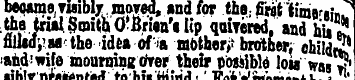
became . visibly , moved , snd for the ; first "tiirifl'sin «/ the trial Smith O'Brien ' s lip quivered , and hi * £ filltdi M'the idea of a mother ; ' brother , child- * : ahd ; wife mourning oVer their possible lo ts was vi ' fiblyp _^ sented to his iaiad . ; ' Ma / moment he bm his heW on his hand ; he firmly pressed bis brow fa a'few _Seconds , and again resumed bis wonted' calm , new ' .. ' Not so the audience , the bar , tha jury , thi occupants of the benches / all continued deeply movei . and from many a manly eye , til'wbich tears had lor , _, been strangers , tbe big _dropi rolled in ' rapid succej . sioi . We never remember to have seen so _profound a sensation as tbat produced by the gifted advocate whose action and tone , far more eloquently tbsu eves his living words , expressed the deep emotions with whioh bus own heart was moved at the contemplation of ari adverse Verdict _beoama viaihlv _i-invAri . and ft » f ha _£ _'«* ' _«'_ ... .
] ' Tet even in this base of blood I do not ssk- for pity ma-wailing spirit : I ask it in the spirit of a free constitution , is accordance with the rooted principles of onr common law . Those principles ought to shine out in glorious perfection in th ' 8 great cause between tbe prisoner snd the Crown ; and a verdiot in accordance with them is not a triumph over thelaw , bat a triumph of the law . If , however , you shall ooEviot my olient , neither will I nor will he censure that conviction . I trust he will meet his fate with the faith of a Christian and the firmness of a man ; The last accents of his lips will breathe a prayer for Ireland ' _s'happiness and Ireland ' s constitutional freedom ; and in that moment of his mortal agony he will be consoled if throrjgh his sufferings and his sacrifices some system ef government shall arise such as I aver has
ne ver yet existed—wise , impartial , _oomprehensive / and above ail , whioh may _csnduot to wealth , prosperity and greatness the country he has loved , not wiseir perhaps . but too well . Our Sovereign in tbat oath wherewith she seals her coropaot with a free people premises to exercise in all her judgments jtutioa in meroy . That _jestice you administer ; no remorse . l « s , croeI , sanguinary code , but justioe in meroy . iln nothing can frail _mertals approach so nearly to the attributes of the Almighty as in the " administration of justice here below . Divine justice will be tem . pered with mercy , or dismal will be our fate . Tha awful issues of life and death are now in your hands . Do jastice in mercy . The last faint murmurs on your quivering lips will be for meroy ere the immortal spirit shall take its flight to , I trust , a better and a brighter world . —
• Witnesses were then called for the defence _^ Mr William Hamill—Was the original secretary ofthe Irish Confederation . ( Counsel here handed the witness a document , whioh he examined , and said contained the original rules of ths Confederation . ) The rules were first submitted at a preliminary meeting at Radley ' s Hotel . Mr Smith O'Brien attended the meeting . The rules were in proof , bnt they were in manuscript also , Those roles were adopted at a general meeting at the Rotunda . A lecture on the use and _oapscity of Confederate Clubs , delivered at the Doctor Doyle Chrtyhy Charles Gavin Daffy , was circulated among the members , A report on the formation and government of Confederate Clubs was also circulated among the members . Coased to be secretary ' in Jane , ' 17 ; was summoned to attend the trial ss a _witne-a for the crown : "
By the Attorney Ganeral—The Confederation waa formed in January , 1810 . The Council of the Confederation consisted of twenty-one at first ; Mr O'Brien , Mr Dillon , Mr Doheny , Mr M'Gee , Mr John Martin , MrVarian , and others were members . Mr Brennan was not a member , nor was Ms Lalor . . By-Mr Fitzgerald—There were olergymen on the oounoil ; among others tbe Rer . Mr Meehan and the Rev . Mr Kenyon were members ef it . Dr Gray , one of the proprietors of the Fbseiun ' _s Jodrsai . and a member of the Irish League and of the Repeal Association , verified the documents pro . duced aa the rules of those societies . A pamphlet produced was a report . of' A Speeoh delivered by Mr
O'Brien _m the House of Commons , in 1843 ; on the Causes of . Discontent in Ireland ; ' and a letter produced was one written by Mr O'Brien on joining the Repeal Association . Both the speeoh snd letter were circulated among the members of the Repeal A _ssociation . Had . known Mr O'Brien intimately since 1844 . Had conversed very frequently with him on politioal subjects . Had never heard him express himself disrespectfully towards the Queen . Had often heard him say he wonld retire from _pubho life rather than be a party to any _unconstitn . tional agitation . Cross-examined by the Solicitor General-The early meetings , held for the purpose of forming the League , were held in the room ofthe Friiua . _* - of .
fioe ; the terms were agreed upon before July 10 th ; witness was aware of the ooalitien between the two parties . The meeting was not one of moral or physical force advocates ; it was a meeting of moral force advocates . They thought there was a difference in their opinions with regard to the mode of conducting the repeal agitation , but they found ont when they met and consulted together that there was ho real difference of opinion as te the manner In which tha agitation ought to be carried on . It was understood the clubs were to be separate from the League . Members of olubs were not necessarily excluded ; the only persons who were exoluded were the place bun * ten . None of the members of tbe League were to be responsible for the . acts-or opinions of any other
body or individual . Members of tbe Association and of the Confederation wero admissible to the League ; the only exclusion was the place-hunters . . John Maher , Esq , ; , deputy lieutenant of the county of _Wex / ord , and tennerly member for the county _, was a friend of Smith O'Brien ' s and had been for many years . He came to witness ' s honse on Saturday , the 22 nd of last July , at half-past seven o ' clock He came from . Enniscorthy in witness ' s carriage ; he came in consequence ' of an invitation which witness wrote to him on the 21 « t oi April last . The letter produced was the . letter of invitation . ( This letter was one of those found by theerown in ths portmanteau of Mr O'Brien , Misted at Cashel . ) Mr O'Brien remained at , the boase that night . A servant came to witness ' s dressing _rooss at half-cast
eight o ' clock , to say that Mr O'Brien wished to speak to him , and he immediately went to him . The Attorney _Grnerai objected to this evidence . He thought a private transaction of tbis sort ought not to be put in evidenoe . Mr Fitzgerald said the oharge against Mr O'Brisn waa founded upon certain acts . The orown had traced him to Enniscorthy , and he ( Mr _Fitsgerald ) wished to show what he did when he went there . One of the declarations relied upon by the Attorney General was the evidenoe of a policeman , proving what Mr O'Brien did between the time of bis arrival at Enni-oortby nnd the bouse of Mr Meagher . Chief Justioe Blackbnrne said it did not appear to the court tbat evidence onght to be adduced npon any matter in whioh the crown bad not made a declaration .
The examination wss then resumed—On going to the room where Mr O'Brien was , Mr O'Brien said tome——The Attorney General again objeoted to evidence being given as to private matters , of conversation between Mr O'Brien and the witness . . Mr O'Brien ( who appeared mnoh agitated at the opinion of the court ) here said—lam sorry to interrupt you , my lord , but I must ask , in common fairness , whether every speeoh made by me subsequently to leaving Dublin , and reported in suoh a fashion as I believe no speeohes were ever reported before , by common policemen , are to betaken as evidenoe of my intention , and my declarations made to my private friends to be exolnded . It appears to me the most monstrous decision ever heard in a court of juBtioe . '
Sir Colman O'Loghlen was abont to ask the witness to state what Mr O'Brien said to him , when Mr O'Brien said—I thick you bad better save yourself the trouble of going further . It ia quite farce , and I oall upon you to give up the case , as the Court is evidently against me . I say tbis is a substantial violation of all the principles of justioe , and I call npon my counsel to give up the oase . Mr _Fitzgerald—My lords , I have sent for Mr Whiteside ; who ia not in court , and in the meantime perhaps yoa will allow me to examine Mr Maher with respect to other matters . The Court—Ohcertainly , Mr _Fitraerald ;
, Mr Maher ' e examination was then continued—Mr Meagher and Mr Dillon , who arrived at my house at an early hour by the mail , left it after breakfast in company with Mr O'Brien ; I know Mr O'Brien since 1835 , and I think I am acquainted with his political sentiments ; I oan distinctly say that he is attached to the Queen and to the constitution ; I told Mr : O'Brien ths morning after be arrived at my house that I had asked Dr Synnott , my own parish priest , and one or two other clergymen , to meet him at dinner .
MrO Brien-My lords , I must appeal to yoa to Know whether the conversation I held with Mr Meagher , on the morning of my departure , is or is not to be received by the court ? The Solicitor General—As the rejection of the evidence with respeot to the conversation appears to proy upon Mr O'Brien ' s mind , lam willing , on the part of the crown , to withdraw my objeotion to its reception . The Attorney Ganeral-But , my lords , I hope it will not be considered aB a precedent . Chief Justice Blaokbume-Onr opinion is that counsel for Mr O'Brien have a right to adduce evidence with respeot to any transactions included in the deolarations made by the crown , but tbis being a matter distinct from the allegations of the orown he
is not so entitled . The Solicitor General , however , has no objeotion . You may proceed , Mr Fitzgerald . Examination of Mr Maber continued—On tbe morning of hia arrival a servant came to say Mr O'Brien wanted to speak to me . On going to him , he said there were two " , other guests for whom be _^^ J , waa D 0 t P rePMed . He added , ' Meagher and Dillon oame frem town , and bring the news of the suspension of the Habeas Corpus Aot , aad that a warrant iB issued for my arrest , whioh they think may have come down by . the same ooaon as them _« selves . Get us some breakfast , and let us go on our way . There aro some friends in Kilkenny whom I would wish to consult . ' I told him I would Bend my _WKjage with then , They _bresWiwW _, A & dleftiB
-
-
Citation
-
Northern Star (1837-1852), Oct. 14, 1848, page 6, in the Nineteenth-Century Serials Edition (2008; 2018) ncse.ac.uk/periodicals/ns/issues/ns3_14101848/page/6/
-