On this page
-
Departments (3)
-
Text (7)
-

Imperial sarltattmtt
-

COMMEMORATION OF TnE SEVENTY-NINTH ¦ • '...
-
A Railway excursion from Birmingham to E...
-

POISONS AS MEDICINE
-

Death op Tiiomthk SOTU?roR.—Wo notice wi...
-

•fHflt-Rna. «v-f
-
DEATH. AtKoclidale, on the ISth'insr., T...
Note: This text has been automatically extracted via Optical Character Recognition (OCR) software. The text has not been manually corrected and should not be relied on to be an accurate representation of the item.
-
-
Transcript
-
Note: This text has been automatically extracted via Optical Character Recognition (OCR) software. The text has not been manually corrected and should not be relied on to be an accurate representation of the item.
Additionally, when viewing full transcripts, extracted text may not be in the same order as the original document.
Imperial Sarltattmtt
Imperial _sarltattmtt
MONDAY , Mat 13 . - HOUSE OP LORDS . —On Lord Bbotjcham presenting a petition from University College , upon the subject of university reform , . TheDuke of Wehjxgiox observed that whilst the universities were anxious to introduce every requisite improvement , that which they could not do was to repeal the statutes by which they were governed . He hoped that no proceedings would he taken which would have the effect of forcing some of the _inost respectable , faithful , andloyal of her Majesty ' s servants to choose between their duty cf obedience to her Majesty's commands and their duty with respect to the execution of the law .
A conversation on the Greek question arose but the final consideration on the subject was postponed until all the papers were before Parliament . The __ Distressed Unions Advances ( Ireland ) Bill was read a second time , and the house then adjourned . HOUSE OF COMMOXS _.-AnsiaAUAs Colonies Gotebsxext Bun — On the order ofthe dav for the third reading of this hill , Mr . W . Gladstone rose to move , as an amendment , the following resolution : — " That this house , adverting to the numerous provisions of the Australian Colonies Government Bill , which require the interference of the authorities at home in the fututure regulation of the affairs of those colonies ,
and desirous to reduce as far as possible the occasions for such interference , and to place the political institutions of the said colonies upon the basis most likely to be permanent , will not give its further sanction to that bill until there shall have been afforded to the governors , legislatures , and people of the said colonies an opportunity of considering the provisions of the measure as they stand , in conjunction with the several proposals varying from them which have been submitted to the notice of the house . " He said that this could by no possibility be a final measure , or satisfy the colonists , and that in the case of New South Wales especially ; which held two-thirds of those affected by the measure , we were
not only narrowing the franchise ( excluding . the great capitalists of the colony on the one hand , and the newly arrived respectable emigrants on the other ) , bat were letting in the element of convict representation , which would tend to the worst form of oligarchy . He then assailed the absurdity of allowing those _colonies in which no representation really existed to alter the franchise , while that right was refused to New South "Wales where a representative body had been created . On the ground that this measure would mischievously impair and restrict the privileges of the colonists , he should endeavour to delay it , and he should nrge upon the house such postponement as wonld enable it to give the colonies a well-considered bill .
Mr . Roebuck assented to , and seconded the , proposal for delay . He described the bill as crude , inconsistent , and mischievous , and also as an evidence of Lord Grefs desire to shirk his duties . He protested against the house becoming a registering body , to confirm and enrol the acts of ministers . Mr . Haw . es accused Mr . Gladstone of opening up every topic and principle of colonial government , instead of taking the more direct course of moving the third reading that day six months . He described it as a mockery to propose to send out the bill , loaded with amendments and substituted clauses , to four colonies , and ask four governors to return reports on which practical legislation could be founded . Such a proposal had never been submitted to a House of Commons . He said that the decision on the bill was to settle the question whether England should have colonies or not . He defended the provisions of the bill , declaring that it did adopt existing institutions , and denying that it was in reality objected to by the
eolomsts . Mr . Ey _elxk Denisox said that the bill was wrong in much that it provided , and wrong in much that it omitted ; __ wrong in the form of constitution it granted —wrong in the federal assembly it provided—and wrong in withholding from the colonists ths management of their own affairs . It was especially wrong aa regarded the case of the waste lands of the colonies . On this latter point he had an amendment on the paper , but he should at this moment promise only his support to Mr . Gladstone ' s amendment . After farther discussion the house divided , end tbe numbers were—For the original clause 226 For the amendment 128 Majority against Mr . Gladstone .. 98
Several other amendments having been made and negatived the bill was read a third time aud passed . The House then went into committee on the Stamp Duties Acts , and agreed to a resolution on which to found a bill . Sir _Hesrt . _Whmhjghbt asked for some explanations from the Chancellor of the _Exchequer , He was willing to let by-gones he _by-gones , but he should like a statement which would show the house in detail how the anticipated loss of £ 300 , 000 was to arise . The Chaxceuau of the _Exchequer said it was impossible by anticipation satisfactorily to apportion the losses of each department .
After some conversation the house resumed . The house went into committee pro forma on the _factories Bill , in order to withdraw the clauses proposed by Lord Ashley , and to substitute those proposed by Sir George Grey . Colonel _SmiHOBP hated wishy-washy compromises , and hoped to hear that Lord Ashley adhered to his original plan . 1 Lord . Jons MaxxeRS urged upon Ministers the importance of bringing in the bill as early as possible , as the agitation occasioned much excitement in the country . Sir George Gbet assented to the observation , and proposed to fix an early day for the discussion , The house then adjourned . _T . " ¦ , TUESDAY , Mat 14 . HOUSE OF LORDS . —Lord Pobtuax moved for ihe appointment of a committee on the state ofthe law affecting parochial assessments ; with the object of having an uniformity of rating .
The Marquis of Laxsoowxe stating that the Government had no objection to the committee , the motion was agreed to . The noble Marquis gave notice that on Friday he should more that the house at its rising do adjourn till the Monday after Whitsun week . Several hills having been advanced a stage , their lordships then adjourned . HOUSE OF COMMONS . —Public business was delayed until nearly six o ' clock by debates upon the second readings of the ; London ( Watford ) Spring "Water Company Bill , and the Metropolitan _Watevworfcs ( Henley-on-Thames ) Bill , which'brought a Tery full house . Both bills were rejected . Mr . Gbasteex _Bekkelet moved that the house
should resolve itself into a committee of the whole house to take into consideration the acts relating to the importation of foreign corn . Prefacing " his speech by apprising the great agricultural interest that he would show them their position , and what they had to expect , he observed that _althattgaai the opening of parliament mention of agricultural distress had been omitted from tbe speech from the Throne , and the complaints of the interest had been treated with contempt , while the landowners were insultingly told that they were raising the cry only to maintain their rents , the Premier had at last admitted that _srch distress really existed . At last , that was to say when wheat on the average was at £ 10 a load , aud the importations continued to
increase _, men , by way of relief , when the agriculturists asked for bread , the Ministry gave them bricks . Landlords were told fo reduce rents , but he contended that no such reduction could diminish the distress ; and if it would , no government had a right to ask a sacrifice from private persons to repair-the ruin caused by public legislation . The hybrid free trade experiment had utterly failed ; and although . Ministers tried to amnse the sufferers with the fallacious and ( from free traders ) the inconsistent promise that prices wonld rise , such would not be the case . It was the duty of government tode-Tise some remedy for the distress they admitted Be then adverted to the fact that while free trade was called the system of the day . there was a _ilntv
on thirty-six manufactured and thirty-five _agricultural articles of import , a circumstance ' which showed _therecognisednccessityforsomerestrictUn -Either , he urged , give protection , or complete your experiment , and do not set the Englishman in competition with untaxed foreigners and with the slave labour of America , and other nations . He stated that the prices of agricultural produce had declined from January to April 1850 , and the trifling rise now . was a mere casualty . Wages were wretchedly low —in some counties six shillings a week—and after harvest matters would be far worse . He complained of the stress that had been laid upon the hasty exjressions ofa few agriculturists who ' were suffering under their nnparafleled grievances , while the Orlando-Furioso orators of free trade were allowed to go about the country , calling the farmers " oxen " and " cowards , " and all kinds of opprobrious epithets . After reading a _xariety oi documents in
proof of the distress of the agriculturists , he said that the experiment of free trade must now cease , and protection mast be granted to loyal men , who were always ready to form a constitutional force , to which the owners of mills and factories were glad to appeal when their own men rebelled against them . Ihe Ministry used unconstitutional means to force majorities , aud compelled men to vote against their _^ _Bsciences ; but if injustice were still to be inflicted in such a * manner , Parliamentary Reform _woir \ d soon be called forby the people . - _* _"" _" iECfl ? BMil ) HA 8 nE _swd , he had heard nothing _rtSffiw ° _* _£ * _" _* % _" _» justify the granting _^ _SS r _^* nofc conceive that the cast ofagnCTltural distress had fairly been made out . _™ if ? _Ji _^™ _ced' that the' fermers were really rmned , he should be happy _toaccede to the _^ inquiry demanded , bnt he must see that for three consecutive years the price of wheat averaged _lovrer
Imperial Sarltattmtt
than under the old Corn Law before he could consent to a reconsideration of our legislation . The farmer hau \ and could afford , a time both of high and low prices . _; .: _•> : ¦ - Colonel _SiBtttOm ? said that he was bound to vote for the motion , although ho had no idea that it wonld be carried . He . had no hopes from the present Parliament , and looked anxiously to a dissolution . As for the Free-traders , they " were sheep in wolves ' clothing . " . ' Mr . _Plumpibe said that the agriculturists were very hardlv treated , and were insulted by one party with prophecies that never would be accomplisiiea _,
while another party seemed to have _tahen wr _«« , « . motto » Success to ' manufactures , and perish _agnt _^ i _^ ffiff SB intere _. wafmor _^ ily taxed than _SOvbrng _vA to the amount of tho _^ _cess , when ascer _^ ncd , he thought that interest entitled to relief . I _> would have been better to maintain alow fixed duty „ _, compensation for this excess but as matters had been thus far setttled , the free-trade exper ment ought to be tried through , although he was by no means sanguine as to its success . that there
The Marquis of _Grasut said was an obvious reaction throughout the country against free-trade , and that re-action was occasioned by a severity of distress which extended to all classes . He read extracts from the letters in the [ Morning Chronicle upon the state of Ireland , in evidence of the wretchedness there , and he also cited statements which appeared in this journal , showing the impossibility of finding employment for the needlewomen . Agricultural wages in the south and middle of England had , in some instances , fallen as low as 4 s . fid . a week , and corn throughout the country , was shown on the 4 th instant to be at 30 s 6 d ., while the manufacturer was feeling the home market—his best resource- _^ -gradually slipping away from before him . The whole nation would therefore , ere loug , pronounce upon the free-trade experiment .
Sir B . Hall taunted the Protectionists with going about the country , deluding the poor farmers into the belief that great things were to be done for them , and then coming to that house and doing nothing . This kind of farce ( whicli he compared to the proceedings of the Irish Repeal party ) had been going on for three years , and that every night when the discussion . commenced the Protectionists could muster twenty-seven members only . That was not the way to carry a measure , or force on a line of policy .
Mr . W . Miles said that the taunt was unmerited ; that he and his party knew perfectly well that the _presenfcParliainent was in favour of free-trade , but are-action was coming , tho manufacturers' home trade was falling off , and when the desirable effect in altering the state of parties in that house had taken place , the Free-traders might be certain that he and his friends would assuredly propose a recurrence to the old system . Mr . Miiuhsli , said , that the best proof that wages had not fallen was , that the consumption of bread had increased by one-third . The operative population was in better circumstances than ever : and
even the farmers were , in the present state of prices , better off with wheat at 45 s ., than some years ago with it at 60 s . But he would state that the former price was what the farmer ought to have , and gentlemen who advised him to sell lower , were induciBg him to sacrifice his property . He then addressed himself to Mr . Sandars' recent statements as to the price at which he had imported foreign corn , and described the cheap wheat _alleged to he Pomeranian by that gentleman was bad _Silesian , and that on the day it arrived in England , it was as . below good English wheat , and 7 s . below red Rostock .
Mr . Sandars accused Mr . Mitchell of ignorance upon the snbject of corn , doubted whether he would know one variety of foreign wheat from another if it were laid before him , and denied that he had produced , or tried to produce , any erroneous impression upon the house or upon the farmers by his statement as to the wheat in question , the quality of which he . defended . He read a great number of statistical details in support of his theory as to our probable dependence on foreigners for the supply of food . Mr . Wilson entered upon an examination of the last speaker's figures , and charged him with calculating from the lowest fluctuation , instead of from averages . The present period of prices was an exceptional time , and the last three months afforded
no fan ? criterion . But , even now , the prices at all the continental ports were rising , while , in England , the corn-inspector ' s report showed that , at Canterbury , wheat had risen within the last four weeks from 38 s . 7 d . to 40 s ., and in Berkshire from 40 s . to 44 s . But he would look at the general bearing of the free trade system ; and it was matter of congratulation that although , as yet , there did not exist that universal prosperity which could be desired , what suffering there was chiefly fell upon the helpful middle , and not upon the helpless working classes ; whereas , in 1849 , there were 784 , 000 outdoor paupers , and 943 , 000 paupers in all , there were , in 1850 , but 748 , 000 out-door , and 809 , 000 in
all . And the suffering was by no means confined to the agricultural classes , for the residents in great towns shared it . It was , he contended , absurd to charge the distress which existed upon free trade , for it arose from other great causes , the chief of which was the condition of the railway system . In 184 S we had 147 , 000 men employed on railway lines , and now we had but 45 , 000 , which showed 100 , 000 idle workmen . As _regarded other classes , there was , in 1846 , the sum of £ 51 , 000 , 000 invested in railways , bringing an income- of £ 2 , 700 , 000 ; while , in 1850 , there was £ 102 , 000 , 000 so invested , bringing an income of but £ 2 , 500 , 000 ; showing that fifty-one millions of money had been sunk .
Mi * . Heebies said , that although the last speaker , in his elaborate calculations , had evaded the result at which he ( Mr . Hemes ) arrived , ¦ ho had been unable to deny point blank that free trade was in a great measure the cause of the suffering he admitted . Remarking upon the opinions Lord John Russell formerly held as to the expediency of an 8 s . duty , and as to _SGs . being a fair remunerating price to tbe farmer , he declared himself at a loss to reconcile with these opinions his lordship's reply to the deputation which had recently addressed him on behalf of protection . He professed himself shocked at hearing the term " experiment" applied to the recent legislation , as he had not been informed , at the time that legislation was in
contemplation , that it was an experiment , but supposed it was a course upon the necessity and wisdom of which the government had decided on conviction . He appealed , however , to Ministers to admit that they were disappointed with the result of that experiment . Passing to the terms of the motion , he said that he was convinced that a moderate fixed duty , which would be most acceptable to the farmer , because it would circumscribe competition and repress importation in ordinary years , and which duty would injure no other interest , would not operate to the materially increasing the price of food . He advised government to concede the duty , and . not to meet the Parliament in 1851 with an oppressed and irritated body of agriculturists on
posed to them ; and ho warned them that they would need the support of that loyal body when their own " domestic opposition" which was always turning against them on some question or other , should finally rebel against them . . ; The Chascellob ofthe Exchequer was glad that this motion had been brought on , because discussion was far better conducted in that house than by deputations and manifestos . He rejoiced , also , at finding that the opposition had been brought to something definite , and that Lord Stanley , had at length boldly unfurled the standard of protection ; ( Loud and significant Opposition cheering . ) The advocates of [ two lines of policy were now fairly at issue , and he would therefore
de-. clare for himself and his colleagues , that though they believed that no' Parliament which could be got together would reverse our recent legislative policy , be that as it might , by that policy they would stand or fall . While disclaiming any idea of insulting the agricultural interest , he would equally disclaim any thought of encouraging in that body a delusive hope that there was any misgiving on the part of government as to the wisdom or value of the ftea trad © policy of the country . In reference to the motion , ho then proceeded to deny the fact that there was any general distress in the country , and wished to establish its _non-existtence from facts , not by counter-assertion . With this view , he recapitulated the points of Mr . Wilson ' s
speech , reiterating that gentleman _' 3 arguments , and then went onto adduce evidence of his own , taken from the statistics of poor-law relief , of crime , of revenue , and of exports . On the first head he shotved the large diminution of the present poor-law relief _, from the amount in 1849 ; and , in reply to Lord Granny , he selected the counties round his lordship ' s residence , namely , Leicester , _Nc-rtWpton _, and Rutland , as affording marked instances of this _de-? o _^? f \ As t 0 IreJaml _« hestated that whereas in April , 1849 , there were S 15 _. 829 persons receiving relief ; in April , 1850 , there were only 338 , 000 , showing a dimiauhon of 476 , 983 . In reference to crime , an invariable accompaniment of distress , he stated that at the Epiphany sessions of 1850 there was a _decrease of 247
prisoners from the same period in 1849 , anil at the" Easter sessions a similar decrease of 327 As regarded the revenue , there had been an inorease on all those items which were an index to prosperity , yiz ., excise , stamps , taxes , and the income-tax , and that increase was being maintained up to the present tune } except ( on account of the anticipated changes ) in the _cise of stamps . The exports , which evidenced the employment given to the working class , showed also a large increase , and in the agricultural article of wool there had been a similar improvement . - These facts , to bis mind _. Bhowedthe propriety , wisdom , and policy of a legislation which Lord Stanley had described as fatal and insane , but by which the present government had resolved to , stand or fall . Mr . _DisaAEia wished to reply to the Chancellor of
Imperial Sarltattmtt
fi , _iT _? KCheduef , " fdr ' the 8 akeof giving the house a tb 0 S _£ more accurate idea of the policy of the _rrtnXrtvi ban _^ ad _yetbeenipresented to _£ _S _^ _S m «» " _tweniv-meD , " he pointed to the now densely crowded benches , butsai _& that had the house been aware that it was to be favoured with Sir B . Hall ' s eloquence , the seats would havo been as completely filled at an early hour . . He accused the Chancellor of the Exchequer with repeating not only his own speech on the first day ofthe session , but Mr . Wilson ' s of that night . For himself , he should not have recommended this motion ( which had come rather unexpectedly upon him ) , because it was partial in its terms , and referred to ono class only ; whereas
bo should have framed it so as to demand inquiry into the condition of every suffering class . Ho would , however , endeavour to give an _ldea-of what ho understood by protection . To tax a community for the advantage of a class was not protection , hut plunder . What he and his party desired was _legis-r lation founded on tho wise legislation of 1842 , and upon the mistakes of 1846 . ' He was for reciprocity with foreign nations , but for real reciprocity , and he would enact that their products should not conie into our ports duty free when our products were met by hostile tariffs . As regarded the particular article of agricultural produce ; he wished that placed upon a fair basis for the reciprocal process ; and as at present agriculture bore heavy and
exclusive burdens , he would ask that it should cither be compensated by a duty of 7 s or 8 s ., or , which he much preferred , b y a due adjustment of those burdens , and of taxation . He thought that wo were quite wrong in reducing Customs duties , which were not odious to the English , instead of attacking Excise , which they hated . Under all circumstances ; he should support the motion , which , to a certain extent , _pointed in a right direction . Mr . CobdeiV said that Mr . Disraeli ' s party did not seem to like the dangerous position which had been taken up by their leader . As to the remitting agricultural taxes , Mr . Disraeli and his frierids wero disagreed , for at their last meeting they had declared that they would not be bribed from demanding protection by any remission which could be
proposed to them . All the trouble and time which had that night been devoted to the question ofthe price of corn had been utterly wasted ; forthe real price of corn was the price it fetched in the world ' s market , and at that price the labourer had a right to buy it . He declared that'he had never regarded free trade as an experiment , nor did the country so regard it . He re-asserted , that , free trade was working most fortunately . He commented upon the hel p less kind of advice given by the leaders , of protection to tho farmers , namely , to wait passively for a dissolution , for by the time it arrived they would be completely ruined if their own predictions were verified . But he was not afraid ofa dissolution , and he advised the Protectionists , to havo no hopes from one . -
Mr . Newdeoate ( amid tremendous manifestations of impatience ) explained his own views aa to a dissolution , and attacked Mr . Cobden for , saying one thing in the West Riding and another in the house . Colonel Dunxe spoke shortly against free trade , which he declared-had been ruinous to Ireland . Mr . Grastlet Berkeley ( at half-past one ) briefly replied , quoting a passage from Sir Biilwer Lytton's _. poetry , as descriptive of Lord John Russell and'his " state craft , " and denying that he himself-had ever been a free trader . The house then divided , when the numbers were— For the motion ... ... ... 184 Against it ... ... ; 298 Majority against Mr , Berkeley ... —114 , THURSDAY , May 16 .
HOUSE OF COMMONS . —Employment of Paupers . —Mr . P . _Scrope gave notice that on ah early day ho should move that all persons maintained at tbe public expense should be employed on some remunerative employment with a view to the saving of their maintenance , and their striving in some means for their self-support . Protectionist Meeting at the Crown and Akchob . Mr . O'Connor said , that riot seeing the
Attorney-General in his place , although he had given notice of the question it was his intention to put , he would put the question to the Secretary for the Home Department , as he would he , as capable of answering it ; and although he meant no offence to the parties to which it related , yet , if the laws of this country were to he equally administered , and if there was not to be one law for the rich and another for the poor-Mr . Cowan here cried "Question . "
Mr . O Connor . — -Does the lion , member for Edinburgh understand the question ? .. And did he not put a much larger one this moment , but not so important a one to the Chancellor of the Exchequer ? His ( Mr . O'Connor's ) question was—whether it was the intention of the Government to take any proceedings against the party that held a meeting at the Crown and Auchor , on Tuesday week lastthe Duke of Eichmond in the chair ? ( " Oh , oh ! " and laughter . ) They might laugh , but he Avas resolved to have a fair definition of the law . ( Shouts of V Order , order . " ) Sir G . Grey rose and said , he would give no answer to the hon . member ' s question .
Mr . O'Connor .--Ah , he thought so ; but if the meeting had been a Chartist meeting , there would be a speedy legal answer to the question . The committal of the Public Libarries and Mu . _seums Bill was proceeded with . Mr . Stanford raised an objection upon general grounds to the mode in which tho measure had been carried to its present _stage . Owe bill , ho observed , bad been discussed upon tho second reading , and another was now offered to tho committee , so completely was its character changed by the omission or insertion of clauses . Mr . Ewabi explained that all the changes in the bill were introduced in accordance with the various suggestions thrown out by members during previous discussions , or sanctioned by the sense of the house at the time . The bill was then carried through committee .
Marriages Bill . —On the motion for going into committee on this bill , Mr . _Diveii moved that the bill be committed that day six months . He was surprised that Mr , Wortley should have brought a bill of such a character into Parliament . On a divison the amendment was rejected . Sir F . Thesiger moved an amendment , the effect of which was to prevent the bill from having - a retrospective effect . The Secretary at War moved that the bill be not extended to Scotland . ¦¦ _-.-. .-On a division both amendments were lost .
The : House resumed , and the further consideration of the measure was postponed till the 13 th of June , Court of Prerogative ¦ ( Ireland ) Bill . —Mr . Keogu moved the second reading of this bill . Mr . Reynolds opposed the motion , and , after a short discussion , the House divided , when-the motion was carried by a majority of 91 to 34 . The other orders of the , day were then disposed of , and the House adjourned at two o ' clock . FRIDAY , May 17 . HOUSE OF LORDS . —Recall op the Frehch Ambasssador . —Lord Bbougham put a question to the Marquis of Lansdowne , relative to the recall of the French Ambassador . > - The Marquis of Lassdowne said that M . Drouvn
de L Iluys had received no letters of recall _* but had read some despatches received from bis own Minister for Foreign Affairs to Lord Palmerston , and had received certain explanations which he had gone to Paris-to communicate to the government . -These explanations he hoped would prevent any interruption of our friendly relations with France . HOUSE OF COMMONS . —Recall of the French Ambassador . —Mr .. Disraeli , referring , to the intelligence received that day from Paris , conveying a report of the proceedings in tho French Chambers , relative to the recall of M . Drouyn de L ' Huys , interrogated the Prime Minister , with the view of obtaining a " fresh explanation" of tho present position of affairs between the British and French
governments . Lord J . Russell prefaced his reply b y observing that the information he could now feel justified in giving must be cautiously limited . He then proceeded to state , that Lord _tforbanby had received a message from tho French Foreign Secretary , M . dela _Hitte , to the effect that : the French government felt aggrieved at the rejection of the arbitration undertaken by France in the settlement of the , dispute with Greece , and that M . Drouyn de L'Huys had been recalled in consequence . The facts , Lord J . Russell added were , that the English government hiidalways been most anxious to accept the friendly offices of France , and that if Baron Gros had not chosen to break off tho negotiations , and leave Greece so precipitately , upon April 22 nd ,
the settlement of the dispute would have been concluded on the basis of tho French mediation . As M . Drouyn do L'Huys was merely accredited to England for the speoial purpose of that mediation , his recall was a matter of course as soon as the negotiations were from any causo . broken off . Abolition of the Viceroyamcy of Ireland . —Lord J . Russell then moved for leave to bring in a bill to abolish the ViceroyaUy of Ireland _, and create a newt ' secretaryship Qf . _state for the administration of Irish affairs . ' . The ultimate accomplishment of this . step , he explained , had been intended ever since the appointment of the . Earl of Clarendon to the Lord'lieutenanoy , and was postponed until the condition of the . country appeared _^ warran t _jt , _ForthepurposesotaoYwamentthe
Imperial Sarltattmtt
imjonveriienco was greatly felt of : the want of bral communication between the' Irish -executive and { he " other departments of administration , arid of tho waiting " for-replies by letter t ) all questions respecting Irish affairs that might bo asked in ¦ Parliament . '; , To Ireland herself the adv antage would bo _' still greater of having a responsible minister at the seat of the general government , !' and present in the imperial legislature . Prefacing the details with tho announcement that a residence would be kept up for the Queen in the _' _Phejnis Park , where the loyal . reception given to her Majesty last year would induce her to repeat her visit at all convenient times , Lord J . Russell
stated that the bill he was asking leave to bring in would enact , that the _tyueeri might at . any time thereafter issue an order in council for the abolition of the'Lord-Lieutenancy , and would confer powers to appoint a fourth Secretary of Stato for tho responsible administration , of the Irish executive government . Ilia lordship then passed a high encomium upon the Earl of'Clarendon ; for his- admirable conduct under contingencies of singular diffiV culty , and after recapitulating the reasons he had already-urged , to prove' that the measure was now judicious , timely , and safe , concluded by moving for leave to bring . in the bill . " Mr . Grattan indignantly denounced the insult that had been inflicted upon Ireland by the omission
of all notice of so important a measure from the royal speech at the Opening . of the session . He proceeded at great length to show that this insult was of a piece with the conduct England had pursued for centuries towards the sister island , whicli had ' crushed her prosperity and reduced her people to traitors and vagabonds ! ' > ' : ' . •' . ' j Mr . _Grooan , Mr . M . J . O'Connell , Sir L . _Q'BniEN , and Mr . Reynolds opposed it ; and after a long discussionthe house divided : — For leave to bringin the bill ...... 170 . Against 17—153 Estimates . —On the motion of _the-CnANCELLOKof the Exchequer , tho house resolved itself , into a committee of supply . The required votes-having been taken , the house adjourned till Thursday next ' .
Commemoration Of Tne Seventy-Ninth ¦ • '...
COMMEMORATION OF TnE SEVENTY-NINTH ¦ ' . BIRTHDAY OF ROBERT OWEN , THE FOUNDER AND FATHER OF SOCIALISM .
This event was celebrated on Sunday , May the 12 th , at the Institution , John-street ,- _Fitzroy-square , by a Soiree and Public Meeting . : The tea party , was so numerous that the tables in . tho large hall-had to be twice set to accommodate the party . William Devonshire Saul * Esq ., President ofthe Goological Museum , _Aldersgate-street , presided ; supported on the right and left by numerous advocates and adirii ' rers of the principles ' of Social Reform . The proceedings _afteivtea commenced with " Now pray we for our country , " from the opera of Massaniello , which was beautifully and effectively , given by the choir , accompanied by tho , magnificent organ of the institution !
The Chairman said they had met to do honour ' to whom honour was due , — " Robert Owen , the father of Social Reform , and long may he bo spared to direct the people to virtue and happiness . " - ( Loud cheers . ) He believed that the nature of things , and the progress of . intellect , would force ' on the system taught by Robert Owen , . whether governments willed them or . not . He was proud to see . that lavgeassemblage met to greet and honour Robert Owen , and lie hoped at the next anniversary they would require and possess a building as'large as St . Paul ' s Cathedral for their purpose ., ( Cheers . ) Chorus—by choi . rand organ— "Freemen rejoice . " Mr . S . M . KYDDrosc , warmly greeted , to propound the first sentiment as follows : — " Tbe Spirit of
Progress , may it triumph in every clime , and unite every party . " He said , if he understood this sentiment , it meant political , moral , mental , and social progress .. Progress was written of in every new / s pfiper , and talked of in every . pulpit , but in those places'it was not rendered in its full meaning . Progress must also indicate the spirit of love , as he COUld not understand it otherwise than as tending to the universal-brotherhood of man . ( Cheers . ) What was gOod for self as a general principle was good for man universally ; hut unfortunately the world was prone to act on ignorant self-interest , which was realising the . Scriptural doctrine of " He who lives by tho sword shall perish by the sword , " which was progressing downwards—for example , if
they progressed only in the knowledge of producing wealth , without . making any progress in the science of its distribution , - they would only be adding to that ' evil of which they so justly complained , and man would not bo happy until he understood this knowledge , and extended it from circle to circle , until its width was expanded as wide as the world itself . ( Cheers . ) : That they had made some progress as compared with what existed . some five or six hundred years ago _^ was true ; but society exhibited an antagonistic spirit _; nevertheless , the theory prevailed , that " all-men are brethren , " but they had to realise it in practice . At present , the world was following out the system of grinding the blood , bones , and marrow of tho people into wealth , still it was pleasing to know that things did pro-, gress ,, and , ultimately , the wisest must be the rrnvnimnva / Miinli _nrmlmic-l _* *\ A _f _* AW _flfiva _nefft
they had an exhibition of progress by the introduction of a measure for Secular Education to the House of Commons by Mr . W . J . Fox , and he said all honour to him for introducing it . ( Loud cheers . ) Against that useful measure they found th 6 strange combination of Catholic and Protestant . Mr . Stafford , 'Protestant , moving an amendment , and Lord Arundel , Catholic , seconding it against that useful measure . This was a proof of . the progress of ignorant bigotry , but he trusted to see a union of all parties on the other side as a proof of progress . All political , moral , and social reform emanated from the people , and must re-act on man , " What was required was a union of all parties to propel onwards progress , so that . . ' - ; '" Man as guided by the sun , v . ; . Shall id due progress run . "
Mr . Lloyd Jones also ably spoke to the sentiment . "Tho Marsellaise Ilymri" was now given in excellent style , the-audience rising , and at the conclusion applauding vociferously . Mr . James _Rioby , in giving the sentiment" Robert Owen "—gave a description of tho life of Robert Owen from his childhood up to the present time—tracing him through shopboy , manager , proprietor , especially as regards New Lanark and his ulterior proceedings . His success had all emanated from his thorough knowledge of the human heart . ( Hear , hear . ) Mr . Rigby gave an anecdote respecting the progress of opinion , as shown in the town of Bolton ' : —A rumour _beincr circulated that
the works of Thomas Paine were about to be circulated in that town , the beadle was sent round to search the houses of tho operatives . On his return his report was , that , " Common Sense" was not to be seen or heard of in Bolton —( Loud cheers ) —that " The 'Rights of Man was : entirely unknown "—( hear , hear )—that the , " Ago of Reason " was n 6 t yet come—and that '' Agrarian Justice " had notbeen known since Bolton was built on the moors —( loud cheers )—but thanks to Mr . Owen , and men like him , common sense would soon prevail , and the age _pf reason follow ; the rights of man would then be known , and agrarian justice be triumphant through the community . ( Great applause . ) ¦' ' . ¦ '•"• Mrs . Matthews followed in a . _very able speech
paying homage to the virtue and talent of Robert Owen ; as shown , in his measures , and , in conclusion , said _^ sho looked forward to great changes , in fact , to social revolutions—she would not be surprised if tho Queen was the last of British sovereigns—that her children were good and efficient citizens in the democratic and social republic—and that thoy at length wero all safely harboured in the good port di Socialism . ( Cheers . ) ' Mr . Sarton , in a satirical vein , . commented , amidst laughter and applause , on the life and proceedings of Robert Owen , and recommondod a wide diffusion of bis . catechism , as an excellent means of diffusing social principles . ; Tho choir and organ having , given , with great
eclat , the chorus— " Long may lite and health be spared him , " ' Mr . Owen rose , greeted wit _^ the most lively , and enthusiastic applause , lie said he was exceedingly happy to meet them on that occasion , to mark the progress made during the last twelve months , and he was resolved that not a . single birth-day of his should pass without an attempt being made on his' part to do something useful . to his fellow men ; he had therefore prepared a proclamation to issue on . the 14 th of May , and which ho should cause to . be widely distributed both in London and . the provinces . Mr . Owen then proceeded to road a copy of the proclamation ; _Trhich asserted . " That the- time had arrived for a peaceable . revolution in tho mmd and practice of the human race . " — " That the great creating _powsr ofthe universe , called God or of hu
nature , creates . all the . natural facultioa - manity , and combines them in different proportions in each individual ; that from the . birthi of , each , these faculties aro directed , wisely or foolishly , _oy society , and that , now tho . means exist to enable society to direct them wisely for all , through each succeeding generation . " - " That the means cf effecting _tto change , m outline and detail , shall be immediately made , known to the world . Mr . Owen ; said ho could not but feel the kindness with whichhe had been received , and declaring himself an advocate . of equality—he meant of education and condition—and resumed his . seat amidst the renewe d acclamations of tho andienee . . A vote of thanks was then given to Mr . D . Saul , for the ability-wkh which he had presided over the _mcQUngi Mid the crowded assembly dispersed ,
A Railway Excursion From Birmingham To E...
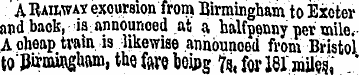
A Railway excursion from Birmingham to Exoter and back , isannounoed at a halfpenny per mile . A cheap _tvain is likewise announced from Bristol to _Birminghftin , the . fe _reboipg ft , fo 181 mUes , ..
A Railway Excursion From Birmingham To E...
MR . JAMES ' tAYLOR _^ AND _FREEHOLDTjAND . ' = _' . G . ' J ' ' . _' : ; SOCIETIES .: Z _^ T _Z-i > _1
. I * , ' _,,- J .. _flO _. tnH EDIT . 0 H .. . 0 l { TflE , I'REEH _01 DER .- t ' Sir , —In looking over your report of public meetings 1 'fihdo _speechdelivered-by Mr . Jambs Taylor , at Ipswich , which contains an attack on a" pamphlet written by myself , called ; " Freehold Land Societies Injurious to the' Welfare of the People . "' As that speech' contains some glaring mistakes respecting my pamphlet , perhaps you " will allow me to notice the fact through the medium of your paper . You will excuse my quoting the whole of his remarks , when I inform you they are one tissue of errors from beginning to end . Ho commences by saying , that " Before he left home he had received a tract from an _anonv ' moiis writer , which ho believed had been
extensively circulated , in order to mar the progress ofthe institution . ( Loud laughter . ) It said that the society told these men ( what men ?) they did not care how they obtained property so that it was obtained ; whethorby the plunder of employers , or by murder , they did not care , —( loud laughter , )—so long as they got a vote . ' He stood there to repudiate such a foul assertion ; and to declare , from _liis very soul , that _if-he thought such a base act would be performed by' tho humblest individual in the society , who thus wished to raise himself in the scale of society , his -protestation should be carried on against that individual . They stood on the proud principle , that he who wished to better his position in life was tho man likely to become more
moral in all his acts , to pay the strictest regard to all transactionsin life , —and to feel a tenfold interest in the well-being of all classes of his fellow-creatures . " In anotherpart of the tract it was stated , that" The society was opposed to the principles for which . their forefathers bled . lie had never known before that their forefathers bled for other than the principles they were advocating ; they did not bleed because they were opposed to an extension ofthe suffrage , or , because they did not wish the productive classes to obtain their rights as men and ' citizen ? ,, ( Hear , hear . ) If their principles ' were opposed , it was not because they desired to make the working classes wiser and better men in the several relations of life , —( certainly Mr . T . must
mean the contrary of-this , )—but simply because there was a vote attached to the movement . ( Hear , hear . ) If there was no vote connected with the society , —if that fact could be forgot ten by any roan , however exalted his position , or . whatever his political-opinions , he would bo the man to come forward and stand upon their platform ;—( whose platform ?) —and advocate , their principles . ( Applause . ) He had merely-referred to tlie tract just to show the animus of those who opposed the society . ; the best argument they could employ against it was that they had a desire to induce men to commit murder and arson , " ( Laughter . ) Now , sir , I havo never , throughout the pages of my pamphlet , made use of language which is here ascribed to me , nor said anything ' that can possibly bear such an absurd , ridiculous , and unreasonable construction . I therefore charge ' Mr . Taylor with either wilfully
falsifying my statements , or , what is nearly as had , grossly misunderstanding them . . It is true that I have accused those societies with advocating principles which our forefathers bled and died in opposing , but my reason for doing so is not tho one which ho would insinuate . Mr . Taylor must have known , when he made this assertion , that I had , in preceding pages of my pamphlet , charged these societies with adopting and promulgating a . principle of property qualification in preference to amoral one ; and that it was to this principle which I alluded when'I made the remark , and not to the reason which he appears to assign . I trust , therefore , that Mr . Taylor will , both from a sense of honour and a love of justice , proceed instantly to withdraw his assertions , or substantiate them by truth and argument , I am , yours respectfully , A Working Mas .
Poisons As Medicine
POISONS AS MEDICINE
. Memorial ofthe Names ofthe 13 , 950 petitioners , to the Housft of Commons , against the Deadly Poisons , used as Medicine by the . Doctors . London : British College of Health , _Uartiilton-place New-road . . "How many thousands of lives are there , ' my father would say , 'that come every year to bo castaway ( in all civilised countries , at least , ) and considered as nothing but common air , in ' completion efan hypothesis ? ' 'Inmy plain sense of things , ' my _uiicle Toby would answer , ' every _suefc instance is MUUDEtt DOWNIU 6 HT , let who will cornwit it . ' ' There lies your mistake , ' my father would reply _, 'for , in the Court ofScimce thero is no such thing as ifurder , 'tis only Death , brother , "—Tristram Shandy . The medical hypothesis , uncle Toby , in 'his plain sense of tilings , ' here anathematises , is that horrid and pestiferous hypothesis , that'Medicine is poison , . and poison is _rnediuine . ' This mercenary , heartless , ruthful hypothesis , by which ? human life is cast , away as nothing but common
air , ' is as savage m spirit as it was barbarous in ongm and it is , at this very daj _; carried into deadliest practice , by the doctors , by advertising quacks , and by _druggists , with all the ardour and vehemence that can be excited by S _' satinble cupidity , and by a most ravenous appetite for gain and guineas . But the hellish hypothesis , that' Medicine and Poison are identical' must be maintained and supported against all ' competition' —it must be carried into a _wide-spread , fatal practice , although it may sweep and desolate the earth as with the besom of destruction ' . ' And v ? hy ! Because upon its maintenance and support , and practical . application , depend the very existence of a highly respectable and proi ' ouudly scientific fraternity—an odious and abominable fraternity , whose consciences are educated and formed upon the infernal maxims of 'The Court of Science' —a court which , is ruled solely by a favoured and fatal hypothesis that _broolts no ' competition' and no demur—a court in which 'there is such thing asmurder— 'H * onlyDEa . TH , hrnthcr !!!'
Johu Hunter said of poisons , that' they take their place in the body , as if that place were allotted for them . ' Yes , 'horrid' mercury takes Us allotted place in the glands , and in the bones—in the glands it excites scrophulous tumours , and the teeth it . quickly reduces . to caries . Prusic acid takes its allotted . place in the heart , ¦ and there radically cures all palpitation by effectuall y stopping all pulsation . Alcohol takes its allotted place in the brain , and by its action upon that organ induces mania , and all' theillsthat flesh is heir to . ' Strychuine , and brucine takes their allotted places in the muscles , in -which tissues they frequently produce speedy and fatal spasms . The late Mistress Marie Manning had something more than a faint and glimmering insight into this Iluntcriaa principle . —yea , with high professional skill sho carried it into full practical affect . Sho knew that , by a particular mode of administration , a bullet would find its allotted place in the brains of her fond admirer , Patrick O'Connor ; bnt , in tho eyes ofthe
professional , the skilful doctress degraded the science , by unprofessionally blending , with her practice , the functions ofa grave digger . By the way , it would act as a very wholesome check upon the poisoning hyj _othesis , if the Legislature could compel the doctor —despite his professional sciuples and repugnance—to excavate the graves of his victims . Soyer does not possess niore skill in catering for thesquenmishnessofa fastidious appetite , than the doctors do in allotting poisons for the specific destruction of any particular organ in the human frame . In a sort of cookery book of poisons , a very learned medical Soyer , who has appended to Ids name the cabalistic letters , ' M D . ' ( query , AnglUe _, ' Murderer Downright V ) In this medical cookery book there is a receipt for poisoning , so definite and obviously efficacious , as would have dazzled the eyes , and charmed tlie heart , and feasted , eveti to surfeit , the imagination and longing 3 of a Marchioness of Brinvilliers . See how the medical lecturer ; instructs his
pupils to ring the changes on _ medical poisons : ' What I have confidence in recommending you to do on every similar occasion is this -having obtained aUihe 6 _enejj ( which arsenic _Ul _^ ov any other remedy has the power to do in any case , change such remedy for some other constitutional power , and change and change'until you find improvement (!) to be the result . * . _«»<> in all such cases , then , you must ' change , conibine , and modify your medicines and measures in a thousand ways , (' agrand peal of poisons , verily , ' ) to produce a sustained result . Arsenic . (!) gold (!!) hon (!!!) mercury (!!!!) creosote (!!!!!) iodine (!!!!!!) opium (!!!!!!!) prussic acid (!! . ' !!!! !) _' & e . _(!!!!!!!!!) ( quory -does this ' && ' , _' here _tnean the virus of hydrophobia , and' the virus of the plague ?) may be all _advantageously employed , both as internal remedies and as lecal applications (!!! ' ) • The sixth edition , ' stereotype , ' of the Medical Lectures from which the preceding ' extract is made , appeared in 145 It in the 1823 that Morison ¦ tlie
S . was year , James , Hygeist _, first raise , d-his voice against the savage and murderous application of poisons us medicines ; so that , great as'has been the progress of _Morisonian Hygeian principles amongst the public at large , it would appear that at present they have had little influence in this respect at least—upon medical theory and medical practice . . But the . public , 'in their plain sense of things , ' are daily becoming more and more alive to ' tlie jeopardy in which they are continually placed , through the deadly chemicals with whicli the _doctors cssny to prop their falling trade _., It appears by , the book , which has elicited-, these remarks on ' Poisons m Medicine _; ' that in 1847 , 19 , 130 signatures were appendedto a petition presented by Sir B . Ha » to the House of Commens against Pharmaceutical Poisons . Considering that these signatures were made almost exclusively in Glasgow , Eu _' mbvwah . awl iw isolated parts of Devon _> and a few other counties ; nnd considering that the public generally have _sinco had tho most liorrifj ing . evidence ofthe baneful effects of medical poisons in Asiatic Cholera , we have a
confident belief , that if due time and proper fawhbijs were now given , in every city , town , village , and hamlet in the kingdom , for . a similar , expression of public , opinion , it would be found that the- numberof signatures would swell from some twenty thousand to several round ! millions . Still we consider that this book is- a very appropriate and graceful' _Meiiobul' to the 19 , 950 v independent _petitionee who did not delay their signatuxas until the movement had become goneral arid popular , anjl who may bo reg ? , _rcled _3 S jlic pioneers , in thelitimane imd holy waita against medical poisoning . Had the House of Commons , in « _omplian ' ce withthe -prayer of _tijat petition , _appchfted a commission , in . 1817 ; and bad _che-mical' poisons been at once discarded _fi'om medical practice ; how _g-oodby anu ,. _je ] i a soil might _. _hava since been saved from tho < grasp of' the _kingvofterrors _. _' _-andfsomthe graves , of the murderedhow . many useful and valuable lives _niigb ' t still have been preserved to the community—how many fond and precious relatives might still have cheered and K _' laddcned the newdesolate hearth I '
Death Op Tiiomthk Sotu?Ror.—Wo Notice Wi...
Death op _Tiiomthk SOTU ? roR . —Wo notice with regret the _deathof . 3 am . es _'SU om , tho sculptor , who expired at his lodgings in 1 _> W York . Mr . Thorn came , to this country from Scotland some twelve _ovfouvteon years ago , in pursuit of a person who had been previousl y sent over by ' tlie proprietors to exhibit : his . Tam . O Slianter and Old 'Mortality , but who , wo _belieye ; mado no returns or report of his proceedings . Arriving in New York , he tracod him , the delinquent — a fellow Scotchman . of some 8 _lirewdrie $ s 3 and address—to this city , and here rocovered , if wo rightly remember , a portion of the money fov -whiclut appeared these admirable works had , been sold , and transmitted it to the proprietors , _Tifto had . heen his _benefaotors _, concluding to rej main here himself , to pursue his .. profession . In exploring th / e country m this vicinity for stone
Death Op Tiiomthk Sotu?Ror.—Wo Notice Wi...
adapted to his _pfli'pose , h 6-br ()\ ighfinto not _^ f finp . . free stone . quarry at Little Palls _wC _£ h since become so famous , Having furnished the " r _^ for . the Court House in _. tnis city , Trinity _ChmT Now Yovk , and many . other public _building _$ ' _* nous parts of the country ; ' With this ston _£ h % produced the two groups already , named exo ° ' an imposing statue of Burns , and filled _w _** orders for ornamental pieces for _pleasure oil _, " _^ The copy of the Old . Mortality _grouo- £ i _U ! the pious old Presbyterian and his _ponTS _?? familiar presence of the immortal _ceniiw _U " * made them tho property of the -universal J T _^ _nooauiudi jwh
_, . - pnue , _vu . me Proprietors Of _T . Hill Cemetery , near Philadelphia ! and is nif _¥ appropriate frontispiece of that spacious _pifl v ° dead . Tarn _O-Shantev and ' _Souter 52 ° _^ " watch and ward" at the entrance of _tht > h e _P table mansion of our friend Boswell L Colt n ' " at Paterson . It is upon those incompamb _n * _?•» that the fame of tho Ayrshire sculptor _mZ _^ rest . They are beyond a doubt the Ct 25 tions of Ins peculiar genius ; and so we beliZ T Kim _nnlV _Angina , l _^^ _n . 1 J . I _„; ' 1 1 t > .. _Ulll'CVH . hft _uiuiavu 3 jutitwiem i
wn .-.-u ; nuugli , HKe _mostmo his class , he was always anticipating the tim of opportunity when he would surpass them m _® ' « more convenient season" never came ' at The Infant Prince . —On the baptism of h , „ fant prince ho will take the Christian _uZ _* " Arthur Patrick Albert , " tho first in _bomS to tho noble and gallant Field-Marshal tRTnt Wellington ( as has been announced , ) the seZrt compliment to Ireland , and as _commemontii " 5 _"'her Majesty ' s visit to the "sister countrv " ° _l the last after his illustrious father , the _PnnV . _1 _« sort-Weekly Chronicle . _tllln ce Con . Ax ANTi-FBEK-TiunE Association has been fn _»« ., nvScotland , with the Duke of Montrose at its JS
•Fhflt-Rna. «V-F
• _fHflt-Rna . « _v-f
CORN . Makk Lane , Monday , May 13—Our arrival , . /¦ - _» _,,,. „ . ' during the past week have been verv moderatP ¦ w ? flour we have been well supplied . _Enrifch _wl . _iX ! ! 5 slowly this morning at an advance of Is ner m- !„; V _® Monday ' s prices , being : without change since i'riri _^ asf foreign met with- buyers at the sam ? rates l , »? _T' an was scarcely so'brisk as last week , tlie _uimLlrL u JaIe in the weather producing its usual eftcc-in _« ™ _Ze doing . Barley scarce , and Is per £ lLJ ? & T Mte dearer _. _nml white peas held for more _inZ kp \ of bats being short , good samples sold pretty ' i _* ,, in J ! Ps Cd per or . higher than on Monday ta _^ i _& g _^ altered . The current prices asunder : — uv _- uw _-sun . Bamsn . —Wheat . —Essex , Suffolk , and Kent , red new is . to 42 s , ditto white , 3 Ssto 40 s , Lincoln'Norfolk and Vol * shire , red Sis to 40 s , Northumberland and Scotch _Jhif 34 s to 38 s , ditto red S 2 s to 3 Gs , Devonshire and _Somerset !
shire , rod , —s to —s ditto iihite , — to —s rve _aistniibarley _, 21 s to 24 s , Scotch 19 s to 22 s , Angus -s to « Malt' ordinary , _ s to -s , pale 4 Gs to 4 i ) s , peas , grey _^» 22 s to 24 s , maple 24 s to 27 s , white 22 s toW _. ' boi _&' _snew 2 _asto 27 _s , beans , large , new 22 s to 24 s , ticks 24 s to 28 s harrow , 26 _ai to 28 s ,. pigeon , 30 s to 82 s , oats , Lincoln and Yorkshire feed , 14 s to las , ditto Poland and potato 15 s to 17 s , Berwick and Scotch , las to 18 s , Scotch feed , 14 s to 15 s , Irish feed and black , 12 s to 15 s , ditto potato , 15 s to lis , linseed ( sowing ) 00 s to S 2 s , rapeseed fcssex _, new £ 30 to _£ W per last , carrawayseed , JEssex _, new 2 fs to 343 per cwt , rape cake , £ 4 to £ 418 s per ton , lln . seed , £ 9 0 s to £ 9 10 s . per 1 , 000 , flour , per sack of 2801 _bs ship , 2 fis to 28 s , town , 35 s to 3 " s . '
i ' _oBEic . v . —Wheat . _—Dantzig , 45 s to 50 s , Anhalt and Marks , 3 G to 40 s , ditto white , 38 s to 42 s , Pomeranian red , 38 s to 40 s , llostock 38 s to 45 s , Danish ,. Holstcin , and _Fricsland , 32 s to 30 s , retersburgh , Archangel , and Higa , 30 sto 33 s , Polish Odessa , 32 s to 38 s , Mariauopoli , andBerdianski , 32 s to _3 Gs , Taganrog , 23 s to 33 s , Brabant and French , 34 s to 42 s , ditto white , 3 Gs to 423 , Salonica _, 28 s to 33 s , Egyptian , 22 s to 2 Gs , rye , 19 s to 21 s , barley , Wisroar andRustock , l « s to 19 s , Danish , lGsto 20 s . Saal , 13 s to 21 s , EastFriesland , 13 s to 15 s , Egyptian , 12 s to 14 s , Danube 12 s to 15 s , peas ) white , 22 s to 24 s , new boilers , 25 s to 26 s , beans , horse , 20 s to 25 s , pigeon , 26 s to 28 s , Egyp tian , 19 s to 21 s , oats , Gronihgen , Danish , Bremen , and Friesland , feed and black , 12 s to 14 s , ditto , thick and brew 13 s to 17 s , lliga , Petersburg )] , Archangel , and Swedish , 13 s to 14 s , flour , United States ,, per WGlbs ., 20 s to 23 s , Ham . burgh 19 s to 21 s , Dantzig and Stettin 20 s to 21 s , French oer 2801 bs ., 28 s to 31 s . *
_Wednesday , May 15 . —We have to report only a scanty supply of grain since Monday , but every article is held with . firmness , the weather being again cold , andungenial for the growing crops . Arrivals this week : — Wheat—English , 830 quarters ; foreign , 3 , 500 quarters . Barley—English , 4 G 0 quarters ; foreign , 1 , 250 quarters . Oats—English , — quarters ' - foreign , 3 , 770 quarters . Flour—English , 910 sacks . ' Richmond ( _ITobksiiuse , ) May 13 . —We only had a thin supply of wheat in our market this morning , which was soon cleared off , at an advance from Gd . to Is . per bushel on last week ' s prices : —Wheat sold from 4 s lOd to 6 s Od _; oats , Is lOd to 2 s Gd ; barley , 3 s Od to 3 s 3 d ; beans , 3 s 3 d to 3 s 9 d per bushel .
BREAD . The prices of wheaten bread in the metropolis are from Gd . to Gl . d _.- , of household ditto ; id . to Did . per 4 lt > s . loaf .
CATTLE . Smitiifield , Monday , May 18 . —The aggregate supply of foreign stock here to-day was but moderate ; but , for the time of year , the arrivals of beasts fresh up from our own grazing districts were large , or 500 more than on Monday last . Notwithstanding that the attendance of both town and country buyers was numerous , the beef trade ruled very inactive , at barely last week ' s quotations . The extreme figure for the best Scots was only 3 s Gd per _Slbs ., and a total clearance was not effected . There was a decided falling off in the number of sheep , owing : to the wet
weather of last week-having prevented sheariug in some localities . All breeds moved off freely at an improvement inthe prices of Monday last of 2 d per Slbs ,, the prlmest old Downs selling at 4 s per Slbs . Lambs , the supply of which was but moderate , sold steadily , and in some in . stances the currencies had an upward tendency . From the Isle of Wight nearly 400 head came to hand . The sale for calves very inactive , at last - week ' s quotations . In pigs very littlo business . wis transacted at late rates . Head of Cattie at _Sjiitufuxd . —Friday . —Beasts , 1 , 031 ; sheep , 4 , 900 ; calves , 240 ; pigs , 210 . Monday . — Beasts , 3 , 579 ; sheep , 23 , 070 ; calves , 177 ; pigs , 250 .
Price per _stono of 8 U > s . ( _simiing tbe offal . _)—Beef _, ; 2 s 43 to 3 s Gd ; mutton , 2 s 10 dto 4 s id ; veal , 2 s 10 _d to 3 s 4 d ; pork , 3 s 2 d to 4 s Od . _Isewgate and LeadenhaUi , Monday , May 13 . —Inferior beef , Is lOd to 2 s 4 d ; middling ditto , 2 s 2 d to 2 s 4 d ; prime Iavge 2 s Gd toosSd ; prime _jtnatt , 2 _sl 0 dto 3 s 2 d ; large pork 2 s lOd to 3 s 4 d ; inferior mutton , 2 s 4 d to 2 s Gi _; middling ditto , 2 s 8 d to 3 s Od ; prime ditto , 3 s 2 d to 3 s Si ; veal , 2 s Id to 33 4 d ; small pork , 3 s Gd to 4 s Oil ; lambs , 4 s 4 d to 5 s Gd ; per Slbs . by the carcase .
PROVISIONS . Losdon , Monday . — Old Irish butter was rather more saleable last week , and a fair quantity cleared off the market at prices in favour of buyers . A few sales of New Limerick were effected for shipment in this and two following months at GGs per qr . on board . Foreign supplies were plentiful , and best Friesland 2 s per qr . cheaper . The transactions in ' Irish bacon were unimportant , and prices stationary . American attracted buyers to a respectable extent , at slightly improved rates . Middles , steady in demand and value . Hams and lard no change . English Bditeb , May 11 Our trade is tolerable steaoyj at rather low prices for the best Dorset butter , butall middling and inferior lists are neglected . Dorset fine weekly 78 s to 80 s per cwt . ; ditto middling 5 Gs to 70 s ; ditto old nominal ; Fresh 7 s tolls per doz . lbs .
_COLONIAL PRODUCE . Losdo . v , Tuesday . —Suoab . — The market lias opened today with an active demand . 1 _. 1 S 4 hhds . of West Indui have been sold ; including 400 hhds . of Barbadocs and /» hhds . of Jamaca at auction . The public 6 ales _, comprising 5 , 170 bags of Mauritius ; 5 , 300 bags of Bengal ; 1 , 180 MS 3 of Mauritius ; 5 , 300 bags of Java , all went ut full prices to 6 d advance . The quotations arc—Mauritius , 35 s to 33 s for low to good middling yellow ; 33 s to 34 s Gd for middling to flue brown ; 26 s Gd to 31 s for very low to low brown ; Bengal , 37 s to 39 s 6 d for low to good middling wlnte Benares : 39 s to 40 s Gd for low to middlins yellow Dhooan ,
SOs to 33 s for brown to low yellow date kind ; Maaras , - » to 33 s for brown and yellow ; Java 40 s Cd to 42 s Gd lorgooa to fine gray ; 37 s to 39 s Gd for low middling . Coffee . —No public sales . Privately , 1 , 000 bags of name Ceylon are reported sold at 40 s p « r cwt . Uice . —8 , 590 bags of Bengal , and 2 , 400 bftgs of Madras , were offered to-day . Of the Bengal , about 2 , 000 bags wore disposed of at awd after sale , at an advance oi about oa per cwt . ' , 10 s to 10 s 6 d per cwt , for fair to good white ; u » Madras sold with spirit at 8 s to 9 s for middling to iair pinky- „•„ . i .. _* , Saitpetbe . —Of l , Wo bags brought forward 3 s 0 _MSf were disposed of nt high prices , 3 _J- per cent , refraction a _« 26 s Gd , aud 12-2 per cent , at 24 s 9 d per cwt .
TALLOW , HIDES , AND OILS . Mosdat , May 13 th . —Letters from St . _Petersburg statethat a very Iimitid business was doing ia tallow on taglish account , yet tbe holders were firm . _About 900 casKSbad changed hands at 111 roubles , _witluia- dowa , . and l w roubles on the spot . Our market is somewhat _m 1 _" _*"' _- In prices , however , we- have no change to notice . To-day , P . Y . C . on the spot is selling at 37 s an _& foi-forward dehveix ' SSs 3 dto 3 Ss-Cd . per . cwt . net cash ; town tallow , 33 s odto 36 s per cwt . net cash- ; rough fat , 2 s per- Slbs . LEADEOTAti . —Market hides 5 fifi > ,. to C 4 fb . _ll . d to _Ijdpflb . ; ditto . 641 b .. to-721 b lid to _l'Jd ; ditto . 72 tt > . ta . SOID . 2 d to 2 id ; ditto SOlb . to 881 b . 25 _dto 2 jd ; ditto 881 b t » 9 Glb . 3 _d-toSJd ; ditto 961 b . to 1041 b . y { d to 3 . $ _dij ditto 101 ft . to _li' 2 . lb . —d to 4 d ; _calf-slsiiia each 2 s Gd _^ to 3 s G < uJ Ilorso- hides Gs . G < J .
Liaseed _pcii cwt . 30 s 3 d to —s ; _rapesesd ; Bng _hsa refined 37 s Od to —s ; brown , 38 s Od ; Gidlipoli per Son . 44 / .. ; Spanishi _& ; Sperm 82 ft to—I . ; bagged ; 33 ?;; South Sca . _SSt . 0 s to —J . ; Seal pid > _'S 7 l . 0 s to —( . id 9 « _cplsurcp _, 33 * .. ; . cod 33 _J . to —I . ; cocoa nut per tea . oSl . tfi 481 , i _sabnj 821 . ,
j . 1 SOOL . 1 CiTt _, Monday , May , _Wth . —Tho invt » Yts o ? . wool into o Londor , lastweekcompsiscd 32 bales Irani Germany , ¦«» <* from Turkey , 200 fVo _s * Bombay , 34 ftom South Australia , a , and £ G 0 l ) from Port Philip . The p _^ lic sales arc still i _>« - _« - cecding , and all th & coloniaUput _wp found « ady buyers , _s . The series will terminate towards , ihe end of next week . LiYERVoot , Mavllth .-Scotelv _~ Thereha 3 been ratnev er move doing this " week in laid _ISghland wool , somo _otws m holdors being _dtsposod to _accent lower prices to close sai . e _» j > before the new clip ; and _xm note according ly , hi « fl " Highland , Cheviot , and Crossed , thow : being _tio transftc c tious _, wedottot alter the _tjuotatioivs _, which , _howevayw « vi be considered nominal . . _' ..... -i _,-i Foreign . —Tho public-, sales aro progressing _sahsactpiw _w , in London . In themosntime , our sales , here by _priv . ¦¦ - contract are limited . Imports for the week , _210 _BiUi = _ii i previously this yen ? , 51 , 130 bales .
Death. Atkoclidale, On The Isth'insr., T...
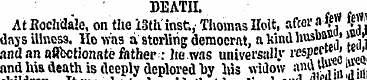
DEATH . AtKoclidale , on the _ISth ' insr _., Thomas Holt , after a _|« if" ; days illness . Ho was a sterling democrat , a kind _husoa _* i _s » * and an _aftbetionate father ¦ ¦ : lie was universally MS _? _Sia-ee » and his death is deeply deplored by his widow an « _JS _!„ _" } : ¦* children . It may be truly said that be lived aud « i « ' " the good cause of human redemption _. Printed by WILWAM RIDER * o _^ o . 5 , Macclesfield-stJ _?* _£ j «* in the parish of St . _Anwe , Westminster , ' at the _rnfl'SfV'SS _office , 16 , Great Windmill-street , Hayraarket , ini thei "' _^' _. _ot-Westminster _. _fovtheEroprietor _. _yfiABGUSO'CO _^^ _SWJ - Esq , M . P ., and published by the said _Wiiuam _JfflJgj w the Office ,, iu-the same atmt _^ _d panih . «« _3-iw _* u , ' _MqrWftim _;— , .
-
-
Citation
-
Northern Star (1837-1852), May 18, 1850, page 8, in the Nineteenth-Century Serials Edition (2008; 2018) ncse.ac.uk/periodicals/ns/issues/ns3_18051850/page/8/
-