
On this page
-
Departments (1)
-
Text (7)
-

jNSTItUCTJOXS FOR REMITTING MONEY ON ACCOUNT OF SHAREHOLDERS OF THE LAND COMPANY.
-
All monks mnst be remitted in Post Offic...
-

THE LAND. TO THE MEMBERS OF THE CHARTIST...
-

r 0^0^ ^^ti^ af&t&ij^^
-

' ^'^^'^"^'"' ' ' AND NATIONAL fRAPESJOU...
-

' '^'^^'^"^'"' '^'''''^^'^'^ ^^^^^^'¦¦^-...
-

IRELAND. NARRATIVE OP MALCOLM M'GREGOR, ...
Note: This text has been automatically extracted via Optical Character Recognition (OCR) software. The text has not been manually corrected and should not be relied on to be an accurate representation of the item.
-
-
Transcript
-
Note: This text has been automatically extracted via Optical Character Recognition (OCR) software. The text has not been manually corrected and should not be relied on to be an accurate representation of the item.
Additionally, when viewing full transcripts, extracted text may not be in the same order as the original document.
Jnstituctjoxs For Remitting Money On Account Of Shareholders Of The Land Company.
_jNSTItUCTJOXS FOR REMITTING MONEY ON ACCOUNT OF SHAREHOLDERS OF THE LAND COMPANY .
All Monks Mnst Be Remitted In Post Offic...
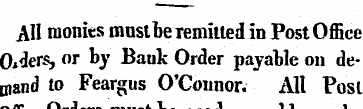
All monks mnst be remitted in Post Office _Oilers , or by Batik Order payable on demand to Feargus O'Connor . All Post Office Orders must be made payable at the General Post Office , St . Marun ' s-le-Granil ,
j _^ ndon , as none otber will be acknowledged _, fhe person s name applying to the local post office for tbe order must be wriiten at full length at the top of ihe order , and wbo must see the order properly stamped _^ aud die order mnst be made payable to FeaTgus O'Connor . -All letters containing money must be addressed as follows , for " The Directors .
Land Office , S 3 , Dean Street , Soho , London . " Note—The local post master Is bound to make all orders payable where the applicant wishes ; the Deputy Treasurer has now -E 172 in Post Office Orders made payable at the London Office , Charing Cross , Strand , Oxford Street , Piccadilly , Old Cavendish Street , Bloomsbnry , Oxford , Manchester , and
Leeds ; manv of them not stamped at the local office , and therefore refused payment by the London branch ; many of them made payable to the parties who may apply for them ; many of them not payable to Mr . Roberts , Mr . O'Connor , or Mr . "Wheeler ; many of them advised in _^ different names to those represented to have obtained them , whereas there ought not to he a mistake of a shilling in ten years-All persons receiving Post Office Orders at tbe local office will see that the order is stamped by the Local Postmaster before he accepts it as satisfaction for
cash , and he will then write the name of the person who has applied for and taken ont the order , at the top of the order . Now nothing can be more simple than this- John "White goes with £ i to the Leeds Post Office , and asks for an order in the name of John White , payable to Feargus O'Connor at the London branch . John "White then writes his name in full at the top of tbe order , and transmits it as directed to the ofiice ;—for " The Directors , Land Office , 83 , Dean Street , Sobo . London . "
The Land. To The Members Of The Chartist...
THE LAND . TO THE MEMBERS OF THE CHARTIST COOPERATIVE LAND COMPANY . Mx Dear Emends , The struggle that I am now making is to secure a nest for every one ofthe human family , of which the strong cannot dispossess tbe weak , as well as a field for the parent aud young brood to work in for their own subsistence . This letter will necessarily be a long one , because my purpose is to explain to jou all that has been done by the late Land Conference ; bnt before I proceed to the analysis I must be permitted to offer a few observations upon our present position and no distant coming prospects .
Firstly , —I call yonr attention to the stunning incontrovertible fact , that , in the midst of circumstances which formerly would have aroused agitation throughout the land , there is but one party existing , active and organised , in the state—and that party is the Chartist party . The Tories are paralysed by the treachery , as they call it , of their leader , but for whose sagacity they would be now in open rebellion . The Whigs are struck dumb by the incompetency of their party to deal with a calamity , ' _¦ fl p in part ont of their own inefficiency . The _freetraders are banging odium upon their own measuVe by being foremost in the ranks of oppression , daily reducing
tbe hours of labour as a first step towards reducing wages . The Socialists have been wrecked upon a rock for want of a proper lighthouse ; they committed the egregious blander of supposing that a spacious and well-furnished house was to pay the tent of land , instead of the land paying the rent of the house . Poor Sturge and his party bave vanished into thin air , while the London management finds it rather difficult to keep the Holborn theatre open during the short season before Christmas . So much for England ; and then look to the present state of Ireland ; a country tbat one short _year ago presented a confederation , which , if properly directed , might hare bid defiance to Europe .
Thus I show you that Chartism is now the only living principle , while I must remind you , that formeily , in the season of calm , Chartism was always tbe most apathetic , and its apathy was an invitation to some crotchet-monger to bid _'{ _p popular support . I Lad ' no objection to admit that Chartism was a _bimijiT howl , but I feel indignant that the howl should instantly cease upon the slightest improvement of circumstances , thus affirming the fact , that want was necessary to elicit principle . When the land plan was first introduced , those who had lived
in idleness upon popular excitement denounced it as calculated to injure Chartism . They knew that they were ignorant of the subject , and they dreaded the addition of the social principle to the political question . But I think I may now ask you where Chartism wonld be but for the Land ? I may ask jou where it was from 1842 to 1845 , when the breath of Landism was breathed into its nostrils "md gave it fresh vitality ? I must remind you of another fact , that onr association now numbers a ! iout twelve thousand members , and tbat in its ranks are to be found the verv best of the old
Chartist body . Again , but for the land where would now be the Chartist Executive or Chartist staff ? The great advantage ofthe Land movement is thistliat it supplies food for sensible agitation in good nines and in br . d times . Good times have always _Wp destructive of Chartism , but now assist it , because it is then that the working classes have the _fet opportunity of subscribing to the Land plan ; _* Me bad times compel them to think about the laud _** the only means of escape-Having made those few observations , I shall now Poceed to a consideration of the business done by - _* _- **• Conference , and shall commence with the pro . Etunme .
Firstl y , —A Finance Committee was appointed to _^• Uiae my accounts from the formation ofthe * 0 Qet * ' to the day on which we met , and you will ¦ _*¦* their report appended to the balance sheet with _** _oecessary observations in their proper place . _L -condl y . —We resolved that the company ' s lands _* * d neither be sold nor mortgaged , but that a _Y * of deposit shonld be established , the machinery _w nich will appear in a simple form in next s Star . This was a most wise resolution , * - •* I still adhere to my original declaration , % t lb ' — ** ¦ — _^^
. in e redemption department , which will be a "cb of the establishment , will enable every _occu-^ J _Purchase his allotment in les 3 than five years _^ - _" ¦ out inconvenience . I shall here merely sketch fc . u a for - - We propose to raise a thousand _^ " _^ _« ery £ 50 payable to the company , j _^ _** e the land and houses of the . company w _•* ° -be depositors ; and we propose to pay _fe _^ * - _* - 65 deposited interest atthe rate of 3 J dtp _^ •~~ lliat is , we hand over as security to the _^ leC _* m , t for every * 10 s * _* we ar € * _** _^ e propose that the additional 1 £ per
The Land. To The Members Of The Chartist...
cent shall become a sinking fund to merge into the redemption fund , and to be applied to the purchase of the occupant ' s property when the affairs of the section are closed . The redemption department will he for receiving amounts paid by the shareholders , whether in possession [ or not , towards the purchase of their allotments , or the fining down of their rent , —for instance , suppose John White to have paid np £ 25 to the redemption fund before he received his allotment , and suppose his rent to be JE 10 a vear , he would receive his land for £ 9
a year , and be allowed one pound a year reduction for the £ 25 he had paid , or in other words , his land would then become his own bank at £ i per cent ., that is , he would be allowed to purchase his property for ever at 25 years' purchase , while the company would be enabled to give 33 years purchase , and while ,-as an individual , he would not be able to secure his allotment at 50 years' purchase ; firstly , because there is no market open for him -, secondly , because individuals would lease their property at the retail price , while the company leases
it * at the wholesale price in the retail market ; and thirdly , if he purchased , the weight of title , legal expenses , and conveyance , would break his back ; while , upon the . other hand , the company , npon the principle of co-operation , not only does those things for him , but further- gives to their tenants respectively , _£ 15 , £ 22 10 s , and £ 30 capital to commence with . Upon thi 9 subject I will give you a simple , comprehensive , mercantile prospectus next week , for the present consoling myself that no profit-monger is , thank God , to
make political property or money profit of your labour and mine . Indeed , if I had mortgaged or sold I could have gone to a cerlain extent much faster than I have gone , but , then , I know the heart-burning tbat would be caused to every occupant when he discovered his ability to buy the land and the impossibility of inducing the purchaser to sell it . Now , for instance , an occupant paying £ 10 a-year rent , and having saved £ 400 , would cheerfully give it all , that is forty years' purchase , to be tbe proprietor instead of the tenant of his allotment ,
While we allow him to purchase his allotment for ever for £ 250 , or twenty-five years * purchase , and always observe that , when an occupant purchases , be is his own banker and his allotment is his ledger . Now I would ask you if any work _, ing man in the world , who has saved £ 250 , can apply it so profitably , so comfortably , so respectably to any other purpose as to the purchase of £ 10 a-year for ever , in land and a house ; while you must bear in mind that , as an individual , he could not purchase the same property for £ 400 , nor yet for £ 500 and you must also bear another fact in mind , that the capital he receives from the company goes in part payment of the purchase which would reduce it to
twenty-three tears' purchase , and something under . For instance , a man draws a three acre share in an estate , the price of which would make his rent come to £ 10 a-year , the £ 22 10 s . capital is included in tbe rent and , therefore , if he choses to pay £ 227 10 s . to the Redemption Fund , he at once becomes the propr ietor instead of the tenant of his allotment , with the title made out and the conveyance costing him nothing . _Now this we never could do if we mortgaged or sold , while the operations of the company will proceed with tenfold vigour and speed . Sale or mortgage would entail fresh expence , the Bank guarantees a profit of 3 $ per cent . Upon this subject I shall be very explicit next week .
Thirdly . The Conference has decided , that the maximum sized Cottage shall not exceed four rooms of twelve feet square each . This is a wise and wholesome resolution , and a just one , because it inflicts injury upon none . It is wise , because it preserves a larger amount of land value than of house value , which is not as valuable as land value . It is just , because the occupants will pay rent in proportion , that is . if a four roomed house cost £ 30 less
than a five roomed house , the occupant will pay 30 s . a-year less for his holding . It is equitable , because it enables the company to locate more members and more speedily . It is no hardship , because the ballot for preference will take place after the general ballot , before the houses are built . And when the allotments are marked out and each occupant ' s share is known , then the corresponding secretary will write to the several members and ask them il
they wished for a _iout loomed house , a five Toomeu house , or a castle with stabling and a court yard , and for the additional expence above the iour rooms they must lodge the money before tbe work is commenced . Upon the other hand , if a single man , who has drawn a three acre or a four acre allotment , shall consider a comfortable three roomed house , each room twelve feet square , sufficiently large , he will notify to the directors , through the secretary , that he will only have a three roomed house built and he will have a reduction in his rent at the rate of five
per cent upon the diminished expenditure . Now I will shew you tbat tbis is a necessary resolution . We are bound to legislate for the general good , and although some working men may say , that they took four acre shares for the express _purpose of having the larger house , yet , as the land is the field for industry and the thing that is to support the house , many of the industrious poor became shareholders for four acres who considered the over-sizp . of the house a grievous tax upon them . I always was in favour of the smallest description of houses , my
principal object being to get possession of as much land as possible , convinced that untrammelled industry would soon enable every man to build a liouse to his taste-, and , even now , I would implore the three acre and four acre shareholders to remember that five per cent will be deducted from , or added to , the rent in proportion to the size of the house , and , that they ought to be able , when they have the security of the land , to raise money at 3 | per cent . As Mr . Smyth , the delegate for Bradford , observed , and than whom there was not a more attentive ,
shrewd , and business-like delegate in tbe Conference , the poor woolcombers in Bradford huddled together in one room , ventilated with a charcoal stove , would think themselves in a palace in a three roomed cottage , and wonld consider it a hardship to have their release from those hells postponed for the gratification of those who wished for large houses . However , I may conclude this head with a simple observation , that nine in every ten who will be entitled to a good four roomed cottage , are now pining in cellars or existing in garrets .
fourthly . In order to pr event a monopoly of the land by any one person , we bave decided that in all cases where an aggregate of persons to the numberof four , wish to hazard their chance upon one ticket in the same ballot , that each ofthe iour shall have attained his eighteenth year at least . It was contended that fathers should have the power of placing tlieir infant children ' s names upon this aggregate ticket , but this , it was clearly shown , would lead to a monopoly , of , perhaps , 16 acres out of an estate of one hundred , or one sixth ofthe whole amount , and might lead to the dilapidation of the cottages upon the three allotments of the infants , and must introduce the MID-
The Land. To The Members Of The Chartist...
DLEMAN SYSTEM ; and for this reason the leases should be made to the infants , for I did not , as reported in the Northern Star , say , that the Company could not make leases to infants , but what I said was that the infants could not make leases . However , I am quite ready to admit the general accuracy and excellence of the report in the Star . But then to the subject , you must lease to the infants , and the father as their trustee must either place three undertenants in the three cottages during their minority , which three undertenants would present the eyesore of slave labourers working amongst freemen ; and , if i
he did not place tenants there , the cottages would go to rain , and , if he did place tenants there , he might demand what rent he pleased ; and as a minor cannot be bound , it would be optional upon attaining his majority , whether he would take to the land or not ; and if the middleman , or the father , suffered it to deteriorate in value , it would be an injury to the whole company . Moreover , the minors could not purchase except by trustees , and that would impose an amount of complicated duty which a hundred directors could not discharge . Again , it must be borne in mind , that minors now stand precisely in
the same situation as they always did ; they may enter the ballot singly , and if they are drawn singly , whether in Cumberland or Cornwall , the father , or some of the family , will be sure to go with the minor , so that in no case will the house become dilapidated or the _lantLneglected . The mode of dealing with the aggregate number is this . Suppose a ballot for fifty to take place , and an aggregate ticket containing four names to be in the box—if that ticket is not drawn within forty-seven , it must be a blank ; if it
is drawn forty-seven , it is a prize , because 4 / , 48 , 49 , and 50 are four allotments , which will ' satisfy the four upon tbe aggregate ticket ; but if it is drawn 48 , 49 , or 50 , it is laid by as a blank , because there will be only three allotments left to satisfy four shareholders . Now , this is no hardship , even if the rule was more stringent , because it is optional with thc individual members whether or no they will risk their chance upon the aggregate ticket ; and as the rule stands , it is now incalculably in favour of the aggregate shareholders .
Fifthly—We have decided that all incidental expenses shall be paid out of the two shillings a share , while the directors' salaries , stationery , «& c ., shall be paid out ofa fund raised by a levy of one shilling per year , or a farthing a week upon each share . This fund also to furnish poor occupants , who are recommended by their localities , with the means of transmission to their respective allotments—the amount to be paid back in easy and convenient instalments , and to merge into the Redemption fund , so that it will be a _savings-bank for the purchase of the allotments by members . Sixthly . —This question has been decided by the adoption of the above rule .
Seventhly . —It has been decided that the Directors shall be empowered to build school-houses under such , circumstances as render the ' r erection necessary , and that the school-houses shall be the property of the Company and not ofthe allottees upon the estate , because tlie expense of the erection and the land should then be added to the rent of the occupants . Eighthly . —It has been decided , that the schoolmasters and schoolmistresses shall be appointed bv
the Directors , with power rested in two-thirds of the occupants to dismiss them upon proper cause . In treating upon this subject , I trust that no schoolmaster will be elected except he is also an agriculturist , as the ground allotted to the schoolhouse should be a model farm , entirely cultivated by the children , according to tbeir strength , who should work upon it three hours a day , from six till eight in the morning , and such other hour in the day as shall be approved of by a majority of the occupants .
Ninthly . —It has bem decided that discretionary power shall be vested in the Directors to expend monies in the improvement of land from purchase to occupation , in manure , draining , and other such operations as will be more cheaply done by cooperation than by individual labour , and not to be deducted from the amount of capital to be respectively given to the occupants . Tenthly . — It has been decided that the Directors shall have the power of increasing the Funds of the Company by the sale of estates . Elevenily . —The Conference have elected Thomas Slingsby Duncombe , Esq . M . P ., Jobn Sewell , Philip M'Grath , Ernest Jones , and Feargus O ' Connor , trustees .
Twelflhly . —The Conference has elected W . P . Roberts , Esq ., as the Company ' s Treasurer , with a vote of thanks for his past services . Thirteenthly . —The Directors have elected Feargus O'Connor as their Deputy Treasurer . Fourleenthly . —The Finance Committee did report , for which see resolution at foot of Balance Sheet . Fifteenthly . — The Conference elected William Cuffay and James Knight , auditors to the Company .
The sixteenth proposition in the programme was withdrawn;—and thus 1 have gone through the several propositions contained in the programme , and I shall now draw your attention to the several collateral questions uot contained in the programme . Firstly . —The Conference has very wisely conferred the power upon four of the Directors to dismiss one of their own body for misconduct or neglect of duty . This is a most wholesome rule , and is a power which the four objecting Directors would
not dare to exercise capriciously , while it will make all more vigilant in the discharge of their duties , and no member of the Company will believe that four Directors would dare to conspire against one , while no member of thc Company will contend that four should be subject to the neglect or improper conduct of one during twelvemonths . The mode of filling up the vacancy is this , —the Directors elect a person in the place of the dismissed officer , and then appeal to the Shareholders to elect , not the person appointed pro . tern , by the Directors , but whomsoever they please . .
Secondly . —The Conference decided that there should be two Secretaries , a Corresponding Secretary and a Finance Secretary , and the Directors have elected Mr . M'Grath as corresponding Secretary , and Mr . Wheeler as Finance Secretary . Thirdly . —The Conference decided that henceforth only one list should appear in the " Northern Star , " and that that List should be a report of all the monies SENT TO ME—that is , that henceforth all monies must be made payable to me , and remitted according to the instructions at tbe head of this _letfer , and no money will appear . in the " Star " except money that is made payable to me by post-office order , and sent as directed in instructions , and received by me before insertion .
Fourthly . —The , Conference decided that the allottees of Herringsgate should not be located till the lst of May . As a matter of course this will be some disappointment , though I doubt it , to a few , but then it must be borne in miud that the Con-
The Land. To The Members Of The Chartist...
ference wa _^^ _WRll ' - 'tb legislate for the benefit of all , and _notTor ' tHefconvenience of a few . Moreover _^ it isj _|^ just rule , and was . urged upon the strongest _if | _rf « _pi \ _t-, Mr . Donovan and Mr . Smyth ; well acquainre _* with the subject , convincing me of the propriety of the step . I moved the 25 th of March ; Mr . Donovan moved the 1 st of July , and Mr . Smyth moved tbe 1 st of May . They contended that from after Christmas till May was the spring
trade and the best trade ; that February _w-iuld be the coldest and most disheartening month for those coming from the heated atmosphere of factories , and that it would be a comparatively idle month upon the land . This alteration was made npon the understanding that the whole available season from February , to May , should be taken advantage of in the cultivation of the several allotments , and let it be understood that a transition from the artificial to the natural state will be much more
cheering when the ground is covered with the budding crops than if covered with snow . It is a bad seasWifoYremoving , it isa bad season for going into a newhouse ; it is an inappropriate season for agricultural pursuits , add to which , the postponement will be a great saving to the occupants , inasmuch as cheaper and better labour can be per . formed upon the principle of co-operation than hy individuals . Another , and no small consideration , is , that our immigrants must feel cheerful and happy upon the very first day they take possession .
Some people who are not shareholders say , that Mr . O'Connor promised to locate a hundred within the first year from June last—Mr . O'Connor did promise it and will accomplish it , and more . When Mr . O'Connor promised it , the standard size of farms was two acres , and we have now 264 acres of ground which , accordimr to Cocker , would locate 132 persons at two acres each , and that was the rule in the first instance . But Mr . O'Connor lias
now , a complete answer for those who assert that a section cannot be located in less than fifty-seven years , three months , three weeks , five days , and two hours . Mr . O'Connor now undertakes to say , tbat , not only a section of 6 , 000 , but a bodyjof 20 , 00 . ) , will be located in less than five years , with the assistance of the Bank . Mr . O'Connor always said , and still repeats it , that he would rathei have a loan of a hundred thousand pounds to be repaid with
five per cent interest than £ 20 , 000 raised by small shares , and that tbe operations of the Company would go on quicker , and the Bank will afford tbat . Further , I could by this time have secured the location of 500 members if I bad mortgaged the land as I bought it , hut , then , that process should have an end , each repetition of it would lessen our available capital , and I hold it to be unjust that tbe interests of 5 , 500 should be injured for the benefit of 500 .
As to the postponement of the time of taking possession , then 1 have no hesitation in saying , that the step will meet with the approval of four fifths of the occupants themselves ; while , upon behalf of the 5965 shareholders , whose interests would have been injured by an earlier occupation , I am prepared to ' take all the responsibility . Fifthly . —All ballots , till the meeting of the next Conference , are fo take place in London . Sixthly . —The next Conference will be held at Nottingham on the first Monday in January , 1848 .
I think I have now given you a very fair analysis of the . business , performed at '' Conference _^ and a better Conference of any class I would not desire to sit in . You will see that I have made myself acquainted with every thing that has been done , and that I took one man's share in doing it . Now , my friends , 1 cannot dismiss this subject without drawing your serious attention to the fact , that the Land question is the one topic now interesting all Europe ; and that , after the several crotchet-mongers had tried their hand at patching the old system , all have been obliged to come to the plan established by that "COMICAL GENIUS , " Feargus O'Connor . Every newspaper in the kingdom is now adopting the plan , in one shape or other , as its own
concoction . Every Irish resolution tends to the same point , while the Nation newspaper is advocating the system , though for the present lamely , because leaning upon a very rotten crutch—one Mr . G . Ramsay , who contends for the substitution of the plough for the spade , as a means of improviug agriculture . Tbis notion is so thoroughly ridiculous and childish , that none but a child would waste his time in combating it . It cuts at tbe very root of the system contended for by the Nation , inasmuch as it would be impossible to carry out the principle of a small proprietary , without first renouncing the plough . 1 wish , from my soul , that every plough and every harrow in England was turned into ashes for manure , and the plough shares into spades to dig the ground .
By the Star of this week you will see that I have not been idle since the Conference , and , besides the industry that its colnmns develope , I have had several conferences with some ofthe ablest merchants in London upon the Banking question , and all appear _j ore than delighted with it , as an auxiliary to aid in the purchase of Land . I have also had conferences with the directors . I have gone attentively through the whole Deed of Settlement with the solicitor , and from it I learn that there is only one great change made—a change which I believe will be
bailed by all who feared that the Land plan would hurt Chartism . It is this : that our members arc not to be tenants , but proprietors . That upon receiving possession tbey are not to get a lease , but the conveyance of their allotment in fee , with a rentcharge reserved , amounting to what the rent would have been . One of the brawlers may ask , what is the difference between rent and rent charge , between lease and conveyance ? Why just this—that in the one case the man is a tenant—in the other case he is a proprietor ; in the one case he is apolitical serf without a vote , in the other case he is a
FREEMAN , WITH THE VOTE , Now , is this no difference ? Did Chartism , with * out the question of the land , ever effect this ? It is a subject to which I am bound to say our solicitor , Mr . Roberts , was the first to direct my attention more than a year ago ; but I hesitated evcD to hint at it until I was convinced of its practicability : so that now the thirty-five occupants at Herringsgate will have conveyances and not . ' eases made to them , and they will be proprietor . * and voters as soon as they are in possession . This circumstance will considerably assist our banking operations , as every shareholder will save , beg ,
borrow , or steal the means of reducing the rent charge at four per cent . In conclusion , I have only to add , that the responsibility and labour imposed upon me by the Land Plan would frighten any other man in Europe , while the more extensive its operations and ramifications , the better 1 . feel myself equal to the task . If 1 had all the money that will smoke and stink in thc kennels and poison the air during the Christmas month , I wouid convert every Poor Law Bastile in England into hospitals for the friendless the old , and thc infirm ; I would convince the Archbishop of Canterbury that famine in Britain is the dispensation of man , and not of God ; and I would prove to the Free Traders that domestic freemen are
The Land. To The Members Of The Chartist...
better customers than foreign slaves . Jnstjfook at th subscriptions , even for this Christmas week , when our class of shareholders" are all pushed to make np their rent and pay their shop accounts ; ill fact , I didn ' t expect £ 10 this week . The greatest pleasure that I derive from the Land Plan is , the belief that in our exchequer wiU be found some THOUSANDS THAT HAVE BEEN SNATCHED FROM THE i GIN PALACE AND THE BEER-SHOP . Again I
promising you a clear and simple _proepectus of our Banking Plan in next week ' s Slar , I remain , Your faithful friend and bailiff , Feargus O'Connor . P . S . —LABOURERS ! BE SOBER ; BUY LAND INSTEAD OF GIN ; AND YOU WILL HAVE A GOVERNMENT OF YOUR OWN CHOICE -THAT'S MY CHRISTMAS BOX TO YOU .
R 0^0^ ^^Ti^ Af&T&Ij^^
r 0 _^ _0 _^ _^^ ti _^ af _& t _& _ij _^^
' ^'^^'^"^'"' ' ' And National Frapesjou...
AND NATIONAL fRAPES' _JOURML .
' '^'^^'^"^'"' '^'''''^^'^'^ ^^^^^^'¦¦^-...
' _'^ _' _^^ ' _^ _" _^'"' ' _^''' _'' _^^ _' _^ ' _^ _^^^^^^ _' _¦¦^ -. _^^ - ' _^^^^^^¦ _^^•¦ _^ - _^ - _^ - _^^ _MW _^^ _WMW . _MW _^ I j , _"" _********** " _* " _" _VOL-j . NO . 478 . LONDON . _SATORDAV _j ) ECE _# p 19 _^^^ _^ _^^ _"" _™ " * ¦ ¦ " * — "
Ireland. Narrative Op Malcolm M'Gregor, ...
IRELAND . NARRATIVE OP MALCOLM M'GREGOR , SO . TIT . As the task I have undertaken is to familiarise the English reader with the manners , customs , habit * , opinions , peculiarities , character , and grievances of the Irish , I should consider it injudicious to clog my narrative with any romantic feelings , which should be confined to my own breast , and , therefore , all
thought of Kathleen shall sleep for the present , nor shall her simple charms in any way influence me in the discharge of my duty . I have been a very earnest reader of novels in my time , and am willing to confess a great debt of gratitude to many of our authors , both living and dead , forthe amusement and instruction tbey have afforded me . Fielding , Goldsmith .. Lytton Bulwer , have drawn many a tear from my eye ; Smollett , Scott , and D'Israeli , have afforded me refreshing laughter , and many of ourfair writers have seasoned a moment of doubtful mood with a welcome
momentary excitement ; but f or the most part novelists commence with the autumnal tint and rising or setting sun , and the effects of the wakiitg or slumbering luminary- upon imaginary scenery , and then select an imaginary being for their hero and tlieir heroine . The silvery spray of tbe briny deep , and all about it , may be matter of absorbing interest to Olivia , while her Charles is wafted from her weeping watchful eye upon its bosom to some distant shore , perchance to hazard his precious life in defence of his country ' s liberty ; and _Constantia may be interested in the hue , delicate texture , and smiling
appearance of the expanding bud , as her Cardemo is engaged on some mission of love , wliich reminds her of his purity ; or Fidelia ' s guitar may be inspired and _refuse response to her angelic touch , if her Edwin ' s absence should chill her heart , and forebode some teasing misgiving . AU these passionate touches may do very well for those who can afford to pay £ 112 s . 6 d ., for three volumes about the sun , moon , and stars , rosebuds and spray , and the exactitude with which the sun rises and sets , and sheds his slanting rays upon all around ; and the inconstancy or jeopardy of the false hero , and the devotion and
hair breadth ' scapes of the daring and reckless heroine ; but it is a branch of literature , if literature it can be styled—but of the peasants reach , and a portion of that course from which 1 fear many social errors have been imbibed . The hero or heroine is for the moment the world of the excited reader , and many a broken heart and pale face has been the sacrifice at the shrine of susceptibility , imagination , and conceit . Rejecting , therefore , the jumble of ghosts , bleeding hearts , and romantic vows , which have been now brought to my recollection , I shall proceed with my narrative .
The morning after I had heard the O'Donnell s history—mind , I abstain from troubling the reader with my night ' s reflections and dreams—I started , with Pheliraeen , for the residence of my friend , Father O'Farrell , at ten o ' clock , having taken a cordial farewell of "The O'Donnell" and Kathleen . We had not proceeded more than some half a mile upon our journey when wc overtook a middle-aged mountaineer , trudging his way to the market of Skihbereen with a pig , who , being an acquaintance of my fellow traveller , after saluting him , asked him where he was going ; and , having learnt his mission , and that I was a friend of Father O'Farrell's ,. he at once threw off all reserve , and , wishing to know something of the opinion of his class of our rulers ,. I asked bim , —
" Well , my friend , wliich of the Ministers do-you like best for Ireland I " " Wisha , " he replied , " there's neither of them any great _things ; but , of the two , I believe Parson Preachlove has the advantage over Parson Giiabum . " " No , no , " said I ; " I mean Sir Robert Peel or Lord John ?" " Wisha , " said he , " but who are thej ) your honour ? I never hear of them . " " Why , " said I , " the Whig and Tory leaders . " " Wisha , " he responded , "I ' m sura the divil a laider we ever heard of in these parts , barring Phelimeen here , and Shamus O'Niel , that heads the factions when we has a ruction at fair or market . " " What ! " I observed , " Do you not read _&**
Times ?' "Ogh ! then , indeed I do ; " he answered . " Well , " I said , " have you not read of t _* * -ose names in that newspaper ?" " What newspaper ? " said he . " Why thc Times ; you _s-sy you read it ?" " Wisha , " said he , " but I don't understand you . I can ' t reai ; only I _dpes be always _mining the times as they passes ; asd , upon my word , I never see worse times for a poor man nor the _present . ' ' I shall not weary the reader with a repetition of our conversation , in which this peasant , a large farmer , appeared to be totally ignorant of everything passing in the world .
As we reached ,, a turn in the mountain pass , 1 observed Phelim and tbe peasant take off tlieir hats and bless themselves , when , turning to me , the former observed , — " There , your honour ; ther's the blessed cave where my father tould you of . " We had now crept and scrambled over about five miles ofa rugged mountain pass-, and were in sight of a small green valley , that seemed to _have-, been carved out of the surrounding hills , and , pou _**)* . ing to which , Phelim said , — "There , your honour , you see that green op-wing there ; and ' just back of the trees is his _reveisn-ce ' s house . "
This intelligence was rather welcome ,, after so rugged a tramp ; and in a few minute- * , we found ourselves at the door of " mine host /* and which , upon knocking , was opened by a neat , motherlylooking person of about sixty years , of age , who accosted me with— " What ' s your honour ' s will ?"and Phelim with a welcome . " Why , " said I , " 1 am a traveller , and have brought some letters of introduction to . the Rev . Mr . O'Farrell from Captain Burford . "
" From Captain Burford ! " exclaimed the good dame , in an ecstacy of delight ; " and wisha , then , and how is his honour ? and won ' t you walk in ? and I'll engago but a dog belonging to him would
Ireland. Narrative Op Malcolm M'Gregor, ...
be welcome to this house i and look _iK-rfl _—Ffl _^ mg a very nice pocket-book out of her pocket—it wa the Captain ' s honour that gave me this -, aud but I loves it for his sake . Wisha , come in ; you'fl starved with the cowld , and I'll soon make you a good fire in the parlour , and get you something fa eat ; " adding"Wisha , Phelim , I wonder where we could send for the priest , for I'm sure he'll long to see your honour . ; hut he has so many calls it ' s a chance if we could find him ; but come in and tell me all about the Captain . My God , then , is he well ?
and but that ' s the good man I'll engage when ihey'de have him out with the troopers , and tell him to bid them fire , but its in his pocket he'de put his band , and not on his sword , and pay what would be 08 them , and but the poor loved Wm ? But the devil * never stopped till they rorrted bim away , that tbey may shoot the people—Wisha , then , when dnl your honour see hio _*? and tow did he look ? and where h he ? and what ( fid he say ? and ; did he ever mention my name , and speak of Father O'Farrell ?—Come in , come-in _•* ¦ and' a thousand welcomes .- for sure ; I ' m keeping you in the cowld all the time . "
This salutation was _poured forth wrth such unbroken volubility that I hadn ' t an opportunity of saying a word until' F found myself in a very snug little parlour , with the Dame' still making the most anxious inquiries about her dear 'friend- the Captain , until at length , in a moment of truce-,. I sasid , " The Captain is well , and does- not forget your kindness and hospitality ; and often speaks or" you' and the Rev . Mr . O'Farrell , and ! desired hfe * best love to him and Mrs . Mahony , who * ,. I'presume * _-P have- now the honour of addressing . ' *"
" Wisha "she responded ' , " the- dear arentleman , that ' s my name sure enough , and but I thought he'd forget me . O my dear ,, he and the- priest used to be great friends- _. be'a walk over and din _« here , and he'de be as simple as * a-poor body ,, and but he'de listen to the Priest-while he'de-be-telling him all about ould times , and ' about the Irish ,, and its often I'd be dropping with ' the sleep until' it would
be almost daylight , and * being rich ,, and young , and handsome , the quality and Parsou Preachlove used to be out of their wits with , him coming here , as they'd like to have _him-forone- of their daughters , but he'd rather be _herejaslie-often said ,. hearkening to the good man of the house . ' But , my goodness , _yoa ' re cowld all the time-Fin talking , I'll soon make you a good fire , we let ' s * it'out here when the- Priest takes his breakfast , to spare the turf . "
u Spare it , " said I , " surely I- saw a heap- nearly half a mile long- —you ; must * keep a great many fires if you burn all that . " ' Why , thanks be to God- ; , we has a good 1 rick infb > od , buf tbpn . _CZnA Iialr .. yAii i ihavtx . vann . t . ha a _snrl ot that agin Ladyday ,. we _> ll ! be buying from , that out : my dear , that would last os-many a long year but sure all does be pulling at- it . " " What , " said I , " and : do they steal' from the Priest ?"
" Steal , is it , " sh'' retorted , rather impetuously , " no , nor a sod , if it rotted there , but then' the poor craythurs hadn ' t the'praties to cut it in tte _? sum - mer , and the Priest gives them lave to _come-. and but I'll engage they ' re as sparing and more than they'd be with their own . Steal indeed , no , no , 1 ? 1 I be bail but they'd ait the praties raw first .. Indeed I'll tell your honour what happened only yesterday at Sessions , before theJ _' _ustices at Skihbereen-.. There was a _pooromidhawn-of a fool of a half-witted craythur , a poor lonfr widow's daughter , and indeed
her only support , God help us , and her ould * mother being taken poorly ,, at ni g htfall she run : over to Parson Preachlove's . rick and was taking a handful of turf to make a fire when the steward caught her , and gave her up to toe _polis _, and kept her all night from her poor ouldi sick mother , and took her off to Skihbereen , and * fined her a pound , or to go to gaol for a month ;; and sare if they'd takeii ! her life she hadn ' t a pound , nor a halfpennv , and : when the
Priest came home at night , my jewel- ; . I never see that man in- such a passion : he sends , the boy off on the mare-to Skihbereen and pays tile pound , and had Molly Murphy ( that was her name ) brought up here , and : indeed you'd think her life-was frightened out of her ,, he stamped and axed how she dared go there for turf ,, while lie had a sod in his rick ? But now stop , and I'll get you something to ait , for you must be hungry . "
I thanked : the dame , but assured her that 1 would prefer waiting till the return of Mr . _O'Farretl , when she replied , ° God help you ,. may be it would be midnight before you'de see bim ; being there ' s SO much sickness and fever now . on account of the bad praties anil cowld ; he'll no sooner be dons' in one place than he'll have a score of calls ( o gs to , and the fi' _-st _question he'll ax ine , is , Well , did you take care of ilia Captain ' s friend ; so you must ait , and I won't be- a minute making you a good : fire . "
The dame was as good as her word ,, and iu less than ten minutes I was seated to a substantial luncheon , over a cheerful turf fire , Mrs . Mahony overpowering me with-attention and : civilities , all in honour of Captain Burford , while she gave me no little * information as to the state of- the country and the character of the-people , who could not possibly hav _£ a more zealous and powerful advocate . now hail a moment to , enquire for my companion , who , Mrs . Mahony _assa-ed me , was very comfortable ia the kitchen and not forgotten ,, as she said there was not an _honsster boy in the * parish , or one that same from a dccetiter stock .
u hen _Pkel' _-m had refreshed ; himself , he came to take leave , and thank my . honour for my condescension in partaking of his . humble- hospitality . I offered hirru a small token of th * compliment I thought I was under ; ' ut be refused it in so peremptory a meaner that I feared to press' its acceptance , lest I slwnid offend him , and whan he left I asked Mrs . MSsUony if sWUiought _nis remaining for a few _d-jivs would be any _inconvsaience , if bis reverenccj invited tne , i _^ sd if they had a spare bed for that , night .
" ¦ Inconvenicnfse , " _shereplaed ; "tncnlll fins-age tke longer you stop the more- welcome you'll be . and as for the _bc- _]^ . we have three of 'them for _strangers , and sometimes we has two , in every one of them , and but if you'll come "with me , you'll se » your sheets _befi-i-e a rousing ! $ • ¦ !; wisha , this is ho house to get a damp bed , I'll be- bound , and , indscd , my
poor dear Captain hat _£ a very severe fit of' sickness from a damp bed , be . tould us he goi at Parson . _Preai _& love ' s one , wet night he slept tben « - » X spent a few hours in walking about tbe little _sequestered valley , and was indulging in another conversation with the worthy housekeeper , when , ' , watting at the sound of horses , she said , "Here's the priest now , aud you'll soon have your dinner . "
In , a lew minutes Father O'Farrell and his curate made their appearance , and having learnt all about me from Mrs . Mahony , who was g ifted with almost superhuman volubility , and befora I presented my letters of introduction , he welcomed me most cordially , and , as if by magic , I found myself quite at home . He read my friend ' s letter , and , like Mrs . Mahony , made many enquiries after tho . writer , liestowed well merited praise upon his several
excellent qualities and the generosity of his nature , when we sat down to a good substantial dinner , and spent a long evening and a part of the night in instructive conversation , from which I learned more of the Irish character in a single night than is likely to be acquired by tourists who become the guests of the wealthy and prejudiced in a long life , and which . I propose making the subject of my next _pai-e _^ w ' ( To It continued . )
-
-
Citation
-
Northern Star (1837-1852), Dec. 19, 1846, page 1, in the Nineteenth-Century Serials Edition (2008; 2018) ncse.ac.uk/periodicals/ns/issues/ns3_19121846/page/1/
-