On this page
-
Departments (1)
-
Text (5)
-

_ fare 23.1S49. THE NORTHERN STAR. 7
-
THE POLICY OF A GENERAL AMNESTY. g (From...
-

Hotal Polytechnic Institution.—Mr. Russe...
-

¦ JhttBenal •ftartiament.
-

MONDAY, June 18. HOUSE OF LORDS.—The Lea...
Note: This text has been automatically extracted via Optical Character Recognition (OCR) software. The text has not been manually corrected and should not be relied on to be an accurate representation of the item.
-
-
Transcript
-
Note: This text has been automatically extracted via Optical Character Recognition (OCR) software. The text has not been manually corrected and should not be relied on to be an accurate representation of the item.
Additionally, when viewing full transcripts, extracted text may not be in the same order as the original document.
_ Fare 23.1s49. The Northern Star. 7
__ fare 23 . _1 S 49 . THE _NORTHERN STAR . 7
The Policy Of A General Amnesty. G (From...
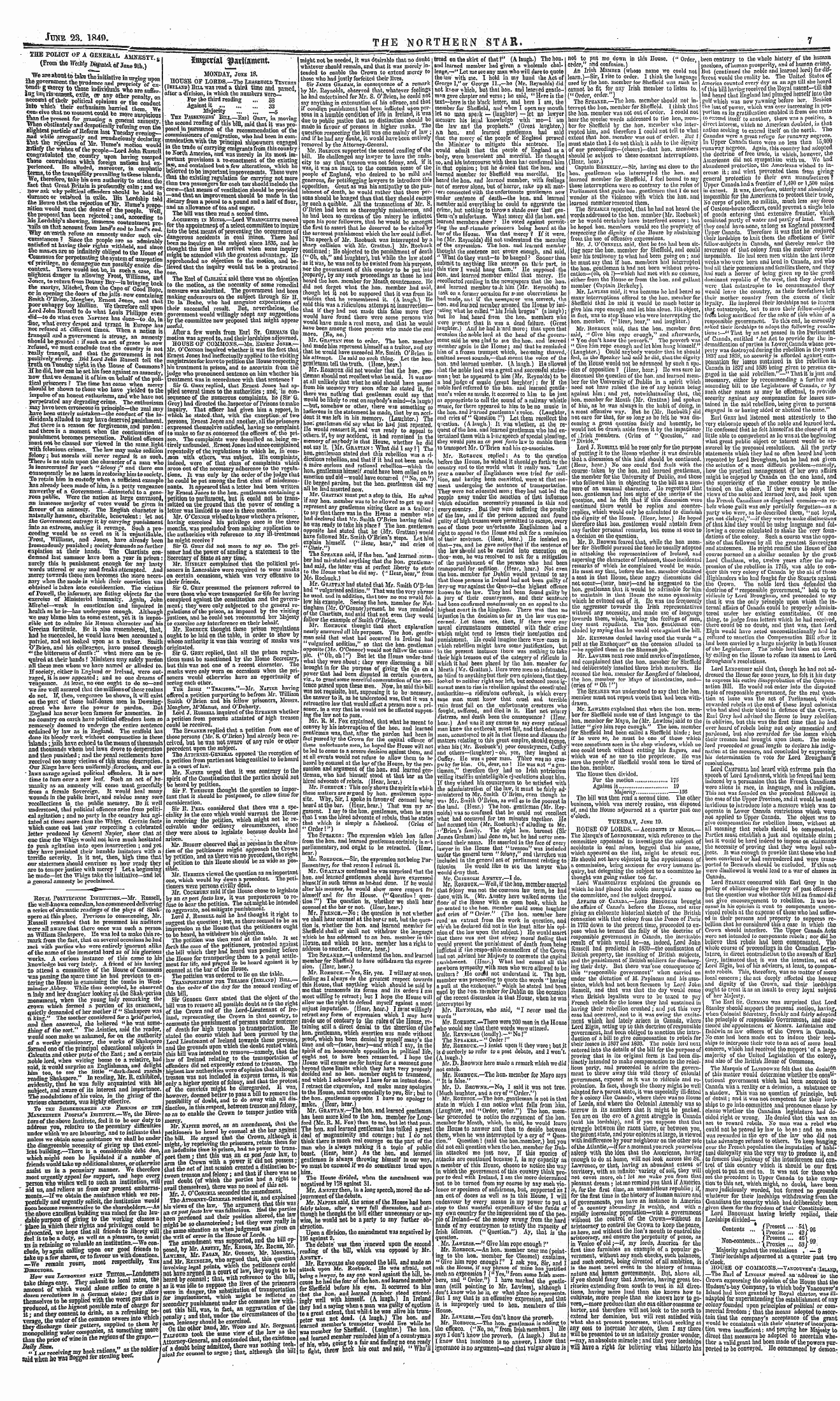
THE POLICY OF A GENERAL AMNESTY . ( From ihe Weekly _mpattli . of June 9 th . ) _^ We are ahoutto _fcibe the initiative in nr « _rinfflm n : & e _government thc prudence and propriety * of _evtenfo g mercy to those individuals wlio are _suffering _imj - _rB-mmeat , exile , or any other penalty , on _ac _^ unt ofth _^ political opinions or tne conduct into which their enthusiasm hurried them We com eive tent no moment could be more auspicious _^ tbe * _pi _^ entfor gnuitmg a general amnesty . Jr _^^ ' _--n _atfy an'l _despoticall y refusing even the _Slightet particle of Reform last Tuesday _evening—| tad while arrogantly and _-namdaciouslv dcclattnK that the rejection of " Mi-. Hume ' s motion would
Satisfy the wishes ofthe people—Lord John Russell congratulated the _^ country npon having -escaped those convulsions which foreign na * So * ss had experienced . He allufed , moreover , "in emphatic ¦ terms , to the _tranquility prevailing * hi 5 _* - " a-ese islands . We , therefore , take his own authority to attest the fact that Great Britain is profoundly calm ; and we now ask why pdfitical offenders _sbcald be held in durance or _retained in exile . His Lordship _to-H ihe _Hoase that the rejection of _fe . Hume ' s pronosition would meet the desire ef the people Well _theproposaVhas been rejected : and , according to ins _Xordslnr , s sbowuig , immense contentment pre" _T _* ails on that account from Lad ' s end to land ' s end Why _OU'cai-th refuse an _amnestv under such circumstances ? Since the people are so _ndmiraWv
satisfied-at having their rights withheld , and since the _masses are so infinitely obli ged to the House of Commons for perpetuating the svstem of usurpation ¦ of privilege , no demagogue can possibl y excite discontent . There wonld not be , in such a . case the slightest danger in allowing Frost , Williams , ' and Jones , to return from Botany Bay—in _brino-hm * back the martyr , MitcheL . "from the Cape of Good ° Ho pe or in opening the doors of the jails now _containing Smith O'Brien , Meagher , Ernest Jones , and that joorunhappy boy Mullins . We therefore call upon . Lord John Bussettt-o do what Louis Philippe even did—to do what even _Xarvaez has done—to do , in "Hue , what every despot and tyrant in Europe has aiofc refused at _cSSl-rcnt times . When a nation is
« ranquil and a government is strong , an amnestv Should be granted : ifsuchanact of grace be now " refused , we must conclude teat the country is not "really tranquil , and tbat tbe government is not -positively strong . Did _Xoi-d Jobn Russell tell the "truth on Tuesday night in the House of Commons ? 3 f he did , how can he set his _faea against an amnesty , now thatwc demand it of him-ou behalf ofthe poliiical prisoners ? The time has come when mercv should be shown to those wlio have yielded to the impulse of an honest enthusiasm , and who have not perpetrated any degrading-crime . The . enthusiasm "may have been erroneous in princi ple—the zeal may lave been utterly mistaken—the conduct of the individuals alluded to may have deserved punishment "
But there is a season fov forgiveness and pardon : and there is a moment when the continuation of punishment becomes persecution . Political offences must not be classed nor viewed in the same Ji <* ht with felonious crimes . The law may make sedition Jelony ; but morals will never regard it as such . "There is no stain npon the character ofa man who 5 s _Ineareei-ated for such * ' felony - " and there can consequently be no harm in restoring him to society . To retain him in custody when a sufficient example las already been made of him , is a petty ven- > -eance _flnwerthy of a . Government—distasteful to a _gcnei-ous public . Were the nation at large canvassed , sm immense majority « f votes would be given in favour of an amnesty . The English character is ¦ naturall y humane , charitable , benevolent : let not ihe Government outrage it by carrying punishment "into an extreme , making it revenge . Such a proceeding would be as cruel as it is uniustiSable .
-Frost , Williams , and Jones , have already been -tremendously punished ; society demands no further expiation at their hands . Thc Chartists condemned last summer have been a year in prison : surely this is punishment enough " for any hasty "words uttered or any mad freaks attempted . And ¦ mercy towards these men becomes the more necessary when the mode in which iheir conviction was obtained is taken into consideration . The victims of Powell , the informer , are fitting objects for the exercise of Ministerial humanity . Again , John _Miiehel—weak in constitution and impaired in health as he is—has undergone enough . Although wc may blame him to some extent , yet it is impossible not io admire his Roman character and his Grecian fortitnde . Ec it also remembered , that , lad lie succeeded , he would have been accounted a patriot , and not looked npon as a traitor . Smith O'Brien , and his colleagues , have passed through ¦ "the bitterness of death : " what more can be
required at their hands ? . Ministers may safely pardon all these men whom we have named or alluded to . If society , either in England or Ireland , were outraged , it is now appeased ; and no one dreams of ¦ vengeance . At least , no one ought to do so—hnd * we are well assured tint the millions of these realms do not . If , then , vengeance be shown , it will exist on the part of those half-dozen men in Downingstreet who have the power to pardon . Bat [ England has never been famous for amnesties . In £ 0 country on earth have political offenders been so _remci-sely * doomed to undergo the entire sentence ordained " by law as in England . The scafibld has done its bloody work without compunction in these islands ; jails have echoed to thc moans of thousands and thousands whom bad laws drove to desperation and then punished ; and the penal settlements have received too many victims of this same description . Our Kinss have been uniformly- ; ferocious , and our
laws savage against political offenders . It is now time to turn over a new leaf . Sueh an act of humanity as an amnesty will come most gracefully -from " a female Sovereign . It would heal many wounds in the public lie , _irt , -and subdue many sore recollections In tbe public memory . Be It well understood , that political offences arise from political agitation ; and no party in the country has agitated at times more than the "Whigs . Certain facts which came out last year respecting a celebrated letter produced by . General _Napier , show that at one time tbe Whigs would not liave much hesitated to push _notation iuto open insurrection ; and yet they have punished their imnibla imitators with a terrific severity . Is it not , then , high time that our statesmen should convince us how ready they are to temper justice with mercy ? Let a beginning he made—let the "Whi gs take the initiative—and let a _sreneral amnestv be proclaimed .
Hotal Polytechnic Institution.—Mr. Russe...
Hotal Polytechnic Institution . —Mr . Russell , the well-known comedian , lias commenced delivering a scries of dramatic readings of the plays of Shakspcre at this place . Previous to commencing , Mr . Bussell remarked that he presumed his auditors were all aware that there once was such a person as "William Sliakspere . lie was led to make this remark from the fact , that on several occasions he bad - met with parties who were entirely ignorant alike ofthe name ofthe immortal bard as of his glorious -works . A curious instance of this came to his _"knowledge but very lately . A friend ofhis having to attend a committee of the House of Commons was passing the spare time he had previous to entering the House in examining the tombs in "Westminster Abbey- _"VVLilethus occupied , Le observed a ladv and her _dausrhtcr _looking at the Skak _* -pcrian
monument , when thc young lady remarking the crown which formed a portion of its ornament , quictlv demanded of her mother if" Sliakspere was a kin- *' . - '"' The mother considered for a hrief period , and then answered , she bettered "he was _somo--thinff of the sort . " The Asiatics , said the reader , wouEl soon make ns ashamed , for on the authority of a wortbv missionary , the works of Shakspere formed one ofthe principal educational subjects in Calcutta and other parts ofthe East ; and a certain noble lord , when wilting home to a relative , had said , it would surprise an Englishman , and delight "him too , to see the little " dark-faced rascals readino * shakspere . " In leading , Mr . It , exhibited , evidently , that he was fully acquainted with Ms subject , and aware of its interest and importance . ! Ehe modulations ofhis voice , in tlie _giving ofthe various characters , was highly effective .
To THE _SnAnEHOrDEKS and Phiexbs _o-p THE _JIancdesiek Peo-cxe ' s Institute . —We , tbe Directors of the above Institute , feel it to be our duty to address you , relative to the pecuniary difficulties under -winch we arc labouring , and to intimate thai -unless we obtain some assistance we shall be under ihe disagreeable necessity of giving up that excellent building . —There is a considerable debt due , which might soon he liquidated if a number of friends would take up additional shares , or otherwise assist us in a pecuniary manner . We therefore most urgently appeal for support , and hope every person who wishes well to such an institution , will
aid us , and relieve us from our present _embarras-¦ Bients . —If we obtain the assistance which we respectfully and urgently solicit , the institution would soon become _xennmerativc to the shareholders . —As the above excellent building was raised for thc laudable purpose df giving to the working classes a place In which their rights and privileges could he advocated , we hope that all friends to liberty will feel it to be a dutv , as well as a pleasure , to assist ns in retaining so valuable an institution . — "We conclude , by again calling upon our good friends to takeup afew shares , or to favour ns withdonations . -We remain yours , most respectfully , The
_^ _vT-rS lW « - « _s _^ . _tos . _-Londoners fake things easy . _^ " _^' _^ K _?^ 2 tf ! amount of which would alone suffice to _« J » dozen revolutions in a German . state ; they allow themselves to be supplied with the worst gas thatis produced , at the hignest possible rate of charge for it : and they consent to drink , as a refreshingj beveraije , the water ofthe common sewers into which they discharge their gutters , supplied to them by monopolisinf _water companies , at something more San the pricV of winein the regions ofthe grape _.-^ l _^ _eeeiving my baek _^ ons » as the soldier _Said-ffS _^ _aS " flogged for _steals beef .
¦ Jhttbenal •Ftartiament.
¦ _JhttBenal _ftartiament .
Monday, June 18. House Of Lords.—The Lea...
MONDAY , June 18 . HOUSE OF LORDS . —The _Leasehoid Tekcbes ( Ikelasd ) Bill was read a third time and passed , after a division , in which the numbers were Por the third reading ... ss Against it ... ... ... 33 Majority ... ... _ 5 " The Passengers' Bill . _—Eai-1- Gret , in _moving the second reading of this bill , said that it -was proposed in pursuance of the recommendation of tbe commissioners of emigration , who had been in communication witMhe princi pal shipowners engaged in the trade of carrying emigrants from this country to " " North America , and was merely in its most _importa-at provisions a re-cuactment of the existing lay , and contained but a few alterations , which he
_ueiieved to he important improvements . These were that the existing regulation for carrying not more than two passengers for each ton should include the crew—that means of ventilation should be provided —and that au improvement should be made in thc dietary from a pound to a pound and a half of flour , and an allowance of tea and sugar . The bill was then read a second time . AccmEXTS ra Mixes . —Lord "WnAioiciirEE moved for the appointment of a select committee to inquire into the best means ' of preventing the occurrence of dangerous accidents in coal mines . Tliere had been no inquiry on the subject since 1835 , and he thought the time had arrived when some inquiry might be attended with the greatest advantage . He apprehended no objection to the motion , and believed that the inquiry would not be a protracted
one . , The Earl of _Caulkus said there was no objection to the motion , as the necessity of some remedial measure was admitted . The government had been making endeavours on the subject through Sir H . Tie la Beche , who had sanguine expectations of their successful result . But , nevertheless , the government would willingly adopt any suggestions by the committee now proposed that might appear useful . After a few words from Earl St . _Germans the motion was agreed to , and their lordships adjourned . HOUSE OF COMMONS . —Mr . Ernest Jones . — Mi' . O'Coxxon inquired whether it was the fact that Ernest Jones had ineffectually applied to the visiting magistratesfor leaveto petition the House respecting his treatment in prison , and to ascertain from the judge who pronounced sentence on him whether his treatment was in accordance with tbat sentence ?
- Su- G . Gret replied , that Ernest . Jones had applied several times to the authorities ; and ; iii consequence of the numerous complaints , ho ( Sir'G . Grey ) had directed the . Inspector of Prisons to make inquiry . That officer had given him a report , in which he stated , that , with the exception : . of two persons , Ernest Jones and another , all the prisoners expressed themselves satisfied , having no complaint to make so far as concerned the officers of . the prison . The complaints were described as . being _^ entirely unfounded , . Ernest Jones had since complained
repeatedly of the , regulations to which he , in common with others , was subject . His complaints , indeed , were of that class of complaints which arose out ofthe necessary adherence to the regulations . It was only by the order of the judge that he could be put among the first class of misdemeanants . It appeared that a letter had been written by Ernest Jones to the hon . gentleman containing a petition to parliament , but it could not be transmitted on the ground that the power of sending a letter was limited to once in three months .
Mr . O _' _Connok wished to know whether a prisoner , having exercised his privilege once in the three months , was precluded from making application to the authorities with reference to any ill-treatment he might receive ? Sir ' G . _Ghet did not mean to say so . The prisoner had the power of sending a statement to the Secretary of State at any time . Mr . _Hixdlet complained that thc political prisoners in Lancashire wero required to wear masks on certain occasions , which was very offensive to their friends .
Sir G . Gkey presumed the prisoners referred to were those who were transported for life for having conspired against the constitution and the government ; they were only subjected to the general regulations ofthe prison , as imposed by the visiting justices , and he could not recommend heY __ Majesty to exercise any interference on their behalf . Mr . Roebuck thought these prison regulations ought to he laid on the table , in order to show by whose authority it was this wearing of masks was _orisinated . girG . Gket replied , that all the prison regulations must be sanctioned by the Home Secretary , but tbis was not one of a recent character . The masks were only worn on occasions when the prisoners would otherwise have an opportunity of seeing each other .
The Inisn - Traitors . "—Mi-. Napier having ofiered a petition purporting to befrom Mi' . William Smith O'Brien and his fellow prisoners , Messrs . Meaeker , M'Manus , aud O'Doherty . Lord J . Hussell inquired ofthe _Steaker whether a petition from persons attainted of high treason could be received . * The SrEAKEK replied that a petition from one of those persons ( Mr . S . O'Brien ) had already been received , but lie waa not aware of any rule or other precedent upon the subject . . - Thc _Attcknet-Geneilvl opposed the reception of a petition from parties not bcingentitlcdto be heard in a court of law . Mi-. Napier urged that it was contrary to the spirit ofthe Constitution that the parties should not be heard by petition . . Sir P . _Tuesiger thought the question so important that it should be postponed , to allow time for consideration .
Sir 11 . Peel considered that there was a speciality in the case which would warrant the House in _receiving the petition , which might not be receivable under ordinary circumstances , since thev were about to legislate because doubts had
arisen . . > . _-- . -:. • ... . , Mr . Bright observed that as persons in the situation of tbe petitioners might approach the Crown by petition , and as there was no precedent , the right of petition to this House should be as wide as possible . . , , Mr . _HKuraES viewed the question as an important one , which would lay down a precedent . The petitioners were persons civilly dead . . Mr . _Cockbuux said if the House chose to legislate by an ex post facto law , itwas preposterous torefuse to hear the petition . The actmight be intended to aggravate , not mitigate punishment . Lonl J . Husseli , said ho had thought it right to _surest the question ; but , as there seemed to be an impression m the House that the petitioners ought to be heardhe withdrew his objection .
, The petition was then read at the table . It set forth the case of the petitioners , protested against the bill which they had heard was pending before the House for transporting them to a penal settlement for life , and prayed to be heard against it by counsel at the bar cf the House . _ The petition was ordered to lie on the tawe . Transportation fob Treason ( Ireland ) Bill . — On the order of the day for the second reading of Sir George Gket stated that the object of the bill was to remove all possible doubt as to the right of the Crown and of the Lord-Lieutenant of l'eland , representing the Crown in that country , to commute tho punishment of persons under sentence
of death for high treason to transportation . He stated the course whieh had been pursued by the Lord Lieutenant of Ireland towards these persons , and the "rounds upon which tbe doubt rested which this bill was intended to remove—namely , that the law of l'eland relating to the transportation of offenders did not expressly extend to treason The _highest law authorities were of opinion thatalthougn treason was not included in express terms , it was only a higher species of felony , and that the protest of the convicts might be disregarded . It was , however , deemed better to pass a bill to remove the possibility of doubt , and to do away with all distinction , in this respect , between treason and felony so as to enable the Crown to temper justice with
Mr . Napiek moved , as an amendment , that the petitioner ' s be heard by counsel at the bar against the bill . He argued that the Crown , although it mi _«** ht ,-by reprieving the prisoners , retain them for an Indefinite time in prison , had no power to transport them ' , that this was an ex post facto law , to arm the Crown with a power it did not possess ; that the act of last session created a distinction between treason and felony ; and that if there was no real doubt ( of which the parties had a right to avail themselves ) , there was no need of this act . Mr Ji O ' _CosxEix seconded the amendment . _. The-ATTORNET-GENEiui . resisted it , and explained his views of the law , The argument that this was _™ ex pose facto law was fallacious . Had the parties _bSen _pardoned and their position altered , the law St be so characterised ; but they w ere really in _Knme situation as when judgment was given on
the writ of error in the House of Lords . - The amendment was supported , and the biu opnosed b y Mr . _Anstbt , Mr . _Keogh , Mr . Roche , Mr . _iSs _? Mr . Fagan , ' . Mr . Godson , Mr . Monsell , _SX _Refolds , who argued that , this question involving legal points , which the petitioners could not have ar _& in a court _oHaw _, they ought to be heard hy cowisel ; that , with reference to the bill , as it _wal idle to suppose the lives ofthe prisoners were in _d-mger , the substitution , of transportation for Imprisonment , which mig ht be inflicted as secondary punishment under the common law without this bill , was , in fact , an aggravation of the penalty ; and that , under the circumstances of the leniency shodd be exercised .
case , Outhe Other hand , Mr . Wood and Mr . Sergeant Taifoubd took the same view of the law . as the _IKey-General , and contended that , the existence of a doubt being admitted , there was nothing _technfeal for counsel to argue that , although the bdl
Monday, June 18. House Of Lords.—The Lea...
mig ht not be needed , it was desirable that no doubt whatever should remain , and that it was merely intended to enable the Crown to extend mercy to those who had justly forfeited their lives . Sir James Graham , in consequence of a remark by Mr . Reynolds , observed that , whatever feelings he had entertained for Mr . S . O'Brien , he could not say anything in extenuation of his offence , and that if condisn punishment had been inflicted upon persons in a humble condition of life in Ireland , it was due to public justice that no distinction should be made in favour of persons in higher ranks . The question respecting the bill was one mainly of law and if he had any doubt , it would have been entirely removed by the Attorney-General .
Mr . Roebuck , supported the second reading ofthe bill . He challenged any lawyer to have the audacity to say that " treason was not felony , and , if it was it was an _insujt to thc common sense of the people of England , who desired to be mild and generous , for pettifogging lawyers to introduce this opposition . Great as was his antipathy to the punishment of death , he would rather that these persons should be hanged than that they should escape by such a quibble . All the transactions of Mr . S . O'Brien had been so thoroughly mischievous , and lie had beea so careless of the misery he inflictcc upon his poor followers , that hc would be amongst the first to assert that lie deserved to be visited by the severest punishment which the law could inflict . [ The speech of Mr . Roebuck was interrupted by a
sharp collision with Mi-. Grattan . ] Mr . Roebuck continued : Hc objected to tho punishment of death ( "Oh , oh , " and laughter ) , but while the law stood as itwas he was not to bo twisted from his purpose , nor thc government of this country to be put into jeopardy , by any such proceedings as those he had heard the hon . member for Meatn . countenance . He did not forget what the lion , member had said , though let it not be supposed that it was from its wisdom tbat he remembered it . ( A laugh . ) lie said this was a ridiculous attempt at insurrectionthat if they had not made this false move they would have found there were some persons who would have made a real move , and that he would have been among those persons who made the real move . ( No , no . ) ¦
Mr . Grattam rose to order . Tbe bon . member had made him represent himself as a traitor , and ' - . ay that he would have suceeded Mr . Smith O'Brien in his attempt . lie said no such thing . Let the hon . gentleman telUhotvuth . ( Hear , hca ? . ' _) Mr . Roebuck did not wonder that the lion , gentleman should not recollect what he said . It was no ! at all unlikely that what he said should have passed from his memory very soon after he stated it , for there was nothing that gentleman could say that would be likely to rest on anybody ' s mind —( a laugh ) —but , somehow or other , there was something so ludicrous in the statement he made , that by an accident it was left in his memory . ( Laughter . ) The hon : gentleman did say what hc hod just repeated . He would reassert it , and was ready to appeal to others , if , by any accident , it had remained in the memory of anybody in that Housewhether he did
, not say it . [ Mr . Grattan : What did I say ?] The hon . gentleman stated chat this rebellion was a ridiculous rebellion , and that if it had not been made , a more-serious and rational rebellion—wliich thc lion , gentleman himself _ffouldhave been called on to sanction and aid—would have occurred ( " No , no . " ) He _betrged pardon , but the hon . gentleman did say all he had asserted now . Mr . Ghattan must put a stop to this . He asked 11 any hon . member was to bo allowed to get up and represent any gentleman sitting there as a traitor ; to say that there was in the House a member who had declared that Mr . Smith O'Brien having failed he was ready to take his place ? The hon . gentleman opposite had stated that he ( Mr . Grattan ) would have followed Mr . Smith O'Brien ' s steps . L"t him explain himself . ('' Hear , hear , " and cries of ' Chair . " )
The Speaker said , if the hon . " and learned member had mi-stated anything that the hon . _gcntlemahad said , the latter was at perfect liberty to state to the Ilouse what he did say . (•• Hear , hear , " from Mr , Roebuek . ) Mr . Grattan had stated that Mr . Smith _O'B-ien had " vulgarised sedition . " That was the very phrase he used , and in addition , that now no one would follow his example . Seeing the hon . member for Nottingham ( Mr . O'Connor ) present , he was reminded ofthe Chartists , aud said that not even they would follow the example of Smith O'Brien .
Mr . Roebuck thought that short explanation nearly answered all his purposes . The hon . gentleman said that what had occurred in Ireland had "vulgarised sedition , " so that the hon . gentleman opposite ( Mr . O'Connor ) would not follow the example . ( " Oh , oh ! " ) But let tbe Houso under-tand what they were about ; they were discussing a bill brought in for the purpose of - " j iving the Q . u en a power that had been disputed in certain quarters , viz ., to grant some merciful commutation ofthe sentence passed upon these men . Now , he said this bill was not requisite , but , supposing it to be - neessary , the answer to it , as he understood was , that it was a retroactive law that would _affect a person now a prisoner , in a way that he would not be affected supposing the law not to pass .
Mr . R . M . Fox explained , that what he meant to convey by his interruption of the lion , and learned centleman was , that , after the pardon had been in fact passed by the Crown for the capital offence of these unfortunate men , he hoped the House will not be led to come to a severe decision against them , and at all events would not refuse to allow them to be heard by counsel at the bar ofthe House , by the persuasion and argument of the hon . and learned gentleman , who had himself stood at that bar as the hired advocate of rebels . ( Hear , hear . ) Mr . Koebuck : This only shows the spirit in whHi these matters are argued by hon . gentlemen opposite . Why , Sir , I spoke in favour of counsel being heard at the bar . ( Hear , hear . ) That was my argument . I say to the lion , gentleman , when he says that I was the hired advocate of rebels , that he states that which is simply a falsehood . ( Cries of "Order ! " )
The SrEAKEn : The expression which lias fallen from thc hon . and learned gentleman certainly is m > t parliamentary , and ought to be retracted . " ( Hear , tear . ) Mr . Roebuck . —Sir , the expression not being Parliamentary ,- for that reason I retract it . Mr . _Gkaitan confessed he was surprised 'hat the hon . and learned gentleman should have expressed himself in such terms as hchad done . If he would alter bis manner , he would show more respect for himself and for fhe House . ( "Question ! question ! " ) The question is , whether we shall hear counsel at the bar or not . ( Hear , hear . )
Mr . FuENcn . —No ; the question is not whether we shall hear counsel at the barer not , but the question is . whether the hon . and learned member for Sheffield shall or shall not withdraw thc language which he has addressed to an bon . member in thN House , and which no hon . member has a right to address to another . ( Hear , hear . ) The Speaker . —I understand thehon . and learned member for Sheffield to have _withdrawn ths expression . ( Hear , hear . ) Mr . Roebuck . —Yes , Sir , yes . I will say at once , feeling as I always do the greatest respect towards this House , that anything which . should be said by me that transcends its forms and its orders I am most willing io retract : but I hope the House will
allow me the right to defend myself against a most unjust imputation . ( Hear , hear . ) I m ? st willingly retract any form of expression which I may have made use of contrary to the rules of tbe Ilouse , retaining still a direct denial to the _assertion of the hon . gentleman , which assertion was made without proof , wbich has been denied by myself many ' s the time and oft—( hear , hear)—and which I say , in the spirit of an honourable opposition in political life , ought not to have been reasseited . I hope the Ilouse . will excuse me for having for a moment gone beyond those limits which they have very properly decided and no hon . member ought to transcend , and which I acknowledge I have for an instant done .
I retract the expression , and make many apologies to the House , and more especially to you , Sir ; but to the hon . gentleman opposite I have no apology to make . . ( Hear , hear . ) Mr . Grattan . —The hon . and learned gentleman has been more kind to the hon . member for Longford ( Mr . R . M . Fox ) than to me , but let that pass . The hon . and learned gentleman" has talked a great deal of magnanimity and courage : but I do not think there is much real courage on the part of the man who is always making it a topic of public boast . ( Hear , hear . ) As the hon , and learned gentleman is always throwing himself in our way , wo must be excused if we do sometimes tread upon bim .
The House divided , when the amendment was negatived by 1-78 against 31 . Mr . ANSTErthen , in a long speech , moved the adjournment of thedebate . Mr . Napier said , the sense of the House had been fairly taken , after a very full discussion , and although he thought the bill either unnecessary or un « wise , he would not be a party to any further obstruction . Upon a division , the amendment was negatived by 195 against 9 . Thedebate was then renewed upon the second reading of the bill , which was opposed by Mr . Aks tby . .
Mr . Reynolds also opposed the bill , and made an attack upon Mr . Roebuck . He was afraid , not being a lawyer , io say one word against the bill , because he had the fear of the hon . nnd learned member for Sheffield before his eyes . It occurred to him that the hon . and learned member steod exceedin gly well with himself . ( A laugh . ) In Ireland the y had a saying when a man was guilty of egotism to a great extent , that whiht he was alive his trumneter was not dead . ( A laugh . ) The hon . and lparned member ' s trumpeter would live while he wSmember for Sheffield . ( Laughter . ) The lion _, and learned member reminded him ofa countryman of hU who . Eoing to a fair and finding no one ready ? o fight ! threw back his coat _anduaid , "Who'll
Monday, June 18. House Of Lords.—The Lea...
bread on the skirt of that ? ' | ( Alaugh . ) Thehon . and learned member bad-given a wholesale challenge , — " Let me see any man who will dare to quote the law with me . I hold in my hand the Act of George I , " or George II ., —ho ( Mr . Reynolds ) did not know which , but that hon . and learned gentlemnn gave chapter and verse ; ho said , " Here is the text—here is the black letter , and here I am , the member for Sheffield , and when I open my mouth let no man speak — ( _lauahter ) — let no " lawyer measure bis _lejlal knowledge with me—I' am the law and the prophets . " ( Great laughter . ) hn hon . and learned gentleman had said that the mercy of the people of England pressed the Minister * to mitigate this sentence . He
would admit that the people of England as a body , were benevolent and merciful . He thouoht so , and his intercourse with them _ha-t confirmed him in that opinion ; but he denied that the'hon . and learned member for Sheffield was merciful . He heard the hon . and learned member , with feelings not of sorrow alone , but of horror , rake up all niatters connected with the unfortunate _gentleman now under sentence of death—the lion , and learned member said everything he could to aggravate the crime , but nothing to throw a shade over that" gentlem m _' s misfortune . "What mercy did the bon . and learned members show ? lie voted against permitting the unfrlunate prisoners being heard at the bar of the House . Was that mercy ? If it were ,
he ( Mr . Reynolds ) did not understand the meaning of the expression . The hon . and learned member tHou _*| ht the sentence not severe enough , and said , '' "What do they want—to be hanged ? Sooner than submit to anything like success on their part , in this view I would hang them . " He supposed the hon . and learned member called that mercy . He recollected reading in the newspapers that the hon . and learned member to dc him ( Mr . Keynolds ) to task on p . former occasion for S"me observations he had made , an : !' , if the _newsyarer was correct , the hon . and leaincd member amused the House by itni-• ating what he called " his Irish brogue" ( a laugh ); but ho had , heard from the hon . members who were _p-esent that it was a dead failure . ( Great laughter . ) And he had k"ard more ; that upon that occasion the ' noble-lord at the head of the government said he was _slad to see the hon . and learned
member again in the Ilouse ; and that lie reminded him of a frozen trumpet which , _becoming thawed , emitted sweet sounds , —that meant the voice of the hon . and learned member . ( A laugh . ) He allowed ihat the noble lord was a great and successful statesman ; but he appeared to him ( Mr . Reynolds ) to be a bad judge of music ( great laughter ); for if the noble lord referred to the hon . and learned gentleman ' s voice as music , it occurred to him to be just as appropriate to call the sound of a railway whistle music , for there appeared to him to be no music in the hon . and Karned gentleman ' s voice . ( Laughter , and cries of" Question !¦ _' ) Let , them recollect the _question . ( Alaugh . ) It . was whether , at the request ofthe hon . and learned gentleman who had entertained them with a hiu speech of special pleading , they would pass an ex post facto law to enable them to transport Mr . O'Brien and his co-associates .
Mr . Roebuck replied ; As to the question before the House , he wished it should go forth to the country and to the world what it really was . ' Last year a number of Englishmen were tried for sedition , anil having been convicted , were at that moment undergoing tbe sentence of transportation . They were not educated men ; they had not led the people away under'the sanction ' of that influence which education necessarily possessed in this and every country . But they were suffering the penalty of the law , and if the persons accused and found guilty of high treason were permitted to escape , every one of those poor _un'brtunate Englishmen had a right to appeal to tho Ilouse and ask for a remission of their sentence . ( Hear , hear . ) He insisted on
that—yes , and he gave notice that if the sentence of the law should not be carried into execution on thos" men , he was resolved to ask for a mitigation of the punishment of the persons who had been transported for sedition . ( Hear , hear . ) Not even the lion , member for Dublin would pretend to say that tiiose persons in Ireland had not been guilty of levying war against the Que _^ _n- _^ tke highest offence known to the law . They had been found guilty by a jury of their countrymen , and their sentence had been confirmed unanimously on an appeal to the highest court in the kingdom . There whs then no injustice in the decision so far as the law was concerned . Let them see , then , if there wei _* e any moral circumstances cennected with tlieir crime
which might tend so lessen their inculpation and punishment _^ He could imagine there were * cases in which rebellion might have some justification ; but in the present instance thore was nothing to take their high treason out of the category of ridicule in which it had been placed by the hon . member for Meath ( _V " r . Grattan ) . Here were men so infatuated , so blind to any thing but their own opinions , that they _, looked to neither right nor left , but seduced some ignorant men to rise in rebellion against the constituted authorities—a ridiculous outbreak , ia which every sane man must know that cruel and terrible ruin must fall on the unfortunate creatures who fought , suffered , and died in it . Had not misery distress , and death been the consequence ? ( Hear ,
hear . ) And was it any excuse to say every rational man knew the outbreak must fail , and that educated men , accustomed to sit in that House and discuss the matters relating to this great , empire , shoul d escape , when _lifs ( Mr . Roebuck ' s ) poor countrymen , Cuffey and others —( laughter ) - oh , yes , they laughed at Cuffey . He was 11 poor man . There wag no sympaihy for hiin . Oh , dear , no ! He was not '' a gentleman , " therefore thsy had no Irish patriotism veiling itself in unintelligible ejiculations about him . If they wished his country men to be satisfied with the administration of the law , it must be fairly administered to Mr . Smith O'Brien , even though lie
_wat Mr . Smith O'Brien , as well gs to the poorest in the land . ( Hear . ) Thehon . gentleman ( Mr . Reynolds ) was so confused that hc could not recollect what had occurred for ten minutes together . He had accused him ( Mr . Roebuck ) of alluding to Mr . " 'Brien ' s family . The right lion , baronet ( Sir James Graham ) had done so , but he had never mentioned their name . He asserted in the face bf every lawyer in the Ilouse that " treason" was included under the general term " felony , " aud therefore was included in the general act of parliament relating to felonies He would like to sue the lawyer who would di'ny that . Mr . Ciiisholm Anstey . —I do .
Mr . Roebuck—Well , if the hon . member asserted that felony was not the common law term , he had done , with it . ( Mr . Anstey here walked across the floor of the House with an open book , which he _pi-i sented to ihe hon . member amid some laughter and cries of- " Order ; " ( The hon . memher here read an extract from the work in question , and wlrch he declared did not in the least alter his opinion of the law upon the subject . ) He would assert that there was not that stroii- ? moral feeling that
would prevent the punishment of death from being inflicted if fhe respo"Sible counsellors of the Crown had not advised her Majesty to commute the capital [ . unishm ' ent . ( Hear . ) What had caused all this newborn sympathy with men who were allowed to be traitors ? He _coisd not understand it . The hon , member was proceeding to quote the words " having a pull at the exchequer , " which hc stated had been used by the _i-on . mimbcrforPubiin on the occasion of the recent discussion in that House , when he was interrupted by
Mr . Reynolds , who said , "I never used the words " Mr . Roebuck . —There were 200 men in the House who would say that these words were uttered . Mr . Reynolds ( loudly ) . — "No }" The Speaker .- "Order !" Mr . Roebuck . —I insist upon it they were ; but it is _disorderly to refer to a past debate , and I won ' t . ( A laugh . ) Mr . D . BnowNE here made a remark which wc did not catch . Mr . Roebuck . —The hen . member for Mayo says "It is false . "
Mr . D . Browne . —No , I said it was not true . ( Much laughter , and a cry of " Order . " ) Mr . Roebuck . —The hon . gentleman is not in that state in which I can notice what falls from him . ( Laughter , and "Order , order . " ) The hon . member proceeded to notice tho ftrgumont of the hon . member for Meath , which , hc said , he would leave the House to answer and then to decide between them , when he was interrupted by a cry of " Question . " Question ! ( said the hon . member , ) but you did not call question when the hon . member for Dublin attacked me just now , If this species of attacks arc continued because I , in my capacity as a member of this House , choose to notice the way in which the government of this country think pro per to deal with Ireland , I am the more determined not to be turned from my course by any such violence or specimen of unfairness , but , supported as I am out of doors as . well as in this House , I will
endeavour by every means m my power to put a stop to that wasteful expenditure of the funds of my own country for the improvident use of the people of Ireland—of the money wrung from the hard hands of my countrymen to satisfy the rapacity of Irish idleness . ( "Question . " ) , Ay , that is the question . . Mr . Law-cess . — . Give liim rope enough !" Mr . Roebuck . —An hon . member near me ( pointing tothe hon . member for Clonmel ) exclaims , " Give him rope enough ! " I ask you , Sir , and I ask the Ilouse , if any phrase of mine has justified sueh an expression ? ( " Yes , " from some Irish -members , and " Order . " ) I have marked the gentleman ( still pointing to Mr . Lawless ) , although I don't know who he is , or what place he represents . But I say that is an offensive expression , and that it . is improperly used to hon . members of this House .
Mr . Lawless . —Tou don't know the proverb . Mr . Roebuck . —The lion , gentleman is adding to tlio offence . ( "No , no , " from Irish members . ) He says I don't know the proverb . ( A laugh . ) But as I know that insolence is no answer , I know that ignorance is no argument—and that vulgar abuse is
Monday, June 18. House Of Lords.—The Lea...
not to put mo down in this Ilouse . (" Order , order , " and confusion . ) An Irish Member ( whoso name wo could not learn . )—Sir , I rise to order . I think thc language used by the hon . member for Sheffield was sueh as cannot bo fit for any Irish member to listen to . ( "Order , order . " ) Tho SrEAKER . —The lion , member should not interrupt the hon . member for Sheffield . I think that the hon . member was not out of order . I could not hear the precise words addressed to the hon , member for Sheffield by the hon . member who interrupted himand therefore I could not tell to what
, extent that hon . member was out of order . Bnt I must state that 1 do not think it adds to the dignity of our proceedings —( cheers)—that hon . members should : bc subject to these constant interruptions . ( Hear , hear . ) Captain _BEnKEU-y . —Sir , having sat close to thc hon . gentleman who Interrupted the hon . and learned member for Sheffield , I feel bound to say those interruptions were so contrary to thc rules of Parliament that guide lion , gentlemen that I do not wonder at the violence with whicli tho lion , and
learned member resented them . The SrEAKER repeated , that ho had not heard the words addressed to thc hon . member ( Mr . Roebuck ) or he would certainly have interfered sooner ; but he hoped hon . members would see tho propriety of respecting the dignity ofthe Ilouse by abstaining from the use of offensive expressions . Mr . J . 0 ' Goxxell said , that he too had been sitting near thc hon . member for Sheffield , and couhl bear his testimony to what had been going on ; aud he must say that ' if : hon . members had interrupted the hon . gentleman it had not been without provocation —( oh , oh !)—which had met with no censure , either from thc Ilouse or from the hon . and gallant member ( Captain Berkeley ) . . Mr . Lawless said , it was because ho had heard so many interruptions offered to thehon . member for Sheffield that ho said it would be much better to
give hini rope enough and let hiin alone . His object , in fact , was to stop those who were interrupting thc hon . member , ( "Hear , hear , " and laughter . ) Mr . Roebuck said , that the hon . member first said , . " Give him rope enough , " and afterwards , " You don't know the proverb . " Thc proverb was " Give him rope enough and lot him hang himself . " ( Laughter . ) Could anybody wonder that he should _fenl , as the Speaker had said he did , that the dignity of the House would not bo advanced by sueh a species of opposition ? ( Hoar , hoar . ) Ho was sure lie discussed tho question of tho hon . and learned member for the University of Dublin in a spirit which need not have raised the ire of any human being against him ; and yet , notwithstanding that , the hon . member for Meath ( Mr . Grattan ) had spoken of him , as he was always in the habit of doing , in a most offensive way . But he ( Mr . Roebuck ) did not care for that , for so long as hc felt he was discussing a great question fairly and honestly , he
would not be drawn aside from it by the impatience of 1 Irish members . ( Cries of "Question , " and "Divide . " Lord J . Russeil said he rose only for the purpose of putting it to the House whether it was desirable that a discussion of tbis kind should be continued . ( Hear , hear . ) So one could find fault , with the course-taken by tho hon . and learned gentleman , the member for the University of Dublin , and thoso who followed him in objecting to the bill as a measure of an unusual character . Hc regretted that hon . gentlemen had lost sight of the merits of thc question , and he felt that if this discussion were continued there would be replies and counterreplies , which would only be calculated to diminish the dignity of tho Houso . ( Hear , hear . ) lie hoped therefore that hon . gentlemen would abstain from any further personal remarks , but come nt once to a decision on the question .
Mr . D . Browne feared that , while the hon member for Sheffield pursued the tone he usually adopted in attacking the representatives of Ireland , and aspersing the character of Irishmen , those incidental remarks of which he complained would bo made . Ho must say that , hefore thc hon . member obtained a seat in that House , these angrj discussions did not occur —( hear , hear)—and he suggested to the hon . gentleman that it would bo advisable for hini to maintain in that House tho same equanimity which he evinced out of it . He was too frequently thc aggressor towards tho Irish representatives without any necessity , and made use of language towards them , wliich , having the feelings of men , they must repudiate . The hon . gentleman concluded by saying that he would vote against the bill . Mr . Reynolds denied having used thc words " a pull at the Exchequer" on the occasion alluded to —he applied them to the Shannon joh .
Mr . Lawless next rose amid marks of impatience , and complained that the hon . member for Sheffield had deliberately insulted three Irish members . He accused the hon . member for-Longford of falsehood , the hon . member for Mayo of intoxication , and—( cries of "Oh ! " ) The Sj ? eaker was understood to say that tho lion _, member must not repeat words that had been withdrawn . Mr . Lawless explained that when the hon . member for Sheffield made use of that language to the hon . member for Mayo , he ( Mr . Lawless ) said to the latter "give him rope enough . " The hon . member for Sheffield had been called a Sheffield blade ; but if ho were so , he must be one of those which were sometimes seen in the shop windows , which no one could touch without cutting his fingers , and which was of no use to the propriecor . Re was sure the people of Sheffield would soon bo tired of
the hon . member . The House then divided . For the motion 1 * 73 Against it 19 Majority 156 The hill was then read a second time . Tlie other business , wliich was merely routine , was disposed of , and the Houso adjourned at a quarter past one o ' clock . TUESDAY , June 19 . HOUSE OP LORDS . —Accidents in
Mines—The Marqu : s of Londonderry , with reference to the committee appointed to investigate thc subject of accidents in coal mines , begged that his name which appeared on the list , nii g ht bo struck out . He should not have objected to the appointment of a commission , being anxious for every humane inquiry , but delegating the subjeet to a committee hc thought was going rather too far . Lord WiiAKXcuiTE explained the grounds on which he had placed the noble marquis ' s name on the committee , and the subject dropped .
Affairs of , Casada . —Lord Brougham brought the affairs of Canada before the Ilouse , and alter giving an elaborate historical sketch of the British connexion with that colony from the Peace of Paris in 1702 down to the present time , proceeded to expose what he termed the folly of the doctrine of responsible government in Canada , the _inevitablo result of which would be—as , indeed , Lord John Russell had predicted in 1839—the confiscation of British property , the insulting of British subjects , and the punishment of British soldiers for discharging their duty . But there was ' one consequence of this " responsible government" when carried on under thc dictation of M . Papineau and his associates , which had not been foreseen by Lord John
Russell , and that was that tho day would como when British loyalists were to be taxed to pay French rebels for the losses they had sustained in having their rebellion crushed , * and yet this very case had occurred , and to it was owing tho excitement which had lately arisen in Canada , where Lord Elgin , acting up to this doctrine of responsible government , had been obliged to sanction thc introduction of a bill to give compensation to rebels ibr their losses in 1837 and 1838 . The noble lord next entered into the details of the bill for the purpose of proving that in its original form it had been distinctly intended to make compensation to the rebellious party , and proceeded to advise the government to throw away this wild theory of colonial
government , exposed as it was to ridicule and reprobation . In fact , though the theory nii ght be well adapted for a parent state , it was especiall y ill-fitted for a colony liko Canada , where there was no House of Lords , and where the Colonial Assembly was so narrow in its numbers that it might be packed . You aro on tho eve of a groat struggle in Canada ( said his lordship ) , and if you suppose that that struggle between the races there , or between you , the parent state , and your colonies at large , is viewed with indifference by your neighbour on the other side ofthe Atlantic , —if for a moment you rock yourselves asleep -with the idea that the Americans , having enough to do at home , will not look across thc St . Lawrenceor that having an abundant extent of
, , territory , with an infinite * variety of soil , they will not covet more , oh ! let mo wake you from that pleasant dream ; let me remind you that if America is , forthe first time , an unambitious republic ; if , for the first time iu the history of human nature and of governments , you have an instance in America of a country abounding in wealth , and with a rapidly increasing population—with a government without the control of the Crown—without an aristocracy to control the Crown to keep the peace , as here , and without the lion ' s mouth to control the aristocracy , and ensure the perpetuity of peace , as in Venice of old ;—if , my lords , America ; for the first time furnishes an example of a popular
government , without any such checks , such balances , and such control , being divested of all ambition , it is the most novel event iu the history of human nature and human governments . But , above all , if you should fancy that America , having great territories extending from south to west in all directions , having more land than she knows how to cultivate , more people than she knows how to govern , —more produce than she can either consume or barter , and therefore will not look to the north to extend her dominion , but will rest satisfied with what she at present possesses , without seeking at any cost to increase her store , then I say there will be presented to us an infinitely greater wonder , —nay , an absolute miracle ; and that your lordships will have a right for believing what hitherto has
Monday, June 18. House Of Lords.—The Lea...
been contrary to the whole history of the human passions , of human prosperity , and of human crime . But ( continued thc noble and learned lord ) far different would the reality bo . The United States of America counted every day as an age till she heard of this bill bavin" received the Royal assent—till sho had heard that England had plunged herself into tho gulf which was now yawning before her . Besides tlie lust of power , which was ever increasing in proportion as its gratification enabled it from one state to extend itself to another , there was a positive , a direct interest , which no . American doubted , in that nation seeking to extend itself on thc north . Tho Canadas wero a great _refuse for runaway negroes . _IntTppor Canada there wore no less than 15 , 000
runaway negroes . Again , this cout * try had adopted the doctrine of free trade , in which ) however , the Americans did not sympathise with us .- Wc had abandoned protection , the Americans wished to in * crease it ; and what prevented them from giving * ceneral protection to their own manufactures ? Upper Canada had a frontier of 1 , < L 00 or 1 , 500 miles in extent . It was , therefore , utterly and absolutely impossible for the Americans to protect their trade , No corps of police , no militia , much less any force of Custom-house officers , could prevent a single bale of goods entering that extensive frontier , which consisted partly of water and partly of land . Tariff thov could have-none , as long as England possessed Upper Canada . Therefore it was that 1 ) 0 conjured
tlieir lordships to knit them the affections ot * their fellow-subjects in Canada , and thereby render the severance of that colony from the mother country impossible . lie had seen men within thc last three weeks who were born and bred in Canada , and who had all tlieir possessions and families there , and they had such a horror of being given up to the great dominant republic of the west , that they declared were that catastrophe to be consummated they would leave the country , as their forefathers left their mother country from the . excess of" their loyalty . He implored their lordships not to hasten that catastrophe , but- to save their fellow-subjects frdfh being sacrificed for the sake of this whim of a responsible government . To this end , he earnestly
asked their lordships to adopt the following resolui tions : — " That by an act passed in the Parliament of Canada , entitled 'An Act to provide for the indemnification of parties in Lower'Canada whose property was destroyed during the rebellion in the years 1837 and 1 S 3 S , no security is afforded against compensation for losses sustained in tlie rebellion in Canada in 1837 and 1838 being given to pertons engaged in the said rebellion . "— "That it is just and necessary , cither by recommending a further and amending bill to the Legislature of Canada , or by such other moans as may bo effectual , to provide security against any compensation for losses sustained in the said rebellion , being given to persons engaged in or having aided or abetted the same . "
Earl Grey had listened most attentively to tho very elaborate speech of the noble and learned lord . Ifc confessed that he felt himself at the close of it as little able to comprehend as he was at the beginning what great public object or interest would be answered by thc proposed resolutions . All the party statements which thoy had so often heard had been repeated by Lord Brougham , but ho had not given the solution of a most difficult problem . —namely , how the practical management of her own affairs might be enjoyed by Canada on the one hand , and tlie superiority of the mother , country be maintained on the other . If they were to adopt the views ofthe noble and learned lord , and look upon the French Canadians as disguised enemies—as
rebels whoso guilt was only partially forgotten—as a party who were , as ho described them , " not loyal , yet not disloy . il , "—if they were to make distinctions of that kind they would bo using language and following a course calculated to shako the very foundations of the colony . Such a course was thc opposite of that followed by all thc greatest Sovereigns and statesmen . He mi ght remind the House of tho course pursued on a similar occasion by the great Lord Chatham , who , twelve years after the suppression of the rebellion in 1745 , was able to conquer this very colony of Canada by the aid of thoso Highlanders who had fought for the Stuarts against
the Crown . The noble lord then defended tho doctrine of " responsible government , " held up to ridicule by Lord Brougham , and proceeded to say that it was the only principle upon which tho internal affairs of Canada could bo properly administered under her existing constitution . Of ono thing , to judge from letters which ho had received , tliere couid be no doubt , and that was , that Lord Elgin would havo acted unconstitutionally h « d ho refused to sanction the Compensation Bill after it had been carried by a large majority in both Houses of the Legislature . The" noble lord then sat down by calling on tho House to refuse its assent to Lord Brougham ' s resolutions .
Lord Lynduurst said that , though ho had not addressed the House for sonic years , he felt it his duty to express his entire disapprobation ofthe Compensation Bill . Ho would not enter into the disputed topic of responsible government , for the real question at issue was the act of Parliament , which rewarded rebels at thc cost of those loyal colonists who had shed their blood in defence of the Crown . Earl Grey had advised thc House to bury rebellion in oblivion , but this was the first time that he had overheard of rebels being not only amnestied and pardoned , but also rewarded for the losses which their treason had brought upon them . Thc noble lord proceeded at- great length to declare his indignation at the measure , and concluded by expressing his determination to vote for Lord Brougham ' s resolutions .
Lord Campbell had heard with cxtremo pain tho speech of Lord Lyndlmrst , which ho feared had been induced by a persuasion that the French Canadians were aliens in race , in language , and in religion . This act was founded on the precedent followed in tho ease ofthe Upper Province , and ifc would be most invidious to introduce into a measure whicli was to operate in Lower Canada restrictions which wero not applied to Upper Canada . The object was to give compensation for rebellion losses , without at • ill meaning that rebels should be compensated . Parties must establish a just and equitable claim ; but it would be hard indeed to impose on claimants the necessity of proving that they were loyal subjects . It was enough to provide that those who had been convicted or had surrendered and were transported to Bermuda should be excluded . If this act were disallowed it would lead to a war of classes in Canada .
Lord Stanley concurred with Earl Grey in the policy of obliterating tho memory of past offences ; but the question was whether this bill as framed did not give encouragement to rebellion . Ifc was because in his opinion it went to compensate unconvicted rebels at thc expense of those who had suffered in their persons and property to suppress rebellion that he considered this a case in which the Crown should interfere . The Upper Canada Acts wore not intended to compensate rebels ; nor did ho believe that rebels had been compensated . The whole course of proceedings in the Canadian Legislature , in direct contradiction to the avowals of Earl Grey , intimated that ifc was the intention , not of Lord Elgin , but of his advisers , at least , to compensate rebels . This , therefore , was no matter of mere local concern ; the act deeply affected the honour and dignity of thc Crown , aud their lordships ought to treat it as an insult to every loyal subject of her Majesty .
The Earl St . Germass was surprised that Lord Stanley should support the present motion , having , when Colonial Secretary , frankly and fairly adopted the principle of responsible Government , and sanctioned the appointment * of Messrs . Lafontaiiie and Baldwin as law officers of thc Crown in Canada , So case had been made out to induce thoir lordships to interpose their vote to an act of mere local concern , which had received the support' of a largo majority ofthe United Legislation of tho colony , and also of thc British Houso of Commons .
The Marquis of Laxsdowxe felt that the dccisi ° of this matter would determine whether the cons titutional government which had been accorded to Canada was a reality or a delusion , a substance or a shadow . This was no question of principle , but of detail ; and ifc was not competent for . their lordships to go into committee and pronounce clause by clause whether the Canadian legislature had decided right or wrong . Hc denied that this was an act to reward rebels . So man was a rebel who could not be proved by law to bo so ; and no man was rewarded in the eye of the law who did not take advantage refused to others . To keep hanging over the French population the imputation of habitual disloyalty was tho very way to produce ifc , and to foment that jealousy of the interference and
control of this country whicli it should bo our first object to put an end to .. It was not for those who set the precedent in Upper Canada to take exception" to this act , which might , no doubt , have been more judiciously worded , but formed no grounds whatever for tlieir lordships withdrawing from the Canadians the security which had deliberately been given them for the freedom of their Constitution . Lord _Broucuam having briefly replied , theix Lordships divided—Contents _J _& _SZ'Si _" Non . contolt ! ... { _gS :: ; _Sj _* Majority against the resolutions . — 3 Their lordships adjourned at a quarter past two o ' clock .
HOUSE OF COMMONS . _—Va-xcouver ' s ' _IsLATO , —The Earl of Lixcoln moved an address'to the Crown expressing the opinion ofthe House that tho Hudson ' s-bay Company , to which body Vancouver ' s Island had been granted by Royal charter , was illadapted for superintending the establishment of any colony founded upon principles of political or commercial freedom ; that the means adopted to ascertain that the company ' s acceptance of the grant would be consistent with their charter of incorporation were insufficient ; and praying her Majest y to direct that measures be adopted to ascertain whether a valid grant had been made of the powers purported to be conveyed . He commenced by demon-
-
-
Citation
-
Northern Star (1837-1852), June 23, 1849, page 7, in the Nineteenth-Century Serials Edition (2008; 2018) ncse.ac.uk/periodicals/ns/issues/ns3_23061849/page/7/
-