On this page
-
Departments (3)
-
Text (12)
-
 Untitled
 -
 Untitled
 -

"I WILL HATE MERCY AXD XOT 5ACKIFICE." X...
-

LINES -OX SEEING THE ACCOUNT OF THF MEET...
-

iSefctcfcs
-

THE VOICE OF AN OCTAGENARIAN, DENOUNCING...
-

THE LOYE GIFT, FOR 1843. LcndoD, H. G. C...
-

3UcaI anS Enteral $MeUt«iKf
-

LEEDS.—Charge of Stealing Tallow. —On Tu...
-

DEATH FROM WANT. Death from want ! Ayo, ...
-

CASE OF MANSLAUGHTER. On Tuesday morning...
-

We have good reason to know that a confi...
Note: This text has been automatically extracted via Optical Character Recognition (OCR) software. The text has not been manually corrected and should not be relied on to be an accurate representation of the item.
-
-
Transcript
-
Note: This text has been automatically extracted via Optical Character Recognition (OCR) software. The text has not been manually corrected and should not be relied on to be an accurate representation of the item.
Additionally, when viewing full transcripts, extracted text may not be in the same order as the original document.
Ar00316
Ar00310
"I Will Hate Mercy Axd Xot 5ackifice." X...
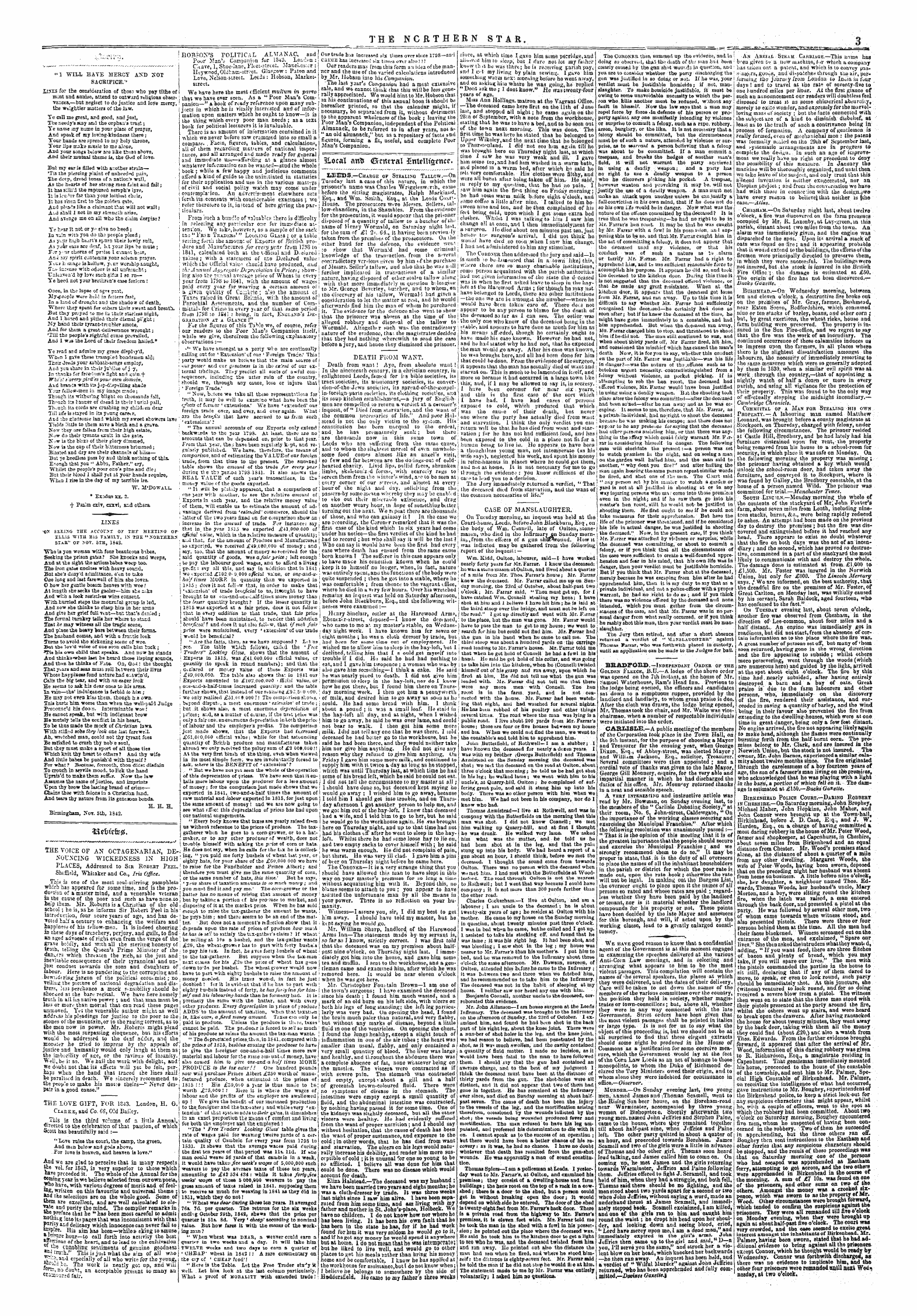
"I WILL HATE MERCY _AXD XOT 5 ACKIFICE . " Xrsxs for the consideration of those who pay tithe of mint and annise _, attend to outward religious observances , —but neglect to do justice and loye mercy , the weightier matters of the law . Ye call me great , and food , and jnst , The needy ' g stay and the orphan ' s tru 3 t ; Te name my name in your place of prayer , And speak of my loving-kindness there Tour bands are spread to my holy throne , Tour lips _nisie ausic to me alone , And yonr songs beiow are like those above , And their mutual theme ia , tbe God of love .
But my ear is filled with a-otber strain'lis the piercing plaint of nnheed ** d pain , The deep , dread tones of a nation's wail , As the hearts of her _strong men faint and fail ; It has _stlli'd the raptured seraph ' s lyre , It is icuv ' _-cT fa ? than your loitisit _choir , It has risen first to the _golden i _^ ate _. And _pleads like a claimant that will not wait ; A- _^ d shall I not in my _strength arise _. And avenge me on all who the claim _tespiss ? Te _h- > ar it not or y- > cive no heed ; In viin with you do the people plezd ; As y _~ * ir _high ht _^ irfs spurn their lowly suit , As voir cars are deaf , kt _vo-ir litis be mute : — _.-. - , - . ... — .. _HHW
. . , For _v-ur chorus of pnise I cannot _tyar , _Ani rjy spirit contemns yonr solemn prayer . _Tuur h > n : _age is hollow , yvur _worship taught , Tat _inc'nse with odour is all _unfrr . ucht ; _TJilcavea'd by love such gifts I sc rn—Te heed not your brethren ' s case forlorn j Once , in the lapse of ag ~ s D 23 t , _My _^ _isople were fctrl _. i in fe : rers fast , In a lacd of drought an J the _shadow of death , Where they spent for others their sweat and breath . Bat _thsy _prcyed to me ia their starless night , And I he _^ rd and pitied their dismal p » ght ; My hand their _tyrant-tronbler smote , And for them a great deliverance wrought ; 'Till the people ' s rightful cause prevailed , And I was the Lord of thtir freedom hailed . *
Te read ard admire mv grace di . « pl _.-sy'd , "When I gave these trampled bondsmen aid ; _Thsir deeds your sabbath-songs employ , Ar . d you share in their jG . y .. " _oe of j y , In thinks for _freedom ' s Sght and i ; a _^ n _.- } - Whi ' si sdrery _girdl es your men domain , Avd bra-sis -with its joy-dispelling shade Tour fellow-men ia my image made ; Though its _withering "blight on thousands fall , _Thf-njh _ia lancer of dread is tht-ir 1 urk-1-pall _, _Though its cords are cmshinj my _children dear Tiil life is stayed in its young caretr ,
And the _siadsonie land which my sweet showers lave Yields little to them save a birth and a grave . _Xo-r they are _falltn frem their high estate , _y . jvr do their tyrants exult in the gate , 2 s" jw is the bl _= Z 3 of their glory dimmed , Kow is the cup cf their bitterness brimmed ; Blasted and dry are their channels of biiss—But ye h « dless pass by aud think nothing of this . Enough that you " Abba , Father , " cry , Whilrt tbe people ' s poor _oce ' s pine and die ; But ; their blood I shall yet 3 t your hands require , "When I rise in the day of my terrible ire .
W . il'DOWALL . _Exodus xx . 2 . T Psalm cxiv _, exxvi , ar . d othera
Lines -Ox Seeing The Account Of Thf Meet...
LINES -OX SEEING THE ACCOUNT OF THF MEETING OF ELLIS "WITH HIS FAMILY , IN THE ' NOBTHEEN SIaB . " OF NOV . 5 TH , 1842 . "Who is yon woman -with four beauteous bibes _, Seeking the prison gates ? She knocks and weeps , And at the sight the artless babes * weep too . The iron gates unclose with heavy sound , But she ' s dsny'd admittance , e ' en to take One long and last farewell of him she loves . O how her gentle bosom heaves with woe . ' At length she seeks the gaoler—him she iiks And with a look resistless wins consent . "With hurried steps the mournful grcup is led , And now she thinis to cla * p him in her a _* rm 3
And give her gnef full _vtnt—but that ' s denied ; The formal 1-urnkey tells her where to stand That he may witness all the tragic scene , And place the heavy bars between their forms . Tbe husband comes , and with a frantic _loek Turns to avoid the sickening scene of woa But tbe _lov'd -voice of one soon calls him back ; Tis his own child that speaks . And now he stand 3 And _thinfa-wben last be heard those lisping sounds , And tben he thinks of _Fite . Oh , _Go-A l the thought That years and seas _mus _* . roll between their lives "Whose happiness fond nature had e :. twin'd , Calls the big tear , and with an eager look He seems to ask his dear ones to his arms . In vain—the' _indulgence ia f » rbid to him ; He may not even kiss them , thongh h . s own . Tnis hurts him worse than when tie well-paid Judge
Prononnrrd his doo ; n . Interminable woe . ' He caEDot speak , but with indignant brow He mutely tells the conflict in his heart , To be thus made the mock of Chrislian kiwi "With _stifi _^ d sobs ihey look one las t farewell . Ah , wretched man , eonld not thy tyrant foes Be satisfied to crush thy nob e soul , But they must make a sport of all those ties "Which knit thy heart to others ? And thy wife And little babes be pnnish'd with thyself ? For what ? Because , forsooth , thou didst disdain To crouch in servile mood , to lick the hand _TJprais'd to make them suffer . Now the law Assumes the name of justice , and imprints Upon thy brow the lasting brand of crime—Quins thee with felons ia a Christian land , And tears thy nature from its gencjous bonds . H . H . H Birmingham , Nov . 5 th , IS 42 .
Isefctcfcs
_iSefctcfcs
The Voice Of An Octagenarian, Denouncing...
THE VOICE OF AN OCTAGENARIAN , DENOUNCING WICKEDNESS IN HIGH PLACES , Addressed to Sib Robebt Peel , _Sheffield , Whitaker and Co ., Iris Office . This is one of the most soul-stirring pamphlets which has appeared for some time , and is the produrr . _oa of a master mind , and a venerable veteran in the cause of the poor and such as have none , to _heip them . Mr . Roberts is a Christian of the old scheol ; he is , as he informs Sir Robert Peel in his introduction , four score years of age , and has devoted half a century to enhancing the welfare and happiness of his fWiow-men . It is indeed cheering in these days of treachery , perjury , and guiltto find
, an _aged advocate of right even from the verge of the graTe boldly , and - with all the _steriiBg honesty of truth , telling the Queen ' s Prime Minister of the dan _^ f rs wh ich threaten the rich , as the just and inevitable _conseqnence of their tyrannical and unjust condnct towards the sons and daughters of labour . Here is no pandering to the _corrupting and _bewijdfrinjj jargon of the political _economist ; no Veiling ihe picmre of national degradation and distress , ' its : perchance a mock _sensibility should be Ehocied at the bare recital . We have here homely truth in ail its _native power ; and that man must be less or mort- than mortal that can read these pages unmoved . Yet the venerable author _mi-cht as well
address his pleadings for justice to the poor to the stones ofthe mountain , or to the raging torrent , as to the men now in power . Mr . Roberts might plead with the most surpassing eloquence , bu ; his efforts would be addressed to the dtaf seder , and the monster he tried to impress by ihe appeals of justice and humanity would only laugh at them as the imbecility of age , or the _ravines of insanity . "ft eD , be it so . Wc hail the work with delight , and We doubt not that its effects will yet be felt , perhaps when the hand that traced the lines shall he _paralised in death . W e sincerely recommend to the _people to make his mono theirs— ** Never despair in a good cause . "
The Loye Gift, For 1843. Lcndod, H. G. C...
THE LOYE GIFT , FOR 1843 . LcndoD , H . G . _Claeke , and Co . € 6 , Old Bailey . . _Afiis is the third volume of a . little Annual , directed to the celebration of that passion , of which Scott has beautifully said : — " Love rules the court , the camp , the green , And men below and gods above , For love is heaven , and heaven ia love . " And we are glad to perceive that in many respects toe vol . for 1843 , is very superior to those which have preceded it . Tho whole of the Annual for the coming _-jear is we believe selected from our own poets , 7 * 110 hare , with various degrees of merit and of
_feel-*&& _, written on this favourite and universal theme ; tod the selections are on the whole good . Some of tbem are excellent , and are well calculated to _elevate and purify the mind . The compiler remarks in *™ Preface that he " has been most careful to admit _nOitiLg into its pages that was inconsistent with that puri ty _asd delicacy which innocence can never fail to •¦ _Bspire . Hia aim has been—whiles- eking to amuse * _» ? _tour—to call forth into activity the best * ff ? _5 : ions of the heart , and to lead to tbe cultivation 0 f tne _tunoblini * . sentiments of genuine goodness _"w truth . " _Thisisjust what the aim of all who
B } . " ' ? . aa ,, i _specially of all who write for the _yonng , _fpf _' - ' -abe . The woik is neatly got up , and wiii ore no count , an acceptable present to many an _fesaivurjd fair .
The Loye Gift, For 1843. Lcndod, H. G. C...
HOB 50 N'S POLITICAL ALMANAC , and Pour Man ' s Companion for 1343 . Lonc _^ n _Cltave , 1 , Shoe-lane , Fleet-street . _Manchester Heywnod _, 01 cl . atn-strret . Gla ? _-: ow : Paton and Love , Nelson-street . Leeds : Hobson ,
Marketstreet . We have here the mest efficient mullum in parvo that we have ever seen . As a " Poor Man ' s Companion— " a book of ready reference upon many subjects in which he is vitally interested and of information upon matters which he ought to know—it is the thing which every poor man needs ; as a text book for political lecturers it is invaluable . There is a _; i amount of information contained in it ¦ nhich we never before saw crammed into so small a compass . , Facts , _figures , tables , and calculation ? ,
all of them _regarding mutters of national importance , and all arranged ar . d made ready for general and immediate _use—affordin-i at- a glance almost whatever information can be wanted—stud the whole book ; while a few happy and judicious comments afford a kind of guide to the uninitiated in statistics for their application and use in the various matters of civil and social polity waich may come" under _eontempla-ion . An _aiivertis' _.-ment elsewhere sets forth its-contents with considerable exactness ; we refer therei ' ure to it , _instead of here giving the particulars .
From such a _bun-llo of valuab _l es there is _difficulty in _selecting any particular one for immediate attention . We t-ak _? , huwever , as a sample of the sack _tne"FBi-. B Traders '" Looking Glass ; or a table sening forth the amount oi Exports of British produce and Manufactures for every _ycXr _fr- _otn 1793 to 1841 , calculated both at the oificial and _Declared _yakies ; with a statement of the Declared value which the Official value should have produced , and th ? Annual _yly _^ _reijate Depreciation in Prices ; showing also the _annual _average price of Wheat iu every year from 17 S 8 to 1841 , with the amount of wages paid every year for weaving a certain amount of a j ; _iven qmlny of _Cambric ; also tha amount ol Taxes raised in Great Britai . i , wkh the amount of Parochial Assessments , and the number of Committal •» for Crime in every year of that same period frt > m 1758 to 184 ! : being , in fact , _Eaglasd ' s _De-GBADATKUf AT A GLANCE I "
Fur the figures of this _TahJe we , of course , refer our readers to the Poor Man ' s Companion itself , while we give , therefrom the following txplaiiaiory observations : — - ' * We have amongst us a party wro are continually calling cut for ' _Extension' cf our ' Foreign Trace . " This party would make us _beiitve tbat the main source of jur . power acd our greatness is in the orient of our external tradings . Tfct-y predict , ail sorts of awful consequences , including the utter ruin of the country , should we , through any cause , lose or injure that ' Foreign Trade . " " So- ? , b _^ _tore we take all these _repTesentn . _'ions for truth , it may be _vrell to examine what have been the f _^ _recls cf _funner ' extensions . " We have * extended' our foreign trade over , and over , and over again . What aro the _bentji ' . s ihat have accrued to us frem such ' extensions' ?
" The annual accounts of our _Erports only extend ba . _ck-w _:-jrds to the year 1798 . At least , there are no accounts that can be _dtptntitd on , prior to that year . From that year , the > have been iegui : i . ily k-pt _, acd _recn ' _iariy published . We have , therefore , the means of comparison , and of estimating the VALUE of our foreign trade , from that time to the present . The _annexed _table shows the amount of the trade for every year during tl e tbs perioa 179 S 1811 . It also snows the REAL VALUE of each year ' s transactions , in the money value cf the goods exported .
" It will be plainly apparent , that a comparison of one > ear wiih _another , to tee the relative amount of Exports in each year , and the relative money value of them , will enable U 3 to _estimate the amount of advantage derived from ' extended' commerce , ahould the latter of the two _year 3 fixed on for comparison show an increase in the ameuni ot trade . Fer instance : say that in the year 1 S 15 we exported £ 41 . 000 . 000 of _qficial _lalue , which is the relative measure cf quantity ; ai . d that , for the amount of Produce and Manufactures bo exported , we re-ceived £ 49 , 000 , 000 ef money ; and say , too , that the amount of money so received for the said quantity of goods , was a fair price ; left enough
to psy the labourer good wages , ana to afford a liviBg prvSt : E _*» y all tbis , and aay in audition that in 1 S 41 we _( _Xpcrtsd £ 102 . 0- 0 . 000 oficial va ' . ne , or one-and-ahalf times MORE in quantity than we exported in 1 * 1 . 5 ; does it not _follow that , in order to make that ' extension' of trade beneficial to us , it « Ought to have brought to ua _cat-and-ont-i . alf-tiiues more money than the hsstr quantity brought ? If the lesser quantity in 1 SI 5 was exported at a fair price , dots it not follow that in every addition to that trade , that fair price should have been maintained , to render that addition benrjicia ! f and does it not also foll-w , that if such fair price were maintained , every ' extension * of our trade would be beneficial ?
"Are the facts , then , aa we _hava supposed ? 1-t ns see . The table which fuliows , called the ' Free Traders" Looking Glass , shows that the amount of _Experts in 1815 , was £ 41 . 000 . 000 official value , cr quintiiy ( to speak in round number *); and that the Gec'ared or mco . ey value of those Exports was £ 49 . 000 , 000 . The table also shows tha : iu 1841 our Exports amounted to £ ' , OOO . ouO _« ffiji . il value , or oi-e-mid-a-haif-times increased quantity : and the table further shows , tbat _instead of our _rcaiiaiDg £ 9-5 ' 0 i' 0 O , we only realised £ 51 . 01 S 000 ) 1 The _comparisonsJ ; o : > _3 ,
beyond _disput-.-, a most enormous ' extension' of _tr-irie ; but . it shows also , a most enormous depreciation of prices ; a * ad , aa & matter of _cuuise , if the hrbl price was only a fair one , _anenc-micus depreciation in Loth theprice of labour and tha employer ' s profits . The comparison jnst made shows , that the Exports had increased £ 61 , 0 ( 0 , 000 official value ; -while for that astounding quantity of BritL-h produce and manufactures taken abroad we ouly received the paltry sum of £ 2 OOt . OOO !! At the very first blush of the thing , even when viewed in its most simple form , we are involuntarily for _« 6 d to _aak . u-here is the BENEFIT of ' extension' ?
_. " Bot we have not yt-l seen the whole of tbe operation of this depreciation of prices . We have seen that it entails mere labour upon the producer for a le _.-s amount of morrey ; for the comparison just made shows that we exported in 1841 , two-and-a-half times the amount of raw material and labour exported in 1815 , for just upon the same amoant of money ! and we are now going to see wbat f ff _? c : this depreciation of prices baa had upon our national engagements . " Every body knows tbat taxes are yearly raised fr * m us without reference to tbe prices of produce . The taxgatherer when he goes to a corn-grower , or to a hatmaker , or to any other producer cf wealth , does not trouble himself with & £ ki *> g the price of com or hats . He does not say , wben he calls for the tax he is
collecting , you paid me forty bushels of wheat last year , or eighty hats , for your share of the £ GU , 000 000 we have to raise for the Fundholder and Prince Albert ; acd therefore you must give me the same quantity of corn , or the same number of hats , this time . ' But he says , * y _^ _-uT sha re of taxation amounts io so much money ; and yon must find it and p 3 y me . ' The corn-grower or tbe batter has no means of raising that amount of money but by _takim-a portion cf his _produce to market , and disposing of it at the market price . When he has aold _ertowjh to raise the tax-gatherer tbe ameunt he wants , be pays him ; and there _seercs to b _» an end of the matter . Bat does not a moment ' s rtflection show that it depends upon tha rate of prices of produce how muzh he has It sell to satisfy the _ttx-gatber _' _s claim ? If wheat
be selling at 10 s a bushel , and the tax-gather wants £ 20 , the wheat-growtr has to par * with forty bushes to pay his tax . In fact , hesvts forty bushels of wheat to the tax-gatherer . But suppose when tke tax-man next _ctmes for his £ 2 o the price of wheat has g » ne down to * 5 _s . per bushel . The wheat grower would now have to pirt * t » itn eighty bushels to raise the .-. mount of money needed . His taxes _woU'd , in fact be just doubled ! for it is evident tbat if he has to part with eighty _bushels instead of forty , he has forty less for himself and his labouring-hands than he formerly had . It is precisely the _sama with tbe hatter , and with every other producer . Every depreciation in vrices of _roduce-ADDS to the amount of taxation , when tbat _taxation is , lite" our » , a fixed money amount _Taxes enn only be paid in produce . Unless the produce is there , taxes cannot be paid . The _producer is forced to sell so much
of his produce as raises the amount the tax-man wants . " The depreciated prices . th _^ n , in 1841 , compared with the pricta of ISIS , besides causing tbe producer to _hava to give the foreigner one-ann-a-half times more raw material and labour for the _sime s m < unt of money , have _aUo caused him io give or . e-anda h'Jf limes MORE PRODUCE io the tax eater . ' . ' One hundred pounds now wiil purchase Prince Albert £ 250 worth of manufactured produce , when estimated :. t the prices of 1815 1 . ' ! His £ G 0 , 0 i . 0 a year is thus made to te worth £ 75 , 000 ! I Here it is where the wages of labour and the _prcSts of tha employer are swallowed up ! We give the benefit of our increased production to the , foreigner and the _tax-tater ; and while every ' extension ' of that _systcEi ados to their ga ' _-ns , it diminishes in an exact proportion the mtans cf comfort and living for both the employer and the employed ! ' '
"The ' Free TradersLooking Glasstable giveathe rate of wages paid for weaving twelve yards of a certain quality cf Cambric for every year from 1798 to 1 S 31 . It shews tbat the average _wates paid during the first ten year * of that period was lis . lid . If hue man could weave 36 yards of tbat _csmbiio in a week , it wonld have taken five week's wages of 5 , 000 , 000 such weavers to pay the average taxes of those ten years , amounting to £ 42 534 434 : while it takea forty-five weeks' wages of those 5 000 , 000 weavers to pay the gross amount of taxes raised in 1841 , supposing them to receive as muoh for weaving in 1841 as they did in 1831 , which tbey do not ! ' Wheat was dear during those ten years . It averaged 76 s . 7 < L per quarter . The returns for the six weeks endivg October 29 th , 1842 , shews that the price per quarter is 51 a 8 d . Very ' cheap' according to nominal value . But how fares it with tbe means of the working man ?
" When wheat was dear , a weaver ccnld earn a _quarter- in two weefcs and a day . It will take him TWELVE weeks and two days to earn a quarter of _OHEaP" wheat in 1842 1 ! A rare commentary on the _ciy of cheap food" ! " Here is the Table . Lit the Free Trader Btu y it welL . Let him look at the last column particularly . What a proof of MORALITY with extended trade :
The Loye Gift, For 1843. Lcndod, H. G. C...
Our trade his increased six times over since 1798—an-i CHIME has increase ;'; his . tunes over abo ! ! . ' Our readers may from this form au idea ofthe _man-£ _& nd the use of the varied _calctila-. icns introdueed y _Ilo _^ sou inl ° his Companion . The last year ' s Companion had a most extensive _eate and we cannot thihk that this will be less ¦¦ cnerally appreciated . We would hint to Mr . Hobson that in his continuations of this annual boon it should be hereafter printed , so that the calendar mi _« ht , it necessary , be separated from it , without detriment to the apparent wholeness ofthe book ; _leaving the Poor Man ' s Companion , independent ofthe Political Almanack , to be referred to in after years , not a" an old almanack , " but as a repository of facts _and fi _nures , forming a fit , useful , and complete Po or Man ' s Companion .
3ucai Ans Enteral $Meut«Ikf
3 UcaI _anS _Enteral _$ MeUt « _iKf
Leeds.—Charge Of Stealing Tallow. —On Tu...
LEEDS . —Charge of Stealing Tallow . —On Tuesday last a case of this nature , in which the prisoner ' s name was Charles _Wrigslesworih , came before the _fiittin-j _magistrates , Kulph Mark / and , Esq ., and Wm . Smith , hlsq ., at the Leeds _C'lwr * .-House . The prosecutors were Me ? srs . Sellers , tallow-chandlers , in the Shambles . From the evidence for the prosecution , it would appear that the prisoner disposed of a quantity of taliow to a . butcher ofthe name of Henry Wormald , on Saturday night last _, for the sum of £ 1 2 _< . 6 i ., it having been previou .-ly taken from the premises of ihe _prosecutors . On the other band for the defenoo , tho evidence -. _vcn * _. ro fhow that Woraiaid had some criminal knowledge of tho transaction , from tbe several
contradictory versions _j-iveii by him < . f the purchase of Messrs . Seller ' s taliow , and also that ho was sill further implicated in transactions of a biinilar nature , having disposed of other stol-n tallow along with that more immediately ib question b : _longiutr to Mr . George Beverley , butcher , and to whom , en the disccvery of his tallow , _Wormal-1 had given a consideration to let tho matter at rest , and ho would afterwards find him the man of whom he purchased it . Tho evidence for the _detence also went to show that the prisoner was absent at the time of the alleged robbery and disposal of tho tallow to Wormald . _Altogether such was tho contradictory nature of the evidence , tha ' . the magistrates decided that they had nothing wherewith to send the case before a jury , and hence they dismissed the prisoner .
Death From Want. Death From Want ! Ayo, ...
DEATH FROM WANT . Death from want ! Ayo , from absolute want ! In the nineteenth century , in a christian country , in enlightened Leeds , famed for _iis bible societies , its tract societies , its nussionary societies , its _conversion-of-the-Jcws societies , its _spread-of-the-Kospelin-foreign-parts societies , its clothing _societies , and its soup kitchen _establishment , —a jury of _Englishmen are compelled to return a verdict at a _coroner ' s inquest , of " Died from _starvation , and the want of the common necessaries of life . " And poor Halstead 13 not tho only victim to tho system . His constitution has been unequal to " the ordeal , and he has prematurely sunk ; but there are thousands now in this same town of
Leeds who are _suffering from tne same cause , and to whom the _slightest morsel of even unwholesome food comes almost like an an--el ' s visit , so few and far between are the _doungs-ou * . of coldhearted charity . Livid lips , pallid faces , shrunken limbs , _skek-toniz rd forias , with scarcely rags to screen them from t _!; e winter ' s wind , _a-.-e to be seen at every corner of our s _reets , and almost at every hour of the night and uay . solid'ing from the passers-by some means whereby they may be enab . Vd to eke out their _miserable « _xistence , and drag on another weary hour , in Aope of soniethiug better turning out the next . We repeat there are thousands of those , and who can gainsay it 1 In the case wo are recording , the Coroner remarked that it was the
first case of the kind which in six years had come under his notice—the first verdict of the kind he bad had to record ; but who shall say it will be the la 6 t ? Who can say it would have been the first had every case where death has ensued from the same cause been known 1 The sufferer in this case appears only to have mace _hisconoitiun known when he could keep it to himself no _locger , when , iu fact , nature was entirely spent , and the functions of the body were quite suspended ; then he got into a stable , where he was comfortable ; from thence to the vagrant < jffice , where he died in a very few hours . Over his wretched remains an inquest was held on Saturday afternoon , before John Blackburn , E ; q ., and the following _witnesses were examined : —
Henry Sinclair , ostler at the Harewood Arms , Eben'z ' r . _r-street , deposed—I know tho dectased _, viho came to me a * , my master ' s stable , on Wednesr day night week . I have known him fer seven or eight months ; ho was a cloth dresser bj trade , but had been for s _& ms time out of employment . He wished me to allow _liim to sleep in the hay-loft , but I declined , telling him that 1 s ould get myself into trouble if I did . Ho said he had had nothing to cat , and I gave him twopence ; a woman who was by also gave him some-thing—I think a cake . He said he was nearly pined to death . I did not give him permission to flcep in the hay- ' oi ' t , nor do I knowhow he got there , but I found him there on Thursday morning week . I then got him _a-pennyworth
of milk , aud desired him to go away as soon as he could . He had some bread with him . I think about a pound ; it was a small loaf . lie staid in the hay-loft all day , and at night , when I wished him to go away , he said he was over lame , and could not bear to walk . I then got him some more milk . Idid not tell any one that he was there . I told deceased he bad be ; ter go to the workhouse , but he said he had been there , and they would _neither take him nor give bim anything . He did not give any reason why they refused to give him anything . Ou Friday I gavo him somo more milk , and continued to supply him with it twice a day as long as he stopped , wbich was until Thursday last , at which time he had some of his bread left , which he said he could not eat .
I did not tell the circumstance to my master at all ; 1 should have done so , but deceased kept saying he would go away ; I wished him to go away , because I told him I should get into trouble , and on Thursday afternoon I got another person to help me , and we got him out of the hay-loft . I knew that deeeased had a wife , and I told him to go to her , but he said he would go to the workhouse again . He . vas brought here on Thursday night , and up to that time had not had his clothes tff after he went to Bleep in the hayloft . Whilst there he had some loose hay to lie on , and two empty sacks to cover himself with ; ho said he was warm enough . He did not complain " of pain , but , thirst . He was very ill clad- I gave him a pini of bter on Thursday night before he came here .
The Coroner—It is a very strange thing that you should have allowed this man to have slept in this way on your master ' s premises for so long a time without acquainting him with it . Beyond this , no blame seems to attach to you ; you appear to have _ass'sted the unfortunate man by all tbe means in your power . _Thsre is uo reflection on your humanity . Witness—I assure you , sir , I did my best to get him away . I should have told my master , but he kept saying he would go .
Mr . William Sharp , landlord of the Harewood Arms Inn—The statement made by my servant is , so far as I know , strictly correct . I was first told that the deceased was on my premises about halfpast nine o ' clock , on Thursday night last . I immediately got him iuto the house , and gave him some tea and muffin . I sent to tho workhouse , and a gentleman came and examined him , after which he was removed here . It would be near eleven o ' clock when he was got here . Mr . Christopher _Fountain Brown—I am one of the town ' s surgeons ; 1 hs _^ o examined the deceased since his death ; I found him much wasted , aud a mark of an old burn on his left side , with ulcers on both his legs of long standing ; the left leg
particularly was very bad . On opening the head , I found the brain much paler than natural , and very flabby , but without any marks of disease , beyond a little fluid in one of the ventricles . On opening the chest , I found the lungs healthy , except a slight touch of inflammation in one of the air tubes ; the heart was smaller than usual , flabby , and only contained a very small quantity of blood . The liver was large and healthy , and _throushout the abdomen there was a complete absence of fat , none whatever being on the muscles . The viscera were contracted as if with severe pain . The _stomach was co & tracted and empty , except -. about a gill and a half of greeenish brown-coloured fluid . There were no symptoms of disease in the stomach . Tho
intestines were empty except a small quantity of fluid , and the abdominal intestine was contracted , by nothing having passed it for some time . One of the kidneys waa _slightly deceased , but all the other viscera were healthy . Ha had evidently suffered from tho want of proper nutrition ; and I should say without hesitation , that the cause of death has been the want of proper sustenance , and exposure to tbe cold ; in other words , that he has died from want and starvation . The ulcers on his legs wonld naturally increase his debility , and render him more susceptible of cold ; it is unusual for one so young to be so afflicted . I believe all was done for him that could be done . There was no disease whioh would account for death .
Eliza Halstead . —The deceased was my husband ; we have been married two yearB and eigh t months ; he was a cloth-dresser by trade . It was three weeks last night since I saw him alive . I have been separated from him some timo , and am living with my father and mother in St . John ' s-plaoe , Holbeck . We have no children . I do not know how nor where he has been living . It has been his own fanlt tbat he has been in the state he has , for if he had work found for him it was very seldom he would go to it , and if ho got any money he would spend it anywhere but at home . I do not moan that he was intemperate ; but he liked to live well , and woHld go to other places to get his meals rather than bring his money home and be comfortable . I know he has applied at the workhouse for _assistance , butl do not know when ; 1 believe he belongs to somewhere by the side of Hodders £ eld . He came to my father ' s three weeks
Death From Want. Death From Want ! Ayo, ...
since , at which time I gave him some porridge , and al _' _--. v ; _-d him to sleep , but I dam not let my father know th it ho was there ; he is receiving parish pay , and I _t' _-t my living by plain sewing .. ' I give him something warm nex _* . morning before ho went . away , and ou abkiug him where he was going , ha replied ' Dont ask me ; I dont know . " He was twenty-four years of age . Miss Ann _Hollings , matron at the Vagrant Office . —The deceased came here first en the Ilth of June last , and _stopptd all night ; ho came again on the _28-n ot baptember , with a note from the workhouse , stating that he was to have a bed , aud to bo seen out of the town next morning . This was done . The first time ho was here he stated that ho belonged to Upu _« r Wikeley _. and the next time that he belonged to Thurstonland . I did not see him _asiin till he
was brought here ou Thursday night lust , at which time I saw he was very weak and ill . I gave him some tea , and had him washed in a warm bath , ai . d placed in a warm bed , after which ho said he teli very comfortable . His clothes were filthy , and were all burnt after being taken off him . He said , in reply to my question , that he had no pain . I saw him again the first thing on Friday morning ; he had some warm milk before eight o ' clock , and some coffee a little after nine . I talked to him between nine and ten , and- he then complained of his feet being cold , upon which I got some extra bed clothes . Whilst I was talking-to'him I saw him change all at once , and I then _immediatelyisent for a surgeon . He died about ten minutes past ten , just beioi _' _ti tr . e surgeon ' s arrival . I did not think he would have died , so soon , when I saw him change . I ha . d not administered tOhim any stimulant .
Iho _CouoNiiR then addressed the jury and said—It is much w be , _lamped that in a •¦ town " like ! this , where _th-jre aro so many charitable institutions , _soaio person acquainted with the parish authorities had not _yiven information of the state the d _< ceased was in when ho fir . st asked leave to sleep in the hayloft _, at the Ha-wood Arms ; for though he may not have belonged to Leeds , there are oilier institutions —the on . ) we are in amongst the number—where ho would have been taken caro of . There docs not appear to be any person to blamo for the death of the deceased so tar as I can see . The ostler was tho only one who know of tho deceased being in the stable , and _anni-ars to have done as much for him as his means _uffirded , though ho certainly-ought to
havi 3 made his _cas-3 known . However : he had not , and ho had stated why he had not , that he expected the man would go away . After his case was known , he was brought here , and all had been done for him that could -be done . From the evidence of thesurgeon _, it appears that tho man has actually died of want and starvat on . This is much to bo lamented in itself , and more so because it had occurred in a largo town l . ko this , and , if 1 may be allowed to say it , iu seciesy . I _h-tve been coronor for near six years , aud this is the first case of the sort which I have had . I have had oases of persons exposed to cold , which produced that which
was the cause of their death , but never ono where tho party has actually died from want and starvation . 1 think the only verdict you can return will be that he has died from wimt and starvation ; for he has not had sufficient food , and has been exposed to the cold in a placo not fit for a hum-in being to live in . Ho appears to have been a _thoughtless young man , not intemperate ( as his wife says ) , negieoted his work , and spent his money in refreshments in plaees where ho could get them , and not at home . It is not necessary tor me to go tl : rough the _evidence : you know sufficient of tho car o to _h' _^ d you to a decision .
Tho Jury immediately returned a verdict , "That the deceased dud from starvation , aud tho want of the common necessaries ol ' life . "
Case Of Manslaughter. On Tuesday Morning...
CASE OF MANSLAUGHTER . On Tuesday morning , au inquest was held at the Court-house , Leeds , before John Blackburn , Esq , on the body of Wm . Cjniifll , late of Oulton , _stonemasuii , who died in tho Infirmaryon Sunday _morning , from the effects ot * a gun shafwouud . How it was inflicted may be gathered Irom the following report of tho inquest : — Wm . Kidd , Oulton , labourer , said—I have worked nearly forty y ears for M r . Farrar . I knew the deceased : ho was a stone mason atOulton _, and livod about a quarter of a mile from Air . Thou . Farrar's house ; Air . Farrar knew the _dtceaned . Mr . Farrar _calltd me up on Sunday morning , the 23 rd of October , about half-past two o ' clock ; Mr . Farrar said , " Thou must get up , for I
_hav « catched W m . Conneil stealing my hens ; I . have shot at him and I believe I have hit him ; he is laid at the third stoop over the bridge , and must not he left on the road . " I got up directly and went with Mr . Farrar to the place , but the man was gone . Mr . Farrar would have to pass the man to got to my house ; we went to search fur him but could not find him . Mr . Farrar had the gun in his hand when he came to call me . The third stoop was about a hundred yards on the Carriage road leading to Mr . Farrar ' a bouse . Mr . Farrar told me that when he got hold of Conneil be had a fowl in his hand . Ho said be got bold of his collar , and was going to take him into the kitchen , when ho ( Conneil ) twisted himself out of his grasp and ran away , upon which he fired at him . He did not tell me what the gun was loaded with . Mr . Farrar did not tell me that there
were any more men with Conneil . The hen roost is in tha farm yard , and is not connected with the house . Mr . Farrar had been watching tbat ni ght , and had watched for several nights . He has beeu robbed of hia poultry and other things several times . The road where the man was lying is a publie road . I live about 200 yards from Mr . Farrar ' s house ; there are four or five houses but ween my house aud bis . When we could not find the man , we went to the constable ' s aud told him to apprehend him . John Butterfield , of Kothwell— I am a slubber ; I
bave known the deceased for nearly a _desen years . I was with my brother ( George Butterfield ) and Thomas _Armisttad on the Sunday morning tho deceased was shot ; we met tho deceased on the road at Oulton , about three o ' clock that morning ; he told us he had got shot in his leg ; he walked lame ; we went with him to his uncle ' s , at Quarry-hill , Oulton ; be complained of suffering great paia , and said it stung him up into his body . There waa bo other person with him when we met him . We had not been In bis company , nor do I know who had .
Thomas _Armistead—I live at Rothwell , and was in company with the Butterflelds on the morning that this man was shot . I did not know Conneil ; we met him walking up Quarry-hill , and at first I thought he was drunk . He walked very lame . We asked him what was the matter , and he told us he had been shot at in the leg , and that the pain stung up into his body . We had heard a report of a gun about an hour , I should think , before we met the deceased . I thought the sound came from towards Oulton . There waa no person with the deceased _when w . _imet him . I bad met with the Butterflelds at _Woodlesfor _^ . Tho road th rough Oulton is not t _^ ie nearest to Rothwell ; but I went that way because I could have company ; it is not more than 300 yards further than the other road .
Charles Cockerham . —I live at Oulton , and am a labourer ; I am uncle to the deceased ; he Is about twenty-six years of age ; he resides at Oulton with his mother . He came to my house on the Sunday morning _, in question , about twenty minutes past three o ' clock . I was in bed wh * n he came , but he called and I got up-1 assisted to take his stocking erf . and found that he was lame ; it was his right leg . It had been shot , and was bleeding ; I saw shot In the leg ; my house was nearer to Mr . Farrar ' a than his mother ' s . I put him to bed , aud ho was removed to the Iuflimary about three _o'clock the same afternoon . Mr . Dawson , surgeon , of Oulton , attended him btfore he came to the Infirmary ; it was between two and three when we fetched him , and he recommended us to take him to the Infirmary . The _deceased was not in the habit of sleeping at my house . I neither saw nor heard any one with him . Benjamin Conneil , another uncle to the deceased , corroborated this evidence .
Mr . John Allanson—I am bouse surgeon at the Leeds Infirmary . The deceased was brought to the Infirmary on the afternoon of Sunday , the 23 rd of October . I examined bim , and found he bad been shot in the back part of his right leg , about the knee joint . There were a number of shot holes in the leg , and the knee joint , we had reason to believe , had been penetrated by the shot , as it wa _<< much swollen , and the cavity contained a quantity of fluid matter . I made no incision , as it would have . been - fatal : to the man to have followed them . I should say tbat the gun had contained an average charge , and to the beat of my judgment 1
think the deceased must bave been at the distance of thirty yards from the gun . The shot-holes were all distinct , and it did not appear that two of them had gone in together . He has remained at the Infirmary ever since , and died on Sunday morning at about halfpast seven . The cause of death has been the injury to the vessels of the leg , and the mortification arising therefrom , occasioned by the wounds inflicted by the shot ; tbe vessels being wounded produced fever and mortification . The ra » ti refused to have his leg amputated , and professed his determination to die with it on . I cannot speak as to the euccess of an operation ; nut there would have been a better chance of his
recovery : as it was , he had no chance . I have no doubt whatever that death has resulted from the gun-shot wounds . He waa apparently a man of sound constitution . Thomas Spiers—lam a policeman at Leeds . I yesterday went to Mr . Farrar ' s , at Oulton , and examined hia premises ; they consist of a dwelling-house and farm buildings ; the hens rooat on the top of a rack in a cowshed ; there ia a door to the ehed , but a person could get In without breaking open ttie door ; it would depend on which side he entered . The door of the shed Is twenty-eight feet from Mr . Farrar ' s back door . There
is a private road from the highway to Mr . Farrar ' s premises . it is eleven feet wide . Mr . Farrar told me he took tbe man in the shed with a fowl in his posse :-sion ; he pointed out the place where the deceased was . He said ho took him to the kitchen door to get at light to see who he was , and the deceased twisted from him and ran away . He pointed out also the distance the man had ran when he fired , and where he stood himself : the _dittnnca is _eighty-severi feet . Mr . Farrar said he told the man If he did not itop he would fi ' _. e at him . The statement made to me by Mr . Farrar was entirely voluntarily ; I asked bim no questions .
Case Of Manslaughter. On Tuesday Morning...
The Cou ' oNEn . then ' summed up tbo evidence , and in doing so observed , _th-4 . _t thi ; citato of _tlu man h . v . t bean clearly caused by the gun . ' shot wour . _ds in question , and you are to consider whether the party discharging the gun was justified in so doin _^ or sot . It he was , your verdict must be justifiable homieide ; if not , manslaughter . To make homicide justifiable , it must be owing to soma unavoidable necessity to which tbe person who _kilis another must be reduced , without any fault in himself . Now the law says that a man may repel force by force -In defence of his person or property against anyone manifestly intending by violence or surprise to commit a felony , such aa a rape , robbery , arson , burglary , or the like . It is not necessary that a felony should ba committed , but the circumstances
must be of such a nature , attended by violence or surprise , as to _wtrrant a person believing that a felony was about to be committed . If a man commit a trespass , and breaks the hedges of another man ' s field , it will not warrant the party _a-itrievei in using a deadly weapon ; and a party has no right to use a deadly weapon to a person who he discovers pinking his pocket A trespass , however wauton and provoking it may be , will not justify the use of a _deadly weapon . A man must not make an attack upon another unless he can justify a full conviction in his own mind , that if he does not do so his own life would be in danger . Now what was the nature of the offence committed by the deceased ? It is true that he waa trespassing—he had no right to be in
Mr . Farrar ' a hen _rooi-t It maybe that he was caught by Mr . Farrar with a fowl iu his _pos 3 ts- > ion , and supposing thia to be so , and that Mr . Farrar caught him in the aut of committing a felouy , it does not appear that tbo deceased usati any violence , or that his conduct was of such a nature as to alarm or terrify Mr . Farrar . Mr . Farrar had a right to apprehend hint , aud t _» _uss _sufficient _reasonable force to accomplish his purpose . It appears he did _so : aud took the deeeaaed tothe kitchen door . During this time it is not suggested that , the _deceased offered _violence , or that he made any great resistance . When at the kttchen door , ib ¦ appear .- - ¦ that . the deceased got louse from ¦ Mr . Farrar , and ran a _** ay . Up to this time it is difficult- to say _whether Mr . Farrar had sufficiently
recognised the deceased—he certainly had rioue bo soon after ; but if he knew the deceased at the time , he might have gone immediately to a constable , and had him apprehended . -But . when the _dtcaaswl ran away , lit . Farrar charged him to stop , and threatened to shoot him if he did not . Tho man still continued to run , and when about thirty yards _olF , Mr Farrar fired , hit him _^ and occasioned the mischief which has caused the man's death Now , itis for you to say , _whether this conduct en the part of Mr . Farrar was _justi liable—was his life in danger?— -was the nature of thy _. offtnee such as to betoken _urgt-Et necessity , contradistinguished from a felony without violence , as pocket picking . It in • _Ueniptlni * to rob the hen roost , the deceased had offered Violence , Mr . Farrar would have been justified
_in'usihg . using a deadly weapon . Bat the shooting took place after the felony was committed—after the deceased had Owen se a < jd—after he ran away and as he was escaping . It seems to me , therefore , that Mr . Farrar , as a private individual , had no ? right to shoot the deceased bee ; ius-j he was making his escape ; and there does not appv-ar to be any pretence for saying that the deceasoii had other _persons assisting him , or that there was anything in the affray which could fairly warrant Mr . F . trial iu considering trimssU in danger . The following case will elucidate the present : —a person was set to watch pritnises iu ths night , and on seeing a man on the garden wall hailed him , and the man said to another , *¦ why dont you fire ? - ' and after hailing the _man again hearing the same person repeat similar words
he fired , and shot one of . the men . The Ciurt said " -my _person set by his master to watch a garden or yard is not at all justified in shooting at or in any way injuring persons who ma / como into those premises _eveu in the night ; and if he raw them go into his master ' s hen roost , still ha would not- be justified in shooting them . He first cm-lit to see if he could not take measures for their apprehension . But here the life of the prisoner was threatened , and if he considered his life in actual danger , he was justified in shooting the deeeased . " Now , in the present case , if you think Mr . F ; _irri ! r was attacked by violence or surprise , while the deceased was committing , or about to commit a felony , or if you think that all the circumstances of
the case were sufficient to create a well-founded apprehension and fear in his mind , that his own life was in danger , then yOur verdict must be justifiable homicide . But if you think that Mr . Farrer shot at the deceased , merely because he was escaping _frara him after he had apprehended him , then it is my duty to say that as a private individual , and not a police-officer with a proper warrant , he bad no right to do ss ; and if you think there was no violence _offered by the deceased and none intended , which you must gather from the circumstances of the case , and that Mr . Farrar was in no personal dinger from what really occurred , or if you think he rashly shot this man , then your verdict must be manslaughter .
The Jury then retired , and after a short absence returned a verdict of " _MANSLAUGHTER , " against Thomas l _* arrar _, -who was forthwith placed in custody , until an application can be made to the Judges for bail . BRADPOB . D . —Independant Order of the Golden Fleece , B . U . —A lodge of the above order was opened on the 7 th instant , at the house of Mr . _fiamuel WaterhouBe , Ram ' s Head Inn . Previous to the lodge being opened , the officers and candidates sat down to a sumptuous supper , provided by the landlord and landlady , to whom great praise is due . After the cloth was drawn , the lodge being oponed , Mr . Thomas took the chair , and Mr . Waite was vicechairman , when a number of respeotable individuals were initiated into the order .
CARX-ISLE . —A public meeting of the members of the Corporation took place in the Town Hall , on the 9 th instant , for the purpose of choosing a Mayor and Treasurer for the ensuing year , when George Dixon , Esq . _j of Abbey-street , was elected Mayor ; and William Jackson , Esq ., solicitor , Treasurer . Several committees wero then appointed ; and a cordial vote of thanks was given to the late Mayor , George Gill Monnsey , esquire , for the very able and impartial manner in which he had discharged the duties of his office . Mr . Moun ey returned thanks in a neat and sensible speech .
A verv iNTKREsn . _NG and instructive article was read by Mr . Bowinau , on Sunday evening last , to the members of the "Carlisle Debating Sooiety , " at their room , No . 6 , John-street , Caldewgate , "On the importance of the working classes _seouring and exercising the Municipal Franchise . " After which the following resolution was unanimously passed : — " That it is the opinion of this meeting that it is of the greatest importance that the people should secure and exercise the Municipal Franchise ; and we strongly recommend them to do so . " It may be proper to state , that it is the duty of all overseers
to place the names of all the inhabitant householders in the parish or district for which the poor rate is made out ,, upon- ' -the rate book ; otherwise the rate will not be legal . In-making out the _BurgeBS List , the overseer ought to place upon it the hames ' of . all persona so rated and whose rates are paid ; regardless whether they have been paid by the landlord or tenant , nor is it material whether the landlord compounds for his property Or not . These points have been decided by the late Mayor and assessors for this borough , and will , if acted upon by the working classe , lead to a greatly enlarged constituency .
We Have Good Reason To Know That A Confi...
We have good reason to know that a confidential agent of the Government is at this moment engaged in examining the speeches delivered at the various Anti-Corn Law meetings , and in selecting and arranging what appears to him to be the most violent passages . This compilation will contain the names of ' he several speakers , the places at which they were delivered , and the dates of their _delitery . Care will be taken- to set down the names of the members of the various committees over the country , the . _position they hold in society , whether magistrates or _town-councillors ; but , above all , whether they were in any way connected with the late
Government . Strict orders bave been given that th « most violent passages shall be printed in italics or large type . It is not for us to 6 ay wrhat the object of this proceeding is , but we should not bo at all surprised to find that these elegant extracts should some night be produced in the House of Commons as a justification for some coercive measure , which the Government would lay at the feet ofthe Com Law Lords as an act of homage to those monopolists , to whom the Duke of Richmond declared the Tory Minister * owed their origin , and to whom alone they were indebted for continuance in office . —Observer .
Murder . —On Sunday evening last , two young men , liamed James and ; Thonias Scamell , went to the Rising Sun beer house , on the Boreham-road near Warminster , accompanied by three young women of _Bishopatoio . Shortly afterwards _ttvo young men . named John Jeliries and Stephen Paine , camo to the house , where tj * . ey remained together till about half-past nine , when Jeffries and Paine left . Tho other party quitted in about a quater of an hour , and proeeeded towards Boreham . James Scamell and two of the girls were a little in advance of Thomas and the other girl . Thomas soon heard loud talking , and James called him to come on . On coming up , he met James and the girls returning towards Warminster , Jeffries and Paine following them . Jeffries offered to fight Jw Scramell , and took hold of him , when they had a struggle , and both fell ,
Thomas said there should be no fighting , and the men stood about two yards apart for a second or two when John Jeffries , without saying a word , made an underhand thrust at James Scamell , and immediately stepped back . Scamell exclaimed , I am killed , and ono of the girls ran to him and caught him round the waist ; he dropt his head upon her shoulder , and looking down and seeing blood , cried , *• Lord have mercy upon me , I am a dead man , " and immediately expired in the giri ' _a arms . John _Jeffrieg then eame up tothe girl and . said , D—n you , I'll serve you the same , " and struck her a violent blow on her head , which knocked her backwards —he then ran away- An inquest has been held , aud a yerdiot of " Wilful Murder" against John Jeffries returned , who has been apprehended and fully comiaitted , ~~ Dovixe 3 Qaxette . i
We Have Good Reason To Know That A Confi...
An AbeiaL Steam Carriage —This mine has _b' _-eu given ¦ '*; •¦ . ' a new machine , _f- » i * which a company has-taken . out a patent , and which is to convey _pas-Hviigurs , goous , and _dispatched through _liieair , perforinhiti tho _journi-y from London to _Inuia in t ' _vur days ! and to travel at the rat *? oF seventy-five to one _hundred miles per liimr . At the first glance of such an announcement oijr readers will doubtless feel disposed to treat it as . some chimerical _absurdity , merely to _exite "vender , and expressly for the marvelloving mas * of society ; out thefact 3 connected with the subject are of a kiud to diminish disbelief , at least as to the truth of such a contrivance being in
process of formation . A company of gentlemen is really formed , _evcti of me ' _chaniohal men : the paten ! was formally ' scaled on tho " 29 th ef September last , and _systematic arrangements are in progress to complete the _'de- _^ igu . In such an a ;* e of _improvement we really have .-no right or precedent to deny the possibility cf this measure . In January tka macsiine will be thoroughly organised , and until then we take leave of the sui > _jet : t _, and only trust that this alleged ¦ invention is neither _exaggerated , nor an Utopian project . ; and from the conversation we have had with those in counec . ion with the _designee have every reason to beiievei that neither is | che case . —Atlas .
Chesham . —On Saturday night last , about twelve o ' clock , a fire was discovered on the farm promises occupied by Mr * R . _Laz-anby , at Lay-green , in thia _parish , distant about two miles from tho town . An alarm was immediately given , and the engine was dispatched to . the spot . Upon its arrival a stack of oats was found onfire ; and it appearing probable that it wouid extend tothe buildings , the efforts ofthe firemen wore principally directed to preserve them , in which they wero successful . The buildings were not insured , but . the stock is insured in the British Fire Office ; . the damage is estimated . at £ 50 . The _origin of tho fire has not been discovered . — Ducks Gazette .
Bushmead . —On Wednesday morning , between ten and eleven o ' clock , a destructive fire broke out on tho premises ' -of Mr . Gray , farmer , Bushmead , near Eaton Socon , Bedfordshire , which consumed nine or ten stacks of barley , beans , and other corn ; but , by great exertions , the wheat ricks , house and farm building were preserved . The property is insured in the Sun Fire-office , and we regret to aay that tho fire was the work of an incendiary . The continued occurrence Of these calamaties induces ua
to impress upon the farmers , in all places where thero is the slightest dissatisfaction amongst tho labourers , the necessity of immediately resorting to tho same measures which were so generally adopted by them in 1830 , when a similar evil spirit was at work through the country , —that of appointing a nightly watch of half a dozen or more in every parish , and using all vigilance for the protection of their property . This was found to bo the only way of _effectually stopping the midnight incendiary . — Camhridac Chronicle .
Committal of a Man for Stealing his own Property . — A labouring man named Matthew Leonard , was brought before a county magistrate at Stockport , on Thursday , charged _\? ith felony , under the following circumstances . The prisoner resided at Castle Hill ,-Bredbury , a , nd he had lately had his furniture distrained upon for rent , the property being removed from his house to a school-room for security , in which place it was safe on Monday . On the following morning the property was missing ; the prisoner having obtained a key which would unlock the school-room door , had taken away the furniture , and conveyed it to Stockport , where it was found by Galley , the Bredbury constable , at the house of a person named Wild . The prisoner was committed for trial . —Manchester Times .
South _Lincoln . —Monday morning the whole of the contents of the stackyard of Mrj John Foster ' s farm , about seven miles from Louth , including nineteen stacks , barns , & c , wero being rapidly reduced to ashes . An attempt had been made on the previous day to destroy the premises ; bat the fire was discovered and extinguished before it had reached any head . There appears to exist no doubt whatever that the fire on both days waa the act of an incendiary ; and the second , which has proved so destructive , commenced in a part of the stackyard the most likely to communicate with and destroy the whole . The damage done is estimated at from . £ 1 , 000 to £ 1 , 500 . Mr . Foster was insured in the Norwich Union , but only for £ 800 . The Lincoln Mercury says . _, 'We are informed , on the best authority , that the dreadful fire on the premises of Mr . Foster , of Great Carlton , on Monday last , was wili ' ully caused by his servant , Sarah Baldock , aged fourteen , who has confessed to the faot . "
On Tuesday evening last , about seven o ' clock , another fire was observed from Chesham , in the direction of'Lee-common , about four miles and a half distant- An engine was immediately got in readiness , but did not start , from the absence of certain information as to the place where the fire wa _. St A great number of persons set off , but many of 'hem soon returned , having gone in the wrong direction and the fire appearing to subside ; whilst others more persevering , went through the woods ( which are numerous here ) and guided by the light , arrived at the _spst about eight o ' clock . The fire by this time had . nearly subsided , after having entirely destroyed a barn and a bay of oats . Great praise is due tothe farm labourers and other persons , who , immediately on the . discovery
of the fire , rendered their assistance , and succeeded in saving a quantity of barley , and the wind being in their favour also prevented the fire from extending to the dwelling-houses , which were at one time in great danger , being only a few feet distant . No engine arrived , the fire not appearing likely again to make head , although the flames were continually bursting forth from the half burnt corn . The premises belong to Mr . Clark , and are insured in the Norwich Union , but the Btock is not insured . The owner , Mr . John Barnes , experienced a similar calamity about ' twelve months since . The fire originated throngh the carelessness of a boy fourteen years of age , the son of a farmer ' s man living on the premif es , who acknowledged that he was playing with a light in . the barn , a portion of which fell on it . The damage is estimated at £ 150 . —Bucks Gaxetta ,
Birkenhead Police Court . —Dabin g Robbery in Cheshire . —On Saturday morning , John Brophey , Michael Maher , John Hopkins , John Maher , and John Connor were brought up at the Town-hall , Birkinhead , before J . D . Case , E-q ., and J . W Harden , Esq ., on a charge of having committed * most daring robbery in the house of Mr . Peter Wood , farmer and shopkeeper , at Capenhurst , in Cheshire , about seven miles from Birkenhead and an equal distance from Chester . Mr . Wood's premises stand alone , at the distance of about a quarter of a mile from any other dwelling . Margaret Woods , the wife of Peter Woods , having been sworn deposed that on the preceding night her husband was absent from home on business . A little before nine o ' clock .
she , her daughter , a neighbour named Thos . Edwards , Thomas Woods , her husband ' s uncle , Mary Morton , and a boy , were sitting round the kitchen fire , when the latch was raised , a man entered through the back door , and presented a pistol at the party . He was followed by several other men , two of whom came towards whore witness stood , and also presented pistols . There were three or four persons behind them at this time . All the men had their faces blackened . Witness screamed out on the entrance ofthe men , and exclaimed , " Spare our lives . " She then asked theintruders whatthey want * d , adding , " If you want food , there are three flitches of bacon and plenty of bread , which you may takeif you will spare our lives . " The men with
, the pistols commanded the parties in the house to sit still , declaring that if any of them dared to move , to speak , or even to look round , such party should be immediately shot . At this juncture , she ( witness ) ventured to look roand , and for so doing received a severe blow from a pistol . The witness then went on to state that the three men stood with their pistols presented at the party around the fire , whilst the others went up stairs , and were heard to break open the drawers . After having ransacked the house for about twenty minutes , they went away by the back door , taking with them all the money they could find ( about £ 20 , ) and also a watch from Thos . Edwards . From the further evidence brought forward , it appeared that after the arrival of Mr .
Wood , information of this daring robbery was given to R . Richardson , Esq ., a magistrate residing in Capenhurst . That gentleman immediately mounted his horse , proceeded to the house of the constable of the township , and sent him to Mr . Palmer , Special High Constable of Birkenhead . Mr . Palmer , on receiving the intelligence of what had occurred , gave instructions to Mr . Boughey , _fuperintendentof the Birkenhead police , to keep a strict look-out for any suspicious characters that might appear , whilst ho , vii _. h a- couple of officers , went to the spot at which the robbery had been committed . About tvro o ' clock on Saturday morning ; Boughey encountered five men , whom he suspected of having been concerned in the robber y . Two of them he succeeded
iu apprehending , but the three others ran off . Boughey then sent instructions to the Eastham and otbor ferries that any suspicious characters should be stopped , and the result of thoso proceedings was that on Saturday morning one of the persons who had escaped was apprehended at Eastham ferry , attempting to get across , and the two others were apprehended in Birkenhead in the course or the morning . A sum of £ 7 10 a . was found on one of the prisoners , and other sums on two of tae others . AmongBt the money was a crooked sixpence , which was sworn to as the property or sat . Wood . Other circumstances were brought forward ,
which tended to confirm the susp icions against the prisoners . They were all remanded till five o clock on Monday evening , when they were brought up again at about half-past five o ' olock . The court was very crowded , and the case seemed to excite great interest amongst the inhabitants of Birkenhead . Mr . Palmer , having been sworn , stated that he had additional evidenoe to bring against all the prisoners except Connor , whioh he thought would be ready by Wednesday . Connor was forthwith discharged , as there was no evidence to implicate him , and the other four prisoners were remanded until next Wed » nesday , at two o ' clock _.
-
-
Citation
-
Northern Star (1837-1852), Nov. 19, 1842, page 3, in the Nineteenth-Century Serials Edition (2008; 2018) ncse.ac.uk/periodicals/ns/issues/ns5_19111842/page/3/
-