On this page
-
Departments (2)
-
Text (6)
-

Untitled Article
-

Untitled Article
-

NOTTINGHAM ELECTION.
-

TO THE IMPERIAL CHARTISTS.
-

Untitled Article
-

Untitled Article
Note: This text has been automatically extracted via Optical Character Recognition (OCR) software. The text has not been manually corrected and should not be relied on to be an accurate representation of the item.
-
-
Transcript
-
Note: This text has been automatically extracted via Optical Character Recognition (OCR) software. The text has not been manually corrected and should not be relied on to be an accurate representation of the item.
Additionally, when viewing full transcripts, extracted text may not be in the same order as the original document.
Untitled Article
My Beloved Fhiekes , —Much that I should hate . said in my letter this -week yon will find in my -speech at iLe nomination of candidates&tNotting-I ham . I find that , as was the case when the Whigs I before relied upon the Irish place-hunters for power ; tc crash the English Chartists , the trig teggarrnan , who has been the bane of freedom for the last quarter of a century , has commenced his new career by fresh abuse of the Chartist party , at Conciliation HalL This doating , place-hunting driveller , had
net the candonr or the courage to tell his dupes that nearly 400 , 000 English Chartists had petitioned against the Irish Coercion Bill . Was I not right in designating the fusion Ministry as ' a coalition of English capitalists and Irish place-hunters , and am I not now justified in proclaiming it as my determination , and what should be your policy , to oppose the Whig faction on every hustings by all available means at our disposal , " and to prefer a Conservative , Protectionist , Tory , or the devil himself , to a fusion "Whig ?
Wheat has already fallen 10 s . a quarter in Liverpool , and a great majority of the growing corn is irreclaimably lost , and let us ask how the Whigs and the place-hunters can contend against such a catastrophe and our registered enmity . Had it not been for the resolution of the men of Nottingham that I should proclaim our principles before Sir John Gain Hothouse , I should have met Macanlay at Edinburgh . However , my pledge was to meet him
at the next general election — the present skirmish is but a stolen march of the Wnigs , and the unopposed return of their Cabinet bespeaks neither increased confidence nor diminished hostility . I glre yon the following notice of my speech at If ottingham fiom the old bung-hole ( the Jbrmny Advertiser ) , and from if you will learn that the liberal portion of the press meditates another crusade against what it is pleased to call inflammatory
language . Ur . J-EAKGUS O'Cohso * then ros » , and was greeted by bis adherent" : with thundering applause . He commenced his oration by attempfiag to refute the various allegations of Sir Jonn Hobhouse , that the Whigs had done good ; and , after continuing in a strain of the extremest litaperation for about two hours , in -which he dealt out much language ofabighly inflammatory and seditiousnature , he concluded bj delivering a variety of messages to the Hon . "Baronet , charging Mm strictly to convey them to the Caj , jnet the purport of whieh was , that the people looked upon them as "base , brutal , ana Woody , " and would not hare themfor rnlcrs . Sir Jons promised to do the bidding of the Agitator .
The Sheriff ( Nathan Hurst , Esq .. ) put both candidates to the vote , wben tke show of hands was immense ' y in fcyour of Mr , O'Connor . "Without waiting for a poll to be uemanaeOj Mr . O'Gonuor -withdrew from the contest , and Sir John was declared to be duly elected . The Sun is more tolerant , the Times is awed into silence ; my speech did not suit the Book of the Post , and in fact they hope once more to crush us by insolence or by silence , but I hurl defiance at the whole press gang ; and with you at my back I will drive the
Whigs and the Irish beggars into obscurity once mor e . They hope , forsooth , not only to govern the country without us but against us , and while they are drasging every channel of corruption for adherents , they had not the courage to be h onest , or even to pretend to be honest , by appointing the one man alone in whom the people had confidence , to a place in the Cabinet . Not that I imagine that Dancombe would have defiled himself by associating with such a crew , but they might have paid the people the compliment of inviting him .
I have been asked to attend at the opening of the People's Hall , at Manchester , on Sunday week , the 10 th instant , an invitation which I accept with pleasure , as I trust it may be the means ot inspiring the faithful with conidence , and of retrieving the waverers . A great press npon our space this week precludes the possibility of addressing you at greater length just now , and therefore I must conclude by assuring you of my unaltered and unalterableattach ment to your principles , and my continued devotion to your cause . lam , my friends , Tour faithful fricuil ana servant , Feabges O'Coxxob .
Untitled Article
Sir John Cam Ilobnouse , having accepted the office of " President of the Board of ControuV' the Ri . sht ; Honourable Baronet was subjected to the disagreea-) hie necessity of appearing before the constituency ' of the Borough once more , to ask them to confirm his appointment , by returning him again to Parliament . He has long been unpopular here , owing to his close alliance with the Whigs , who are thoroughly detested by the people of Nottingham and from " the moment it was announced that he lad become , " part and parcel" of the Russell Administration , every one asked— " Will he not be opposed ? " "Is it possible that he will be allowed to walk over the course ? " Up to Monday . it appeared that the Wkia minister , would not meet with any
opposition , as all parties seemed to think that it would not be worth while to incur the expense of a contest just now , seeing that the General Election is so near at hand , when both Sir John and kis colleague ilr . Gisborne , are sure to be sent about their business . Late on Monday evening however , a stir was observed amongst the active members of the Chartist body , and on the following morning , large posters appeared notifying that Mr . Fear » us O'Connor would be nominated in opposition to the Whig placeman . A second bill shortly afterwards announced a public meeting , to be held in the market place at seven o ' clock in the evening , to be addressed by Messrs . P . M'Grath , T . Clark , and C . Doyle , of the Executive Committee of the National Charter Association . Mr . O'Connor was also expected to be present and address the inhabitants .
THE MEETING . Long before the hour of commencip . g business the people were to be seen wending their way to the place of meeting , and shortly after seven o ' clock there were about ten thousand persons present . Mr . James Sweet was unanimously called to the Chair . He commenced Us address by declaring his deadly hostility to the intended reiga of Whiggery , and his determination , as an elector , to offer it all the opposition in his oower ; he had been persecuted by the Whigs for the annoyance which his conduct had caused that faction , but still he was determined to persevere , and if his vote could have any effect upon their existence , they should be again consigned to that obscurity which they were so eminently calculated to adorn . He had the pleasure to introduce to their notice Mr . Thomas Clark , who on coming forward was loudlv cheered : he explained the reasons
which had induced the Directors of the Chartist movement to appear before the people of Nottingham in oppositiou to their late candidate , Sir J . C . llob-Jiouse , and contended they -would l > ave failed in tlie performance of a great public duty had they not met the Whi" Ministers on the threshold , and declared their determination to oppose the domination of the party who had not left untried any means for the extermination of the Chartists . Mr . C . alluded to some of the acts of Sir J . C . Uobhouse , as a justification for the opposition which he and his friends liad resolved to offer him , and retired to make way for Mr . C . Doyle , who was cordially greeted ; he proceeded to analyse the creed of the uewly formed Cabinet , and adduced historical facts to prove that . the Whigs had never been more than mere expediency managers , always persecuting the real friends of the people .
Mr . Dotle dwelt at length upon the misconduct of the llussell party when last in office , and concluded an energetic and powerful address by appealing to tlic electors of Nottingham to reject Sir J . C . Jlobliousc . The chairman nest introduced Mr , Phillip M'Grath , vrko was received with loud applause , lie congratulated the working men of Nottingham upon the spirit which they Lad evinced in assembling together in such large numbers with such short notice , lie was sure they would on the morrow at tlic nomination , sustain their high character for independence and intelligence . Like his brothers of the Executive , lie had tlie most unbi / undtd confidence in them : so
much so , that they were ctrtam of success . Air . O'Connor ' s object in meeting the Whig knuJit , was not so muck to find fault with him personally , as to strike a blow at the party of which the inconsistent Baronet formed a part . Sir J . C . Uobhouse hud once been a" Radical Reformer , " but for reasons , which , from motives of delicacy aud chastity he would not mention . Sir John had retrograded , but the penulthad jirogrcs'ed . ( Cheers . ) " Finality" would not do in tho e days of improvement when knowledge was ' . sprcadijjp al-rcad w « b a celerity that was as antoundi in */ , as it was grati ' yijijj . ( Cheers . ) 0 » wa , i < l must f be " tlie movements of ibe new . Ministry , ortki-y v . ouiu be iiiirlc-a frova power Iiy sn indi = nr . jit and justly « caaeK i td Fo ; Je . ( Mr ^ M'Hrat n s stores wns here who reached Nottingham by thecidn . owttran ., an . who mis met and fc-eorted to ike meeting by t . ou-Znlsof the working men . ) After the encermg waich
Untitled Article
greeted his appearance had subsided , Mr . O'Connor stepped forward and assured the meeting that his only object in being amongst them was to plead the canse of labour , which had hitherte been left out of the calculation of statesmen , but thanks to tho increasing intelligence of the aye , Labour ' s Sons were now able to advocate their own rights , in such a manner that tyrants trembled at their growing power . _ Sir J . C . Hobhouse was not a friend to the rights of labour , and therefore he would oppose him . ( Cheers . ) He would meet him on the hustings in the morning , - ( loud eheers ) -and as Nottingham had been the sceneof someof his former triumphs , he doubted no that he was once more on the eve of an additional triumph . ( Cheers . ) His victories , however , were for the neonle . not for himself . ( Hear . ) He had no
personal iltfeeling towards the gentleman wnoni Be was presentto oppose , but he detested his politics and his party , and he would therefore struggle against them to the last . As it was not his intention to become hoarse by speaking too much in the open air on the night previous to the engagement , and as they had already heard good speeches from those who had gone before him , he would take leave of them for the nightand promise them to renew his acquaintainship with them in the morning in the most friendly wanner imaginable . ( Loud and continued cheering . ) Mr- O'Connor was then accompanied to his lodging by a number of the working men , and the meeting broke np . Mr . O ' Connor ' s appearance amongst us once more has created the greatest possible-enthusiasm and excitement . It seems like old times I
[ The Whig committee of Sir J . Hobhouse had been busily engaged in reprinting and distributing thousands of Cooper ' s infamous letterfrom Lloyd ' s Refuge for Renegades , and the fact having been communicated to Mr . O'Connor , and a copy handed to him , he said " The Whigs have been circulating the mad poef 8 letter . " Shouts of laughter and cheers answered this announcement . It was well for Cooper that he was not present . This fact of printing his ' filthy letter" for the purpose of damaging Chartism ,
settles the question of Cooper bewgnow a Chartist , " since the enemies of Chartism claim him for their own . We wish Cooper joy of his new friends . He may rejoice that his "filthy" letter has been printed and circulated at the cost of Whig gold , but let him not natter himself that his Whig friends have succeeded in damaging Chartism or Mr . O'Connor ; they have however consigned the moralising slanderer to a still lower depth in the " Purgatory of Suicides . " — " Alas poor Yorick ! " !
THE NOMINATION . WznsESDAT . —The nomination took place this morning , and as we all anticipated , Hobhouse was quite unpopular , Mr . O'Connor's reception was everythingthat we could desire , and he in return acquited himself so far exceeding everything in the shape of public oratory that ever we heard , that to some other pen must be left the task of pourtraying its effects upon those who had the good fortune to hear it . After the usual ceremonies had been completed , Frasc s Hart , Esq ., proposed Sir John Cam IJobhouse as a fit and proper person to represent . the borough of Nottingham . ( Cheers and groans . ) Thomas Herbert , Esq ., Mayor , seconded the nomination . *
Mr . James Sweet proposed Feargus 0 Connor , Esq . ; aud Mr . William Moit seconded the proposition . Sir Johs Cam Hobhouse , on rising , was greeted with partial cheering and tremendous groans and hisses , which having subsided , he addressed the electors , saying that had not his Honourable opponent requested for him afair hearing , he had no doubt the electors would have granted him one . He was pot astonished at Mr . Feargus O'Connor conducting himself so handsomely towards him , as they had sat side by side in the House of Commons , and he ( Sir John C . Hobhouse ) had had the honour of being his coadjutor on questions of great importance and reform .
—( Hear , hear . ) The Hon . Gentleman proceeded to defend himself from the charge of being a " renegade , " advanced against him by the proposers of Mr . O'Connor . He cited his labours in the Liberal cause in aiding in carrying the Reform Bill , the Catholic Emancipation Bill , &c . He continued : — Having said that it is my boast to be one of those who , long -iivftre reform ; was ponufar— Jong before reform was the watchword of Ministers—long before reform was the favourite word and sentiment with monarchs—I now declare that I and my much-lamented friend Sir Francis Burdett —( groans)—and Mr . O'Connor can tell you it is fact—that we belonged to the persecuted band who moved onward
and earned reform . —( A voice , "What are you now ? " ) I am twenty-four years older than I wa * then . —( Laughter , and a voice " Older and worse . " ) But 1 am telling you what I was at my first setting out , and the principles I then espoused I have never for a moment ceased to act upon since . —( Hear , hear . ) I have been accused of being what is called a party man : it 5 s perfectly true , as my honourable friend the seconder of Mr . O'Connor has said . I did find fault with the Whigs , and I would now if they were to do as they did then . But I beg leave to say I did not go to the Whigs , but the Whigs came to me . —( Applauseand Hear , hear . ) When I went into Parliament in 1819-20 , the Whigs were not friendly
to Parliamentary reform . But when they proposed to bring that great measure ( the Reform Bill ) forward , I became incorporated with that party , and 1 have never seen any reason to desert them . He proceeded to vindicate the past measures of the Whigs since 1832 , and eulogised their good intentions for the future , ne retired amidst the cheers of his friends and the overpowering groans of his opponents . [ We have merely indicated the purport of the Whig Candidate ' s speech ; for a fuller report we must refer those who wish to see the speech to the Times , Clironicle , Post , Herald , Daily Newt , and M . Advertiser—all these papers report Hobhouse ' s speech , but give not one word of Mr . O'Connor ' s . ]
Mr . O'Connor upon presenting himself was received with loud cheers and waving of hats , which appeared to astonish his opponent . When the applause had subsided , he spoke as follows . Mr . Sheriff , electors , and non-electors of Nottingham , the only triumph that I seek to achieve from this day ' s proceedings is that of reading such a lesson to the right lion , gentleman who claims your support , as may induce him to abandon his new course of error and return to the advocacy of those principles which he held dear in former days , and which would yet render him dear to the working classes . ( Cheers . ) My desire is to exhibit to him such a manifestation of popular improvement as shall convince him of the
hopelessness of longer governing this country by factioH . ( Cheers . ) There is no office more valuable than that of censor , and its loss has received but a poor substitute in a corrupt and venal pres 3 . ( Cheers . ) When a candidate presents himself for the suffrages of the people , it is due to him , and justice to them , tbat his opinions and pretensions should be searchingly canvassed , and with that view I shall now proceed to examine the qualification which the right honourable gentleman's proposer and seconder have endeavoured to establish as his title to your support . First to the gentleman who proposed him . He based the right honourable gentleman's pretensions npon the fact that he had been a consistent
ind strenuous advocate of . ' civil and political liberty . This branch of the subject I shall consider in its proper place . The worshipful mayor , who seconded tho nomination , ingenuously , if not prudently , confessed that some differences of opinion upon various subjects existed between him and the right honourable gentleman . He told us , however , that , as another op . portuaity would shortly occur of canvassing those differences more minutely , that the present time was neither fitting nor appropriate to the purpose . He further told us that the differences were immaterial , as between the present time and the right honourable gentleman ' s next appearance no public business would be transacted , while he told us in the next breath—and I am glad that he is not an Irishman , as lie favoured us With
more than one bull — ( Cheers anil laughter )—lie told us that it was necessary to re-duct the right hon . gentleman that he might aid IMMEDIATELY iu carrying out those great national measures which were about to bo proposed by the government . As Jar as his friend is . concerned , he has committed even a greater blunder than this , for if I had been inclined to canvas the individual character of Sir John Cam Ikibhouse , he has placed it out of Kiy power , hy Leaping upon him such excessive tiilogiiun for those measure ? , in the acfwap ' -isluuwit of wl-idi he has informed you die right hon . -gentleman was a principal actor , —therefore , I am now justified in treating him iuhis corporate capacity , as a member of an administration which I mean to charge with euormoua crimes , in-
Untitled Article
consistencies , and follies . ( Cheers . ) The right hon . gentleman cannot expect to reap ^ individual glory and escape censure . I now turn ttfifeconsideration of the right hon . gentleman ' s appeal . In commenting upon the harsh epithet applied to him by the friend who proposed me , he observed , that "HARD WORDS BREAK NO BONES ; " but from the tenor of his address I fear he forgot the twin
adage"SOFT WORDS BUTTER JS O PARSNIPS . " In replying to the charges made against him by the friend who seconded me , he has told you , and truly , that to the Reform Bill to which he gave his support , he owes the power of nomination that he has exercised here to-day . I admit it—but is that an answer to the general failure of the Reform Bill . The queation is not , whether these two gentlemen have received aright , or a boon ; but the question is , whether it has been withheld from thousands and tens of thousands to whom the Reform Bill promised it . ( Loud cheers . ) The right hon . gentleman has told you , that he not
only extended the suffrage to cities and boroughs , but that he also extended it to counties . Yes , it is true , he gave us a rural constituency of .. an hundred and eight thousand . tenants-at-will , slaves to " tnercaprice of their landlords ; and capable of overawing the bit of liberality that previously existed in counties . ( Cheers . ) And the right hon . gentleman has boasted , that the Government , confident in its measures , confident in popular support , and confident in its own integrity , has appealed—not to boroughs , not to small constituencies ; but to London , to Nottingham , to Edinburgh , Plymouth , and the West Riding of
Yorkshire . Aye , but to whom do they appeal ? Faction knows where to lean , faction knows what to avoid . They have appealed to rotten constituencies , created by their own Reform Bill for their own purposes . ( Loud cheers . ) The whole tenor of the right hon . gentleman ' s address was confined to the laudation of the Whigs for measures in carrying which they had no share . He appears to forget that there exists a material difference between men looking for power , and the same men exercising power . ( Cheers . ) He has travelled far out of tlie record . He has gone into the old
almanack , bufcl shall confine myself te the period beyond which the memory of man goeth not—the Reform Bill , with a mere passing glance at some of those changes for which the right hon . gentleman takes credit—the merit of which is not due either to him or his party . He has instanced Catholic emancipation , as if tho Whigs had carried or oven forwarded that measure . It was one of those conditions upon which the union between the two countries was effected ; and often as the Whigs were in power , from the period of the Union to the passing of that measure , they gave to it but a mere party , factious
support , making it the war-cry of Ireland , and using it simply for the purpose of party ascendancy ; and even then it was not the Whigs , nor yet the Tories , that carried it ; it was carried by Daniel O'Connell and the Irish people , when it was dangerous longer to resist it . ( Cheers . ) The Test and Corporation Act , of which he has also boasted , was passed antecedent to the Reform Bill , and by a boroughinongering Parliament ; and the Municipal Act , for which he takes credit , was but a poor boon for so great a measure . A boon which transferred power from a bloated to a hungry faction , and imposed more taxes
upon you to fatten the lean Whigs , whilst it excluded you from any participation in municipal affairs-( Loud cheers . ) The hon . gentleman has told you that the only change in him is that he is twenty-four years older than when he first advocated the great principles of Reform .. In mercy to . l » m ... and . in justice" to you , would lie had remained at his then age , and in possession of his then principles . ( Loud cheers and laughter . ) I now turn to a consideration of the fruits of the Reform Bill , which he has told you by his labours was made more Radica ] and sweeping than the Whigs had originally intended .
Let us canvas its results , and the means by which it was carried . The government of that day , unable of itself to force the measure upon the boroughmongering parliament , had recourse to declamation nr . d popular agitation , never before witnessed in this country . A Minister of the Crown corresponded with the Birmingham unionists—the reform demagogues had so recommended their measures to the favour of the industrious classes , that the nation appeared to conspire in one general effort to effect the great change . The flame of reform , as was natural , traversed the country , and even reached the remote
county of Dorset . ( Tremendous cheering . ) All the angry passions of an excited people were put in requisition , to balance the weakness of a faction . ( Loud cheers . ) So the measure was carried , and now for its results . The right Iioh . gentleman has told you that he and I sat upon the same side of the House , and were coadjutors in the supportof Reform-We did sit upon the same side of the House it is true , but we did not vote npon the same side of the question . Who carried the Irish Coercion Bill ? ( Tremendous cheering . ; Who voted for it ? You did , I did not . ( Loud cheers . ) It was a bill more a-
trocious in character , more unconstitutional , less needed , more base , brutal , and bloody , than that by timely opposition to which you have succeeded to temporary power . ( Cheers . ) Your Reform Bill promised justice to Ireland , but have you governed the country by the ordinary law ? Did you keep your pledge ? Did you redeem your promise ? or did you not pack the House at the dead of night with your military supporters , flushed with wine from the Royal table , aad did you not exhibit your new Whig jurors in their military uniforms , the jurors whose finding was to become a substitute for that of a constitutional
jury . Have you forgotten your Courts Martial , your domiciliary visits , your suppression of public opinion , and your law to transport Irishmen for being out of their hovels aftersunset . ( Tremendous cheering and waving of hats . ) If you have , Ireland has not , and I never shall . ( Loud cheers . ) Have you forgotten your starvation bill ? by which you hoped so to degrade the labourer as to compel him to sell his labour for any pittance that the proud capitalist may condescend to offer him . ( Continuedcheering . ) Have you forget that you separated husband from wife , and both from their children ? ( Great
cheering . ) Have you forgot that-a Whig judge so far strained the ordinary law as to transport the Dorchester labourers , whose hopes you had raised , and whose passions you had excited , by straining an act of par liament enacted for suppressing mutiny in the navy ? Have you forgotten that you attempted to suppress tke Birmingham Unionists and Trades' Unions that helped you to power ? Have you forgot your protestations in favour of the free expression of public opinion , and have you forgot your inhuman crusade , not only against the conductors , but against the poor vendors , ot the unstamped press ? ( Loud and
continued appfause . ) Have you forgot the war that you waged against the Chartist body for the mere expression , nay , in many instances , for merely listening to opinions which you in your youth had propagated ? Have you forgotten your £ 1000 bail before tri : il ? Have you forgotten your cropping of hair ofF your own disciples —their consignment to felons' dungeons and felons' fare , to the treai ! - wlieel and silent system , for two , three , four , and five years ? ( Uproarious applause , and "Take
that , Johnny . " ) nave you forgotten the trial of working men by special juries ? Have you forgotten the spies , the informers , the lickspittles that drained your Exchequer , made you bankrupt in fawn , and Wliiggery a term of just derision throughout the world ? ( Tremendous cheering . ) Have you forgotten tho use you made of the royal prerogative , and has if . escaped your memory that while Louis Fhillippe , the tyrant of France , was seeking opportunities to extend amnesty to political offenders , you were abusing tho royal prerojrati- ,
Untitled Article
you were tarnishing the brightest gem in the royal diadem , by searching the hulks and the prisons for objectsof royal clemency . ( Tremendous cheering . ) During ' , your rule we had a royal marriage , and royal f-babes , pledges of royal felicity , and none furnished you with sufficient pretext to liberate ' : ine of your own political disciples . No ! you allowed them to pine in dungeons , and som < . of them to breathe their last as victims of the ORDINARY LAW . ; ( Indescribable sensation and cheering . ) Wh ^ re was your justice ? Where was your mercy ^ , when you made one of those sixty , who ,
after the most savage i-Vengeance had been taken by the law ^ otedifor a ' continuance of your triumph , and kept iis still in felons' dungeons ? ( cheers . ) Was it according ^ to the ordinary Jaw you sent me for eighteen months to a'feion ' s dungeon for proclaiming the principles which . you' had instructed me in . ( loud cheers . ) Ah ,, but I survived your tyranny ! My party , : notwithstandirig' the treachery of your j Attorney General , your , / Sco | ch auyenturer , yo « r political ' n § jtlari : i your tramping pauper , your Chan : l ^ & ^ 'iiPB i ^^ TSffirefmyeriul andfaererlrnined ^ toresistyour ' coaiition "
of English Capitalists and Irish place-hunters than at any former period of our existence , ( loud and continued cheering and waving of Hats , ) and here from this spot I hurl defiance at your authority , and tell your Cabinet from me , that tlie world has never presentcd . in any country , a union organised for liberty such as that which now exists in this country , ( loud cheers . ) We may be less violent than we were , but our partial reaction has been occasioned by the fact that , for five long years the greatest statesman that ever the world beheld has conducted on incipient Chartist agitation , ( loud cheers . ) Sir Robert Peel
( renewedcheering ) has left you upon a bed of thorns , which your finality Lord , NOT YET STRONG ENOUGH FOR THE PLACE , will find it difficult to follow in the steps of that giant performer . And although you have succeeded him by a happy accident , yet I tell you nineteen in every twenty of the people of this country would vote to-morrow for his restoration to power . ( Great cheering . ) You live but upon sufferance , within your Cabinet are the elements of dissolution , you have three Greys , all holding the most important offices , with a Ponsonby for your Irish Lord-Lieutenant , and Charles Buller ,
who is a disciple of Grey ' s , upon your flank . The difference between Brougham and Grey is this—that Brougham will agree with nobody ; Grey can't even agree with himself . ( Cheersand laughter . ) Do you suppose that the heated Protectionists , after their temporary spleen shall have subsided , will not rather coalesce with Peel than bear even your extensive pledges for the preservation of office . A coalition may destroy you , a thunder storm would annihilate you . ( Laughter and cheers . ) Aye , I request of the right hon . gentleman to look right and left on his way home , and throughout he will see the greatest
enemy to Whiggery—he will see rcore corn irreclaimably lost than ever was known at this period of the year before . He will see twothirds of the wheat fields , not laid but flattened , all proclaiming the incompetency of an imbecile government to complete the great commercial policy of its predecessor . ( Cheers . ) The right hon . Baronet , after proclaiming what the Whigs did not do , raised our hope , by a promise to define the future policy of his government . You and I , and all of us , were anxious for such an important developement . But he began with lauding the commercial policy of
Sir Robert Peel , the foundation of . which , he said , was . Ia id / 1 by the present-Prime Minister / and his party ;_ forgetting : the " noble Lord ' s 83 ; fixed duty , which was his lowest bid for free trade support , until lured by the tempting bait of a replenished Exchequer , ( Cheers and laughter . ) when he said , take all , perish every interest , for another suck at the old cow . ( Cheers and laughter . ) The right hon . Baronet and his friends will soon suck her dry once more , and then the haberdashers , the manufacturers , the clothiers , the bankers , shopkeepers , and speculators , of which our representative assembly is composed ,
will call out for another clerk , another bookkeeper to sit behind the desk of the great counting house of the nation . ( Cheers and laughter . ) The right hon . Baronet , however , failed ; to gratify our curiosity further than by assuring us , that the thing would eventually be ^ done . What that tiling is , however , whether it is his thing , or Lord John Russell ' s thing , thnt is to be done , we are left in blissful ignorance . ( Tremendous cheers and laughter . ) I have no confidence in the right hon . gentleman ' s thing . I tried it before , and found it wanting ; it will not stand the popular scrutiny . ( Uproarious laughter . )
The late Lord Chancellor Plunkett once observed , that we Irish barristers were frequently about the thing , and about the thing , but not a whit nearer the thing , and so it is with the present administratration . But as the right hon . gentleman-has so vauntingly boasted tho capacity and intentions o his present leader , let us canvas the meagre programme upon which he once more hopes to secure tke public con 6 denee . We have the test of his efficiency in an indictment . framed against himself , which his friends have foolishly paraded as his fitness for office . After ten years' uninterrupted ' possession
of power we are told of tho social reforms still required . We learn that after the plunder of one party for the gratification of the most powerful , and after the adjustment of the ^ commercial relations of aetiva speculators , that now something must be done for the social comfort of the poor . And what is that something ? He tells us that the " sanatory condition" of the poor is in a deplorable state — that tho state of the " criminal law" is yet a problem to be solved , and that the system of " education" is lamentably imperfect—but not a word about the TEN HOURS '
BILL—( Tremendous cheering)—not a word about the repeal of the Poor Law Amendment Act —( Renewed cheering )—not a word about tho extension of the franchise . ( Repeated cheers . ) Tell the noble lord , from me , that our policy of sanatory improvement is , every man his own ventilator of his own cottage—( Cheers)—every man his own sewerer , that we require no national system of education , that what we require is , every father of a family shall from the fruits of his own labour be able to educate his own family . ( Great applause . ) Wo require no repetition of the national farce , by which £ 30 , 000
was voted for national education , and £ 10 , 000 for the comfort of Prince Albert's horses . ( Renewed cheering . ) The right hon . baronet , practised as ho is in the science of agitation , is not yet aware of the mine that is about to spring under the fragile fooling on Avhich faction stands . He has slept while we were awake . ' He does not understand that Glasgow and Plymouth . Newcastle and Bristol , Edinburgh and Bath , Manchester and London , arc now of one mind . That we have created a new public opinion and organized a new public opinion , and that the next demand upon the leaders of the movement party will be bravely and successfully to direct that opinion . ( Tremendous chcerm '' . ) While he and his parly ; irc
clamouring for cheap bread , which means low wages—( Cheers . )—tho people have set their hearts upon tho . thhig that produces bread TilK LAND . ( TremendousCheering . )—He and his party may talk for ever about their commercial arrangements by which' the people arc led to hone for their miserable share , bufcl tell them that labour will be Siitisdeil with no change short of that which will make every man his own producer and his own consumer , regardless whether tlie surplus isworih 3 * . or . 1 : 3 per quarter . ( Gn : ; it applause . ) lias tlic i » hfc hon . baronet enjoyed' tho repose of Rip Van Winkle , ami has he been asleep while the universal movement has been going forward ? Whether we leok
Untitled Article
to Russia with its despotism , or Prussia with its despotism , to Poland openly struggling , dr the Italian States secretly conspiring , to France in a state of ef fervescence , faction in Spain living upon periodical revolutions , or Portugal after her triumph , to Austria bending beneath the weight of the wrongs of her Italian States , or the republic of Switzerland struggling for more popular freedom , can he , I ask , for a moment , suppose that England , though less excited , yet upon occasion more excitable , will hang back in this universal inarch for freedom . ( Cheers . ) No , I tell him
that , in spite of Whig coercion , of the strained ordinary law , of party and judges , packed juries , suborned witnesses , spies , perjurers ! ami informers , in spite ; of the dock , the dungeon , and the scaffold , the English mind and Englishmen will knock down and trample upon your boasted landmark of corruption ) and with an irresistible torrent sweep away every vestige of usurped rights and stolen privileges . ( Tremendous cheering and waving of hats . ) The right hon gentleman has named penny postage as a great boon : I admit it ' as a means of communicating grown opinions , and I ask him if he can contemplate the
rapid progress of their transit , without shuddering for the reign of despotism . Can he think of our railways , and our steam navigation , and hope that tho science of legislation is alone to stand still white all others are rapidly hurrying on to the goal of perfection , ( cheers . ) Has he reflected that we can now shake hands with America , in possessisn of a republic , and kiss France panting for the same form of government , without coming to the conclusion that England is the great volcano in the midst of ocean , and that the free expression of opinion is the only safety valve that can save us from explosion . ( Great
cheering , in which Sir J . Ilobhousejoined . ) I agree with Junius and with Burke , that agitation is as the hue and cry that prepares you for tho thief by announcing his approach , but once stop it and ho will come stealthily upon you in the night . ( Cheers . ) There is no dangei 1 of a physical revolution in England , so long as public discussion is permitted , but once stop it , as in France , and other countries , and you may retire to rest in peace to be roused by the war cry from your slumber . ( Great cheering . ) We have not hepn bohiiwl In me march of mind , wnen we find America , in possession of
republican institutions for three quarters of a century , compelled to adopt our cry for the Land , as tho only means of completing her freedom . What- country with the wealth and the power that England can boast of , is so liable to combustion from apparently insignificant causes , and yet the death of any one of Mireo old gentlemen , might throw us into anarchy . andconfusion . If Mr . O'Connell , Louis Philippe , or the Duke of Wellington , die to-morrow , the wisest man would not vouch for ten days' permanency of our institutions . And thus your system must be bad , when it cannot stand the death
of one old man , or a single thunder-storm . ( Great cheering . ) The right hon . gentleman felt sore at being reminded of his old opinions . I shall not torture him with further extracts from his juvenile speeches , not liable to the same charge of incorrectness as Hansard , the Mirror , or the press—the dread of hasty and intemperate speakers . This is a book written at his own express desire , lest his opinions of those days should be misconstrued or forgotten . Here are resolutions embodjing his opinions , and -testifying . his fitness as a represent ative for tho . radiciilism they contained . From this book I learn
that he declared himself a Republican in 1819 . ( Loud cheers . ) He also declared himself for the extension of the Franchise , not merely to my two ftiendB , who have proposed and seconded me , but to the mechanic , the artisan , and the labourer . ( Cheers . ) He has declared himself for the fullest extension of the suffrage , for short Parliaments , and equal electoral districts , and yet while he was Minister , land others have been treated like felons for propagating those principles -which rendered him worth the purchase of his party . ( Cheering . ) Of all mea living I have a right to charge him as the author of all my
suffering . "When I was allowed but half a glass of wine , the toast that my father used to propose was PROSPERITY TO IRELAND , when I was entitled to two , the second was " A DOWNFALL TO TYRANNY ALL OVER THE WORLD , " and when I got three the last was the health of Lords Grey and Russell , Sir Francis Burdett , aDd John Cam Hobhouse . We were four of a persecuted family , even of a persecuted race . I was the youngest ; it was my task to read the parliamentary debates and speeches of the reformers , and the room not unfreauently rung with
cheers for Hobhpuse . My eldest brother's tasK was to read Cobbett ' s Register , and my ' second brother read the Examiner , and my third read the leading articles in the daily and weekly newspapers . Thus I was one of the pupils of the right hon . gentleman . And now , I ask him , how he can dare to look me in the face , having abandoned those principles , while the weight , the penalty , and odium of sustaining them devolved upon me . ( The most indescribable scene ever witnessed upon a hustings followed this appeal . Mr . O'Connor keepinghis eyes sternly fixed upon Sir John Hobhouse , whilethevastmultitudecheeredandcheored
again ; those standing behind the right 'hon . gentleman stooping forward to get a peep , while he blushed and turned pale , attempting , but in vain , to look his opponent in the face . ) Ah ! Sir , continued Mr . O'Connor , I am too faithful a disciple to be converted or intimidated by your dishonourable coalition , or your unnatural fusion . ( Cheers . ) You boast of Whig consistency , while you arc obliged to appeal to the Tory Duke to be your Commander-in-Oliief . You boa-t of Whig honour , when the consistency of Sir Robert Peel alone saved three juvenile statesmen , Lord Dalhousie , Sidney Herbert , and the Earl of
Lincoln from falling into your patronage-baited trap . ( Cheers . ) Do not , however , mistake me , this fusion is what I have long expected , and now hail with joy . You have now destroyed all political distinctions as tar as name goes—you have marshalled the rich oppressors of all classes against the poor oppressed , and therefore do I hail it . A great charge against the Chartists was , that they sometimes allied themselves with the Tories against the Whigs , but now you have destroyed the right to repeat that
charge . You have had your fusion , we'll have our fusion , and perhaps out of the two fusions , wo may have a confusion , too strong for Whig liberality or tho ordinary law . ( Loud cheers . ) How coiues it that you boast of what the Reform Bill baa done , when we fiud you relying upon Catholic Emancipation , the repeal of tho Test and Corporation Act , and other changes effected by a borouglmioiigering Parliament , » nd now basing your pretensions to power , not nwv . what the reformers have done or will do , but upon ivliat the Tory Peel has effected . You shuddar like
; i guilty man at the recollection of your own acts , and would vainly cover your misdeeds by stripping tho honoured carments from your opponents . ( Cheers . ) How , in the face of truth , of practice , and of acts , can you presume to eulogise the Reform Bill , when it is a known taut , that whereas' Mr . Pitt and his successor * never calculated upon a larger working majority than 30 , tho same party were enabled in the teeth of your Reform Bill to secure a majority of one hundred . ' ( Loud cheers . ) Is that a proof of progress , or is it not a tact that whereas the Whig constituencies arc too liberal for their representatives , tho Tory representatives are too liberal for their constituencies . ( Cheers . ) How have you
Untitled Article
gained your majorities ? At first , by extensive pi- - mises from the Reform Bill , you secured a majority of over 150 , and in 1834 J you perished under the weight of your own profligacy . You supported youc government uv patronage and expensive commigsions ; , youdied a natural death ; you ; fell to pieces tromyour own rottenness , and then in the hope of propping the edifice by splicing what appeared sound , you got a vote of confidence in Lord Althorp , and every member calling himself liberal , with the exof
ception myself , signed the degrading document . Aye , even the Irish pedlars , the prostitute place- hunters , voted confidence in the man , who , but the , year before , had coerced their- country . and deprive * her people of even the semblance of a ' constitution . You were expelled from ' office , ' . and ' in . 1835 you * ' came in upon no better cry thanV" the Irish Chuieh " , and keep tho Tories out . " You lingGredon till 1837 , f wasting of Whi jf consumption , when the death of tho monarch furnished you and your beggarly supporter ! with theory of the LOVELY young Queen and Reform , and from that period till ISil , you irent oa ' bribing , dissipating , corrupting , and betraying , till ' at last you perished to rise no more , except \\ pr 8 $ b / tho ruin of a man who accomlished what darei tuitvii iruv / viuUduvu
p you - —••• v » * uvv | ' nllwv JVU UUlCfX npt propose . You exhausted the Exchequer , joa disgraced the country , you dishonored the name of whig , and made Reform a bye-word of contempt . ( Loud Cheers . ) When we raise tho midnight torch , once more , which we assuredly will , if yon will not redress our grievances , and admit ; us to a full , free and fair participation in the reprcgeutation of t"e country—will you again treat us to your ordinary law ? When we again rise as one man , will you prosecute us again for circulating the : opinions which you say you have not abandoned j ? If you Bhould attempt it , sir , give me leave to tell you that I have added a new element to Chartism .- Aforetime ^ we fought the battle with tho hand-loom weavers and
operatives alone , but now I have added alarge section of the agricultural labourers to the main body of the movement . And when the price of com tumbles , as ifc assuredly will , not to the plentiful , but the starvation point —when bread is :, cheap' bufc labour unemployed , then . Sir , how will you resist the torrent ? Then you will learn that Sir Robert Peel kept the Irish Coercion Bill as a backdoor to walk out of when he- had introduced , and carried his great commercial measures . But even upon this subject I may boast a little . Our neutrality had no slight effect upon the carrying of those
measures , for perhaps you are not aware that we who had successfully combated and beaten the League from its infancy , assembled in Manchester in December last , and there camb to the resolution that the threatened starvation of the Irish people , added to the dreaded scarcity in England , rendered it impolitic longer to oppose the measure .. ( Cheers . ) Nay , more , Sir , to show you that we weref ully alive to the merits of the question , during the period oftt . V > ° - i ^ itcat- » £ our resistance . - « eeilc&cne very terms to the , Cni-n Tax that Sir Robert Peel was compelled to adopt . This was the form of our resolution , that although the Corn Laws are UNJUST IN PRINCIPLE . th «
working classes would not ' receive ariy | benefit from their repeal until , by the enactment of the People ' s Charter , they shall be able to direct the change to national instead of class purposes . ( Cheers . ) I ura now , Sir , drawing to a close . I have sought for no other triumph than that which my conscience tells me I am entitled to . But , before we part I must assign the proper reason to the only act of clemency of which your party boasts—I mean , sparing the life of Frost and his companions . ( Cheers . ) Sir , thai act was wrung from your fears , not from your clemency . In vain did Sir Frederick Pollock plwul , im
vain did Lord Brougham plead , for a mitigation oC punishment ! Five times they implored , but were af often repulsed > ' until an express came from a military officer , high in command , threatening to publish , s letter received from a Whig Minister during the Reform agitation , wherein he was directed not to interfere if popular fury should break out in favour of a Reform Bill . This threat , Sir , had the desired effect , and to youv infamy , and not to your mercy , we are indebted for the lives of our companions . ( Loud and long continued cheering . ) You boast of having moulded your cabinet to the popular will ; hut I ask
you , how it was that our man , Duncombe , was overlooked ?—the only one amongst you in whom ths People have confidence . ( Tremendous cheering . ) I ask you , if you are a liberal , and the friend of labour , how comes it to pass that you voted against his motion for reducing the labour of the lace workers , although demanded by a majority of the masters and their hands ; and with the knowledge of the fact that your leader had become the . champion of' shophoys , at Exeter Hall , who required relief from the monotony unA tedium of doing nothing behind the counter . ( Cheers . ) How comes it , if you are a libe ral , that you were one of those sixty who voted for
keeping your disciples in dungeons , after the offended law was more than avenged . ( Cheers . ) How happens it , that if the law is pure , and not used for party purposes , that when prosecuted by the Whigs we selected Tory barristers to defend us , and when prosecuted by the Tories we relied upon the advocacy of Whigs ? How happens it , that with the exception of Baron Rolfe and Baron Alderson , that on the numerous Charti 3 t Trials simple justice was never extended to Chartist prisoners . ( Cheers . ) —and how comes it to pass now that you have formed an administration with only two members , who are not in the Cabinet , in whom the people have hope ok confidence—I mean Mr . C . Buller and Mr . Jervls
—and even those , I fear , you will corrupt . ( Cheers and laughter . ) Now , Sir , mark me , and mark me well , [ arraign your errors as those of the head ; yoo are amanof powerful eloquence and capacious mind With one exception , during the whole period I was in the House of Commons , 1 never knew a speech that secured a vote or changed [ an opinion , exeen * one made by you . Upon that occasion you secured seven , my own amongst the number . Abandon you ? evil ways , therefore , and come from out that darkness which has so long obscured your vision into thffl daylight and sunshine . ( Great applause . ) Resume your position , not as a , Republican , but as a Chartist , and you will be the second man in the empire . Duncombe will ever hold the first place in popular
affection . ( Tremendous cheering . ) The rock upon , which the system will split will be the ignorance of out- representatives . Public opinion has marched beyond your commercial policy , railway speculation , sanatory improvement , educational reform , and tlie problem of criminal laws . When you return , , tell your leader to grant those PRUDENT AND TIMELY CONCESSIONS mentioned in his felling letter , and then , we shall want no criininailaws as we shall have no criminals . But tell him there is danger even in the frown of four million unemployed paupers , who , we aw told , depend upon parochial relief , though willing to work . Tell him that the royal chaplain , the lion , and Rev . Baptist Noel , has charged him with a heinous crime and grave offence when he stated that there wero five hundred
thousand perishing souls lingering within the precinou of tho royal palace , living without God and without hope . ( Loud cheers . ) Tell hint more , and tell it to your colleagues-TELL THEM THAT I AM IN THE FIELD AGAlN- ( trcmcndous and long-continued cheering ) at the head of a phalanx whose numbers will bear thinning by thousands , but . who will no longer submit to that disparity which exists , of starvation foe the industrious , while tho idle live iu pampcrcl luxury . ( Loud cheers . ) Toll him that 1 wnl rue equal to any emergency that his crooked policy way impose upoa me ; that I hurl defiance at his coahtimi and his fusion : and that , if necessary lor the
achievement of tho People ' s Charter , I will dio m thcatten . pt to gain it . ( Tremendous cheering and wivinc of hats . ) Tell him that we are norther dead nor dyln " . Toll him thai / you have witnessed a hctt public opinion that i , irresistible ; that , hi spite * persecution , our flag till waves in the tawj ; ;« £ ou-, principles are : -ANNUAL PAJLIA ^ MS UNIVERSAL SUFFRAGE ; ^ 1 ^^ BALj NO
lotVSS ^ ^^ ECTATION : PRO ( Continual to the Eighth Page . )
Nottingham Election.
NOTTINGHAM ELECTION .
To The Imperial Chartists.
TO THE IMPERIAL CHARTISTS .
Untitled Article
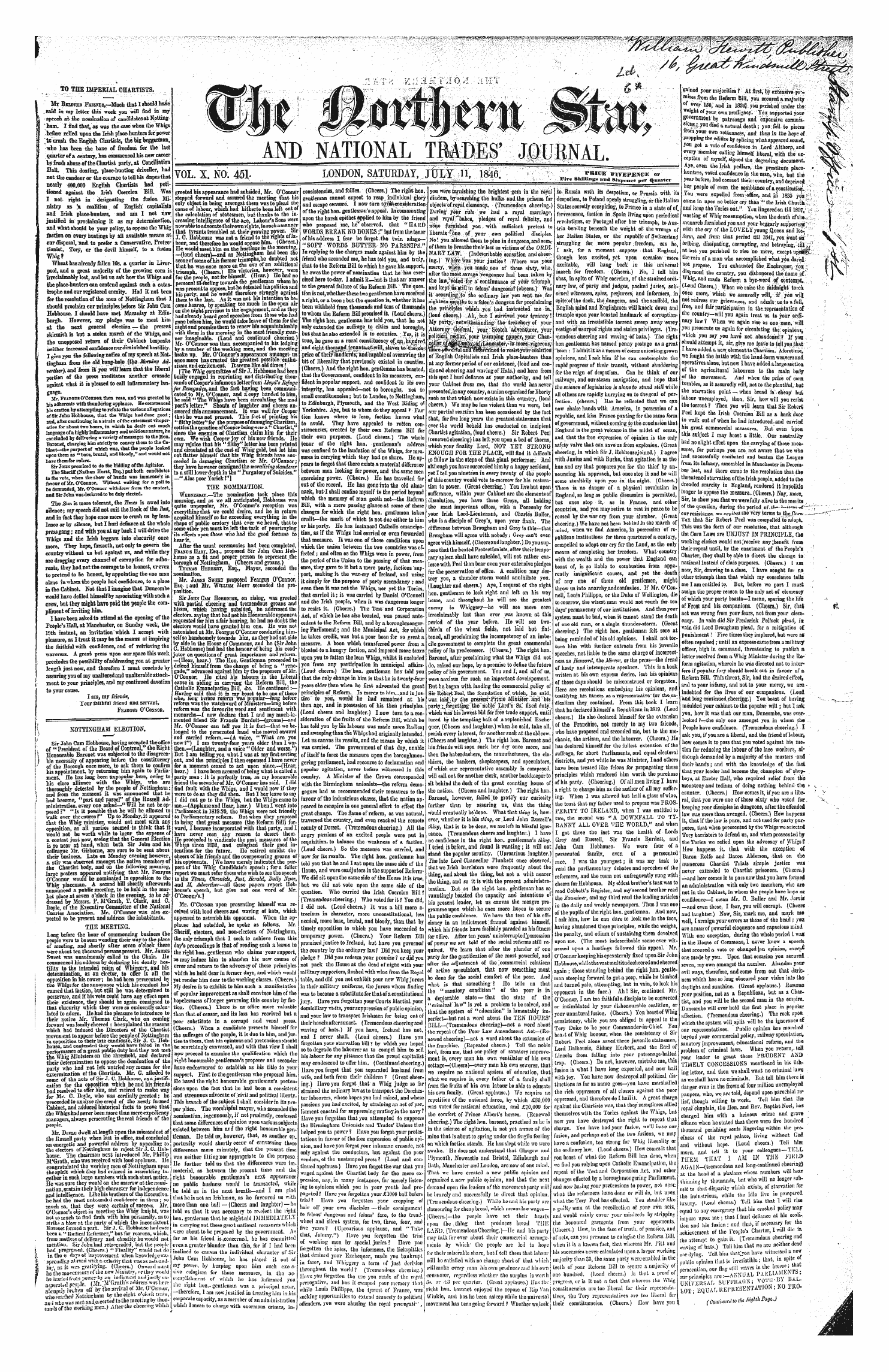
VOL . X . NO ; 45 L LONDON , SATURDAY , JIJIYH , 1846 . - 'Wv ^ - > lvc 9 hi ™^™^^ " - ' ¦ - - . ¦ -.... ¦ . ¦ ¦;;; : ¦ ..:. ; , , > v , five Shilling * and Sixpence pev Quarter
Untitled Article
¦ ¦ IA ' ' ' ^^^^ . ' . Si rv ¦ > - * »• - * - «¦ " - v' - ¦ - * - m x& AND NATIONAL TBiDiS' JMJINAL .
-
-
Citation
-
Northern Star (1837-1852), July 11, 1846, page unpag, in the Nineteenth-Century Serials Edition (2008; 2018) ncse.ac.uk/periodicals/ns/issues/vm2-ncseproduct1374/page/1/
-