On this page
-
Departments (4)
-
Text (14)
-
Untitled Article
-
Untitled Article
-
Untitled Article
-

Untitled Article
-
Untitled Article
-

WOtttv *?^K
-

uemew.
-

immw amwtmtittff.
-
Untitled Article
-
pannteB. ~~~.is..
-

Untitled Article
-

Untitled Article
-
Untitled Article
-

Untitled Article
Note: This text has been automatically extracted via Optical Character Recognition (OCR) software. The text has not been manually corrected and should not be relied on to be an accurate representation of the item.
-
-
Transcript
-
Note: This text has been automatically extracted via Optical Character Recognition (OCR) software. The text has not been manually corrected and should not be relied on to be an accurate representation of the item.
Additionally, when viewing full transcripts, extracted text may not be in the same order as the original document.
Untitled Article
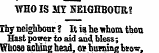
WHO IS MY NEIGHBOUR ? Thy neighbour ? Itiahenhomthou Hast power to aid and bless ; Whose aching head , oi burning brow . Thy soothing hand may press . Thy neighbour ? 'TiBthefainting ' poor Whose eye with want is dim , - "Whom hunger sends from door to door , — Go thon , and Bucconr him . Thy neighbour ? 'Tis that weary man Whose years are at their brim , Bent low with sickness , care , and pain-Go thon , and comfort him .
Thy neighbour . 'Tis that heart bereft Of every earthly gem : Widow and orphan , helpless . left-Go thpu , and shelter them . Thy neighbour ? : Yonder toilingslave , Fettered in thought and limb , "Whose hopes are all beyond the grate : — Gothou , and ransom him . "Whene ' er ttoumeet ' atahumanform , Less favoured than thine own , Bemember , 'tis thy neighbour worm , Thy brother , or thy son . Oh ! pass not heedless—pass not On 1 Etth&ps thou cans ' t redeem The breaking heart from misery ;—Go , share thy lot with him .
THE LABOURER . The labourer , the labourer , God ' s nobleman is he—His works are graven in the soil—They float on every sea : The keystone in the social arch ; Utility his crest ; His days are spent in manly toil , His nights in balmy rest .
Untitled Article
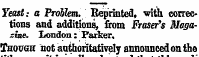
Yeast ; a Problem . Reprinted , - with corrections and additions , from Fraser ' s Magazine . London : Parker , Though not authoritatively announced on the title page , it is well understood that this work ' is from the pen of the author of Alton Locke , a writer who has lately done much to call attention to " the Condition of England Question , " and who undoubtedly possesses rare powers , both of description and mental analysis . Yeast may be termed a philosophical novel , for it has characters exhibited , both in action and in discourse . The purpose is similar to that of Alton Locke , bat the scene is
transferred-to other classes of society . In his former work , Mr . Kingsley dealt with the artisans ; in this , the story and incidents relate to the intellectual classes of society and the peasantry . The story is , however , subordinate to the main purpose of the author . This is , to exhibit the miseries of the poor ; the conventionalisms , hypocrisies , and feebleness of the rich ; the religious doubts which are shaking the strong , the religious delusions and cowardly submissions that are enslaving the weak ; the mammon-worship tainting the ¦ whole of society above the poor , and the brutish , abject spirit , but . angry discontent , pervading the mass , at least of the agricultural labourers .
Yeast , however , may be looked at as a series of sketches loosely strung together , descriptive of palpable social evils iu the mass , and of metaphysical broodings among the more thoughtful youth ; a struggle which perhaps is always taking place , and which is no further distinctive of the present age than the form that is given by our intellectual and religious activity . The origin of evil , its presence in the world , what- man was made for , what lie straggles for , what becomes of him—have been questions that excited the speculative of all ages , taking various channels , according to the circumstances of the time . Considered
from this point of viewj , as a life-like picture of the hearings of the mass , and the mental fermentation going on among individuals—of the yeast of society—the book displays great ability , and challenges careful attention . It is powerful , earnest , feeling , and eloquent ; the production of a man acquainted with society —who has looked closely upon its various classes , and has the power of reading the signs of the times . He has a truthful vigour of description—a rhetorical , rather than a dramatical power ; or he sacrifices the latter to his habit of expressing his . opinions in dialogue , -where the author talks rather than the dramatis persona * . There is a genial warmth of feeling in the beok , and wide human sympathies .
Although the framework or story of Yeast is not well conducted or concluded , it is judiciously contrived for the purpose of embodying some of the principal types of existing society . The first hero , Lancelot Smith , iB a young man of vigorous frame , strong passions , and a powerful mind . He has had his moral practice , if not his principles , corrupted at the university , althongh he has taken high honours ; his mind is unsettled by logical scepticism , and by the " Bhams " be sees everywhere . Argemone Lavington , the daughter of an oldfashioned squire , is the type of what the
author thinks a similar class in woman ; intelligent , highly educated , religious after the Tractarian fashion , but making self the object of all , though unconscions to herself . By a well-worn accident , Lancelot and Argemone are brought together under peculiar circumstances , and love is the result The attachment is put an end to by Mrs . Lavington after Lancelot is ruined by the failure of his uncle ' s bank ; Argemone dies , and her lover goes abroad , without having been able to settle his opinions . - Bound these two characters move many others , with more or less connexion .
There is Mr . Lavington , the type of the country squire ; the Vicar of the parish , a darklydrawn Puseyite , and eventually a convert to Rome ; Luke , a cousin of Lancelot , and representative of the more youthful and silly Tractarians , who places his conscience in the keeping of his priest . The uncle of Lancelot , the religious banker—though his religion does not prevent him from embarking in speculations that stop the bank—represents the " respectable" class of traders ; Lord Minchampstead , the rich manufacturing commoner
ennobled into apeer , may be considered the type of a class of which therearebut fewliving examples ; Lord Vieuxveis belongs to Young England . Colonel Bracebridge , the justest and most finished picture in the book , is a representative of the travelled , all-accomplished English gentleman and soldier , with loose principles , loose practice , but of generous sympathies , and with deeper feelings , and with more thought than the generality would give liim credit for . The catastrophe which overtakes him is the blot of this well-conceived and carefully-executed character , for it is improbable altogether .
Besides a number of rustics , and people more or less conspicuous , there , is one Tre garva , a Wesleyan gamekeeper of the squire , who may be considered the type of the thoughtful and faithful humble class , as his friend or patron Lancelot is of the intellectual ; and for Lancelot , Tregarva cuts through many puzzling sophisms , as he is the first means of opening his eyes to the state of the poor and the realities of life .
There are various scenes chiefly in relation to country society . One of these is when Lancelot accompanies Tregarva to a country fair , a sad and terrible picture of the "boldpeasMitry . '' After wandering about disappointed with the absence of sports , merriment , or humour however poor or coarse , Lancelot enters a booth , and , under the guidance of Tregarva , looks and listens to what is going on . "You'll see something , if you look round , sir , a P-eatdeal easier to explain—and I should have tnouzht , a great deal easier to cure- ^ -than want of wits . ' . ' . . ..... "And what is that ? " k- . ' i : •
. How different looking , the young ones are from their fathers , and still , tnore from their , grandfa thers ! Look at thosethree . prfourpld grammers talking together there . ' For ' all their being shrunk
Untitled Article
£ J ! L ? & oT * » > won > t 8 ee sn <* fine grown men anywhere m this booth " ™ iS ^? w ° * Lan cel ° t recollected now having remarked it before when at church ; and having wondered why almost all the youths were so much SffS&E ? ! ower * l ) raiDed » water-jawed "W > y ait , Tregarva I " Worse food , worse lodging , worse nursingand , I m sore afraid , worse blood . There was too much filthiness and drunkenness went on in the old war-times , not to leave a taint behind it , for many * generation . The prosperity of fools shalldestroy " Oh ! " thonght Lancelot , •' for some young sturdy , Lancashire or Lothian blood , to put new life into the old frozen South-Saxon veins ! Even a drop of the warm enthusiastic Celtic would be better than none . Perhaps this Irish immi gration may do some good after all . " ¦¦ .. ¦ ^ n ^^ 8 ^ ^
Perhaps it may , Lancelot . Let us hope so , since it is pretty nearly inevitable . Sadder and sadder , Lancelot tried to listen to the conversation of the men round him . To his astonishment , he hardly understood a word of it . It was half articulate , nasal , gutteral , made up almost entirely of vowels , like the speech of savages . He bad never befere been struck with the significant contrast between the sharp , clearly-defined articulation—the vivid and varied tones of the gentleman , or even of the London street boy , when compared with the coarse , half-formed growb , as of a company of seals , which he heard : around him . That single fact struck him perhaps far more deeply than any ; it connected itself with many of his physiological fancies ; it was the parent of many thoughts and plans of his after-life . Here and there he could distinguish a half sentence . An old shrunken man
opposite him was drawing figures in the spilt beer with his pipe-stem , and discoursing of the glorious times before tbe great war , " when there was more food than there were mouths , and more work than there were hands . " " Poor human nature !" thonght Lancelot , as he tried to follow one of those unintelligible discussions about the relative prices of the loaf and the bushel of flour , which ended , as usual , in more swearing and more quarrelling , and more beer to make it up : " poor human nature always looking back , as the German sage says , to some fancied golden age , never looking forward to the real one which is coming . " : ¦ - " But I say , vather , " drawled out some one , "they say there ' s a sight more money in England now than there was afore the war-time . " " Ee 8 , booy , " 8 aid the old man ; "but it ' s got into too few hands . "
"Well , " thought Lancelot , " there s a glimpse of practical sense , at least . " A transient accident induces the company to call upon their warbler , for some singing ; of which this is a sample : — Blackbird was by this time prevai ' ed on to 8 ing , and burst © ut as melodious as ever , while all heads were cocked on one side in delighted attention . I zeed a Tire o'Monday night , A vire both great and high ; But I wool not tell you where , my boys , Uor wool not tell you why . The varmer he come screeching out , To zave 'uns new brood-mare ; Zays I , ' You and your stock may roast , Vor aught us poor chaps care . " " Coorus , boys , coorua !" And thechorua bur 4 out ,
Then here s a curse on varmers all , As rob and grind the poor ; To re ' p the fruit of all their works In •*** for ever evermoor-r-r-r . A blind owld dame come to the vire , Zo near as she could get ; Zays , " Here ' s a luck I warn't asleep , To lose this blessed hett . They robs us of our turSng rights , Our bits of chips and sticks , Till poor folk 3 now cant't warm their hands , Except by varmer ' s ricks . " Then , &c . And again the boy ' s delicate voice rang oat the ferocious chorus , with something , Lancelot fancied , of fiendish exultation ; and every worn face lighted up with a coarse laugh ,. that indicated no malicebut also no mercy . Here is a capital delineation of an English day , in this present March month : —
A silent , dim , distanceless , steaming , rotten day in March . The last brown oak leal , which had stood out the winter ' s frost , 6 pun and quivered plump down , and then lay ; as if ashamed to , have broken for a moment the ghastly stillness , like an awkward guest at a great dumb dinner party . A cold suck of wind just proved its existence , by tooth-aches on the north side of all faces . The spiders , having been weather-bewitched the night before , had unanimously agreed to cover every brake and brier with gossamer cradles , and never a
fly to be caught in them ; like Manchester cotton spinners , madly glutting the markets in the teeth of " no demand . " . The steam crawled , out of the dank turf , and reeked off the flanks and nostrils of the shivering horsesj and clung with clammy paws to frosted hats , and dripping boughs . A soulless , sky less , catarrhal day , as it that bustling dowager , old _ mother Earth—what with match making in spring , oxlA files diampitres in summer , and dinner giving in autumn—was fairly worn but , and put to bed with the influenza , under wet blankets and the cold-water cure . "
On the great question wbich , at the present day , occupies the attention of all classes , Mr . Kingsley writes forcibly and boldly . Here is a powerful remonstrance with a poor Puseyite hankerer after infallibility : — Not that . Any thing but that . Whatever is right , that ia wrong . Better to be inconsistent in truth , than consistent in a mistake . And your Romish idea of man is a mistake—utterly wrong : and absurd—except in the one requirement of righteousness and godliness , which' Protestants and heathen philosophers have required and do require just as much as you . My dear Luke , your ideal men and women won't do—for they are not men and women at all , but what you call " saints . " . . . . . " ;
Your Calendar , your historic list of the Earth ' s worthies , won't do—not they , but others , are the people who have brought Humanity thus far . I don't deny that there are great souls among them ; Beckets , and Hugh Grostetes , and Elizabeths of Hungary . But you are the last people to praise them , for you don ' t understand them . Thierry honours Thomas a Becket more than all Canonisations and worshippers do , because he does see where the man's true greatness lay , and you don ' t . Why you may hunt all Surius lor such a biography of a medieval worthy , as Carlyle has given of your Abbot Samson . 1 have read , or tried to read , your Surius , and Alban Butler , and so forth—and they seemed to me bats and asses—one
really pitied the poor ' saints and martyrs for having such bliud biographers—such dunghill cocks , who overlooked the pearLof teal human love and nobleness in them , in their greediness to snatch up and parade the rotten chaff of superstition , and selftorture , and spiritual dyspepsia , which had overlaid it . My dear fellow , that Calendar ruins your cause —you are tacres arutocrates— kings and queens , bishops and virgins by the hundred at one end ; a beggar or two at the other ; and but one real human lay St . Homobonus to fill up the great gulf between—a pretty list to allure the English middle classes , or the Lancashire working men!—almost
as charmingly suited to England as the present free , industrious , enlightened , and moral state of that Eternal City , which has been blest with the visible presence and peculiar rule , temporal as well as spiritual , too , of your Dalia Lama . His pills , do not seem to have had much practical effect there . . . . My good Luke , till he can show us a little better specimen of the kingdom of Heaven organised and realised on earth , in the country which does belong to him , soil and people , body and soul , we must decline his -assistance in realising that kingdom in countries which don't belong to him . If the state of Rome don't show bis idea of
man and society to be a rotten lie , what proof would you have ? . . . . perhaps the charming results of a century of Jesuitocracy , as they were represented on the French stage in the year 1793 ? I can ' t answer his arguments , you see , or yours either ; I am an Englishman and not a . controversialist . The only answer I give is John Ball ' s old dumb instructive " Everlasting So ! " which he will stand by , if need be , with sharp shot and cold steel— " Not that ; anything but that . Xo kingdom of Heaven at all for us , if the kingdom of Heaven is like that . So heroes at all for us , if their heroism is to consist in their being not-men . Better no society at all , but only a competitive wild beasts ' -den , than a sham society . Better no faith , no hope , no love , no God , than sham ?
tnereoi . 1 tike my stand on fact and nature ; you may call them idols and phantoms ; I say they needle so no longer to any man , since Bacon has taught us to discover the Eternal Laws under the outward phenomena . Here on blank materialism will I stand , and testify against all Religions and Gods whatsoever , if they must needs be like that Roman religion , that Roman God . I don ' t believe they need—not I . But if they need , they must go . We cannot have a " Deus quidam , deceptor " If there be a God , these trees and stones , these beasts and birds must be His will , whatever else is not . My body , and brain , and faculties , and appetites must be His will , whatever else is not . Whatsoever I can do with them in accordance with the constitution of them and nature , must be His will , whatever else is not . Those laws of nature must reveal
them ; and be revealed by Him , whatever else is not . Man ' s scientific conquest of nature must be one phase of His Kingdom on Earth , whatever else is riot . - I dOn-fr deny-that there are spiritual laws which mm is meant to obey—How can I , who feel in my own daily and inexplicable nnbappiaess , the
Untitled Article
ruits of having broken them ? -But I do say , that those . spiritual laws must be . in perfeot harmony with every fresh physical law . which we discover : that they cannot be intended to compete . Belf-destractively with each other ; that the spiritual oannot be : intended to be perfected by ignoring or crushing the physical , unless God is a deceiver , arid his universe a self-contradiction . And by this test alone will I try all theories , and dogmas , and spiritualities whatsoever—Are they in accordance with the laws of nature ? And therefore when your ^ arty compare sneeringly Romish Sanctity , and "English-Civilization , I say , " Take , you the banctity , and give me the Civilization !" ' The one maybea dream , for it is Unnatural ; the other cannot be , for it is natural ; and not an evil in ifc at which you sneer but is discovered : day by day . to a
owwgto some infringement of the laws of nature . When toe " draw bills on nature , " as Carlyle says , " she honours them , "—our Bhips do sail ; our mills do work ; our doctors do cure ; our soldiers do fight . And she does not honour yours ; - for your Jesuits have , by their own confession , to lie , to swindle ,- to get even man to accept theirs for them . - So give me the political economist , the sanitary reformer , the . engineer ; and take your saints and virgins , relics and miracles . The spinning jenny and the railroad , Cunard ' s liners and the electric-telegraph , are- to me , if not to you , signs that we are , on aome : points at loast , in harmony with the universe ; that there is a mighty spirit working among us , who cannot be youranarchic and destroying Devil , and therefore may be the Orderingand Creating God . " '
Yeast is a work written by a thinker , and it will , we trust , set many thinking about the deep and grave questions mooted in its pages .
Untitled Article
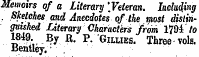
Memoirs of a Literary [ Veteran . Including . Sketckes and Anecdotes of the most distinguished Literary Characters from 1794 to I ' ,, ^ y R . P . Gillies . Three vols . Bentley . ' These memoirs open with glimpses and sketches of Scottish country and landlord life at the close of the last century , among which amusing prominence is given to that of au old starched Tory laird who had accepted the absurd challenge ' that he could utterly smash and destroy withinouehourand withno
, weapon of any kind to help him , all the crockery ware that could possibly . be brought before him withm that space of time ; and who , conceiving himself bound in honour to keep his word , did do it accordingly , by dint of strong arms , and legs fortified with huge fisherman's boots . This kind of anecdote is followed by notices of Edinburg h life . Mr , Gillies , during attendance on lectures at the university in 1806 and for some following years , having seen somethiHg of the society in which the Scottish . jmihi
was rich at that time , and witnessed the first sprightly runnings" of Scott ' s great and fruitful genius . Here the autobiographer is often livel y and interesting in his retrospect . Mr . Gillies began life under favourable auspices . He belonged to a family of some distinction in Scotland , and inherited a patrimony , which though small was apparently sufficient for his wants arid tastes . All the outset of his life is accordingl y fair and untroubled . Ho indulges in literary pursuits ' without any sharper stimulus than his predilection for them ; becomes an advocate without the necessity of toiling for fees ; is
bibliographical , and can afford to give large sums for rare black-letters or editions of Shakespeare ; writes poemB , and corresponds with poets ; studies and delights in German literature ; takes part in the outset of Blackwood , and writes for that and other journals ; translates some foreign dramas with success , and begins the ' series of translated scenes from German , Danish , and other plays , by which his name became afterwards best known . Meanwhile his small estate had become involved , and soon after passed from him . He left Edinburgh iu 1821 for a tour in Germany . ( where , among other notable circumstances , he made the
acquaintance of Goethe , who reminded him in appearance of John Kemble , ) and continued to live in the Scotch Athens but for a few years after his return " . The most memorable part of his memoirs of this date is the description of Scott ' s warm and zealous friendship to him in the midst of his own troubles and distresses . But Mr . Gillies seems to have had little capacity of self-help when distress once fairly overtook him , nor had his practice of literature at any time qualified him to make it very profitable . He came to London in 182 fr ,. and -with hearty hel p from Scott , established the Forei gn Quarterly of which he soon ceased to be editor , however , and never afterwards appears to have recovered any steady source of support .
We have run over the outline of . Mr . Gillies ' s career ; but autobiography , save towards the latter part of the work , is little more than a link to connect . together anecdotes and sketches of marked individuals with whom the author came in contact . These relate to some of the most distinguished men of the age , in literature arid Scotch law , and to characters even yet more remarkable in themselves from peculiarities which the state of society in
Scotland in the last century rankly developed . TheBe things are told well , though verbosely ; and the reminiscences of that period have a more kindly feeling and a freer air thaa belong to those of a latter day , when misfortunes may have soured the mind . The anecdotes and characters of literary men will be found interesting ; the sketches of the Scottish gentlemen of those days will give an excellent idea of life in the North during the latter half of the eighteenth century .
Some of these indicise consist of what are called " good stories ; " and perhaps the best relate to the Laird of Bonnymune , an unconscious humourist , who was once so celebrated that George IV . used to command the attendance of a certain Mr . Harris who was skilled in imitating him . Two peculiarities characterised the Laird—he would never use a carriage , ar id never sleep from home ; which traits produced the Laird ' s nightrride .
The good old magnifico ' s taste in drinking became at length obtuse ; so that one evening after dinner , at a friend ' s house , he very willingly drank cherrybounce , mistaking it for port , and declaring that it was a " pleasant , pure , fruity , and generous wine , and very old in bottle . " As a matter of course , when the midnight hour approached , the laird wished to ride home , and the horses were ordered . But Peter had never in his life seen his venerable master " so far gone ; " besides , they had a long way to ride , and the night was both dark and gusty , , . ¦¦
After some consultation with the kind host and his family , it was agreed that Bonny mime could not and must not attempt to ride home . But as any proposition for his going to bed or staying in the house after twelve o ' clock would be resisted and resented with obduracy , stratasem was used . They led him out of doors with a light , which the wind instantly extinguished . Then , in the pitchy darkness , they assisted him to mount , not upon horseback , but upon a" fail dyke , " Anglice turfwall , a common kind of fence in the far North , nere Peter had cleverly attached the bridle to the stampofaneider-buBh ; he put the reins and the whip into his master ' s hand ? , and then retired , with the words , " } Joo , your honour , the road's straight afore ye !"
Aw : iy went the laird , as he supposed , whipping and spurring to bis heart ' s content ; fill he arrived at the land of dreams and utter oblivion , when , wearied of his exertions , he tumbled off . Sow Peter ventured to advauce . "Eh , sirsJbechme , to think o' the like o that . ' * Then , raising his voice , " We ' re at hame noo , sir ! we're at hame , I ' m tellin * ye ! Your honour ' s just fa ' en off at our ain stable door . " But stratagem was no longer needed . The laird
persisted mo » -t comfortably in his profound sleep , and was carried to bed without -a murmur . Next morning , however , no sooner did he awake to consciousness , than he vowed vengeance for the trick that had been played on him ; declaring , moreover , that hud he been allowed bis own way , he could have ridden home as well as ever he did in his life . He departed at daybreak , in huge wrath , and would not , by any persuasions , be induced to visit at the same house again .
Lord Buchan , the elder brother of Erskine , had throughout life those eccentricities which age only fully developed in the ex-Chancellor : he-figures conspicuously in the pages of these volumes . ; Here is ^ an account of Cupid and the tea-kettle : — ' - . •• : ¦ : ¦ ¦ ¦¦ ' ¦ Another of his Lordship ' s breakfast parties dre * on him the ridicule of all the town . It was even
Untitled Article
and vindictive « u 5 Se 5 & * !? 8 "f " \ vet ( W scond ; 'Urd buSI ' m -K J wa 8 f ? rced t 0 au " rank . * hirMSr * eleoted , *» " ° young ladies of he him 3 rSteSon ^ e the : . 5 ineMu «? s , whilst " SSK ¦ ,- ™ > " Glorious Apollo . " WttT h ^ , . ^ eatudroundthepresident ' sbelaurelledhead . " j-ii ^ SBs&as fflsSSr ^ B ^ iasrsS ! MMAJNug or screechm ? . ran nut : nf fha » nJ n ' i
* ni 8 'tnninv hiiin / i « i . ° * ii— . »«««•• « r detracted nn ^ - « J ¦ r / P ° H ° cared not a-rush . It Q ^ esSS ^ lf ^ f rom ^ his own dignity , in his fofSs ^^ ^ PreEeUtPrim 9 Mia ^ JKiLiS ,, timb ( not in 1808 , but two years SSS ^ Ws ?* ss ^ s John Ru ^" me Mmiste I doubt not that Lord
SXff ^ i "' reraemDer those meetings , like Sv En ° S l" » Psesoutof dream-land ; and , pos-S « t * , . ? Cr T ° ? hedthatheC ( Juldrecallthe ooletad ^ ft 8 f C ! \ P - ^ ° the tumoil 8 of office 'o the books at 1 i - u W room ' wel 1 8 tored with theSkrpn ? * « k Pro / eas 6 r Playfair ' s ; or from of thVSrf » ¦ ' . W > t 0 fcbe twlli * glimmer tL BPvi - tmghalU - foresaid - IweblTecfc some of 2 rMto appointed to act the part of Advocafa , f 0 r ( Jueen ^ Mary ; how Lord John did cut SiaT ir \ by affec ^ pit ? and ' ly spasms , demolish all chance of acquittal for that unhappy princesg-at leastwithin the walls of "the Speou-
Untitled Article
[ The following is inserted by express desire of the parties concerned . ]
AN ADDRESS Written and spoken oirMonday , the 10 th of March 1851 , for the benefit of Mr . P . Martin , one of the political victims of 1848 , at the John-street Institution , John-street , Fitzroy-square . By . John ShAw , Brethren , Chartists , Friends ! who kindly sym-¦ pathise . ¦ - ¦ In woe , endured by simple or ihe wise ; Yom \ gen ' rous hearts or hands are ne ' er withheld From 8 uftering nature . No ! when ye have beheld The tyrant ' s victims in adversity , And human pangs plead god-like liberty ! You ' ve ' plied their wants , and thus decreased their pains ; '
The patriot ' s soul you ' ve cheered . Aye tho' his chains Should fret , and gall , and sear his noble heart , He smiles full conscious that he acts a part Shall freedom win . Delight imbues his soul , Still panting for the prize—tho wished-for goal Of power for all ! Yes , heaven itself designed Fraternal love , peace , plenty , to mankind . Alas ! of Nature ' s bounties so deprived By base oppression , that we ' re now arrived Where famine gaunt stalks dail y through the land . Grim death strikes down our brothers with the brand Of despot knaves . Shall we still brook the frown Of haughty titles—priest , or prince , or crown ? Forbid it , ShadeB of Cromwell , Hamp ' den , Pym ! houatriot ancestor of
T _ p * pure him "Who disregards , a suffering nation ' s cry , And ihooks in weakness cowardly sophistry ; Progress repelling by finality , ' , Upholds the Throne , the Church , and all State ills By bludgeons , budgets , torn-fool Papal bills . Taxes on labour , knowledge , air and light-On all things else , by minions armed to fight . Spirits arise ! Oh , ye immortal men ! Come Sidney , Marvel , Milton , and Tom Paine ; Thou martyred Emraett , Tone , Fitzgerald brave ; Or cCart « right , Hunt , and Cobbefct quit the grave Diffuse your wisdom , and despair dispel , And lead humanity from earthly hell , Till throueh ourFranks resounds the word "Unite !' The world shall witness majes ty and might Our common foe to vanquish . ¦¦
¦ n ,, i . , _ ' Y -. While we servo Poor Martin hero to-night , prove we deserve " The . Rights of Man . " Ah , then shall stand aghast Both Whig and Tory Lordlings , when at last A People ' s voice proclaims , " Wo will be free : " Our motto ' s not Divorce , T'tis Unity ! Poor feeble Martin ! Friends , his former zeal Still glows within ; # for him 'tis I appeal . True democrats his sterling worth must know— ¦ His tortures too from the ferocious foe ; Vile whig bastiles have wrought iu him no chango ,
Sor would he now with oligarchs exchange His poverty and rags . His noble mind Now laughs to scorn the wretches who confined In dungeons cold , whence his afflicted limbs Disease engendered , singing Chartist hymns . Thanks , fair ones , thanks ! and men who help each other ; : ' You ' ve happy made to-night a suff ' ring brother . , Grateful for boons , your aid ho'll ne ' er forget While red blood warms his heart . —But I must yet , ( If true you think him to our righteous cause ) Crave one good luety round of loud applause . * Lord William Kussell beheaded for high treason .
Untitled Article
ADELPHI THEATRE . . The author of a new melodrama , produced on Monday night under . the title of The Disowned , has missed one grand quality— -clearness of construction , and for the absence of this quality nothing else can compensate . We perceive that a certain gentleman , whose love has been slighted in his youth , has rflurdered his rival , and adopted the daughter of that rival as his own child . We perceive that another gentleman , who has , likewise . ; n youth carried off his steward's betrothed , has brought up his illegitimate son without explaining the intimate connexion which exists betweenthem . We perceive that the steward desires to make of this : lad an instrument of vengeance , but that his plans are defeated , and that'the
youth dying at the end of the tale , through the exp losion of a brace of pistols while a house is burning , is acknowledgecTby his parent . All this we perceive , but we are nnable clearly to trace the course of action through the four hours which it occupies , and hence many scenes fall perfectly flat , and there is a disjointed appearance in the whole work . The entire Adelphi company is employed to give it effect , and there are ' -the accessories of elaborate set scenes and popular rustic groups , but the piece altogether wants point and purpose , and hence nothing comes out with full force . Some of the situations told with the audience , and there was considerable applause at the end , mingled with demands for the author . But there were also many hisses , and the piece cannot be said to have made a real "Adelphi hit . "
. LYCEUM THEATRE . Mr . Jerrold , jup ., son of the celebrated author , has written a smart little farce , entitled Cool as a Cucumber , which was produced on Monday night . The cool gentleman , admirably represented by Mr . Charles Mathews . has picked up a cigar-case belonging to an Old gentleman ' s son , and on the strength of this introduction enters the old . gentleman ' s house , and makes himself perfectly at home . The son , who has been banished from his father ' s house to prevent a ihesaUiance , is treated by tbe intruder as aburglar when he comes home a « ain , but at last the impertinent wight atones for his misdeeds by attempting a reconciliation between father and son . nothing can be slighter than the structure ol t » 's » we , but Mr . Charles Mathews is-well fitted , and the dialogue is exceedingly neat . The success is unequivocal ,
HAYMARKET THEATRE . A very novel experiment was on Monday made at this house-the production of an English , version of Molieres Tartuffe , not lowered into the condition ot the Hypocrite , but closely following the original , blank yersb being substituted for the French Alexandrine . So literal is the rendering that , with the - exception of a short speech made to heighten the " exit" of Damis in the third act , we do not believe there is a single line not to bo found in Mohere . The manager , in putting the the
piece on stage , has gone to work in the right way—transferring to the Haymarket boarda the usages of tho Theatre Francis . The drop scene did not descend between the acts , but a few bars of music alone ' indicated tho division ; the one room in which the whole action takes placeisltted up with characteristic elegance , an imitation of an oak floor-being -one of-tho loading features , and the . costumes were of : theimost recherche kind . We have .: had * ' flights wi' Burns . ' This wasreally an evening with Moliero . The actors were placed in an entirely new position ; they had to accommo-
Untitled Article
date themselves to a convention not their own nnd the way in which they moved in their newhtmn Bphcre did .. them great cwdlt . Mr . wSt r a 8 " Tartuffe , was the measured hypocrite , carefullv weighing every syllable , and conveying the inward uncloannesg . by an artful glance . Miss Reynolds as Elraire , the great part' with the " grandos coquettes" of the French stage ; wa 3 ladylike and quietly fascinating . Mrs . Fitzwilliam , as Donne , was overflowing with arohness , and every point that she uttered told thoroughly , whether- it was delivered with sarcasm or good humour . Less characteristic are tho half docilo Manane , played' by . Miss Laura Addision ; tnegaUantValore , represented by Mr . Howe ; tho fiery Damis , enacted by Mr . Davenport ; tho vacillatingOrgon , sustained by Mr . Limhm-V . Mm « nn ,
s bio Cleante exceedingly well read by Mr Rogers ; il ! , vi ' » JA L 0 ya 1 ' per * ° rm ? d by Mp - Charle tS ? l w l t ? P ° ? damo Pernello , set forth by Mrs . Stanley , but al those parts we reef feotively given , and there was ; the pleasing sensaturn that the piece was aa well supported as the . present condition of tho stage will allow Persons Srar !? K FreDCh ^ oatre pnl ^ where ofth ; , hlVe ^ n trained 'n the conventions a want ol IZTf l \™ 7 ' perha P - complain of wn ?? ikefev ^ 5 ^ former 8 ; but t 0 th 09 e Fn » K » f standard , anil regard a body of fnfim ? f'K- ^ "Pnerl totally difer viously eKaSad * a * 'hioh n * hV have be » P" - s 2 Kli » « « S uf' / 8 a ml ' new attemPt . the Ecr wl ^ " J ™ * « e been highly graablv It mthf V audllnC 0 tbe P ibce wenUdmiwhpLwfc ™ , ' ] aTe been deemed questionable ta which the unfJl « 5 f ? rated at " dran » and n Jhini , Uy Of P lace 18 « o r igidly ' observed farfcic . l i « «™ f n y a PP »™ ation to , the broadly tarcical is carefully avo ded . But everv situition was thoroughly relished . ThaiftM f ^ lZ
= » = ^ a SLJ ? ol 8 morous applause , as . well as the scenes that show the . exposure of the hypocrite , and from ™ i egmnin f t 0 th ? ' t ^ wiiSrf weariness . A general call was raised for tho performers at the end , and Mr . Webster announced r «« ' # / or repetition amid loud applause .. Mr . J William Wallaok appeared on Wednesday evening in the qharaotei ? ot HanUt ;> His performance ovinced considerable talent , and in some of tne great scenes he made a strong impression ; bu he has one fault , so great that it absolutely neutralises all his merits . He is the slowest actor we have ever seen upon the stage . There is no play in which the dialogue is so varied as in Hamlet ; in many parts it is as light and collbquail as the language of comedy . But Mr . Wallacks move at one uniform pace ; asking a question or making a passing
re-2 U ? i . ' w u SA T solemn ' weasured tone , with which he utters the gravest and deepest thoughts , lie utterly forgets the advice to the players , whieh , m this character , comes from his own lips ; ho cannot speak a speech " trippingly on the tongue ;" he must mouth it , be its import what it may . This grievous fault gives extreme heaviness to hisperiormance . ¦ ¦ A farce , entitled Ihke thebestofit , founded on a French vaudeville oalledZsiWr Casse , was pro-( Iuced on Wednesday night . Mr . Beniamin Burr ( Mr . Buckstone ) , a gentleman of " tho" fast " sohool ,. and Mrs . DriveT ( Miss P . Horton ) , a lady whom he has followed into North Wales , findin '» themselves alone at a small inn , and being unable to progress , in consequence of the nearest bridge being broken , choose as a pastime a game of cards , with the condition that the loser shall be the slave
of the winner for two hours . Burr loses , and is consequently reduced to a state of serfdom . At this crisis Mr . Driver ( Mr . Howe ) , the lady's husband , arrives at the inn with a theatrical lady ( Mrs . Fitzmlliam ) , on whom he passes himself off as a single man . _ Mrs . Driver , concealing herself , 'and availing herself of herpower over Burr , compels him first to challenge her husband , then , when to her astonishment Driver accepts the challenge , to apologise , and finally to make love to the danseuso , Poor Burr has no taste for the artistical lady , but is compelled to marry her at last , and resolves to " make tho best of it . " The weight of this little piece resis principally upon Mr . Buckstone , whoso coolness under all difficulties was admirably sustained . The odd situations and the points in the dialogue created amusement throughout .
¦' ¦ ¦ ¦ QUEENS THEATRE . Another version of Asael the Prodigal was produced oa Monday night . The plot is similar to that produced at Drury Lane , with the exception that instead of being an Israelite , Azael is one of a tribe of Arabs , and that the piece terminates in the death of the false friend by the hand of the profligate . The spectacle is well got up , the scenery is gorgeous , the dresses in good taste , and the dialogue is nearly , if not altogether , original . Azael is represented by Mr . C . Gveen , Znido his betrothed by Mrs . C . Boyce , Lia , Miss C . Gibson , ana Nephte by Miss F . Hamilton . These artistes contributed much to the success of this melodramitic spectacle , and at its conclusion Mr . Green was called for by tho audience , when he announced its repetition until further notice . Life ' s Helm , which wo noticed in ouv last , concluded the evening's entertainment . ''
Wotttv *?^K
WOtttv *?^ K
Uemew.
uemew .
Immw Amwtmtittff.
immw amwtmtittff .
Untitled Article
A Slight Mistakb . —When Sir Isaac Newton changed his residence , and went to live in Leicester-place , his next door neighbour was a widow lady , who was much puzzled by the little she observed of the habits of the philosopher . One of the Fellows of the Royal Society called upon her one day , when among other domestic news , she mentioned that some one had como to reside in the adoining house , who , she felt certain , was a poor mad gentleman , " because , " she continued , " he diverts himself in the oddest way imaginable . Every morning , when tho sun shines so brightly that we iiro obliged to draw the window-blinds , he takes his scat on a little stool before a tub of soapsuds , and occupies himself for hours blowing soapbubbles through n common clay-pipo , which he intently watches floating about until they burst . " He is doubtless , " she added " now at . his
favourite amusement , for it is a fine day ; do come and look at him . " The gentleman smiled , and they went up stairs , when , after looking through the staircase window into the adjoining court yard , he turned and said , " My dear madam , the pci ^ on whom you supposo to be a poor lunutic is no other than the great Sir IsaacXewton , Btudying therefraction of light upon thin plates , a phenomenon which is beautifully exhibited upon the surface of a common soap-bubble . " ¦ A " Convert" from Mormonism . is travelling over the kingdom exposing the absurdities of his late creed . At Chester last week , he said tha t after he had become somewhat sceptical , he re solved to put their , abilities as to " ousting out
devils" to the test . Going one day into the assembly with a downcast , vacant look , and showing signs of eccentricity in his behaviour , the "brethren" at once declared that he was -possessed with the devil . " On their saying this , he pretended to attempt to escape , but they followed and overtook him , and then muttered some prayers over him , in the midst of whioh he was so tickled with the mode in which he had deceived them , that he burst into an iavoluntavy fit of laughter . The brethren at once declared that the "devil" had been expelled , and " congratulated him on hia happy escape /'
The CnEiP Gas Question ' . —Meetings have been held to promote an amalgamation between the " City of London Gas-light" and the "Great Central Gas Consumers" Companies . The junction , it is said , will save the expenditure of £ 70 , 000 . The capital of the amalgamated companies is proposed to be £ 250 , 000 , in Bharesof £ 10 each , tho conditions of the Act of Parliament of the Great Centra ] Gas Company to be applied to the amalgamated companies . Committees have been appointed to agree to further detail . Meanwhile ; the citizens may congratulate themselves on the certainty , in any case , of procuring cheap gas . '
Tub Contribution tuat will win the Prizr —It is . rumoured that government intends sending to the Crystal Palace copies of all . the measurestliat have been passed this year , as its contribution to the World ' s Exhibition of Industry Pi > ;/( i ¦ "
Pannteb. ~~~.Is..
pannteB . ~~~ . is ..
Untitled Article
• Ti , ' ? 0 HARI ) T wheels m » ke their carriage-road in the fairest face . Jivlh B ? ST pbysicians are Dn Diet » Dn Quiet » a ** h « . te ° . « 8--Anecdotes are often spoiled by S £ feU t 0 ries ' a 8 wella 8 ^' ' ° ften <*< - Souare K ? V ° , of the barren wast e '" Leicester SKuKS ^ ° ° the J ^ st specula-The exports of silk manufactures , twist and yarns are increasing at the rate of eighteen per . Cos .-Why are the authors * ho treat on physiognomy like soldiers ? Ikeause tUy wriu abolt face . . . " Thb nuiiAL police numbers about 3 , 000 , and costs £ 20 , 000 per annum ; or nearly £ 70 per man to the counties that have it .
By doino gooij with his money , a man , as it were , stamps the image of God upon it , and makes it pass current for the merchandise of heaven . — Rutlrdoe . Passions and Affections . —It is just on entering into life that wo anchor by the passions and aflections , and if the ground does not hold us , we drift away hopelessly . A hekpbcted husband says that , instead of himself and wife being one , they are ten ; for she is 1 and he is 0 , Tub Sloakes .- " It is far worse to be cast in wax than into prison ! " as the Sloanes will say when bwoTHorro 1136 " ™ " * Madame Tussaud ' s " Cham-FABLTs .-Thes most ignorant have knowledge
n ; to I"sn . MAN at . temperance meeting the other night referring to his standing in society , said that tie nau been a working man ever since he was born . Wild and TAmk Animals .- " Which is the moat dangerous of all animals ? " said . some one to Uiogenes . — " Among wild animals the slanderer , and among the tame , the flatterer , " replied he . Proposing . —Some maiden ladies object to the first part of the proverb "Man proposes and God disposes , lor , they Bay , the men don ' t propoise . , 4 ( jiiiilt . —As the shadow follows the body in tho splendour of the fairest sunlight , so will the wrong done to another pursue the soul in the hours of prosperity . Friends . —Those who have resource * with in themselves , who can dare to live alone , wantfiiendsat least , but at the same time best know how to prize them the most .
Heads and Tails . —The cat-heads and cat-tails aro two very different parts of a ship . The cattails disorder the equanimity of the jolly tars very much , and they fly to pig-tail for consolation . Hardsomb and Good Womhw . —It was a pertinent and forcible saying of the Emperor Napoleon , that a " handsome women pleases the eye , but a good woman pleases the heart . The one is a jewel and the other a treasure . " Umcultivatbd Land , —From a recent report it appears that fifteen million acres of ground remain uncultivated in England , and this rather from the want of skill and industry than insuperable natural obstructions .
Foor l < ugitivb Slave Bill ! " said Mrs . Partington , as her eyes ran over the morning papers ' , and her quivering lip botrayed the agitation of her mind ; " poor fugitive slave , Bill ! I hopo from my soul they ^ won ' t catch him—I hope they won't . " Wexford has been rid of beng ' ars by a very simple process . The magistrates imprisoned the vagrants for _ twenty-four hours , and had them well washed . This discipline was found to act wonderfully well , for not ono submitted to it twice . —Iriih Paper . Fashion—a power 88 invisible and as despotic as the grand Llama of Thibet . Her mandates , of which the origin is utterly unknown , are nevertheless
understood and communicated by some inscrutable instinct , and obeyed with still more inexplicable and uninquiring submission . ¦ HOW TO FIND PLENTY OF ROOM IN A CUOWDBB Omnibus . —Conductor : Would any gentleman mind going outside to oblige a lady ? Unfortunate gentleman ( tightly wedged in at the back ) : I should be very happy , but I only came yesterday out of the Fever Hospital . [ Omnibus clears in a minute . ] The Washington Monument , now in process of erection at New York , is to be fiOO feet high ; 55 feet square at the base , and 33 feet square at the top . It is now 76 feet high , and hae cost 12 , 000 dollars , having taken two years to bring it to its present
elevation . Enjoyment . —There is a limit to enjoyment , though the sources of wealth be boundless ; and the choicest pleasures of life lie within the ring of moderation . A . Pari . umekta . ry Division . —Sibthorpe says , " The present House of Commons may bz divided into two classes , cotton apinnevs and yarn Bpinners ; and he doesn ' t know which is worse . " Metropolitan Sewers . —The gross amount
required for the Metropolitan Sewei'B , exclusive of compensation , will be £ 1 , 080 , 000 , which will be raised and paid off by an additional rate of 3 d . in the pound for thirty years . Whbn is a Person Rich Enough . —When 1 was young , an old gentleman asked me , "When is a person rich enough ? " I replied , " When he has a thousand pounds ? " "No /'— "When he has ten thousand ? " " No . "— " A hundred thousand ?" "No . " - "What then ? " " When he has a little more . "
Thought . —A vast chain of associations is often spread out before the mind by a few simple words , and those associations are , nine times out of ten , totally different from any other that the speaker intended to awaken . Numbkr One . —A gentleman who haB occasion to walk with two ladies , with ono umbrella , should always go in the middle—that secures a dry coat to himself , and showing no partiality to either of the ladies . Thb editor of the Bangor Mercury says that he knows two individuals , who are cousins , having the same name , whose fathers were brothers , whose mothers were sisters , and whose wives are sisters . He challenges the whole world for a similar coincidence .
A Union Workhouse . —Acrowd of sots , cronies , and drabB , blighted maidens , and blooralesa children , dwell there in " wards" and " dormitories , " existing by " dietary , " fed without a host , wearied without work , herding without love , and dying without a mourner . —rimes . Population of the World . —Professor Newman says it is a mathematical certainty that , if the existing population of the world were to increase for about eleven or twelve centuries , at the same rate as the British popula'ion has for some time past , no room would be left on the solid earth for men , women , and children to stand upon , allowing only a square foot fov each .
A Gbntlr Hint . —A sportsman , who , during the shooting season , had gone to pass a week with a friend in the country , on the strength of a general invitation , soon found by a gentlehint , that he would have done better to have waited for a special one . " I saw some beautiful scenery , " was the visitor ' s first remark , " as I came to-day by the upper road . "" You will see still finer , " was the reply , " as you go back to-morrow by the lower one , " California . —The population of St . Francisco 13 about 35 . 000 . In that city Beven newspapers are published ; there are ten first-class hotels , and eight express companies . One hundred and seven miles of streets are laid out , about a quarter of which are built upon , and seven miles are substantially planned in roada and side walks . Forty-seven steamers are eraployed on the California rivers , and eleven steam ships are employed on the Pacific side , between San Francisco and Panama .
A Miller , who lately quitted his mill to keep a public house , sent lo a painter to paint him a sign , on which he would have a mill . " I must have the miller looking out of the window . " "It shall be done , '' said the painter . " But as I was never seen to be idle , you must make him pop in his head if any one looks at him . " This was promised , and in due time the sign was finished and brought home . " It is well done , " said mine host ; "but where is the miller 1 " " Oh ! " replied the painter , " he popped in his head when you looked . "
ML de Nikuwerkkrksis at present executing the model of the statue of Napoleon , destined for tho city of Lyons . It represents the Emperor with his hand on his heart , pronouncing tho phrase , since become historical , of " Lyonese , I love you ! " In 1814 , on arriving at Lyons from Grenoble , the Emperor was surroumled by such sv compact and enthusiastic crowd that he delivered no speech , and could only utter ihe celebrated exclamation mentioned above . THEFoLLTopPRiDE .-TheRev . Sidney Smith , for many years one of the contributors to the great English Reviews , thus discoursed on the folly of pride in Mich creature
a as man :- " After all , take some quiet , sober momentof life , and add together the two ideas of pride and of man ; behold him , creature of a span high , ntalking through infinite spaceiu all the grandeur of littleness . Perched on a speck of the universe , every wind of heaven strikes into hia blood the coldness of death ; his soul floats from his body like melody from the striiu ;; day and night , as dust on the wheel , he is rolled along the heavens , through a labyrinth of worlds , and all the creations of God are flaming above and beneath . Is this n f roatureto make for himself a crown of glory—to deny his own flesh—to niock ' at his fellow , sprung from that dust to which both will soon return ? Dnes the
proud man not err ? Does he not suffer ?_ Jiaes ho not die ? When he reasons is he neverf ^ pjjSfcbv - * difficulties ? When he acts , is he rie * er lCm ! M ^{ . . 4 s pleasure ? When he lives , is ho frec-TffipJ % | ,. < . §• ¦ . When he dies , can he escape the c' 6 niinojn > : £ i *^ f J& Pride is not the heritage -uf man ; bumi ] V * $ w&J 'fa ** dwell with fmtty , . and atone for isMrauc ? , e ^ , nf t 3 *»>; imperfection . " " \~ S&M A % \ . ¦ > fu . j , vSjij ? 5 ;
Untitled Article
aild March 29 , 1851 . mTTn r ^ £ l : ; ' ¦ : .. ffifi fine - — _ : ~ -. -
Untitled Article
PUBLICATIONS . RECEIVED . ^ fc ^ lT * ' * ? K ? - *• jAMB 8 ' ' ( Parlouif Library . ) Simms and M'Intyre . Voices of Freedom and-Z yria of £ ove , by-T . GBKAld ¦ Massbv , a . Working-Man . Watson .
, MUSIC . : A Lay fa-the CJmrch , the poetry by A Pabk , music by R . M'Phebsion . Purday . The Census , a comic song , by A ; Park . Purday .
Untitled Article
ROYAL POLYTECHNIC INSTITUTION . The chemical professor of this establishment , Mr . J . H . Pepper , has just commenced a lecture on the preparation and bleaching of flax . The lecturer stated that about £ 9 , 000 , 000 were paid annually to foreign countries for this article , which we might very well raise ourselves . After a brief description of the preparation of the plant , a portion of which might be described by three concentric circles , viz ., the epidermis , or outer bark , liberi or inner bark , ( wherein the fibre resides ) called the heart and centre circle , composed of woody matter , termed the boon . After explaining , the killing , rotting , or rusting , the breaking and Bcutching , the lecturer alluded to the various new chemical processes which had been devised , to get rid of tho troublesome operation of kittinu . and stated that
a handsome fortune would reward the disclosure of a new , complete , and expeditious plan for preparing tho flax yarn ; but care waB required in all chemical processes to prevent the weakening or partial destruction of the fibre . ' All flax contained matter which ' it was necessary to get rid of in the best kind of goods ; white and fair linen of course being an absolute requisite of civilised life ; Bleaching agents might be considered under three heads . First , Absorption agents , such as charcoal . Second , Be oxydezimg or , hydrogen , giving agents as the preparation of white indigo , by protoxide of iron . Imrd , Oxydizing agents , which were numerous , and of these ohlorine wasthemost valuable . Afti-r alluding to the first , and second , which were not used for bleaching fabrics , the learned professor proceeded , by a number of experiments , to snow tbe agency of chlorine . '
-
-
Citation
-
Northern Star (1837-1852), March 29, 1851, page 3, in the Nineteenth-Century Serials Edition (2008; 2018) ncse.ac.uk/periodicals/ns/issues/vm2-ncseproduct1619/page/3/
-