On this page
-
Departments (3)
-
Text (11)
-
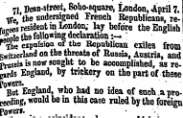
71, Dean-sfreet, Soho-square, London, April 7. \ fe ' the undersigned Trench Republicans, retirees residents London; lay before the English «Mpleth9 following declaration:— ! 'ifce expulsion of the Republican exiles from Switzerland on the threats of Russia , Austria, and pmssia is now sought to be accomplished, as regards England, by trickery on the part of these yo*ets. ¦ Bat England, who had no idea of such aproning, would be in this case ruled by the foreign Pofferi. . ... . " ¦ ¦ ¦:
-

Untitled Article
-
Untitled Article
-

Untitled Article
-

Untitled Article
-
Untitled Article
-

£m»erwl teliamettt. r,»«^,,T an «*. - ««*»«
-

Untitled Article
-

Untitled Article
-

IBB FRENCH REFUGEES IN ENGLAND.
-
Untitled Article
Note: This text has been automatically extracted via Optical Character Recognition (OCR) software. The text has not been manually corrected and should not be relied on to be an accurate representation of the item.
-
-
Transcript
-
Note: This text has been automatically extracted via Optical Character Recognition (OCR) software. The text has not been manually corrected and should not be relied on to be an accurate representation of the item.
Additionally, when viewing full transcripts, extracted text may not be in the same order as the original document.
71, Dean-Sfreet, Soho-Square, London, April 7. \ Fe ' The Undersigned Trench Republicans, Retirees Residents London; Lay Before The English «Mpleth9 Following Declaration:— ! 'Ifce Expulsion Of The Republican Exiles From Switzerland On The Threats Of Russia , Austria, And Pmssia Is Now Sought To Be Accomplished, As Regards England, By Trickery On The Part Of These Yo*Ets. ¦ Bat England, Who Had No Idea Of Such Aproning, Would Be In This Case Ruled By The Foreign Pofferi. . ... . " ¦ ¦ ¦:
71 , Dean-sfreet , Soho-square , London , April 7 . \ fe ' the undersigned Trench Republicans , retirees residents London ; lay before the English « Mpleth 9 following declaration : — ! ' ifce expulsion of the Republican exiles from Switzerland on the threats of Russia , Austria , and pmssia is now sought to be accomplished , as regards England , by trickery on the part of these yo * ets . ¦ Bat England , who had no idea of such aproning , would be in this case ruled by the foreign Pofferi . . ... . " ¦ ¦ ¦ :
Ihere « a coincidence , however , which is very r emarkabla At the moment when the governmen ts of Europe demand of the British Cabinet that we shall bo put out of the pale of humanity the mercenaryiaurnals of the counter-revolution iu Prance redouble their accustomed violence against bs ; and two individuals ( for diplomacy has not but official agents ) unite to accuse us of the basest and most detestable designs . Who are these two individuals ? One of them is a Frenchman , who is not a political refugee a though he has assumed that title , and ° whose coming to this country baa not to our knowledge been satisfactorily accounted for . This individual afar having made before a police magistra various . allegations of a most odious character against us , has since , in an official examination
made by order of the superior authorities , been obliged to deny theittruth , which denial has been duly recorded in aformer report addressed to the government . ¦ ' The other is a native of this country , who has forfeited the confidence of the political party : whose cause he pretends to espouse , and who seeks to recover his lost popularity by exciting among the masses old and nearly forgotten international hatreds . The ' antecedents . of tbh individual were , however , so well known to us that not one among us would enter into any communication with him . notwithstanding'all the advances he has made to that effect , which is no doabtonr inexpiable crime ! In Ms eyes ; but the English public will hare no difficulty " in difining ' tbat , without our being either assassins or incendiaries , we may be folly justified in regarding with distrust such a false democrat as Mr . Feargus O'Connor . , - , ; , .,
We , therefore , declare in the most solemn manner that whosoever attributes to us , the French Republicans , refugees now residing in London , designs sueh as those individuals have attributed to us , or in any manner similar to them , is a vile slanderer . We make this solemn declaration , not because we dread to be driven from the refuge we have found in this country , for the revolution which has had power in France may resume that power , and in so doing exact , perhaps , too large a satisfaction for the wrong of which we should be the victimsan idea which never entered into our minds .
We make this declaration voluntarily , we make it freely , we make ib without afterthought without any fear of menaces ; we make it in the name of the eternal principles of brotherhood and concord among nations and peoples—principles for which we n » w suffer the pains of exile . We may be calumniated , but the world will never fcelieve that men the very first act of whose advent to power was the destruction of the scaffold , —men who accomplished a great revolution without shedding a single drop of blood , without committing an act of violence , without imprisonment , and without confiscation—the world will never believe that we
are assassins or incendiaries . J . P . Befcjeau , F . Bertrand , Y . Chutelet , C . Delescluze , Dibon , Dupont , Tremond , D . Perroo , Theodore Earcher , Langeron , Ledru ftollip , Lionne . Labat , Darcaanitz , Laniard , J . Madan , E . Febvre , E . M . de Montjau , je , Gustavo ffaquet , F . Pardigot , Petit-jean , 6 . Philippe , Roussier , Bibeyrolla , A . fticateau , Suireau , L Villain , Goguin . c Thong& Ireland is my country , the world is mv Eepoblic
Untitled Article
AMERICAS ANTICIPATIONS OF EXGLISH KEVOLUTIOK . ( From tho New Tork Weekl y Herald . ) The great London Exposition of 1851 is , in the first place , a great London Speculation ; and it will , uoabtless , pay a handsome dividend upon all expenses Secondly , it was" the invention or discovery of flu Royal Highness Prince Albert , who , from being aniere cipher , or gentleman in waiting upon Her ^ kjest y . irasnaturmUy ambitious of doing something upon his own accouut which would make a little * ° i « in the world . To encourage this loyal and laudable ambition of the Prince , his scheme was se&ed upon with enthusiasm , and the Crystal Pa" ¦« ig the Prince ' s feather . It is also to be understood that John Bull is a self-complacent and jomewhat self-conceited personage , and that wkile « invites an exhibition of th « arts , inventions , and improvem ent ! of the whole world , he is none the in of
¦ n ^ T or confident the exhibition himself . *" civilised nations , however , have unanimously !?* Pted the challenge ! and among them the wiled States have promptly transmitted a ship «« of Yankee notions" fer this world ' s biraar . " ' rathercalculate" that some of these ipeci-™ 0 » of American « kili and ingenuity , and some of *^ e products of onr manufacturing and agricultu-^ iin dujtty willimpresB her Majesty ' s Commiisin « n very favourably with our national advancetT ? m the useful arts . We doubt not that in the "' PWcity of valuable suggtstions in the article * ^ "Jbited , our country will contribute her fair Igafent 3 br ttf contributions to this world ' s fair carried ouf ¦» ice St . Lawrence are , however , " the least im-£ tant ofthe « ieeimi » nKof our liomfi nroductioni or be
^ "Eed f the Exhibition . There will somejj ~ 'S of the bone and sinew , " of the country'' on ^ ground—something of the materials from which t * iB ^ ! Catest empire on the earth has been cut out of not ^ v with n the l st cent 01 ? - Bn * * hese »• dw ¦ " - A sbi ^ lcxet probably within a few ^ J ^ wuh the most curious and interesting species of philosophy and socialism which either this fly other country Las ever produced . A depnll Of American Socialists / we undertake to say ,
Untitled Article
will take the front rank of the agitators and reformers who are to be concentrated in London during the summer . Such a deputation is going out , filled to the brim with all the combustibles of Red-Republicankm , Socialism , Chartism , anti-rentism , and all the ingredienta of revolution and reform . And tbe question " of , the first importance is—what are the designs and what are to be the consequences of tbis world ' s Convention of Socialists and Chartists in the city of London at this particular crisis , and under these very favourable circumstances fur a strike at the integrity of her Maiesty ' s empire ? * will take the front rank of the agitators and
refor-Let us briefly consider this question . The Red Republicans and Socialists of France , beaded by Ledru Rollin and others , the disciples of the same school from Germany , the Irish Repealers , the English Chartists , and the American double-distilled philosophers and reformers will all meet in London during the ensuing spring arid summer . And , while it is manifest that the English press and the British Government are apprehensive of mischief from this gathering of this revolutionary elements , it is not improbable that they are ignoraut of the extent of the danger . The late repeated attempts and repeated failures at a change in Her Majesty's Ministry are doubtless attributable to the revolutionary contingencies that might follow ,, with the World ' s Fair , and the world ' s multi £ ude turned loose upon" London . " A new Ministry would probable require the hazardous
resort to a Parliamentary election ; and the Iron Duke has had the sagacity to induce the Queen to avoid it , and to wait till the crowd disperses . But is all danger thus removed ? . Are there not symptoms of , the mouldering dements of an eruption , waiting only the time and ttte opportunity ? Great Britain is deeply agitated with the Catholic question—there is no prospect of any material abatement of the prevailing starvation in the manufacturing districts , and starvation is always ripe for revolt . The city of London contains a population of 50 , 000 . of similar materials to the mob that stormed the Tuileries , and carried off the Royal Family to prison and to execution . It will be easy then for the . conspiring social and revolutionary leaders in London to organise a descent upon Manchester , simultaneously with a riot in the metropolis to divert the attention of the military from the real point of assault .
By a confidential communication , received by the last packet , we are advised that a number of leading men in Liverpool are seriously contemplating a scheme of secession , from the whole complicated machinery of the oppressive government at London . Theschenfcembraces theideaof aKew Republic , of which . Liverpool , Lancashire , and the Principality of Wales are to constitute the nucleus . A line of steamers from Liverpool to Charleston is to be immediately laid down , which will give to the former city the European control of the richest traffic on the globe . Wales is-proverbial for its minerals . There are certainly wealth and resources
enough within the lines prescribed , for an independent government . The important consideration is the temper of the people . Walei is largely populated by Dissenters from the Established Church , and Liverpool contains a numerous population of Catholics . How far the question of religious freedom , and exemption from church taxes might amalgamate these materials , the occasion may one day determine . At all events , they are among the materials , of discontent under the existing state of things ; and whether England is menaced with dangerfromthis particular republican project or not , 8 heis ripe , and full of the seeds of discord , rebellion ,- and revolution .
Once lighted , the blaze of insurrection would eoon absorb tbe manufacturing districts , and the city of Liverpool . Nor is it to be presumed , that the horrible sufferings of the people of Ireland would be any encouragement to their loyalty in Buch a crisis . They would probably rise at the slightest sign of co-operation from a similar movement in England . Ic is evident that , sooner or later , there must be a revolutionary bwleverstment throughout Europe . The crowded and suffocating density of the manufacturing population—the continuous state of famine prevailing . in Ireland—the
suffrage question—the revival of the old religious fends , those precursors of previous ciyUwari—will not justify any extreme confidence that England , when it comes , will be exempted from the general revulsion . On the other hand , the apprehensions of the British government of danger from the World ' s Fair seem to . be better founded . The Queen may congratulate her loyal subjects on the happy cirenmstance , if , when the pageant of the great London exposition shall have vanished , there shall remain no revolutionary reminiscences behind .
Untitled Article
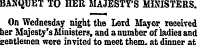
BASQUET TO HER MAJESTY ' S MINISTERS . On Wednesday night the Lord Mayor received her Majesty ' s Ministers , and a number of ladies and gentlemen were invited to meet them , at dinner at the Mansion-house , when the usual loyal toasts were given . ThetoaBtof her Majesty ' s Ministers having been proposed , Lord John Russell said—I might content myself with having returned thanks for the honour you Lave done us , -were it not . that this day recalls to my mind the condition in which we were placed three years ago . We can all recollect , on the evening previous to that 10 th of April , what were the doubts , the misgivings , the fears that there might be some violation of the public
peacefears , even that there might be loss of life on the ensuing day . But , my Lord Mayor and gentlemen , on the evening of-the ensuing day we found ourselves perfectly safe ; and safe , not I will venture to say , on accouct of the armed force that was in tbis metropolis—although the armed force , the small armed force that was in London would , no doubt , have done its duty if there had been occasion for it —but because the people themselves rose —( cheers ) —they rose , not to cause , but to prevent riot and disturbance ; they rose to maintain , and not to subvert the institutions of the country . ( Loud cheers . ) I trust that on any similar occasion the same spirit will be evinced ; and that , knowing , tho benefits we enjoy under this free government , we shall be ready to defend those benefits , and to transmit the
institutions wo prize to our posterity . We are about to have in this country large numbers of foreigners assembled to see what I trust may prove one of the most interesting si ghts that the world ever beheld . It has been rumoured , and your respected Recorder has mentioned that rumour elsewhere , that advantage would be taken b y some of those who will come toviiit this country to disturb our internal peace ; but I feel confident that that peace will be preserved , not only by the strong arm of law and justice , but because I feel that any who , on such an occasion , being our guests in this city , should attempt to disturb that peace , would bo condemned by the universal voice of mankind as guilty of the basest violation of the sacred laws of hospitality . —
( Great cheering . ) Ou the toast of the Foreign Minsters being given , the American minuter , the only one present , ( peaking of the Exhibition , said I have taken , a-deep interest in its success—( bear , hear)—and I have not a doubt that peace , and quiet , and goodwill will reign in your borders for six mentbs to come —( cheers)—and that when the great number of foreigners that shall have aom « here shall have gone home , they will carry none other than the kindliest feelings with them . ( Renewed cheers . ) The toast of the " House ot Commons and Lord Palraerston having been proposed , tbe secretary for foreign affairs complimented the civil lord and the merchant princes , and said , it is the dispensation of Providence that
mankind should he divided into rich and poorthat the rich should be comparatively few , and that the poor should be comparatively many ; but , though no human legislation can alter that arrangement , it is in the power of our lawgivers 80 to legislate that the poor shall be protected from oppression b y the rich , and that the rich shall be defended against violence from the poor . ( Cheers . ) That duty the Parliament of England has amply aid successfully performed , - and hence it is that , while we have seen all the nations in Europe convulsed with disorder—while we have
keen industry suspended , commerce i araly ' ied , i » - mtitntions civil and political overthrown—while we have teen fields that ought to be trod only by the peaceful husbandman beat down by tb » trampling of the iron heel of armed legions—while we have seen them bathed with the blood of kindred though conflicting armies—the people of this country havo exhibited an example of tranquillity , of order and obedience to the laws , which so long as the history of these times shall endure , will command tho admiration of roankind . —( Cheere . )—Several other toasts were proposed , after which the company brokwup .
Untitled Article
Xatiosil Reform League . —At a meeting of the council , on Monday last , it was unanimously re-« olved — " That the thanks of the meetingbe given to Messrs . Hunniball « nd Graham , of the Chartist Convention , and their colleagues , for the . support they gave in voting for the principle of true money , based on real consumable wealth , as laid dowu ' in the sixth proposition of the League .
Untitled Article
MONDAY , April 7 . HOUSE OF LORDS . —The Mutiny Bill and tbe Marine Mutiny BUI were respectively read a Becond time , on the motion of the Duke of Wellington . - Lord Brougham presented a petition from the ward of Farringdpn-Without , praying that the Corporation of the city of London might be reformed . Some other business was also despatched , and their lordships adjourned . HOUSE OF COMMONS . —A new writ was ordered to issue for tbe Leith Boroughs , in the room of Mr . Rutherford , who bad been appointed a Judge of Session . .
The Serjeant-at-Arras having reported the course he had pursued in taking into custody a witness examined before the committee upon- the St . Alban ' s Election , ' who had been considered guilty of prevarication , a conversation ensued turning upon the ques-. tion of privilege , and after various statements from Mr . Ellice , the chairman of the Committee in question , a Speaker ' s warrant was ordered to issue for the oaption . of three other individuals , who were charged with / aripus . attempts to prevent testimony ^ from penetrating to the committee . ' _ Ihcomb Tax . —The report from the Committee of Ways and Means having been brought up , . Mr . nsBBiBS moved the resolution of which he had given notice , setting ; forth that the income tax had
been intended , and ought to have been a temporary measure , and declaring that the renewal should now be limited to such an amount as might be deemed necessary , in the existing state of the revenue to provide for the expenditure- sanctioned by Parliament , and for the maintenance of public credit . The ¦ hbn . member quoted the authority of various officials in the present and former ministries , and of other distinguished statesmen , to show that the general understanding on which the income tax was originally granted bad been a temporary concession to financial necessity . lie argued from the nature of the impost , its unjust and inquisitorialcharacter , and the general unpopularity that attended it , that its contiouance was only to be endured so long as the crisis in which
it originated should exist . Tbis , he contended , hnd now passed away- ( hear , hear ) -and pointed to the improvement of the revenue , and expanding surplm now acknowledged by the Chancellor of the Enheqoer , in proof of the assertion . Among all the taxes which financial prosperity would enable us to abolish he assigned the 6 rat place to the income tax . ( Hear , hear . ) The actual surplus for the year he estimated at two millions , and recommended that two seventh of the income tax should be remitted , causing , a sacnfice of revenue to the extentof £ 1 , 600 , 000 , and suggested that certain regulations in tho assessments of the window duties , which must in this case be retained , would remove all the sanitary objections to that impost . ( Cheers . )
The Chancellor of the Exchequer vindicated his consistency with the past , by showingthat his opposition to the income tax , when first proposed ; was offered with a special reserve of those very iustifications that could now be pleaded , viz ., the abolition of taxes upon consumption , Buch as tbe corn . sogsr , and timber duties . The renewal of the tax , in 1845 , was asked by Sir R . Peel solely for the purpose of commencing those experiments in taxation , and in that proposition he bad himself concurred . Remarking that the comparative injustice of the several sehedales in income assessed to the tax , was a matter of great doubt , he urged many arguments to prove that it would be unwise to restrict the new tax to a period of a single year . He proceeded to justify his own scheme of finance , contending that the taxes which
he proposed to remove were more injurious than the income tax , and besides promised to expand under alleviation . so much , as ultimately to replace tbe whole amount of revenue sacrificed at first . He commented upon the significant omission of a corn duty from tbe financial proposition enunciated by Mr . Herries , and dwelt upon the inconsistencies between his plan and that of Lord Stanley . The Chancellor of the Exchequer concluded by declaring that he did not , even now , wish to have the income tax voted in perpetuity , but to be continued for a while , for the sake of those more burdensome duties which it had enabled them to abolish- ( Hear , hear . ) . Mr . PRIN 8 KP characterised the propositions of Sir C . 'Wood- as instances of class legislation . -None of
his remissions wouldy ield the slightest benefit to the labouring classes . Mr . F . Peel , without giving an unreserved assent to the whole scheme of the finance minister , supported the renewal of the income tax . He reminded the house of the circumstances under which that tax had been imposed and continued from time to time , with the progressive intention of reducing the burdens on articles of consumption . Since 1842 ne less than ten millions of dnties had been struck off , yet the public revenue now showed that the customs and excise receipts were higher by one million annually than they were before . This policy was , however , still uncompleted ; and the abo : lition of the income tax would leave a large deficiency in the Exchequer , to supply which they
would find it necessary to re-impose some of the indirect taxes . ( Hear , hear . ) While any protective duties remained , he could not consent toaban * don the tax upon income . ( Hear , hear . ) At the same time , he did not altogether approve the government mode of distributing their surplus . ( Hear , hear . ) The window duty might have been retained in great measure under the modification of a house tax , which , as a criterion of expenditure , appeared to be a more just basis of taxation than the amount of income . ( Cheers ) . . Mr . T . Baring censured the pliability which had led the government to form their finance schemes accordiugto the behests of popular agitation . Confessing to a strong prepoosession in favour of
maintaining a handsome surplus by way of security , be could not consent to forego so large a proportion of the existing margin as was proposed by Mr . Herries , although he coincided in the principle on which his resolution was based . The hon . member went on to criticise the theory , and the details of the income tax , remarking upon its injustice , and deducing from the contraction shown in the aggregate of Schedule D , the conclusion that either the incomes from industry were dwindling under the operation of free trade , or that the subjects were guilty of most extensive frauds . The reduction oi the window duty was a partial benefit , conceded merely for a popular purpose . Mr . Wilson declared that tbe resolution now before them brought into antagonism two great
parties , one wishing to re- ; mpose protective duties , the other desirous of following out ; the policy that had actuated the governments for some years past . He then entered in much detail , into the financial and commercial history of the country since the prevalence of free trade principles , showinc how rapidly the public revenue bad filled up the chasms occasioned by reduction , and how vast bad been the expansion of exports and imports in almost every article known to British commerce . Denying the validity of the doctrine that any tax , if politic in itself , was to be repudiated merely because it had been called a war tax , the hon . member complained that the agriculturists were never contented with their share in the general advantages from a diminution of burdens , but required some exclusive boons devised for their benefit as a class . The
census tables proved that the per centage of the population dependent upon agriculture was perpetually decreasing ; he enlarged upon the necessity Of throwing open the channels of industry in other directions . Mr . BooKER objected to the income tax chiefly because it would enable the government to pursue the suicidal policy in which they had embarked . He also believed it was essentially unjust in its operation , especially upon tbe farmers , who were forced to pay an income tax even upon their lotses . Rent was a symptom of prosperity far more undeniably than any Of the signs so frequently paraded before them , and in rent there had been a reduction of twenty percent ., or more . He denounced the vain-glorious clap-traps that had been uttered on the score of the enhanced production and cheapness of commodities .
Mr . Slahei believed that the free trade policy had proved not lesB beneficial to the agricultural than to other classes , Mr . grooms read extracts from Hansard , " to prove that the present Ministers , when not in office , had declared the income tax unjust , unequal ,, and fraudulent . . . ,. . . Mr . Reiholds , intended to oppoie the renewal of the income tax , which be had supported on a previous occasion , and explained the considerations whereon he had arrived at his new opinion . ' Lord C . Hamilton found that the vote for three years « r& 3 equivalent to a renewal of the income tax to perpetuity , and called on the house to tpluse it , unless some attempt were made to smooth away its injustice and inequality . Mr . S . Crawford also declined to vote for the tax in all its oppressiveness , which the Chancellor of the Exchequer could not be persuaded , to modify . Sir R . H . Isqus urged various objections to the details-of the income tax , but confessed that the proposition of Mr . Herries left all the evils it contained" untouched . Believing that the finance
Untitled Article
fSln rf ., R ^ , o f government offered much relief to •^^ . ^^^ ' ^^ . ¦ •«»« wi > Vw ? b * ^ 1 « n Mr . HERRifes ' g . amrindm ^; ^ the or ^ a mo tion .:...,: „ . . ^ 78 ^ ¦ M r e a ™»« fo «» t was con . ^ uenily lost . : paSer ftjw amend ^ nt stood' next on the S « fhtfV rsome conversation it was agreed The resofntS , at ? ? that ' ™ endment on Friday J&S& ^ M f 0 urth the necessity of . devoting ofS . relief of theowners and occupiers » m i nn ^ n ^ E / epeated the not 'co " 6 had given of an ZZ t restri <* ing the renewal of the to come tax to one vear ¦ . ¦ ¦¦ iinlnnn 1 r n
takWr p ° BDKNrw 'shed for some opportunity : of whethortL 8 eme Of the house upon the question proved a 8 smnMsnfc of the tax could not be im-Th ^ r ^ ? ^ en brought up and agreed to . The other business was then disposedof , and the bouso adjourned at a quarter-past one . ¦ ¦ TUESDAY , April 8 . , S ° f .. W > BM . 4-Thb nouee went into tomrnittee on the County Courts Further Extension | JML . . 7 - " * — /"" . ¦* * " w » iw * M ^ VVUOkVU
, ^ The ; Lord Chancellor objected to several of tho clauses which imposed upon'the county courts du- - « jgs ^ whwu : they were wholly incompetent to perform . , The effect would be to introduce gratfc . variety in the law , as administered in . different pans of the kingdom . The bill committed the blunder of making the judges of county courts arbiters of causes which required all the learning and experience of Masters in Chancery . Lord Brvugham defended the clauses . Xord Cranwor th gave a modified assent . He thought there were many matters which could be equitably and satisfactorily , decided by the judges of the county courts . - ; . ' . ¦ •• :., Ultimately gome of the clauses objected to were withdrawn , and . one , ( the 35 th ) was rejected on a division . The other clauses passed throug hcommittee , and their Lordships adjourned at twenty miiutes to nine o clock .
' HOUSE OP COMMONS .-Chorch RAT » s .-Mr . Trblawnt made his annual motion , supporting it by the usual arguments , for a Select Committee , to consider the law of Church Rates , and the difference of practice which exists , in various patts of the country in the . assessment and ; levy of such' rates , and to report their observations to th « house . " Mr . Harbcastlk seconded the motion . The events of the last two years had shown that the Churoh of England contained not only two rival parties , but two antagonistic religions . - How much was that circumstance calculated to aggravate the feelings of Dissenters , seeing that they were not only compelled to pay an impost to which inconsoience they objected , but actually to contribute to the promulgation of doctrines which they believed to be false ! If the levying of Churoh Bates b . e not an act of persecution , it is an act of the nature of persecution . - ¦
Lord J . Russell would not object to the motion , believing that it was desirable that some attempt should be made to settle the question . Sir R . Ikolis heard the statement of Lord John Russell . with regret . Church rates were a burden on property , payable by property : and the owners acquired their possessions , liable to the burden of such payments . Mr . Bright contended that it was a breach of the principle of religious liberty to compel persons to contribute under any pretext whatever to a purpose of which they disapproved on reli gious grounds . He advised Sir Robert Inglis , and other sincere adherents of the Church of England , to set their house in order , for assuredly in their oaso troublous times were approaching . ' Mr . A . Hope would give a ready assent to the inquiry . He did not wish it to be considered that the question of Church Rates should be deemed immutable . ¦ . ¦
Messrs . Hetworth and Lennard thanked Lord John Russell , in the name of their Dissenting constituents , for consenting to the inquiry . The motion was then agreed to . Lord A 8 HL 5 I rose in a very thin house to move for . leave to introduce a bill to encourage the construction of lodging-houses for the wording classes . He adduced a variety of details to show the necessity which existed for such an enactment , if it was deemed an object of . importance that the lower orders of the population should be raised in the scale of physical and social existence . In the more crowded parts pf London and other large towns , it was frequently found that four or five families were lodged in a comparativel y small , ill-ventilated , and badly-situated room . Accurate statistics had shown that these localities were the hot-beds of disease and immorality . The efforts which had been made
in the way of establishing model lodging-houses had proved most successful . The bill . he asked leave to introduce had for its object the removal , or mitigation of an enormous evil . It will be permissive in its operation , would be carried into effect bj the local authorities , and only after sanction was given by a certain portion of the rate payers . ' The measure would apply to England . Lord Ashley mentioned that the establishment of model lodginghouses had been greatly facilitated by tho repeal of the duty on bricks . .. The motion met with hearty approval from Mr . Slanbi , Mr . HuiiB , Mr . Pox , Lord Clabdk Hamilton , Mr . Labocchere . Sir G . Grkt , in the course of approving remarks , stated that meanB for 'defraying the expense of obtaining charters for such bftncficial purposes was under the consideration of government . Leave was granted to introduce the bill .
Distress in Ir « und . ~ T 1 i 6 . impoverished condition of Ireland wns brought under notice by Sir U , Barron , who moved , " That this house willresolve itself into a committee , to take into consideration the ; stateof Ireland , with a view to relieve the distress there existing . " Taking the circumstances of Ireland as they existed in 1845 , and comparing them with the state of matters now , Sir Henry showed an immense deterioration as the result . The great agents in bringing about that deterioration were the tariff , the abolition of the corn laws , and the new poor law . . Sir W . Somerviixk spoke of tho unfairness of taking 1845 , as the year of comparison with 1851 . That was the year before the famine ; but , even during that period , as was shown by the report of Lord Devon ' s Commission , the labouring classes particularly were in a most wretched condition .
Compared with the last year , or the last two vears Ireland was making some advance , and he hoped would continuo to advance . To agree to the motion would be to raise faUe hopes , and he hoped the house would at once negative thu proposal . ' Sir L . Q'Brun , Mr . ' Reynolds , Mr . M . O'Connell , and Mr . S . Crawford , addressed the house , but great diversity of opinion was expressed as to the cause of Ireland ' s misery and the remedies . On the suggestion of Mr . S . Crawford , words extending tho inquiry to the velaiions between landlord and tenant were added . Lord J . Rossell was of opinion that if tbe house assented to the motion , its mover would find that every proposition lie made would be opposed by his own supporters . Ireland was far from being in a state of prosperity , but this at least could be said , that the symptoms of distress were not as aggravated as before . ¦
The house then divided— . ... For the motion 129 _ . Against it . ........... 138-9 The orders of the day were disposed of , and the house adjourned , at half-past , twelve o ' clock , till Wednesday noon . . . - . WEDNESDAY , -A « ni . 9 . HOUSE OF COMMONg . -The house met at noon , and , after receiving n great number of petitions upon the subject , proceeded to the discussion ^ c three metropolitan market bills , which stood at the head of the orders of the day . ¦ ¦ ' . ¦ Mr , B . Dbkisor' withdrew the Metropolitan Cnttle Market Bill , and , Sir J . Duke having moved the second reading of the Smithtield Enlargement RIe 0 PB the
• l ^^ T « B objeoted to plan embodied in the bill , which was drawn up ' under the auspices ot th « London corporation . The area proposed to be added to the site of the market he believed to be altogether insufficient , the dangerous passage of d'oves through , the-streets would still be continued , while- the enlargement , such as it was , would cost more than a million , and must be paid for out of the pockets of tbe farmers and eraziers trom the country . . He moved that the billte read a second time that day six month « . Mr . r ITZROT leoonded the amendment . Sir C . KniohtleV opposed the removal of the market . Hfc had been in the habit of sending cattle to Snuthfield for forty years , and had alwavs found the market to be admirabl y arranged . If the inhabitants of the locality did not desire its removal , what business ,- he asked , hml other people with the matter ? ( Laughter . ) ¦¦ . "" ... Sir II . -VK RSjix advocated a change of site , which was required by the vast iucrea « eof the population ,
Untitled Article
and by the wantqf lairage . A metropolitan market ought to bft acce 8 sibleby rail ; ( Hear , hear . ) Mr . W . WlL LiAJlSJffiskdbothliills to be . rcferred to the committee . ; he eould . rjoVconseni to the government bill asit stood , ' which gave too ' much power to the commissioners . : * ¦ ' "* l ¦ Mr . K . SKTMER ^ upported the city ' plan , as did ' nrfnJ : 1 ¦? % f ° the P of the city , was prepared if the government consented , to let both BXlS ? f M- ewnmtoefc The corporation dhl keL S * $ 1 fi ^ nment making a £ many mar-Kets as they pleased . ao long as they ? did . not take tiK T jmarHetl " -M ChMM . ) He pmnted oS H > e advantages of the corporation p \ ah , wliioh nSLTfl ^ g » evances ; whereartliat ' of S government let most of the evils as they wore , ami would greatly increase the pride' dfthbatJV ^¦ : -T mi
. w lewis contended for ttio ' necegsity of " removing the ; meat markotfinto theiubufbe . ; No'im-HKff 1 - ' W' Po ^ obvia ^ ei W-. todrtSj M&fnwr ^ % P er Petuate the nuisance now , ES A r u hoar ' > tte "eclai ' e . i . that Mr . Alderman Sidney maintained that the scheme proposed by the corporation : Vas * quite sufficient : and pronounced the government proposition an-inoit OI fL d ? riV * —• ^^ ri S htof , the Mr . Hvms ; intended . ' to , vOte ; for ; Tthe ; Vecond reading ,-4 elfeving thatthto pbratiQu-hatAright to be heard before the committee up stairsi ' Air . Wa kley ridiculed the pretensions of the ministry to interefere in so many kinds of- business , f hey had undertaken burials last session ' , and were becoming butchers in this . He contended that 'bv
taking the market out of town , ' the price of meat would be largel y enhanced in town . ' . Sir G . Guby submitted that it was improper to throw the responsibility of selecting between two conflicting achem . es . The commissioners had reported against retaining the market within the metropolis , and it was for the house to choose bttween adopting that report , or allowing the plan of the corporation to take effect , ( Hear hear ) . Mr . Stafford opposed the removal of tho market . ¦ ¦• • ¦ -. ' : Mr . W . Milks supported it .
Mr . Osborne reminded the house that they were about to vote upon tho question whether the two bills should be referred together to a committee ? Mr . S . WORTLEy denied that the alternative presented to the house was , as Sir G . Grey had stated , whether one of two localities should be preferred ; the government had suggested no locality . The real question was , whether the corporation , being in possession of a valuable market , which was inadequate to existing want ' s , and camo forward with a scheme which the commissioners had described as a vast improvement , were not entitled to an inquiry ? The corporation bill was opposed by Sir . B . ' Hall and Mr . Mackinnon , and supported by Mr . Mas-TERMAN . '
Lord J . Russell said it was his duty , as a member of ; that house ; if the interests of his constituents did not coincide with those of the kingdom at large , to prefer the latter . The question , he observed , was not as to two competing schemes , but whether Smithfield-market should be removed from its present site to . another to be selected by ' commissionera . With an increasing population , it would be almost impossible to enlarge the present area sufficiently without destroying valuable property , a sacrifice to be compensated by an increase of tolls . This was part of a great public question , affectinc the health of 2 , 500 , 000 of the community
Mr . Mowati opposed the bill , which was supported by Sir H . Halford . •¦ . Upon a division , the amendment was carried by 240 against 124 ; so that the bill is lost . " Tho motion that the Ministerial bill , ' entitled " The Smithtield Market Removal Bill , be read a second time , and referred to > select committee , " excited some miscellaneous opposition , during the course of which various explanatory statements were offered by members of the government . ' A division was ultimately called , when the second reading of the bill was affirmed by a majority of 230 to 67 i—1651 ' ' ' '
A warm conversation followed this division , but at length ttie motion , that the bill should be referred to a select committee , was agreed to , and the house rose shortly afterwards .
THURSDAY , April 10 . ¦ HOUSE OF LORDS .-Loi-d Brougham introduced a bill for affording to suitors in the Court of Chancery a speedier and less expensive administration of justice . . HOUSE OP COMMONS . —Colonial Expenditure . — Sfc W . Molbswortii moved resolutions to the effect that steps " should be taken to relieve this country from its present civil and military expenditure on account of the colonies ; and ' that it is expedient to give to the inhabitants of the colonies , which are neither military stations not convict settlements , ample powers for their local self-government . He began by stating the amount of the expenditure incurred by tho united kingdom ou account of the colonies . According to the last return for 1840-47 , this amount , was £ 3 . 500 , 000 ,
the civil expenditure being £ 50 , 000 , the military £ 3 , 000 , 000 . He then entered into satisticul accounts of the military expenditure in all our . colonies , and contended that it was only necessary to garrison eight military stations with 17 , 000 men , which would cost £ 850 , 000 , not much exceeding the charge for the Cape of Good . Hope alone , with a Caffro war these colonies were governed as they ought to be , he contended that no troops would be required there at the expense of the Imperial Treasury , except for military stations and convict settlements , A military force demanded for colonial purposes should be paid by the colony ; if for Imperial objects , by the mother country . From the Australian colonies nearl y all the troops could bo withdrawn . In approaching the case of the South African colonies , he took occasion to review the
whole subject of the Caffre war , inquiring , first , who was to pay the cost ; secondl y , the causes which had led to the war ; thirdly , what steps should be taken to protect the mother country against the expense of future frontier wars ? He assigned reasons wh y the whole burden of the present conflict in British Caffraria could not be thrown upon tho colonists . His inquiry into its causes embraced a com-Jrehensive survey of the policy pursued by the local government towards the native tribes and a criticism by no means favourable , of the proceedings of Sir H . Smith , who with ' Lord Grey , he alleged , ' was responsible for this war . Id conclusion , Sir William estimated the ultimate saving in tho military expenditure for the colonies at £ 1 , 600 , 000 , besides £ 130 , 000 out of the civil expenditure . Mr . Urquhart seconded the motion .
Mr . Hawbs opposed the motion . Its object was neither more nor loss thun to induce the house to abandon all its colonies , wherever there , was a British force and an imperial expense ,. incurred , with the exception of convict arid purely military stations . The voluntary abandonment ef such aii empire , was a sacrifice which no country , was ever known to have made . Mr . Ilawes disputed the relation which existed between the possession of local self-government , and the non-necessity for British protection . With regard to the frontier policy of Sir Harry Smith , and which had been obleoted to by Sir William Molesworth , Mr . Hawes asserted that it . wai in strict accordance with the
recommendation of every governor of eminence who had ruled the colony , Commendable readiness had beendisplayed by the colonists , to rallyin supportof the local government . Exceptions hnd occurred but these were clearly owing to the bad example shown by the persons who taught and exemplified resistance in tho case of the convict question . After all the entire Baling which Sir William Molesworth held out was only £ 1 , 200 , 000 , arid for . that sum was the house prepared to abandon the greater part of our colonial empire ? Mr . Adderlkt supported the motion ; contending yiat the policy developed b y Sir William Molesworth was sound and economical , while the policy of tbe Colonial-office was rotten and expensive .
Mr . Stanley believed that the effect of the motion would be to dis « ever England from her colonies ; and to that he never would consent , Mr . CeBDBN remarked that Mr . Stanley had overlooked the circumstance that the rate-payers of England had something to say to the question under , discussion , Mr . Hivres had aBked—Would England give up her colonies for £ 1 , 200 , 000 ? Mr . Cobden would ask in return—Would the colonists give up the mother country for £ 1 , 200 , 000 ? Lord J . Rossbll withdrew the question from merely financial considerations , declaring that it involved nothing less than the maintenance or dissolution of the empire . It was sought not to dituiuish but to abolish the whole military defences of the colonies-to have their union witlithe mother country dependent upon the natural attroctiona of origin and race . These , he showed wonlrf , ALii fait In Canada the" tendenS of race S
Untitled Article
• ''"'¦¦¦¦ ¦ - ¦" - " ¦ . ;^ : V : '; , r- v strongly towards the United states asttowards Enjr « land . At the Capo the majority elaimad - a Dutch oriein ; m Trinidad a' Spanish ; and elsewhere we new lusolntiona hoterogenous mixtureofTaqesi ' un the motion of Mr . Hums the debate-was then ad journed to Tuesday next . l # ? ' ?~ ' " - ' J-ne house rose at one o ' clock . , v ^ '' ; ' r ?
TmrW FRIDAY , April H ; -,. / ,- ,: te 2 ton IHi . L 0 R ? s-Tne Counf ^ Uourts Ex-I nrrf r ! WM Tea ^ il thir ( 1 time ana ' passed .. ( detai s of nJ entcr ? at'aom - Cleigth into : the ;| SSslSi ^ lordships adjourned ... -- Blil s ' anu luei " HOUSE-OF COMMONS . ~ On ' . the motion for gomg into committee on the ABsesi&fcucegX ^ Mr . DisitABLt moved an amendment-- " That in anj . Toliof . to be granted by ther ^ ission of ad justment of taxation , due regard oug ^ obo paid to the aiatressed condition of the ownersilind occup iers of land . " Estimating the rental .. ofjftlfe country at sixty millions a . vear , the loss on ; J $ JJb amount was or soon would be , understated at ^ ten per cent . ;
making six millions . The farmerWcapital sup- poaed to be 300 millions while thexToVn law lasted , ' had since uridergono a depreciation- MJfHOO millions . Here ho maintained was a cause bfF-suffering that demanded , not : relief from an impoverished exchequer , but a consideration \\ hen aiurilus had to be distributed ' . Adverting ' to tho gow ' nimcnt proposition for . transferring to tho consqlidatqVl ffind " some of the cost of pauper lunatics , ' ¦ he ' deil . uced trom it an admission of the principle that all ' paupers' ought to be maintained out' ofltW genoval . revenue , and . a partial adoption ' of this Srs oi kn ° rT - ^ » f reat « "tf . to-th 23 cupiers of land . A similar chance iiiMn al « o hd file 7 h ' 1 rCgaVd tOtbe ° P ™ fitur " = ur 01 gaols IJesides them . v sum of £ l . 700 . onn JU n £ n ,, l
was levied in con unction with the W- rite but not devoted to the support of the pX ' forming an extra burthen P Upoh the ' lahd ^ fe alleviate which the financial aurplusmi ghthavebeen justy and beneficially employed' This , ffiSS ? would be . a better boon than the windb ™ ' ' Foe tho removal of what were called th ' e estabn / S - ^ s he considered thSt the landed interest eoul | prefer an undeniabl ^ claim This " amounted , for ' Enj . land ¥ nd ' irto&WMm per year . ' .:- Eulogising -the industry , " the loyaltv and the patience of the agriculturists under al sufftr ngs and al disappomtmei . ts , he denuded on their behalf , that while other classes enjoyed untaxed bread , they mi ght be allowe d to possess untaxed Inborn- lie wished only that the ministry , during the holydnys , would reconsWcrtheir budget Mr . LABoucimnB hardly knew how to treat the resolution as serious . Mr . Disraeli had hinted at changes quite inconsistent , with the remission nf th *
window tax , and nevertheless , had deel ' nred his intention to support that measure . _ . - Gladstone without approvine entirel y either « m ?» ° ?« u"ten « l P « tf «* t or that of Mr . Disraeli , felt Obliged to ekct between them upon a balance of advantages Viewed in connexion with contend rary incidents , he looked upon the resolution before them as having eomo relationshi p with protection whose restoration tho party stood pledged to attempt . Admitting the possibility that the incidence of the local taxation was unjust to tho land , he could npt consent to alter it before the question of protection was finall y settled . Mr . Smjoni ) , inquired what was the real meaning of free trade , and after giving vhriouB illustrations of high and low prices , concluded that ' the latter meant . nothing hut dear tnouev Lord J . Manners considered tbe permanence of our boasted , manufacturing prosperity extremelv
uountiui . it could not endure , he contended , unless the home market were cultWateu , and the agricultural consumers raised from their depression This was impossible under their present burthens , and while they were left to struggle againsfforeign competition . ¦ 6 Mr . Bright stated the case assumed bv Mr Disraeli to . bo a claim for special relief , on the plea of special distress . He denied one half of this caso altogether . There was no proof that the owners of land were seriousl y injured . Rents had fallen very slightly , and in some pluces not all . Fluctuations were experienced in all trade * . The ironmasters were now surfenn > r from a diminished demand The Yorkshire clothiers were suffering from the hiah
prices ot woo ' , by which the farmers benefited-Returns showed that the contribution paid from tho land to the poor rate had diminished l > v one-half since 1833 . The iariners were suffering ' from the effects of a ticious system , and for their relief he su ? . "" Proved business arrangements , more skilfu husbandry , adjusted rents , and abolished game laws . t- ^ t ° " * KCKI ; Lon of < he Exchequer contended that Mr . Disraeli had violated all consistency by consenting to . support a proposition , and vet inovini ? an amendment which utterly defeated it Ha
dared the . complainants , of distress among tiie labourers to deny , that the condition of the peisantry throughout England- -was better than ever before . Wages had nowhere fallen one half but prices had . Regretting the baneful influence of rural d emagogues , he unhesitatingly trusted -the question to tho good sense of the country . Sir R . Peel , identifying himself with the agricultural interest although a' froe-trador , intended to Toto for Mr . Disraeli ' s proposition Lord J . Russell declared that the motions so ^ a ^ tt ^*^ " * ' **™
Several members having taken part in the dis cusiion , the houso divided—For the amendment ; 2 H 0 A ^ iinsfc , ;;;;;;; 263 Majority for Ministers 13 The house rose at a quarter past two . .
Untitled Article
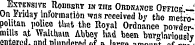
Extensive RonnEnr in tub Ordnance Office — On Friday information was received by the metropolitan police that the Royal Ordnanco powd ° rmills ajt Wakham Abbey had been burglariously entered , and plundered of a large amount of property . The thieves broke into the . cashier ' s office ; forcing open the iron , ia !' e , they took from it £ 320 in Bank of En- ; linid notes , 190 sovereigns , and 18 s . 2 d . m silver and copper . They also effected an entry into the storekeeper ' s room , from whence they took £ 12 . Besides the cash they took a quantity of powder , ami pot clear away with their booty Robbery at the Reform Ci . UB .--On Thursday evening , between nine and ten o ' clock , some expert thieves made their way into the Reform Cluband
, notwithstanding the vi gilance of the hall porter carried off the lavg * eight-day time piece and its glass covering , and got clear away . Extensive Fire at WooLwicn . —On Friday morning'a fire , attended with a great destruction ot valuable property , broKe out in a largo range of premises belonging to Mr . Sampson , a " tallow chandler and melt « r , carrying on business at TSo . 97 , High-street , Woolwich . Owing to the inflammable character of the stock-in-trade , the flumes travelled with unusual rapidity , sq that it was with considerable difficulty the residents were enabled to eftuct a safe retreat . As it was , they were almost suffocated with smoke ; The fire was eventually extinguished , but . not until Mr . Sampson ' s
property was reduced to ruins ; and unfortunately he was insured for only £ 250 , not one half the amount of his loss . The total loss is roughly estimated at £ 1 , 500 . The origin of the fire is unknown . Dari . vo Robbery under the Soutii-Whsterk Railwat . —On Thursday night , a gentleman , ' who was going down the South-Western Railway , proceeded from the York-road along Vine-street , and over the private footpath belonging' to ttlC Compuny , for the pu . posc of getting to the bookingoffices , To reach the latter placo , it was necessary to pass undev . an archway the entire width of the Btation . Scarcely , howeverhad theeciiUeman
, gained the middle of the arch , when he was seized by five men , who pinioned him , and one placed his hand over bis ihouth to prevent" him from giving an alarm . They then took his watch from his pe £ ion , and £ 12 in money , when they gave him a violent blow m the face which nearly stunned him . They then ran off , and got over the fence into Grunby-street , ard made their escape before tho police knew anything of tho outrage or robbery . Owing to the sudden attack nnd speedy flight of the robbers , but a very imperfect , account can be giren of their persons to the police . AYLUBBimT Election . —The nomination of the
candidates took place on Thursday morning in the County Hall . The Returning Officer declared th « show of hands to bo in favour of Mr . Bethell , on which a poll was demanded on liehalfof Mr , Ferrand The poll began at eight o ' clock on Friday morning , Mr . Bethell taking the lead , which he kept during the day . At four o ' clock Mr . Bethell as cemled an elevated position in tile Market-fQUSrp and began to address the people as his constituents The state of the poll wag then announced . _ Bethel ! , „„ f . \ Strand ^ """
Majority for Bethell ... 26 ^ mBmm SH = ? s = li Ser of thP l ! . ? ? , ° T' convicted of the mur-S £ , Y ™ ft- Rov - * -. ^ lest . LeviHarwood reiterates Ins innocence of the murder , nnd neither or the prisoners have made any ' statement that can many way be constructed into a confession of tneir guilt . • .
\\ ESt -Somerset Eusctiok . —The nomination took place on Thunduy in frout of tho ¦ mi'ltethouse at Tnunton , when Mr . W . P . 0 . Lwigton , { grandson of the late representative for the eastern division oftne country , and son-in-law of the Buke of Buckingham , ) was elected without opposition .
£M»Erwl Teliamettt. R,»«^,,T An «*. - ««*»«
£ m » erwl teliamettt . r , »«^ ,, T an «* . - ««*»«
Untitled Article
. . , : .,.. / OP / ^ e ^^/ z ^^ yc ^^ J ^ jrP uXst- , c / T ^ . ^ ' : . '" ¦ " ; - ¦¦¦ ¦¦ - . . .. * ¦ ' ¦ ¦ :. •* & ; ¦ * <*¦ ¦ ' , , „ ¦ . / . ; r ,. ; / _ AND NATIONAL TRADES' lOTTRtfAx ; ^
Untitled Article
l ^ jWJ 0 -70 L LOHDON , SATDBDE APRILiUiT ^~ ' [ ' '¦¦ ¦ ¦ r ^ Mfm ^^ m ^ . rr-: mmmmmm ——¦— ' — =- - ¦ .- , . . . __^ — . __ .. "Virc ShllliMgt and NixpcMG * : |»« r . QnnrlW i ' ¦¦ ¦ ¦ - ¦ "''• " : ———
Ibb French Refugees In England.
IBB FRENCH REFUGEES IN ENGLAND .
Untitled Article
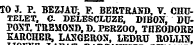
TO J . P . BEZ 3 ATJ ; P . BERTRAND , T . CHUTELET , C- DELESCLUZE , DIBOJf , DUPOST . TREMOXD , » . PERZOO , THEODORE KARCHER , LAXGERON , LEDRU ROLLIS , LIOSXE . IABAT , DARCANSITZ , LXIMARD , J . MADAS , E . FEBTRE , E . M . DE MONTJAU , JE ., GUSTAVE NAQUET , F . PARDIGOS . PETIT-JEAU , G . PHILIPPE , ROUSSIER . RIBEYROL 1 A , A . RICATEAU . SUL REAU , L . T 1 LLAIN . ASD GOGU 1 X .
Gestlemen , —In reply to your letter , I beg to inform yon , that I made no allusion whatever to those brave men who were exiled for contending for liberty in their own country . On the contrary , I esteem and honour every ' man who risks his life , or allows his blood to be shed , to secure his conntry * s liberty bat I do not approve of men of one country trying to create a revolution in another conntoy , for vhese people they have neither feeling nor respect .
As to the brave foreigners who have been compelled to seek refuge in this country , for endeavouring to secure liberty for their own the Poles and Hungarians , for instance—what man has attempted to render them more assistance than I hare ? Gentlemen , you call me a native of this country , but I am not ; but , like yourselvts , nearly all my family have been exiled , prematurely consigned to the cold grave , or obliged
to fly to some foreign land . Yon say : — The tntecedenta of this individual were , however , so well known tone , that not one among us if ouM' enter into as ; communication trith him , notwithstanding all the ad-Taaces he Las made to that effect which is no doubt our inexpiable crime in Ms ejw ; but the Englith public will iaw no dtfijcultj- in divining that , without « ur being chut assatans or incendiaries , we mav ke fully justified m regarding triih distract such afilse ' Oemocrat as Mr . Feargog O'Connor .
Now , gentlemen , let me ask you candidly , what advance I ever made to that effect ? My answer is : ! NEVER ONE IN MY LIFE . But let me tell you , in reply to your abase , that if you were poor and destitute here , I would sell my coat off my back to assist yon . And perhaps yon are not aware that I myself am 3 refugee ; and perhaps you are not aware that I have suffered ei ghteen months solitary confinement for endeavouring to secure liberty for this country . Gentlemen , I do not blame you , or censure yon , for your letter , because I am aware that it was written upon a misconstruction of my letter . The object of my letter was , to save the English people from the result that vould be sure to follow that fury and folly with which foreigners may inBpire them .
And , gentlemen , in conclusion , let me assore yon , that I meant no insult to the brave men who have been exiled from their country , bnt that my letter was solely intended for tho purpose of saving the lives of the English P ^ ple . And , notwithstanding your abuse of me , I beg to remain , Your Faithful Friend and Advocate , Feargus O'Coxxok .
-
-
Citation
-
Northern Star (1837-1852), April 12, 1851, page 1, in the Nineteenth-Century Serials Edition (2008; 2018) ncse.ac.uk/periodicals/ns/issues/vm2-ncseproduct1621/page/1/
-