On this page
-
Departments (4)
-
Adverts (2)
-
-
Text (11)
-
Untitled Article
-

Untitled Article
-

Untitled Article
-

Untitled Article
-

Untitled Article
-

Untitled Article
-

P>eu$. **?•
-

3troieiD$.
-

v anemia -~ —^ ™ .. ..... \^Z
-

Untitled Article
-

B E £S'IFUL HA "*> WHISKERS, by J£™!*? ' .#f c. »«V be, wjlh . certainty, obmlnei
Note: This text has been automatically extracted via Optical Character Recognition (OCR) software. The text has not been manually corrected and should not be relied on to be an accurate representation of the item.
-
-
Transcript
-
Note: This text has been automatically extracted via Optical Character Recognition (OCR) software. The text has not been manually corrected and should not be relied on to be an accurate representation of the item.
Additionally, when viewing full transcripts, extracted text may not be in the same order as the original document.
Untitled Ad
by J £ ™!*? ' . # f c . »« , wjl . certainty , obmlnei a 8 ra&MM ? Si I ' ortio » of 1 { OSALIE COUl'liLLE' 9 or other nro ^ rh- 1 " cvcry « K " > n 6 . instead of any oil « « nS ? SoTi ? 7 u « £ ? urtnl S «' «« e J . in most incurling Whisker , I , ? " P P DrtleE " > producing nnd cause deficient" as I ' \ ., f V . at iln > ' " «"• "• ° " «*<««•*« dren it is iiuli ' i ensabL t , *"' Krc . vncss , Ac . Por chil . S £ ftSSft w r *— SE asasaSsSSgw sffls never regret . i " WMration , windi they will Price 2 s . per pot , sent post free with instruction * In JMTSASSSSi'a * 1 == " * Jir ^ £ s ^? r& ? s ™ "« % ground on the stanm round each packiigc of her prcmn tlOllS . _ _ TESTIMONIALS , / the originals of which , with ninny others , may be seen at tlu > cttublishtnent . Mr . John Bottomlcy , Southowram . — ' Your Parisian Pomade is very superior to unytliiiig of the hind I ever met Yritli .
Untitled Ad
Beware of Guinea , Foreign-named Quacks , who Imitate this Advertisement . Pains in the Back , Grave ' , Lumbago , Rheumatism , Gout , Indigestion , LcUlity , Gonorrhoea Stricture , Gleet , d'c . T ) R . BARKER ' S PUR 1 PIC TILLS * J ( of which there are useless imitations under other title .- ) have in many instances effected a cure when all other mesins bad failed , and are i \ ovr established , by tho consent of every pjtti ™ t who has yet tried them , as also ny the faculty in . iaiSEi . vES , as the most safa and efficacious remedy ever discovered for discharges of any kind , retention of the urine , and diseases of the Kidneys and Urinary Organs generally , whether resulting from imprudence or otherwise , which , if neglected , frequently ending in stunein the bladder , and a lingering death i Tor Gout , Seiutica , Hheumatism , Tic Doloreux , Erysipelas , fula
Untitled Article
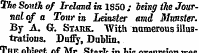
The South of Ireland in 1850 j deing the Journal of a Tour in Leinster amd Minister By A . Gr . Stark . With numerous illustrations . Dufly , Dublin . The object of Mr . Stark in his excursion was partly pleasure , partly to observe the state of the peasantry , the conduct of the landlords , and the workings of the Irish Poor-law , — chiefly perhaps to collect materials for a book which should be illustrated by his friend Mr . 31 . Augelo Hayes . He started from Dublin ; proceeded through Carlow , Casliel , Tipperary , Waterford , Cork and Skibbereen , to Bantry Bay , his extreme southern point ; and
retnrued to Dublin by the way of Kiliarney . Tho excursionist adopted various mode 3 of locomotion — railway , steam ,, public and private car ; he often left the beaten track , and examined places not much visited by the common traveller ; he sometimes lingered in a neighbourhood to inquire into its state , and the character of the gentry . He listened to all that was told him , drew his conclusions from what he saw , and tells the result without circumlocution ; in fact he may be Said to be free in his UBeof names , and in his remarks upon the circumstances and conduct
of their owners , in their capacity of landlords and country gentlemen , resident or absentee . "With the exception of a chapter devoted to Ihe Poor-law , Mr . Stark is not systematic in his exposition of the social and economical evils of Ireland , bnt he takes local facts as they tarn up . Certain things , however , come out systematically , and jobbing especially . The railways seem to have been deeply infected b y it , and even the charitable subscriptions perverted to purposes of private profit . All have heard of Skibbereen and its sufferings : according to Mr . Stark there needed have been none , except perhaps at the outset .
I have been making some inquiries as to the man " ner and amount of the relief afforded to the distressed population of this town and neighbourhood daring the memorable famine of 1846-7 . Here , perhaps , more than in any other part of the tiiisdoin , the potato blight was felt . Skibbereen owed its chief consequence to the health and a ' umidniica of that esculent ; and ot course , when it failed , the privations of the people were proportionately severe . Potatoes were the principal crop reared by the farmers—potatoes created the middle man—potatoes paid the rack rent , and helped the heartless landlord to indulge his passions . When the ro't friled , therefore , the whole fahriobuilt
oj-oii it tumbled to pieces , aad the civilized world rang with the woes of Skibbereen and the neighbouring village of Schull . And the civilized World was not deaf to the cry of agony . Contributions from every point of the compass , in money and food , from Turk and Christian , from Jew ana Gentile , Gael and Saxon poured in to mitigate the horrors of famine . At one time it was feared that humanity -would give up in despair the task of Saving Skibbereen . Money Bent to it seemed like oil thrown on a fire to extinguish it . It was . a vortex that swallowed up everything . Thousands trerc squandered : and if venerable divines and letter writing philanthropists were to be believed
the people perished nevertheless . It has been calculated tbai ; as much money and food was sent to Sk hbcrcen from charitable bodies as should have fed and clothed the entire population for a twelvemonth . Far he it from ma to insinuate that any orie rivalled the licentiate in Gil Bias , who made fumsolf rich by taking care of the poor , and turned to his own use the donations intrusted to him to prevent hia fellow creatures dying of the worst death known to human nature . Still some explanation is necessary , or , perhaps , in future , should Providence ever visit this country with new horrors , the fonntain of charity m many a bosom will be sealed up by doubt and suspicion . The money and food disbursed by the Belief Committee were
duly accounted for , because the Government , which contributed pound for pound , insisted upon the production of a cleat statement . Every penny expended by the Society of Friends was also made patent to the public . But others have not been equally explicit . The Reverend Mr . Townsend , Protestant Sector , was an indefatigable collector Of money and provisions , and was eminently successful , owjd £ to the touching appeals he made through the public journals ; yet I am told that ne gave no Dr . and Cr . accounts of his benevolent services . Sorao apparently well-informed persons roughly estimated the amount of money , &o ., received by the reverend gentleman as not less than £ 14 , 000—but this , I think , must be exaggeration- * - and said that the value of his devotion and
sacrifices wonld ho greatly enhanced by a full revelation . It is all very well , they said , in distributing your Own goods , to follow the Scriptural injunction , and not let your left hand know what your right hand doetV , but the rule , they think , does not hold when you are dispensing the donations of other people . The Catholic Clergy—whose duties during the crish must have been of the most awful kindalso received great means in caBh and necessaries ; bnt they avoir the utmost eagerness to " render anjaccount of their stewardship . " Indeed , publicity , onocacnot help concluding , would answer every good purpose .
According to Mr . Stark , the Great Southern and Western Railway is a good example of jobbing at the beginning : bnt landlords , we suppoBB , have to be propitiated everywhere , and the lavish expense in proportion to the object is national —" when nothing ' s left that ' s worth defence , we bnild a magazine . *' The terminal of the Great Southern and Western Eail « vay Company , at King ' s Bridge , is a stupendous illustration of the contrast we 80 often observe in Irish " enterprises of ] great pith and moment " between splendid beginnings and indifferent results The hugb architectural pile—beautiful in its design , and constructed with a lavish waste of the
VaWornmn ore , that reminds as of the building of Solomon ' s Temple—seems , with its endless succession of offices , stores , vaults , and warehouses , to offer accommodation for the entire traffic of Liverpool , Manchester , Birmingham , and Glasgow . Everything—from the luxuriously-appointed boardroom of the directors , with its Morocco-covered loungers and gorgeous carpet , in which your feet Blnk as on a bed of most , down to the fire-shovel with which the begrimed stoker feeds hi 3 slave the steam-en » ine—is of the most costly and substantial quality . While the reflecting stranger contemplates all these things , which are usually " theoutward and visible signs" of long-established prosperity
and permanent wealth , he cannot help thinking , that , in a country like thiB , which is proverbially poor , and , in the opinion of many , not ripe for railway communication , if much of the money which had been squandered in superfluous buildings , or in the unnecessary adornment of works of utility , had been devoted to purposes of practical advantageinch as the establishment of manufactures along the line , which wonld have fed the traffic returnsthe condition of the shareholders would not be so deplorable as it is now represented . The site choseu for tbe erection of the magnificent terminus seems to have been unhappily selected for the uses ot the railway , as a formidable hill has to ha
surmounted by the train immediately after it starts . Practical engineers assert , that had the spirit of jobbing not governed the counsels of tho directors , BWch more favourable gradients could have been obtained , by adopting , as the locale of the terminus , * position nearer to St .. James ' s Gate , which might have" been procured at a comparatively moderate expense , as it only involved the purchase of a ruined street and some dilapidated tenements . Had mis been done , the ludicrous scene which is of daily occurrence on the line would not have been Presented . As the string of carriages , in one of ^ irieh I was placed , toiled up the hill , at the rate cf aaout a mile per hour . I Lad the curiosity to put
Untitled Article
my head out of the window whC * certainly was amused by an exhibition which is a Remarkable teature m travelling by steam in the mi ^ d ! ° of "' e nineteenth century . Two porters , armed wit . ' lluge mops , preceded the snorting engine , and diHgi'tuty scoured the rail 3 , _ reminding one of the Scutun game of curling , in which the sportsman with lii « Brush industriousl y sweep 3 away all the obstacles on the ice , and coaxes as it were the stone to a further advance . It was laughable to remark the sangfroid with which the railway precursors flourished their mops , cleared awav the dust from the ? I ^ l ^ tura in . fLwii :. ™ I- .. ™ ' V ? . * Mrfi .. ,. f „ . „
rails , and then sat down to await tho approach of the train , not to be cut into pieces , but to quietly get up and recommence the application of their smoothing process . As the carriages finally topped the hill , they contemplated them with a r ^ lf-uomplacent " we-alone-did-it" sort of look , tiia ; seemed to demand the gratitude of all the passengers for having been enabled by their exertions to overcome the formidable engineering difficulty . According to information received in a railway carriage , Queen Victoria saw the Lehis ter property after the manner in which the Empress Catherine saw the Crimea .
" Ihe change in the condition of the Duke ' . « tenantry and peasantry must have taken place very suddenly , " I remarked ,- " as on tbe occasiou of the Queen ' s visit to Carton , we were told that all went ' merry as a marriage bell , ' and every body was comfortable and happy . " "Ah , sir , " said my fellow traveller , with a look of indulgent pity at my simplicity , ' it would have been better if the Queen had never come to Irolai . ti at all , than that she should have been blindfolded in the way she was ; and only that I am told sho is a shrewd little lady , full of intelligence , who looks under the surface of things , she must have been deceived by tho state of apparent comfort which she witnessed on tbe only occasion when she penetrated into the interior of the country . She came down to Carton in a carriage drawn by four
bloodhorses , which carried her over the country at a much quicker pace than we arc now going upon this rail way . The Duke had made a wise provision that nothing unsightly should meet the royal eye during the journey ; for half-a-dozen fleet horsemen preceded the carriage , whose business it was to falsify the old adage that a cat may look at a king . ' Wei ! dressed persons were allowed to remain on the road and take off their hats and cheer the Queen ; but all wandering beggars and vagrants were , without ceremony , whipped over the hedqe into tbe fields , and compelled to remain there in obscurity until the royal train had passed . " " Still , " 1 remarked , " her Majesty's heart must have been gratified at the Bight of the 'boldpi'a-Eautry , their country ' s pride , ' -who appeared so gaily on the lawn of Carton House . "
" Ha ! ha ! ha !"—and the fat grazier roared with laughter , like one that had the lungs of a Stentor . " Bold peasantry , indeed ! Do you know what , sir —it is twenty years since I was in the Theatie Royal , Dublin ; but the last time I was there I saw much more joyous peasants disporting themselves on a lawn on the stage in Hawkin ' s-street ; and of the two I think Mr . Calcraft is a better manager than the Duke . I was at Carton , and can tell you that no one who was not up to the mark in the matter of dress , no person out at the elbows , or whose locks made their appearance through the roof of
his hat , was allowed to approach the lawn . Why , the fellow who danced the Irish jig you have heard so much of , and who was dressed in a cutaway grey frieze coat , corduroy breeches , and worsted stockings and knee-buckles , was a dancing-master from Carlow ; and his fair partner , with the short , homespun petticoat , was a bar-maid from an inn in Athy , who appeared , by particular desire , in that garb ior the first time in her life , and for that day only . " " Any one for Mageney ? " roared the guard . "I am , " responded the grazier ; and my " fat friend" vanished .
A portion of the volume is devoted to an examination of several workhouses that employ their paupers , ( and from tbe necessity of tbe case , generally in handicraft or manufactures , ) as well as to a consideration of pauper labour in connexion with its alleged particular benefits , and the general objection upon principles of political economy . The mere dogmas of political economy are not to be taken absolutely , unless they can be supported by reason . After all there are larger questions connected with a state than the laws that regulate the production of national wealth . Anv one who
wrote under the Poor Law system as administered before the changes introduced during the Revolutionary war , or who looks to the object of the Elizabethan statute , must be held to advocate work by paupers if he advocated a Poor Law . Compulsory work for the able bodied is the very essence of the statute , as indeed the name of icorihouse implies . The question requires examination upon principle . There can be no doubt , but that if these occupants of a workhouse could be made to produce everything they require— " to keep themselves " - —their labour would be purely beneficial . The rates would be reduced to the rent
of the buildings and the cost of management , while the paupers would no more interfere with the labour-market than if they had been sent to a distant country . All the food or raw mater ials that paupers can raise beyond the absolute cost of raising is pure gain . It is no valid objection to say that tbe pauper ' s labour is marketably unprofitable or unproductive ; that it costs more to keep him than he produces . Kept he must be though he does nothing : if it costs three pounds a year for his food and he produces only one pound , it is still a pound gained . There is also tbe use of his improvement of the land .
The case of manufactures or handicraft , and still more the making-up of goods—as garments , shirts , &c . —for sale out of doors , is not perhaps so easily settled . But we think that whatever the pauper uses , that he may properly produce—if he can he brought to do it . But as to articles made for sale , it is a direct interference with independent industry . The taking in work is still more open to question . From the nature of tbe case , it is likely to create a ruinous competition , and to make two or three paupers instead of one . But this part of the question lies deeper than workhouse work . Something is rotten in that state of society when the unwilling and the unskilled labour of paupers has a palpably injurious effect upon employment and wages .
Untitled Article
The History of the Jews in Great Britain . By Rev . M . Mabgououih . Three Vols . London : Bentley . The author of this book of course writes from the Jewish point of view ,, and whatever may be thought of his skill , or the peculiar opinions entertained by him , has succeeded—out of the abundant materials at his disposal—in making a very readable book , if not quite entitled to the appellation of a history . It would exceed the space at our disposal to follow even an
outline in the career of the Hebrews , since their first introduction into this country , or to give an idea of the cruel and merciless persecutions to which they -were exposed at various periods . We prefer , therefore , to , extract a few passages of popular interest . Here is an old friend as he presented himself in the days of the Duchess Mazarine . * It is curious to notice how little " The Wandering Jew " has altered since that time in his traditional lineaments : —
He says be was an officer of the Sanhedrim at the time that Pilate condemned ChriBt , and remembers every particular relating to the Apostles : that he struck our Saviour-at the time of his coming ont of the judgment hall , and was therefore condemned to live till his last , coming . That be had travelled into every corner of the world : and pretends to cure diseases by a touch . He speaks several languages , and gives such a just account of past ages , that people do not know what to think of him . The two Universities sent Beveral doctors to examine him , who with all their utoll were not able to discover the least contradiction in his discourse . One very learned man spoke to him in Arabio , and he answered in the same tongue—telling him that there was 6 carce a single hiBtory in the world that
was true . The same gentleman asked him what he thought of Mahommed ? He answered , he knew him very well ; that he was a man of good understanding , but subject to mistakes as well as other men — particularly in denying that Jesus was crucified ; " for I saw him ! " said he , i " nailed to the cros 3 , with mine own eyes ! I was likewise present at the burning of Rome , by Nero ! " He said likewise , that ho saw Saladin returning frqni his conquests in the Levant , and told several particulars relating to Soliman the Magnificent . He affirmed , also , that he had seen Tamerlane and Bajazete ; and gave an ample relation of the wars in the Holy Land . The common people give out that he works miracles ; but the wiser sort look upon him as an impostor . Perhaps the same individual personified elsewhere , the Messiah , for it is singular that that
Untitled Article
LKrfl " ' thegrea t impostor , Wd Claim to the Messiahship of Israel . ^ Arnong the most interesting particulars in Mr . Margoliouth ' s volumes is , the account of remarkable persons who have embraced or for-Siikea the reli gion of the Hebrews . Perhapsthe most remarkable convert made to Judaism in England was Lord George Gordon-the hero of the No Popery Riots of 1780—who completed a life of religious fanaticism by public apostacy . Mr . Margoliouth has obtained from Hebrew sources some curious information about this erratic personage in his late years . In London : — ™ the Messiahahip of Israel .
Lord George Gordon attended the Hamburgh Synatiogue , where be was called up to the reading of tli « l : iw ; and was honoured with Me Sliebaynich . He prost-nted that synagogue with £ 100 . Ho then went to Paris , and wrote a book against Alario Antoinette , Queen of ¦ France , which proved libellous , and subjt'cteit his lordship to imprisonment at 2 ? ew-• r . 'itc . Whilst in prison , he was very regular in his Jewish observances ; every morning he was seen with h ' i 3 phylacteries between his eyes , and opposite to his heart . Every Saturday he had a public service in his room , by the aid of ten Polish Jews . He looked like a patriarch with his beautiful long
board . His Saturday ' s bread was baked according to the manner of the Jews , his wine was Jewish , his meat was Jewish , and he was the best Jew in the congregation of Israel . On his prison wall were to be seen , first , tho ten commandments , in the Hebrew language , then the bag of the Talitb , or fringed garment , and of tho phylacteries . The Court required him to bring bail—he brought two poor Polish Israelites as guarantees . The Court would not accept them , because of their poverty . The rich Jews would do nothing towards assisting the prisoner , for fear of a persecution . in itr } ' f 5 br 0 k ? healt ' and wwintemd lu the Gordon family vault .
The laying him in the family vault was contrary to his wish : as , to the last , be expressed the strongest desire to be buried in the sepalchres of the ancient people . Though proud of their . noble convert , the Jews gained no advantage from his conversion ; and the balance was struck against them by tho conversion of David Ricardo , the political economist , and Sir bampson Gideon to Christianity . There is a lengthened account in these volumes of the rise and history of the Rothschild family : —from which we extract the following story illustrative of stock-jobbing moraluy and throwing -a new light on the maxim "Ihere ' s honour among thieves"
ran 3 ? ?? JOff financler lived on Stamford Hill there resided opposite to him another very wealthy dealer in stock exchange , Lucas by name . nvhtnS ^ r ? ° 2 ght ^ late ' from a <™ yiual party ; he observed a carnage and four standn » g before Rothschild ' s gate , upon which heordered his own carriage to go out of the way , and com . mnndedI his coachman to await in readiness his re * turn . Lucas went stealthily and watched , unobserved he movements at Rothschild ' s gate . He did not he long m ambush before he heard a party leaving the Hebrew millionaire's mansion ? and going towards tl > o carriage . He saw Rothschild accoropamedbytwo muffled figures ,, step into the carriage , and heard the word of command « t «« m
my - ue followed Rothschild ' s carriage very cosely . But when he reached the top of the street in which Rothschild ' s office was situated Lucas ordered his carriage to stop , fr om which he stepped out , and proceeded , reeling to and fro through the street , feigning to be mortally drunk . He made his way in the same mood , as far as Rothschild s office , and san s ceremonie opened the door , to the great consternation and terror of tho housekeeper , uttering sundry ejaculations , in the broken accents of Bacchus' votarieB . Heedless of the aff D .. u-, » use ^ eeper s ren' ° nstrances , he opened Rothschild ' s private office , in the sam « ai » nn »; nn
attitude and fell down flat on the floor . Rothschild and his friends became greatly alarmed . Ef . forts were made to restore and remove the wouldbe-drunkard , but Lucas was too good an actor and was therefore in such a fit a « to be unfit tobo moved hither or thither . « Should a physician be sent for ? ' asked Rothschild . But the housekeeper threw some cold water into Lucas ' s face , and the patient began to breathe a little more naturally , and fell into a sound snoring sleep . He was covered over , and Rothschild and tbe strangers proceeded unsuspectingly to business . Tho strangers brought the good intelligence that the affairs in Smdn were
an right , respecting which the members of the exchange were , for a few days previous , very apprehensive , and the funds were therefore in a rapidly sinking condition . The good news , however could not , m the common course of despatch , be publicly known for another day . Rothschild therefore planned to order his brokers to buy up , cautiously , all the stock that should be io the market , by twelve o clock the following day . He sent for his principal broker thus early , ia . order to intrust him with the important instruction . The broker was rather tardier than Rothschild ' s patience could brook ho therefere deteimined to go himself . As soon as Rothschild was gone , Lucas began to recover , nnd by degrees was able to get up , being distracted as
hesaid . Mwith a violent-head-ache , " and insistedin spite of tho housekeeper ' s expostulations—upon going home . But Lucas went to his broker , and instructed him to buy up all tho stock he could get by ten o ' clock the . following mornis * . About eleven o ' clock , Lucas met Rothschild , and inquired satirically how he ( Rothschild ) was off for stock Lucas won the day , and Rothschild is said never to have forgiven "the base , dishonest , and nefarious stratagem . " In another place , Mr . Margoliouth speaks thus of the great " lion of his tribe " : — .
Yet , with all his hoardings , Rothschild was by no menns a happy man . Dangers and assassinations seemed to haunt his imagination by day and by night , and not without grounds . Many a time , as he himself said , just beforo he sat down to dinner , a note would be put into his hand running thus : — "If you do not send me immediately the sum of five hundred pounds , I will blow your brains out . " He affected to despise such threats ; thev nevertheless exercised a direful effect upon the millionaire . He loaded Mb pistols , every night before he went to bed , and put thorn beside him . He did not think himself more secure in his counting-house than he
did m his bed . * * It must be moreover confessed that tbe members of the synagogue generally did not entertain the same respect for him as the foreign Jews do for the Rothschilds of Frankfort . Some thought he might have done more for liis brethren than he did , and that if he had only used the influence which he possessed with government and the many friends which he had at Court , all the civil disabilities with which the British Jews continued to be stigmatised would have been abolished , when the proposition was first mooted . ' But Rothschild , " said an intelligent English Jew to the writer , " was too great a slave to hism ' oney . and all other slavery was counted liberty ia his sight . "
Untitled Article
The Exposition o / 1851 , or views of the Industry , the Science , and the Government of England . By C . Babbage , Esq . Murray . - The able and practical author of this work on the great event of the year , has made it a peg on which to hang discussions on almost every variety of topic . Many of them have but slight relation to the chief subject , but as incidental to , and arising out of it ; they possess great and living interest , not only from their own intrinsic merits but the style in which they are treated . In our extracts we shall confine ourselves to such as have reference to the
Exhibition itself . Mr . Babbage thinks that two great errors were committed by the Royal Commission . The first , in the selection of the Bite , and the second , in not permitting exhibitors to affix prices to their articles . He would have preferred the part of tho Park next , to Park-lane , which he calculates would have saved many miles either of walking or driving to those from the eastern part of London . That , however , is mere matter of
opinion ; but the argument to prices . has more weight , and we believe we are right in sayiDg that the Royal Commission abandoned their original intention of allowing prices to be affixed togoods only at the instance of a powerful . body of exhibitors themselves , who expressed their dislike to that regulation through the local committees . The following illustration of the minute circumstances , which will sometimes influence a purchaser in his choico of an article or of a shop , will commend itself to most readers .
Let us suppose that a lady having somo leisure goes out in search of a , fan . She passes several shops in which they . may . or may not be , kept for sale . She sees some fan ' s in a shop window , but as they are not ' open she' passes on , intending to return to-them if she cannot suit Herself- '¦ elsewhere . A few doors beyond there are some fans open , but none of them exactly suit her taste , and she does not like to give the owner of the shop the trouble of opening a number of fans , none of which may please her . In the nest street sho sges iu the window of a shop some fans , which are open . One of these appears to suit her , but there is so
Untitled Article
pnw marked on it * T 7 ~~ ======= shop and examf ^™ . ° t Hke to go into the Bubtlo implement T K rai ? utel y whether the strength to $ EL \ VTu has 8 ufficient be too expensive £ h d Jt 8 ball"ro ° ra trials . ' «* it beyond Motheri "A pur ^ Afihorfc distan % ce selves to her notica h ? 5 i ? - ^ f ™* vre 8 eni the » - eaoh of thcin £ if ^ T ? of an ° ther shop , ' *• One ^ tSS ttW ? ° ^ mM ' kedu P ° little , to the £ 8 hp h h o e f atln * ^ , prefers , a solves to enter thK « iL / Ppr ° - ' sho re " perceiving toKiM ^ i . - ° > But dant in the aZZ ?* W ^¦ * k '" ° * tten " dinner , or 3 , ™ ¦ U x mistrGSS ma y ^ at toy . to ' Ut £ T » l ? uZ " babyj andalio not disturb hS not" ° « L-n cons . eq « ence-I will finds a shopTn h ?« ' fW 1 p , asslnS onward , she fan , althonSi hot lf 7 md 0 W Of , which is a P ™" T witW &Bita ' tR £ °° 'I s tllG las Una Ait . nJl ™ r ° pkeeper-buUh 9 dnnx ;« -.- shott and « v , ^ -. Shedo 8 snot like to eo into tint
, haveeni edTk ffihn T " ' ° - ™' suitable she had va ^? t - ? notthe ™ st posed in the STi ' h ° , g tliat tho fana ex " in store Sin * ^ 1 ^^ T ^ f , f ° ? . » k « P » ments removed a f , n k f m ? ' - i mpedi - open In theWindow » iS *•' , " " i ljr s , ult her les an attendanH ?? n Jl I th lts P rico clearly marked , bly 12 Shfl I \ the 8 h ° P > a ^ the door is hospita l it wS SadS n V ¦ a ? d examines ifc ' and filldin P same class ? ft n f ! Whother there are otllers of the it 7 ^« S ! f ? Pattern ; to . whioh tho reply is , that cha es th A ° u . romainin g- U tnis she purthe foiw / S aIfc ! l ° S h had she entcred « " « & of more eS ^ P ? 8 ] 16 ^ ht ^ vo found , fans both The JS , 5 ^ hel > taste and a * » less price , lnet marling has decided her choice . Within the Crystal Palace itself , Mr . Bab-™ £ l * ? . far the absence of triced EZ / r i 5 view t 0 dimiDi 8 h ^ o wefulness of the collection . —
now ^ Mrl " 8 I 5 allmdeed in numher ' but important from its functions , suffers the greatest inconvenience from tho absence of price Those engaged in studying tho commercial and economical relations of various manufactures , either for the gratification of their own tastes or for the instruction of the public , are entirely deprived of the moat important element of their reasonings . If men article had its price affixed , many relations would strike the eye of an experienced observer which might lead him to further inquiries , and probably to tue most interestin
g results . , But it is quite impossible for him to write to any considerable portion of 15 , 000 expositors for their list of prices or even to go round and ask for ifc in the buildup itself . Price m many cases offers at once a veriffcation of tho truth of other statements . Thus to a person conversant with the subjects , the low price of an article might prove that it had boon manufactored m some mode entirely different from that usually practised . This would lead to an examination of it , in order to discover the improved process . Ihe »« ce of an article compared with iu
weight might prove that tho metal of which it is made could not be genuine . The price of a woven fabric , added to a knowled ge of its breadth and substance , even without its weight , might in many cases effectually disprove the statement of its bein » entirely made of wool , or hair , or flax , or silk , aa the case might be . The exchange of commodities between those to whom Buch exchanges may bo desirable being the great and ultimate object of the Exposition , every circumstance that can give
publicity to the thingo exhibited should bo most carefully attended to . The price in money is the most important element in every bargain ; to omit it is not less absurd than to represent a tragedy without its hero , or to paint a portrait without a nose . It commits a double error : for it withholds tho only test by which the comparative value of things can 1 ) 8 kno ^ TO , and it puts aside the greatest of all interests , that of the consumer , in order to favour a small and particular class—the middle-men .
On the subject of prizes Mr . Babbage has Borne very excellent suggestions ; which if the plan of keeping the Exhibition permanentl y open as an universal gallery of art and produce shall be realised , will be found worthy of full consideration by those who will succeed to its management . For example , he says : — One of the inventions most important to a class of highly skilled workman ( engineers ) would be a small motive power , — ranging , perhaps , fromtho force of half a man to that of two horses , whick might commence as well as cease its action at a moment ' s notice , require no expense of time for its management , and be of moderate price both in
original cost and in dail y expense . A small Bteam engine does not fulfil . tbeBe conditions . In a town where water is supplied at high pressure , a cylinder and a portion of apparatus similar to that of a high-pressure engine would fully answer the conditions , if the water oould be supplied at a moderate price . - Such a source of power would in many cases be invaluable to men just rising from the class of journeyman to , that of master . It might also be of great use to many small masters in various trades . If the eO 9 t per , day were even somewhat greater than that of steam for an equal extent of power , it would yotbe on tiio whole mtoch cheaper , because it would never consumex > ower ' wiihout doing workIt ht bo to
. mig applied small planing and drilling machines , to lathes , to grindstones , grinding mills , mangling ; and to a great variety of other purposes . In all large workshops a separate tool or rather machine , is used for each process , and this contributes to the economy of the produce . But many masters in a small way are unable to afford auch an expenge , Hot having sufficient work for the full employment of any one machine . Of thisclass are many jobbing masters who live by repairing machines . Such also are that class of masters who make models of the inventions of others and carry out forthem their mechanical speculations . To these two classes that of amateur engineers may be added
The lathe with Us sliding rest is the basis of their stock . With this they can drill , and with the addition of a few wheels can cut screws . The further addition of a vertical slide will enable them to plane small pieces of metal by means of facing cutters on the mandril . By other additions tho teeth of ; wheels may also be cut , and in some rare cases a lathe may be converted into , a small planing machine . The loss of time in malting the changes necessary to enable the lathe to fulfil all these different-functions , necessarily confines its use to the peculiar classes alluded to above ; but to make these changes is often less expensive than to be oblk'ed continually to send to larger workshops where
the heavier portion of their work can be exeouted . It would certainly bo desirable , if some good plan cannot be devised for bringing the whole of such operations within the reach of one machine of moderate price , that at least a system should bo devised for combiningthem in two separate machines . Some readers may possibly think such combinations as have been mentioned too minute and special for the subject of a prize ; bnt when it is considered that they bear upon the interests of one of the best classes of workmen , and how important it is for the
welfare of the oommuriity that skill , industry , and intelligence should be assisted in their efforts ' to rise in tho social scale , these details will be excused , In making known and meeting practical wants of this kind we expect to find one of the best material results of the Exhibition . ' . As we have said , there are many other subjects dwelt on more or less by Mr . Babbage in this volume ; and every student of theoretic or practical science will find hints and suggestions of value in its pages .
Untitled Article
The Absconding . Witnesses or St . Aibans . — Captain R . A . Gossott , the assistant serjeant-atarms of the House of Commons , has reported : to Lord Charles RusBell , the serjeant-at-arms , that , in compliance with his lordship ' s directions , he proceeded last , month to Boulogne , to endeavour to obtain information respecting the witnesses in the St . Alban ' s case , who had absconded . On his arrival at Boulogne he waited on the British consul , who acebnipained him to the police and passport offices . ' From ..-too official books he there learned that Georgo Sealey Waggett was lodging : at No . 52 , Rue de THopital , and that James Skegg and Thos . Birohmore were at a small public-house on the port , called the Anchor and Hope , and that the only
other lodger there was a Mv . Frederick , Edwatds , nged twenty-six ' . ' He also learned that John Hayward . had been at the Hotel des Bains for two nights , but had left for Paris about ten days before . He desired Inspector Beckerson ( the officer employed to watch the parties at Boulogne ) to call on Waggett , which he did , and gave him a copy of the proclamation offering a reward for his apprehension . . After reading it . Waggett said ho certainly should not return to England , as he understood the Speaker ' s warrant was of no avail at Boulogne , and thought of moving to some place in the interior of France if ho could obtain a passport . Waggett further stated that he was not aware of Skegg and Birchmore being at Boulogne , but that he had seen Hay ward , who had gone to the Paris races , and had not returned . The inspector observed that he
must have been at considerable expense in coming from England , and remaining in a foreign place , to which he replied , that he had been as yet 'Hiving on a small income of-his own , but he was getting very short of money , and they must send him some without delay . "' Hethen seemed , to think nehad said too much ; and changed the subject of conversation . . With reference io Skegg and Birchmore , he ^ had been made aware . that it would bo vei'y difficult to secure ah -interview with them at their hotel . He therefore made a point of meeting them on the Sands , where they took daily exercise , and endeavoured to enter into conversation with them , but it was of no avail . Captain Gossett , in conclusion , states that tke police authorities at Boulogne have been most active in watching the parties , and had afforded every information ,
Untitled Article
Mark other men ' s shipwrecks thy sea marks . Troubles are like dogs—the smaller they are , the more they annoy you . The new planet has received the name of Irtm from the Greek word Eirene , signifying Peace . Cons . —What would be likely to give tho best report of a fire?—A ' powder magazine . . Wh y 16 the street door like a barrel of beer . '—Because it's frequently tapped . Why is London milk like a Bank of England note ? -because it is not current without the water-mark . , »»» ul - t a bar ^ treat certuil 1 let « rs of the alpl bet with severity J-When he tics up queues (( As ) and puts toupees two ( P ' s ) in irons . - iMPBovaMNTS
in BuicKs .-An improvement re-Vl "" ff , ? the formation of bricks is to shape PJS ' ? ' 1 - -Ifc 1 appears that the recent Papal of 11 ntw ' e - "l \ f ffect of increasing the funds ot the Bible Society by £ 12 , 000 . oflSV ?! ' ? " a ° » ucE .-Thedeclared value SS-a-irar ' Sr ^ 'ftWiaa ; V ^ l T Cos ^ community £ 100 , 000 . Mr H ^ "; herighteou 8 PenaIt F inflicted by G « rS ? ' | ° - "•? ° fficer of lh « Coldstream Somerset ' mlUly CalIed " J « 8 tice throwing a oenSnVf T- "" . ^ " ^ the flmou » t ex-S £ ^?!^ ra = » eo expended annuallis calculated at £ 2100 000
y , . A Rkquesi Complied With .- " Tom , tell . the & » V aI-Ti told ' , ' 11 e * e you a glass of Happiness . —The fruit of falsehood is folly the endofolyisruin Thefmitof truth is wisdom the end of truth is happiness . A cation ' s true happiness , therefore , rests on wisdom . CnitBAN . —Some one asking Mr . Curran why a countryman of his walked about London with his tongue out of his mouth , he said that he " supposed he did so in hope to catch the English accent . Very Tempting . —An aged Quakeress , the other afternoon , was seen intently gazing upon a piece nf brocaded silk , displnyed in a linendraper ' s simp in Fleet-street . Acockneypasser-byobserved , that it was Satin temptine Eve .
A Buddist . —The Colombo Observer ( Ceylon ) records the case of a Buddist who lately committed suicide , " hoping in the next birth to assume the shape of some animal , and thereby to be enabled to torment another person with whom he had quarrelled ! ' H Doctors . —That was a " bit of a wng" who said , " When my wife was very sick , I called an Allopathic physician ; she got no better . I then called an homoeopathic , and she ' mended a little . ' One day he broke his leg , and couldn ' t come at all : then she got well !'' Motives . —The true motives of our act ' iorn , like the real pipes of an organ , are usually concealed ; but the gmlded and the hollow pretext is pompously placed in front of the show .
Good Advice . —One day the philosopher Bias found himself in the same vessel with a crowd of sorry scoundrels . A tempest came on ; and in-Btantly the whole band began t 9 invoke the succour of their gods . " Be quiet , you wretches ! " said thesa » e ; "if the gods perceivo that you are here weave lost !" A gutta pevcha tube has been placed in a colliery in Wales , haying a shaft 400 feet deep , whereby a whisper , either trom ihe bottom or top , is instantly heard : a whistle calls attention , and then follows the message . A great source of mischief will be thus abolished by the use of this safe and expeditious mode of communication .
NoVEti Invention-. —The Lancaster Gazette describes an invention for lighting up turret clock faces with gas lights , on a principle which is perfectly selfregulating . The clock lights itself at the proper hour , namely , at sunset each ni » ht , and extinguishes itself at sunrise each morning , and follows the sitting and rising of the 6 un from the shortest to the longest day , and again from the longest to the shortest day , with only a haf-yearly adjustment . A Useful Hint . —A plain-spoken woman lately visited a married woman and said to her , " How do you contrive to amuse yourself ?"— " Amuse , " said the other , staiting ; " do you know I have my housework to do ?"— "Yes , " was the answer , " I seo you have it to do ; but as it is never done , I conclude you must have some other way of passing your time . "
LIGHTENING THE SHIP . It blew a hai'd storm , and in utmost confusion , The sailors all hurried to get absolution ; Wliich done , and the weight of their sins they'd confess'd , Were transf ' err'd ( as they thought ) from themselves to the priest ; ¦ To lighten the ship and conclude their devotion , They toss'd the poor parson souse into the ocean ! Joint Literauy LABoua . — When " the committee of . tbe French Academy were emph yed in preparing the well known Academy Dictionary , Cuvier , the
celebrated naturalist , came one day into the room where they were holding a srssion . "Glad to see you , M . Cuvier , " caid one of the forty ; " we have just decided a definition which we think quite satisfactory , but on which we should like to have your opinion . We have been defining the word Crab , and have explained ic thus :-Crab , a small red fish which walks backwards . " " Perfect , gentlemen , " said Cuvier ; " only , if you will give me leave , I will make one small observation in natural history . The crab is not a fish , it is not red , and it does not walk backward ? . With these exceptions , your definition is excellent . " ¦ .
Weight of the Bells in Exeter Cathedral . — In the South Tower are eleven bells , ten of which are rung in peal , being the largest and heaviest set in the kingdom , the tenor weighing 2 , 000 lbs . heavier than any other of that denomination in England . The weights are as follows : — Grandison ( Tenor ) 7 , 522 lbs . Stafford 5 , 250 Old Nineo'Clock .... 4 , 300 Cobthorne 3 , 400 Doombell 2350 Fox ..... 1 , 700 Four th Bell on the ten 1 , 400 Pougamouth ( not rung in peal of ten ) 1 , 250 Third Bell on the ten i , ] 5 Q
Second Bell on the ten l inn oecona lien on the ten . „ HOQ Treble Bell 1 , 000 In the North Tower is the Gnat Bell , weighing 12 , 500 lbs ., on which the clock strikes : it was formerly rung by the united exertions of twenty-four men , and its deep sonorous tone was heard at the distance of many miles — 'P . G . B . The Summer of 1851 . —A journal published at Potsdam gives the following predictions , drawn , says the writer , from observations made on natural occurrences : — " The summer of 1851 will be as warm as
that of 1811 , and will consequently surpass in heat the seasons of 1722 , 1831 , ami 1832 ; for , firstly , the years 1849 and 1850 correspond exactly by their temperature with those of 1810 , 1821 , and 1833 , and with those of 1840 and 1841 as regards wet and floods ; secondly , the winter of 1850 resembles those of 1810 —1811 , 1821-1822 , 1833-1834 , and 1841 , for the mildness of the temperature and other' peculiarities ; thirdly , that the summers which we have just mentioned were preceded , as in the present year , by shocks of earthquake . "
Card Playing applied to Nauticai . Purposes . —A captain well known in the merchant service , in con 6 equ . ence . of the . scarcity of sajlors , had to take green hands , or landsmen . Finding it impossible to teach them the " ropeB" of his ship , and fearing a storm , he adopted the following plan for their instruotion . Calling his crew to the quarter deck , lie asked them if they could play cards , and receiving an affirmative , answer from them , he . immediately took a pack of cards and . placed them on the principal rope—the ace on one , the king on another , * c . When the gale came he gave orders ' to haul" taut" on the jack of diamonds , overhaul the ace of spades , let go the ten pf olubs , cast off the dueee of hearts , &c , and in three days he asserts he had as good a working crew as an ? captain need wish for .
The AuTHOBiras at Fault . —When Professor Marjolin , a celebrated French surgeon , commenced life he was extremely poor—so much so , that he was unable to pay the rent of a wretched dissecting room which he had hired . On the expiration of the first quarter , the bailiffs were sent in to seize for non-payment of rent . Marjolin received them with great courtesy , and dwelling in pompous terms on the fragments of decomposing mortality which composed his whole stock in trade , encouraged the law-limbs to " seize his effects . " At the same time he reminded the authorities , that they were bound to preserve the said effects for a month " without degradation or injury , and to return them on offer of payment in the same state as when seized . " It ia unnecessary to say that the conditions were declined , and Marjolin allowed to continue for a few quarters more , until brighter days shone . The great surgeon used to tell
this story himself with infinite glee . —Medical Times . The New York Picayune has a story about a lawyer and a olient . The latterhad been arraigned for stealing a set of silver spoons . The articles were found upon the culprit , and there was no . use in attempting to deny the charge . The counsel seeing no escape except on the plea of insanity or idiotoy , instructed the fellow to put on as silly a look as possible , arid when any question was put to him , to utter in a drawling manner , the word " spoons . " ' If successful the fee was to be twenty dollars . The man did so , and was told to go about hia business as a fool When they had got hUo the taUthe oonnwltapped his client on the shoulder , saying , " Now , my good fellow , that twenty dollars . The rogue looked the lawyer fall in the face , and putting on a grotesque and silly expression , and winking with his wes . exclaimed , " Spoons ! " and then made tracks .
Untitled Article
THE KINGL 1 EST KINGS . 3 o ! ye who in a nohle wort , Win scorn , as flames draw air , And in the way where lions lurk , God ' s image , bravely bear ; Though trouble-tried and torture-torn , The kingliest kings are crowned with thorn . Life's glory , like the how in heaven , Still spriugcth from the cloud ; And soul ne ' er soared tho starry seven , But pain ' s fire-chariot rode . They ' ve battled best who ' ve boldliest borne , The kingliest kings are crowaed with thorn . The martyrs red crown on the brow Doth into glory bnrn , ' And tears that from love ' s torn heart flow , To pearls of spirit turn , The murkiest hour is mother of morn , The kingliest kings are crowned with thorn . As beauty in death ' s cerement shrouds , And stars bejewel night ; God-splendour Iive 3 in dim heart-clouds , Aud suffering nuraeth might , -And dear heart-hopes hi pan ? s are horn , The kingliest kings are crowned with thorn . Lyrics of Love , or Voices of Freedom By Gerald AIasskt . THE TnvftT . TP . RT Trrv / ie
P≫Eu$. **?•
P > eu $ . **?•
3troieid$.
3 troieiD $ .
V Anemia -~ —^ ™ .. ..... \^Z
v anemia - ~ —^ ™ .. ..... \^ Z
Untitled Article
83 June 21 , 1851 . THF NnRTWl ;( _ _ ^ in * . JNOKrHERy JSTar ¦ ' ¦ __ 3 I ~ ¦ ' ' ¦ « - —
B E £S'Iful Ha "*≫ Whiskers, By J£™!*? ' .#F C. »«V Be, Wjlh . Certainty, Obmlnei
B £ S ' IFUL HA " *> WHISKERS , by J £ ™!*? ' . # f c . »« be , wjlh . certainty , obmlnei
-
-
Citation
-
Northern Star (1837-1852), June 21, 1851, page 3, in the Nineteenth-Century Serials Edition (2008; 2018) ncse.ac.uk/periodicals/ns/issues/vm2-ncseproduct1631/page/3/
-


