On this page
-
Departments (1)
-
Text (5)
-

DEATH OF THE DUKE OF WELLINGTON . DEATH (TF TTTTP vnnnTTZ
-

Untitled Article
-

Untitled Article
-

Untitled Article
-

Untitled Article
Note: This text has been automatically extracted via Optical Character Recognition (OCR) software. The text has not been manually corrected and should not be relied on to be an accurate representation of the item.
-
-
Transcript
-
Note: This text has been automatically extracted via Optical Character Recognition (OCR) software. The text has not been manually corrected and should not be relied on to be an accurate representation of the item.
Additionally, when viewing full transcripts, extracted text may not be in the same order as the original document.
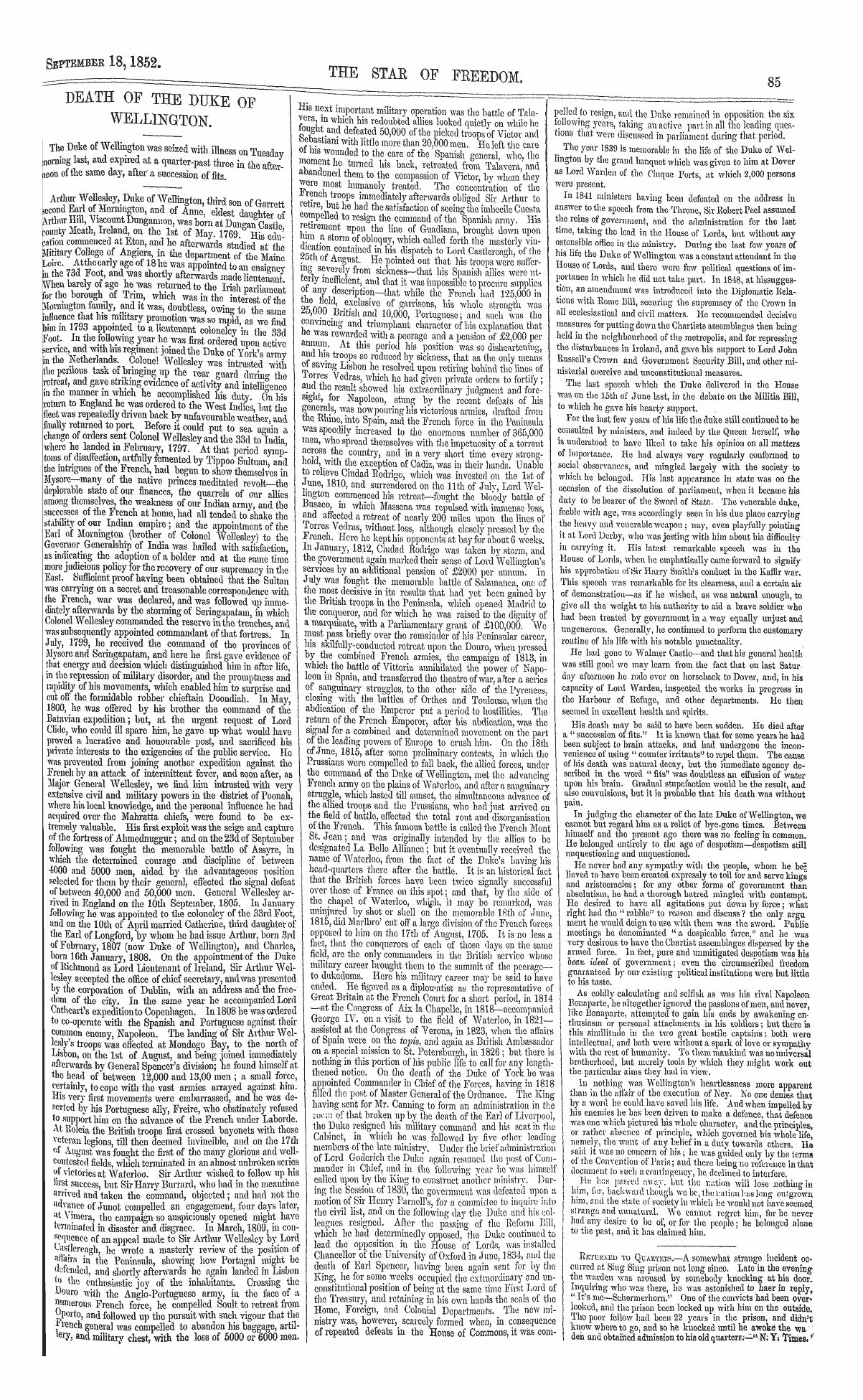
Death Of The Duke Of Wellington . Death (Tf Ttttp Vnnnttz
DEATH OF THE DUKE OF WELLINGTON . DEATH ( TF TTTTP vnnnTTZ
Untitled Article
Arthur Wellesley , Duke of Wellington , third son of Garrett 5 econdMofMomir ^ oii , and of Anne eldest daughte r Arthur Hill Yiscoimt Dimgannon , was bom at Dungan Castle county Meatli , Ireland , on the 1 st of May . 1769 Hk etb ' cation commenced at Eton , and he afterwards studied at the tf , titary CMege of Anglers m the department of the Maine Loire . Atthe early age of 18 lie was appointed to an enskney n the 73 d Foot , and was shortly afterwards madelieuteiTant When barely of age he was returned to the Irish parliament for the borough of Trim , which was in the in eL S
Monnngton family , and it was doubtless , owing to the same mfluence ttiat Ins military promotion was so rapid , as we find him in 1 / 93 appointed to a lieutenant colonelcy in the 33 d f oot In the following year he was first ordered upon active service , and with his regiment joined the Duke of York ' s armv in the Netherlands Colonel Wellesley was intrusted with the perilous task of bringing up the rear guard during the retreat , and gave striking evidence of activity and intellig ence in the manner m which he accmrmlklwi i «* , !„ + „ AL i in the manner m which he accomplished his dut his
y . On return to England he was ordered to the West Indies but the fleet was repeatedly driven back by unfavourable weather , and finally returned to port Before it could put to sea again a change of orders sent Colonel Wellesley and the 33 d to India where he landed in February , 1797 . At that period symptoms of disaffection , artfully fomented by Tippoo SiuW and the intrigues of the French , had begun to show themselves in Mysore—many of the native princes meditated revolt—the
deplorable state of our finances , the quarrels of our allies among themselves , the weakness of our Indian army , and the successes of the French at home , had all tended to shake the stability of our Indian empire ; and the appointment of the Earl of Mormngton ( brother of Colonel Wellesley ) to the Governor Generalshi p of India was hailed with satisfaction , as indicating the adoption of a bolder and at the eame time more judicious policy for the recovery of our supremacy in the East . Sufficient proof having been obtained that the Sultan
was carrying on a secret and treasonable correspondence with the French , war was declared , and was followed up immediately afterwards by the storming of Seringapatam , in which Colonel Wellesley commanded the reserve in the trenches , and was subsequently appointed commandant of that fortress . In July , 1799 , he received the command of the provinces of Mysore and Seringapatam , and here he first gave evidence of
that energy and decision which distinguished him in after life , in the repression of military disorder , and the promptness and rapidity of his movements , which enabled him to surprise and cut off the formidable robber chieftain Doondiah . In May , 1800 , he was offered by his brother the command of the Batavian expedition ; but , at the urgent request of Lord Glide , who could ill spare him , he gave up what would have proved a lucrative and honourable post , and sacrificed his
private interests to the exigencies of the public service . He was prevented from joining another expedition against the French by an attack of intermittent fever , and soon after , as Major General Wellesley , we find Mm intrusted with very extensive civil and military powers in the district of Poonah , where his local knowledge , and the personal influence he had acquired over the Mahratta chiefs , were found to be extremely valuable . His first exploit was the seige and capture of the fortress of Ahmednuggur ; and on the 23 d of September
following was fought the memorable battle of Assyre , in which the determined courage and discipline of between 4000 and 5000 men , aided by the advantageous position selected for them by their general , effected the signal defeat of between 40 , 000 and 50 , 000 men . General Wellesley arrived in England on the 10 th September , 1805 . In January following he " was appointed to the colonelcy of the 33 rd Foot , and on the 10 th of April married Catherine , third daughter of the Earl of Longford , by whom he had issue Arthur , born 3 rd
of February , 1807 ( now Duke of Wellington ) , and Charles , horn 16 th January , 1808 . On the appointment of the Duke of Richmond as Lord Lieutenant of Ireland , Sir Arthur Wellesley accepted the office of chief secretary , andwas presented hy the corporation of Dublin , with an address and the freedom of the city . In the same year he accompanied Lord Cathcart ' expeditionto Copenhagen . In 1808 he was ordered to co-operate with the Spanish and Portuguese against their common enemy , Napoleon . The landing of Sir Arthur
Welicsly ' s troops was effected at Mondego Bay , to the north of Lisbon , on the 1 st of August , and being joined immediately afterwards by G - eneral Spencer ' s division ; he found himself at the head of between 12 , 000 and 13 , 00 men ; a small force , certainl y , to cope with the vast armies arrayed against him . His very first movements were embarrassed , and he was deserted by his Portuguese ally , Freire , who obstinately refused to support him on the advance of the French under Laborde . At Koleia the British troops first crossed bayonets with those veteran legions , till then deemed invincible , and on the 17 th of August was fought the first of the many glorious and
wellconteste d fields , which terminated in an almost unbroken series of victories at Waterloo . Sir Arthur wished to follow up his first success , but Sir Harry Burrard , who had in the meantime arrived and taken the command , objected ; and had not the advance of Junot compelled an engagement , four days later , at V'imera , the campaign so auspiciously opened might have t erminated in disaster and disgrace . In March , 1809 , in confluence of an appeal made to Sir Arthur Wellesley by Lord Castlereagh , he wrote a masterly review of the position of aflairs in the Peninsula , showing how Portugal might be defended , and shortly afterwards he again landed in Lisbon to the enthusiastic joy of the inhabitants . Crossing the kouro with the Ando-Portuguese army , in the face of a
numerous French force , he compelled Soult to retreat from uporto , and followed up the pursuit with such vigour that the * tench general was compelled to abandon his baggage , artille iy , and militarv chest , with the loss of 5000 or 6000 men .
Untitled Article
His next important military operation was the battle of Tala-^ v era m which his redoubted allies looked quietly on while he tought and defeated 50 , 000 of the picked troops of Victor and bebastaani with little more than 20 , 000 men . He left the care oi ins wounded to the care of the Spanish general , who , the moment he turned his back , retreated from Talavera , and abandoned them to the compassion of Victor , by whom they were most humanely treated . The concentration of the ¦ rr encn troops immediately afterwards obliged Sir Arthur to retire , but he had the satisfaction of seeing the imbecile Cuesta compelled to resign the command of the Spanish His
army . letirement upon the line of Guadiana , brought down upon mm a gtorm of oWoqiiy ) which ca ] led forth ^ mastcrl viu . aication contained in his dispatch to Lord Castlercadi , of the -otn of August . He pointed out that his troops were suffcrf S severel y from sickness—that his Spanish allies were utterly inefficient , and that it was impossible to procure supplies fh 1 V GSC 1 > i ption ~ that while thG French lmd 125 , 000 in okV ™ ' exclusive of garrisons , his whole strength was 4 > , W 0 British and 10 , 000 , Portuguese ; and such was the
convincing and triumphant character of his explanation that iie was rewarded with a peerage and a pension of £ 2 , 000 per annum . At this period his position was so disheartening , and ins troops so reduced by sickness that as the only means ot saving Lisbon he resolved upon retiring behind the lines of lorres Vedras , which he had given private orders to fortify ; and the result showed his extraordinary judgment and foresight , for Napoleon stung by the recent defeats of his §? p ? - wasnow P ouringtts victorious armies , drafted from tne . Klnne , into Spain , and the French force in the Peninsula
was speedil y increased to the enormous number of 365 , 000 men , who spread themselves with the impetuosity of a torrent across the country , and in a very short time every stronghold , with the exception of Cadiz , was in their hands' ! Unable to relieve Ciudad Bodrigo , which was invested on the 1 st of nine , 1810 , and surrendered on the 11 th of July , Lord Wellington commenced his retreat—fought the bloody battle of Uusaco , in which Massena was repulsed with immense loss , and affected a retreat of nearly 200 miles upon the lines of l Ved
orres ras , without loss , although closely pressed by the - French . Here he kept his opponents at bay for about 6 weeks . In January , 1812 , Ciudad Bodrigo was taken by storm , and the government again marked their sense of Lord Wellington ' s services by an additional pension of £ 2000 per annum . In July was fought the memorable battle of Salamanca , one of the most decisive in its results that had yet been gained by the British troops in the Peninsula , which opened Madrid to the conqueror , and for which he was raised to the dignity of
a maiqwsate , with a Parliamentary grant of £ 100 , 000 . Wo must pass briefly over the remainder of his Peninsular career , his skilfully-conducted retreat upon the Douro , when pressed by the combined French armies , the campaign of 1813 , in which the battle of Vittoria annihilated the power of Napoleon in Spain , and transferred the theatre of war , after a series of sanguinary struggles , to the other side of the Pyrenees , closing with the battles of Orthes and Toulouse , when the
abdication of the Emperor put a period to hostilities . The return of the French Emperor , after his abdication , was the signal for a combined and determined movement on the part of the leading powers of Europe to crush him . On the 18 th of June , 1815 , after some preliminary contests , in which the Prussians were compelled to fall back , the allied forces , under the command of the Duke of Wellington , met the advancing French army on the plains of Waterloo , and after a sanguinary struggle , which lasted till sunset , the simultaneous advance of
the allied troops and the Prussians , who had just arrived on the field of battle , effected the total rout and " disorganisation of the French . This famous battle is called the French Mont St . Jean ; and was originally intended by the allies to be designated La Belle Alliance ; but it eventually received the name of Waterloo , from the fact of the Duke ' s having his head-quarters there after the battle . It is an historical fact
that the British forces have been twice signally successful over those of France , on this spot ; and that , by the side of the chapel of Waterloo , wh 3 , ch , it may be remarked , was uninjured by shot or shell on the memorable 18 th of June , 1815 , did Marlbro cut , off a large division of the French forces opposed to him on the 17 th of August , 1705 . It is no less a fact , that the conquerors of each of those days on the same field , are the only commanders in the British service whose military career brought them to the summit of the
peerageto dukedoms . Here his military career may be said to have ended . He figured as a diplomatist as the representative of Great Britain at the French Court for a short period , in 1814 —at the Congress of Aix la Chapelle , in 1818—accompanied George IV . on a visit to the field of Waterloo , in 1821—assisted at the Congress of Verona , in 1823 , when the affairs of Spain were on the tapis , and again as British Ambassador on a special mission to St . Petersburgh , in 1826 ; but there is nothing in this portion of his public life to call for any lengththened notice . On the death of the Duke of York he was
appointed Commander in Chief of the Forces , having in 1818 filled the post of Master General of the Ordnanee . The Kinghaving sent for Mr . Canning to form an administration in the room of that broken up by the death of the Earl of Liverpool , the Duke resigned his military command and his seat in the Cabinet , in which he was followed by five other leading members of the late ministry . Under the brief administration
of Lord Goderich the Duke again resumed the post of Commander in Chief , and in the following year he was himself called upon by the King to construct another ministry . During the Session of 1830 , the government was defeated upon a motion of Sir Henry Parnell ' s , for a committee to inquire into the civil list , and on the following day the Duke and his colleagues resigned . After the passing of the Reform Bill , which he had determinedly opposed , " the Duke continued to
lead the opposition in the House of Lords , was installed Chancellor of the University of Oxford in June , 1834 , and the death of Earl Spencer , having been again sent for by the King , lie for some weeks occupied the extraordinary and unconstitutional position of being at the same time First Lord of the Treasury , and retaining in his own hands the seals of the Home , Foreign , and Colonial Departments . The new ministry was , however , scarcely formed when , in consequence of repeated defeats in the House of Commons , it was com-
Untitled Article
pelled to resign , and the . Duke remained in opposition the six loll owing years , taking an active part in all the leading questions that were discussed in parliament during that period . _ The year 1839 is memorable in the life of the Duke of Wellington by the grand banquet which was given to him at Dover as Lord Warden of the Cinque Ports , at which 2 , 000 persons were present .
In 1841 ministers having been defeated on the address in answer to the speech from the Throne , Sir Robert Peel assumed the reins of government , and the administration for the last time , taking the lead in the House of Lords , but without any ostensible office in the ministry . During the last few years of his life the Duke of Wellington was a constant attendant in the House of Lords , and there were few political questions of importance in which he did not take part . In 1848 , at hissuggestion , an amendment , was introduced into the Diplomatic Relations with Rome Bill , securing the supremacy of the Crown in all ecclesiastical and civil matters . He recommended decisive
measures for putting down the Chartists assemblages then beingheld in the neighbourhood of the metropolis , and for repressing the disturbances in Ireland , and gave his support to Lord John Russell ' s Crown and Government Security Bill , and other ministerial coercive and unconstitutional measures . The last speech which the Duke delivered in the House was on the 15 th of June last , in the debate on the Militia Bill , to which he gave his hearty support .
r or the last few years of his life the duke still continued to be consulted by ministers , and indeed by the Queen herself , who is understood to have liked to take his opinion on all matters of importance . He had always very regularly conformed to social observances , and mingled largely with the society to which he belonged . His last appearance in state was on the occasion of the dissolution of parliament , when it became his
duty to be bearer of the Sword of State . The venerable duke , feeble with age , was accordingly seen in his due place carrying the heavy and venerable weapon ; nay , even playfully pointing it at Lord Derby , who was jesting with him about his difficulty in carrying it . His latest remarkable speech was in the House of Lords , when he emphatically came forward to signify his approbation of Sir Harry Smith ' s conduct in the Kaffir war .
1 ms speech was remarkable for its clearness , and a certain aiv of demonstration—as if he wished , as was natural enough , to give all the weight to his authority to aid a brave soldier who had been treated by government in a way equally unjust and ungenerous . Generally , he continued to perform the customary routine of his life with his notable punctuality . He had gone to Walmer Castle—and that his general health was still good we may learn from the fact that on last
Saturday arternoon he rode over on horseback to Dover , and , in his capacity of Lord Warden , inspected the works in progress in the Harbour of Refuge , and other departments . He then seemed in excellent health and spirits . His death may he said to have been sudden . He died after a " succession of fits . " It is known that for some years he had been subject to brain attacks , and had undergone the inconvenience of using " counter irritants" to repel them . The cause of his death was natural decay , but the immediate agency described in the word " fits" was doubtless an effusion of water upon his brain . Gradual stupefaction would be the result , and also convulsions , but it is probable that his death was without
pain . In judging the character of the late Duke of Wellington , we cannot but regard him as a relict of bye-gone times . Between himself and the present age there was no feeling in common . He belonged entirely to the age of despotism—despotism still unquestioning and unquestioned . He never had any sympathy with the people , whom he be : lieved to have been created expressly to toil for and serve kings and aristocracies ; for any other forms of government than
absolutism , he had a thorough hatred mingled with contempt . He desired to have all agitations put down by force ; what right had the " rabble" to reason and discuss ? the only argu Hient he would deign to use with them was the sword . Public meetings he denominated " a despicable farce , " and he was very desirous to have the Chartist assemblages dispersed by the armed force . In fact , pure and unmitigated despotism was his beau ideal of government ; even the circumscribed freedom guaranteed by our existing political institutions were but little to his taste .
As coldly calculating and selfish as was his rival Napoleon Bonaparte , he altogether ignored the passions of men and never like Bonaparte , attempted to gain his ends by awakening enthusiasm or personal attachments in his soldiers , but there is this similitude in the two great hostile captains : both were intellectual , and both were without a spark of love or sympathy with the rest of humanity . To them mankind was no universal brotherhood , but merely tools by which they might work out the particular aims they had in view .
In nothing was Wellington ' s heartlessness more apparent than in the affair of the execution of Key . No one denies that by a word he could have saved his life . And when impelled by his enemies he has been driven to make a defence , that defence was one which pictured his whole character , and the principles , or rather absence of principle , which governed his whole life namely , the want of any belief in a duty towards others . Iia said it was no concern of his ; he was guided only by the terms of the Convention of Paris ; and there being no reference in that document to such a contingency , he declined to interfere .
Jlejuu ; pagfed fiwtiy , but the nation will lose nothing in mm , for , backward though we be , the union has long outgrown him , and the state of society in which lie would not have seemed strange and unnatural . "We cannot regret him , for he never had any desire to be of , or for the people ; he belonged alone to the past , and it has claimed him .
Untitled Article
Ketue-ned to Quarters . —A somewhat strange incident occurred at Sing Sing prison not long since . Late in the evening the warden was aroused by somebody knocking at his door . Inquiring who was there , he was astonished to haer in reply , " It ' s me—Sehennerhorn . " One of the convicts had been over * looked , and the prison been locked up with him on the outside . The poor fellow had been 22 years in the prison , and didn't know where to go , and so he knocked until he awoke the wa den and obtained admission to his old quarters . '~ " N ; Y * Times .
Untitled Article
September 18 , 1852 . mTTT , Z- — ____ THE STAR OF FREEDOM . * k .,.. ____ r ^ . —
Untitled Article
The Duke of Wellington was seized with illness on Tuesday norning last , and expired at a quarter-past three in the afterioon of the same day , after a succession of fits
-
-
Citation
-
Northern Star (1837-1852), Sept. 18, 1852, page 5, in the Nineteenth-Century Serials Edition (2008; 2018) ncse.ac.uk/periodicals/ns/issues/vm2-ncseproduct1696/page/5/
-