
On this page
-
Departments (2)
-
Text (6)
-

Untitled Article
-
Untitled Article
-

Untitled Article
-

TRADES.
-

Untitled Article
-

LITEEATTJUE. ^ —a—
Note: This text has been automatically extracted via Optical Character Recognition (OCR) software. The text has not been manually corrected and should not be relied on to be an accurate representation of the item.
-
-
Transcript
-
Note: This text has been automatically extracted via Optical Character Recognition (OCR) software. The text has not been manually corrected and should not be relied on to be an accurate representation of the item.
Additionally, when viewing full transcripts, extracted text may not be in the same order as the original document.
Untitled Article
great many small Associations will spring up , instead of a few large ones , unless working-men will look forward and take a broader and more Christian view of their work . These small Associations will compete with and ruin one another , and the slop-system will go on increasing still in all branches of industry , although small masters may have become extinct . We will not however dwell upon this danger , to point out which we hope will be enough . In one respect the London Associations have shown most favourably ; they are always ready to
receive foreigner !? where it is possible . In Castle-street there i j an Hungarian ; the North London Builders have M . Nadaud , late a member of the French Assembly , for an Associate ; and the Pimlico Builders not only took in a Lyons workman named Iglesia , tat subscribed and collected sufficient to enable him to send for his wife and family . If they will go on in this spirit we have no fear of their success , for they are taking in and clothing those whose presence will bring His blessing who has said , " Inasmuch as ye have done it unto one of the least of these mv brethren ye have done it unto Me . "
We canuot close this Report without noticing one establishment connected with , though not strictly a part of the Society for promoting Working Men ' s Associations , the Central Co-operative Agency , established at 76 , Charlottestreet , Fiferoy -square . - The Central Agency originated in the desire of enabling the working population of London to obtain the articles of their ordinary consumption , such as groceries , &c , of a quality on which reliance could be placed , and at prices as low as the necessary expenses of the business admitted . It soon appeared that this object would be most surely effected , and a further valuable object be attained , by forming in place of the retail establishments at first contemplated , a centre , which should furnish at wholesale prices the goods required to establishments set up either by working-men or others , for the purpose of supplying their own consumption . Scores of establishments of this nature existed , as it
appeared already , under the name of " Co-operative Stores , " in the north . A disposition to form them existed everywhere . A central house of business , provided with sufficient funds , conducted by persons well acquainted with the business they undertook } carried on under such supervision as should guarantee the iionesty of the management , would , it seemed , be of great value , both in . guarding the existing Stores against the frauds often practised upon them , and in making it easy to form new stores . The Central Agency was established to discharge this function , and we are glad to say that it has hitherto done so to the satisfaction of its founders . Its business transactions with the Stores of England and Scotland are already very considerable , and are steadily increasing . Hew Stores have sprung into existence in various places through Us means . At the same time it is quietly becoming the instrument of a yet more valuable and —the end of bringing the widely scattered elements of Co-operative action into direct connexion with each other . For we must caution all our readers who are
unacquainted with the subject , not to think that they know the extent to which Co-operation has gone in England when they have read this report . We are only avery small stream of the great flood ; there are , as we have just said , hundreds of Co-operatiue Stores already working , and hundreds of others springing up through the length and breadth of the land , and Working Associations also , although the growth of these in England is more slow . There are in London itself many bodies of working-men either in Association already or preparing for it , who are in no connexion with us , such as plumbers , weavers , carpenters , and hardware-men . Some of these are on the eve of starting , others have enrolled members , and opened subscription lists , while others again are as yet inorganic , having an existence in talk only , But we need say no
more , for any one who has been living at all with working-men during the last three years must have been astonished at the wonderful spread of this idea of fellow-work— -by people in general called Socialism—amongst them within that time , and above all at the progress it has made within the last nine months , he will be as sure as we are , that great results of one kind or another , must soon follow this steady gathering together of the forces of lahour , for mu'ual help in productive and distributive industry . We hope he will also agree with us that the part of every honest man just now is to throw himself heart and soul into the movement , and to teach by words and deeds , that men do not come together
m Associations to divide profits Individually , and heap up capital , but to learn to live and work together like brothers , to see justice done to the weak , and to preach the trade gospel of the duty to labour and the right to live thereby . There is indeed much need at this moment that educated men should come forward , to guide the movement if possible , at any rate to share in it ; for the number of these—never enough to do the work which they had to do , well has of late fallen off , several of the most active members of the Society having gone abroad and others having left London . Meantime the numbers of working-men become larger every day . ¦ ' , ¦
Our task is done , and the reader who has gone with us thus far , will be by this time aware , that a little society founded by a few clergymen and lawyers to help small bodies of their poorer brothers in carrying on their trades for the benefit of themselves and their families , honestly , openly , as Christian men in a Christian land—a Society not three years old , with a capital of some 1 , 5007 . and an income under 2001 . a year—has had to face for itself and to decide upon most of the difficult questions which are , or ought to be , puzzling the wise heads of political economists and statesmen , We cannot but think that the experience of our Society may be valuable to many besides ourselves , and that wiser heads and stronger wills than ours may find , in the history of our struggles , hints which will help them in solving the great question which England must solve , or die— " How shall our working people be delivered from their present misery , and be made free men and free citizens ? " May God send wiser and stronger men to . lead the van , and that soon , for the lime presses ! dif Castle Street , Oxford Street .
Untitled Article
The Chairman having read the placard convening the meeting , said—that in the month February last , au attempt was made by an employer in Westminster to reduce the wages of his workmen . The workmen offered some resistance . The employer stated that it was much against his will , but he was amen to it by the competition of the other employers in the trade . The workmen had so long suffered the greatest privations in consequence of this plea of the employers of " competition" that they determined to work steadfastly and unitedly , to bring about a uniform rate of wages in the different shops , and urged the masters to endeavour to establish a uniform scale of prices for the work distributed to the public . About fifty employers responded to their call , andequested the to
i—0— . THE STRONG BOOT AND SHOE TRADE—IMPORTANT PUBLIC MEETING . On Tuesday evening last , a public meeting was held at the . Temperance Hall , Broadway , Westminster , to hear the statement of the men who were thrown out of employment on Monday , Oct . 18 th , for refusing to sign the "document" put fortlr by the employers in "Strong Boot and Shoe Trade . " The hall was crowded to excess , and great excitement was manifested by the unanimous vote of the meeting . Mr F . Crump was called to the chair .
r men submit their scaleof charges forthe different descriptions ot work . In London there are 104 employers in the strong trade , most of whom i , h « n riSe " * the seat" as workmen , and had now become the employers of JSv * \ - meetlng of emPloyers ' which the first deputation waited on with £ ?« m " ? t ? erevrere 52 P pesent » a ™* at the request of the workmen had ¦ fiw'Sr * " ?¦ t 0 ^ atte ? att ° itt the scale ™ til the ™» thaiZthOuwt T / oyers and workmen > lhe empl ° yers ha ™ & s « pula ^ time the tconn T ? . SUPP ° ° f three-fou ^ of the trade . Well , in a short tofan ^^*?^ '' * * ° n the empIoyers ' and U P ° » statin ° ««* three-fourths of the employers had consented to the scale , they were told that SSSspV— - " 5 S-SS 5 tney appointed twelve of their number , men by no means leanine towards thp workmen , as a "board of trade . " This beat the three WtanT&Z ^ T ^ ss ^ s ^ Z ^ : ^ . " « " «« " snobs *^ 22 ftS 5 ! la " Sbl ! ? l flrst busines «• * how they should introduce
r , ^ rA . ; . * » msmmm shoes for a miserable pittance who were not oniv ™ t iirfo ,.- . « .. ?„ „„„ k i . P ^ J ^ Z ^ ttS ^ jL ***
Untitled Article
able subterfuge of the employers to pay low wages for work which they take care shall not be inferior to what they call " best work . " The employers issued a scale of charges far inferior to the men ' s and in addition to announcing that they meant to discharge all their men , on the 18 th inst ., they put forth a document binding the men to sign that they would not support any men who had disputes " with any employer paying these wages . " If the ' master" liked to give more he could , said the employers , but they knew that such would not happen , as the men were precluded from demanding more , and they had " competition" too often on their lips to voluntarily raise the wages of the men . He would explain another infamous system of fraud . The men stipulate that all shoes made on lusts 10 inches long be paid men ' s wages for , 10 inches is what is
known as " first size , " but the master ' s hare fraudulent * ' measuring sticks" by which so great is the deception that a " sixth size" appears to be a "fourth Bize' * and they pay accordingly , and instead of getting two shillings and threepence for ordinary shoes , they get but one shilling and sixpence , so if a man make seven pair a week he is defrauded of Jive shillings and threepence . The " masters " declare they will starve the workmen who have made them rich , as some of them nre , into compliance . But it is now more than a week since , and although all have suffered great privation , very few , very few indeed have disgraced themselves by signing the "document . " They have studied other trades knowing that if they yield this " document" system must have become general .
Other workmen should feel it as their duty to lend them a helping hand , and with but little assistance they will conquer . The trade is so busy that if all were employed there would be wanted * 200 or 300 more men . The men feel that this is an opportunity to raise the wages from the miserable pittance they have of late years received . About 200 men are out of work , and although there are 800 in the society , the wages are so low that their brother shoemakers cannot support them . Why , take the year through , good weather and bad , and average the earnings of the men throughout the trade , and we shall find that the average earnings of each man is not more than twelve shillings per week—( loud cheers , and cries of assent ) . The Chairman concluded by mailing an appeal on behalf of the men , and resumed his sea * loudly cheered .
Mr . Isaac Wilsoit moved the following resolution : " That this meeting views with surprise the conduct of the employers of the strong boot and shoemakers' trade in discharging the men in their employ for refusing to sign the masters' document . This meeting likewise repudiates the right of" masters" to dictate what workmen shall do with their earnings , and furthermore we pledge ourselves to render every assistance in our power to the journeymen strong boot and shoemakers by dealing only in those shops where a fair rate of wages is paid and no document required to be signed , and to raise , subscriptions to support the men who have so nobly resisted this encroachment upon the rights of labour . " Mr . Wilson said he was surprised to find that the greatest tyrants among these employers were the men who had sat on the stool . Whatever may be their
plea , the public must determine to put a stop to their tyranny by dealing only with those shops wheve the men receive justice . We find a dozen " employers " going to " settie" the prices these men shall receive for their labour . But justice would demand that he who produced the property should fix the rate of wages . These men would not sell their shoes to the customers who walked into thenshops and offered to fix the price they would give . But , as society is constituted , it is nothing but fair that at least as many men as " masters" should decide upon these matters . We must put a stop to these continued repetitions of tyranny by banding the trades together as they were in 1832 , for the mutual protection of the rights of labour . If the employers had consulted justice and their own interest , even as they should have done , they would have worked to bring about
what the men desire . They would try to put a stop to that selfish competition among themselves by paying uniform wages ttnd taking uniform prices for work worth the money . The public would not then b « defrauded in the quality of the work , and all classes would be gainers . Until a careful regulation is made , the men ' s wages will go down day after day . Let both men and employers consider that the employer ' s is the least important branch of the trade . They merely hand over to the consumer what the poor hard-working shoemaker produces , in the meantime taking care to replenish their pockets out of the transaction . The workmen must become more united , and pay attention to these things , and by their united intelligence bring about a sy stem where the mere
distributor shall not get the lion ' s share ; and if this question is not rectified throughout all society , in a few years we shall have society in a state of anarchy . We must at once mate arrangements for the producer , mid distributor to partake in proportion to their importance . When a man works piece-work , as in the case of the shoemakers , and hands in his work , if he likes , his connection with his employer is dropped , but what are we to think of the men who offer such a thing as this document to a man who is only bound to do a certain piece of work each bargain . Let workmen , ask themselves whether they will support such men , or whether they will not rather go to those places where men are fairly paid for the work produced . ( Loud cheers ) .
Mr . M'Intyrb . ( of the West-end boot and shoemakers ) was pleased to have the opportunity to second the resolution . Will men believe in future ages that in this day of England ' s greatness , in this time When we boast of our hi gh civilisation , and the superior intelligence of our workmen , that these intelligent workmen themselves are not allowed to put a value on the work they produce for society . Such is the case , and it can only be remedied by the better paid workmen assisting the down-trodden shoemakers . Although 800 in number , their society's funds have been so reduced by the continued harrassing of the ' employers last winter , that they are forced to look for extraneous assistance
Let committees of workmen be formed in Westminster and elsewhere to collect the penny subscriptions of those who are favourable to their cause , and we should soon find that if that and Mr . Wilson's recommendation to buy of the good shops only were combined , that we should conquer . When the document was offered to the engineers we thought that it would have been presented next to the better paid trades in succession , but they got to extremes—the highest to the lowest ;' and here they are calling upon the men of 123 . per week not to support one another in raising such a miserable pittance to the wages of a free man . ( Cheers . )
Mr . Walpourd ( of the Working Builders' Association ) said , that men would for ever be at the mercy of their employers until they were united in a national union and began to carry out the principles of association . In spite of " Uncle Tom ' s Cabin , " we hare a slave trade at home , and we must reform ourselves before we send missionaries across the Atlantic . We can do it if we will only buy our shoes of those who give their men the better wages . If possible , let a little money be got together , to put the men in shops of their own , and no doubt they would get plenty of ordets . Let working-men remember that if on Saturday night they go short of a pint and a screw they can give half-a-quartern loaf to starving children of the shoemaker . ( Loud applause . ) [ A gentleman here threw a package on the platform , in which were two halfcrowns , ] : ,
Mr . Searles advocated the establishment of local committees to raise penny subscriptions . When these men get 12 s . a week they earn it by working all hours . When the world is asleep , there is the poor shoemaker , with a halfpenny candle , working away to keep body and » onl together . Lectures , and mechanic's institutions , and cheap literature are not for them . We must work bravely , and do away with such a social anomaly . Mr . Kendall ( one of . the " Employers' Association " ) here came forward , and tried to palliate the conduct of the employers by declaring they were animated by a desire for the well-being of the men . Mr . Kendall ,
however , so irritated the meeting by his remarks , that it was with difficulty he could be heard , and a most terrific storm of yells and hisses were raised when Mr . Kendall assured them that if they did not come lo some terms it is probable that in the bad seasons the masters would give them only one shilling and sixpence for making a pair pf strong boots ! The Chairman and Mr . J . Wilson having ably disposed of Mr .. Kendall ' s view of the question , the resolution was put to the meeting , and was carried with not a single protesting hand . This was followed by a round of applause . A vote of thanks wa « given to the Chairman , and at his instance , the like compliment was paid to the reporters for the Star of Freedom and Reynold ' s Newspaper , followed by three hearty cheers .
Untitled Article
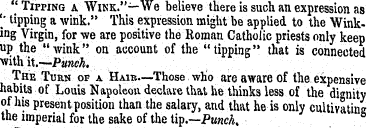
^ " Tipping a Wink . " —We believe there is such an expression as ' * tipping a wink . ' * This expression might be applied to the Winking Virgin , for we are positive the Roman Catholic priests onl y keep up the "wink" on account of the "tipping" that is connected with it . —Punch . The Turn of a Hair . —Those who are aware of the expensive habits of Louis Napoleon declare that he thinks less of the dignity of his present position than the salary , and that he is only cultivating the imperial for the sake of the tip . —Punch
Death in SroRT .-In a report of the proceedings of the British Association Dr . J . D . Marshall stated , on exhibiting a specimen of ^ Bonaparte ' s Gull , " that it was "the only one hitherto shot in Europe . The learned Doctor has forgotten that several hundred specimenswere shot in the streets of Paris on Dec 2 , —Ibid .
Untitled Article
A . Brief Inquiry ixto the Natural Rights of At London : Watson , Queen ' s-head-passage , Pa ternost ^ Of late much has been heard at public meeting ^' " social rights . " We wish we could add that all tttT ^ said relating thereto was calculated to advance the know ) i the people in relation to so important a subject . Unhannf ? Vf sacred question of social rights has been used rather as a than discussed for the purpose of diffusing sound inf ^'" ^ Like " the charter , name and all , " « the whole hog , 0 ^ 1 ^?^ the words " social rights" have been abused , where thev I have been used only in connexion with calm and earnest eff IOUl < * elevate the multitude from the grovelling depths of icr nora ° l 0 Jho rvl / i » ij-iMC ! eminent nf n-nnnllnforl 1 . « .. m ., 1 ^ J // < - , * . . | 1 '' C 6 | 0 the lorious eminence ot unpolluted knowledge «
g , So ?» ni tj- ? should be the war-cry of the people , but there can be but i hope of that as long as men will claim for party what was m for mankind ; and not hesitate to do injury to a noble caus ^ that they may gratify their sectarian intolerance . We welco * this little work iu the hope that it may prove an instalment tow » rT that improved order of discussion in which sense shall take tl place of sound ; and men be more intent upon advancing tr t than eliciting the " thundering cheers" of ; passion led partizan Though the author falls short of realizing all that his title-Mffe m lead the reader to expect , he still has done something towards nr ^ senting in a tangibleshape those ideas of political and social justice ' winch though much talked of are certainly not too well or " ' widely understood . In any future work he will do well to adorn ° more dispassionate tone in relation to reformers , as honest and ([ say the least ) as ultra as himself ; and , in our humble , opinion wiH act wisely to employ his pen upon something more important than that incomprehensible riddle , religion . Too much of the political
sectarian breathes in Ins page ? . Take for example his accusations against the French Communists and Socialists—imputing to them therujn of the late revolution ; an assertion untrue , unjust and ungenerous . , At the period of the revolution , the most extreme Socialists—ihe only organized Communists , properl y so calkd were the followers of Cabet . Immediately on the overthrow of the monarch y' they rallied to the republican flag . On the 25 th of February the ^ -citizen Cabet caused to be po sted on the walls of Paris a proclamation , in which he exhorted his friends and followers
to unite around the provisional government , to adjourn iheir own peculiar ideas and projects , to be moderate , generous , and lo act only as Frenchmen , democrats , and republicans . The communists acted as advised . What was their treatment in return ? Persecution , calumny , proscription , and menaces of death ! Wh y ? because they desired to establish the true republic—ihe republic ii \ which classes should disappear ; while their traducers and persecutors desired oul y a bourge . ois republic , a sham , a mockery , preparatory to the restoration of the old tyranny , under the name of one or other of the former royal or imperial despotisms .
Objections notwithstanding , we can conscientiousl y and heartily recommend this treatise to our readers . We give the following extracts :
MOOLATRY . J : Although political government has taken various forms in different countries and among different races of men , it can scarcely be doubted that the proneness of the herd of mankind to manolatry , or hero-worship—to follow the most unscrupulous leader , rather than think for themselves as to what is best for their own interests—has had great influence in the formation of all governments . In every clan or community , there would be found at least one individual possessing more physical or mental prowess than the rest ; and he would be always ready at the call of his fellows , if not irom the impulse of his own activity or ambition o accept or assume responsible offices , either of trust or danger , and thence to take the direction of state affairs into his own hands .
Hence the natural origin of despotic governments ; and whether , as in some nations , government takes an apparently less concentrated form , and becomes what is called , oligarchical , or aristocratical ; or whether its base is further widened , and it becomes a democratic republic , its diabolical essence is still the same ; and its results are equally baneful to human happiness . It is still the creation—either from a slavish and blind subserviency , a stupid fear , or from false notions of expediency , of a vast power , more or less external to the people themselves ,, and , consequently , more or less dangerous and obnoxious to their true interests and liberties . The instalment of kings , tribunes , presidents , or parliaments , is a practical annihilation of the natural equality of human rights and constitutes the fall of man into political tyranny and slavery .
CLASSES . The division of society into three classes—the higher , middle , and lower-is necessarily destructive of all real liberty , equality , and fraternity among the people ; and if the higher classes make any approach thereto , it is at the expense of the other classes , by rigidly excluding them from their society , and acknowledging them only as useful panderers to the luxury of the rich . It would be in vain to expect more than the pretence of an acquiescence in the Christian sentiment that ' all mtn are brethren' to exist with this system of class , or rather caste , distinction . It would be in vain , also , to look for any high development of moral ,
intellectual , or even physical characters in a society so organised ; or to expect that public spirit win often rise above the influences of private interests . Thoso beautiful sympathies of humanity which , as our great poet says , ' make the whole world kin , ' are gradually undermined , if not obliterated from the hearts of men ; and a perpetual antagonism prevails between one class and another . The hauteur of the aristocracy , and their tenacious grasp of state power , excite the malice and envy of the middle class ; and the unprivileged and poverty-stricken proletarians , finding their condition get worse and worse , begin , very naturally , to look upon ooth classes as their enemies and oppressors . To designate such a state of things society' is an . ironical misnomer .
The two following extracts are quoted by the author of the work under notice from the writings of Mr . J . B . O'Brien . 1 AND M ONOPOLY . It is assumed that land , mines , rivers , &c , are fit and proper subjects of private property , like bales of cloth , pottery wares , or any otber product of men ' s skill and industry ; and that , accordingly , the works of God ' s creation may be bought and sold m the market , the same as if they were the works of human hands This is a principle so utterly abhorrent to common sense and reason—it is , on
me tace of it , so gross a perversion of natural justice , that the rights of property cannot possibly ; be reconciled to it , nor coexist a moment in presence of it . Once allow the soil qf a country , which God made for all its inhabitants , and for all generations born upon it , to be bought up , or otherwise monopolized , or usurped by . any particular section of any one generations ( be that section large or small ) , and that moment your community is divided into tyrants and slaves ; into knave who will work for nobody , and into drudges who will have to work for anybody or everybody but themselves . No subsequent legislation—no possible tinkering or patchwork in the way of remedial measures can sensibly affect a system based
upon so hideous a foundation . You may talk of forms of government , or of reforms of parliament , but I hesitate not to say that no reform of parliament , no reconstruction of the government can be of the slightest avail towards amelioration . whilst thai glaring and gignntic iujustice constitutes the basis of private property ; and for this simple reasou , because the rights of labour , and the rights of property which ought to be really one and the same thing , are utterly irreconcileable under such a system , As long therefore as it shall prevail , so long must the rich be insecure , and the mass miserable , whatever moy be the form of the government , from monarchy to democracy the most pure and unlimited .
THE NATIONAL DEBT . Parliaments are chosen , and laws are designed , . not to make property fov people , but to protect it for those who have made it for themselves , or obtained it from those that did . If a man builds a house , or buys an ox , it is his rig htful property , irrespectively of Acts of Parliament . Th « law did not give him the
Trades.
TRADES .
Untitled Article
188 THE STAK OE FREEDOM . [ October
Liteeattjue. ^ —A—
LITEEATTJUE . ^ —a—
-
-
Citation
-
Northern Star (1837-1852), Oct. 30, 1852, page 12, in the Nineteenth-Century Serials Edition (2008; 2018) ncse.ac.uk/periodicals/ns/issues/vm2-ncseproduct1702/page/12/
-