
On this page
-
Departments (1)
-
Text (5)
-
Untitled Article
-

Untitled Article
-

Untitled Article
-

THE FRENCH EXPEDITION IN SEARCH OF SIR JOHN FRANBXITSL
-

Untitled Article
Note: This text has been automatically extracted via Optical Character Recognition (OCR) software. The text has not been manually corrected and should not be relied on to be an accurate representation of the item.
-
-
Transcript
-
Note: This text has been automatically extracted via Optical Character Recognition (OCR) software. The text has not been manually corrected and should not be relied on to be an accurate representation of the item.
Additionally, when viewing full transcripts, extracted text may not be in the same order as the original document.
Untitled Article
gent , and denied all knowledge of the affair-but her evidence was n 0 ttaken onoath The case was consequentl y dismissed . The case wa next brought before Mr . Eyan , B . M ., whOj believing it had S previously dismissed by Mr . D'Aicy on sworn testimony , refused to pertain uy ^ Dempseyneri memorialised the Lord Lieutenant on the su lgect , detailin ^ a ir t ^^ cumstences , and the memorial ^ m referred to Sit ^ . M Gfregor that officer sent a reply toS sey , stating that the police at Loughrea would aflbrd him ^ L fa cility in having the matter properl y investigated , as there was no * V & *^ J ^^ * with £ cent , and denied all knowledge of the ^ rl ^
«• «* < rep ly , but that gentleman refused to have any more to do wUh the affa ir . As a dernier ressort a process was issued by the unce again st tiie constable to be tried at the present Quarter Sessions of Gorfc , and Mr . Donelan , solicitor engaged to conduct the case A not ice was served for a jury , and IDempsey was to have proceeded to Gorton yesterday On the prevums ni ght / however , tile girl absconded from Ins house and fr not been heard of up to the tune our correspondent forwarded his letter last night . The affair has CreatS
a great sensation at ^ ugtirea , and undoubtedl y wears the aspect of foul dealing m some quarter—especiall y when taken ft conned with the foctthat the womanBafiert y was sent out tf tie cSyfc kt Hy . We trust the matter will be thorou ghly sifted by the authorities , for as it stands at present , it is extremel y calculated to reflect discredit upon a very valaable bod y of mm < -. G < May Mercury of Saturday . . 9-wm
Untitled Article
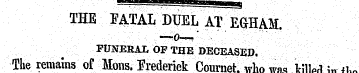
THE FATAL DUEL , AT EGHAM . FUNERiX OF THE DECEASED . The remains of Mons . Frederick Cournet , who was killed in the fatal duel near Englefield Green , was intend on Sunday afternoon in Egham church-yard . Great numbers of Frenchmen arrived bv the 11 . 38 tram at the Staines station , and proceeded to E ^ hain when they partook of some * refreshment at the King ' s Head and Catherine Wheel inns . They then walked to the Barley Mow at Englefield-green , where the body of the deceased was l ' arid
ymcr , where the necessary arrangements for the funeral had been made by Mr . Oades , of Egham . Soon after one o ' clock the procession started , and presented a most novel and imposing appearance . The corpse was borne on the shoulders of six countrymen of the deceased , and the distance being something more than a mile and a half , five different parties relieved each other on the way . At the head of the procession was carried a large red flag , hung with black crape , and bearing the 1 inscription " Republique . Democratique et Sociale . " About 150 [ Frenchmen followed , their heads uncovered , and their
whole demeanour showing the sincerity of their sorrow . Amongst those who took part in the melancholy ceremony were MM . Ledru Eollin , Selioelcher , Savoye , Terrier , Felix Pyat , Astrix , Holland , Javier Durrieu , Martin , Bernard , and Pfleigeiy formerly representatives of the people in France ; and several political writers , including Delesckze , Canaigne , phecmet , Bibyrolles , and others . The grave was dug at the further end of the churchyard , and by the time the corpse , with the procession , arrived at tlie spot , every port . of . the burial ground , and the approaches to the church , Avere crowded with
spectators . Colonel Salwey , Captain Seymour , Sir John Caihcart , Wi Newnham , Esq ., and several others of the neighbouring gentry were present . No burial service was read , but after the coffin had been lowered intG the grave Citizen Delescluze pronounced tlie following eloge in French :- — " Citizens , —In the presence of justice this day arrested—in the presence of an instruction commencedevery one will understand the sentiment of high delicacy which
obliges us to be silent before this grave , around which so many regrets and sympathies ~ are crowded . The feeling must be indeed iinperative which compels us to be silent . What , however , would be the use of breaking that silence ? To speak of the cyriiel loss which democracy has just experienced ! Is 'not every true republican conscience acquainted with Cournet ? That great heartT—that soul so sympathetic—that daring so heroic in danger , which at the age of nineteen illustrated one of the most brilliant careers in the French
navy . What true republican conscience does not know the eminent services which Frederick Cournet has since rendered to democracy , and those which he would have rendered her still ? ^ es , Cournet was a great and courageous citizen , and the name which he leaves to his son as his only fortune is one of those which will remain as the symbol of political honesty and of an unlimited devotion to the ; cause of the people . On Ms deathbed one thought alone occupied Cournet—the republic and the revolution . Let us give him , then ,
the only farewell worthy of him by repeating the last words that fell from his lips—* Vive la Eepublique , democratique et sociale . '" A loud cheer from the assembled mourners then broke in upon the solemnity of the scene , the red flag was furled , and the churchyard was speedily deserted . The friends of the deceased afterwards re-assent bled at the Catherine Wheel , which resounded with their ejaculations for another hour or two , and then the red republicans departed , as they came , by railway for London .
THE INQUEST . Oa Tuesday , the inquest was resumed by the coroner , Mr . C . S . Woods , at the Barleymqw , where the death took p lace . As will be seen the evidence adduced has cleared up much of the doubt and mystery which hung over the case . The jury have returned a verdict of " Wilful Murder " against the four prisoners in custody , and a fifth whose name has not been divulged . It will also be perceived that there are strong reasons to suspect that the duel was not fairly conducted , one of the pistols used on the occasion having been returned to the owner of them , loaded in such a way that it could not be discharged . The first witness called was
Henry Hand , secretary to Mr . Green , of the Shooting-gallery , Leicestersquare , who proved that on Monday evening , the ) 8 th inst ., about halfpast 7 o ' clock , three foreigners came into the gallery to hire pistols «¦ ' for practice , " and they had a pair on leaving a deposit of £ 8 . He produced the pistols , which were rifled duelling pistols , and were those used in the gallery . Witness also produced the memorandum given by him for the deposit , and stated that the pistols were returned about 5 o ' clock on Tuesday evening , by a person who appeared to be a porter or waiter at one of the hotels . la delivering them he stated that one was loaded , and witness immediately passed the rod down the barrel to see that the ball was ^ rawn . thout
Witness then put a cap on to fire it of , but the cap exploded wi a discharge . Witness then put some powder in , but with the same result ; and , having drawn the charge , he now produced the rag which he found in the breech behind the ball , occupying there the space which should have been filled by the powder . With a smaller piece of rag the powder might have got down , but with so large a p iece it was next to an impossibility . There was a charge of powder in the barrel after the rag , and then the ball , which he handed to the coroner . ( Witness explained how he found the rag folded up and twisted in the barrel , and expressed his belief that i » could not have been left there accidentally in cleaning . ) Witness had tried to find the man who brought back the pistols , but had failed to do so
Untitled Article
SSS ^ rJrr ^ WArs vmusl y . Witness had seen one of the persons who took the pistols away am ^ fv - ! ' a ea rin e for the P " ° « e « Allain and Bavronet , cross-examined the witness , who stated that the pistols had beea cleaned on the 5 = r— -asxs . s-j ?
examin ^ U ! T ?*™ ' * R ° maa Catholic ' and nat of France , S slhn ° f "? T ^* Said tkt he re 8 ided at 53 > Old C » CWp ? I > I' / ' * i ^ » wrtM »«* He knew the deceased Frederick Cournet , but did not know how long he had been residing in this country nuel * ^ 7 ' P , ° WeVer ' ° month 8 ' Witness also kn ^ Ema-Si £ T ? TS , Allain > and Barronet ' BartheIemycarae ^ of £ s V ^ f V ^ ° *> He cam e fat ^ the house Pf witness on his arrival , and witness had seen him twice since , when he 2 u \ 5 ° J" ? a 3 ° been there on another occasion . Witness did not recollect Barthelemy telling him the reason wny he came over He remembered Bartheleemy when he came to his house first writing a letter , which he said he could not terminate until he looked at the last which h had reeved from M . Cournet . He also said he must show it to some
one , and therefore he took it away unfinished . Witness then asked M . ^ 71 u- knew Cournet , and he said that he did not ; whereupon witness told him that he was a very fine and a very strong man . * he Coroner—Did he make any reply ? ; Witness .-. Yes ; stretching but his hand towards the glass , as if firing a pistol , he said , « At this I don ' t fear the first comer . " ( Sensation . ) He then left , say , ng that in an hour and an half he would bring the letter . He , however , did not return until three or four days after . From the expressions which Barthelemy made use of when he first came to his housed witness understood him to have had a quarrel with Cournet . The Coroner . —Did anything ever pass as to a duel with Cournet ? Witness . —Not from RnrtVtuiorv .., j : _«' . i . i ... » . /• ..-. ^ . . » . . Witness—Not from Barthelemy directbut from Cournethh he
_ , , toug also judged from the ill-favoured expressions of the former that such a thing would take place Barthelemy slept at his house on the night of Monday , the 18 th , and he supped before going to bed . Witness was present when he supped . Robiliard was also there , and slept in Barthelemy ' s room . Witness , however , did nnt hear what passed between them , as they spoke very low . Barthelemy left next morning at a quarter to 7 o ' clock , and his companion at half-past 11 . Four or five days previously Cournet told him that Bartheleray had been saying in certain society that he would burst hu ( Cournet ' s ) belly . On the 14 th also Cournet , when he returned at night , remarked , " The coward would not accept me to-day ! " referring , as witness understood , to an arranged hostile meeting at Richmond , which however , did not take place .
Louis Joseph Souli , a French advocate , residing at the Hotel d'Angleterre , Cranbourn-street , was examined through an interpreter , and was much affected in giving his evidence . He said that he was a friend of the deceased , M . Cournet , but did not know Barthelerav personally ; Three days before the death of Cournet he communicated with witness , and said he had adesire to avoid the fatal rencontre , but it was impossible , for the terms of the offence were such that lie could not withdraw or offer any explanation , and that the insult was in the nature of a menace . He knew M . Allain , and M . Barronet was his friend . Witness knew nothing as tthe
o preliminary arrangements of the duel except what he had heard . French duels were always arranged in writing , and had their proceedings based on the same principle as the law . When there was an opportunity there were two seconds or witnesses , but when there was difficulty only one . Among gentlemen , the privileged arms were pistols and swords , and they very seldom fought with two kinds of weapons ; but wh « n both were coupled it was generally a duel «« to the death . " It was a general rule that the man had the choice of arms whose honor was attacked . It was very difficult at times to know who was first offended , and then the second * acted according to the law of equity . In the event of a person choosing pistols who was a good shot , the seconds increased the distance , and thus made the contest more equal . If the duel took place with pistols , the combatants were usually placed 40 yards apart , and walked a certain " space towards each other , when they fired . Again , they sometimes drew lots as to who should fire first . It was the custom that the seconds should be charged with the loading of the pistols , and that in doing so they should show the powder and ball used . The general rule was , that each second should load the pistol of . his principal , and it was always first ascertained if the pistols were clean . .
Joseph Joanny Pardigan , a bootmaker , residing at 78 , Wardour-street Oxford-street , said , he knew Barthelemy very well . H e was an engineer , and witness was aware t he wanted to fight M . Cournet . Witness saw him the day before t iduel took place , but had no conversation with him . M . Cournet ha told witness that Barthelemy wanted to fight him . M . Naquet , the witness who refused to give evidence on the previous occasion , was here recalled , but it turned out , on examination that he knew nothing of the affair beyond having been told by M . Cournet that he was likely to fight a duel , This closed the evidence , and . •
The Coroner proceeded to suniup the case to the jury , going carefully through the depositions of the different witnesses , and pointing out its material portions . He showed them that there were three things for them to ascertain--first , the cause of death ; secondly , the person or persons who either caused or assisted at it ; and , lastly , the degree of criminality that attached to such person or persons . It was clear that the death had been caused by a pistol-shot , and that , either as the principals or seconds , the four prisoners in custody were all present when the fatal wound was inflicted . > In the eye of the law , all who participated in such acts were guilty of the crime of murder .
The Jury > after deliberating ior a short time with closed doors , returned a verdict of " "Wilful Murder' * . against the four prisoners in custody , and a fifth , whose name was unknown to them . " . Frederick Cournet was a noble and courageous man , and his death is an irreparable loss to the Republican cause . Our readers will remember the prominent part taken by him in the events of December last , as recorded in the work of Xavier Durrien , which was reprinted in our colums . And in nobleness and
courage , his youth equaled Ms riper manhood . When only 18 years of age , he and six other men in a boat took a Spanish frigate on the Tagus . For this gallant , deed , in which his life underwent great trials , he was decorated and rewarded by the French nation with ' the honorary distinction of tlie Legion d' Honneur , and before he had attained his 21 st year , he was made a lieutenant in the navy by Admiral Roussinii the minister of the marine service under the government of Louis Philippe . The noble-hearted Cournet deserved a better fate !
. COMMITTAL OF THE PRISONERS . Oa Wednesday the town of Chertsey was in a state of great excitement , it having been known that the' four persons in custody were to undergo another " examination in the Town . Hall , and it reached a greater height from the extraordinary statement which came out at the inquest , held on the previous day , vizjliat there was reason to believe that there had been some foul play , in consequence of one of the pistols having been so plugged up that it was impossible it could have been , discharged . Long beforethe
Untitled Article
TownTlf T ? ° - ' a Sreafc crowd had assembled in front of the Town Hall , and almost immediatel y afterwards the large building ^ CoIn ' ercSZ ^ p " ^ h Briscoe ' l" and tIiere were also present Y ^ SASSS £ sSS ^ T ' Hon > Captaiu " * ' - o ^ xs ^^ zif the nobi % and sentry of ston fonKhLT ° - MeSS 1 ' S < Barronet and Allaia > and Mr- Huddlesionior me other two prisoners . oveT TheonlTLfdS ^ ? itnesses P ™* <™ Hned were read ° If gaming any new facts is as follows ¦ wt
SL ; ^™* : ^ Mnn < 3 PnrHiiTAn ™« r . ——• " "a anj » lityis 13 IS I 0 U 0 W 5 I — ^ S&s ^ X ^^ xzzi aSKTAff- ^^ - ^^ -s saia &
ne ne naa some on His table . The r > e -sons nut- tha \ v «„ ~ "" , IV Both then said they musMry them , as they had beet i "S i I ' ing . Each of them took pistol and a piece of rag as w L a ca S handkerchief , which he gave them . { The rag found in th pistol £ produced and shown to the ' Witness . t He would not m . E ^ lS Aat produced . The rag was torn into slips , and after it ' was usld tZ were thrown mto the fire-place , as they were dirty . The rag was put in with a cane , which was longer than the pistol ; he had it at home . Thev blew into the mouth of the barrels ; their hands were on the nipples at the time ; they found the wind come out , and said , "It's well . " Thev said they must now seal up the pistols . They rolled them up in a largc " shcef ot brown paper , and tied it nfc with string , and sealed it with thirteen sea 5 , lh ® Pistols were then delivered to Brisson , and the seals to Allain .
x > y lur rarry : Hie parties di « everything which was just , fair , and honourabe . The whalebone whwli was pufinto the pistols was rather pointed at the end . Ever since lie had known Allain lie had behaved himself as a gentleman . He could say the same of Barronet , whom he had Imown fourteen or fifteen months . ' Messrs . Parry and Huddleston having addressed the bench , the prisoners were fully committed for trial . '* nlSf'J ^ ^ V 1 ^ 1 for a c ° Py of tlie depositions , in order that an ap-£ t L - iT 111 ? ma / ^ t **®* which Ml < - Gnwebrook , the clerk , said should be got ready as soon as possible . ihe coutt , wheb . was densely crowded to the close , then broke up . ¦
. LATEST PARTICULARS . nrrSn , / f . l uest and ^ at the examination on Wednesday an extraordinary sensation was created in consequence of that part of the evidence Itr V / T ° f rag ^ VUlg been foimd in one of «» e pistols , and which created a strong suspicion that there had been foul play , and this Zl ^ H ^ fT ^^™ ^ tha » one mdivicluul , that only one shot waj fired . The following extraordinary facts are obtained from a source which may be fully relied upon , and will most certainly ti
^ r ^}^^ appeared . When the parties met on the ground ( and there is now no longer any concealment that Barthelemey was the deceased ' s opponent ) , it was agreed ihat each party should fire two shots . The deceased fired first , and missed . Barthelemey then attempted to fire ; but the pistol would not go off . A second attempt was then made to lire , but with the same result Barthelemey then wished to take to the swords , but M . Cournet would not do so , and actually gave up his pistol for Barthelemey to fire , but at trat hfusedthe
e re , on ground that his opponent had no weapon . Cournet insisted on his doing so , as it was his right to do . Again he ( Barthelemey } wished to continue with swords , but again Cournet refused , and insisted on his firing , which he at length did , and the result is already known . It is therefore clear , beyond all doubt , that , so far from Cournet having been unfavourably dealt by , it is positive that Barthelemey had the pistol which was not discharged . It is also beyond all doubt that although Barthelemey s pistol would not go oft ; he did not for one moment suppose that anything improper took place with reference to it . After the
statement made at the inquest with reference to the pistol being so plugged up with the rag , the countenance of . Barthelemey , when this part of the evidence was given on Wednesday , was watched with the most intense interest , as it was fully expected there would be a great change in his countenance ; but so far from such being the case he smiled , and appeared more at ease than at any other part of the inquiry .
Untitled Article
The Moniteur of Sunday published a report addressed to the Minister of Marine by M . Bellot , the lieutenant in the French army who was authorised by his Government to join the expedition in search of Sir John Franklin , and who has just returned to England in the Prince Albert . After giving a professional account of his voyage , M . Bellot says that on meeting with Sir E . Belcher on the 18 th of August , the superior equipment of his expedition rendered the assistance of the Prince Albert superfluous , and she therefore sailed for England on the 23 rd . M . Bellot continues : —
" From the heights of Beechey Island the route to . the . north and west seemed to be open . The winter was comparatively mild , and frequently windy , two conditions alike hostile to the formation of ice . The icebergs which we met with in Lancaster Strait and Baffin ' s Bay proved by their unusual thickness that numerous inlets have this summer thrown off blocks of ice which have adhered to them for years . Everything , then , seems to promise brilliant success to this . squadron , which numbers many , names famous in the English navy for energy and ability ; If you desire ir , Monsieur le Ministre , I shall have the honour to address you a more
detailed account of our expedition as soon as I shall have had time to arrange my notes , taken amidst incessant occupation . Mr . Kennedy was pleased in his despatch to the Admiralty , which has been re-produced by the English press , to describe in the most flattering terms the part which I took in this expedition in the name of our naval service . It is impossible for me not to recognise in that description the same kindly feeling which guided him throughout the voyage , and the example of which animated the officers and crew of the Prince Albert in their conduct towards me . May I be
permitted , M . le Ministre , to call your attention to this fact . I should easily have forgotten that I was the first and only representative of the French nation in an arctic winter , but for the continued attentions , the special marks of respect , which I can only attribute to my quality as a French officer . The reception of Lad y Franklin and the Lords of the Admiralty , will ever render me proud of this period of my career , if to these suffrages I can , Monsieur le Ministre , join the certainty that I have answered your expectations , and worthily maintained by my conduct the honour of the French navy . "
Untitled Article
Anecdote of Wellington . —The Banner of Ulster publishes the subjoined characterstic letter of the late Duke of Wellington ; his Grace's correspondent being a . gentleman residing near Belfast , who at the time felt some chagrin at the style of the answer returned to his somewhat singular inquiry : — " Belfast , 17 th June , 185 LField Marshal the Duke of Wellington . —May it please your Grace , —I have taken the liberty of requesting your opinion—Was Napoleon guilty or not of the murder of his prisoners at Jaffa , and if there is any military law or circumstances which would justify the deed?— . Yours respectfully , —J . H . " Reply : — " London , 23 rd June , 1851 . —F . M . the Dnke of Wellington presents his compliments to Mr . H . He has also received Mr . H . ' s letter , and begs leave to inform him he is not the historian of the wars of the French republic in Egypt and Pyria .. "
The French Expedition In Search Of Sir John Franbxitsl
THE FRENCH EXPEDITION IN SEARCH OF SIR JOHN FRANBXITSL
Untitled Article
October SO . ] Win ? -cm i n- a * «¦* ^ ==== ^^ FREEDOM . m
-
-
Citation
-
Northern Star (1837-1852), Oct. 30, 1852, page 3, in the Nineteenth-Century Serials Edition (2008; 2018) ncse.ac.uk/periodicals/ns/issues/vm2-ncseproduct1702/page/3/
-