On this page
-
Text (2)
-

Untitled Article
-

Untitled Article
Note: This text has been automatically extracted via Optical Character Recognition (OCR) software. The text has not been manually corrected and should not be relied on to be an accurate representation of the item.
-
-
Transcript
-
Note: This text has been automatically extracted via Optical Character Recognition (OCR) software. The text has not been manually corrected and should not be relied on to be an accurate representation of the item.
Additionally, when viewing full transcripts, extracted text may not be in the same order as the original document.
Untitled Article
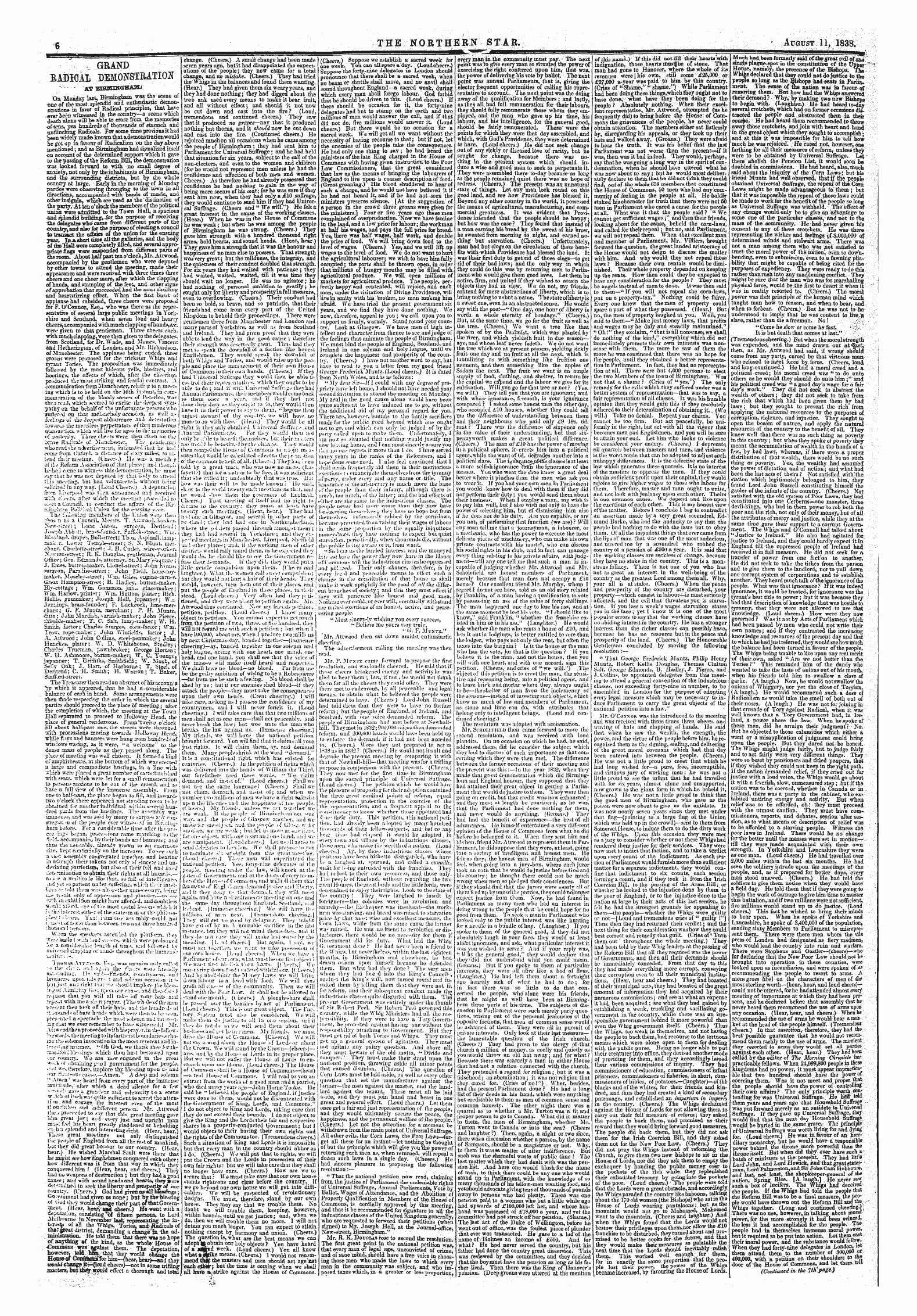
GRAND EAfilCAL BEMONSTHATION -- ¦ -- ¦ - AT BmanNGHAMJ On Monday last , Bmningham was the scene of « ne 6 f the most splendid and enthus ^ Uc demonstration * in feror of Radical principles , that have ever been witnessed in the country—a scene -winch death alone trill be able to erase from the memories ^ oftens , yea hundreds of thousands of staunch and unflinching Radicals . For some time previous it had "been madefy made * known that adraonstratjonwould be got ap in faToor of Radicalism on the day above mentioned ; and as Binningham had signalized itself on account of the determined support -which it gave to the -passing of the Reform Bill , the demonstration
was -looked forward to -with no small degree of anxiety , not only by the inhabitants of Birmingham , and the surrounding districts , lint by the -whole country at large . ~ - Early in the morning of Monday parties were observing thronging to tie town in all directions , accompanied Trim bands of music , and other iTigjgnj ^ which are used as the distinction of the party . At ten o ' clock the members of the political union wereadmitted to the Town Hall , a spadons and splendid bmldinj ,-for the purpose of receiving "tie delegates wlw > came from -different part * of the <» nntry , and al *> for tie purpose of elecnnga council 10 transact the affaire of the union for the ensuing Tear . In . &shart time all the galleries , and the body
of th ? "Hall were completely niled , and several appropriate flag * were suspended from different parts of the room . About h * " past ten o ' clock , Mr . Attwood , accompanied T > y the gentlemen who were deputed by other towns to attend the meeting , made their cheers and one cheer more , after which the clapping of hands , and stamping of the feet , and other si ^ ns of approbation that succeeded had the most thrilling and neartstimng effect When the first Burst of applause >»» d subsided , three cheers were proposed for F . t > 'Connor , Esq ., -who "was there tis the representative of several large public meetings in
Yorkshire and Scotland , when seven londand hearty cheers , accompanied withmnch clapping of hands , Arc . were given to that gentleman . Three cheers each , with much clapping , were then given to the delegates from Scotland , for Dr . Wade , and Messrs . Vincent and Hetherington , of London , and Mr . Richardson , of Manchester . The applause being ended , three groans were proposed for the trickster Whigs and tvraut Tories . Tie proposition was immediately follovred by the most hideous yell * , bis-ings , anil hooticcs , the effects of -which , after the chtvring . produced tL ^ Tnost striking and ft-ai fa ! contrast . A communication from Manchester . rehri : 'g to a
meeting which is to be held on the lb ' th instant , in cjiemeiuora-ion of the bloody > cenes of Peterloo , wa--then re ^ J , -which seemed to excite ihe utfpt-st \ vrjpatby oa the behalf of the unfortunate persons who * u nYr . \ i on that inel-iiichoh' occasion , as well afeelngs of the Jeypcs : abhorrence . ind- dc-r ^ lation towards the mercilej ? perpetrator * oflhr . t muJerou .-tr-mr"acrion , vLich will live fur ages in : he memories of po ? ti * r i ' y . Three cheers were , then ; riven lor the brave Radicals of M « incte-- ; er . TLi * _ gozuk -. nan who read she a-lrertifi'Tncat , intimated ; h ; it be h : i . j corne from Oxlbr I . a di .-r . mee of > i . \! y inile . s to attend th-ir nv-vtins . ( Cheer-. ) lie was a meinb . r of iLe Refurm Association of rhat phci » ; and tho ;; La Lv' -hnl come to witness this demonstration , he must s : iv riiat he was uot deputed ;> v ih . it 6 » -J ™ to utterti !
tLis laivdag , bnt bai volunu-erei . without bi-iis « r -oliciieJ in ant-ft ay . ( Loud Cheer .-. ; A deputation from I-ItiTpoiil was tl . en anuoaactM a : id received wilb cl . tt-r .-s , afrer wliich the is *** . * na : i ^ roCtvdeJ n > el ^ ci a Council , to conduct tbe-affairs of the Dir - " '¦'" j ' r'ii Political . Union for the e-Jsuini : y .-: ; r . The : ' . juv > - s"Li ^ members of tii ^ L iiU . si " * < :- •? . - then ; V * n as a Council , Mt- < sr . « . T . Au « oo 3 . bunker . Ne-w-sirvet ; liaac AaTon , strava , Derili-uu ; Jo ^ pli Abbr . tt , br 3-= 5-foundi-r , SujVulk-str . ivt ; Win BI = _\! aa-3 . draper . Bnll- ; ireet ; Thos , A > piaall . la : npmak . T . Loktt Temple-street ; S . X . Jliunt , lEerchanr . Charlorte-street : J . H . Curler , "wire-work > t . Xi' -rior .-street ; R . K . Douglas , ^ eutleman , Journal Office ; Geo . Edraands , attomev . St . Mary ' s- ' sijnart *; J . Ernes , bntton-maker , Lionel-street ; Jolin Kvaus , > ur ? eon , Paraiise-street : John FieIJ . boue-tovmaker . Moseley-street ; Wm . Giles , eugine-tnmer
Oreat Hampton-strrt't ; B . Hadley , button-maker . Bly-cottage ; Wm . Gnmison . jvm .. glass-mater ; Win . Harlow . printer ; Win . Hntton , plater ; Rich . Hollis , gunmaker ; Jo ;< eph Hoi ] , jnpanner ; W . i . Jemdngs . brass-founder ; F . Lnckcock , lime-merchant ; G . F . 31 natz , mercLant ; P . H . . Muntz , ditto ; John Macdisb , varnish-maker ; John Piercel cbi ile-iiiaier ; T . C . Salt , lamp-maker ; W . H . Smiib . factor ; Charles Snn-gw :, cora-facror ; Wra . Trow , rope-maker 5 John Winfields , factor : J . A . Attwood ; John Collins , sreel-penmaker ; John Hanckes . plater ; _ "VT . D . ViTiitehouse , Studley ; Charles Trueman , pawnbroker ; George Hortan ; W . 11 . Asamoore , bulton-inaker ; W . C . Younge , japanner ; T . "GriSths , Smitlifield ; W . Monk , of Seilr Oak : J . Hart , of Harborne ; T . Steel , of 13 entend ^ C . H . Smith ; H . Watson ; T . Baker , Stafford-street .
The Treasurer Ihen read an abstract of hisaccotmrs by which it app _ eared , that he had a " -considerable balance of cash in band . Some arrangements were then made respecting the ordtr in which the several parties should proceed to the place of meeting ; aft *? r the completion of which , the meeting at the Town Hall separated to proceed to IloUoway Head , the place of general rendezvous . Prom twelve o ' clock till about half-past one , the streets wefe thronged ¦ Jilll procasaoui moving towards IJoUo- » -. iy-Head . while flags and banners were hong jrom bulidreis of windows waring , as it were , ~ a welcome" to the dense mass of people as they passed alen ? . The plac ^ of meeting wa ? "well chosen . It formed a kind of amphitheatre , at ihe bonom of which was erected
a large and commodious hustings , in a line wkh ^ Lich were placed a great number of curl ? ft : n >;<]; ed with seats , which -were let for a < mall femunenition to persons anxious to be ont of th ^ crowd , an J u > iave a full vi ? w of tne immense assembly ,. Trom one to half-past , tbe place began to riil , and iowards two o ' clock " there appeared not stsndin ? ronrn !¦> be obtained iW another indi-. idual witliin several hundred virvis from the tra > tin 2 S . The a *< ernh ] v wa -. nuaecfi ? . aa-i -sv ^ is -aad bj many to surpa *> a * iV C'lngre ^ ti ; > n of the people ever witiie < -t » d in ] 5 jr . ; . i ; : «' - hain before . For a considerable ticje afyr th ^ - yr- > - cee iii £ .- beean . proce . oions came rnruckiug to tht 1
h-.-Id . accompaninu by their bands and banners ; and thus the usseaibly , ilreidv ^ ro-ani to an euormuii . < ~ i ? . e . kept continually on ibe increase : To-. » i > e .-urb a va >* assembly congregated inze' jatr . and bearins In t .-i-. iniph the ' ir tokens not or : ly of sincere : uiJ undrvinxiug patriotism * bat also of rhwrfy H an . j ihi'd -eu raiiii ; ition to obtain their rights , at all hazards . — to - -e a mriititaJe like thnt . « o fall of intel'iu ' t-nc ^ , -ud yet ro patient under - ^ uslVrin ; :. wLi ~ h tl :-ir intel-L . ' r :. ¦ - ¦ T'i ] 'J tlu-ra was altvcrht / r u : iiiec «*> . * 3 rv , fjf inu i-e I ¦ l ^ "U !^ «> n iy of oppression aa ! plnadr-r . — -to sr ' t * uch iu v . 'xluLidon mirht nave afff » r » Ii-d . and doubtless w .-uli rilTor . l . «• : ; , » nf the most i : « eln ! ! , ¦ ¦*> , « n < wLit-h it
1- tn , " i : itere .-l eith-r of the ? tate » min <> r th ^* phil ^ o - , i \ i" ; 1 . irTni . Tt ;;;" . i : »! m : i > e a » s mbly -coijld not < U .-i-t olK-A ^ r tliiii l . » -. 'lweeii tvroiiad tir .-e haujr ^ -d " . housia 1 : > sr > i » ns . W . ; ea xtn' < pe . iki > r > oscenleJ tbe plniform . tVev 'Xere Ua : 3 e i . w .: h ljui t- ; j- *< T > . which were jinfloatri'd for a conviderab :. ' ! -ni .: h of tim-. n :: d } .. l ! .. wfj by suiii " r >; il cl 3 p ' J 2 u £ fi . " u ; uid > throuehout the . iuiineiis " * iiiuliii-i ! -- * . 1 iluS . M Att ' . vo-. o . Ks . j . wu 3 i : r : rtii : in > h-K- crJV-d - ¦) the ciiYr . ';¦ :. ' . : u ' . ill the f ' : « -. -r * »> r ,. F ;! .- - , ' - ! ¦
^ . ¦• unaiuir . llf < r : —rr-. 'ini >' , Ci > uu \ rvin ^ n , ; ra ! bnuurr . * . upon t-. is lt .: . and scOeani occasion it \ - b :: t jo < t itr . 1 riirkt t : a : ~ e -houl I implore the bl .- " - iTi ^ uf Aimi . 'hty V , o : n ;» . » n ^ sr cnu— . and li .-r .-f ,- •• 1 rvqu «> t thnt you will all tak » i > if yonr bat > n : id repe-t with me a sL < rt prayer . ( Theivn'Ji »? oftliemfii vrvsent then took off tueir hats , and the Inuidn d > of ¦ J . i- ; sa . n < i * of bare b- "ads whiclt wvre vh « .-n to hi ' seen . pre .-. 'Lti-i a spectacle tin- roo-t ^ . lenai and int . r . ' -tln ^ tUat we ever remember to have witnessed . ) Mr . At ; woDdthenpri > cpededwithbi < j ) rav .-r , in tlv f illov . - : -i 7 Wor-is . theTneeriugtoitsfartnfr . stL (> aiidarie-. echoisj the solemn invocation in the most reverent a ; : d
int-: e-r . n £ manner . " Oh . God , we thank thee £ v the mui . ifw i bV-.-inss -which thou hast bfstoweJ upon our country . \\' e are now engaged in tU- jrreai ^•¦ ik <>! ^ binhiing ^ 'ol gorenant-nt for the people , - -: i w ^ , therefore , implore thy Lle- ^ ing upon us and oar n . iiT ^ -oi ! - ca ; j > -. \— . Amen . " A dt '> y and solemn Amen'' -w . i < heard from every part of the iaimenst muj-i ; -il » « , after ¦ which a dead silence for a few - ro ; i < l- save a graujetir and ulemuity to a scene « . .. u-a oj i ? # eli wa- , j ., ite sufficient to arrest ihe atten-: i' » find crtsssc the interest even of the most t : ou :. ; tie > s : rad ^ . iifferent person . Mr . Attwood uie ^ proreeue-i to « iy ihat this cn-at meering gave nan great jov ; a :: d - every just \ ind upright man mu .-: f ^ eJ Lis heart greatly gladdened at beholding < -i : h u splendid and interesting aSht ( Henr , hear . ) Tac's-j great meeun ? s not only distinguished t : ie people of England from all the rest of mankind , bat they did great boaour to our country , fllear
near . ) He wished Marshal Soult were there that he might see how Englishmen conquered eacbotherhow different was it from that wav in which they conquered him ! ( Hear , hear , and" cheers . ) They had uu weapons of destruction ; but they nad a good canse ; and with sonnd £ eads and hearts , they » ere dev- * -ri ; j ; ne . i to seek the liberty andpKXspentjrof *> ur county . ( Cseers . ) God had givenm » ail Wwrfngs ; Go . eruinent bad given us none ; bnt by tbeWessing oi liod they would change their part of that Government . ( Hear , heaiyiip cheers . ) He went with a depuiai . on , consisting ^ il -fifteen persons , to Lord iklttounie m Norember lasfc representing the int , r ^ of all the ^ Tngs , Toriel an 4 : RadicaU of tha- ^ eattlistnct . demanding a ^ hange ^ i -th e adiniiusttaoon . He told them that there -was no hope of anytnini of the kind , as the whole House of Commons . was ^ j ^ ainst them . - The deputation , howeve ^ toll . ¦ ¦ JaHfc-iliat they would change the House of & > mmta » for him —( hear , hear }—and they would change itr ^ lond cheers }—not in some trifling 1 matters ^ batdM ^ wccl d e ffec t a thorough and total
Untitled Article
change . ( Cheers . ) A smaBchange had been made seven years ugo , bntit had disappointed the expectations of the people ; they now came for a total change , and no mistake . ( Cheers . ) They had tried the Whigs in the balances and found them wanting . ( Hear . ) They had given them six -weary years , and they had done nothing ; they had digged about the tree ank used every means to mate it bear fruit , and all -without effect ; and should it not now be cut down and cast into the fire ? ( Loud , tremendous and continued cheers . ) They saw that it produced no grapes— -nay that it produced nothing but thorns , and it should now be cat down and cast into the fire . ( Continued cheers . ) He rejoiced much on all occasions -when he came among the people of Birmingham ; they had sent him to Parliament for Universal Suffrage ; and he had held
that situationfer six years , subject to the call of the non-electors , and even to the ^ omen and children ( for he would not represent men unless he had the confidence and affection of both men and women . Cheers . ) As therefore he hadalready possessed that confidence he nad nothing to gain in t&e ww of being more secure of his a&ati for he was sure £ they sent him now , when they had only a £ 10 suffrage , they would continue to send him if they had Universal Suffrage . ( Cheers and " We will . " ) He felt a great interest in the cause of the working classes . ( Hear . ) When he was in the House of Commons he was weak ; but when he was among the people of Birmingham he was strong . ( Cheers . ) They eave him strength with a hundred thousand right
arms , bold heart * , and sound heads . < Hear , hear . ) They gave him a strength that it was the honour and happiness of no man else to possess . That strength was very great ; but the mildness , the integrity , and the quietness of their conduct doubled that strength For six years they had waited with patience ; they bad waited , waited , waited , till it was time they should wait no longer . He was no agitator ; he had nothing of personal ambition to gratify ; he sought only for liberty and prosperityin full measure , even to overflowing , " ( Cheers . ) TheiT conduct had been so bold , so brave , and so patriotic , that their friends had come from every p ; : rt of the United Kingdom to behold their proceedings . There were 2 en 5 emen there from Manchester and London and
manr parts of Yorkshire , as w-ell as from Scotland and Ireland . They bad given proof that they were able to lead the w .-vy in the good cause ; therefore their strength was deservedly treat . Thus had they met to speak the downfall of a faction like honest EnKli > hmen . They would > peuk the -downfall of both WLijs and Tone * , and would raise up the people and place the mauasfemrrnt of their own Hou .-e of Commons in tht-ir own hands . ( Cheers . ) If they had Vniwrsal Suffrage , they v-oul > l then be able to Co . trol tbeir repreS ' - .-ntaiivi-s . which they ought to be : it ;] e to do ; and is" wit . ; Universal Su fin . j . v they had Annual Farliaint * ni > . tht-ir members would come , back 10 them once a yer . r . r . iul if they had not Joae ilsrir duTT a ^ tlu-Y ouu ' at to -rai . XheV WOUld tlieil
hare it in their jjower i <) say to ihfin , " bpgone lliou unjust stewarl of thy coiu . try , we will haw no more to do with thee . " ( Hear . ) They wonU ho all rijht il they only obtained Universal 5 uffr .--. i-. * aud Aiin :: al I ' ar iiaiUv-rjts . J " or lLi-y w ^ uld thcij not >> nlvbe .: ! ile to beavlii iht ^ uselvi's , Lu ; ; hi * ir ni . ; . tens Wi > wiKilJ )» t" bt'itethu-d by : bc chunjt : T . wy would then compel the llous ' . oi Ci'in-inoiis to ai > j ) i nitusures tku . 1 would bt * cu ' culated t-tlect to theyr -m -tioii o : iLe ( . " onuuuii beiii-iit of all . ( Chtvrs . ) Theyhnul ten loll by a great tuu : i , who was now no uure . ( L . ifayeu . ) that lor a l-ation to be fiee , it was sufficient that -he willed it ; undoubtedly that was true . Uu : hiiw wa- > their will to be made known : Ilv sai , .. Ai . iw ti > the ' -vurld tweutvsui-h int * .-tiu 2 < as th . - . t . ;; m !
in * wuii . d ^'>>>\ v iht-in the covcrnors of Ei . t'liuiJ Cheers . ) Tuat i » ji-i * iiiig of itself hud no ri ^' ht f <> dic : a-tj 10 the coumrr : thsy inu .-t , at ]< -: i .-t . liai-e nve : i : y ? ueh Tnv ^ linps . ( llvar , hear . ) Thar had hi' uiic ~ . n Glasgow , aud ieveral in oiht-r jiart ^ ol ^ c 't ' an . l ; they had hal > me iu NortliuruLt . Tlimu wht-re tl : e suLjers pa . » scd ilm-uirb amuupst them ; ihey Lai h ;\ d severnl in Yorkshire ; and they c \ - pe- ' eJ meetings 211 Maii < -li ;> ter , Liyerpoul , Sh .-lTicld : Ui i other pl : ice >; a :: d , if il . e working m- 'u of other ui > tricts WDuid rai : y round tli- 'in , as he exp .-cted th-y would do . he should likf to ? re tin- tJoNt-rijjnt-jjt refuse tlieir dvTr . ands . ll" they di-i . they wnnld put a Hale gem !** ct > : jjpulsii ) 2 ) upon t ) u- ; u . ( Chrvrs aiid laugliUT . ) What i ! k * women call * v . ivt ioir . pu ] . -iuii ;
but they would : ioi hurt ; i hair of their lit * aii . < . J ' . ' . ev woiild , however , turu bt-m out of thi-ir placi-s , and put the people of Euslanu iu tLo « o places , in tli-ir stead . ( Loud clu-er ^ . ) \' fry oftt * n had thev petitioned , und thi'y were ai . out U > petition : > t ; aiiil Mr . AttWQodthus"contiuued . N »! W ir . y frifi : d-. p' -ution , petition , petition , ( l ^ ud cli i-i-r ^ . ) 1 k ; iow ir . iiuv object to petitions . Yoa caiinul t-xpectto gi-t much from thfi petition of two . three , or K \ e hundred , they wflluot reirarJ me wiih such a petition ; l > u : wii .-r , 1 bavelOOjDOO , about me , when 1 prolnce twomiili ' i us by next Christmas-day , banded together —( i : uuien »»' cheering)—ay , bauued tof : ether in one solemn and holy league , acting with one heart , one mind , one head , and one hand , vou shall see that the voice of
the masses v-iil make itself heard and respecteii . . We shall have no blood—no blood . Far from iu >* be the guilty ambition of wising to be a Robespierre —far from me be such n feeding . No blood shall be shed by us ; but if our enemies shed blood—if they attack the people—they must take the consequence . ? upon their own heads . ( Creat cheering . ) 1 will take care , as long as J possess tie confidence of mv countrymen , and I will never forfeit it . ( Loud cheering . ) I will take care that that two millions of nien ? hall act as one man—shall act peaceably , and never break the law ; but woe unto the inaowho breaks the law against us . ( hninei ^ e cheerm ? . ) My friend * , we will Lave the national peduon brought forward . Yon will find that it claims all vour
jnst r ights . It will claim them , ay . and demand them . M an v people shrink at the word "demand . " It is a constitutional right , which has existed for centuries . ( Cheer < . ) In theprrition of rights which was delivered into thi > hands of William ihe Third , our forefathers used tlie ^ -words , W ' -e ciaim demand , and" in ^ i .-t of . " ( Loud cheers . ) Shall we not u-e the ^ a - . ne language ? ( Cht-ers . ) ^ hail-we not claim . di-ia : ii : 1 , and h . ^ i . st o f ; and wh . 'U we uumlier t-Tu inilh * i' : is of men we have a right * t * . jr : si- > up . i-n ih «' iibt-rtii * .-. jiu-1 thy happiness of tue people ( Ch ^ .-r .-. ) My friend-, uiiirss vrt- art t " ^ . Mlif r We : iFe Weak . It" tke pe « - » l- of IJirmir . rU ' . ' . u ttci 4 > 5 K " way . and the people of ( ila < pow a : io ; hi'r , ui : d we mjNf fi r > ne i >; j-ct . n ; : d the j > ei » pV i > f ( j ] - > 4 . ' , -w JV > r
u : ini :. er , wt * r . re vrt * : ik ; hut let us muvt > at < i .: i- ; : ; :: (» . for oiir- i >"! ijv-rt . with dijf ii-art an j un ^ liruid . ; i : tl w «* are oujjiipotent . (' . o-. id cheer * . ) Let x : s : •!! a « ri-e to send Jelt * cares tn L-iti .-on . Wf sh . ill prnjw .- ; ' !« vnii to uu- . uiu ^ e s ' .: i ur i-i-jlu frviiu tlu < irrout iu ? ''t ' im . ( L-. j-l ciii-t-rs . ) 'i"J . f .-e men will sHju'rintoinl tlie national pciitiun . Ves , foriv-j ; hie Qi'k'i'ati'S of tl : e peo ^ ' e . iiieeii : irf nndi-r the law , will knock at the g-itesol tioi eminent , auu at the di > . ) rs ofi-very :: ifiuberofihi * Ilo'i . vnf Cujniui-ns , and will 1-. 41 them thu : 2 , l »; K ) . < Kit ) , if £ :. gl-l . au'n deiuaniljn > : ir »* -uji'l liberty , a : i-l i ; tliv'v deiiy \> that di * : nau-l . lb ** y v . ili mt-.-t a ^ aiu . and ' invi- a .-i . 'jjulnjiit-i ^* mi *** tinc on one aud tbv « amf ilny tbrouahout KiiL'land . Sc > tl ; ui « l , : u . d lr .- ] un » i . IJinnh'TiS ' . ' cli ( . *' 'riiit ' . J We will Ir . a p l \ u-
unuions of m-.-n nexf . | 1 re : n < -i : dons chftTim :. ) Tfiey will sret ln > gi >> d !>> ' delayum . Thej- iniiiiit have got nil' by an h notiralilf -afriiire in tilt ? iirsi instance , but they wiii not mind tlieHis-. 'hi ' .-. and ii thr-y * lo lint rari * they viiil make ba . l wors , * ) iy the ujeii-iiiig . IL U' ! cVierr-. j liul ajraiu , 1-say . wiinu .-t act tn ^ cl l . iT , wt * \ v . ; : it to take possession ol <> ur ¦ >\ v : s h <> u-e . | L > ud ch >* er .-. J Wht * n we h . ivc a P . ir'iaiiii-n : « ifi . * . ir . > wn . what : nustbe ( 'iirfir > ti > lg < . * ft ' : Wt * n ; u-t J-r-t ai .-i .-h C 1 . n 1 La ' . T > . [ t h . vt-. ] Vii-; nu-t ijrinp d < i-s-ii f > oj s > , 1 ] , % ••] will ) inbuur . [( 'Leers . ] And by sibol ' Sbin ^ theM ' . 'iiry Laws we will brin-i Jo-vrn lri }»> nr to n 3 t'v < -l with" food . Wv will thus pro . 'h all i-: «> - . •¦<¦ of the community . Then we will Jeal with the J ' ojr Law . ll shall not be allowed to
.-rand one month . ( Lheers . ) A plouah-slmre shall !« ' pa » i * d owr the b ^ stilrs by act of Parliament . ( Loud cheers . ) This i- » our great object . The Factory >} s' . vm n ; u > t a ' ,.-o l > e considered . Wt * will luakt-tiii-m do justicj to : ill in ouo -e-ssiou , an i if they d <> not do ? o we will son " J tlifin about tlu-ir bu-i : itfss : iT ) d L'"t b . * : tiT men . My friends , we must drive the llou-e of Commoiis . [ Clu-ws . ] We will nut siy a word a ' . > ont the llou >? nf Lords or about the Crown . We will stand by the Crown —( cheers)—aye , and by the Uous- * of Lords in its proper place . Bm w « win not suiTerihe Housj of Lords toenc .-oacli npon -mr House . ( Loud Cillers . ) TUe HilUse . of Common- > ha ! i be a House of Commons —( hear )
—a real ilou .-e of Commons . - 1 will road to you an extract from the works of a g » od man and a patriot , who died many years ago—John 11 orneTouke . 11 e said he believed the people of England , if justice -were dpue to them , would not be discontented with the ( j overnment of King , Lonfs , and Commons /' 1 do not object to King and Lords , taking care that they do nor exceed their bounds . I do not object to give the King and thi * Lords thfir fair and respective shares in a properly-conducted Government ; but 1 would objecs to their having their own rights and the rights of the Commons too . ( Tremendous cheers . ) Such a situation of King and Lprds it is impossible but that every man in ine couutry should abhor as I do . ( Cheers . ) We will put that to rights , we will pnt the Crown and the Lords in possession of their own fair rights : but we will take care that they shall
no longer have ours . ( Cheers . ) How are . we "to secure that ? W-emnrf take care thatour own house stands righu-ous and clear before the cotratry . If n-e go beyond out own house we will get into difficulties . ' We will be suspected of revolutionary design * . We must , therefore , stand by our own house . They may-say that we trouble them . jSo doubt we will trouble them , keeping , however , within bounds , until we get justice ; and , when we do , then we will trouble them no more . I will net detain you much longer . You can expect to attain nothing except by hannony and union . ( Cheers . ) The question is , what are the best means we can adoptHobtain our Loly objects ? You have heard of a JMtted week . ( Lbnd cheers . ) You all know whatii | pke means . ( Cheers . ) I would not recommend &K the masters and men should act agn ' xut leach . < $ har ; bnt the time is coming when we shah all hate » V 4 trike against the House of Commons .
Untitled Article
( Cheers . ) Snppose we establish a sacred week for one week . Yon can all spare a day . ( Loudcheers . ) Snppose the forty-nine delegates in London should pronounce that there shall be ; a sacred week , when no beam o ~ shuttle shall move , and no anvil shall sound throughout England—a sacred week , during which every man shall forego labour . God forbid that he should be driven to this . / Loud cheers . ) If there should be occasion for it , the forty-nine delegates had but to stamp on the earth and two millions of men would answer the call , and if that did not do , five millions would answer it . ( Loud cheers . ) But there wguld be no occasion for a sacred week . We will get all we want without the necessity of having recourse to that ; but if not , let
the enemies of the people take the consequences . He had only one thing to say ; he had heard the ministers ofthe late King charged in the House of Commons with having given instruction to the Poor Law Commissioners , that the great considered that law as the- means of bringing the labourers of England to live upon a coarser description of food . ( Great groaning . ) His blood shuddered to . hear of such a . charge , « ad he would not have believed it if he had not heard it , and if be had not seen thrt ministers preserve silence . [ At the suggestion of a person in the crowd three groans were given for the ministers . ] Four or five years ago these men complained of overproduction . Now we have famine in the land , and alow price forlabour ; the workman
at half hiR wages , and pays the fall once for bread . Yes , there was half wages , half work , and double the p rice of food . We will bring down food to the level of wages . ( Cheers . ) Yes , and we will lift up wages to the level of food . We do not want to hurt the agricultural labourer : we wish to have him fully occupied ; the port * shall be thrown open , in order that millions of hungry mouths may be filled with agricultural produce . We will open millions of markets for agricultural produce . The people , perfectly happy and contented , will rejoice , and each man , under the visitation of Divine Providence , will live in amity with his brother , no man making him afraid . We have tried the present government six years , and we find they have done nothing . We
now , therefore , appeal to you ; we call upon you to support us firmly , warmly . Stand . round your country . Look at Glasgow . We have men of high intellect and character from thence to see andjudge of the feelings that animate the people of Birmingham . We must bind the people of England , Scotland , and Ireland in one solemn and holy league , until we complete the happiness and prosperity of the country . ( Cheers . ) 1 have not another word to say , but have to read to you a letter from my good friend Ccorgp Frederick Muntz . ( Loud cheers . ) It is dated from North Wales , and is as follows : " . My dear Sir— If I could with , any degreeof propr iety nave left home , 1 should not 'have needed your second invitation to attend the meeting on Monday .
My zeal in the good cause uloue would Lave been-< iuite sufficient to have induced me to go , without the additional aid of my ¦ personal regard for you . There " . ins however , bounds to ilie family sacriliees made for tht * public pood beyond which one . ought nut to "go , and which can only be judged of by the party called upon to make them . Unfortunately ,-I : im now so situated'that nothing , would justify my now k ' .. \ mg home , and I "can most-sincerly assure you t'l . 't no (> n < * regrets it more than I do . I- have served nviny years in the Tanks of the Reformers , and I hope " drtue som- * good . 1 also feel convinced that 1 shall aL'aiii fr ^ cjueiitly aid them in tlieir . meritorious exertions ti eiuaticip ^ U * themselve-. s from the tyranny ofp , » rtv , un-li-r every and any name or title . The itnoraiiire oi ihe aristocracy is much more the bane of die peopli ? than tln-ir infamy , although there is much , too much , of tlu > littter ; and the bad efteqts of ciihiT are the saine to tho indusiiious classes . The people neve * ' had iut < rc * cause than they now have
I' -rt-sertu-i ; tht-iiis .-l-. es ; thev have no hopi ; but from themselves . Jii ! : m : ouriy nibbed by the corn-laws , boc . iuse j » ri . * vent * 'd from raisin" tlu-ir wages oMabonr in the sriine prfij'Hi-tii' ! i by the equally iniquitous muuev-laws . they have nuthinc : to expect but quiet starvation , pt-rio iii-: illy , when thousands die , without tin * public Lt-inii aw . ire o ! it , from want . jm > 1 o ; i ; i ; is tin * l-. inded iutoresl and the moneyed i :: tr t \* l ) i : iYe the pmvi'r thi' y now havt ' in the House of Common .- will the industrious classes be oppressed and pii . ' . iL'cd . Tlieir only chnnce , therefore , is by e \ erv lei ; il and peaceubli * means to effvet such a . chailiri . * in t'ie coustitutiou of that house as shall make it work uprifhtlj-.-for the good of all the dillereut brauches of socit-ty ; and this they must effect if t ' nev will persevere like honest and gwod . nie , n N otbV . ia ever conld , or ever will , eventually' withstand tbe united exertions of an honest , active , and . persever ing people .
" ^ lost sincerely wishing you every success , " Believe me yours v .-rv trnlv , ' ft . F . XfVNTZ . " ' Mr . Attwood then sat down amidst euthu ' siastic cheerinjr . The ; uhvr ,. isemiMit calling the raec-ling was then read . ^ Ir . P . Mt ' . \ rz came forward to propose the first resolution , and was loudly cheered . He said that if those cheers betokened energy and acririty lu » was gln'l to hear them , but , if not , lie would not thnn . k them for all the cheers they could offer . ' They were there met to endeavour , by all peaceable and lepal means , to obtain what he believ . jd the people were determined to have . ( Cheers . ) Lord John llussell
had told them that they were to have no turther refonn ; but the people of England , ol' Ireland , and Scotland , with one voice demanded reform . The people of Dinningliani had met before at Newhallnill . They m « t in JSH 2 ' QlW , 0 ( H ) \> . ices then demanded reform , and ^ OO . iKJii h-. iuds would have been hold up to enforce the demand , if it had not bi'tin acceded to . ( Cheers . ) Were they not prepared to act in 1 > 3 S as in 1 S 32 ? ( Cheers . ) He would not insult and degrade the present meeiing by comparing it with that of Newhnll-hill—that , meeting was for a trifliri " purpose in comparison "with . the present . ( Cheers . ) Th ^ y now met for the first time in Birmingham uj > on the sacred principle of Universal Suffrage . ( Loud cheers . ) The petition which he would huv <
the pleasure of proposing f « r their adoption contained the three irreat cardinal points of reform , equal representation , protection in the exorcise of the the representation , and a fre ( jue : ; t appeal to the f- * nssiiut *! icy to kn-ow whether those appointed had < i- > ii ' . * tlieir duty . This petition , this national ' petition , had already b »* en adopted by many hundred thw-twaiid-i of their fellow-subjects , and befire any 1 ' » 1 itr tisiii : had i-I-ipsed it would be adopted , in every town aud villaire by tin ? industrious classes , ' thiise . men why make tiit * wenltli of a narion . ( Loud chivrs .. ) Ay , by those industrious . classes whose i » i * rii : tm- havl * been liithcrto disregarded ,- who iiave In * n l ;» :- { hed at , spurnrd , imd called a cauttillc , uuiit for i » -iriir enlrus ! fd with the franchise . Tliev
hu-1 to look to their own lvsuunv . s , aud these only . The people of Kmrland , without ri'pnrding the two srvnt Hous ;* s . tlie ^ reat lord s and the little lord s , were 'ii'termiued to enjoy iheirriglits . Look to tbe state of the country ! They won * laughed to insult by forei ^ uors—the colonies were in revolution and anarchy—tin * . E . vihi'i'Ui'r was insolvent—the workiinn wasstarvin «; ,. aud bread w ; is raised to starvation p : i .-e by that i ; i . tst wise and excellent measure , the Cum Law-, while from the » u ; ne cause the fanner w ; t < ruin <* d . Me was no friend to revolution or distnrbanci 1 . there would be no necessity for them il ( Jovernment did its duty . What had the Whin CJ . \ eraruent dorse ? He had licv ^ rbeen a friend to the Whins , but neverthi ^ ess , within the last eighteen months , in liinninuham and t'lsewlitre , hn bad
ilriwn o ^ iiiim upon himself because lw duiunded them . Kut what li . id they done ? The very luen whom they bad fo : cd into the King ' s Council-, anaiust tl . e King ' s will , now turned round aud insulted tlu-m by telling them th : it they were not fit for r < . * fonn , and their subsequeiit conduct made the industrious classes quite disgusted with them . The pa-cut Government was entirely imdiT- ' the ' . thumb of . Sir It-ibert Peel . Sir Robert " Peel governed this couJitry , wliile the Whig Ministers had : ill the resp :-n .-ibility . If they were to have a Torj'Governiiit *! it . he protested nirainst lmving one without the rv-ipnnsibiHty attaching to ( Jovernment . But they iiiTist get rid of both Tories and . Whigs . They mtist get up a . gi-neral system of agitation . Theyinus ! m » t-ajritatw * < my paltry question . And above all , they must bewar- * ofthe old motto , " Divide and conquer . " They must make their stand upon the
national position , throwing asidu . all minor point * that raused disunion . ( Cheers . ) The question of Corn Laws must be hud-aside , as well as every other question that set the manufacturer against the farmer—the man against the master , and the landlord against the tenant . These must all be laid aside , and they must join hand and heart in one great and general effort . . ' ( Loud cheers . ) Let them once get a fair and just representation of the people , and they would ultimately secure the peace , the happiness , and the permanent welfare ofthe people . ( Cheers . ) Let not the attention for a moment be withdrawn from the main point of-Universal Suffrage . All other evils , the Corn Laws , the Poor Laws- « forget all these for an instant—let nothing be thought of but the principle -which will give you the power of returning such men as , -when returned , will repeal a dozen such laws in a single day . ( Cheers . ) He had sincere pleasure in proposing the following resolutio
n : — " That the ^ national petition now read ,, claiming from the justice of Parliament the undeniable rights of Universal Suffrage , Annual Parliaments , Vote by Ballot , Wages of Attendance , and the Abolition of Property Qualification in Members of the House * of Commons , is cordially approved by this meeting , and that it be recommended for signature to all the industrious classes of the United Kingdom generally who are requested to forward their petitions ( when signed ) to Mr . Joseph HolL , at the Journal-omce New-street , Birmingham . '' Mr . R . K . Qovqlas rose to second the resolution . The first great point in the national petition wasi that every man of legal age , unconvicted of crime , and of sane mind , should have a free voice in choosing those men who made the laws to which every man in the community was subject , and who imposed taxes which , in a greater or less proportion ,
Untitled Article
every man in the community must pay . The next point was to give eyery man so situated the power of exercising the ri ght conferred upon him , that was , the power of delivering his vote by ballot . The next point was annual Parliaments , that is , giving ; the elector frequent opportunities of calling his representative to account . The next point was the doing away of the qualification for Members ; and lastlyj as they all had full remuneration for their labours , they should fully remunerate those whom they employedy and the man who gave up bis time , his labour , and his intelligence , for the general good , should be fairly , remunerated . These were the points for which they were that day assembled , and which , with God ' s Providence ^ they were determined to have , ( Loud cueerii . ) He did not seek change out of any sickly or diseased love of rarity , but he
sought tor change , because there was nothing in the present system which should induce a wise and good man to seek to perpetuate it . They were assembled there to-day because as long as the people remained quiet there was no hope of redresH . ( Cheers , ) The present was an unnatural state of things . Let any man look round on this good land , and see how Providence has blessed it . Beyond any other country in the world , it possessed the nieans of agricultural , manufacturing , and commercial greatness . It was evident that Providence intended that the people should be happy ; but how was thecase ? They found that instead of a man earning his bread l » y the sweat of his brow , he Sweated from morning to night , and earned
nothing but starvation . ( Cheers . ) Unfortunately , man had but clogs on the circulation of those benefits With which Providence had blessed the land . It was'their first duty to get rid of those clogs—to get rid of their bad laws ; and the only way in which they could do this was by returning men to Parliament who would give them good laws , Let them be active , firm , and united if they wished to attain the objects they had in . view . We do not , my Mends , contend for mere abstractions of liberty , which is to bring nothing to usbut a naine . The state of liberty is a sweet one , even in ah abstracted sense . He would say with the poet— " One clay , one hour of liberty is worth a whole eternity of bondage . " ^ Cheers . ) But , at the same time , we go for the fruit as we'll as
the tree . ( Cheers . ) We want a tree like that spoken of by the Psalmist , which was planted by the river , and which yieldeth fruit in due seasonaye , and whose leaf never fadeth . We do not waut the tree which we at present possess , yielding sickly fruit one day and no fruit at all the next , which is tantalizing us with something like fruition one moment , and then something like the apples of Sodom the next . The fruit we want is an ample supply oi food , clothing , and shelter , in return for the capital we cj ^ pend and the labour we give for its cultivation . Will you go for that tree or not ? ( Yes , we will . ) They tell you that you are ignorant ; and with whoiji * ignorance , forsooth , is your ignorance compared ? 1 asked some honest men the other day ,
who Occupied £ 10 .. houses , whether they could tell me the diflereuco of understanding between them and their neighbours who paid only £ 9 19 s . ( id . rent ? There was the difference of sixpence only iu the value of their understanding , " -but that sixpennyworth makes a great political difference . ( Cheers . ) The man of £ 10 has the power of moving in a political sphere , it erects him into a political agent , while the want of Gd . degrades another into a political slave . The igiibrance ^ ftKe classes is at least a more selfish ignorance tkalT the ignorance of the masses . You who-wear the shoe know a great deal better where it pinches than tb e men who ask you to wear it . If you had yonr own men'in-Parliament you would know : how to deal with them if they did not perform their duty ; you would send them about their business . Wh . e . 111 employ a man , my wish is to pay liim well ., but I also wi . * -h not only to have the
power of selecting Mm , but of dismissing him also if he does not do his duty . Are you capable , or are you not , of "performing that function ( we are ) . ' Will any man tell me that a journeyman , a labourer , or a mechanic , who has the power to execute the most delicate pieces of machinery , who can make his own private contracts with his master , who can discuss his soeialrights in his club , and in fact can manage every thing ' relating to hw private affairs , with jndgmunt—will any one tell me that such a man is incapable of judging whether Mr . Attwood and Mr . Suholeh ' eld are honest members of Parliament , merely because that ' man . does not occupy a £ 10 house ? Our excellent friend Mr . Murphy , whom I regret I do not see here , told us an old story related by Franklin , of a mail having a qualification to vote by possessing an ass of the value of forty shillings . The . man happened one day to lose his as ? , and at tliu same moment he lost his vote . " I should like to
know , " said Franklin , '• ' whether the franchise existed in him or in hit ) ass , " ( Laughter . ) He would ask whether the man who rents a house of £ 10 , nnd lets it out in lodgings ! , is better entitled to vote than the lodger , who pays not only the rent , but often the taxes into the bargain ? Is it the house or the man who has the vote , for that is the question ? If you believe it is the mail , and not the house , then you will vrith one heart , and with one accord , sign this petition . ( Cheers , ; and cries of " we will . " ) . The
objec-t of this petition is to en > ct the man , the sensitive and reasoning being , into apolitical agent , and to leave brick and mortar where , they , always ought to be— . theshelter' of man from the inclemency of the seasons— -instead of investing such objects , which know as much of law and members ' of "Parliament , as stone and lime can do , with attributes that belong only to intelligent beings . ( Loud and continued cheering . ) The resolution was adopted with acclamation . Mr . SchoLki'IELD tlleh came forward to move the
second resolution , and was received with loud plaudits . On no occasion on which he had , he said , addressed them , did he consider the subject which they h . id to discuss of such importance as that concerning wliich they were then met . The difference between the former occasions of their meeting and the present was this : —In the year 18 . ' 32 j when they made that groat demonstration which did Birmingham and England honour , they supposed that they had attained tlieir great object in getting a Parlia ' - muni that would do justice to-them . They were then going on credit , but that credit was now exhausted ; and they must at length be convinced , as he was , that the Parliament had done nothing for them , and never would do anything . ( Groan . * . ) Thev
had had the'benefit of experience—the best of all advantages . He himself entertained a very different opinion of the House of Commons from what Vie did before he belonged to it . When they sent him and bis-hon . friend Mr . Attwood to represent them in Parliament , Ire did suppose that they Were , at least , going into a society of intelligent and honest men , He felt . as they , the honest men " of Birmingham would feel , when going into a jury-box ,, where each juror took an oatli that he would do justice before Hod and his country ; he thought there could not be much wrong when men so pledged their consciences . But if they should rind that the jurors were nearly all of thcinttcd up by one of the parties , the ' ycould ' noftonger expect justice from tbeln . Now , he had found in
Parliament so many men who had an interest in doing wrong to the people that lie could hope for no good from them . 1 o . seek a man in Parliament who looked only to the public interest was like hunting for a nei-dle in a bundle ofh . ay . ( Laughter . ) If you spoke to them of the general good , if they did not absolutely laugh in your face , they would at least ati ' e " ct ignorance , and ask . what particular interest it was you wished to serve ? And if your reply was , ' Why the general good , " they would declare that they ' " did hot understand what you could mean . ( Groans . ) -But . if you spoke to ' them of particular interests , they vcere all alive like a bed of fleas . ( Laughter . ) He had left , them about a fortnight ago heartily sick of . what he had to do ; for
in fact there was so little to do that concerned the people , who alone were Ms friends , that he might as well have been at Birmingham three parts of his time . The subjects of discussion in Parliament-were such merely party questions , arising out of the personal jealousies of the opposite factions , that men of common sense would bn ashamed Of them . They were all iu pursuit of private interests . Only look at their lqst measurethe lamentable question of the Irish church . ( Cheers ? J They had given to the clergy of that church a million of money , as coolly and quietly as youiwould throw an old hat away ; and for what ? Because there was scarcely a man in either House that had not a relation connected with the church .
They pretended a regard for religion ; but it was a falsehood ; an abomination ; it was not religion that they cared for ; ( Cries of no ! " ) What , besides , had the present Parliament doue ? He had a long list of their deeds iu his hand , which were anything but creditable to them as men of common sense and common honesty . The other night there was a quarrel as to whether a Mr , Turton was a tit and proper person to go to Canada . What did it matter to them , the men 6 f Birmingham , whether Mr . Turton went to Canada or into the sea ? ( Cheers and laughter ?) Then , again , a night or two since , there was a discussion whether a parson , by the name of Sampson , should be a magistrate or not . Why . to them it was « a matter of utter indifference . But such was the shameful waste of public time . ' The last m-ftter which they had dealt with was the -pension-list . And here one would blush for the name
of man , tQ think there could be any one who would stand up in Parliament , with the knowledge of so many thousands of his fellow-men wanting food , and ye t snonld advocate . giving tens of thousands of pounds awayto persons who had plenty . There was one pension paid to a woman who but a littlje while ago had upwards of £ 100 , 000 left her , and whose husband was possessed of £ 18 , 000 a year , and yet the committee'had not struck off her pension . ( Shame . ) The last act of the Duke of Wellington , before he went out of office , was the foulest piece of plunder that ever was transacted . He gave to a lad of the name of Holmes an income of £ 500 . And for what ? He had never served the country , but his father had done the country great disservice . This was reviewed by th « committee , and they decided that the boymust have the pension as long as his father lived . Then there was the King of Hanover ' s pension . ( Deep groans were uttered at the mention
Untitled Article
of this nameO If this did not fill iheir hearts wife indignation , those hearts mustl be of stone . That man had gone to Hanover , where the whole of its revenues were | his own , still some £ 26 , 000 or £ 27 , 000 a-year was paid to him by this conntry . ( Cries of ¦ M -Shame , ''' > shame . '') While -Parliament had been doing-these things , which they ( tight not to have done ; what have they been doing for the people ? Absolutely nothing . When their excel lent representative , Mr . Attwood , attempted ( as he ¦ frequently .. did ) to bring before the Hofcje ; of Commons the grievances of the people , be nerer could obtain attention . The memibers either sat listlessly by . disregarding : his appeals , or they took up their
hats and walked away . ( Groans . ) They were afraid to hear the truth , ft was bis belief that the last Parliament was not worse than the present— -if it was , then was it bad indeed . They Would , perhaps , say that he was going a long way in the spintof . condemnation , when he should have uttered what he was now about to say ; but he would most deliberately declare to thetathathe did not think they could tini , pat of the whole 658 members that constituted the House of Commons , 50 men who had anytcommunicy of feeling in the people at all . He boldly staked his character for truth that there were not 60 men in Parliament who cared a curse for the people at all . What was it that the people said ? "We
cannot get sufficient wages ; " andthentheir friends , looking about for the cause , beheld the corn-laws , and called for their repeal ; but no , said Parliament , we will not repeal them . When that : excellent man and member of Parliament , Mr . Villiers , brought forward the question , the great landed aristocracy of the House would not deign to discuss the matter With him . And wh y would they not repeal those laws ? Because their own rentals would be diminished . Their whole property depended on keeping up the rents . How then could they be expected to have any consideration for the people ? They must
be angels instead of men to do so . It-was then said to them— "If you will not repeal the corn-laws , put on a property-tax . " Nothing could be fairer . Every one knew that the men of property could spare apart of what they possessed . ( Hear . ) But no , the meu of property laughed at you . Well , you said to them— "Make just money laws , that profits and wages maybe duly and steadily maintained . " . "Oh ! " they exclaim , " thatis all nonHense ^ , we shall do nothing of the kind , " everything which did not immediately promote their own interests was nonsense with them . The more he saw bf them thf >
more he was convinced that there was no hope for the people , until they obtained a better representation in Parliament . In fact , they had no representation at all . There were but 4 , 000 persons to elect the two Members of the town of Birmingham . ' Was not that a shame ? ( Cries of " yes . " ) The only remedy for the evils which they suffered under was a better system of representation—that was to say , , a fair representation of all classes . It w * is his humble opinion that they would gain this if . they resolutely adhered to their determination of obtaining it ., ( We will . ) Take no denial . Repeat your cluims . You cannot be too firm . But act peacefully , be uniformly in the right , but act with all the vigour that
becomes' men and Englishmen , and you will be sure to attain your end . Let him who looks to violence be considered your enemy . - ( Cheers . ) - I deprecate ; all quarrels between masters and men , and violence is the worst mode that can be adopted to adjust such unhappy differences . It is the defective state of the law which generates these quarrels . Itis no interest of the masters to oppress the men . If they could obtain sufficient profu upon their capital , they would rejoice to give higher wages to those who labour for them . Therefore , master and man ought to unite , and not look with jealousy upon each other . Theirs is one common cause . We depend and live-upon the exertions of each other . Thig is my honest new ofthe matter . Before 1 conclude I beg to contradict
an " assertion made by a very great scoundrel , Edmund Burke , who had the audacity to say that the people had nothing to do with the laws but to obey them . Of all the impudent things that ever came from the lips of man that was one of the most audacious , and uttered too by a scoundrel who robbed the country of a pension of £ 300 a year . It is said that the working classes are reckless of change , because they have no stake in the country . This is a monstrous fallacy . There is not one of you who has not as great an interest in the well-being ofthe country as the greatest Lord among them all . Why ,
your all is at stake . ( Cheers . ) When the peace and prosperity of the country are disturbed ,- your property—which consist in labour—is most seriously affected , and the evil that threatens you is starvation . If you lose a week's wages starvation stares you in the face ; yet I know it is one of the most popular errors to say that the working classes fi a ve no abiding interest in the country . He ha 3 a stronger interest than the richer classes can possibly have , because he has no resource but in the peace and prosperity of the land . ( Cheers . ) The Honourable Gentleman concluded by moving the following resolution : —
" That George Frederick Muntz , Philip Henry Muntz , Robert Kellie Douglas , Thomas Clutton Salt , George Edmonds , B . Hadley , J . Pierce , and J . Collins , be appointed delegates from this meeting to attend a general convention of the industrious classes , not exceeding forty-nine in number , to be assembled in London for the purpose of adopting every legal measure which may be necessary to induce Parliament to carry the great objects of the national petition into a law . " Mr . O'Connor was the introduced to the meeting aud was received wick three times three cheers and waving of hats and clapping of hands . He said that when he saw the wealth , the strength , the power , and the virtue ofthe people before him , he recognised them as the signing , sealing , and delivering
ofthe great moral covenant which had that day been entered into between the people . ( Cheers . ) He was not a little proud to meet that which he had long wished for—a pure , free , incorruptible , and virtuous jury of working men : he was not a little proud to see the . infant that he had travelled with for six years , almost alone and unsupported , now grown to the giant form in which he beheld it , ( Cheers . ) He was not a little proud to think that the good men of Birmingham , who gave us the poison were now about to give us the antidote . It was now nearly seveu years since they met under that flag —( pointing to a large ilag ofthe Union which was held up in the crowd)—sent to them from
Somerset House ,-to induce them to do the dirty work ofthe Whigs . Upon this occasion they were met as a jury to consider whether or not these Whigshad rendered them justice for their services . They Were now met to indict that faction , and to take a vSrdict upon every count of the- indictment . As each spssion oi" Parliament would furnish more than sufficient matter for a separate indictment , they would confine that indictment to six counts , each session forming a count , and if they took it from the ^ Irish Coercion Bill , to the passing cf the Arms Bill ; or whether ' he . looked to the injustice done by them to the poor of England , or to the injustice done to"the nation at large by their acts of this last session ,, he
felt he had the strongest grounds for appealing to them—the people—whether the Whigs were guilty or not —[ Loud and tremendous cries of " guilty ! " ] Thus then they had returned tlieir verdict ; and the next thing for their consideration waa how theytould best correct and remedy that guilt . ( Cries of ' Turn them out' throughout the whole meeting . ) They had been told by ' their Whig leaders at the passing of the Reform-Bill that all they required was the power of Government ,-and then all their demands should be immediately conceded . From that day to this they had made everything more corrupt , conveying their corruption even to all their municipal institutions , ( Hear , hear and cheers . ) They Had boasted «• £ fVi / iin rn-iiiti / iinni 0 r » t" 0 t" V » a ** T \ Ck f \ nflQCTlin « VT TTltt « T 1 * A « i ^ vilaxikva Vi
AJl Ll'Cit llIU . lll . L'lua . l U-VyLi- j »_ . j uuuo > y <^ mgticab amount of information they had acquired by their numerous commissions ; and see at what an expense it had been acquired ; see what they had gained by establishing a weak , truckling and vacillating government in the country , while there was un irresponsible government behind it more powerful than even the Whig government itself . ( Cheers . ) Thus the Whigs , too weakin themselves , and not having the people to back them , had recourse to the tortuous means which were alone open to them for dealing with the public purse . Being no longer able to' their creatures into office , they devisad another mode of providing for them , and they accordingly-issued their various commissions of inquiry . They had commissioners of education , commissioners of infant
pr isoners , commissioners of fisheries , in short , commissioners of bibles , of potatoes , —( laughter)— -of the blacks and of the whites , for their friends and kindred , and thus they had created a kind of secondary patronage , and established an imperiwn in imperio in the country . ( Cheers . ) The Whigs declaimfid against the House . of . Lords for not allowing them , to carry out their full measure of reform ; they asked the people to back them , and promised as -their reward that they Would bring forward good measures The people did back them , but they did not ask them for the , Irish Coercion Bill , and they asked them not for the New Poor Law . ( Cheers . ) They did not pray the VVhig 3 instead of reforming the Church , to give them two new bishops to sit in the House of Lords , nor did they ask them to empty the exchequer by handing the public money oyer to
the pockets of the rich while , they replenished their exhausted treasury by going ; into the pockets of the poor . ( Loud cheers . ) The people were told that the Lordawere a great obstacle , and accordingly the Whigs paraded the country like baboons , talking about the 170 old women ( the Bishops ) who sat in the House of Lords wearing pantaloon' } :, bnt a * the mountain would not go to Mahomed , Mahomed went to the mountain . ( Cheers and laug hter . ) And when the Whigs found that the Lords would not . bestow their privileges upou them , nor allow tne * iy franchise to be disturbed , they turned about and promised to be better cooks for the future , and that they would make their measures so palatable the next time that the Lords should inevitably relish them . This worked well enough ^ for _ them , for in exactly the same proportion that the ^ eo . pie lost their power , the power of the . Whigs became increased , by favouring the House of Lords .
Untitled Article
Much had been formerly » aid of the great evil of one single plagues-spot in the cohstitntioB of the Upper Honse ^ namely , the preaencr of the Bishops ; Th » White declared that they could not do justice-to the pe ^ 0 :. ao ^ vu % : ' | Q ^^ : ^' iMGb-. 'M : PaiiiB . mem . The senge of the nation wasi in favour of removing them . Bnt how had the Whi g * answered their demand ? Why , by making tyro new Bwhops to begin with . ( Laughter . ) . He had heard to-day several crotchets , which had on former occasions distracted the people and obstructed them in their courpe . He had heard them recommended Ap throvr away thb ^ crotchets , aiid join with heart and hand in the great object whichtney sbdght to accomplisl ) : * and at this it was impossible for him to tell how much he was rejoiced ; He cared not , however ^ one
farthing for all their measures of reform , unlesi they were to be obtained b y Universal Suffrage . Let them abolish the Pension List , it would soon be doubled in coiinnissiohs . He had heard , also , much said abont the iniquity of the Corn Laws j but his friend Muntz had well observed * that if the people obtained Universal Suffrage , the repeal of the Corn Laws might be niade advantageous to them ; but that it was impossible the repeal of those laws could be made to work for the benefit of the people so long as Universal Suurage was withheld . The ' effect of any change wouldohly be to give an advantage to some one ofthe particular qlass ' es ^ arid not to the mass of the oommnniry . Hehad never given big consent to any of these crotchets . He Was there
representing , the Wishes and feelings of 3 , 000 , 000 of determined minds and stalwart arnis . There was not a man among them who was not satisfied to trust-the moral power of the nation , ' even to downbending , even to sublnission , even to a fawning pliability that might ; be capable of being cited for the purposes of expediency . They were ready to do this rather thanrush into any maddening conflict . They might be sure that the man who was for marshalling physical force , would be . the first to desert it when it was in reality resorted to . ( Cheers . ) The moral power was thdt principle of the human mind which taught man how to reason , and when to bear , and when to forbear . ( Cheers . ) But he was not to be understood to imply that he was content to livey £ slave , rather than die a freeman . No ! / xV
" Come he slow or come he fast , h > ; k Itis but death that comes at last . " v v . ( Tremendous cheering . ) But when the moral strength was expended , and the mind drawn out at "fast ^ then , as Mr . Attwood had said , if wrong should come from any party , cursed be that virtuous man who refused to meet force by force . ( Cheers , loud and long-continued . ) He had a moral creed and a political creed ; his moral creed was "to do unto others as he would they should do unto him ; " and his political creed was " a good day ' s wage for a fair day *« work . " They did not seek , to abstract the wealth of others j they did not seek to take from the rich that which had been given them by bad laws ; but they sought to prevent the rich from
applying the national resources to the purposes of corruption , violence , and injustice . They sought to open the bosom of nature , and apply the natural resources of the country to the benefit of all . They knew well that there was no such thing as poverty in this country ; but when they spoke ol" poverty they meant the accumulation of wealth / in the hands of a few , by bad laws , whereas , if there were a proper distribution of that wealth , there would be no such thing as poverty . Yes , the wealthy had assumed the power of dictation and of action ; and , what had been the last acts of theirs ? Not satisfied with ' the station which legitimately belonged to him , they found Lord John Russell constituting himself the gaoler of the infants ofthe country . ( Cheers . ) Not
satisfied with the old system--of Poor Laws ,-they . had constituted into one Cerberus—one monster , three devil-kings , who had in them power to rob both the poor and the rich , not only of their money , but of all the attributes of mercy and justice , while they at the same time gave their support to a corrupt Government . The Whigs and Q'Connell had talked about " Justice to Ireland . " He also : had agitated for juodce to Ireland , and they : could hardly expect it in England ^ till the oppressed people of Ireland had received it in full measure . He did not seek for a transfer of power from one fact i on to another . He did not seek to take the tithes from the parson and to give them to the landlord , nor to pull down one corrupt system of corporations and to establish
another . Iheyheard much talk ofthe ignorance ofthe people . What was that ignorance ? It it was indeed ignorance , it would be trusted , for ignorance was the tyrant ' s best title to power ; but it was because they had that description of knowledge that was hostile to tyranny , that they were not allowed to nse that kno-wledge . . ( Loud cheers . ) How wete they now governed ? Was it not by Acts of Parliament which had been passed by men who could not write their own names ; and if they contrasted the increasing knowledge and resources of the present day and that to which hehadjustreferred , they would seehowmuch the balance had been turned in favour of the people . The Whigs being unable to live upon any real merit of their own , asked " Are We not better-than "the
Tories ? " This reminded him of the dandy who wanted to take the taste of unions put of his mouth , when his friends told him to swallow a clove of garlic . ( A -laugh .- ) Now , he would not swallow the onions of Whiggery , nor yet the clove of Toryism . ( A laugh . ) He would recommend such a dose of Radicalism as would take the smell of both out of their noses . ( A laugh . ) He Was not for joining in that crusade of Tory against Radical , when it was well known that a Tory Government had , in Ireland , a power above the law . When he spoke of these men , did he arraign their judgment ? No . But he objected to those calamities which either a want or a misapplication of judgment cpuld bring upon the people . But they dared not he honest .
Ihe Whigs might judge fairly , but to judge fairly and to act fairly were , very different things . They were so beset by pensioners and titled paupers , that if they wished they could not keep in the right path * If the nation demanded relief , if they cried out for justice with a loud voice , the Whigs would go about it with a feverish , slow , unmeasured step but if the nation was to be coerced , whether in Canada or in Ireland , there was a party in the cabinet , who exhibited untirin g energy and activity , Bnt when relief was to be afforded , oh ! they must proceed with the utmost caution . They must have commissioners , reports , and debates , session after session , as to what means or description of relief was to be afforded to a starving ueonle . Witness the
poor laws in Ireland . There would be do change tor the better until the masses were set in motion- ^ till they were made acquainted with their own strength . In Yorkshire and Lancashire they werd as one man . ( Loud cheers . ) He had travelled over 2 , 000 miles within the last six months . He had seen , the soldiery intrude upon the meetings of the people , and , as if prepared for better days , every man stood unawed . ( Cheers . ) He had told the soldiers to give them notice when they would have a field day . He told them that if they were going to begin the work of carriageto g ive him time tomuster this battauon , and if two millions were not sufficient , five millions would stand up to do justice ; ( Lond cheers . ) This fact he wished to bring their minds
to bear upon . When he spolce of Yorkshire and Lancashire , he spoke of 3 , 400 , 000 ofthe population , sending sixty Members to Parliament to misrepre ,-sent them . There were there men whom the vile press of London had designated as fiery madmen , who would lead the country into ruin and warfare . There were Stephens and Oastler— - ( cb . eers ) - ~ who for declaring that the New Poor Law should not be brought into operation _ in these counties , were looked upon as incendiaries , and were spoken of as recommending the people ; to resort to arm 8 . A more gross libel on the characters of men of the most sterling worth —( hear , hear , and loud cheers ) - ^ could not be uttered , for he had attended almost every meeting of importance at which they had been
present , and he declared before that assembly that ne never heard them recommend the use of arms upon any occasion . ( Hear , hear , and cheers . ) When he recommended the use of arms he would bear a DrtJ ket at the head of the people himself . ( Tremendous cheers . ) In that assertion , therefore , they had the best possible guarantee that he would not recommend them : rashly to the use of arms . The moment thejr resorted to arms they would set all parties against each other . ( Hear , hear . ) They had been ^ called by the editor of The Morning Chronicle inrpracticable fellows . When 24 , 999 , 800 people in these kingdoms had no power , it must appear impracticable that two hundred should have the power ' , of coercing them . Was it not meet and proper-that
the people should have the power of controunig their own affairs ? The only principle Worth con * tending for was Universal Suffrage . He haflNold them years and years ago that HocVehold Suwragd was put forward merely as an antidote to Universal Surrrage . If they gave up Universal Suffrage , they would find that the next day Household buffragft would be buried in the same grave . The principle of Universal SufiTage was worth living for and dying for . ( Loudcheers . ) He was in favour of an hereditary monarchy , but . he would have ajesponsible power behind the throne . more powerful than the throneitsejf . But when did thpy ever have suoh a batch of ministers as the present . -They had litt * Lord John , and Lord Howick , nnd that great statesman , Lord Pakaerston , and Sir John Cam . Hiobhonse , tho
and lasfcj not least , the shopkeeper-general of nation , Spring Rice . [ A laugh . l He never saw such a box of lacifers . The Whigs had deceived the people . If the Whigs had told the people that the Reform : Bill was to be a ^^ final measure , the peop le would have thrown out the Reform Bill ana the . Whigs together * ( Long and continued cheering . ) j There wasno nse , however , in talking about poral power , for the more strongl y it had been evinc « a > the less it had accomplished for the people . -The Eeop le had in themselves immense moral power , utit required to be put into action . Let thenx cast their moral power , and the substance would follow-When they had forty-nine delegates in London , let them attend them to the number of 300 , Q ( KH ) r 400 , 000 , with a petition oh their shoulders to - tw » door of the Honse of Gommons , and let them tell ( Continued in the titi-p age . )
Untitled Article
$ THE NORTHERN STAB - : ^ r : , . ; . - > , "; ¦ ... . ; :, :, AigfeCT ^ : IS ^; v- ;
-
-
Citation
-
Northern Star (1837-1852), Aug. 11, 1838, page 6, in the Nineteenth-Century Serials Edition (2008; 2018) ncse.ac.uk/periodicals/ns/issues/vm2-ncseproduct528/page/6/
-