On this page
-
Text (1)
-

Untitled Article
Note: This text has been automatically extracted via Optical Character Recognition (OCR) software. The text has not been manually corrected and should not be relied on to be an accurate representation of the item.
-
-
Transcript
-
Note: This text has been automatically extracted via Optical Character Recognition (OCR) software. The text has not been manually corrected and should not be relied on to be an accurate representation of the item.
Additionally, when viewing full transcripts, extracted text may not be in the same order as the original document.
Untitled Article
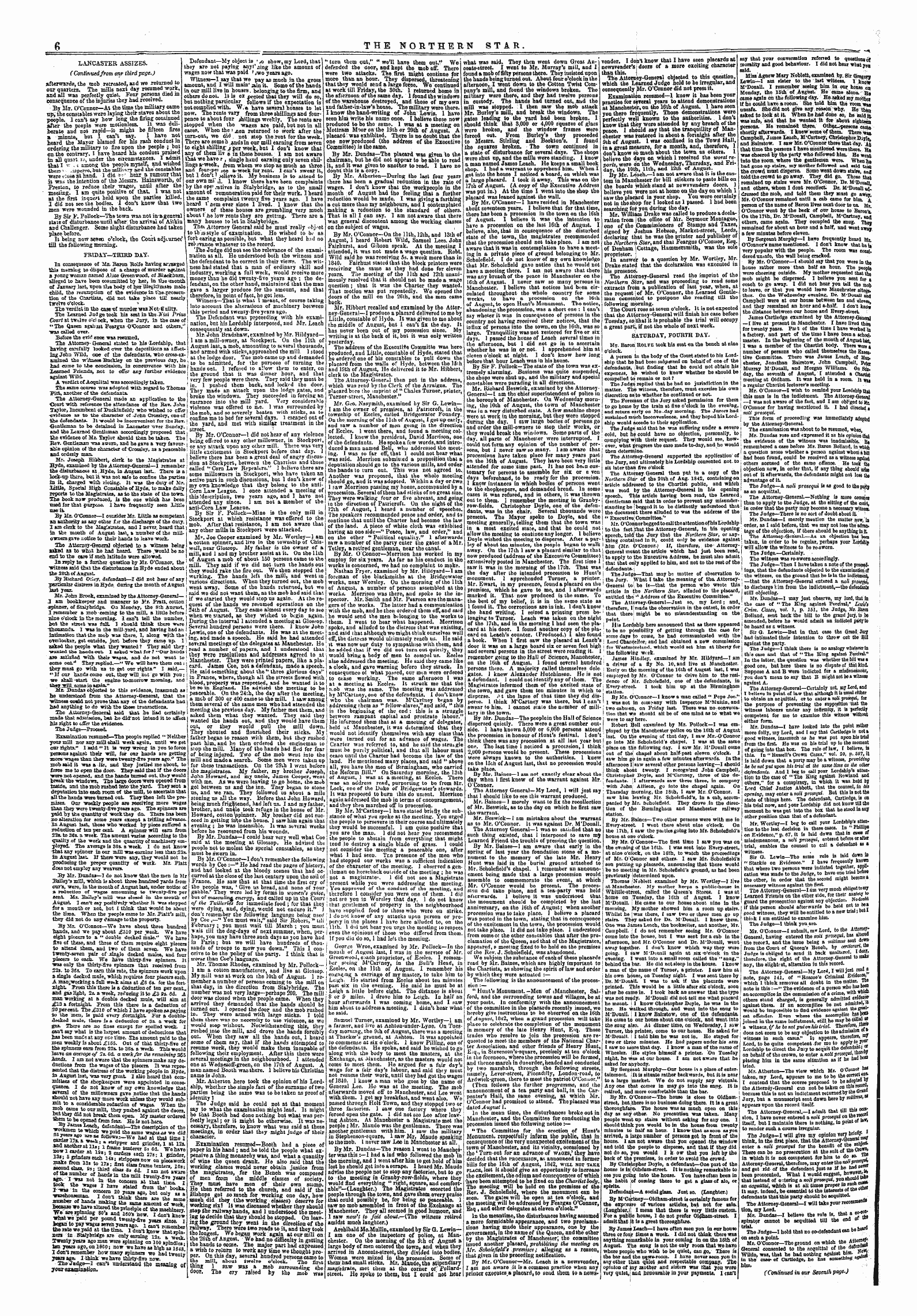
LANCASTER ASSIZES . ( Continuedfrom onr third page . J afterwards , the mob retreated , wdwa returned to our gratters . The mills next day resumed "work , aid all was perfectl y quiet . Fonr persons died in consequence of the injuries they had . received . Bj Mr . O'Connor—At the time the military came up . the constables were laying their staTes about the people . 1 can't say how long the firing continued after the people were motionless . It . was deliberate and not rapid—it might be fifteen fires & minute , but I « an't say . I nave not heard the Mayor blamed for his rash conduct in
ordering the military to fire npon the people j but on the contrarv . I hare heard his conduct praised in all quart , t . ^ under the eiicumstanceB . 1 adnut that I - -1 among the -peopls myself , and'wished them - ¦ -asperse , but the military and the constables ¦ wer e riosext hand . I did tm- - hear a lomonxinat It was the Intention of lha Messrs . Hainsworth , of Preston , to reduce iheir -wage ? , until after the meeting- I « n quite positive oF that . I "was not at the first inquest held npon the parties killed . I did not see the bodies . I don ' t know that two men were wounded in the back .
By Sir Y . Pollock—Tie town was not m-a general state of disturbance until after : the arrival of Aitkin and Challenger . Some slight disturbance had taken place before . It being now seven o'clock , the Court aojcuraec ' tm the following morning .
FRIDAY—THIRD DAY . Is consequence of Mr . Baron Rolfe having ar / arged this msrning to dispose of a charge of murder agtanst s young woman named Alice Greenwood , of IDacfcburn , alleged to hive been copimitted by her , in U ^ e . month of Junior ? last , npon the body of ber illegitimate male child , the resumption of Uie evidence in fae-prosecution of the Chartists , did not t&ke place till nearly twelve o ' clock . * Tee Teroict in tha ^ ase ^ of murus "was 3 f ot > € uilty . The Learned Jud . ge took his seat in the-lTtsi Prius Court at twelve o '< : 3 ock , -when the Jnry , in the case of " The Queen agaisist Feaigus -O'Connor and others /' "was called over . Before the evic ? ence was resumed ,
The Attorney- General stated to bis Lordship , that "b « ing carefully looked over the depositions as Effecting Jelm Wild , ooe of the defendants , who cross-examined the witness Suckle ? on the previous day , he 2 iad come to the conclusion , in concurrence "with his Learned friends , sot to offer any farther evidence against Wild . A verdict of Acquittal was accordingly taken . The ssxne courss was adopted With jegard to Thomas Pitt , another of the defendants .
The Attorney-General made an applicatien to the Court "with reference the attendance of the Rev . John Taylor , Incumbent of Ihickmneld ; -who wished to effisr evKecee as to "the character of-JcHn Crossley , one of ihe Ae ? imX * . TilK- Ifc -would be iccon-penient for t be Rev . ¦ Gentleman to be detained in Lancaster -over Sunday , and the Learned -Gentleman accordingly proposed that the evidence of Mr . Taylor should then be taken . The Rev . Gentleman iras sworn , and he gave a very favourable opinion of the character of-Crossley , as a peaceable and orderly man .
Mr . Joseph HiSbert , clerk to the Magistrates at Hyde , examined by the AttorneyrGenaral—I remember the disturbances ax . Hyde , in August last .. There ib a lock-up there , bat it -eras not safe to confine the parties in it , charged with rioting . It was the duty of Sir . little , Special High Constable of Hyde , to make daily reports to the Magistrates , aaio the state of the town . Tbs book now produced , is the one Thick has been used for that purpose . 1 have frequently seen Little use it . By iir . O'Connor—I consider Mr . Little as competent SB authority as any other f n the discharge of the duty . 1 am clerk to the Magistrates , and I never , heard that in the month of August las-, a number of the miilownersgave notice to their hands to leave work . The Attornsy-tianeral objected to a witness being msied as to what he had heard . There . would be no end to the ease if sneh latitnda weie allowed .
In reply to » further qnestion by Mr . O'Connor , the witness said th&t the disturbances in Hyde ended about the 20 th of August Hj Richard Otiey , defendant—I did not hear cf any particular distress in Hyda . daring the month of August last year . Mr . John Brook , examined by the Attorney-General—J am bookkeeper atd manager to J ' t . Pratt , cotton spinner , of Stalybridge . Oa MondBy , the 8 th Aneust , 3 remember a mob-earning to the tttVii , a little before sine o ' clock in the morning . 1 can't tell the -number , but the street ¦ sraa fnlL I should think there were
"thousands . I ma in the mill-yard , and having had an intiTTintioa that the mob was there , I . along with the OTBlooksr , g « t outads , just before they came up . 1 asked the people what they wanted ? They said they TT 3 Hied the bands out . I asked trttat for ? "Oar hands » se -B&iisEed « Uli tiai * vr&gea , and do » ok trail to eome out * They » j > lied . — " We -will have them out : they must go with as to get our rights . " I said , — ** lf our hands coma out , they wIQ not " go with yon ; -we shall -start the engine to-morrow morning , and ibsjjwilL come in again . " 2 dt Bnndas objected to this evidence , inasmnch as be understood from ths Attorn&y-General , that the witness co « ld not prove that any of the defendants had had anything to do with the these transactions . The Attorney-General said feat be nad certainly scads that admission , bat he -did" not intend it to affect Ms right to ofier the evidence . The Judge—Proceed .
Examination resumed—The people replied " Neither your mill nor any mill shall werk again , until we get our rights . ** 1 add "It i « very wrong in you to force persons against their will , for our hands are getting more Traces than they were twenty-five yean ago . ° The mob said it was a lie , and they Jostles me about , to force me to open the door . They-said that if the doors ¦ were sot opened , and the hands turned out . they would treat the windows . The large doors were opened from inside , and the mob rushed into the yard . They sent a deputation into each room of the mill , to ascertain that aQ the hands were turned out They then left the
premises . Oar weekly people are receiving more wages than they were twenty-five years ago- The spinners are paid by the quantity of -work they do . There has been 330 alteration for some years except a trifling advance . In August last , those who worked by piece Buffered a reduction of ten per cent . A spinner will earn from 22 s . to 36 s . a week . The amount varies according to the quality of ii . e work and the quantity of machinery employed . The average is SOs . a week . I do not know -that any spinner in onr nilll waa earning less than : 22 s in August last . If there were any , they wonld not be producing the proper quantity of work . Mr . Platt does not employ any weavers .
-By Mr . Bundas—I do not knew that the men in Mr Bailey's mill , which is about three hundred yards from out ' s , were , in the month of August last , under notice of a reduction of "trages amounting to twenty-five per ftSnt . Mr . Bailey ' s mill -was dosed is the montb of August I cant say positively -whether 5 t -was stopped for a month or not , bat I think that would be about the tune . When the people came to Mr . Piatt ' s mill , they did not do any
A maniwqrJdng a full week aims at £ 6 « s . for the fort Bight Prom this there is a deduction of ten per cent ., aid gas light , 2 i a week , reducing it to £ 5 2 s . 6 d . A man working at & double decked mule , will aim at £ 13 x fortnight . Prom this there ia a deduction of 20 percant The £ 310 of which I have spokenaa-paying to "the men , is paid every . fortnight . For a double-Jeeked mule , ttere ia a deduction of 33 . a week for gas . There ar-B no fines except for Broiled wotk . I cant say -what is the largest amount of deductions that has been mace at any one time . -The amount paid to the jnen weekly is about £ 155 . Out of that thirty-fiTe of the spinners earn from 22 s . to 36 s . a week . This wonld leave cm < xceragz < f 5 s . Gd . a week for the rtmaimng 355 Jtaxds . I am not aware that the spinnera make any deductions from the wages of the piecers . It was represented that the distress of the working plople in Hyde , in ^ August last , was very grsat I aleo heard that committees of the shopkeepers were apocinted in
conBeguence . I no not know of my own knowledge that several of the miHowners gave notice that the hands should not have any more work unless they wonld submit to a considerable redacfion of wages . When the mob csm& to onrmm , they pnshed agai = Bt the deors , Mtaey ^ a not break them open . My master ordered a ^ to *» opened from fear . He is not-here . i Jame 8 leach , oefendant—The description of fte *<^ en te Trhicb we paia &e same ^^ WB md iS 5 K V ^ J ^™™?™ tpA i
SwlaAruM o ^ e * «« r Ss 6 d . We have IpSHS tprEririr ss a ? stjlsz jssr ^ My ^
We anpiming- go ' s and i 6 o- b iow . j don ^ ^ T ^ atwe paid per pound twenty ^ ve yem an ^ l Jepn ^ pay wa ges aeren years ago . iLn remember the rate we paid at the time . I don't know thatrota nea in Stalyeriige are only earning ^ SL T SSL Iwenty years ago men were spinning on iob spindles ten Te ars ago , on 1900 ; now we haye as high as 1648 * don't remember how many spinners we had twenty jean age . I think we have thirty-five no-w . Tha Jadge—2 csnft nnderstand tlie mesaang of roar examination .
Untitled Article
Defendant—My object is * , o show , my Lord , that they are not paying anyt ' aing like the amount of wages now that was paid * / wo years ago . Witness—I say that we pay as much in the gross amount , and I will main ain it . Some of the hands in our mill live in houses , belonging to the firm , and others do not . It is ez oected that they will do so , out nothing particular follows if the expectation is not complied with . W . © hare several houses to let now . The rents vary from three shillings and fonrpence to about four ihillings weekly . The rents are stopped when the -wages are paid , but not in all case ? . When the j ^ en returne d : to work after the
turn-out , we did . not Btop the rent for the week . There are Bomeh aaid 3 in our mill earning from seven to eight shiUinf ^ pe week , but I don ' t know that any of them liv e in these houses . I am not aware iat we have r , angle hand earning only seven shillings a-week , / rom whom we stop as much as xhree and four-pej aoe a-week for rent . I can ' t swear it , but I don ' 1 relieve it . My bnsiness is to attend to our own mi' J . 1 know there have been complaints by the ope' natives in Stalybridge , as to the small amount of remuneration paid for their work . I heard the same complaint twenty five years ago . I have heard t ' nemerer since I lived . 1 know that the
owners of these houses are grumbling very much about t ie low rents they are getting . There are a many houses to let in Stal y bridge . The * Attorney General said he must really object to tb is style of examination . He wished to be as fort earing as possible , but what they heard had no relevance whatever to the record . The Judge did not see the relevance of the examination at all . He understood both the witness and the defendant to be correct in their views . The witness had stated that a man of ordinary skill and industry , working a fnll week , would receive more money than he did twenty-five years ago ; the defendant , on the other hand , maintained that the man gave a larger produce for the amount , and that therefore , in point of fact , he got Ies 3 . Witness—That is what 1 meant , of course taking into acconnt the alterations of machinery between this period and twenty-five years ago .
The Defendant was proceeding with his examination , but his Lordship interposed , and Mr . Leach consequently sat down . Mr . John Bradshaw , examined by Mr . Hildyard—1 am a mill-owner , at Stockpert . On the 11 th of August last , a mob , amounting to several thousands , and armed with sticks , approached the mill . 1 stood at the lodge door . Tne mob came up and demanded to be admitted , for the purpose of turning the hands out . 1 refused to sHow tbfm to enter , on
the ground that it was dinner hour , and that very few people were there . They said they must be in . 1 pushed them back , and locked the door . They made an attack npon the lodgs gates , and broke the windows . They succeeded in forciuK an entrance into the mill yard . Very considerable violence was offered to me . 1 was surrounded by the mob , and so severely beaten with sticks , as te confine me to bed for sewal days . 1 escaped out of the yard , and met with simil ar treatment in the street . ' *'
By Mr . O'Connor—1 did not hear of any violence being offered to any other millowner , in Stockport , ot any attatk upon any othtr mill . There was very little escitement in Stockport before that day . 1 believe there has been a great deal of angry discussion at Stockport , between the Chartists and those called *• Corn Law Repealers . " 1 believe there are some millowners in Stockport , who have taken an active part in such discussions , but 1 don ' t know of my own knowledge that they belong to the anti-Corn Law League . 1 once attended a meeting of this description , two yeare ago , and 1 have not attended any since . 1 am not a member of tbe anti-Corn Law Leaeue . By Sir F . Pollock—Inline is the only mill in Stockport at which resistance was offered to the mob . After that resistance , I am not aware that any other mills in Stockport were attacked .
M * . Joe Cooper examined by Mr . Wortley—1 am a cotton spinner , and live in the townthip of Chis-• wdl , near Giossop . My father is the owner of a mill , and 1 and my brother assist at it . On the 11 th of August a mob of about 150 persons came to the mill . They said if we did not turn the hands out they would rake the fire out . We then stopped the working . The hands left the mil ] , and went in various directions . When they turned out , the mob went away . Some of the hands returned , but we said we did not want them , as the mob had said that if we started they would stop us again . At the request of the hands we resumed operations on the 24 th of Angnst . They came almost every day to see when we started , as they wished to btgin again .
During the interval 1 attended a meeting at Gloa-op . Several hundred persons were there- 1 know John Lewis , one of the defendants . He was at the meeting , and made a speech . He said he had attended several meetings of the delegates at Manchester . He read a number of papers , and 1 understood that thej were resolutions and addresses agreed to at Manchester . Thej were printed papers , like a placard . James Coe , not a defendant , made a speech . He said something about the " three glorious days " in France , where , though all the streets flowed with blood , property was respected , and be wanted it to be so in England , lie advised the meeting to be peaceable . On the 24 ' -h , the day after the meeting , a mob of 300 or 400 came to the mill . 1 saw among them several of the same men who bad attended the meeting the previous day . My father met them , and asked them what they wanted . They said they wanted the hands out , and they would have them
out , or they would pull the mill down . They shouted and flourished their Bticks . My father began to reason vriih them , but they rushed past him , and he then ordered the engineman to stop the mill . Many of tho handB had ikd for fear of being injured . Two of the mob went into the mill and made a search . Some men were taken up for these transactions . On the 29 ih 1 went before the magistrates . My father , my brother Joseph , John Howard , and my uncle , James Cooper , Trent with me . As we were leaving to go home , the mob got between us and the inn . They began to stone us , and we ran . They followed us about a mile stoning us all the way . Before that John Howard , being much frightened , had left us . I and my father , brother , and unele took refuge in the house of Mr . Howard , cotton Winner . My ; brother did not succeed in getting in \ o the house . 1 saw him again that evening ; he was insensible . It was several weeks before he reeovered from his wounds .
By Mr . Dundas—I could hear very well what Coe said at the meeting at Giossop . He advised the people not to molest the special constables , as they must be sworn in . By Mr . O'Connor^—I don ' t remember the fo llowing word 3 by Coe : — " He had read the pages of history , and had looked at the bloody scenes that had occurred at the close of the last century upon the soil of France . He saw that at that time the first cry of tbe people was , ' Give us bread , and none of jour gabble . ' They were led b y forms in womerCs ffuwe , but f
omosevfinjg energy , and called up in the Court of the TuillerUu for immediate food ; for that they were dying , and , dying , would not endure it . " i don ' t remember the following language beiug usec ' by Coe , — " You must wait , " said Sir Robsrt , " tili February ; you must wait till March ; you must ¦ R ait tiil the dog-days of next summer , when , perhaps , you may have three such days as you have had in Paris ; but we will have hundreds of thou-Eands of troops to mow you down . " This I conceire to be the policy of the party . I think that is worse than Coe ' s langnage .
Mr . Thomas Rhodes , examined b y Mr . Pollock—1 am a cotton manufacturer , and live at GloS 3 op . My mill was at work on the 10 th of August . 1 remember a number of persons coming to the mill on that day , in the direction from Stalybridge . The number was not very large—perhaps 200 . The mill door was closed when the people came . When they arrived they demanded that the hands should be turned oat . 1 opened the door and the mob rushed in . They were armed with large sticks . 1 told
them there was no necessity to use violence , &S We would step vmhont . Notwithstanding this , they rushed into the mill , and drove the handB forcibly out . When they saw all the hands out , 1 heard some of them say , that if the hands attempted to resume work , they would make them incapable of following tbeir employment . After this there were several meetings in the neighbourhood . 1 attended one at Wednesoff-green , on the 17 th of August . A man named Booth was there . 1 believe his Christian name is John .
Mr . Atherton here took the opinion of his Lordship , whether tbe simple fact of the surname of two parties being the same was to be taken as proof of identity 1 The Judge said he could not at that moment say to what the examination might lead . It might be that Booth had done nothing but what was perfectly legal ; or it might be otherwise . It was necessary , therefore , to know what was said at these meetings , in order that they might judge of their character .
Examination resumed—Booth had a piece of paper in his hand ; and he told the people what expensive a thing monarchy was , ; and what a quantity of wine the queen drank . He also said that the working classes would never obtain justice from the magistrates , for tbe Bench was composed of men Ccom the middle classes of society . They must have men of their own stamp . He then refered to the church , and said if the Bishops got so much for working one day , how taaeh did thej ( the working classes ) deserve for working six ! It was discussed whether they should
stop toe railway bands , and 1 understood the meeting to decide that they should be stopped . On leaving the ground tho j went in tha direction of the railway . There were two reads to it , and they took the longest . We began work again at our mill on the 26 th of August . We had . no difficulty in getting the hands to oome . Tee major part had expressed a wish to return to werk anj time we thonenfc proper . On this day , several hundred persons came to the mill , about twelve o'clock . " The first thing 1 saw Was a mob surrounding the door , The cry raised by the mob was
Untitled Article
" turn them out , " " we'll have them ouW We defended the door , and kept the mob off . There were two attacks . The first might continue for more than an honr . They dispersed , threatening that they would send a large force . We continued » t work till Friday , the 30 th . 1 returned home in the afternoon of the same day . 1 found the windows of the warehouse destroyed , and those of my own and fatber-iriA&w ' f house . The military were there . I know the liand-writing of John Lewis . 1 have seen him write his name once . I believe those now produced to be the same . 1 was at a meeting on Mottram M ^ or on the 19 th or 20 th of AugUBt . A placard -was exhibited . There is no doubt that the one sow produced ( the address of the Executive Committee ) is the same .
By Mr . Dundas—The placard was given to the chairman , but he did not appear to be able to read it , and it was given to another to read . I have no doubt this IB a copy . By Mr . Atberton—Daring the last four years there has been a gradual reduction in the rate of wages . I don't know that the workpeople in the month of August had the feeling that a further reduction would be made . I was giving a farthing a cut more than my neighbours , and I contemplated making a reduction to the standard of others . That is all I can say . I am not aware that there was general discontent among the working classes on the subject of wages . ,
By Mr . O'Connor—On the 11 th , 12 th , and 13 th of August , I heard Robert Wild , Samuel Lees . John Fairhurst , and Gibson speak . At the meeting I attended , it was not made a wage question . Robt . Wild said he was receiving Ss . a week more than in 1840 . Fairhust stated that the block printers were receivin g the same as they had done for eleven years . The meeting of the 11 th and 12 th unanimously resolved that it should not be made a wage question ; that it was the Charter they wanted . That motion was put repeatedly . Wo opened the doors of the mill on the 26 th , and the men came back .
Mr . Hibbert recalled and examined by the Attorney-General—I produce a placard delivered to me by Little , constable of Hyde . It was given to me about the middle of August ' , but I can't fix the day . It has never been out of my possession Bince . My writing is at tho back of it , but it was only written yesterday . The address of the Executive GomtaUte was here produced , and Little , constable of Hyde , stated that he erdered one of his constables to pull down the placard from the walls of Hyde , between the 15 th and 19 th of August , Ho delivered it to Mr . Hibbert , clerk tb the Magistrates . The Attorney-General then put in the address , which was read by the Clerk of the Arraigns . The placard bore tho imprint of " Chales Turner , printer , Turner-street , Manchester . "
Mr . Geo . Nasymith , examined by Sir G . Lewin—I am the owmcr of premipes , at Patricroft , in the township of Eccles , called Bridgewater Foundry . Oa the : morning of the 11 tb of August , I got up early , and saw a number of men going in the direction of Eccles . 1 went there , and found a meeting collected . I knew the president , David Morrison , one of the defendants . He spoke a few words , and introduced a man named Bell , who addressed the meeting . I was so far off , that 1 could not hear what was said . Morrison submitted a proposition that a deputation should go to the various mills , and order the bands to turn out . This was not agreed to .
Another was proposed , that the whole meeting should go , and it was adopted . Within a day or two 1 san Morrison passing my house , accompanied by a procession . Several of them had sticks of no great size . They were walking four or five abreast , and going in the direction of Patricroft . On the night of the 12 th of August , 1 heard a number of speeches . The speakers recommended peace and order , and to continue that until the Charter had become the law of the land . A piece of white cloth was exhibited having an one side—'* Peace , law , and order , " and on the other * " Political equality . " 1 afterwards saw a number of the party eater the gates of a Mr , Tetley , a retired gentleman , near the canal .
By Mr . O ConnoT—Morrison has worked m my employ for six years . As far as his conduct in tho works ia concerned , we had no complaint to make . Nathan Fryer , examined by Mr . Hildyard—I am foreman of tbe blacksmiths at the Bridgewater works , near Worsley . Ou the morning of tho 11 th of August , a number of persons assembled at the workd . Morrison was there , and spoke to the inspector . Mr . Smith and Mr . Pearson are the managers of the works . The latter had a communication with the mob , and he then ordered them off , and said he would send the men belonging to the works to them . I went to hear what happened . Morrison spoke , and alluded to the distress that was existing , and , said that although wo might think ourselves well
off , the distress would ultimately reach us . He said it was now our duty to sympathise with them , and he added that if we did not turn out quietly , they would bring a bod ; of men to compel us . Eccles also addressed tho meeting . He said they came like a clock , and gave warning before they struck . In consequence of what passed , our men were ordered to cease working . The same afternoon I was at a meeting at Eccles . It struck me that the n . ob was the same . The meeting was addressed by M ' -Carmey , one of the defendants . I don ' t know who the chairman was . M'Cartney btgan by addressing them as " fellow-slaves ' . " and said , " this is the beginning of the end : this is a struggle between rampant capital and prostrate labour . "
He informed them that at a meeting of delegates , held at Manchester , it was determined that they would not identify themselves with any class that , were turned out for an advance of wages . The Charter was referred to , and he said the struggle must be purely political , and that all labour must cease until the Charter had become the taw of the land . He mentioned many places , and said " above all , you have the men of Birmingham , who carried the Reform Bill . " On Saturday moraine , the 13 th of August , 1 was at a meeting , at Eccles . There was an address read , purporting to be from Mr . Lock , one of the Duke of Bridgewater ' s stewards . It was proposed to burn this do ument . Morrison again addressed the mob in terms of encouragement , and they then marched off in procession .
By Mr . M'Cartney—1 have stated briefly the substance of what you spoke at the meeting . You urged the people to persevere in their coarse and ultimately they would be successful . 1 am quite positive that you are the man . 1 did not hear you recommend the people to abstain from everything that might tend to destroy a single blade of grass . 1 could not consider the meeting a peaceable one , after what 1 had seen . Tte presence of the men who had stopped our works was a sufficient indication of the character of the meeting . 1 observed a gentleman on horseback outside of the meeting ; he was
not a magistrate ? . 1 did not see a Magistrate present while you were addressing the meeting . Yon approved of the conduct of tbe meeting , and therefore 1 consider you were one of them . 1 di f l notsfe you in Worsley that day . 1 do not know that gentlemen of property in the neighbourhood have supplitd food to- those who were on strike . 1 < Jo not know of any attacks upon person or propenyinthe places 1 have here alluded to , on the 11 th . 1 d ' . d not hear you urge the meeting to respect even tho opinions of those who differed from them . If you did do so , 1 had left the meeting .
Geor ^ o Wroe , examined by Mr . Pollock—In tho moach of August last , I was in the service of Mr . Greenwood , cuach proprietor , of Eccles . I remember seeing McCartney , in the Bull's Head , in Eccle ? , on the 11 th of August . I remember his engaging a carriage Of my master , to take him to Lu ; gh- Ho started from Eccles about ten minutes past six in the evening . He said he must bo at Leigh a little before eight . The distance is about , 8 or 9 miles . I drove him to Leigh . In half an hour afterwards I was coming home , and I saw him about to address a meeting . I didn ' t hoar what he said .
Samuel Turner , examined by Mr . Wortley—1 am a farmer , and live as Ashton-under-Lyne . On Tuesday momeng , the 9 th of August , there was a meeting at Thacker ' s ground , at Ashton . It was appointed to commence at six o ' clock . 1 know Pilling , one of the defendants . He spoke , and said he wished to go along with tie body to meet the masters , at the Exchange , at Manchester , as the masters would not come to meet them . He argued for a fair day ? s wage for a teix day ' s labour , and said they must not resume their work , until they had got the wages of 1840 . 1 know a man who goes b y the name of General Lee . Ho was at the meeting . The mob afterwards moved off to Manchester , and Lee went withthem . 1 got my breakfast , and went also . We passed through Holt Town , and they s topped two or three factories . 1 eaw one factory where they forced open the gate . 1 did not see Lee after
leaving Ashtcn . At Manchester a Magistrate met the people j Mr . Maude was the gentleman . There was another gentleman with him . 1 saw the military in Stephenson-equare . 1 saw Mr . Maude speaking to themob . i never saw Lee in Manchester at all . By Mr . Dandas—The reason 1 went to Manchester was this : —l had a lad who followed the mob in the morning , and 1 went after him to get hold of him lest he should get into a scrape . I heard Mr . Maude advise the people not to stop any factories , but to go to the meeting in Granby-row-fielde , where they would find everything u right , square , and comfortable "—( Laughter . ) The Magistrates escorted the people through the town , and gave them every praise that could possibly be , for being so peaceable . 1 saw no mob assembled in front of the Exchange at Manchester . They all seemed in good humour , and 1 saw now ' t to fait about . —{ The witness retired amidst mnoh laughter . )
Archibald Mo . Mullin , examined by Sir G . Lewin—I am one of the inspectors of police , at Man * Chester . On the morning of the 9 ih of August a large body of men entered the town , and when they arrived in Ancoats-street , they divided into bodies . Women were mixed in the procession . Some of them had small sticks . Mr . Maude , the st ipendiary magistrate , met them at the corner of f ' pllardstreet . He spoke to them , but I could ' not hear
Untitled Article
what was said , They then went down Great Ancoats-Btreet . I went to Mr . Murray ' s mill , and I found a mob of fifty persons there . They insisted upon the handB being turned out . About four o'olock in the afternooin , j went down to the Cotton Twist Company ' s mill , and found the windows broken . The military were there , and the ; had twelve persons in custody . The hands had turned oat ,, and the mill was stopped . : I then saw the mob attack Mr . Barley ' s mill , and break the windows . The sates leading to the yard had been broken . I should think thai 3 , 000 or 4 , 000 Equates of glass were broken , and the window frames were forced out . From Burley ' s they proceeded to Messrs . Stirling and Beokton ' s . I found
the squares broken . The town continued in a state of disturbance for several days . The shops were shut up , and the mills were standing . I know a man named James Leach . He keeps a small book shop . I had a warrant to apprehend him . When I got into the house I noticed a board , on which was a large placard . I took it away . This was on tbe 17 th of August . ( A copy of the Executive Address was put in . ) At the time I went into the shop the placard was leaned against the wall . By Mr . O'Connor—I have resided in Manchester about seventeen years . I believe that for that time , there has been a procession in the town on the 16 th of August . I believe it was the intention to have a procession on the last 16 th of August . I believe , also , that in consequence of the disturbed state of the town ,, the magistrates recommended that the procession should not take place . I am not aware that it was in contemplation to have a
meeting in a private piece of ground belonging to Mr . Scholefield . I do not know of my own knowledge that Mr . Scholefield gave notice that he would not have a meeting there . I am not awaro that there was any breach of the peace in Manchaeter on the 16 th of AugUBt . I never saw so many persons in Manchester . I believe that notices had b » en circulated throughout the whole country for some weeks , to have a procession on the 16 th of August , to open Hunt ' s Monument , Tbe notice , abandoning the prooession , was a short one : 1 can't say wheter it was in consequence of persons in the country not having received their notices , that the influx of persons into the town , on the 16 th , was so large . Tranquillity was not restored for five or six days . 1 passed the house of Leach several times in the afternoon , but 1 did not go in to ascertain whether he was in or not . 1 apprehended him at eleven o ' clock at night . 1 don't know how long before that hour Leaoh was in his house .
By Sir F . Pollock— The state of the town was extremely alarming . Business was quite suspended , the shops were shut up , and the military and special constables were parading in all directions . Mr . Richard Beswick , examined by the Attorney-General—I am the chief superintendent of police in the borough of Manchester . On Wednesday morning , the 10 th of August , the town of Manchester was in a very disturbed state . A few machine shops were at work in the morning , but they were stopped during the day . I saw large bodies of persons go and order the mill-owners to stop their works , or thoy would break the windows . Some parts of the day , all parts of Manchester were interrupted . I could not form any opinion of the number of
persons , but I never saw so many . 1 am aware that prooessions have taken place for many years past on the 16 th of August . They have been very little attended for some time past . It has not bev-n customary for persons to assemble for six or s yen days beforehand , to be ready for the procession . 1 snow instances in which bodies of persons went to the shopkeepers , and demanded bread . In some cases it was refused , and in others , it was thrown out to them . 1 remember the meeting in Granbyrow-fields . Christopher Doyle , one of the defendants , was in the chair . Several thousands were present . Tho Mayor spoke to Doyle , and the meeting generally , telling them that the town was in a most excited state , and that he could not
allow the meeting to continue any longer . 1 believe Doyle wished tbe meeting to disperse . After a parley of about ten minutes , the people began to walk away . On the 17 th 1 saw a placard similar to that now produced ( address of the Executive Committee ) extensively posted in Manchester . The first time 1 Baw it was in the morning of the 17 th . That was the day after the intended procession to Hunt ' s monument . 1 apprehonded Turner , a printer . Mr . Ewart , in my presence , found a placard on the premises , which he gave to me , and 1 afterwards marked it . That * now produced is the same . To the best of my belief , it is in the same state as 1 found it . The corrections are in ink . 1 don ' t know the hand writing . I seized a printing press
belonging to Turner . Leach was taken on the night of the 17 th , and in the morning I had 6 een the placard at his door . I found another copy of the placard on Leach ' s counter . ( Produced . ) I also found a book . When I first saw the placard at Leach's door it was on a large board six or seven feet high and several persons in the street were reading it . I remember going to tho Hall of Science , Manohester , on tho 16 th of August . 1 found several hundred persons there . A majority called themselves delegates . 1 knew Alexander Hutehinson . He is not a defendant . 1 could not identify any of them . The Magistrates informed them of the excited state of
the town , and gave them ten minutes in which to disperse . /> t the lapse of that time they did disperse . 1 think M'Cartney was there , but 1 can ' t swear to him . 1 cannot state the number of military in the town . By Mr . Dundas—The peoplein the Hall of Science dispersed quietly . There were a great number outside . 1 have known 5 , 000 or 6 , 000 persons attend the procession in honour of Hunt ' s festival . 1 don't think there was any procession at all last year but one . The last time 1 noticed a procession , 1 think 2 , 000 persons would be present . These processions were always known to the authorities . 1 knew on the 15 th of August last , that no prooession would take place .
By Mr . Baines—1 am not exactly clear about the day when I first knew of the warrant against Mr . O'Connor . The Attorney General—My Lord , 1 will just say that 1 should like to see this warrant produced . Mr . Baines— 1 merely want to fix the recollection of Mr . Beswick , as to the day on which he first saw the warrant . Mr . Beswick—1 am mistaken about the warrant as to Mr . O'Connor . It was against Dr . M'Douall . The Attorney General—1 was so satisfied that no such thing existed , that 1 interposed to save my Learned Friend the trouble of pressing tho question . By Mr . Baines—1 am aware that early in the spring of last year the foundation stone of a monument to the memory of the late Mr . Henry Hunt was laid in the burial ground attached to Mr . Scholefield'B chapel . 1 remember an announcement being made that a large procession would
assemble to commemorate the event , at which Mr . O'Connor would be present . The procession did take place , and a tea-party was held afterwards , 1 believe it was understood that the monument should be completed by the last anniversary , on the 16 th cf August ; when another procession was to take place . 1 believe a placard was posted in the town , stating that in consequence of the excitement in the town , the procession would not take place . It did not take place . 1 understood from some ot the other constables that after the proclamation of tho Queen , and that of the Magistrates , appeared , p meeting fixed to be held on the premises of the Rev . J . Scholefield , was abandoned . We subjoin the substance of each of these placards read by Mr . Baines , which are highly important to the Chartists , as showing the spirit of law and order by which they were actuated : — The following is the announcement of the
procession : — " Hunt ' s Monument . —Men of ( Manchester , Salford , and the surrounding towns and villages , be at your posts . In conformity with the announcement of the committee in the plaoards recently issued , we hereby give instructions to be observed on the 16 th of August , 1842 , when a grand procession will take p lace to celebrate the completion of the monument in memory of the late Henry Hunt , E ? q . Those trades who resolve to join the prooession are requested to meet the members of the National
Charter Association , and other friends of Henry Hunt , E-q ., in Stevenson ' s-square , precisely at ten o ' olock in the forenoon , where the procession will be formed , and thence march in dueorder , headed and conducted by two marshals , through the following streets , namely , Lever-street , Piccadilly , London-road , to Ard wick -green , thore to meet the patriot O'Conuor . " ( Then follows the further programme , and the announcement of a tea party and ball , in the Carpenter ' s Hall , the same evening , at which Mr . O'Connor had promised to attend . The placard was dated August 1 .
In the mean time , the disturbance , ? broke out in Manchester , and the Committee for conduoting the prooession issued the following notice : — 11 The Committee for the erection of Hunt ' s Monument , respectfully inform tbe public , that in consequence of the very unexpected excitement of the town of Manohester , and its vioinity , occasioned by tho' Turn out for an advance of wages , ' they have decided that the procession , as announced in former bills for the 16 th of August , 1842 , will not take place , lest it should give an opportunity to increase the excitement , the odium and consequences of which have been attempted to be fixed on the Chartist body . The meeting will be held on the premises of the Rev . J . Scholefield , where the monument can be seen . The gates will be open at ten o ' olock , and the meeting will be addressed by FeargHS O'Connor , Esq i and other delegates at eleven o ' clock . "
In the meantime , the disturbances having assumed a more formidable appearance , and two proclamations having made their appearance , one by the government , in the name of the Queen , and the other by the Magistrates of Manchester ' , the committee issued another placard , prohibiting * he meeting on Mr . SchoUfield ' s premises > ' alleging as a reason , that given in the preceding notification . By Mr . O'Connor—Mr . Leach in a newsvender , I am not aware it is a common practice when any printer esecutesa placard , to send them to a news *
Untitled Article
vender . I doht know that I have seen placards at newsvender's ! doors of a more exciting character than this , j . The Attorney-General objected to this question , which the Learned Judge held to be irregular , and consequently Mr . O'Connor did not press it . Examination resumed —! know it has been y ; our practice for several years to attend demonstrations at Manchester * on the 16 th of August . 1 have seen you there frequently . Those demonstrations were perfectly well known to the authorities .. 1 don't know that they were attended by any breach of the peace . I should say that the tranquillity of Manchester was restored in about a fortnight after the 9 th of August . 1 was confined m the Town Hall , in a great measure , fora month , and , therefore , 1 don't know so much about the town as others . 1 believe the days on which 1 received the worst
reports were on the Wednesday , Thursday , and Jmday , the 10 th , 11 th , and 12 th of August . By Mr . Leach . —1 am not aware that it ia the custom in Manohester for bill stickers to paste bills on the boards ivhich stand at newsvendere doors . I believe you were not at home on the day on which 1 saw the placard in your shop . You were certainly not in the shop for 1 looked as 1 passed . 1 had been searching for you during the day . Mr . William Drake was called to produce a declaration from jthe office of Mr . Seymour Montague , one of the ' Commissioners of Stamps and Taxes , signed by Joshua Hobson , Market-street , Leeds , declaring that he was the printer and publisher of the Northern Star , and that Feargus O'Connor , Esq . of Denham ( Cottage , Hammersmith , was the sole proprietor , j ,. « .,, « In answer to a question by Mr . Wortley , Mr . Drake stated that the declaration was executed in his presence ! . The Attorney-General read the imprint of the Northern Star , and was proceeding to read some extracts from a publication of last year , when , at the request j of Mr . O'Connor , the Learned Gentleman consented to postpone the reading till the following morning . # The Court rose at seven o ' clock . It is notexpeoted that the Attorney-General will finish his case before Tuesday , sojthat it is probable the trial will occupy a great part ; if not the whole of next week .
SATURDAY , FOURTH DAY . Mr . Baton ; Rolfe took his seat en the bench at nine o ' clock . I A person in the body of the Court stated to his Lordship that he had been subpeened on behalf of one of the defendants , { but finding that he could not obtain his expencas , be wished to know whether he should be compelled to remain or not ? The Judge replied that he bad no jurisdiction in tbe matter . The witness , therefore , must exercise his own discretion as to whether he continued or not . The Foreman of the Jury asked permission for them to go home by the train at five o ' clock in the evening , and retura early on Monday morning . The Jurors had sustained much inconvenience , and they hoped his Lordship would accede to their application .
The Judge said that he waa suffering under a severe cold , but hf could have no objection , personally , to complying with their request . They would see , however , what progress the case made to-day , and he would then determine . The Attorney-General supported the application' of tbe Jury , aqd ultimately his Lordship consented not . to Bit later tban five o ' clock The Attorney General then put in a copy of the Northern Sidr of the 20 th of Aug . 1842 , containingan article addressed to the Chartist public , and which waa read by the Attorney-General in his opening speech . Thia artiole having been read , the Learned Gentleman said that in order to prevent any misunderstanding he ! begged it to be distinctly understood that the document there alluded to was the address of the " Executive ! Committee . "
Mr . O'Connor begged to call theattention of hia Lordship to tbe fact Jthat tbe Attorney-General , in his opening speech , told the Jury tb at tbe Northern Star , or anything contained in it , could only be evidence against Dim ( Mr . O'Connor . ? If , therefore , tne ; Attorney-General meant tbe article which had just been read , to apply to the Executive Address , he must also admit that that only applied to him , and not to the rest of the defendants . 1 The Judge—That may be matter of observation to the Jury . ^ Vhat I take the meaning of tha Attomey-Genetal to I be is—that the person who wrote this article in the Northern Star , alluded to the placard , entitled the ;'' Address of the Executive Committee . " The Attorney-General—Just so , my Lord ; and , therefore , I [ made the observation in the outset , in order that there might be no misunderstanding on the p » int !
His Lordship here announced that aa there appeared to be no possibility of getting through the . case for some days to come , be had communicated with the Lord Chancellor ,- and bad obtained a new commission for Westmoreland , which would set him at liberty for the following week . James Hindley , examined by Mr . Hildyard—I am a driver of a fly No . 10 , and live at Manchester . Early on the morning of the 16 th of August last , I was employed by Mr . O'Connor to drive him to the residence of Mr . Scholefleld , one of tbe defendants , in Every-street I took him up at the Birmingham otation . ; By Mr . O'Connor—I know a man called " Pope Joe . " I was not in company with Inspector M'Mullin , and two cabmen , on Friday last . There was no . conversation that we should all be of one mind as to what we were to say : here .
Robert Bell examined by Mr . Pollock—I was employed by the Manchester police on the 16 tti of August last On tbe evening of that day , I saw Mr . O'Connor go into Mr . Scholtfield ' s chapel . I was at the same place on the following day . I saw Mr . M'Douall come out of the * chapel about half-past eleven o ^ clock . I saw him go in acain a few minutes afterwards . In the afternoon ijsaw several other persona leaving—I should tbink about twenty . I recognized John Campbell , Christopher Doyle , and M'Cartney , three of the defendants . I afterwards saw these three , in company with John Allison , go into tne cbapel again . Oa Thursday toorning , the 18 tb , I saw Mr . „ O'Connor . I saw him leaving Mr . Scboleficld ' s , in a cab , accompanied by Mr . Scholefield . They drove in the direction of the Birmingham and Manchester railway station .
By Mr . Baines—Two other persons were with me in Every-street . I went there about nine o ' clock . On tbe 17 th , I saw the pai ties going into Mr . Scholefield's house at one o'clock . By Mr . O'Connor—Tho first time I saw you was on the evening of the 16 th . I was sent into Every-street , at nine o ' clock , on the 16 th , to watch the proceedings of Mr . O'Connor and others . I saw Mr . Scholefield's son putting up placards , announcing that there would be no meeting in Mr . Scholefleld ' a ground , as had been previously determined upon .
Thomas jNoblett examined by Mr . Wortley—I live at Manchester . My mother keeps a public-house in Whittle-Btreet , called the Queen ' s Stores . I was at home on Tuesday , the 10 th of August I know M'Douall . j He came to our house about nine in the morning . My mother showed him a room up stairs . Whilst be i was there , I eaw two or three men go up stairs . They asked for Dr . M'Douall . I knew them . One was James Leach , the bookseller , and another , Mr . Campbell , j f do not remember seeing Mr . O'Connor come into the bouse , but I was sent for a cab in the afternoon , and Mr . O'Conuor and Dr . M'Douall , went away together , t don't know which way they were going . I saw M'Douall again at . six-o'clock in tbe evening . I went into a small room called the " snug , " behind the bar . He did not sleep in the house . I know a man of the name of Turner , a printer . 1 saw him at his own house , on Tuesday night . I was sent there by Dr . M'Dou&lL I was to ask if the placards were
printed . This would be a little after six o ' clock , soon after be came in . I took back an answer that tbe type was not ready . M'Douall did not tell me what placard he meant . 11 know Christopher Doyle , be waa in the bar . He walked through , and went i nto the snng to M'Douall . j I know Bairatow , one of the defendants . He came to our house about one o ' clock , and went into the snug also . At dinner time , on Wednesday , I saw Turner , the printer , come to our house . He asked for M'Douall . j I told him he was not in . He stayed for two or three minutes . He had papers under his arm I saw no more that day . I know a man of the name of Wheeler . [ He styles himself a printer . On Tuesday night , he was at our house . I am not aware that he asked for anybody . By Sergeant Murphy—Our house « a place of entertainment , lit is situate rather backwards , but it is near to a large { market . We do not supply any victuals . Any one that comes in may go into the annj ? . It is retired , and more comfortable than the bar .
By Mr . O'Connor—The house is dose to Oldhamstreet , but there is no business doing there . It ia a great thoroughfare . The house was as much open on this day as any other . No precaution Waa taken . Many people went up staira without asking for any one . I should think you would be in the house from twenty minates to half an honr . I know that as soon as you arrived , a large number of persons got to front of the house . I am not aware that you opened the window and told the people to disperse , and that if they did not do so , you would I k ow that you left by the back of the , premises , in order to avoid the crowd . By Christopher Doyle , a defendant—One part of the house is in Olhdam-atreet . It ia nothing remarkable to aee you going into the house . You have of ten been in the habit of coming there to get a glass of ale , or spirits . j Defendant—A social glass . Just bo . ( Laughter . )
By M'Cartney—Oldham-street is certainly famous for the exposure of various articles , bat not for sale . ( Laughter . )! I mean that there is very little custom . For a public house , I do not prefer Oldham-street . I admit that it is a great thoroughfare . By James Leach—I have often seen you in eur house three or four times a week . I did not think there was anything remarkable in your coming in on the 16 th of August . The snug ia not the only room that we have where people who wish to be quiet , can go . There is the bar and the news-room . I have never seen yon in any other than quiet and respectable company . The opinion of my mother and sisters was that you were Yfrry quiet . ; and bODourable in your payments . I can't
Untitled Article
say that your conversation referred to questions of morality and good behaviour . I did not hear what yen said . Miss Agnew Mary Noblett , examined by . 8 ir Oregon Lewin—I am sister to the last witness . T kno * M'Douall . I remember seeing him in our house da Monday , the J 5 tb : of ^ Attgnst . He c ^ alone . |[ a cape again on tha following day . He asked ay ntdttiee if he could have a room . She told him the room was unsafe . She did not give any reaaonwhy , He then asked to look at it When he had done so , he said ft . was safe , and that he wanted it for about eighteea persons . He remained there . Othex- ^ persons cama shortly afterwards . I knew some of them . Therei wa » Campbell , James Leach , M'Cartney ^ Christopher Doyle , and Bairstow . I saw Mr . O'Connor there that day . At
that time the persons I have mentioned were there . Ha waa cheered by the party who followed him . He went into the room "where the gentlemen were . When ie had gone np stairs , my mother followed and said ttafc the crowd must disperse . Some went down stairs , ana told the crowd to go away . They did go . Those that remained up stairs were Mr . O'Connor , Dr . M'Douall , and others , whom I donfr recollect ; Dr . M'Douall adl dressed the mob , and told them they must go away Mr . O'Connor remained until a cab came for him . a person of the name of Baron lives next door to us . Mr . O'Connor went by tbe back of onr house to Baron ' s On the 17 th , Dr . M'Douall , Campbell , M'Cartney , aai others , came again . They occupied the snug . Thej remained for about an hour and a half , and went away a few minutes before eleven .
By Sergeant Murphy—I have frequently heard Mr . O'Connor ' s name mentioned . I don't know that he tj very popular with the people . The room was coad derei unsafe , the waU being cracked . By Mr . O'Connor—I should say that you were in the house rather more than half an hour . The people were cheering outside . My mother requested that thg mob might be dispersed . I believe you sent for s coach to go away . I did not hear you tell the niob to leave , or that you would leave Manchester altoge . ther . On the Wednesday evening , Dr . M'BouaU an 4 Campbell were at onr house between ten and eleven , and they remained an hour and a-half . I don't kno »
the distance between our house and Every-street ¦ James Cartledge examined by the Attorney-CtenenI —I live at present in Manchester . I have lived there for twenty y ears . Pa » t of the time I have worked ia a factory , and part of the time I have been a school master . In the beginning of tha month of August lift , I was a member of the Chartist body . There were » number of persons who called themselves the Exeea tive Committee . There was James Leach , of Man . Chester , Jonathan Bairatow , John Campbell , p { er Murray M'Doualk and Morgan Williams . On Sm . day , the seventh of August , I attended a CbarUjfc meeting at Oldham . It Was held in a room . It ym a regular Chartist lecturer ' s meeting .
Mr . O'Connor—I wish to remind your Lordshi p ( hat this man is in the indictment . The Attorney-GfeneuJ —I was not aware of the fact , and I ' am obl ' ged to Mr O'Conuor for having mentioned it . I had directed s noli prosequi . This form of proceeding was immediately adopted by the Attorney-General . The examination was about to be resumed , when , Mr . Dundas rose and expressed it as his opinion thi the evidence of the witness was inadmissible . He remembered a case before Mr . Baron Bolland , in which a question arose whether a person against whom a bill had been found , could be received as a witness againtt others accused of the same offence . He took the objection now , in order that , if any thing should arise out of it afterwards , the defendants might not lose the advantage of it The Judge—A noli prosequi is as good to the party as an acquittal . -
The Attorney-General—Nothing is more ceiDBjoa tban to apply to the Judge , at the sitting of the court , in order that the party may become a necessary witness The Judge—There is no sort of doubt about it . ; Mr . Dundas—I merely mention the matter now , Ia order , as I said before , that we may not lose the adju tage of the objection , if there should be anythingfnff . The Attotney-Geries&L—A . a aa objection bas been taken , in order to be regular , perhaps you ; loird&ip will allow the witness to be re-sworn . The Judge . —Certainly . The Witness was re-sworn accordingly . The Judge—Then I have taken a note of the proceed ings , that the defendants objected to the examination of the witness , on the ground that he is in the indictment ^ —that the Attorney-General entered a noli poseqvi , to discharge £ im from the indictment , —tbe defendants still objecting .
Mr . Dundas—I may just observe , my lord , that Is the case of "The King against Percivalj" Liviiis Crim . Cases , vol . 1 , p . 151 , the Judge , Mr . Baren Bolland , sent back the bill to the grand jury , to be amended , before he would admit an indicted party to be heard as a . witness . Sir Q . Lewin—But in that case the ChancL : Jary had intimated their intention to throff oat tie BUI against the party . The Judge—I think there is no analogy whatOTerin this case and that of " The King againat iP ^ rciTaL 11 In the latter , the question was whether the Mil was a good one , but here there is no dispute of that kind . Suppose A and B were indicted for a nMemeMionr , you don't mean to say that B might not be a witness against A .
The Attorney-General—Certainly not , ay lord , and I believe in point of law that although it is osnal either to obtain an acquittal , or to enter a npii prosejui , for the purpose of preventing the supposition that the witnesB labours under any infirmity , it is perfectiy competent for me to examine this witness without either form . Mr . Dandas—I have looked into the point rather more fully , my Lord , and I say that Cartledge is not a good witness , inasmuch aa he was put upon hia trial from the first He was on his trial up to the moment of going into that box . The rule of law , I believe , la
this . In " Russell ' s Crown Cases , " vol . 20 , p . 597 , it is laid down that a party may be a witness , providing he be not put upon his trial at the same , time as the other defendants . And 1 beg to call your Lordship's atten . tion to the caae of " The King against Rowland and others , " for a conspiracy , in which tt was held bj Lord Chief Justice Abbott , that the counsel , in Ms opening , may enter a noli prosequi . But this is not the state of things here . The defendant , Cattledge , is on his trial now , and jour Lordship did not know till the moment he was put into the box that he stood in an ? other position than that of a defendant .
Mr . Wortley—I beg to call your Lordship ' s attention to the last decision in these cases , la " Phillips on Evidence , " p . 67 , it is laid dawn thatm eases of misdemeanour , a noli prostqui , entered before or alter trial , enables the counsel to call a defendant as a witness . . Sir G . Lewin—The same rule is laid down in " Starkie on Evidence . " I h ave frequently known that where two persons were indicted together , appu * cation was made to the Judge , to have one tried berore the other , in order that the second might become a necessary witness against the first . * — Tbe Attorney-General—lam very much ebligedtomy Learned Friends on the other side , for ttwir . -wwJT £ guard the prosecution against any objec tion . « oaouw if this person should afterwards be held not to cea good witness , they will be entitled to a new tnal ; DM i think I am entitled to examine him . The Judge—I tbink you ate .
Mr . O'Connor—I snbmit , mv Lord , to the Attorney ' General , having entered the noli prosequi , &M . alte' ®| the recori , and the issue being a mitimus sent &om from the Court of Queen ' s Bench , by ceriioran , we Judge is obliged to Bend it back unaltered . I deny , therefore , the right of the Attorney-General to maw any , the slightest , alteration in this record . The Attorney-General—My Lord , I will just read a note , page 141 , of "Roscoe ' e Criminal Endenw , which I think removes all doubt in the matter . u& note is this : — " The evidence of a person whoi has Me an accomplice in tbfl commission of a crime , with wm » others stand charged , is generally admitted e ? i < F ? w against them . If an accomplice be not »^* %£ w ™ h hf , irrmossihl « to find Rvidence against the g *™ '
est offofader . Even where the accomp liea DMWW joined in the same indictment , still he may becaliea ^ a witness , if he be not put on his trial . Thetelote , ^ does not seem to be any objection to the admission < n » witness in Buch cases . " It appears , tbe" w : ¦? £ Lord , to be quite competent . for me to ^ P' ^ j . ™ ,-Lordship to direct the Juvy to acquit the defendant ! « on behalf of the crown , to enter a . noli prosequi , tna ^ J placing him in the same situation as if he Uvxvx * tried . « ... Mr . Atherton—The view which Mr . O'Connor o » taken , my Lotd , appears to me to be the < 5 ° *^* I contend that the course proposed to be adop _ tea » J the Attorney-General can not be taken on this reeo w , because thia is not an indictment returned by the tt »" Jury , but a munnscript sent down here by vaama , » appears upon the record itself . The Attorney-General . —I admit that till ftlii « g sion , I have never entered a noli prosequi on the repo » itself , but I maintain there is nothing , in point ot » »
to render such a course irregular . The Judge—I will give my opinion very brMf think , in the first place , that the At torney . Gen . erd « enter a noli prosequi for the benefit of the m <*» There can be no prosecution at the suit of the w ^ in which it is not competent for him to do . ;* V , ^ f Attorney ^ General , therefore , miy eater the ^ 'J ^ S ^ and get rid of the defendant jost as if be had new been prosecuted . What I would suggest , nowe ? f ^ S that instead of entering &noliprosequi , yott shoaiaw an acquittal , which is at all times proper to Bucn cw » . It may . indeed , be ^ ^ essential td the interests qf tne ow » defendants thafcthis party should bei acquitted . The Attorney-General—I will take your recommend * tion , my Lord . njxfit ? Mr . Dundas—I believe the rule is , that a eo ^ spirator cannot be acquitted till the end oi »
The Judge—I hold that no co-defendant can be nea » on sacb a point .. i .-,, * Mr . O'Connor—The ground on which the ff ^ h General consented to the acquittal of tb ^ defenoa ^ Wilde , was , that he had nothing against mm . J ^ in . tho case-of . Carttedge , be lias tromething as """ hlnr . , ¦ - ' ( Continued in our Seventh page . )
Untitled Article
fi THE NORTHERN STAR .
-
-
Citation
-
Northern Star (1837-1852), March 11, 1843, page 6, in the Nineteenth-Century Serials Edition (2008; 2018) ncse.ac.uk/periodicals/ns/issues/vm2-ncseproduct641/page/6/
-