
On this page
-
Departments (4)
-
Text (12)
-

Untitled Article
-

Untitled Article
-

THE NORTHERN STAR SA7TRDAY. DECEMBER T. 1*44.
-

Untitled Article
-

Untitled Article
-

Untitled Article
-
Untitled Article
-

Untitled Article
-

Untitled Article
-

5Eo L%r^rr0 anXi crorrr^ponUrnt^
-

OVERLAND MAIL
-

akct&cm&<©(r4wrft $nnurjsffj8, fct
Note: This text has been automatically extracted via Optical Character Recognition (OCR) software. The text has not been manually corrected and should not be relied on to be an accurate representation of the item.
-
-
Transcript
-
Note: This text has been automatically extracted via Optical Character Recognition (OCR) software. The text has not been manually corrected and should not be relied on to be an accurate representation of the item.
Additionally, when viewing full transcripts, extracted text may not be in the same order as the original document.
Untitled Article
ROMANCE IS REAL LIFE . The ^ following singular case ' came before the Castlehar ^ oard of Poor Law guardians a few days since . ^¦ n old man applied for admission to the "workhouse , whose appearance and manner and style of speaking denoted evidently that he had belonged to , or moved in , the ranks of respectability before ad-Terse circumstances had reduced him to his present distress . The Earl of Lucan . —What is toot name ? Applicant . —My name , my lord , is Michael Fitzgerald . I was born in the T-icinity of thi 3 "town , in the Tillage of Minolla . 3 hare moved through ererr phase of fortune ; and , from having' been once the possessor of "wealth and opulence , I have come by a sad ricissitude , brought on , indeed , not by my own conduct , but by the misconduct of others , down to the position which I at present occupy . The Earl of Lucan . —Indeed , how was that f
Applicant . —The incidents of my life are extraor dinary , my lord , yet may be briefly told . In my Touthful days , being desirous to travel and push my ibrtune in a' foreign land , I left Ireland for the island of Madeira , taking with me a cargo of such goods as 1 thought would be disposable , on remunerative t erms . My wishes and expectations were not then disappointed . Change of scene and the new rlimate invigorated mv spirits , and the enterprise in which I had embarked * proved most profitable . Revolving to settle permanently in Madeira , I employed all my available capital in pursuingthe trade which I had found so beneficial ; and onlvalew years had elapsed , when the proms of mv engagements so accumulated ,
as to leaTe me at length in possession of an immense fortune . The Governor of the island , whose acquaintance I had the opportunity of making , advised me to turn mv capital and attention to the cultivation of land , whereby agricultural produce could be pro-Tided internallv , -trrthom being compelled , as was ihen the case , to import from America the provisions requisite to support the planters on the island . WeD , my lord , 3 assented to his proposal , but took the precaution of making him enter into an agreement with me to indemnify me for any expense or casualties 1 should incur . by the < rrani of . £ 7-5 . Ot ><> . When the agreement ^ ras thus closed . 1 converted all the -merchandise then in mv warehouses into cash , as
soon as a cheap and rapid sale permitted ; and with -ample funds I proceeded first to Ireland , and afterwards to England , to purchase all sorts of plauts and seeds , and implements of husbandry . With a lanre canro of these 1 returned to Madeira , and soon after besnra the calrare of the fields , to a sreat extent , aeoordirur to the terms of the iovera «> r "> treaty . Nothins could have gone on more auspiciously than our first acricultnral essay ; and 1 am rjow enabled to boast that 1 was the nrst roan who introduced into that island the cultivation of ]» otati > es . Hut . my lord , to be brief—the Governor tia * -irithdraini from the island , through the influence and intrigues of those persons who deriving a profitable trade from the importation of provisions , anil who were ,
consequently , averse to the proceedings I was engaged in . The result was , that I was compelled to desist , after having all my own funds expended in the manner related , and without any further prospect of indemniB--eation than tie fulfilment of the -Governor ' s agreement . To see myself justified . 1 went to Portugal . The Governor , who made the agreement with me , laid my claim before the Kins , and his Maiestv was ¦ p leased to approve of it , and to direct that my claims should be liquidated alone with those of other British claimants . Some delay having taken place in ray jjettins the compensation to wliirh 1 was entitled , " and -which -was * qqs approved of , I went to Mr . TTanl ( who was then ( . 'harjre d'Aiiaires In Porrngali , requirinc of him to > ee me justified .
Mr . Ward gave me only promises of compliance . It was publicly stated , ? ome time " , that a large remittance ofmoney had been sent over by the King of Portugal for the purpose of compensating the British claimants . I Vrote frequently on the subject of my claim to the Duke of Wellington , but at length I received a note from hi < Grace , stating that of the many letter * of mine to which 1 had in my last communications referred , he bad received not a sincle letter : thus it was apparent xhat the conductors of the Foreign Post-office are tbe greatest robbers that ever Irred- I am not aware that the suppression of my letters took place in consequence of ibe 1 ' osr-ofhYtespionage of Sir James Urahain ; bui this much there is reason to suppose—that in the money remitted from Portugal the Duke of Weliiu-iToa made the first great gap—( great laughter ')—by applying an enormous portion of ii to himself . 1 < lo nut think
that Sir Robert Peel w »» uld a » -t tan * : he seems to be a gpil-TTypanrn— iionesi mac . ; R * rnew « l lau ^ Llcr . j My principal object in vomisi . b < -r < -. at j . rvs * -iii , i- t >> get tiu ? opportunity of making ihe . 'nju-tie < -1 <> which I have been snljsvtod public ami n- > li-rhai- —s <> that it may . at length , rraeb . the authorities ami induce them to errant me rviivss . If tlie maxim ** " irr . e . thai the people are bo * l lurcraed where the priricij / nprevaHs that an injury duue tu tin * ine .-uioi subject i = . an injury to the wn *> Te eoimiraimy . > . un-ly it applies to my case in an especial wanner , and the public should insist , and the Govf-j-n : nrt } t -h-mld Of-termiue . that the WTonc 5 to which 1 have *> een < o inn ^ subjected should , it length , eive way to impartial justice , and to the payment lu nir < -f tIkc-i * moneys irhicb "srere remitted from Porrupal ; cr mv indemnification , aeeordiuir to my claim . n > acknowledged by the Kin-r .
The Earl of Lucan . — With refprejiro lo your claim * , the jrentlemen of the press , who are cow present , may assist vou more than we can ; the province of the board of guardians is merely to eon-ider the propriety o jyoirr admission . The elaimani withdrew . Mr . G . Onnsby . —lie is a rine oti lellow . . However rich be mav have been -formerly , he > cenis poor now . I think we ousrht to comply with hi- application . Admitted .
Untitled Article
LONDON . Pimuco . — Thx Wzi ~ h MiRTTRa . —A crowded and enthusiastic ineetlns was held in the A >* embly Room of the Belgrave Tavern , Ebury-street , on Wednesday evening , iJecember the 4 th . for the purpose of giving rhe electors and inhabitants an opportunity of expressing r . eir sympathy with tbe patriots , rrost , Williams , and . i " on « . Mr . William Whitehorn was unanimously called to the chair , and in a neat but brief speech , opened the proceedings . Mr . W . Matthews read a memorial in accordance with the object , and mo * ed its adoption . Mr . F . O'Connor rose amidst great applause to second the memorial . He said he quite agreed with the ¦ vrorkinir 2 ? ian who lia <) addressed thein . lkat Frost ' s cruue was not trea > oii . bui
Chartism . The trials of the W cKh Martyr * had shown the gross inequality of the laws . They ube manyr > , had to pay tlown in hard ca .-Ji l , W » i guineas , before two counsellors could be cot to stir in advocacy yt the accused ; whilst the ^ uecu itml d have six advocate ? tv conduci th »* ]» iv * ecuii «> n at the expense of the ]« eop ] t-. i Hear , iu-ar . i V \ ho . under such circumstance ^ would say the law- were equal , or that those men had had a fair trial 1 < hear , hear . ) Again . : J 2 jurymen ua « i K * eletinr-. .-. mi Jje >? r ? yns tried ^ it woulil Ijc rciutmbvivd . werv i * advocst-e * of the ncn-i-k-rtwi * . t-laimins xht-vote . Sueli a jury was a = } » - tantsin the box to try a Catholic . ¦ l . oud cheers , i Mercv was said to be the bridnest jewel in the Crown .
yet with all the royal birtb > , roy : d ehri-tciung > . vi > nin-rs . and Morions vjrioric > , no juen-yJiad bs-t-n > bow ] i toFrosl and hi > iielluw niartyrs , ¦ ' llv : ir .- Lwir i Mr . O'Connor then entered into a Iumiu » u * exposition of the pricriples of the Peoj'le '? Charit-r . ai ;< l « t'iic ] uJe « l a very eloquent address amidst the iu >> -t trcmcn . loucharms . The memorial wa > then put to the meethiz . and carried unanimously . —Mr . ' uifay . in ashoii bin fon-ible 5 peevh . mov » -il a re ^> 5 nli <« iii _ favour i > 1 the l ' er , T , ] e " s t'harter . which « s - ^ i- « . i-dt- « i l « y Mr StallwiKjiI . and carried unanimously , i . iii the motion of Mr . i > ~ Vo nn » r , --. t-eudetl b y Mr . Funj . a k » I < - "I thank .- was unanimously awarded i «> thi' < hairniau . Three cbct'rs were then givi-n for tkr Charter , and three loud v ' .-vt r- i « r Mr . ' * '«> is ! u » r . aad iLt 3 in-ctm < i
was di = * t ' jved . ItotCOilXS Te ^ I 3 J « "N 1 jil . 1 IMBM . ' UMMSTIEF-. ^ aville House . Leif « --tt ? r—qiuuv . " W t-J ; :.- ^ 3 a ^ fmin :, Dec . 4 th . Mr . Gras-by in the chair Mr . ( onoilv Teported , that thcpla-t < Tci > Lad r » --itlvni tolcjul their aiato thetestimonir . l ; ano ai-otbat tbe c > . ar . io-hui- > would not fail to lend their aid tmiin- ihv « an Inn . Highbury . On Mondav evening la > t . aoid that the , suij-. rij . tii . n was going on well in Fin > iiur . - Mr . Thow likewise reported , that the Islington l'liilanthropio ^ rK-u-tys list was fillinsfast . Mr . Maiih .. UK . tmalier , reported that the city " division had appointevl ccUei-tors . who would wait on their brother member- for their su ^
< = eriptions , on Snndav mornins , l > ec . the stb . ami following Sundays . " Tbe Secretary read a nott- trom Mr R C Payne ^ Halstead , Essex , enclosing il cojirribution Mr . T . 3 L Wheeler banded in . on ben ah of Mr . Gardner , the following sums , making a total ot ^ 4 13 s . \> d . : from Crayford . Kent , collected at a public meeting , £ 1 13 s . 6 d . : Mr . Gardener ' s book , £ 1 «* . 3 d . ; 113 X 113 /? ditto . Ids % L ; Logau s ditto , 133 . « d . -, Hume ' s " ditto , -i > . Vd . ; Donald ' s ditto , 3 s . yd . ; Boyle ' s ditto , 2 * . « . Ul .: >* a * li 5 ditto , Is . ( Ki . A letter was read from Mr . Stallwopd eutlosins a post-office order , receirfrl throu gh the Editor
of the W&Uy Xtyat oA — from Mr . James Turner , "Wellington , Salop , for £ 1 . Mr . Norman handed In ! £ 3 , received fromMx . Gregory , of Carrington , and from Mr . G . Tayldr , on behalf o " f the Trades of Manfhsgter , £ 5 , —Errata in last week ' s subscriptiou list forlirs . Isaac , Is ., read 10 s . Th ' e sums announced from Chrppenham and Granthaiu should have been announoed as firom the United Patriots' Benefit Society . Omitted in last week ' s . WrA-TH -Star , Mr . MiDs , Is . Letters , announcing the favourable progress of iie Testimonial Ptmd were read from Norwki , JBristoL the Associated Trades of Dublin , Svwerb ? Birmingham , and otherplafces .
DKRiDTCL MlTKDEBS K KlKG S CorVTT . —The town and neighbourhood of Frankford -was thrown into s . state of excitement on Friday night last by the announcement of a savaee and brutal murder which it was ascertained had recently been committed at Coolfin , two miles fcouth of that town , in
Untitled Article
the parish and barony of Ballyboy and King ' s County , on the bodies of two fanners , named Thomas and William Sheppard . The particulars are as follows : —Ambrose , Thomas , and William Sheppard , coiyointiy , took a farm of about 24 acres , at Goolfin , n the month of August last , from which a family , named Daly , were previously evicted or ejected for non-payment of rent . After agreeing for the land ¦ with the landlord , the Rev . Ralph Coote , and before going to reside on it , a threatening notice was served at Derryeooley , near Rahan , where they then resided , which notice they disregarded , and entered into the occupation of the farm ; after which a second notice
was served on a portion of their family who still resided at Derrycooley , stating , "that if theSheppards at Coolfin persevered to occupy Daly ' s farm they would be murdered . " Of this , as of the former , they were heedless , evincing resolution and determination , by using all possible means to protect themselves , being well armed , and having their dwelling-house in a strong state of defence , wit ' a a fire-proof room therein constructed by themselves , in which they rested by night with perfect safety ; but lately they became apparently intimate with the people residing in that neighbourhood , and were not so apprehensive of danger as heretofore , so that Thomas and William remained in the house for the last
few days , while Ambrose went to Derrycooley to bring up his wife , child , and furniture . On Friday night last he returned , and , on approaching the house , he found it dark and apparently deserted . The door was closed ; he pushed it in , and called loudly for his brothers , but receiving no answer , he became alarmed , went to his wife , who had remained outside , and made known his suspicions . Without further delay he ran into the town of Frankford , to the Constabulary Barracks . Head-constable Magennis and party promptly repaired to Coolfin with him , and , having procured a light , searched the- house , and found Thomas Sheppard lvins with his face on the floor , and his head literally smashed to pieces , and the brains protruding . An iron hatchet covered with blood was close to the
body . William Sheppard was not in the house . They then made search about the farm , which , from the darkness of the night , proved unav-ailing ; but on the following morning , when davlight came , the search was renewed , and William Slicppard was then found lying in a ditch some distance from the house , most liarbarously murdered , his head broken to pieces , and the brains escaping . A spade broken to pieces was found near the body . This bloody and inhuman deed must have been perpetrated in the day time , probably on Friday morninc , as it appears thl'V wen .-seenat an early Lour on that morning at their ' labour ljpar the houte ; and Ambrose Sbeppard , on his arrival , found their hoi > e harnessed in the fields . On . Saturday , at twelve o ' clock , Mr . James Dillon , county coroner , held an inquest , when a verdict of ' Wilful Murder against some persons unknown" was recorded .
Barxslzt Weavers . —On Monday the 2 d inrt ., the linen-weavers of this town met in Pickering's large room , which was crowded long before the appointed time for meeting ; Mr . J . Grimshaw was called to the chair , who briefly stated the business of the meeting , and called Mr . Frank Mirtield to state the result of a deputation * of which he was one ) that had been employed to measure the yard-sticks of all masters whose lengths were considered to be too great . Mr . Mirficld stated they had found several too long , bui were allowed to make them correct before they left the warehouses : some few had yet to be measured . Mr . J . Yailance next addressed the meeting , and moved — " That the masters be respectfully requested to commence paying wages by the list of 1 > v * i ; instead oi the one by which they are now paying , " which was seconded by a person in the body of the meeting , and carried unanimously . Another person tben
moved" That the fancy drill masters be requested to give an advance on that fabric , " which was also carried without a dissentient . The meeting was then adjouaned till next Monday night at seven o'clock . SHREWSBIRT . —SlKIKI or RiCTOKY Hands . —] On Monday -. ixteen young women , emploved as line spreaders , in the factor } - of Messrs . Marshall and Co ., were fined -3 d . each by the overlooker , John Roberts , for having spread tw heavy ( as he said ) . Thi ? tyrannical overlooker professes to be a strict Christian , and is guilty daily of the most barefaced oppression . If
the Jpoor women spread mo 3 i < rht . they are fined ; il too heavy , they are fined ' The hands are lined ever ? week from Id . uptoSd ., ' . til ., and , on one occasion , ] "d ., upon some paltry pretext or other , while the majority of them don ' t tret more than is . Od . per week . This tyrant well knows that he is driving many a poor lass into the path of ruin to save themselves from absolute starvation . Yet he is a Christian—a pious and religious man ' . The hands struck work last week , but subsequently returned on tbe understanding thai Mr . Overlooker was to be curbed for the future .
Mela _ ni -h oly Ai cuiKNT . — A melancholy and fatal arv-vdeia vx-vuryvd on 'luesdav . forenoon , at Clitheroc . Whilst Robert Clark and John Bank- -sverr rniraged in liic operation ot ^ rindma . owing to the extraordinary velocity with which the stone was movins , or > ume other cau > e , it dew asunder from ceutrifuual iuTve . and one part "truck John liartlc under the chin , inflicting such injuries as to caur ^ instant death . UtiTu FRi > M I > estitithin . —Yesterday afternoon an in < jue ~ t wa < taken before Mr . Baker , at the Cumberland Head , on the view ufthe body of William Goduiaa . aired 4 ' . » , who was found dead , in a miserable apartment at No . l « i , Graham's-buildings , Twistersalli-y , Bunhill-row . It appeared from the evidence that the deceased obtained his livelihood in the city by sweeping i-hiinuie .- » . His wife had been for some time an inmate of the workhou > e of St . Luke , Oldstreet . The deceased was last ^ en alive by a man im ' iied l > ird . who lived in the house when 1 the
deceased lodjred , on rriday afternoon , and on Wednesday following his wife called to * ee him , when he wa > found m a corner of the room , on tiu' bare floor , without the slightest covering over him . The room was also destitute oj iurniture of every description , the only article in it being a few sacks , some cinders , and soot . Life had evidently been extinct several hours . The body was taken to St . Luke ' s workhouse , and was opened , by Mr . Courtency , the parish doctor , who found death to have arisen from a rupture of a vessel at the base of the brain . Bennett , the summoning officer , said that throughout his long experience of scenes of wretehednes * he had not seen one worse . Verdict , Natural death .
The Northern Star Sa7trday. December T. 1*44.
THE NORTHERN STAR SA 7 TRDAY . DECEMBER T . 1 * 44 .
Untitled Article
TH £ MESSIEURS CHAMBERS ' , AND THE THEORY or wages . The wfctiltsalt ? philosophers << f Edinburgh , l \ u- Mi-s » r * . C ^ iiSBtBS , havt recently jiublirtinl a travt . entitled Tbe Employer and tlir Emp ] o _ r « . V ^ h iii > l "' 7 bi-stow murli ] Hiir , N in ' . J F ' -mili :- 7 *' . ' . ;<" Wtiset-n a Mt . JiMts Smith , : i Victory liliU vwiii-r , an < l a Mr . RirniKD Jatksos , a c- tin . pjnnt-r . " t >? J > rove thai as Capnal i =-the pod . so it - ! i > iuid be wor > hipp <»< l ° > tnt > i » "rki « r < -3 a ~ ' > :- « : that Labour i- a rtt * j « fiidant thiiifj : and tha : tin vniplvjril ¦» « - » ar . iiu-aiculabK- : \ iuonnt of 7 r * titii-it Jv the tiujjuyvr « h'j "con-iesiviidi . " t <> ifiiv him work . The eiposure of th < wfaVni- ^* e . « , tjjr fraihi' -s . t )) i-
hioon . 'J ' i'iicw- * . the intemjKraiif * -. and the iin ]> m \ ulenc * - "f llie working classe-, —all <•! vhiiii art o . 'Um- < jiu-ihvs of ,, j . j , j-T- ^^ :. » n ^ iid misrule ratbrr ilian rhanicien ^ lirs t * I a dt-cidtdlx imi-iv » -inp jteoplc—ar- x ) it- points a ! whirii !);< .- . rr . 'n- ¦•! " Mr SMITH . "' tlie Capitalist , ~ arc ^ i >>! ; « hilf j > oi > r Jiri _« us . a Uind of pa .- > : » v iiutrumfiit in Smith ' s hamis , is . alter the manner ^ f the many . - old farmers-, " whose ) Jf » -- } " ! 3 Sr J > rc 7 ud ) i > nf : ir < !¦•!¦} lu' > - )> ren " ) ' « . ; r . >><••} hi : t -iiiirU •¦ lun-.-ut with ¦ - j : i- -a ^ ci-iou > trt-e trad .-r . " —• -tuiiUt-0 b \ tbt- ¦> ' •'/ - ¦ ' ¦ •' ' •'• : (¦; ami f » """¦<« 7 rca ' i" !!!!!^ ' >> f Mr . "Smith , a ^ : •¦ mnVv bun a ; ij > f . ir . i : '¦•¦ ' a ha-l ; , i-. hhitI : ¦• tlir o } , ini .-:. » r . i ) n- anta ; : "i > i » t . ;<• Ik- a ; ! -ast > n .-liakon ,,, [¦ .. ,. ; , n ,. ) ,.- . -.- ;•¦ V . t--- T : * M- ii- > uln ¦¦] " in-aftvr
oun--. n . Tlie hurn and busdf of riii >» i " al bat [¦ - ¦• . ¦ . 3 ud .-J the j- »>> il . iVit \ ¦¦ : " an ?• arli' -r liojiiv of tlii < . tli .- ui" * t wily and ia » i > ii > rti- l > i- " \ that ha < V i-n ainu -1 ai tin- intert-s-t nf tl ) . working ila > s » - ~ siucv tii < m-.-moranlf paoiphlvt * 'f Ui .- L" .: ^ blr and IloijbU- Rf % .-r > -nd Uajiti-t Nosl . The snVioinrd n ^ -te win J : or ., liourttr . tl : at ;! -. <• ~ ubjttt was ODt- whii-li tho * t i-vnnvrtol « ith the I'Uir irere m > t JikcJy t < - pa ? . * -. vit-rin Mlmct-: ivliflt- it ait- > limits . > ur i-ouiraeut t-: i tht tract in tin- present number of tin- >? wr . From ii : at notr it will be Srt * n that Mr , li ' CuSN'iB jirojuxes to ivel < - ; ab ' - > ru . ulj with the ' diaii-jTUe ; " and therefore we -li ^ ll ( ¦ ¦¦ nEDt otir rciu : ir 5 v * . to ^ omr- t » i its must ^ larin ^* al ? ur < liues . f « Uit ^ . and iaconsisleniio .
It ir . i fai-J ptrliaps not jren ^ -r . \ ll \ knuisii . that Chadir ; rs . --t" Po ^ r Iatc ivjtoricty , is the bosom friend of the Mtrssr > . CniUsrsj : and therefore' « v may infer that he lias lv ^* y their iusiructor u j » on a ireiiiis-t- which is c- ^ i « 1 euil \ inlen'ls ? d a _ - ; an auxiliary to thi- present starvation system . The " dialogiK- " opi-ns -nith the nvital of Mr . Smith ' s magical rise in the viurld of manufactures , and the fascinations of the great things that he has accomplished by sobrirtv , attention , ptr ^ rverance , and travel—not t ' orgettin- < a few instances of unparalleled gotnl luck , and one of a rerr successful marriage , which appear to have so
coinplelelv "jldbtrpafUd " poor JacksOS as to have rendered hnm an easy prey to his judicious instructor : Skitb inspires Jacilsoh -with a large amount of self-esteem ; and would assure him that all that he ( Smith ) had so successfully accomplished was equally within the reach of the man Jjcesojc . And hence we find each alluring prospect laid before the employed met "with the becoming observation , or response— " why , I confess I never saw it in that light before ; " "there is such a deal offituff talked of , that it is so long before one gets at the truth ; " or "I confess it is rather stranpe I never heard such explanation before . " Here we quite agree with Mr . Jacksoh . We much doubt that it had been his lot , or that of any other
Untitled Article
man , to hear so much " stuff" talked , as was conveyed to him by Mr , Smith . The blow aimed at Trades' Unions is ominous at the present moment , if taken in connection with the letter of Mr . DcNCOMBEto the Trades of Sheffield ; us the manifest object of the tract is to convince the middle classes generally , as well as the satisfied portion of the working classes , of the necesiity of putting down all Labour combinations , and of strengthening the hands of Capitalists ,
to the end that all tbe benefits arising from the PKOTEC . tio > " of Capita 1 ., and from the gratitude of the emplujed may be fully developed . This is the aim and end of : the " dialogue f and many cases drawn from the situation of Dublin , Belfast , Bandon , Nottingham , and other towns , though wholly irrelevant and unconnected with the question at issue , have been lugged in as arguments in aid of that blow which will assuredly be aimed at the last remaining rights of the working classes .
Air . Smith is professedly a " free-trader ; " although , through Mr . Jackson , he proposes some startling considerations for reflection , and the answers to which must come from others . For instance , he tells us that th « re-» ult of a strike in any district has usually been tilts removal of the " concern" to some other district , where , the capitalist might work unshackled by the rules or regulations of the employed . . Vow , this is one of those unjust privileges which we have contended against ; and as the only means of meeting which , ' we havu proposed uiu / orm regulations through National Trades' Unions ¦ , so that the migrating Capitalist , who flies from justice in one district may be met by a similar code of laws in that to which he may remove—thus giving to Labour the same
protection that Capital enjoys . Mr . Smith is compelled to admit that wages are regnlated by the number of " hands " in the market ; and he takes our standard for illustration . He informs us that fifty in a thousand being unemployed , will inevitably regulate the wages of the nine hundred and fifty at work ; and that the magical inventions , improvements , and alterations , between " brisk" ami " slack" trade , have a never-ceasing tendency to u \> gment the competitive unemployed reserve . Thus , fifty in the thousand may constitute the surplus to-day which a new invention jiut into operation nuiy uugiiiyut to a hundred to-morrow ; and u . change- from " bviik " to "slack"' trade nuij further uufnucut uutil tin Omployed become the minority , and the unwilling idlers Ttimajoritv .
Xow , to deal uith such a cas < -, —not at all an unprecedented tiiic , —should be the abject of every friend of the working classes , and of e \ ery well-wisher to Mjciety . When the idle resen •• consists but of one in twenty , or lit ' ly in a thousand , by g-xni regulation / the employed c < . > ul < l withliold their competition from the Labour mai'ket . As nineteen men employed about v > liat tliey are all i-e « jviived to do will receive more wages than twenty men doing the work -of -nineteen , it is the interest of the nineteen at work to support the one in idleness ,, rather than to allow his labour , reduced in value , to be brought into competition with tho > e at work . This principle may' ,
perhaps . apl > ly to so Inrge . a reserve as one iu ten ; but there we fear it » efficiency ceRses ; and where isolated Trades' regulations fail , then a qiner a l system should stur n to prevent the Labour market from being prejudicially glutted . Mr . Smith , while evidently looking for legal controul to destroy Trades" Unions , not only eschews politics altogether , but further assures us that " wages cannot to regulated by law ; " and although Mr . Ssiith induce * Mr Jackson to put the question , he must have been avrare that tviiUe lie denies the j « jwcr ot' <> i | iiulsziiig wages by In *—in which we fully concur—he is throughout eouteudinu for protection for Capital .
¦ What ne have to ask of Mr . Smith is this ;—us lie hrus aibnitted that the scv ^ -ltts of Labour in the market has a tt-ndeucy to reduce ¦ «?* $ »* ; and as he admit" lliat Labour is I ' apital , t / ii / hnx n . r . ot pfopo / td < i rcnit'rfj / fuf all (/ . « . ¦ > .- ¦ erils ichieh he ttdmitt arise frm the ric ^ li-y of Moater / , '(/¦• coprici' jii . ' iH's of trade , and tfn : irrttjulvriUi < if ilenitinil iirnl upyhl i Wt HAVE PRoFOSLU THE J ^ AjSl ) AS THE KKMEDT and although Mr . Smith syieak * nyj » roviii ;; ' j » of Emigration ' he does not venture to recommend U as a " remedy " II .-tt-lls us , indeed , that " foi-iety has done much f »> r tile pour in the erection of hospitals , infirmaries , " and so forth He would , we presume , hate added wf » rkhou » e < ., had not f n . iDWirx , « lio » e further presume ] . ersf . iui ( ed , 1 m kson reminded him . with a nudge , tlm * . th . it would l » - •¦ letting tli <> cat out of thel » a ^ " Mr . ^ smth is against early mar
ri ^ jc ^ s . —but i- inlaKiur of j ^ eojili ug other elillle- , lelK us that " ai ' our forefathi-rs came here from other e . uintries . he see .- no reusoit wlij we should not l ' ollow their « rxam |> lc , : ind p ' . » fo Oif places from whence they came . ' ^ o that " multiply » ud be fi-uitful" is a divine mnxim which applies to aJl the world except Great Britain . Emigration , education , and lentilatioji are Mr . Smith ' s only specifics : —Emigration , without telling us wh . re tu im , or how to get there : —Edueation 3 the advantages of which we shall give in Mr . Smitu ' s own poetical language . He says : " I know of nothing so well calculated t <> assuage the hardshi p * ufoti' - ' s lot as a habit of reading instrucli \ e and enu-rtainin : ; Ifoks . The mind i > i expanded ; a World formerly supposed to be dull and miserable is seen to abound in beauties , and a NEW RZLisn is given to r . j .
ISTZSTE , HoWEVEB DRTDGING BE THE OCCtPATlON . Besides , I cannot syrnpatliise iu the idea that working uun aw tu be Jiitied bicau . ^ p ( hey labour . La bour is not an evil , but a positive blessing ; it is only injurious when earned to excess . " flere , then , we learn that the chief value attached to education by Mr . Smith is , that it may reconcile the slave to his " drudgei-v" b \ { ircsi-ntiiig ; scenes of bliss and beatitude tr / i > A A < - caimot hoj'r to enjmj . ' Hare Mr . Smith i " Incomparable Mr . Smith . ' Philanthropic Mr . s ? iuitli : " Vt-ntilaiinn , " the remaining specific , Mr . Smith tells us " mu .-t be done by law ; " and . iu faet , the simple right to breathe fresh air , is the only privilege which our philosopher appears to think cau be conferred b y ljn \ upon the workine elapses :
>" e are anxious to > ev Mr . O'fnxxou ' s travestit- of tin ¦¦ d ialogue" between SjjlTU the ca { -ihilitt , and . IacksoS ( At coiirert ^ d ffave ; and ofler the subjoined letter as our apology f >> r not entering mure fnllv on the subject . — 1 ) 11 AJI IloUSON . — - ^ aji } n return if % ou ean * - (» af' tile rooin this wevk to bun rh ; miln-i \'« traet ; Il'l am toi > late , I shall expect a larger gra \ e for it in next week ' s Sinr . It is the worst , and far the weakest , of the " 1 ' ree Trade Dodge- " thai 1 have >¦•! m-.-ii ; ii .. r- ' . il" )» " - « ible , than 13-jPTii-T Null ' s rigui . irole . Voui > \ itjt r ' -ul \ , I ' l tRols U ' l '< iS \\ , H
H"VV ARL" THE MlNKTEKs To Men 1 'AHLIAMENT ; Yhf - ^ ecsion <"» t * iMj appi"Oiicbf < . T ) it' n *» t »* "i" pi-epar-. 'itii . ii ha * been sounded . Th . duy . if mei-ting for ' tin * disjiatch ot" bus > ne > s " ha ~ bet n duly i ;< i ;> tu-l ; and Ministers are deeply eiigriu ' ed in the concoctiuii of measiuv ' s n herewith to meet the as-embled legislators . ; The difficulties of Peel are now coinnii'minu . Hitherto nlj , omparatiiely , } ia < been plain vailing . IJunic it ! , ; is hvwa * . on the t'T-rent of public iinliguatUiti let loose \>\ Whij : treailjt-ri aiid Whig baseness , looked up to , as ho wa * . a ^ ihe only man of the incoming party at all
able t-i lead , " be found himself in a position more in de-pen d ' -i it of his t . upporter » than any Minister tlr . v ' t ever held the reins of power . lie WUb , ill eonscipjluncil , able to embody hit oien l / iinrf iii his legislative acts . He was t-nabled to pass measures founded on principles , ami pregnant with consequences , which bis main body of supporters had unceasingly and consistently opposed and de . precated , —dragging them through the mire to their ovrn ruin—their own declarations and predictions being the witnesses . Never before was there an instance of an English Minister being able to do what Peel has done . Suspected , feared , nav . even dreaded bv his
omi pariy : n- > confidence reposed in him by any one ¦ still was he thrown up bv eircumstanees on the surface of events , and enabled lo use tbe power of the " iir' -rt C' -i-f ' . rroHvi firty" to the curbing of the arrogaii pretensions of the Church ; the keeping from local power tlie rabid Orangemen of Ireland ¦ . the handing over ot the principles of protection to the advocates of Free Trade ; tile passing of the new Tariff , with it .- admission ot' all food ( excepting coraj at merely nominal duties , tbe virtual Repeal of the Corn Law , iu the Canadian Cora BID : and the giving up of Eiig-land ' s supcri ' ority in the manufacturing market , in the legalising of the free exportation of machinerv . All this Peel
has been able to do , in spite of the opposition and hostility of his own friends ; and that too with comparative ease ; True , there have been faint signs of rebellion and disaffectiou , but which only ended iu showing the subserviency of the Conservative party as a whole to a man they detested and hated . True , the Duke of Buckingham would not " swallow the leek ;"—but then he was choked off with a paltry blue riband . True , there was much growling and grumbling amongst the " farmer ' s friends , ' when they were required to pass the Tariff that doomed their estates to confiscation ; but then the " vyhip " waa exhibited , and , like thorough-bred spaniels , they " licked the band that smote . " True , the "free and independent " representative * of asp \ cultural constituencies thought |
Untitled Article
they were at " liberty " to vote for the mitigation of the atrocities of the Factory system ; but they were speedily commanded to undo what they had done ; and like dutiful slavee , they obeyed . True , there was a demonstration of "independence " of eoritroui and a "bouncing" show of resistance to the unreasonable demands of the Minister , personally and peremptorily made , on Mr . Myles's Sugar Duties question—which ended in the reversal of the vote of the " firm , " undevi ating " jump-Jim-Crow sticklers for "pure representation . " True all this : but equally true , that hitherto Peel has been able to coerce his supporters into the support of Aw measures ,
however much " against the grain" those me a 6 urea might be : and that consequently there has not been any real opposition for him to contend with . He hag indeed hitherto been lord paramount : able to say , "Go ; and he goeth : come ; and he cometh . " Now , however , the aspect of affairs promise to be different . Now signs of real opposition appear to bu setting in . The "farmer's frxerndt" are finding out that the measures Of Peel tell woefull y against them ; that Stock for the market , ready fatted , brought in by hundreds in a week from abroad—fed on foreign grass , foreign hay , foreign rape , foreign cake , and foreign corn ; brought over
by foreigners ; "driven " on our own lands by foreigners , and sold in our own markets by foreigners , who thus pocket all the proceeds , employing none of our labour but to kill and prepare the carcase for the retail market ; the " farmer ' s friends" find out that all this is not to lUir interest ; that neitheT their grazing land nor their capital is employed ; that the stock they have is consequently depreciated iu value ; that their ' ¦ estates " are melting out of their grasp ; and consequently a growing fueling of dissatisfaction and uneasiness is manifesting itself on every band , which threatens to become really formidable to the'Minister , ami which , hefore this , he has seen cause to fear and dread .
This feeling , so likely to result in real opposition to Peel , whose measures have engendered it , daily receives force from the operation of the Tarin" in other articles of food besides bi- ' -f ; and especially from the thousands of barrels of AiUcric . au ( lour that reach our shores , after having buen sinug | iicd iktoss the St . Lawrence int-o Canada . Nor are the ship loads of cured beef and pork ; the thousands upon thou-und * of lb « . of cheese ; the heap- ; of fruit and other garden produce ; the vcmel Load * of Uau that are constantly reaching us , withouttlmir effect . These all tend to make the ' tanner" who whittle at the plough , " open their eyes , turn them up in wonder and astonishment , suul
fuel anything but - / fateful to the man who has exposed flu-m to such unequal competition as a means of relieving them from difficulty . ' It was from this section > jf Pecl ' n army that we long since i-aid danger to 7 ii » j would arise . (> n the first promulgation of the Tariff selu-im , Mr . wVonnor pointed out what its operation on the landed interest must inevitably br >; that it could only have the eflvet of rendering comparatively valueless English grazing farms ; that it would impose the necessity of further and better cultivation of the cultivable lauds ; that prices must necessarily
depreciate ¦ that rents would assuredly be affected ; ami that thf ¦• fanners who whistled at the plough" would rebel against , ami turn out , the "fanners who whistled at Downing Street . " How truly is all this coming to pass . How soon the prediction is in proofs of being fulfilled Though the " agriculturists" could not at first see how th « y n-ere to be affected hy / V , J > Tariff : though they could uot see that a duty of only i'l a ) i < nd n « s a premium on the importation of foreign beasts though they could not discern that with a duty on foreign tallow—a duty on foreign hides —a dutv on foreL'ii horn
— a duty on foreign hoot *—a duty on foreign hair—a duty on foreign Kmes , < i ( l of ichiWt articles rfrr ; though the . 'ignculturnlistcould not at fir » t see this , nor believe it « h , n it w . ipointed out , yet tiny are now beginning to feel Ih , i'ff ' , <; i < . and , by re-action , they are about to rea < li tin- - strung ' Minister , inducing wcnkneiss in the liifbcrt .. nn , iln ,-i-jibli place
The rttorm i-bn >« lug . The " whistler .- at tin , , J « . iij _ 'Ii " are gathering up > ' '' u light . They feel that thru have been sarrinced . Tliey di-cover that IVel lias nsi-tl t ) n-m . iir : iiii-t themselves . They lcmi tliat hi ., good-nntur . . Uv . t .... k Ibein out of thei ) - ' depth , knowing that they vvoiud tlnu . like Mwine , " ' c \ it their own thinats with tin ir own petti toes . " They : in eonscinus . luoi cover , t ) i ; tt tile , 'li'pv rlu-v lime thu- been ik'i-ii \ ed into taking cnimot I , ? ytwit ; Xhnt tli « - > . lil Tariti' ravmn he iviin ' i l ; tliar » h < - c ' uri-. niil Cam Hill cannot be npeiiled ; tliat tlie blow iiitlictcd ' on their order by these measures must be . endured ; .-md tl , t'i are therefore i » -eixiri »(} to dtnuiiul ! vui'thin > j in their turn
" hir-h fhall sarrifi *; ' f . ' ivielHvly else . ' The / Vi > i / v . * . jt ))( , ttm > i > it } i- < l from I ' d' if the Mali-taj . The " cry " for it i- beiiig Kot up . It is making be : id- » ay . " Farintj-s anil l . dnlK'id . s ar < associating lor the pm-po-e .. f pn-ssinj t the demand on the Ministers , and on / AW / - " friends , " the representative . ' :. It has already hi om > - so formidable a- to cans , alarm in J'owning . stivt t . Peel knows tlmt if tin " cry ' ' becomi ' any thing like general , bv vvmsv either yield lo \\ , .. r ; jv v'lt , If the t . iriMcrs take tlie matter in hand in earnest . ; ts tbt-y from appmrnnces seem disposed to do , they will operate on their ¦ friends" the member ^ for Cuimries and Acrivultural
B . Toughs ; and if only ,, > ir h / tlf of PeelV ordii . iry . sup porters are detaeheil fi'mi him on this •]> iestion , his fauiti sealed ! That they will lie so detached may be reasonably expected : for interest will dictate that course to them . In the repeal of the Mqlt-tax , they Mi in iuihiediatr 1 -ntjit . ' and they will he disposed to secure it . This measure i < not like the Tariff—prospective ; distant : dubious . It might be matter of speculation as to what would be the etV .-et of a measure which would take some five years to devvlope its full operation ; but as to what would be the i-tl ' ect of a repeal of the Malt-tax there can be no dispute . That tax amounts , with tile e \ pen > es of excisemen and collection , !¦> si , me 1 " J , iM > iVi > i > i > . uiim .-ill y ; iui'l till- ellei 1 i . / iln' ivj'i ; il v . oXlld asxlll-i'dlv be I' ) V . I'V thtlt . "Ktn it ) (/ . ( l \ t'LtJS i . ttlir i'"t 1-
siinwr * of nirilt , t- 'i be fetched out ; lgiu ' ll I nay be , if J'eel could clVcct it : but //« r . it would be . spite of fate , for the time . The etlect of the repeal of this nionstrwiis tax . on the fanner who ; r ,, ns the barley he trets mad * into m ; i ! t . wotili ! t > -- . iirf-ei ¦ t '»> r al . I that he now iias to add ti < tile cost .. ! ' | . r . >< hi ' in ^ r rile barley ( idlld be -, 'H ed to him ; and lie would ul-o cnjijy the beilfh ' tarising from inciva-ed con-umption , throut : h the increased means of the p « opli' to consume . The benetitalid advantages of such repeal are therefore apparent—manifest—tangible : and we may fully tipcat that they v > ill lie energetically sought for . It U true that Peel cannot art ' , rd to give up the tax . it i ^ true that In c . innot do without the " amount . " It is true that if ! . >
loses i 4 , U ( Kl , 110 ( 1 , not only will he h : ne to l . id l \ r ; Well to his surplus , " but eiijuy iln- eouijiauy of : \ H"eiiieiidoii > tfjtrit . It is true that without the Malt-tax , th < ( jtneii would In- in danger of hnving to go « hort ; Prince AllivrtV " allow aiic < " be r .-iluccd ; the " jiretty misM * . " on the pension list lie without "' i | uarti'raife , " and the fundholdei without t-lividciid . It i- title , all this : hut what of it r The agriculturalist i \ ill say , ' what have 1 to do with Unit , ' S (; i ! c necosjty > vas pleaded when the interest ufthe cultivators of the soil had to be sacrificed ; and My nf . essitUs , arising from the operation of your own fleecing measures , have made it imperative that 1 seek for relief at whatever cost . The repeal of the Xfalt-tax will bo an immediate relief as far us it goes . The repeal of tlii > Mult-tax I can enforce from you , or brink you up : ami , therefore , that repeal I must demand . "
And thus will begin the bntt ) .- of the laifds and the funds . Tims will begin the contest between the holders of the soil and tl » e liwrs uut of tin- taxes . * f <\ speed it ! and the D .-vil aid it ' . What , then , can Peel do ' . Can he keep the farmers who whistle at tbe plough " quiet ' Can he blarney them over ? Not if the '" beasts" continue to come ! Sot il the choeci ' , and pork , and beef , a . ndpouitr \ . mJ egfe's , and Hour , and hay , anil caudles , and fruit , and irpetaMes , continue to come . And that these will continue , according to season , no one can doubt . All the elements then , are at work to get the " cry " well up . " Peel , therefore , has to prepare to meet it ; and thus arises the first rial difficulty he has had to contend with . It is one which he w ill be a stateman and a tactician indeed , if he burmounts with pow er unimpaired . ¦
That this matter of the agricultural "cry" is producing its effect iu •' headquarters , " let the following testify . We take it from a paper devoted to agricultural purposes , and an ardent supporter of the Peel Administration . It is a paper that has been found to have " shrewdly g-uessed " at the intentions and plans of Minister- on for mer occasions of Cabinet Councils . The opinion of BeU ' M Wtekly Messenger is therefore worth attention . He says : — JAn extraordinary Cabinet Council was held daring th « past -week , the bnsines ? of which was considered so important by the Premier and the Secretary of State , that all the Ministerial Ministers of the Council were present . The inatt < u- _ of discussion turned upon the probable om-
Untitled Article
barrassment of the Ministers from ' the two important subjects now so generally oceupyim ? public attention : — first , the , association getting up in the country to obtain the totaljor partial repeal of the Malt-tax ; and , secondly , the measures which are to be brought forward earl y in the next session for the relief of the labouring community . We fear ive must add , thirdly , the question whether the PropertyiT ax shall cease on the 1 st of April next , or shall be continued for another two years , or , in . other words , as long as jSir R . Peel ' s Administration shall continue ; for if it be continued for another two years , we feel convinced that we ahaJl be permanently fixed with it . On the ; question of the "farmers' defection" from the Miniterikl ranks , the Messenger says : —•
As to the movement getting up for tha repeal of the Malt-taxi it touches the Ministers in more-points than one , and all of these very sore points . Sir Robert Peel holds his office almost entirely by the support of the agricultural body . Thus , any division of this body , which should impair its strength ,-nnd give him only a fraction of it , instead of jits united force , would inevitably he fatal to his Ministry . ; It could not stand a month under any considerable defection of the county and country members ; the union of | the Whigs , Free-traders , and -Radicals would then outweigh the numerical amount of that portion of his party in the house which he now derives from mere Government influence . Under the Reform Bill this latter influence , has indeed been reduced to within a very small
compass , [ a £ was ( sufficiently proved by the defeat of the Whig Ministry , ; wlm possessed all this Government influence to the very last . Now , this Malt-tax Repeal Association is producing this division amongst tho agricultural body . Hence the great degree of alarm which obviously exists in the ministerial ranks upon the point of this agricultural as-Boeiation fto obtain the total or partial repeal oftheMalttnx . It is understood that the Ministers cannot give up this tax , and therefore they must stand the consequences . The main questions among them , we believe to be , first , whether a partial repeal may be conceded ; and secondly , if not to be supported by the Government itself , whether
it may be left what is called an open question ; that is , that the 'agricultural members of the Ministry may vote upon it a 4 they please , it is understood that the great parliamentary leaders of the agriculturists are themselves nearly equally divided upon the subject . W « know enough of Sir Robert Peel to indulge no expectation that he will give way ! to any considerable exteut . No one , indeed , better understands , or more uniformly exercises , the sysr tern of expedience compromises , and what the French call thr j , i . * t « miOt u ; i / ut no one is more impatient under any tl . inu ; like ; an opposition w personal independence amongst his own phrty .
There , jtheu , the difficulty is . ' There it exists : and Peel must grapple with it . Hut it is not the only one . There are the . jineaMires for the relief of the labouring poor . ' It seem * the time is , at length , come when that question 1 ntuft ) ' < ' - 'ihsiil ' i -rij ' Thank
don . itiiiuK " jt ' abim't . The * fi-i-1 that they must now tin soui < -Uihfj . ) What that something i . s , we shall in due time he made , acquainted with . Certainly we shall not speculate as to "hat it may be . All we have to do is to point the question out , - as one o . real difficulty for IVel to grapple with . He will he a "lucky" man indeed , if he produce ' measures" on this head that Mil satisfy jrenerally . ff he satisfies the p < x > who need ' relief and protection , he will have ihe propertymen—those who would a thousand times over sooner
acrihce a man than a hare—at him open-mouthed , joined by all the trarlickers iu human sweat of every degree If his measures - ' satisfy" the "lords of the soil and the loom , " tliey will run great danger of being solemn mockeries' of th < mi& < ry-etiduring . slaw , and be met by tlmt Class nith a torrent of scornful indignation . Then there will be Lord John Russell at his heels , anxious to trip him up , and set himself off by contrast us thf- better ' humanity-monger" of the two ; so that I'ril reeiuii likely to have to cook a " pretty kettle of fish . " It will be well for him , if he gets his dish served up without his fingers being burnt .
. Next session brings on again the question-ot the Income Tux ; To be . or not to be ; that ' s the ' question" the Commons will put to the Ministers . The Ministers , we apprehend . iiin . it fni \ " to be I" Then for a ft !? ' * - Then fora struggle . [ And yet how ia Peel to do without it ? All the ' ¦ siiiplu . s ' he has had has been created bv it . Had il not been for the i . 'D . uU'J . UOu , his _ " deficiency " would have been w . ieful . How can he dispense with it ? But of uh . it avail ;' will Midi a representation he to faction ? They want p .-i-l ii . ut , Tu put him out a good " cry " js needed . It is pMtMhlc that the repeal of the Income Tax may U-coini .-s-uj-h "cry ; " and no doubt but the " hangers on on pro * idifiue " will try it . Whether they will succeed or not is another onestion ; but it is not unreasonable to
- ¦ u ppi . M- tiuit many who voted for the " odious impost " "rigiiiitlly . j f < - > pt the finances out of the Whig mess , will oppose it iw " , "ii the ground that , at . there is n "surplus , " the ti , e'f'it >/ for a war-tax in the time of peace has ceased . All things cn ^ idered , then , Peel has his work . He ini-ets 1 'ai'lut ineiit surrounded liy dirticult ^ (^ uesti . ins , full of ilifnl-ultie » themselws . It ih not improbable that In may he upset . The chauces are decidedly against him . Jt behove-ith' - people then-lore to be prepared . If I ' eel goes out— a dissolution follows . The next dissolution , come wheniit may . ou ^ ht to see twenty ^ eal representatives of the people r . turned . To this end the people ought to work : [ and to that work we call them . " lie yr r « ad \ . " i
Untitled Article
' ¦ « iLoai . " -f-A FifT MB Pinch . —A Bristol , friend , Mr . W . 11 . < iifton , sends us the following : —Let it be " read , marked , jlearned , and iuwardly digested" by all who intend to 'list" and fight for glory : —Passing one evening through j Old Market-street , about two months ago , 1 was struck with the appearance of , a wretched being , who , likii a ghost , crawled along the streets barefoot and almost naked . He was a man of colour ; and from the Costume ( white ) which he wore , contrasted with hisdark features and rlcshless form , inspired the beholders with au involuntary feeling of horror . He was begging , by his manner , jbut spoke no words . In the rerlti-tiou of a light which hv carried suspended from his neck , I fancied 1 perceived something glitter on his breast , and imagining it t . ii ]»• sonic Indian curiosity , I stopped and
addressed him , ; it the same time placing my hand on the article which had attracted my attention . When , to my ¦ surprise , -, and I will add , to my shame , I discovered it to b ,- —What ! Hear it—You who employ men to do murder in cold hUmd ! ll > -: ir it , mighty England , and bo ; ist ot'ijoiii' " < Hi , f'i "—it was a \\' aterl- ? o M- < lnl . '" Asi . inisbt-il 1 . i . sl . ei ] " where he gi't if . <» r » a » it fns own ' " ' ¦ Yes . " Sir , he replied in exceedingly good Kivghsh , i " lliu long was you a soldier f " I eut } uired . " Ten years" w ; is the auswer . "Have you . any ; t -ision ' . " "No ! " - "When where you discharged . ' " " After Wat .-iliio . " ' ¦ \ Vli : it did vli set on leaving : " "The ami . i- nil "t lm-swlio It-rt then . " he replied , - which w . is . j f ijri'n . enibeT i-i ^ rJir . a few mouths- ' pay , as >> lt , > d . ii " ii » -i / , " ' " ^ h it is vour name , and what regiment did
v . iiv sei-v < i in ' . ' 1 ; isk > -d . " 1 tui can sec . sir , here , " said he , : i . » hefturu . < l th « -edge of Ivis " j ?«» -ie < i « s xi < f <; f , " upon which I read il forget the Christian ii : uue ) . but " Bi .-liuj ' . ¦ I' -M'i'iiir . 'I'lii i ; .-t . " : : Hy Uu- time a liumboi- . if j-iorsonp luid e . 'll « -cted r"Uuj the poor wretc . " ., Ji-om vv ) if » in he ici-i-ix d t"k ' -ns of - "yiiipathy an < J relief . N .. I being a \> le 1 . 1 v . ^ ist the t . inpiatioii to comment ' 'i tin- littuiiUuiiug svi n .- ot ; i stranger , who had fought for England's glory ; ., jc u ho bore the badge of hvavvry "U hi-s l > o ><¦!!!—starving in tLe street-, in i . ne of England ' s j , i . ja ! ist cities . I . oiniufuri d \ cniiiijf uiy tceliugs !•¦ tin )•> ji ; iiidci- ; but t > tic of ihiiM- minions of tyranny »> lin nr . Only l > rj > ' wb < -n wouw-n or druukardv ; ue to lie st . ivc . l , -U- ) ip « , ( i forward and ordiml the poor creature to , ; .. M-fi , jn" There . " I cried , " th < < ' is I ' . ugUiml ' . lo .. k at it . " And now , t rep . at . vv hat think y , ou of the ' hU'i-ii" Of poor iiUhop . ' Hide your heads for shame , ve ; iri-tucr . u .-. who drain tin-life-blood—but spunk the in
U .-iii-i \ ti ; i ^ l . lw'Vs >> uphold you your injustice ; Wm . T » OBf * t , lioLToN . — Newspapers can be posted to Ireland < i { any (/«(< , free of chai"g < " ; to the I ' uitod States of America within so en days of publication , on the payment of-il . : ; iud tu France within the same time , for id . Mb JSlasdELL , Sctton-in-Ashfieid . —Ye * , any one rated io the relief of the poor , in any amount , small or large , is liable 10 the Highway Kate , ami can be made to pay . M « . Sx . vLtvyooD reyui-its us : to state that lie received 4 s . for the iuiners—per -Mr . iUiy—from the Lambeth ( . hiti titts ; and that he has forwarded it to their treasurer , Mi " , ilaiiin Jude . Mk . Jous Clakk , district secretary for the Newcastle miners , has rec . iveil tin- following ^ uu \ s , cvilK'c ' . tvi foi thv mii . ers i < f L > urliam and Nurthuniberland , which he desires us to notice : —London , per T . Alldis , JC ' -i , Ui-ighbourlK « id , of Newcastle , per H . Inghain . - Js . HJd . Andrew Mackenzie . — Alva . —Received , his suggeifioii sli . ill be Httciulfd tu
Io the Lovjt » s of Freedom . —Capt . Francisco- Manjarit , a Spanish refugee , ami one \> f the brave defenders oi Barcelona in the lievolution of 1 M 3 and IM 4 , and also at the tortineation of Kig * ut-ra until its' surrender to General Attmeller . having arrived in London , aud being desirous at this critical juncture to join his compatriots in Spain ; it is earnestly requested that the several localities , ! and those sympathizing : with him , will furnish the necessary mean ! -. Subscriptions will be thankfully received by Tbos . M . Wheeler , 243 J . Strand , or at the London l ) istrict Council , TumaKain-lane , ou Sunday afternoon . Subscriptions to b" of avail , must be speedily remitted t- " > tbe above places .
Untitled Article
SUBSCRIPTIONS RECEIVED BY MR . O'CONNOR j FOR THE EXECCT 1 VE . | £ s . a . From Todniorden , per R . Brook .. . . 1 10 0 From the Cap of Liberty , Brighton , per W . Flower | . . * . . . . 0 3 0 From the Chartists of Stroudwater . ., 070 Prom a Friend at Nailswonh . , , 0 0 I CABD 8 . From the Oap of Liberty , Brighton , per W . Flowei-i . . ' . . . . 020
Untitled Article
VICTIMS . From the Cap of Liberty , Brighton , per W . Flower , . . _ _ _ q ¦> . MIMiES . From the Cap of Liberty , Brighton , per W . Flower . . . , \ 9 j
JEN SIN MORGAN . From the Cap of Liberty , Brighton , per W , Flower . . . . , . t 2 « RECEIPTS PER GENERAL SECRETARY . ' SVB 8 CBIPTWX . Southampton ... 2 0 Dewsbury . . . . l g Marsdeii . . . . 6 6 Littleton - . 1 * Halifax 3 9 Ilebden Bridee . K ft Bradford . . . . 3 8 i Baraford . . . h i CARDS . Aecring-ton .... 1 8 Leith ¦ 3 « llitheroe .... 1 1 Edinburgh . . , ' 17 9 Sabden Ill Do . Mr . Cameron e Clockhouse . . . . -i 0 Baraford ... 0 8 Iledden Bridge ., 10 Haggate .... 3 { Greenock .... 3 3 Burnley ; ..... 3 a Linlithgow .... 5 0 Bacup ¦ ¦ ¦ . . I % MIS 8 IONABT F 0 . VD . T . Salmon . . . . 0 ti Bradford ... a W Salmon . . . . 0 t >
JEXE . 1 S JUOECAJI . Au Englishwoman ¦ 1 I MBS . ELLIS . An Eng-lishwoman . . if DUNCOMBE TESTIMONIAL . An Rng-lishwoman . . . . , • 1 I THOMAS MAKTIN WHEELER , SecretarT
Untitled Article
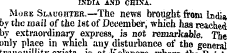
INDIA AND CHINA . More Slaughter . —The news brought from india by the mail of tie 1 st of December , which haa reached bv extraoi-dinary express , is not remarkable . The only place in which any disturbance of the general tranquillity exists , is at Kolapore , where the Rajah being a minor , the government haa been administered by various agents , who , by acts of despotism and oppression , drove the people into resistance . This Rajah being allowed by the treaties to maintain 1 , 000 men , his forces were sent into the provinces to put down the rebellion . The iasurgents soon routed them and then retired into the mountain fortresses . One
ot them , Siununghur , was taken by storm on the 1 : 1 th of October , and a portion of the garrison who resisted were put to the sword by the British troops that Arere invited to aid the Rajah ' s agents in suppressing the iifuvrection . The storming of tho fort of Samemg / iuT and the defeat of the body of insurgents that came to its » relief , had in part lowered their courage , yet their demands were as forcible as ever . They had lost about r > oo men at Saiuungtuir and near it ; yet their resolution to defend their properties and their rio-hts seems to be unshaken . The Madras and Bombay Governments were exerting their utmost influence to put an end to those commotions .
N inde . —The intelligence from Scinde states that perfect tranquillity prevails there . Sir Charles Napier had adopted the plan of marching the troops away from the rivers' banks during the time when the exhalations from ihe mud while drying rendered their residence there exceedingly dangerous . Sicknees prevailed to any remarkable extent in only four regiments . Sir Charles Napier was , it was said , about to proceed to Upper . Scinde , in order to make effectual arrangements with the tribesmen , Poolajee , and nlong its neighbouring mountains . The Pusja . b still presents the same picture of dis .
trarted councils . Heera Singh , the I ' rime Minister of the young Lahore Rajah . Dhuleep , has not terminated his disputes with his uncle Ghotlab-Singh . Troops were prepared on both sides , but the Minister has . sent some agents to try the effects of negotiations . Nothing positive was known of the results at the time of tbe departure of the steamer , Heera Singh U wily and crafty , and may succeed in overcoming the strength of Ghoolab , although the latter is now ° animated by a wish , to au-up .- the death of his brother Suchet , who was slain through the machinations of the Minister .
From Bombay the chief points are the conviction oi the infamous Aloo Paroo , for being implicated ia burning the merchant ship Belvedere in Singapore harbour . This scoundrel appears to have made 3 practice of burning ships which be had insured , and of which five or six were destroyed within four years . Another subject of interest in Bombay arose from the commitment for trial at the December criminal sessions of Thomas liraithwaitc , the master of the ship Neptune , from Liverpool . He , it appears , treated the steward with great cruelty , and actually cave upwards of 200 lashes to a French lad on board for sonic supposed otf ' ence . The case of this boy was broutrht forward by a French merchant , named Roussac , who received every assistance from the magistrates . Tbe trial of- Hraithw . Vite , for his cruelty , was loudly demanded by the public of that Pres ' ideiic \ .
f ' ltuM- Si . voapohe we learn that an English expedition had been . sent to attack the piratical tribes on the north-west count of Borneo : it consisted chiefly of her Majesty ' s ship Dido , Captain' Keppel , and the Hon . Company ' s steamer Phlegethon , which went uj ) the river Sukarran . The boats were at first repulsed ; but , bung reinforced , they returned and demolished the fortifications , and . took above sixty guns . The ship Ceylon , I ) . Ferguson , master , from London to Bombay , was totally lost on the morning ol the 1 st of October , on the northernmost reef of the Laccadives . The captain and crew arrived safe in Bombay . The ship Brilliant , from Calcutta to Bombay , was last on the 10 th of October on the point of Saugur Sands : the crew were saved .
The Monsoon had terminated . The fall of rain m Bombay was under six inches , and fears were entertained of the want of water next spring . In the interior of the country the fall , though not great , was seasonable , so that no apprehension was entertained ol that most dreadful scourge—a famine , which is periodical in India .
Untitled Article
Maktleboxe . —Death by Intoxkatios . —Wednesday an inquest was held before Mr . G . J . Mills , deputj coroner for Middlesex , at the Marquess of Granby , Great Miirylebone-street , on the body of Charlotte Crop , aged 53 , a seller of watercresses . Mrs . Ann Dunford , of No . 2 , Chesterfield-street , said deceased lodged in her house . About half-past six o ' clock on Saturday evening , on coming out of her own apartment , she found deceased sitting on the stairs . She
spoke to her , but lvceivtufr 110 answer , she procured a light , and then found that she was dead , or dying . Air . Joseph , the surgeon , was sent for . His assistant came , and pronounced life quite extinct . Sbe had seen deceased about twenty minutes before , quite intoxii-ated , in which state she had been ever since the previous Tuesday , without intermission . She wa * in tlu- habit of getting intoxicated . The jury returned a verdict of "Died from the rupture of ' a vessel of tile drain , from the effects of intoxication . "
Whitechapel . —Death from Destitltio . v . —Wednesday evening , Mr . Baker held an inquest at the Royal Oak , Whitechapel-road . ou the body of William Hall , aired sixty-three years . It appeared from the evidence that , on the evening of " Tuesday-week , the deceased , who was evidently in great distress , procured a bed at a common lodging-house in Wentwortbstreet , S pitalhelds . The next day be complained ol being xery ill , and went to l > ed again the following day . lie bad no money to pay for that night's lodgiiiir . the amount of which was ' threepence , halfpeuuy . Sonio of hi . « fellow lod ^ is , although themselves very poor , pitying his condition , subscriU'd the amount , and also gave him some fond . ( u \ Friday he hecant f very ill ,, nnd was apparentIv in a dying state , an " cold
sniil that he had received his deal !) from a K had caiijrht . when placed in the casual or v agrant ward of the Peekham Union , where he had slept w tvw > nidus , previous to coming to the ' odgiug he Ottn occupied . Tbe deceased was removed to the worsln > u- » e , but died in less than three hours after his admission . Mr , Reed said he had made a /** - ' ' moru-m examination ; he found inflammation of the lungs , evidently the result of cold and exposure ; then was no disease to which lie could aftriotrw death , his bodily powers were completely exhaust aud there was no doubt that privation and the e £ " eitement consequent upon his removal to the WOI * J house in the state he was then in had accelerate 0 death . The jurv returned a verdict of i % died from
natural causes . '' Is ^ UEiiT SEAR Watpori > . —On ^ atimlay lafit a ^ UW qtu-st w ; is held by Mr . Osbaldistou , at the A rticUOive lim , Crossley-green , near Watford , upon the bo « v John Green ) aged sixty , in the employ of M ?* - "' pivkenson and Longman , of Cro . tlt-y , paper maKers , whose death was caused by his foot slipping , w » n »» stepping from the masonry forming the banK 011 lock on to the sill of the lock gate * . From the e ^ deuce of tbe driver , whose duty it is to rai *> ^ paddle ( or flood-irate ) on the towing-path side yt " ¦
lock , he had just completed raising the padoie . » - he was astounded by the cry from tbe boatoan «* go the paddle , " followed by a splash in the water-The driver instantly - let go the paddle , and pro ceeded across the lock in sean-h of hi * mate but » was nowhere to be found . He then hallooed V >?™™ who had passed over a bridge close l > v , only a iev > eonds before , and with his help the body was tmm . Even .- exertion was made by the two men to rcsro the body to animation , but in vain . M r . ^ " * J sunreon , " of Riekmansworth , was itched as speeoi ^ , possible , but on his arrival he pronounced fl »™ spark to be extinct . The jury returned a « nUg Aetidentattv droned . One of the J ?^^ KJ the coroner , said , that notwithstanding there < M u ^ appear the slightest negligence on the paf " ^ •' 1 - . . " ? . AuJ ?_ , ™ -, nt « the lUTf Wisuv * \> t \
canaj proprietors , or uvu au ~ . ~» zr : jr . - ii * \ mto suggest that an immediate step affixed to tne lasvCSon , betweeuthebank- ^ ide andtfae *** £# of tho lock gates , would be likely to P ** " ^* , ^ currence of accidents . The breasts of the && ^ shoidd form an even superficies upon tha D * " ** to facilitate crr-5 "' r An n A *** m < "ht-
Untitled Article
THE NORTHERN STAR . [__ 3 December 7 , 1844 .
5eo L%R^Rr0 Anxi Crorrr^Ponurnt^
5 Eo L % r ^ rr 0 anXi crorrr ^ ponUrnt ^
Overland Mail
OVERLAND MAIL
Akct&Cm&≪©(R4wrft $Nnurjsffj8, Fct
akct&cm& <©( r 4 wrft $ nnurjsffj 8 , fct
-
-
Citation
-
Northern Star (1837-1852), Dec. 7, 1844, page 4, in the Nineteenth-Century Serials Edition (2008; 2018) ncse.ac.uk/periodicals/ns/issues/vm2-ncseproduct836/page/4/
-