On this page
-
Departments (1)
-
Text (9)
-

Untitled Article
-

Untitled Article
-

Untitled Article
-
Untitled Article
-

Untitled Article
-
Untitled Article
-

THE J\ T OJLITHERN STAR. SATURDAY, MAY 8, 1841.
-

Untitled Article
-

Untitled Article
Note: This text has been automatically extracted via Optical Character Recognition (OCR) software. The text has not been manually corrected and should not be relied on to be an accurate representation of the item.
-
-
Transcript
-
Note: This text has been automatically extracted via Optical Character Recognition (OCR) software. The text has not been manually corrected and should not be relied on to be an accurate representation of the item.
Additionally, when viewing full transcripts, extracted text may not be in the same order as the original document.
Untitled Article
TO WILLIAM LOY-ETT . TJeah Fin , —As you addressed a circular to K : e inviting me to join you in the formation of eh association to promote the advancement and the political emancipation of the people , I owe . it to you , as Hn act of courtesy due to your character and ionner services in the cause of the people , to state ' the reasons why I decline co-operating with you now . I may observe , in the first place , chat -with many of the sentiments embodied in the Address ta the Political ie 3 Social Reformers I cordially agree . We hare committed many errors , it must be confessed ; and would be greatly benefitted by the prevalence of a kindlier spirit amongst onrselTes ; tie absence of mnch of the pomp and pageantry to which yon have alludedof
tfaoe ^ h which yon , as well as myself , hare been both the abettors and the recipients ; and I desire , also , to witness a more intellectual character in onr i movement ; more mental and less phvsioal power ap- ; plied to crash those who , by fair speech and smooth , -words , seek to seduce the people from the onward path Of principle . Bat admitting the necessity of correcting errors and supplying defects , you have failed to establish the necessity of a new National Association . j JTnJess you are so uncharitable as to supposo that the J members of the present Executive , or of the National 1 Charter Association , -would wilfully reject improved ; means for obtaining their freedom " and happines , you ' had no reason for superseding the present by the formation of another A « s&ciation : still less were , yon justified j in doing this when yon had never attempted to prove ! its insufficiency , and at the very tima , when you said ¦ you had no spirit of hostility against , it . Your first step , therefore , appears unwarranted , and inconsistent
iritb the very spirit and pried pies of Chartism . f Again , —The means which you took to introduce your views amongst us , and to elicit support , were con- i trary to that open , manly style which the love of truth and of free discussion would dictate . Tour document i professsd important national objects-, " and it was pr ivately and confidentially addressed to a nrnn- 1 ber of selected individuals . This secrecy was illegal ' on your part , and involved all who countenanced it in an illegal act of a vary serious nature . Had it been a development of a plot to overturn > y force the existiag Government , the ¦¦ peculiarity « f the case -would have justified it ; but j ¦ whe n it was a plan submitted to the judgments of those to whom it was addressed , and depended for the sue- \ eess of its avowed objects upon tho soundness of that judgment , you ought to have availed yourself of the ¦ advantage which disenssion would give yon of having Bound views formed by eliciting free expression of \ opinion .
By a blind faith in your jndgtnent , and reverence ) for your character , many thoughtlessly complied with I your urgent request , and replied by return of post ' They hare since reflected , and k&ve had the mortiiica- ' tion of discovering , by not " taking a night to think j ont , " tiey have temporarily perilled their characters , > and the- cause they thought to serve . Thi 3 cirenm-Btance proves that howevt-r calm , clear , discreet , and henest a leader may be , it is always well to thir >\ before ' ¦ we act under his guidance . As you deprecate the evils of leadership , . you will , I \ hope , feel more honoured bv the sentiments of an inde-,
pendent thinker , when differing from your own , than yon will by the blind submission of his will to yours . Sat supposing that we were ready to overlook and forgive the insults which you have virtually given to the members ot the old Association , and the inconeistency between the democratic objects of your Assoeiation , and the aristocratic manner of establishing it , and also discharge from our minds the suspicions which i the whole circumstinces naturally awaken—supposing that we merely consider the cornpintive ntility of your orjaniiatioa asd plans , we ought . I think , to withhold ' ¦ our support from yours for several reasons . :
That the erection of halls of science , libraries lectures , & « ., for the people , is a great and desirable business , I must admit , bat previous to this , or Limultaneonsly with it , there should be a thorough change in the physical condition of the people , far less toil , more fool with tiig lighter work ; a substantial increase of substantial things wonld be necessary to secure you audiences to all them , to listen to j-our lectures , and to enjoy the intellectual feast Without this previous physical improvement , your halls wonld be an unfeeling in » ekery of a starving people . Jf the higher classes choose to erect hails of science , out of the weal'h obtained by starving the people , let them do so . It would be quiie consistent with their other philanthropic schemes which you have often eloquently
exposed ; but do you really expect to realise from those who earn twopence a day , a quarter of a million of money , to be invested in the erection of halts or the formation of libraries ? Suppling that you could raise this sum , is there no other more useful purpose to which it coaid be applied ? What would you sa . v to investing it in the purchase of land , thi cultivation of the soil , rescuing the agricultural labourer from his serfdom and misery , and our manufacturing population , fey establishing manufactures , from the grinding rapacity of mill owners and capitalists ? This would be an active , ever-increasing and useful application of the people ' s capital ; or suppose , as suggested by fee editor of the Star , we employ the artillery of the press against the citadels of
iznoraioe . Wiil ii not be more effective ia enlightening the peop l * upon those subjects upon which knowledge is at present most required , than lectures upon general Science ? We want knowledge , it ia true ; bat all knowledge is not of equal valne at all times . Political kao wied ge , a » d with it political pa wer > is the one t hing needful now . Tour scheme would , therefore , " waste a large portion of our resources . There is an order or method in the law of progression with which your cberns does not harmonize , but with which it is at Tarian&e . Practical philosophy rejects ir—oppressed humanity pronounces it a mockery . ' Yoar Chartist brethren , and old and honoured companions , are
puzzled with it , or suspect sinister influence and sinister objects . Your countrymen , who lov-d you , sorrow that you should have taken up a position so strange and suspicions . Tarnish net the lustre of yoar fair naais by perseverance in a course which is opposed to their feelings . Their gratitude and honour cannot co-exist with the esteem snd approb ; tion of their deadliest enemy , and vilest deceiver . Trusting that yon may have the wisdom to discover and the magnanimity to confess yonr errors , I am , your former Friend and Brother Chartist , J . Williams .
P . s . —Lest y- ~ u should consider those s .-ntdments as called forth by the condemnation you have rectived from others , I may state , that on receiving your circu ' I communicsteJ to Mr . Dcegan , who was present at the time , my opinions upon it ,, and be can prove that they were substantially those contained in this letter .
Untitled Article
THE DISCIPLINE OF BEYERLEY . M Ill-fated man , for whom such various forms Of misery wait , and mark their future pivy : " Bishop . Pobtei's . to the editos of the kop . thesn' stab .. Sib—Tn the history of the Inquisition-we frequently read of the unhappy victim being-TtifciscU awjiiie from the horrors of the rack , in order that expiring nature might gather strength to endure the torture of his bumaa fiends a little longer . A siroUar practice seems to be ai'jpteO . in the case of Mr . Ptddie ; although it has been rep-atedly proved , by his in-ii'p jsition , that his constitution cannot bear the torture of the treadmill , yet the moment he rallies a little again in regard to health , he is as invariably again subjected to the brutal discipline and treatment ; so much so , that at last tbe surgeon has form *! it imperious to interfere in his behalf . After sympathising with his wife on the tr * ub ! e and distress th 3 t his last communication had for some days occasioned her , owing to the gloomy bnt true picture he had drawn w her of his situation , he writes : —
"Taese last nine weeks my health has retragaded sadly , and my appetite has been very ba-3 . " For these ten days back 1 D 3 Ve been unable to eat as much food as I usually did in one day . I am troubled with a constant and very oppressive pain at the breast , very severe heaiache , and so weak , that I feel ii a labour to Write to you . That this is the effect of the barbarous torture of the treadmill is now evident , and its cant inuanci at last acknowledged to be dangerous . If my last letter gri » ved you , the one I intende ;! to hive written this day would not only have grieved you . but when pu . bUsh .-d cmld not have failed to have produced much ffxeifcemtat npon the public mind ,- as I intended to have drag = r& . l every circumstance before the public eye that , could have shown all the real Buffering I have experienced , as I feel no inclination to be sacrificed without a struggle . But , thank GjJ , the immediate motive is now removed .
" To day the state of my health was particularly examined , and the conclusion is , that the surgeon has found himself called upon to interfere , and ordered me not to bs subjected to the mill again ; . a longer continuance being obviously dangerous to life , so that I have now the prospect , the causa of illness being removed . of a restoration to health , unless indeed the seeds of consumption are not too deeply planted in my system bobs roote-i out by any alteration in my subsequent treatment , ail the appearance of which I at present , it most be confessed , carry along with me ; but which I iruit will in a few weeks disappear , as I have every confidence in the skill and humanity of the surgeon . " Your exertions have , in some measure , been trowoad with , success , in directing a considerable poi fcion of public attention and public sympathy to my « ue ; I hare a strong hope that God wiil crown with his blessing tho 8 « efforts , and turn even the hearts of my truly bitter enemies .
" I fly for comfort to the living fountain of all true # o _ ol&tfon—the word of God , and have found much from two p issiges , the same that comforted the heart of the persecuted John Bunyan when in prison like myself f-T his love of troth ; but not like me condemned to th ~ -rxt . ' ca . ty of physical sugaring—not like me , denied the use of tho tongue ; for be preached in prison to all t ~ . at cons to hear him , and they wtre uianynot lii-j . 'lie , dvaisd the liberty of writing down prtseat though *» for rafter usefulness ; for he wrote his immortal * Pi ! gr . ; a « P vcres / tiers—not like me , su ^ ectei to a most ¦ ¦ a ; : axi traJv annoying surveillance <^ o that I enreo ca mot comply vitii the most urgent calls vf nature , at kn-i . in r _ -j wnr je > n in prayer to AlmurLty Gj ! , but tin ' er the imr : dilate in .= ytction of a fer . OT-cr . afcare ); fur he constantly preached from the -window of
Untitled Article
bis prissn to the people in the street . The passages that coniforttd his mind , and impart the same feeling to mice , are : — " I will take care of thy remnants ; leave thy fatherless children to me , 1 will preserve them aliva Let thy widow also trust in rue , " " To Mr . Martin , Mr . Vincent , the Ker . Mr . Hill , Mr . Malcolm , and the gentlemen of the public press , who have generously exerted themselves in my welfare , return , in my name , my warmest thauks . Tell them that my hope rests in a great measure npon them , and that I believe that , if the Whigs are left t » themselves , I shall , if God spare me , remain here every houi of my barbarons sentence . It pleasas me also much , to learn that 1 am not forgotten by my friends in the country as well as the metropolis . 11
I have seat you a long rhapsody in rhyme . To your getting it , I do not anticipate any objections , as I have obeyed the in junctions of the magistrates in confining myself to the expression of my own feelings Thenua 3 ure is eccentric and irregular , and perhaps dors not merit the name of poetry . It ba » , however , answered one good end to me already by affording occupation for my thoughts ; so you will not wound my vanity in condemning it . " Such , Sir , are the heart-ending statements given of his inhuman treatment , by an innocent victim of Whig tyranny . I need not add any remarks ot my own . The bare recital will be sufficient Yours , ike , Jane Peddie .
Untitled Article
THE BILLING AND COOING . Thask Heaven , since we last appeared , we have witnessed the self-humiliation of the basest , the most brutal and bloody faction that ever appeared upon the stage of life . Is there not a striking similarity between Bcxton ' s drunken " Beadle , " who requested a friend to lend him 5 s . to fine himself for being drunk , and her Majesty's servants who requested as to lend them two millions four hundred thousand pounds to fine themselves for being rogues , and the people for not getting drunk ! However , Jim Crow has been dressed for the part which he is destined to play for the benefit of Melbourne , Russell , O'Coji . nell , and Co ., both in England and Ireland .
what was considered the minimum of justice to Ireland has been reduced by just 60 per cent ., by ths process of increasing the rateable franchise from £ 5 to £ 8 , " to conciliate the enemies of Ireland" as Moepstu said , —an old , but fatal experiment ; while the real enfranchisement iof Howick ., —not his £ 5 rating above rent , but his £ 20 rating npon occupancy , —wa 3 nobody's child , because it would extend the franchise immeasurably , and do away with all perplexity of registration . That question , however , has been set at rest ; it has answered its end , and we are spired from further consideration of the base and uagentlemanlike trick .
But how do matters now stand ? Jim Crow has been dressed up for both England and Ireland . Upon the Irish side , is Mokpeth ' s extinction-ofleases plan , which will be called Universal Suffrage ; and upon the English side , is Cheap Bread and Sugar . In Ireland , whatever the Ministers may Buppose , the principle will damn them ; while , in England , the lime , the mode , and the reason of its development , will make them sink even lower , if possible , than they before stood in the estimation of every honeit decent and virtuous man .
How do they stand upon this question ! The fop Minister , the palac e buffoon , set his face against it , and Russell gave no hope ; but when the Chancellor of the Exchequer wants two millions four hundred thousand poands , and finds the national means incapable of bearing further pressure , he say 3 , " I'll put on a bit of liberality , and go a popularity hunting ; but I must start with a principle : ' and he accordingly discovers , and says— " No taxation could be so injurious as a permanent disorder in the national finances ; and the sum they had sow to provide for teas so large , as to make it abiohUely necessary to act icith some degree of boldness . "
Such is the Whig whip , after nine years retrenchment ! and the English of it is , " nothing so damnable as that we , the ministers , should be without pay . " Well , the Chancellor goes to work , and says , "from reduction of timber duties I willinsure an increase of £ 750 , 000 , but I will be content with £ 600 , 000 ; upon sugar , a great article of consumption with the hand-loom weavers , I will create , by reduction of duties , £ i 00 , 000 of an augmentation . " But take it at £ 700 , 000 , and the remaining £ 400 , 000 , ( for he only required £ 1 . 700 , 000 for the permanent thing , but £ 2 400 , 000 for the present emergency ) he would anticipate from his noble friend ' s Corn Law scheme .
Bm this i 3 not the best of it . The £ 1 , 700 . 000 is to be permanent , the additional £ 700 , 000 only temporary ; that is , give it once , and then get it out of the devil ' s exchequer who can , or reduce our wants below that amount any other year who dare . The surplus of £ 700 , 000 for the present emergency , Mr . Babi ^ g say 3 he will have no difficulty with , as he can give an order upon labour for that amount in Exchequer Bills , payable by the people .
Just so the matter stands . The oligarchy in the midst of more poverty , distress , and dissatisfaction than ever was known to exist in this or any other country , and after nine years of retrenching reforms , says , " our expences have increased beyond jour mean 3 of supplying the needful , even with bayonets to help us in the collection , to the enormous amount of £ 2 , 400 . 000 for the present year ; and if you let us get a House of Commons upon the popular principle of increasing wealth by increasing consumption , instead of having recourse to direct taxation , then see what we will do for you . "
Let us see if in this new scheme as regards the nibble at the Corn Laws , whether or no , as in all other caies where Whiggtry is concerned , principle has not been sacrificed to expediency , and whether the alliance at Nottingham was half as " unholy" as an alliance would be between the total Repealers and those who distinctly admit the justice of taxing food so as actually to make a tax of £ 1 , 600 , 000 upon corn , part and parcel of the permanent burden of the country .
Let this be borne in mind , that Mr . Baring and his party are now performing a " bold stroke" for a place ; that he says , " No taxation could be so injurious as a permane > t disorder in the national finances 1 " By this he means , that all should be made easy ; that both ends should be made to meet ; and that a scheme , not to be sessionally altered , should be at once proposed , having permanency for its object . How then is the permanency to effect
the principle of untaxed food ? and mark the only grounds upon which the holy brotherhood of parsoas have been induced to join in the cheap food chora 3 , " O ! it is unchristian" — " muzzle not the ox , " and so forth : while the revenue derived from the Corn Laws last year wa 3 £ 1 , 200 , 000 , and which Hr . BABisG designs to increase , permanently , to £ 1 , 600 ^ 00 , as a thing to be calculated upon in aid of aristocratic demand a d payment of her M . 3 jeay ' s servants !
Bat then there ifl one part of the subject which must be kept uppermost in the public mind . It i& this : —there are two questions ; the one is the nosing of fifty millions sterling annually , and the other is the means of doing so . Let it be observed , that about the first , that is the raising , a II are agreed ; that ' s settled ; for , be they Whig 3 or be they Tories , while there is a shot in the l&cker they will have it out . But , then , we come to the means ., which are merely
problematical . Should the electioneering , dissolving , specious means of doing the thing , by the fascination of a sugared loaf and cheap timber , instead of direct taxation , fail , what comes next ? Why , only an issue of £ 2 , 400 , 000 worth of Treasury paper , and a fresh pul ) on the Savings' B ^ nkj , that is £ 2 , 400 , 000 of direct taxes . And hire ' ^ the juggle ! Like the Irish Ri-fcUtration Bill , tao Ministers neither hoped , expected , or intended its success : but if lost , k wiil be a good hustings chp-trap of O ^ h ! you see
Untitled Article
ice offered to do anything to conciliate the old enemy ; but , no , it was impossible !' Then with regard to taxes ; see the danger in following a vicious guide . The Whigs " out-run the constable ; " they increase our expenditure by five millions sterling annually , and then resolve still to hold on by the '' purse-string ; " they propose a measure against which their Prime Minister set his
face , not with any , the slightest , hope of carrying it , or of realising the promised results if carried , but with the single intention of compelling their successors ia office to do that by direct taxation , which the charming Whigs -would have done with a sugared hot loaf . But the country will remember that however payment is called for , the retrenching Whigs created the necessity by their unprincipled expenditure of the public money .
When a dissolution shall come it matters little to us what the real or ostensible casus belli shall be ; we are only to think of the past , and to use it as a warnicg for tho future . With this view we unhesitatingly declare , that the nine first years of Reform wholly under Whig dominion , has been a period of national distress , private suffering , and class intolerance , for which the whole annals of English history furnish nothing like a parallel . That they have been compelled to draw their precedents for liberality from abroad , and afar off ; for instance , from India and China , for
which the people paid ; while every English freeman ' s house has been made a den of slavery . Expenditure increased , places multiplied , cruelties practised , without even pretext of law or observance of decenoy ; poor working men held in bail of £ 1 , 000 , and incarcerated for merely attending public meetings , ( to which they were invited by a Minister of tlie Crown , ) for periods four times as long as those to which the very worst description of imprisoned felons have been subjected ; the right of petition destroyed ; the right of meeting to petition invaded by
brute force ; riot transformed into high treason ; ugly looks into riot , and foul thoughts , engendered by fouler acts , construed into conspiracy ; our Judges , for the first time in English history , flying , for Whig convenience and love of persecuting the people , from the old and long-established acceptation of the hobgoblin , " conspiracy , " the most damnable fiction of our criminal law : in short , search hell ' s records , and when you shall have struck out crime for crime , still will the Whig catalogue be the blackest in the country ' s annals . Nothing ever has been like it—nothing again ever can be like it—and nothing like it should have been .
O , the delights of being an appendage to such a step-dame ! Canada , in her "honey moon , " is to have an increase of ten per cent , laid upon her exported timber ! Edward Ellice has no wood lands in Canada ! Under all the circumstances , then , what becomes the duty of the country when the questions propounded in the House shall be discussed upon the hustings ? We have had the anomaly of nine whole years without an opposition in the British Senate House . We have had a set of licentious slaves , disregarding popular opinion and support , and enabled
to do so in consequence of the unprincipled wholesals support , through good and bad , sunshine and cloud , of one political knave . And this is what they call abolition of rotten boroughs ! having substituted rotten men for them . This must be stopped . We must have an opposition for her Majesty . She is not safe . We repeat it , she positively is not safe without it . A parliamentary opposition is a royal safety valve ; while an unopposed licentious Ministry ( and all unopposed Ministers are licentious ) is the greatest enemy of royalty , without being a friend to
democracy . We must , then , take care that the Whig members in the next House are too small for a party , and too large for a faction . As many as two hundred would produce anticipations of a return to office , and consequent caution in the establishment of evil precedents which they may be called upon to fulfil when in power . One hundred and eighty would be a kind of crisis . One hundred and fifty would make them rabid , and one hundred and twenty ( just the right number ) would make them bite .
Let us , then , have the biting minority of six score , if we can ! and such fun waa never seen in Tooleystreet among the tailors ! It would be Bedlam let loose I Then , instead of " I am free to confess that her Majesty ' 8 Government had no alternative but in the strong arm of the law to suppress popular insubordination , " we shall have "Give us OUR Charter . " " Universal Suffrage and no Surrender ; " "The Constitution guarantees and the
Reform Bill promised it . " " Let in the Thames to cleanse the House . " " Hurrah ! for Cromwell , ' " O , for Wat Tyler , or Jack Cade 1 " " Give US OURPsisoxers . " " No Vote , no Tax . " "Let thk People back vs for the only thing worth having , THE VOTE . " " We never were Whigs ; WE WERE ONLY BACKERS , WHILE YOU WERE RUNNING FOR THE TMAL STAKES . " " We WERE KNOWN TO be Chartists . " "We must have the Charter . "
Ireland as bhe ought to be , or Ireland in a Blazk . " Now such , we assure our readers , would be very bland and coarteous language for a biting minority of 120 ; -while the very same 120 making part and parcel of 250 , would but look for a renewal of office and approve of all that had been done , as the best means of insuring electoral support . People of England , Ireland , Scotland , and Wales ! her Majesty's servants , your servants , will shortly appear beforeyou with an appeal to their past services , as reasozs why you should vote a " permanent tax , " to pay their salaries—for that is the real" casus belli . ' , Do they deserve it ? We say not .
Men of England , Ireland , Scotland , and Wales ought you not to be proud in thus being justified in your opposition to the " Plague , " who have compromised their principle of untaxed food , by actually supporting a proposition which has for its olject the infliction of £ 1 , 600 , 000 annually upon that very article of food 1 Men of England , Ireland , Scotland , and Wales what now is your complaint ? Is it not that you are poor because you have no controul over your labour ?
once , then , get a Corn-Law-Repeal-House , and what , we ask you in the simplest language , have you to expect , but that you will bo wholly at the mercy of men who , with some opposition , have ruined your country , wasted your property , disjointed 6 ociety , made sterile your fields , made bleak your homea , callous your hearts , and cold your hearths ; who have dragged the wife from your bosom , the child from your knee , the site from your corner , and tho mother from your embrace !
Once repeal the Corn Laws without having a voice in the making of those laws which are righteously to adjust the great change , and how will you regulate demand aud supply 5 How , with the facility of a House of Masters , giving themselves facilities in procuring fictitious money , can you stop the creation of four times the quantity of machinery now in existence , ( and note too much , ) or regulate its
productions , or have over it tho slightest controul ] Can you stop gambling in your labour ! Will America , the Brazils , Russia , Germany , or Prussia wear more coats , breeches , shirts , and stockings than they want , that you may have , in return , a sufficiency of food 1 If you make too much , who will give you food in return for a mere drug Must you not make slaves of yourselves to undersell them , or starve in idleness 2
Get your Charter , and then go to bed by steam , and dress yourselves by steam , " iu the language of Butter-worth ; but get a House of Masters without the Suffrage , aud then go without bed , or clothes to dress with ! Now , then , has our struggle commenced ! " Fustian jackets , " watch every man and every move , ours among the rest ; auU , upon the first note ot desertion , kick Hm . overboard : defeat every meeting for everything s # or < of the Cfia , r ( e . r but not . by
Untitled Article
brute force , as the Whigs did at Birmingham . But if you are struck , strike I—if you are insulted , retaliate : but beware that you are not entrapped . A great , a mighty effort will now be made . If we are but true to ourselves , the battle is ours ! b ^ ut if we renew the Whig tenure of office , nothing short of revolution can cleanse the " Augean stable . " Whoever is for peace and the Charter , let him hold fast by us , and "no surrender . " Whoever is for a House of tyrants to lord it over slaves , let him cry ?• Hurrah for the Whigs !'
OUR BATTLE NOW IS , ANTI-WHIG , ANTIPOOR LAW , ANTI-CORN-LAW-REPEALWITHOUT-THE-CHARTER , ANTI-RURALPOLICE , and anti-oppression in all its hideous forms ! Onward , and we conquer ! backward , and we fall !
Untitled Article
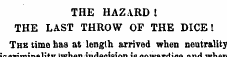
THE HAZA . RD 1 THE LAST THROW OF THE DICE ! Thk time has at length arrived when neutrality is criminality , \ when indecision is cowardice , and when delay may be death . Unfortunately for our enemies , tkey have exhausted their whole strength and expended their ammunition ( before the battle ) in forced marches , where there was no point to defend ; they have discharged their heaviest guns in mere sham fight ; and , now that the charge has been sounded , they have no reserve , no plan of attack , no safe retreat ; indeed , no forces ready for the engagement .
The press , the generals in this fight , have had eight day ' s opportunity to pnt forth their whole strength , and what do we findi So far from a single new point being urged in favour of a total Repeal of the Corn Laws , we hear an invitation to parties who not long since declared anything but complete repeal to be a farce , to join those who have considered tbe gradual settlement of the question the safest and most judicious plan . Here , then , is indeed an "
unholy alliance" between parties who look for a fixed duty as an end ; with those wbo hail it merely as a means to an end ; the effect of which end would be to prostrate England and every thing English , in chains before those foreign caterers who would condescend to feed us from their store . It is bad enough to be fed by three Devil Kings ; but how much worse to be at the mercy of the Autocrat of all the Ruesias , the German Diet , and the rival Republic of America ? But we say that the press has brought up no reserve to reinforce those troops which , for twelve months , we have required only to meet to insure a triumph over them ; no matter , whether in skirmish or pitched battle . We must therefore ask , what are the new pretensions of our subdued enemies \ We look in vain to their leader , the Morning Chronicle , and there we find the old hash not even warmed , but merely tossed up and served with its cold sauce , unseasoned by a single spice to give it a flavour . In fact , the only change which we can observe upon the eve of battle , is the very reverse of what we should expect from an able General . Instead of seeing the troops in close column to receive the first charge , we find the rank and file thrown into open column thus : —
" Had repeal of the corn monopoly been proposed immediately after the passing of the Reform Bill , when there was an overwhelming liberal majority in the House of Commons , it must have been carried . " Thank you , Chronicle , it would have been carried ! and hence was it not proposed until disappointment from Reform had rendered its support a good electioneering clap-trap , and its defeat
certain ! Yes , it would have been carried ; but is there another paper in Englnnd that would thus , in one short sentence , heap odium upon the men whom it profcsseB to serve , by reminding us that the House , when strong , devoted its giant strength to coercion and starvation , and now , when weak , parades its own dishonour for the paliry purpose of holding office upon a question which the Chronicle tells us it has lost the fitting time to carry ?
Again , then , we say that they have no reserve ; and we have not yet Bred a single shot from our exhau&tless store . We begin the campaign then , by thus taking the head of our troops , and telling the whole enemy to come on ! We tell all parties that the day , nay , the hour , has arrived , when each and every man in the state ( bo his political opinions or rank in society
what they may ) must make up his mind to take his stand upon the soil or upon the mill-shaft . Ours shall be the battle of the soil against steam ; notofthelandlordsof thesoil , whose supineness weakness and folly wo most heartily despise , and who dead to the voice of justice or humanity , must now awaken themselves to the cry of " necessity , " and " our estates are in danger . "
Is not the present unenviable position of the landlords just what it ought to be , and just what it was sure to be ? While strong and powerful , they lent their trength to every enemy of the people , in whatsoever shape ho presented himself ! At length their turn has come ! A t the dictation of the Tamworth Baronet , they
mortgaged themselves , when they vainly hoped only to mortgage the people to the fund-lords ; but the ^ team-lords having appropriated all beyond the meanest subsistence as their share of labour , are now about 10 throw tho lords of the soil upon their otn resources , as the tender-hearted lords throw tho people upon their own " poor resources , " having first allowed the masters to rob them of every
resource . The land-lords gave the parsons seven years' renewable tenure , well secured . The land-lords gave the steam-lords a rural police to coerce the poor to work for little , or die without a murmur : and now has the day of retribution come 1 The minister who not twelve months since registered a vow to stand by his order , iiings them overboard , and merely delays their ruin by a time just sufficient ia the English of Lord J . RussELL ' sannouncement , tomarshal
all the hostility of the country against them ! Yes , his Lordship ' s declaration is notable ; " he postponed the consideration of the question to allow the country time to meet and speak . " Let the friends of the Noble Lord take warning by his Lordship's invitation to the people to meet , and speak out ! and let the brawlers take heed lest Whig persecution of poor working men for obeying his Lordship ' s invitation , may be turned into a good precedent by the Tories for committing the damp Repealers to the well aired cells of the Chartists !
Again , we say that we have neither Bympathy nor compassion for the landlords ; and if it were not prudent in a consideration of the question , to distinguish between tbe soil and the lord of tbe soil , we should say give them all that punishment which they have so justly merit ! but inasmuch as the lords of the soil cannot be punished , without at the same time punishing tbe innocent people , we make a distinction between the land and the landlord .
Now , to argne the relative value of steam or soil production to the whole people , whether they be of the aristocracy , the middle classes , or the lower orders . In the outset , we say that we are for the most perfect machinery which the mind of man can invent , provided it is made man ' s "holiday instead of man ' s curse . " In the wise and startling words of Mr . Butterworth , lately delivered at Bradford : —
"We care not if Mr . Cobden can go to bed by st eam , and dress himself by steam , provided that steam does not t ake the bed from thb WORKING MAN AND LEAVE HIM WITHOUT CLOTHES TO PUT ON , "
Untitled Article
We have no hesitation in saying that if the above sentenco had been spoken by either Sir Robert Peel or Lord John Hdssexl it would have been printed in letters of gold , and would have been a golden peg upon which the Lord or the Baronet might , with safety , have hung an immense weight of folly . It was a noble sentiment . It , ia fact , embraces the whole question . We will consider whether a repeal of the Corn
Laws would convert machinery into man ' s holiday , and would spare Butterworth his bed and clothes ; and atk over which of the twomeans of productionthe natural means of the land , or the artificial means of machinery , anygovernment , even oueelected by tha whole people , would have moat controul ; and whether a House returned upon a pledge to repeal the Corn Laws would be just the House to give the people a greater interest in the produce of machinery or the benefit of tbe repeal .
In the first place then ; we say , in contradistinguishing between the power of the people in acquiring controul over the land and over machinery , that over machinery , not more than one in five thousand of society can have any controul ; in machinery not more than one in five thousand can have any interest ; and under machinery not one even of tho five thousand caD , by possibility , havo any security ; while , in land , every individual in the State may have an interest , amounting to house ,
food , and raiment , according to the expenditure of his labour , which is his capital ; and which is a thing divisible into the minutest parts , according to the most humble means and wants of each ; over land the people may have controul ; under land the people may have security ; and all these advantages may be made to flow from a proper system without in the least degree diminishing the rents of landlords ; on the contrary it would increase them by bringing them into the retail market .
But , says the scientific political economist : " what does the operative know about land ? what does he care about land 1 " We answer , quite enough , without intending to devote himself to its culture , to teach him that he can have more controul pver the land between Bury and Manchester , than over the lands of Russia , Prussia , Poland , Germany , or America ; quite enough to know that all that is now required for his complete and entire subjugation is to destroy
his home market for consumption , and take from him all power of control over his market for production . He now sees 60 per cent , of his order unemployed , while he does not hear of a single man being found naked in the streets of St . Petersburg , Vienna , Berlin , Warsaw , or New York , for want of his produce . He seeB 4 # per cent , of his order at half work on half pay , with storehouses full ' of his produce : while his belly is hungered , and he is told : —
"Aye , aye , true enough ; but you know if we could get corn , ( all that our customers have to give us in return for labour , ) you would all have plenty . " And he says" Yea , verily , I know it ; but will they give us their corn for dearer manufactures than they can . buy at home 1 " . " O no , no ; but then we shall be able to compete with them , and even to undersell them at home V " How , pray ; how ?" " Why—why—why—why , you know , by—byby—by , you know—O , cheap food , of course . "
" Well , but must you not sell cheap to buy cheap ; and is not our labour the thing you sell , and our food the thing you want to buy , and sell us second hand ! ' ' Why—why—why , you see the labour would not be cheaper—but the food would . " " Well , if the labour was not cheaper how ' , could you compete or undersell , especially , when our labour has to pass through the Royal toll-bar , the Funded toll-bar , the Army toll-bar , the Navy toll-bar , the supernumerary King and Queen toll-bar ,
the Court toll-bar , the Civil List toll-bar , the Police toll-bar , the Church toll-bar , the JudgeB' toll-bar , the Half-pay toll-bar , the Place and Pension toll-bar , and all the other tollbars , to the amount of fifty millions annually j together with the side gates for foot passengers ' , such as the Corporation bar , and tbe Water-pipe bar ; the Gas-light bar , and the Paving and Watchingus bar ; the Catch-thief bar , and the Gaol-committee bar ; the House of Correction bar , and . the kill-the-Chartists bar ; and then , at the end , there's the four-thousand-millions-personal-debt bar ?"'
O , don t you Bee , we have nothing to do with that ; the customs and duties will be taken off , and the excise , and land-tax and malt-tax will-pay all those things . " " What ! then , afterall , you aro obliged to fall back even upon our vices for support , and still to tax our land , eh i Get thee gone , thou barefaced rascal thou haBt had plenty of opportunities to serve thyself , and us , too ; but thou hast ruined thyself iu trying to ruin us , —so get thee about thy business ! I am not going to be tailoring on the shop-board , or
be stunned in the rattle-box , for the Russian , the German , or the Prussian , while he is getting more wages by my dependence and working his own bit of land for himself in peace and happiness , the produce of which will always be worth something , and which he may sell , or let it alone ; while if YOU don ' t sell my produce at your own price I may starve and be damned till you get a demand for my supply !! Butbarkee , Boniface , when did thou ever do me a kind turn in all thy life ? Tell me that , and I'll vote for thee . "
" Well , come , never mind ; let bye-gones be bygones ; but just let us join to beat the odious landlords , and then thou shall see . " " Nay , I'll join for now ' t but my Charter !" " Well , but just help us to get the Corn Laws repealed , and thou shall have that after . " " Nay , never a ^ ain ! Thou cheated me in 1832 , but thou'lt not do it again . " Such a conversation , we think , be 3 t illustrates the objects , motives , and views of those with whom the people are now asked to join .
We have frequently told our readers that the landlords gratuitously sacrifice ten millions annually in rents , in order that they may hold the exclusive representative power which follows the possession of land , and by which they are enabled to share in all sorts of pelf and patronage , at least one hundred millions sterling annually . Now , ouco alter the system which thus makes it worth their while to sacrifice so small an amount of " rent" to so large an amount of " render , " and you bring all the land of the country , ( at least as much as our present scanty population would require , ) into the advanced retail market . But once get a House of Commons sufficiently strong to repeal the . Corn Laws , and then farewell Charter . ' farewell
Household Suffrage with a Lodger clause ! farewell Household Suffrage of any sort 1 farewell repeal of rate-paying clauses ! farewell to the removal of any single obstacle at present ia the way of the franchise ! and welcome tyrants to what you have long looked for—a House of Masters ! I Yes , give us such a consummation , and at once England becomes a slaveland beyond redemption ! her people dependent upon the domestic tyrant for employment , and upon the foreigner for support ! Then farewell green fields of your fathers ! farewell to the liberty of your sires ! farewell to the beauty of your daughters I farewell to the independence of your sons ! farewell to all that is dear ta -man , and lovely in the sight of God I home , peace-, religion , and contentment ; all , all , farewell ! I
Who new was right ! We told the people that the fellows who asked us to join could get Household Suffrage without us ; let the people gee that they have been offered their owu measure , ' against oaf consent . " These are the time 3 to try men ' s souls . " No Repeal before the Charter 1 Down with the'tyrants who , in their strength , gave us coercion , starvations transportation , incarceration , a Rural Police , and the Arms' Bill ; and who now , in their weakness , would sell us to the slave-drivers for a quarter's salary Down with the nasty , unprincipled , dirty dogs . \
Untitled Article
MR . HENRY HETHERINGTON AND THE NORTHERN STAR .
We had prepared an article in reply to Mr . Hetherington ' s somewhat " odd" letter , bat % & Mr . O'Connor has replied at great length , and u our space is wanted for intelligence of the "ihotsment , " we shall permit Mr . Hetherington to walk quietly off with as many laurels as he can carry away fromithe field ; merely referring attention to his letter in connection with that of Mr . O'Co . vxos and with the knowledge that all our readers lure of our whole political career .
One word in reference to the letter of Mr . Clews We never charged him or any of the signets with having direct intercourse with Mr . O'Conneu , We have never impeached his honesty ; bat we do impeach hia judgment when we see him lend himself to the furtherance of a scheme which is clearly calculated to serve all the purposes of O'Connell and the Whigs , and by the same process to damn the people ' s caase . So far from the Star or Mr . O'Connoe having any dislike to Mr . Cleave , we know that Mr . O'Connor has ever expressed for him a very great personal regard , and we really think he has no right to complain of personal attack , or even slight from us .
We shall conclude by furnishing Mt . Ci . iuvb with a more appropriate motto than he has selected — " Would this hand were off before the deed was done . " The remaining portion of O'Connor ' s letter to Mr . Hetherington , being a development of plots , plans , and conspiracies , we chose rather to withhold till our next , than to place it at the end of that portion which we now give ; when that comes , we fancy that the country will be able to estimate the talk about " the sword and the scabbard , "—they will see who first drew the sword , and who , for four years , has continually parried the thrust without returning it .
Untitled Article
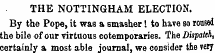
THE NOTTINGHAM ELECTION . By the Pope , it was a smasher ! to have so roused the bile of our virtuous cotemporaries . The Dispatch , certainly a most able journal , we consider the very worst authority upon the subject , as there is too much personal feeling mixed up with the matter between the leading daily and tbe leading weekly prints . If the Devil had opposed Walter , " Pobucou " would have exclaimed , " O I what a nice Devil ! let us have him by all means . " Since oar friend , the ex-alderman , so unceremoniously hung up his aldermanic toggery in Farringdon-without , or Cripplegate , or whatever ward had the misfortune to receive the cast-off garment , the feud has been deadly between the rival papers and belligerent
Editors . Tbe Examiner also raves , and calls the alliance an " unholy alliance . " While we admit the Examiner to be a great authority in Courts of Justice , th « Cabinet , and " Boudoir , " we must reject his opinion upon all matters of principle ; because our friend has certainly favoured us with the most fascinating representation of Jim Crow in high life . The Dispatch speaks as though the Chartists «
Nottingham thought the House of Commons consisted not of 657 Members and Mr . Walter , but as if the House consisted of Mr . Walter and 657 others , thus making Mr . W . tho " hea d and front ' This reminds us of an anecdote well told in the history of the Irish wars , and as it is quite in P *^* we give it . There was a large body of militia menand volunteers encamped upon the Curragh of Kildare , and amongst other officers , was one Lieutenant Po , who , being an original , was always counted as a squadron in himself . Thus if any one asked " how many at such a party , " or "how maay go : ng w such a party , " the answer was , " twenty-five , ' o " twenty , and Po . "
Upon one occasion , Lord Cathcart appointed » day to inspect the force ; and upon being met by the adjutant , his Lordship inquired , " Well , Mr-Adjutant , what's your strength ? " " 16 , 000 andF » my Lord , " was the reply . " Po , Po , Po , " » P »* £ his Lordship , " why , damn it , have you all g « i » " pot ! " "No , my Lord , but a very distinguish * officer of that name has given rise to the joke-Now we beg leave to assure the Dispatth , W » although we do not suppose that the return of *«• Walter will send the other 657 to pot , yet will » make many of them sing out . It is a trick w followed up at Leeds , York , Halifax , Bradford Wakefield , Huddersfield , Manchester , Bolton , So * port , Liverpool , Stroud , and Leicester ; and » ™
other places will shortly find it oat . What , we should like to know , would M * - BiiS take for the reversion of his seal 1 We b *« Bttm suspicions that the Hon . Gentleman would MW even alter the bastardy clauses in the new Bi fatal to poor men under the 43 rd of Elizabeth , dui to poor women in the 3 rd of Victoria . On the result , the World writes as follows :-
" The result of the Nottingham election and tt » turn of Mr . Walter—owing in a great d ^" , ^ ,-support which he received from the wo * "g Tgftli * has caused a wonderful change in the tone Horning Chronicle , which begins to find ° at fZ for day is gone when the people will mate ^ ""T-ai the Whigs , for no bettor reason than -that m ' oBti keep out the Tories . The lesson has been a usc ^ ^ and will convince some of those in the upper raow >
The J\ T Ojlithern Star. Saturday, May 8, 1841.
THE J \ OJLITHERN STAR . SATURDAY , MAY 8 , 1841 .
Untitled Article
-== 5 THREE GLORIOUS DAYS I Bt a reference to our columns it will be g ^ that the People ' s Parliament has assem . bled ; and upon the exertions of the peopj . themselves must wholly depend its efficiency . The man who requires more than merely time for si gnfe * hia name is not worthy the name of friend or Patriot ; and ten seconds being sufficient for the process , who can refuse \ Let Saturday , Sunday and Monday , then , be three gloriouB days ; and ever
glorious they will be in the annals of the country if the signatures of the working classes procured within that time shall ensure the return of Frost Williams , and Janes to their native land , and the incarcerated victims to the bosoms of their families Up , then , every man , woman , and child , who csa scratch hia name or make his mark ; let 'hem ti once be appended . . What three minutes will fail to effect , three times three years may equall y fail { 0 effect . Is the country aware that THE LIFE OF J . B . O'Brien is despaired of in his Whig DUNGEON ?
Feelings which will not be harrowed by sach at announcement , we shall not endeavour to enlist ! We are happy to say that the greatest unanimity pro . vails in the Convention , and that with the greatest prudence they have decided upon accepting tie voluntary assistance of all who tender it . Hurrah ! then , for the three glorious days 11 Let not a moment be lost ; and , when the sheets are signed , let them be made up in the samo fona as a newspaper , with both ends open , and addressed as follows : — T . S . Duncombe , Esq ., M . P .,
Petition 6 , Albany Court Yard , to Parliament . London . And when despatched , let notice by letter be instantly given under cover to : — Mr . J . Cleave , For the 1 , Shoe Lane , Fleet Street , Convention . London . Hurrah ! again hurrah !! for the three glorioui days 11 i
Untitled Article
4 THE NORTHERN STAR .
-
-
Citation
-
Northern Star (1837-1852), May 8, 1841, page 4, in the Nineteenth-Century Serials Edition (2008; 2018) ncse.ac.uk/periodicals/ns/issues/vm2-ncseproduct854/page/4/
-