On this page
-
Departments (1)
-
Text (3)
-

jSEGOND EDITION.
-

Untitled Article
-

Untitled Article
Note: This text has been automatically extracted via Optical Character Recognition (OCR) software. The text has not been manually corrected and should not be relied on to be an accurate representation of the item.
-
-
Transcript
-
Note: This text has been automatically extracted via Optical Character Recognition (OCR) software. The text has not been manually corrected and should not be relied on to be an accurate representation of the item.
Additionally, when viewing full transcripts, extracted text may not be in the same order as the original document.
Jsegond Edition.
jSEGOND EDITION .
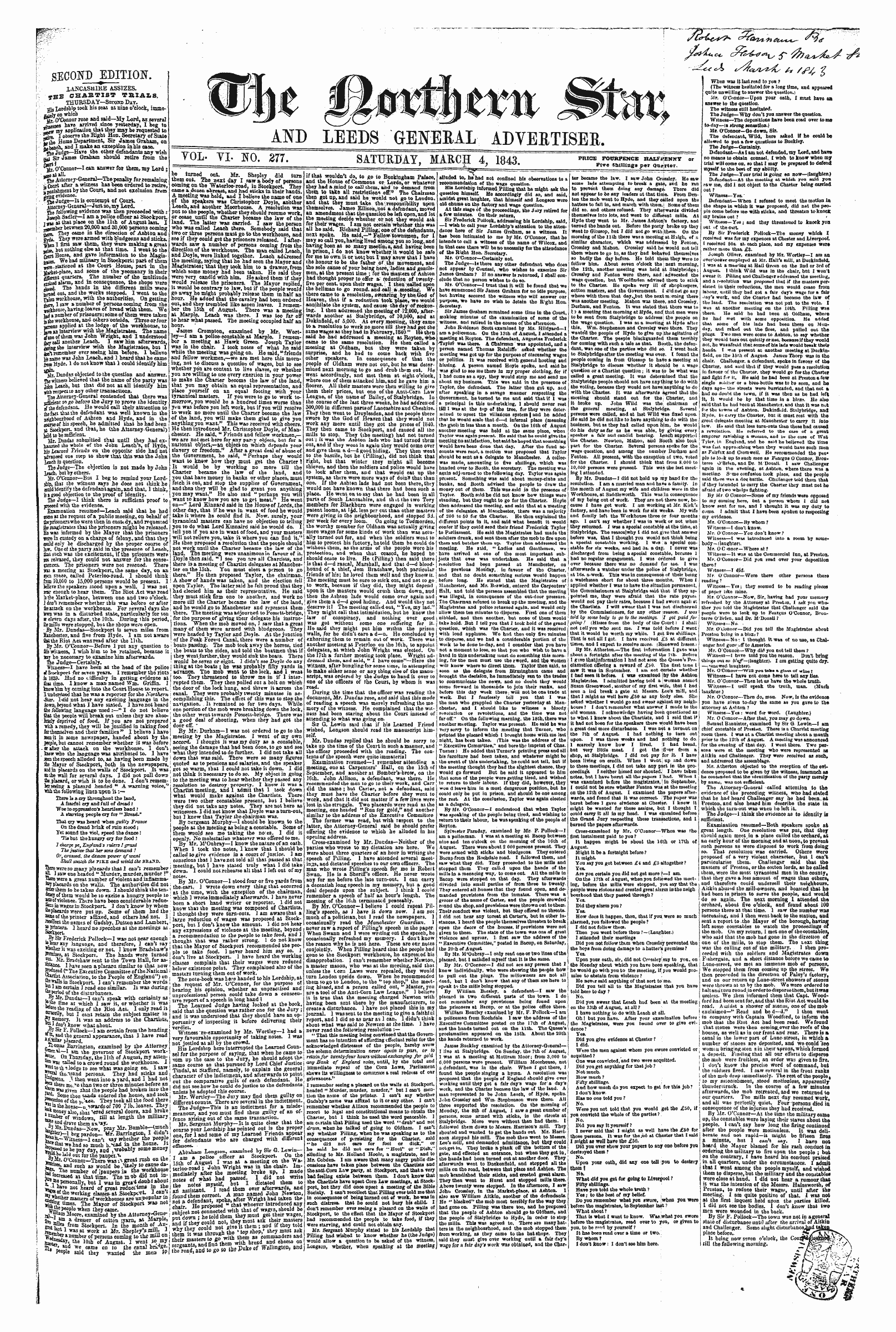
iASCASUlKE ASSIZES . THE CHARTIST TRIALS . THURSDAY—Secosd Day . Sis Lordship took bis seat at nine o ' clock , iminejutelT on which * jfr-0 Coniiorrose and said—Mj Lori , as severs ] Jesses iave arrived since yesterday , I beg to jLfuy application that they may be requested to 3 L 3 observe the Bight Hod . Secretary of State 5 $ e Home Department , Sir James Graham , on Sbeoeh . and I make an exception inhiB case . ^ he Judge—Have the other defendants any -wish pjr James Graham shonld retire from the * jk O'Connor—lean answer for them , my Lord ; -ggjjalL WtiiCJ nut ini
Trip J ^ w - LMVjfeuaujr li / r ^ CUiOUUU £ jCwirt after a witness has been ordered to redre , ? wmishineni hy the Court , and not exclusion from 2 rftiif eTidence . " jje Judge—It is contempt of Court , ^ Bornej-General—Just so , my lord . 53 ie following evidence was then proceeded with Josep h Sadler—I am a . police officer at Stoekport . I jjs jiihat place on the llih of August last . I ioejabei between 20 , 000 and 30 , 000 persons coming SjbT They came in the direction of Ashton and |« k . They were armed with bindgeons and sticks , o ^ en I first saw them , they were miking a great . gise , hut nothing else at that time . I went to the rfcart Bonse , and gave information to the Magiaj- ^ s , "We had military in Stockport : part of them jsreZstetioned at the Court House , part in the jjgfcei-place , and some of the yeomanry in their ggkent quarters . The number of the multitude jjjjj ^ i alarm , and in consequence , the shops i ? ere ^ ei The hands in the different mills were
^ ned -ont , and the worts stopped . I went to the jTjion workhouse , with the authorities . On getting ftgre , l .-saw a number of persons coming from the 1 ^ house , having loaves of bread with them . We ^» jmmber of priso n ers ; some of them w ere take n jBtheworkhDnse , and -others outside , ^ hreeorfonr arsons applied at the lodge of the workhouse , to &e » n interne W with the Magistrates . The name ^ oae of diem was John "Wright , and I understood fer call another Leach- I saw him afterwards , ^ jriBg th e in ierrifiw with the Magistrates , but I ja * t remember overseeing him before . I believe is jame w&s John Leach , and 1 heard that he came hem Bjde . 1 do not know that 1 could identify him
^ r . Dondas objected to the question and answer . $ b witness believed that the name of the party was John Leseh , but that did not at all identify him jirh resppci to any other transactions . Hie Attorney-General contended that there was gfiaent yygo before the Jury to prove the identity jf the defendant . He would call their attention to Rafael thasihe defendant w&s well known in the igghbonrfcood of Ashton and Hyde , and in the aosiseof iis speech , he admitted that he had been ji Swckpon . and tbat , he tine Attorney-General Jgldtobssnficient . Mr . Dnnda 3 submitted that until they iad exhausted iha trhols ef the John Leach's , of Hyde , las Lesmed Friends on the opposite side had not jdnnced « ne step to show that ihiB was the John laei in question .
3 ie Judge—The objection is not made by John Jach , bntby others . Jir . O'Connor—Bat I beg to remind yonr LordjSsg ^ Hax ike witness says he does not think he eenld identify ihe defendant again , and that , 1 think , j » good objection to the proof of identity . The Jndge—I think there i 3 sufficient proof to jroeeed -frith the evidence . Summation resnmed—Leach said that he had tcme at the request of a public meeting , on behalf of gsprisonerswno were then in custtdy , and requested 2 s magistrates that the prisoners might be released . Hb -was informed by the Mayor that the prisoners jere in enstodj on a charge of felony , and that they eonld onlr be discharged by the proper coarse of
3 iw . Oneoi she party ^ s&id in the presence of Leach , fiat such was the excitement , if the prisoners WBre Tsu released , they could not answer for the eonsegaaces . The prisoners were not rescued . There ns * meeting at Sioekport , the same day , on an jpai soaee , called Peterloo-road . I should think faan 10 , 000 to 15 , 000 persons would be present . I JeSsre the speakers stood npon a wall . I was not vsr enough to near them . Tne Rot Act was read a ^« Market-place , between one and two o ' clock . I don ' t remember whether thi 3 was before or after 6 » attaci on the "workhoase . For several days the Iran was in a disturbed state , particularly for ten e deren days after , the 10 th . During ibis period , as nulls were stopped , but the shops were open .
- By Sir . Dcndas—Swckport 13 seven miles from Xiscbester , and fire from Hyde . I am not aware ibi the Riot Act was read after the 11 vh . Bj . Mr . O'Connor—Before I put any question to & witness , 1 wish him to be retained , because it Xsj be necessary to examine Mm afterwards . lie Judge—Certainly . "Witness—I liare been at the head of the police ef Srorkport far seven years . I remember the XlOta a 15 S 9- Had no cifficolty in getting eTidence at £ nt iime . I know a man named Wa . Griffin . I knBTR"iflm by coming into the Court Honse to report . I -nndersiood that he was a reporter for the Northern Suit . IsM not hear any exciting language in the town- bfroud -what I haTe stated . I hare not heard
ihe / oDosing language Tised : — " I do not believe fiat the people wSl break ont unlesB they are absoktelj deprired of food . If jon are not prepared tiili aremedy , they will be justified in taking food fcrtieiaselTes and their families " I belieTe I haTe Kesit in some newspaper , handed about by the J » p ! e , lut cannot remember whether it was before o after the attack on the workhouse . I don ' t Ibok who the language was attributed to . I haTe Jeen the speech alluded to , as haj ingbeen made by fia 'llajor of Stockport , both in the newspapers , lad in placards on the walls of Stockport . It was Ei the wall for seTeral days . I did not pull down tbe . pl&e&rd , or wi = h it to be done . I don ' t rememiojeeing a placard headed a A warniDg Toiee , " ¦« iih the foBowing lines apon it ' , —
Tbas la&aj throughout the land , A feazfol ay and full-of dread l "Woe to oppreaaoD ^ heartless 'band . ' A atarnng people « ry for " Bread . " Hat « ry was beard -when gmUy France On the dread brink of ruin stood ; Yet sound tfee -viol , speed tbe dance . ' TisiHt tbeinngjy cry lot food ! J diargs ye , Bv ^ ani ' s rulers 1 gnat The justice thai Tier sons demand 1 Or , aroused , fhe demon power of-want Shall snatch ihe pjke and -wield ihe BRA 3 fD
^ iaeirere so many placards that I can ' t remember * 1 I saw one headed" Murder , murder , murder !" Sere were a great number of Tiolent and inflamma-* J placards on the walls . The authorities did not £ kr lhem to be taken down . 3 shonld think the ten-«^ J of them wonld be to excite a hungry people to « 2 of Tiolenee . There haTe been considerable rednoaKs imfage 3 in Stoctport . I don ' t inow by whom S * pl « ards were pnt ap . Some -of them had the Bias of the printer afixed , and others had not . I JfcoBeefc the names of Gadsby . Dntton and Lambert , £ jniBter 3 . 1 heard no speeches at the meetings at Swiport . -B j Sr Frederick Pollock—I was not near enough » i £ ar snj languageand thereforeI can ' t say
, , *>* &er it was exciting or not . 3 know Bradsbaw's ^ SEses , at StocAport . The hands were turned * 5- lit . BradsLaw sent to the Town Hall , for as-^^ ce . I haTe seen a placara similar to that now fenced CTce ExtcutiTe Committfce of theHatitnal **» rfet Association , to the People of England" ) on gswaJls in Stockport . I can ' t remember the words {? & 1 an certain I read one similar . It wa 3 during "ilPenod of the disturbances . *> S Mr . Bnndas—1 can ' t speak with certainty as »« & fime at Trhich I saw it , or whether it was * we the reading of the Hiot Aet . 3 only read it rporilj , bnt I cant retain the snbject matter in ? J aemorr . It wss an address to the Chartists
^ J doa ' t in 0 W ^ iaj abont . r ? J iat F . Pollock—1 am certain from the heading «? j sjidths general appearance , that I haTe read iMiihr pladrd . itonug Barriaston , examined by th e Attorney ° ^ £ iaL—1 am tae goTernor of Stockport work-^ ee . On Thursday , the 1 lth of August , my atten-^ »» s ? allsd to a crowd round the workhouse . I ** tto ii t lodge to see what was goiDg on . 3 saw y jfd iWisand persons . They had sticks and r ^ Seoia 3 then went into a yard , and I had not v 2 jiere mt ''e than two or three minntesbefore an r ^ was gi -rezi Jhat ihe peo pl e had broken into tbe £ « , gome thon saods entered the honse , and took the They took all the food
^^ 3 on of W- * ee . there r ^ ihBhosse-iiVWBrdsofTOO 71 b . loaTe 3 . They f ** Bxmey also , shat "¦ & * & seYeral doors , and broke J ^ ^ ? Endows , tin at length the military 3 % Hr . SaSS ' ow ^ pW ^ - Bnmble-tmnA r ^ O-l beg pardoni- « r . Barrington , 1 didn ' t Jgl ^ Witnil-I can ' t t » j whether the people C ? & « W 6 had so rnnch b . **^ in the lionse . Jt ^ d to be pay day , and ^ fc&hlj some money ^ J ^ Ir . 0 Connoi—There was i \ great rush on tiie g ^ -aad aich as wonld be - Mkdy to cause da-S ^ The nnmber of Imnners ia the workhonse at mob did not
^ acreased that time . The in-£ " Joe personall y , bnt 3 was in grea" * ^ oabt about r ^ A haTe not heard of great reductions in fee ^« of the working classes-at J 5 ioekp < . * fc- I can t t / jA&her maEters of workhonses are nnTWPnlar in ^ fR fimes . The Mayor of Stockport was not " ^ people wien they eame . "Uhsm Moore , examined by the Attorney-Geneht L- ? 11 a lesser of cotton jyarn , at Maxple , n lff fc ® Stoekport . In the month of Au-^«^ "" ^ at work at Mr . Shepky ' s inilL 1 ¦ to ^ oer a number of person coming to the mi" on jsjgfdsj , the 10 th of August . 3 went to my Its \ -L ^ T yre esme on t 0 tie c 311 * bru ^ fie . People sad they wanted the men JP
Untitled Article
be tnrned onl . Mr . Shepley did turn them ont . The next day I saw a body of persons oominj ? on the Waterloo-road , in Stockport . They came & aczen abreast , and had sticks in their hands , A meeting was held , and I belieTe the name of one of the speakers was Christopher Doyle , another Leach , and another Moorhouse . A resolution was pnt to die people , whether they should resume work , or eeass nnfil the Charter became the law of the land . The latter was carried . 3 saw the person who was called 3 < each there . Somebody said that two or three persons must go to the workhonse , and see if they oonld get the prisoners released , 1 afterwards saw a number of persons coming from the
direction of the workhoase . The man called Leach , and Doyle , were linked together . Leach addressed the meeting , saying that he had seen the Mayor and Magistrates ; that they took him to a drawer , from which some money had been taken . He said they were Tery candid with him . He asked them if they would release the prisoners . The Mayor replied , it wonld be contrary to law , but if the people wonld go away lie might probably release them in half an honr . He added that the caTalry had been ordered out , and they trembled like aspen leaTes . 1 remember the 15 th of August . There was a meeting at Marple , Leach was there . 3 was too far off to hear what passed . Tbe meeting occupied half an
hour . James Crompton , examined by Mr . "Wortley—I am a police-eonstable at Marple . 3 remember a meeting at Hawk Green- Joseph Taylor was in the chair . 3 took notes of what he said while the meeting was going on . He said , "friends and fellow workmen , —we are met here this morning , not to discuss a question of wages , but to see whether you are content to lire slaves , or whether you are williag to use eTery exertion in your power to make the Charter become the law of the land , that yon may obtain an equal representation , and place yourself on an equal footing with your tyrannical masters . 3 f you were to go to work tomorrow , yon would be a hundred times worse than
yen was before you left work , but if yon will resolTe to work no more until the Charter become the law -of the land , you will make them glad to giye yon anything you want . ' This was receired with cheers . He then introduced Mr . Christopher Doyle , of Manchester . He said , " Friends and fellow workmen , — we are not-met here for any pany object , bnt for a national object , —an object on which depends yoar slavery or freedom , " Aiter a great deal of abuse of the GsTernment , he said , " Perhaps they would want to knew how they mast get the Charter ! It would be by working no more till the Charter became the law of the land , and you that hare money in banks or other places , must fetch it oat , and stop the supplies of GoTernment
and then they will be glad to grant yon anything you may want . " He also said " periiaps you will want to know how you are to get meat . " He went on—** Lord Ennard said in the Houseof Lords , the other day , that if he was in want of food he would take it where he could iind it . Now . surely , your tyrannical masters can haTe no objection to telling you to do what Lord Iiinnaird said he would do . 1 tell you if you aie in want of food , and your masters will not relieve you , take it where you can find it . " He then proposed a resolution that the people should not work xmtil the Charter became the law of the land . The meeting were unanimous in favour of it . Doyle then said . 1 see yon are all Chartists , and there is a meeting of Chartist delegates at
Manchester on the loth . You must elect a person to go there . " He then proposed Taylor , the chairman . A show of hands was taken , and the election fell upon Taylor . The latter said he felt proud that they had elected him as their representative . He said they must stick firm one to another , and work no more till the Charter became the law of the land , and he would go to Manchester and represent them there . The meeting was adjourned to Possett-bridge , for the purpose of gmng their delegate his instructions . When the mob moved on , I saw that a great many of them were armed with bludgeons . They were headed by Taylor and Doyle . At the junction of the Peak Fore = t Canal , there were a number of boats passing . The mob took away the horees , tied
the boats to the sides , and told the boatmen that if they wentfurtber , they would sink the boats . There wcnld be seven or eigtiL 1 didn ' t see Doyle do any thing at tbe boats ; he was probably fifty yards in advance , Tne mob went to the lock , and 1 went too . Tney threatened to throw me in if 3 interrupted them . They then pulled ont a bolt on which the door of the lock hung , and threw it across the canaL They were probably twenty minutes in accomplishing this . The effect of this was to stop the navigation . . It remained so for two days . While one portion of the mob were breaking down the lock , the other went towards Possett-bridge . There was a good deal of shouting , when they had got the door ofL *
By Mr . Durham—3 was not ordered to go to the meeting by the Magistrates . 3 went of my own accord . 1 thought it was my dniy as a constable , seeing the damage that had been done , to go and see what they intended to do fnrtber . I did not take all down that was said . There were so many figures quoted as to pensions and salaries , and the speaker got so warm , lhat I could not take it down . 3 did not think it necessary to do bo . My object in going to the meeting was to hear whether they passed any resolution to destroy-property . I knew it was a Chartist meeting , and I admit that 1 took down what wonld make against the Chartists . There were two other constables present , bDt 3 believe they did not take any notes . They are not here as witnesses . I did not know that 3 > oyle was a turn-out , but 1 knew that Taylor ihe chairman was .
By Sergeant Murphy—3 should be known to the people at the meeting as being a constable . Some of them would see me taking the notes . 3 did it openly . . No molestation whatever was offered to me . By Mr . ll'Oubray—I know the nature of an oath . When 1 took the notes , 3 knew that 1 should be called to give evidence in a court of justice . 3 am conscious tbat 1 have not told all that passed at that meeting , but I have stated truly what I did take down . 3 could not rehearse all that 3 left out of my
note ? . By Mr . O'Connor—I stood four or five yards from the-cart . 1 wrote down every thing that occurred at the time , with the exception of ihe chairman , which 1 wrote immediately afterwards . 1 have never been a short hand writer or reporter . 1 did not know that the meeting was composed of ChartiBts . 1 thought they were turn-outs . 1 am aware that a large reduction of wages was proposed at Stockport , bnt 3 don ' t know tbe amount . 1 did not hear any expressions of Tiolenee at the meeting , bejond a recommendation to the people to take food , and 1 thought that was rather strong . 1 do not know that the Mayor of Stockport recommended the people to take food . 1 neTer heard him say so . 1 don ' t live at Stockport . 1 have heard the working classes complain that their wages were reduced below existence point . "They complained also of the masters turning them out of work .
The note-book was here handed to his 3 jordship , at the request of Mr . O'Connor , for the purpose o ! hearing his opinion , whether an unpractised and unprofessional person could take down a consecutive report of a speech in long hand 1 The liearned Judge having looked at the book , said that ihe question was rather one for the Jury ; and it was understood that they should have an opportunity of inspecting it before delivering their Witness " re-examined by Mr . Wortley—I had a very favourable opportunity of taking notes . 3 was not jostled at all . by the crowd . the Learned
His lordship here interrupted Counsel for the purpose of sayiDg , that when he came to ^ m up the case to the Jury , he should adopt th * same course as that pnrsned by Lord Chief Jnstice Tindal , at Stafford , namely , to explain the general character of tbe indictment , and afterwards to point © Ht the comparative guilt of each defendant . He did not see how he could do justice to the defendants -unless he adopted this course . Mr . Wortley—The Jury may find them guilty on different conntB . There are several in the indictment . The Judge—This is an indictment for a misdemeanour , and yon must find them guilty of an offence arising out of the same transaction . Mr . Sergeant Mnrphy—It is quite clear that the conrse yonr Lordship has pointed out is the proper one , for 3 and some of my Learned Friends appear for defendants who are charged with different ofienoes .
Abraham Longsou , exaxtnn&Z by Sir G . Lewin—1 am a police <> meeT at Stockport . OnOie 15 th of August 3 was at a meeting on the Wa-So-road f John Wright was in the chair . Immediately after tbe meeting broke up , I made Jotes of what had passed . I did not write 5 » notes myself , but 3 dictated them to 2 assistant . I read them over afterwards , and f .., ) ? , correct . A man named John Newton , JTadefindS ioke , after Wright had token the cha 5 He propped " that whoever introduced any asSLwas ffi'ST&sss : ss
Untitled Article
if that wouldn't do , to go to Buckingham Palace , and . the House of Commons or Lords , or whatever they had a mind to call them , and to demand from them to take all restriction' * oft" The Chairman then got up , and said he would not go to London , and that they must take the responsibility upon themselves . James Ellison , not a defendant , moved an amendment that the question be 1 left open , and let the meeting decide whether or not they would ask tor their wages . I am not eertain whether this was all he said . Richard Pilling , one of the defendants , next spoke . He Baid , —^ Fellow-townsmen , for I may bo call you , hating lived among yon solbng . and having been at so manymeetings , and hayios ; been m prison , I do not know whether it would be safe
for me to own it or not ; but I may ' avow that I have the honour to be the father of the movement , and the sole cause of your being here , ladies , and gentlemen , at the present time ; for the masters of Ashton had thought proper to offer * reduction of twentyfive per cent , upon their wages . I then called upon the bellman to go round , and call a-rmeeting . We there came to a resolution , swearing by the God of Heaven , that if a reduction took place , we would annihilate the system , and cause the day of reckoning . 1 then addressed the meeting of 12 , 000 , afterwards another at Stalybridge , of 10 , 000 , and at Dukinfield , of 5 , 000 . At every meeting , they came to a resolution to work no more till they had got the Bame wagesas they had in February , 1840 " He then
Baid ne had addressed a meeting at Hoyton , wb © came to the same resolution . He then called a meeting at Oldbam , but they were taken by surprise , and he had to come back with five other speakers . In consequence of that the people of Oldham were not out , but he was determined next morning to go and drub them out . He went accordingly , and met them at eight o'clock , where one of them attacked him , and he gave him a floorer . All their masters were then willing to give them their prices , but one of the Anti-Corn Law League , of the name of Bailey , of Stalybridge . In the coarse of the last three weeks , he had addressed 300 , 000 in different parts of Lancashire and Cheshire . They then went to Droylesden , and tbe people there
swore by the God of Hpaven that they would not work any more until they got the prices of 1840 . They then came to Sioekport , and caused all the mills to Btop . They ( the meeting ) had not turned out ; it was the Asbton lads who had turned them out , and if they went in again they would oome over and give them a d—d good hiding . They then went to the bastile , but he ( Pilling ) , did not think that rijtbt , but that winter they might all become thieves , and then the soldiers and police would have to look after them , and tbat would eat up the system , as there were more ways of doin * that than one . If tbe Ashten lads had not been there , they would not have known that there had been such a place . He went on to say that he had been in all
parts of South Lancashire , and th a the two Tory members for Blackburn were engaged in working patent looms , at 1 ^ d . less per cut than other masters were giving in the neighbourhood , and stopped 9 d . per week for every loom . On going to Todmorden , the worthy member for Oldham was actually giving more wages for some kinds of work than was aotually turned out for , and when the soldiers went to him to protect his factory , he told them he could do withoni them , as the arms of the people were bid protection , and when that ceased , he hoped he should cease to live . He ( Pilling ) then said there is that d—d rascal , Marshall , and tbat d—d bloodhound of a thief , Jem Bradshaw , both particular friends of his ; he loved them well and they knew it . The meeting must be sure to stick out , and not to go to work , because if they did , they might depend upon it the masters would crush them down , and
then the Ashion lads would come over again and give them a d—d good hiding . And would they not deserve it ? The meeting called out , " Y « b , my lad . " They might call that intimidation , but he knew the law of conspiracy , and nothing over good was got without some one suffering for it . He said they might put him within the prison wallB , for he didn ' t care a d—n . He concluded by exhorting them to remain out of work . There was another meeting at Peterloo on the 16 th , to appoint delegates , at which John Wright was elected . On the 17 th a further mooting took plaoe . Wright addressfcd them , and said , " I have come" —Here the Tf itfless , after bungling for some time , id attempting to make either sense or any thing ebe of the manuscript , was ordered by the Judge to hand it over to one of the oflacers of the Court , by whom it was read .
During the time that the officer was reading the document , Mr . Dundas rose , and said that this mode of reading a speech was merely refreshing the me mory of the witness . He complained that the witness had been staring about the Court instead of attending to what was going on . Sir G . Lewin said that if his Learned Friend wished , Longson should read the manuscript himself . Mr . Dundas replied tbat he shonld be sorry to take up the time of the Court in such a manner , and the officer proceeded with the reading . The contents of the speech were quite immaterial
Examination resumed—I remember attending a meeting , one at Carpenters' Hall , on the 15 th of September , and another at BomberVbrow , on the 16 th . John Allison , a defendant , was there . He recommended tbe men to go to their work , and Carr did the same ; but Cart or , not a defendant , Baid they must have tbe Charter before they went to work , and that it did aot matter if a few lives were lost in the struggle . Two placards were read at the meeting , one headed " Run for gold , " and another similar to the address of the Execntne Committee The former was read , but with respect to the latter , tbe Attorney-General Baid he should prefer offering the evidence to which he alluded in his opening address .
Cross-examined by Mr . Ducdas—Neither of the parlies who wrote to my dictation are here . We were abont three quarters of an hour in writing the speech of Pilling . I have attended several meetings , and dictated speechea to our own officer ? . The man who wrote Polling ' s speech for me is Robert Swan . He is a Sheriff's officer . He never wrote any for me before the late turn-out . 3 can carry a decentlsh long speech in my memory , but a good deal depends upon the subject . I think I could remember a speech of half an hour ' s length . The meeting of the 16 th terminated peaceably . By Mr . O'Connor—I believe I could repeat Pilling s speech , as J have it down now . I am sot much of a politician , but I read the newspapers . 1 occasionally read the Manchester Guardian . 1 never saw a report of Polling ' s speech in the paper . When Swann and I were writine out the speech , he
occasionally refreshed my memory . I don't know the reason why he is not here . These are our notes conjointly . When Pilling heard that the people bad gone to the Stockport workhouse , he express . ed his disapprobation . 1 can ' t remember whether Newton , a master mason , who was at the meeting , said that unless the Corn Iawb were repealed , they would turn London upside down . When he recommended them M > go to London , to the * Hop shop , " the meeting hissed , and a person called out , "Master , you are a tool of the Anti-Corn Law League . " 1 believe it is true that the meeting charged Newton with having been sent there by the manufacturers , to create a disturbance . 1 have not placed this in my journal . 1 was sent , to the meeting to give a faithful report , and 1 did so as nrar as 1 can . 1 didn ' t think about what was said to Newton at the time . 1 have never read the following resolution : —
" That this meeting being convinced tbat tbe Government has no intention » f affording effectual relief for the acknowledged distresses of the people , hereby avow the solemn determination never again to pass , or to retain for iwenty-f our hours without exchanging for gold any Bank of England notes , until , by the total and immediate repeal of the Corn Laws , Parliament aaa-wa its willingness to mm . xat . wt a teal redrew of our grievances . " I remember seeing a placard on the walls at Stockport , headed " Murder , murder , murder , " but I can't
mention the name of the printer . I can't say whether Gadsbs ' s name was affixed to it or any other . I can't remember whether Allison recommended the people to resort to legal and constitutional means to obtain the Charter , but I think he used the word peaceable . 1 am ctrtain that Pilling used the word "drub" and not drum , when he talked of going to Oldham . I can't jsay -whether Pilling , when be was speaking as to the consequences of persisting for the Charter , said "be Ci-X not care for fool or dick , " or he said be did not care for " Hool" or "DicV
alluding to Mr . Holland Hoole , a magistrate , and to Mr . Cobden . 1 am aware that many angry public discussions have taken place between the Chartists and tbe anU-Corn Law party , at Stockport , and tbat a very bad feeling exists between them . I don't know that the Chartists have upset Corn Law meetings , at Stockport , bnt they did once upset a meeting of tbe Bible Society . I cant recollect that Pilling ever told me tbat in consequence of being turned out ef work , he was in sucn distress , that he could not bury his child . I don't remember ever seeing a placard on tbe walls of Stockport , to the effect that the Mayor of Stockport had recommended tbe people to take food , if they were starving , and could not obtain any .
Mr . Sergeant Mnrphy stated to his Lordship that Pilling had wished to know whether he ( the Judge ) would allow a question to be asked of the witness , Longsoa , whether , when speaking at tbe meeting
Untitled Article
alluded to , h * bad not confined his observations to a recommendation of the wage question . His Lordship informed Pilling that he might ask the qnestlon himself . He accordingly did so , and said , amidst great laughter , that himself and LoDgson were old chums on the factory and wage question . At this stage of the proceedings , the Jury retired for a few minutes . On their return , Sir Frederick Pollock , addressing his Lordship , uald , —I wish to call your Lordship ' s attention to the attendanoe here of Sir James Graham , as a witness . It has been intimated to me by Mr . O'Connor ,: that he intends to call a witness of the name of Wilcox , and in that case there will be no necessity for the attendance of the Right Hon . Secretary . Mr . O'Connor—Certainly not ,
The Judge—Is there any other defendant who does not appear by Counsel , : who wishes to examine Sir James Graham ? If no answer Is returned , I shall conclude that no person wishes to do so . ¦ Mr . O'Connor—I trust that it will be found that we have summoned Sir JameB Graham for no idle purpose , but having secured the witness who will answer our purpose , -we have no wish to detain the R'ght Hon . Secretary . Sir James Graham remained some time in the Court , making miuutes of the examination of some of the witness , and retired in the course of the afternoon .
John Kobinson Scott examined by Mr . Hildyard—I am a policeman . On the 13 th of August , I attended a meeting at Royton . The defendant , Augustus Frederick 'Taylor was there . A Chairman' was appointed , and a person named Thomas R&tcliffe asked whether the meeting was got up for the purpose of discussing wages or politics . It was received with general hooting and hissing . A person named Hoyle Bpoke , and said he was glad to see me there in my proper clothing , for if I had come as a spy , they would strip me and send me about my business . This was said in the presence of Taylor , the defendant . The latter then got up , and after speaking in a savage manner respecting the Government , he turned to me and said that if I was a principal in this undertaking , I should never rest
till I was at the top of the tree , for they were determined to upset the villanous system | and be added that be woald scale that d—d infernal place ( meaning the gaol ) in less than a month . On the 16 th of August another meeting was held at the same place , when Taylor was again present . ^ He said that he could give the meeting no satisfaction , but said he , hoped that something would have been done that day . After the fund accounts were read , a motion was proposed that Taylor should be sent as a delegate to Manchester . A collecwas made , amounting to five shillings , which was handed over to Booth , the secretary . The meeting was again adjourned to the following day , Taylor was again present . Something was said about money-dubs and banks , and Booth advised the people to draw the
money out of them . This was said in the presence of Taylor . Booth said he did not know how things were standing , but they ought to go for the Charter . Hoyle then addressed the meeting , and said that at a meeting of tbe delegates , at Manchester , there was a majority of 200 to 50 fur the Charter . He then explained the different points in it , and said what benefit it would confer if they could send their friend Frederick Taylor to Parliament . He said the Magistrates had made the soldiers drunk , and sent them after the mob to fire upon them and butcher them up . Taylor then addressed the meeting . He Slid . " Ladies and Gentlemen , we have arrived at one of the most important subjects that ever was undertaken . He said that a resolution bad been passed at Manchester , on
the previous Monday , iu favour of the Charter , and that no doubt something serious would happen before long . He stated that the Magistrates of Manchester , and Mr . Beswick , entered the Carpenters ' Hull , and told the persona assembled that the meeting was illegal , in consequence of the cut-door pressure . The Chairman refused to break up the meetiug , and the Magistrates and police returned again , and would only allow them ten minutes to disperse . First one of them nibbled , and then another , but none of them would take hold . Bat I tell you that I took hold of the grand question , which was tbe Charter , and it was received with loud applause . We had then only five minutes to disperse , aud we had a considerable portion of the work to be done to-day , and I consider that you have
not a moment to lose , so that you who wish to have a hand in this undertaking must do something this morniDg , for the men must use the f word , and the women wilt know where to direct them . Taylor then said , as soon as the delegate from Birmingham came and brought the decision , he Immediately ran to the trades to communicate tbe ne ^ B , and no doubt they wonld come forward in thousands to join their ranks , aud btfore this day week there j will not be one trade at w » rk . But I fearlessly tell you that I was the man who grappled the Charter yesterday at Manchester , and I should like to witness a bloody revolution or revolutions , and tbe time was not far off . " On tbe following ratming , the 18 th , there was another meeting . Taylor was present He said he was
very sorry to inform the meeting tbat Turner , wbo printed the placard which I brought home with me last night , has been taken . ( This was tbe address of the " Executive Committee , " and bore the Imprint of Chas . Turner . ) He added that Turner's printing press and all his furniture bod been taken , and whatever might be the event of this undertaking , he could not tell , bnt if the meeting thought they had the slightest chance , they would go forward But he said it appeared to him that some of the people were getting tired , and wished to return to their labour . If they did , however , they won d leave him iu a most dangerous position , but he could only be put in prison , and should be one among the rest At the conclusion , Taylor was again elected as a delegate .
By Mr . O'Connor—I understood that when Taylor was speaking of tbe people being tired , and wishing to return to their labour , he was speaking ot the people of Royton . Sylvester Faraday , examined by Mr . F . Pollock—I am a policeman . I was at a meeting at Bacup between nine and ten o'clock on the morning of the 16 th of August There were about 2 000 persons present They were armed with stickd and bludgeons . They entered Bacup from the Rochdale road . I followed them , and saw what they did . They proceeded to the mills and stopped them . They calkd upon the hands of the mills in a menacing way ,- to come out All the mills in
Bacup were stopped on that day . They afterwards divided into small parties of from three to twenty . They entered all bouses tbat they fonnd open , and demanded provisions from the inmates . There was a grocer of the name of Carter , and the people crowded round tbb shop , and provisions were thrown out to tb . 6 m . Their conduct was violent , bnt they offered no threats . I did not hear any tnreat at Carter ' s , but in other instances , I heard tbe people themselves threaten to break open the daors of the houses , if provisions were not given to them . The state of the town was one of great violence and uproar , I ; first saw the address of the " Executive Committee , " posted in Bacup , on Saturday , the 20 th of August
By Mr . M'Oubray—I only read one or two lineB of the placard , but I satisfied myself that it is the same . By Mr . O'Connor—I did not see any person that I knew individually , who were shewing the people how to pull out the plugs . The millowners are not all dead , but 1 don't know that any of them are here to speak to the mills being stopped . By William Bbesley , a defendant—I saw the placard in two different parts of the town . I do not remember any provisions being found upon the prisoners at Bacup , ; or at the police office there . William Bentley examined by Mr . F . Pollock—I am a policeman from Rochdale I saw tbe address of tbe Executive Committee posted on tbe 17 th of August , and the hands tnrned out on the 11 th . The Queen ' s proclamation appeared on the 15 th . About the 20 th tbe sands returned to work .
James Buckley examined by the Attorney-General—I live at Stalybridge . On Sunday , the 7 th of August , I was at a meeting at Mottram Moor ; from 3 , 000 to 6 , 000 persons were present William Moorhouae , not a defendant , was in the chair . When I got there , I found the people singing a hymn . A resolution was proposed that tbe people of England should give over working until they got a fair day ' s wage for a day ' s work , and the Charter became the law of the land . A man represented to be John Leach , of Hyde , spoke . John Crossley and Wm . Stephenson were there . All three supported the resolution . On the morning of Monday , the 8 tb of August , I saw a great number ef persons , some armed with sticks , in the streets at Stalybridge . More were without than had them . I followed them down to Messrs . Harrison's mill . They shouted and wanted to get the hands out Mr . Harrisoon stopped his milL The mob then went to Messrs . Lee ' s mill , and demanded admittance , but they could
not get in . They broke a plank off tb « bottom of the gate , and effected an entrance , but when they got in , tbe hands had been turned out at another door . They afterwards went to Dackenfleld , and stopped all the mills on tbe road , between that place and Ashton . The mob brandished their sticks , and created great alarm . They then went to Hurst and stopped mills there . Above twenty were stopped . In the afternoon , I saw John CroBsley , in the Market-place , » t Ashton . I also saw William Aitkin , another of the defendants . He " blacked" the mob most terribly for the way they had gone on . Pilling was there too , and he proposed tbat the people of Ashton should go to Oldham , and the people of Stalybridge to Hyde , in order to stop the mills . This was agreed to . There are many batters in the neighbourhood , and tbe mob stopped them from working , as they came to the hat shops . They said they must give over working until a fait day ' s wage tor a fair day ' s work was obtained , and the Char-
Untitled Article
ter became the law . I saw John Crossley . He saw some lads attempting to break a gate , and be ran to prevent them doing any damage . There did not appear to be any leaders at that time . From Denton the mob went to Hyde , and they called npon the hatters to fa \ l in , and march with them . 1 Borne of them did so , and others refused . They afterwards divided themselves into lots , and went to different mills . At Hyde they went to Mr . James Ashton ' s factory , and turned tbe hands out . Before the party broke up they went to Glossop , but I did not go with them . On the morning of the 11 th there was a meeting at Haigh , ef v similar character , which was addressed by Fenton , Croasley and Mataon . Crossley said he would not tell them where to so to , as they bad behaved themselves
so badly the day before . He told them they wete to follow him . About seven o'clock the j next morning , the 12 th , another meeting was held at Stalybridge , Crossley and Fenton were there , and j advocated tbe wage question , but Woolfinden advised them to stick to the Charter . He spoke very ill of shopkeepers , cotton masters , and the Government I did nut go any where with them that day ,, but the next m > rnirig there was another meeting . Mahon was there , and Crossley , Durham , and Fenton . It was stated that there was to 13 a meeting that morning at Hyde , and ! that men were to be sent from Stalybridge to address ! tbe people on the wage question . I was as a meeting at Hyde after this . ^ Wm . Stephenson and Crossley were there . They wante ' d the people of Hyde to give up the agitation of
tbe Charter . The peeple blackguarded them terribly for coming with such a tale as that Bqotb , the defendant , was one of the parties who did so . I went back to Stalybridge after the meeting was over . I found the people coming in from Glossop to have a meeting at Stalybridge to discuss whether it should be a wage question ot a Chartist question ; it was to be what was called a great meeting . It was determined that tbe Stalybridge people should not have any thing to do with the voting , because they would not have ! anything to do with the Charter . It was afterwards agreed that tbe meeting should stand out for the ] Charter , and it broke up . John Wild was the ! chairman of
the general meeting , at Stalybridge . Several persons were called , and at last Wild was fixed upon . He said he did not like to have anything ! to do with tbe business , but as they had called upon him , he would do his duty as far as he was able , by giving every speaker a fair and candid hearing . Leach supported the Charter . Newton , Mabon , and Booth also took part for the Charter . Several persons spoke for the wage question , and among the number Durham and Fenton . AH present , with tbe exception of two , voted for the Charter . I should think that from 8 . 000 to 10 , 000 persons were present This was tbe last meeting I attended . ,
By Mr . Dundas—I did not hold up my hand for the resolution . I am a married man aud have a family . In the month of August my wife and children were in tbe Workhouse , at Saddle worth . This was ; in consequence of my being out of work . They are not there now , because I have got work . I am working at Mr . Kirk's factory , and have been in work for six weeks . My wife and family left the Workhouse three or four months ago . I can't say whether I was in work or not when they returned . I was a special constable at the time , at Stalybridge . The reason ] why I did not give that answer before was , that I thought you would not think being a special constable working . I w * s la special constable for six weeks , and had 3 s . a day , I never was discharged from being a special constable , because 1
had no regular engagement . I was ordered to give over because there was no demand for me . I waa afterwards a watcher under the police of Stalybridge , at 16 s . a-week . This was in consequence of their being a watchman short for about three months . When I applied whether I was to have the situation permanent , the Commissioners at Stalybttdge said that if they appointed me , they were afraid that the rate payer * would not pay their rates , because I had sworn agaii at tbe Chartists . I will swear that I was not discharged by the Commissioners , for any other [ reason . / was tofd by some body to go to the meetings . !/ got paid for going ! ( Hisses from tbe body of the Court ) I shall not tell you who sent me . I was told ; before I went that it would be worth my while . I got five shillings .
That is not ail I got . I have received £ 5 at different times , and I expect to receive more . ( Renewed hisses . / By Mr . Atherton . —The first information I gave was about a fortnight after the meeting of the 7 th- Before I give thatjinformation 1 had not seen the Queen ' s Proclamation offering a reward of £ 50 . the first time I saw it was in September . I am not certalu whether I had seen it before . I w&s examined jby the Ashton Magistrates . I admitted having told a { woman named Susan Greenwood , mother of my first wife , that I had seen a lad break a gate at Messrs . Lee ' s mill , and that I might as well have £ 50 as any body else . She asked whether I would go and swear against my neighbours ? I don't remember what answer I made to the old woman . I acknowledge having been questioned as to what I knew abont tbe Chartists , and I said tbat if it had not been for the speakers there would have been a great deal more disturbance . I was n © t a turnout on
the 7 th of August I had nothing to turn out upon . I was three weeks and had nothing to do . I scareely know how I lived . I had bread , but very little meat I got the Ifhur from a shop , at Stalybiidge . I did not pay for it I have been living on credit When I went ; up and down to these meetings . I did not take any part in the proceedings . I neither hissed nor shouted ; I have taken notes , but I have burnt all the papers I had . When I waa examined before the magistrates , I in September , I could not be sure whether Fenton was ! at the meeting on tbe 12 th of August I examined the papers afterwards , and fonnd that it waa corrrect The paper was burnt before I gave eivdence at Chester . I knew it might be wanted for these assizes , but I thought I could carry it all in my head . I was examined before the Grand Jury respecting these transactions , and I burned the papers afterwards .
Cross-examined by Mr . O'Connor—When was the first instalment paid to you ? It happen might be about the 16 th or 17 th of August . Might it be a fortnight before ? It might You say you got between £ i and £ 5 altogether ? Yes . Are you certain you did not get more ?—I am . On the 17 tb of August , when you followed the meeting , before the mills were stopped , you say that the people were riotous and created great alarm in the neigh bouibood that they passed through ? Yob .
Did they alarm you ? Yes . How does it happen , then , that if you were so much alarmed , you followed the people ? I dtd not follow them . Then you went before them?—( Laughter . ) I attended their meetings ; Did you not follow thtm when Crossley prevented the the boys from doing damage to a hatter ' s premises ? Yes . : Upon your oath , sir , did not Crosaleyjaay to you , on the Monday about which you have been speaking , that be would go with you to the meeting , if you would
promise to abstain from violence ? He never said anything of that sort to me . Did you tell ail to the Magistrates that you have told here to day ? No . Did you swear that Leach had been at the meeting on the 13 th of August , at all ? I have nothing to do with Leach at all . Oh ! but you have . After your examination before the Magistrates , were you bound over to give evidence ? Yes . Did you give evidence at Chester ?
I did . Were the men against whom you swore convicted or acquitted ? , : One was convicted , and two were acquitted . Did youget anything for that job ? Not much . How ranch ? Fifty shillings . And how much do you expect to get for this job ? I don't know . Has no one told you ? No . Were you not told that you would get the £ 50 , if you convictd the whole of the parties ? . No . Did you say it yourself ? I never said that I might as well have the £ 5 d for those persona . It was for the / o& at Chester that I sold
I might aa well bave tbe £ 50 . Did you ever show your papers to any one before you destroyed them ? No . Upon you oath , did any one tell you to destroy them ? No . ; What did yon get for going to Liverpool ? Fifty shillings . : Have you told the whole troth ? Yea ; to the best of my belief ; Do yon remember what yon swore , when yon were before the magistrates , in September last ? What about ? i That is what I want to know . Was what you swore before the magistrateB , read over to yon , or given to you , to be rp *< l by yourself 1 It has been read over a time or two . By whom ? I don't know : I don't see him here .
Untitled Article
/ Gr&c ^* ?* c ^ feqsi to ***^
When was it last read to yon ? ( The witness hesitated for a long time , and appeared quite unwilling to answer the question . ) Mr . O'Connor—Upon your oath , I must have aa answer to tbe question . Tbe witness still hesitated . The Judge— Why don't you answer the question . Witness—The depositions have been tead over tome ' to-day—( a strong sensation . ) Mr . O'Connor—Go down , Sir . The dbfena&Bt , Wild , here asked If he could be allowed to put a few questions to Buckley . The Judge—Certainly .
Defendant—Ae I am not defended , my Lord , and have no means to obtain counsel , I wish to know when my trial will come on , so that I may be prepared to defend myself to the best of my ability . The Judge—Your trial is going » n now—( laughter . ) Defendant— -At the meeting at which you said you row me , did I not object to the Chatter being carried out ? Witness—Yes . " Defendant—When I refused to meet the motion in the shape in which it was proposed , did net tbe people come before me with sticks , and threaten to knocic my brains out 1 > Witness—Yes ; and they threatened to knock you out of the cirt
By Sir Frederick Pollock—The money which I received was for my expences at Chester and Liverpool . [ received 50 a . aV each place , and my expenses wer « rather more than £ 3 . Joseph Oliver , examined by Mr . Wortley—I am an overlooker employed at Mr . Halt ' s mill , at Duckinfield . I was at a nibe-ini ? at Hall Green on the 2 nd or 3 rd of August . I think Wild was in the chair , bnt I won't swear it Pilling and Challenger addressed the meeting , and a resolution was proposed that if the masters persisted in their reductions , the men would cease from labour , until they had « ot a fair day's wage for a fair ¦ lay ' s work , and the Cttarter had become the law of the land . The resolution wdb not put to the vote . I
was at another meeting on the 10 th . Pilling was there . He said he had been at Oldham , where he had met with some opposition . He artded that some of bia lads had been there on Monday , and rakod out the fires , aud pulled out the plugs . Two men were come to Ashton , to say whether they would turnout quietly or n » t , because if they would not , ho was afraid tbat some of his lads would break their heads . I wns present at 'another meeting at Duckinfifeld , on the 15 'ii of August James Thorp was in the chair . Challenger , a defendant , spoke in favour of the Charter , and and th it if they would pass a resolution in favour of the Charter , they would go for the Charter and fight f < r it . fie said he had been at Preston a few single solilu-r or a bluebottle was to be seen , and he days ago- the streets were barricaded , and that not a had no doubt the town , if it was then as he bad left ¦
it , it would be by that time in a blszs . He also Baid that hu had been at Manchester , and that it was not for the towns of Ashton , Dukinfiold . Stalybridge , and Hyde , to c . trry the Charter , but it mast rest with the great delegate meeting ; at Manchester to carry it into law . He said that less turn-oats than these hod caused a revolution . Ho referred to tbe case of a great emporer ravishing a woman , and t » the case of Wat Tyler , in Enijland , aud he said he believed the time was fiat appro . ich . iDtj when they would bave such men as Fairfax and Cromwell . He recommended the peo « pie te lo . / k up to such men as Feargns O'Connor , Bros * terre O'Brien , and Dr . M Douall . I saw Challenger again in the evening , at Ashton , where th 6 re was s meeting . S"me confusion took place , and tbe people said there wns a do
By Mr . O Connor—Some of my friends were opposed to my coming here , bnt a parson whom I did net know gent for me , and I thought it was my duty to cuma I admit 'that I hare been spoken to respecting my evidence . Mr . O'Connor—By whom ? Witness—I don't know . Mr . O Connor—Yon don ' t know ? Witness—I was introduced into a room by some * body— daughter ) . Mr . 0 C mnor—Where at f Witness—It was at the Commercial Inn , at Preston . Mr . O'Connor—Did you read over your deposition there ? Witness—I did . Mr . O Connor—Were there other persons there reading ?
Witness—Yes ; they seemed to be reading pieces of paper like mine . Mr . O'Connor—Now , Sir , having had your memory refreshed by the Attorney at Prestan , I ask you whether you told tne Magistrates that Challenger said the people were to leok up to Feargus O'Connor , Bronterre O'Brien , and Dr . M'Douall ? Witne > s—No . - Mr . O ' o ' onnnr—Did you tell the Magistrates about Preston bang in a blaz = ? Witness—Not I thought It was of no use , as Chal « enger had gone -jff to America . Mr . O'Connor—Why did yon not tell them ?
Witness—I have told you the reason , Dont bring things ois so blvff— ( laughter ) . I am getting quite dry ~ —i renewed laughter ) , Mr . O'Connor—Will you tobe a glawi or wine t Witness—I have not oome here to tell any lies . Mr . O'Connor—Then let via have the whole truth . Witness—I will speak the truth , man . ( Muck laughter . ) Mr . O'Connor—Then do , man . Now , is the evidence you have given to-day the same as you gave to tbe attorney at Ashton 1 Witness—Yes : word for word . ( Laughter . ) Mr . O Connor—After that , you may go down .
Samuel Bmnister , examined by Sir Q . Lewin—I am chief constable of Preston . There is a Chartist meeting room there . I was at a Chartist meeting about a month prior to tbe 12 th of August A meeting was announced for the evening of tbat day . I went there . Two persons were at the meeting who were represented as Aitkin and Challenger . They were received as such , and addressed the assemblage . Mr . A thevton objected to tbe reeeption of tbe evidence proposed to be given by the witness , inasmuch aa he contended tbat the identification of the party mere )/ by name , waa nob sufficient The Attorney-General called attention to the evidence of the preceding witness , who had stated that he had heard Challenger say he had been , at Preston , and also heard him describe the state iu which the turn-out was wben he left it .
The Judge—1 think the evidence as to identity is sufficient . Examination resumed—Both speakers Bpoke at great length . One resolution was put , that they should again meet in a plaoe called the orchard , at au early hour of the morning and at noon , to prevent suoh persons as were disposed to work from doing so . That resolution waa oarried . Others were proposed of a very violent character , but 1 can't particularise them . Challenger said that the masters of Preston , or the cotton lords , as he called them , were the most tyrannical men in the county , that they gave a less amount of wages than others , and therefore could undersell their neighbours .
Aitkin abusod the mill-owners , and boasted that he had been in prison to serve the people , and would do so again . The next morning 1 attended the orchard , about five o ' clock , and found about 100 persons there at that time , 1 saw the number was increasing , and 1 then went back to the station , and sent a report to the Mayor of the borough , having left some constables to watch the proceedings ot tbe mob . On my return , 1 met one of the constables , who said that the mob had gone in the direction of one of the mills , to stop them . The text thing was the calling out of the military . 1 then proceeded with the soldiers and Magistrates down
Fishergate , and a short distance before we came to Lune-street , we met an immense mob of persons . We stopped them from coming up the street . We then proceeded in the direction of Paley ' a factory , and on our return up Lune-street showers of stones were thrown at us by the mob . We were ordered to bait ami turn rouud . in order to disperse them , but it was useless . We then informed them that Capt . Woodford had been sent for , and that the Riot Act would be read . Amidst a shower of stones , one of the mob exclaimed— " Read and be d—d . " 1 then went in company with Captain Woodford , to inform the mob that the Riot Act had been read . We found
that stones were then coming , over the roofs of the houses , as well as in our front and rear . There is a > canal in the lower part of Lune- street , in which a number of stones are deposited , and we conld " see womcu bringing aton s in their aprons , which formed a deposit . Finding that all our efforts to disperse the mob were fruitless , an order waa given to fire . 1 don ' t know the precise word of command , bat the soldiers fired . I saw several in the front ranka of the mob drop immediately . The rest of the people to my astonishment , stood motionless , apparently thunderstruck . In the course of a few minutes afterwards , the mob retreated , and we returned to our quarters . Tao mills next day resumed work , and all was perfectly quiet . Four persons died iu consequence of the injuries they had received . By Air . O'Connor—At the time the military came
up , the constables were laying their staves about the people . 1 can't say how long the firing continued after the people were motionless . It was deliberate and not rapid—it might be fifteen fires a minute , bat I caa'fc say . I have not heard the Mayor blamed for his rash conduot in ordering the military to fire upon the people ; bat on the contrary , I have heard his conduct praised in all quarters , under the oiroamstances . I admit that I went among the people myself , and wished them to disperse , but the military and the constable * were close at hand . I did not hear a rumour that it was the intention of the Messrs . Hainsworth , of Preston , to reduce their wage ? , until after the meeting . I am quite positive of that . I was not at the first inquest held upon the parties killed . I did not seethe bodies . I don ' t know tbat two
men were wounded in the back . By Sir i ' . Pollock—The towu was not in ageneral state of disturbance until after the arriral of Aitkio and Challenger . Some slight disturbanceiiadtak ^ eji ^ place before .. ' ^/ ^ A ^ V ^ v It being now seven o ' clock , the Couj ^ ajo ^ ^ p ^ - ;^ /\ till the following morning . " *• /} $£ ? , V ^ * " . V \ F& ^ l ^^ u ¦? ( / iS " . ^^ . jTivc rW > ^
Untitled Article
TOL . YI- NO . 277 . SATURDAY , MARCH 4 , 1843 price foot ^ nc . balf ^ nkv «• - ' k . J w ™ ' Plve Shillings per Qup ' rter .
Untitled Article
^^ # - ^ f ^^ tM ^^^ M ^^^ ^ Jw M > w ^^ Fv % /(^ % % 4 ' —*^ \ y — y —^ / AND LEEDS GrENEEAL ADVERTISER .
-
-
Citation
-
Northern Star (1837-1852), March 4, 1843, page unpag, in the Nineteenth-Century Serials Edition (2008; 2018) ncse.ac.uk/periodicals/ns/issues/vm2-ncseproduct982/page/1/
-