On this page
-
Text (3)
-
5g6 The Leader and Saturday Analyst. [Ju...
-

THE HOUSE OF OBSTRUCTION. THE House of L...
-

QUARKELS OF INDIAN OFFICIALS. FROM " cop...
Note: This text has been automatically extracted via Optical Character Recognition (OCR) software. The text has not been manually corrected and should not be relied on to be an accurate representation of the item.
-
-
Transcript
-
Note: This text has been automatically extracted via Optical Character Recognition (OCR) software. The text has not been manually corrected and should not be relied on to be an accurate representation of the item.
Additionally, when viewing full transcripts, extracted text may not be in the same order as the original document.
Sunday Trading. Your Well-Meaning Man Is...
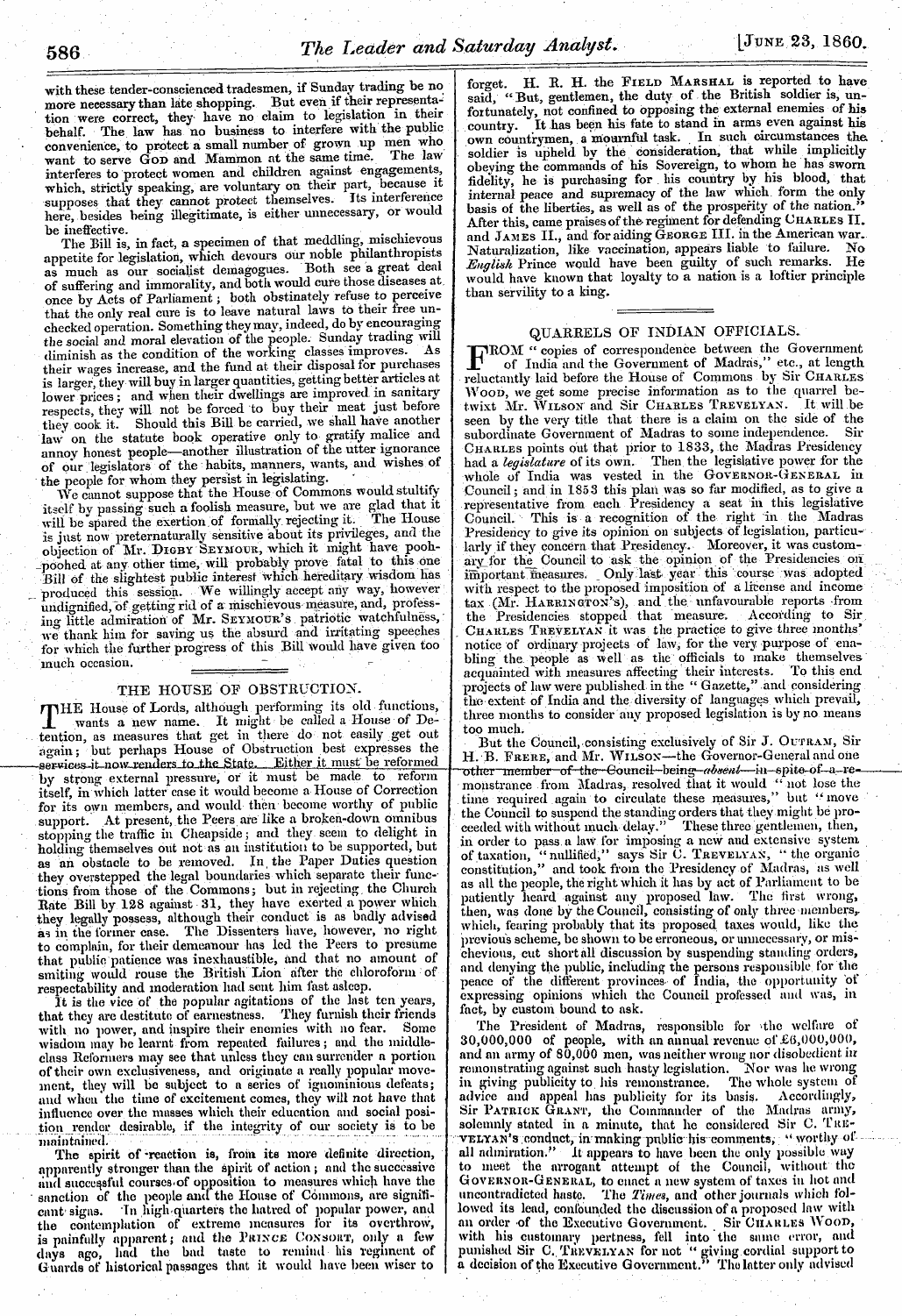
with these tender-conscienced tradesmen , if Sunday trading be no more necessary than late shopping . But even if their representation were correct , they have no claim to legislation in their behalf . The law has no business to interfere with the public convenience , to protect a small number of grown , up men who want to serve Gojd and Mammon at the same time . The law interferes to protect women and children against engagements , which , strictly speaking , are voluntary on their part , because it supposes that they cannot protect themselves . Its interference here , besides being illegitimate , is either unnecessary , or would
be ineffective . . . The Bill is , in fact , a specimen of that meddling , mischievous appetite for legislation , which devours our noble philanthropists as much as our socialist demagogues . Both see a great deal of suffering and immorality , and both would cure those diseases at once by Acts of Parliament ; both obstinately refuse to perceive that the only real cure is to leave natural laws to their free unchecked operation . Something they may , indeed , do by encouraging will
the social and moral elevation of the people . Sunday trading diminish as the condition of the working classes improves . As their wages increase , and the fund at their disposal for purchases is larger , they will buy in larger quantities , getting better articles at lower prices ; and when their dwellings are improved in sanitary respects , they will not be forced to buy their meat just before they cook it . Should this Bill , be carried , we shall have another law on the statute book operative only to gratify malice and
annoy honest people—another illustration of the utter ignorance of pur legislators of the habits , manners , wants , and wishes of the people for whom they persist in legislating . We cannot suppose that the House of Commons would stultify itself bv passing such a foolish measure , but we axe glad that it will be " spared the exertion of formally rejecting it . The House is just rioAv preternaturally sensitive about its privileges , and the
objection of Mr . Digby Seymour , which it might have poohpoohed at any other time , will probably prove fatal to this one Bill of the slightest public interest which hereditary wisdom has produced this session . We willingly accept any way , however undignined , 7 > f getting rid of a mischievous measure , and , professing little admiration of Mr . Seymour ' s patriotic watchfulness , we thank him for saving us . the absurd and irritating speeches for which the further progress of this Bill would have given too much occasion . , ~
5g6 The Leader And Saturday Analyst. [Ju...
5 g 6 The Leader and Saturday Analyst . [ June 23 , 1860 .
The House Of Obstruction. The House Of L...
THE HOUSE OF OBSTRUCTION . THE House of Lords , although performing its old functions , wants a new name . It might be called a House of Detention , as measures that get in there do not easily get out again ; but perhaps House of Obstruction best expresses the BM-iriiM .. tt . ifc nnw-ramters to the State . Either it must be reformed
by strong external pressure , or it must be made to reform itself , in which latter case it would become a House of Correction for its own members , and would then become worthy of public support . At present , the Peers are like a broken-down Omnibus stopping the traffic in Cheapside ; and they seem to delight in holding themselves out not as an institution to be supported , but as an obstacle to be removed . In the Paper Duties question thev overstenrjed the lesral boundaries which separate their
functions from those of the Commons ; but in rejecting the Church Rate Bill by 128 against 31 , they have exerted a power which they legally possess , although tlieir conduct is as badly advised as in the former case . The Dissenters have , however , no right to complain , for their demeanour has led the Peers to presume that public patience was inexhaustible , and that no amount of smiting would rouse the British Lion after the chloroform of respectability and moderation had sent him fast asleep .
It is the vice of the popular agitations of the last ten years , that they are destitute of earnestness . They furnish their friends with no power , and inspire their enemies with no fear . Some wisdom may be learnt from repeated failures ; and the middleclass llelormers may see that unless they can surrender a portion of their own exclusiveness , and originate a really popular movement , they will be subject to n series of ignominious defeats ; and when the time of excitement comes , they will not have that influence over the masses which their education and social position render desirable , if the integrity of our society is to be maintained . ¦ "" '""¦
The spirit of -reaction is , froin its more definite direction , apparently stronger than the spirit of action ; and the successive and successful courses-of opposition to measures whicji have the sanction of tho people and the House of Commons , are significant ' signs . Tn high quarters tho hatred of popular power , and the contemplation of extreme measures for its overthrow , is painfully apparent ; ami the Prince Consort , only a few days ago ' , had tho bad taste to remind Ma regiment of Guards of historical passages that it would have been wiser to
fidelity , he is purchasing for his country by his blood , that internal peace and supremacy of the law which form the only basis of the liberties , as well as of the prosperity of the nation . " After this , came praises of the regiment for defending Charles II . and James II ., and for aiding George III . in the American war . Naturalization , like vaccination , appears liable to failure . No English Prince would have been guilty of such remarks . He would have known that loyalty to a nation is a loftier principle than servility to a king .
forget . H . R . H . the Field Marshal is reported to have said , " But , gentlemen , the duty of the British soldier is , unfortunately , not confined to opposing the external enemies of his country . It has been his fate to stand in arms even against his own countrymen , a mournful task . In such circumstances the soldier is upheld , by the consideration , that while implicitly obeying the commands of his Sovereign , to whom he has sworn
Quarkels Of Indian Officials. From " Cop...
QUARKELS OF INDIAN OFFICIALS . FROM " copies of correspondence between the Government of India and the Government of Madras , " etc ., at length reluctantly laid before the House of Commons by Sir Charles Wood , we get some precise information as to the quarrel betwixt Mr . Wilson and Sir Charles Trevelyan . It will be seen by the very title that there is a claim on the side of the subordinate Government of Madias to some independence . Sir Charles points put that prior to 1833 , the Madras Presidency had a legislature of its own . Then the legislative power for the whole of India was vested in the Governor-General in
Council ; and in 1853 this plan was so far modified , as to give a representative from each Presidency a seat in this legislative Council . This is a recognition of the right in the Madras Presidency to give its opinion on subjects of legislation , particularly if they concern that Presidency . Moreover , it was customai-y _ for the Council to ask the opinion of the Presidencies oil importantTlheasures . Only last year this course was adopted with respect to the proposed imposition of a license and income tax ( Mr . Harrington ' s ) , and the unfavourable reports from
the Presidencies stopped that -measure . According to Sir Charles Trevelyan it was the practice to give three months ' notice of ordinary-projects--of law , for the very purpose of enabling the people as well as the officials to make themselves acquainted with measures affecting their interests . To this end projects of law were published in the " Gazette , " and considering the extent of India and the diversity of languages which prevail , three months to consider any proposed legislation is by no means too much ;
But the Council , consisting exclusively of Sir J . Outram , Sir H . B . Frere , and Mr . Wilson—the Governor-General and one •^ othi 3 r ~ inenrber-ofH ; he—Oouneit- hemtg-absent—hi—spite-of—a—re monstrance from Madras , resolved that it would " not lose the time required again to circulate these measures , " but " move the Council to suspend the standing orders that they might be proceeded with without much delay . " These three gentlemen , then , in order to pass a law for imposing a new and extensive system of taxation , " nullified , " says Sir C . Trevelyan , " the organic constitution , " and took from the Presidency of Madras , as well
as all the people , the right which it has by act of Parliament to be patiently heard against any proposed law . The first wrong , then , was done by the Council , consisting of only throe members , which , fearing probably that its proposed taxes would , like the previous scheme , be shown to be erroneous , or unnecessary , or mischevious , cut short all discussion by suspending standing orders , and denying the public , including the persons responsible for the peace of the different provinces- of India , the opportunity of expressing opinions which the Council professed and was , in fact , bv custom bound to ask .
The President of Madras , responsible for the welfare ot 30 , 000 , 000 of people , with an annual revenue oi £ 6 , 000 , 000 , and an army of 80 , 000 men , was neither wrong nor disobedient hi remonstrating against such hasty legislation . Nor was he wrong in giving publicity to his remonstrance . The whole system of advice and appenl lias j > ublicity for its basis . Accordingly , Sir Patrick Grant , the Commander of tho Madras anny , solemnly stated in a minute , that he considered Sir C . Tkevtsltan's conduct , in . mnking public his comments , " worthy of
all admiration . '' It appears to have been the only possible wuy to meet the arrogant attempt of the Council , without the Governor-General , to enact n new system of taxes in hot and uncontradicted hastp . The Times , and other journals which followed its lead , confounded the discussion of a proposed law with an order of the Executive Government . Sir Charles Wood , with his customary pertness , fell into tho same error , and punished Sir C . Trkvelyan for not " giving cordial support to a decision of the Executive Government . " Tho lntter only advised
-
-
Citation
-
Leader (1850-1860), June 23, 1860, page 6, in the Nineteenth-Century Serials Edition (2008; 2018) ncse.ac.uk/periodicals/l/issues/cld_23061860/page/6/
-
