On this page
-
Text (3)
-
June 23, I860 J The Leader and Saturday ...
-

NEW ZEALAND.—DEFENCE OF THE COLONIES. TH...
-

A FRENCH INVASION. T HE long-tallced-of ...
Note: This text has been automatically extracted via Optical Character Recognition (OCR) software. The text has not been manually corrected and should not be relied on to be an accurate representation of the item.
-
-
Transcript
-
Note: This text has been automatically extracted via Optical Character Recognition (OCR) software. The text has not been manually corrected and should not be relied on to be an accurate representation of the item.
Additionally, when viewing full transcripts, extracted text may not be in the same order as the original document.
Quarkels Of Indian Officials. From " Cop...
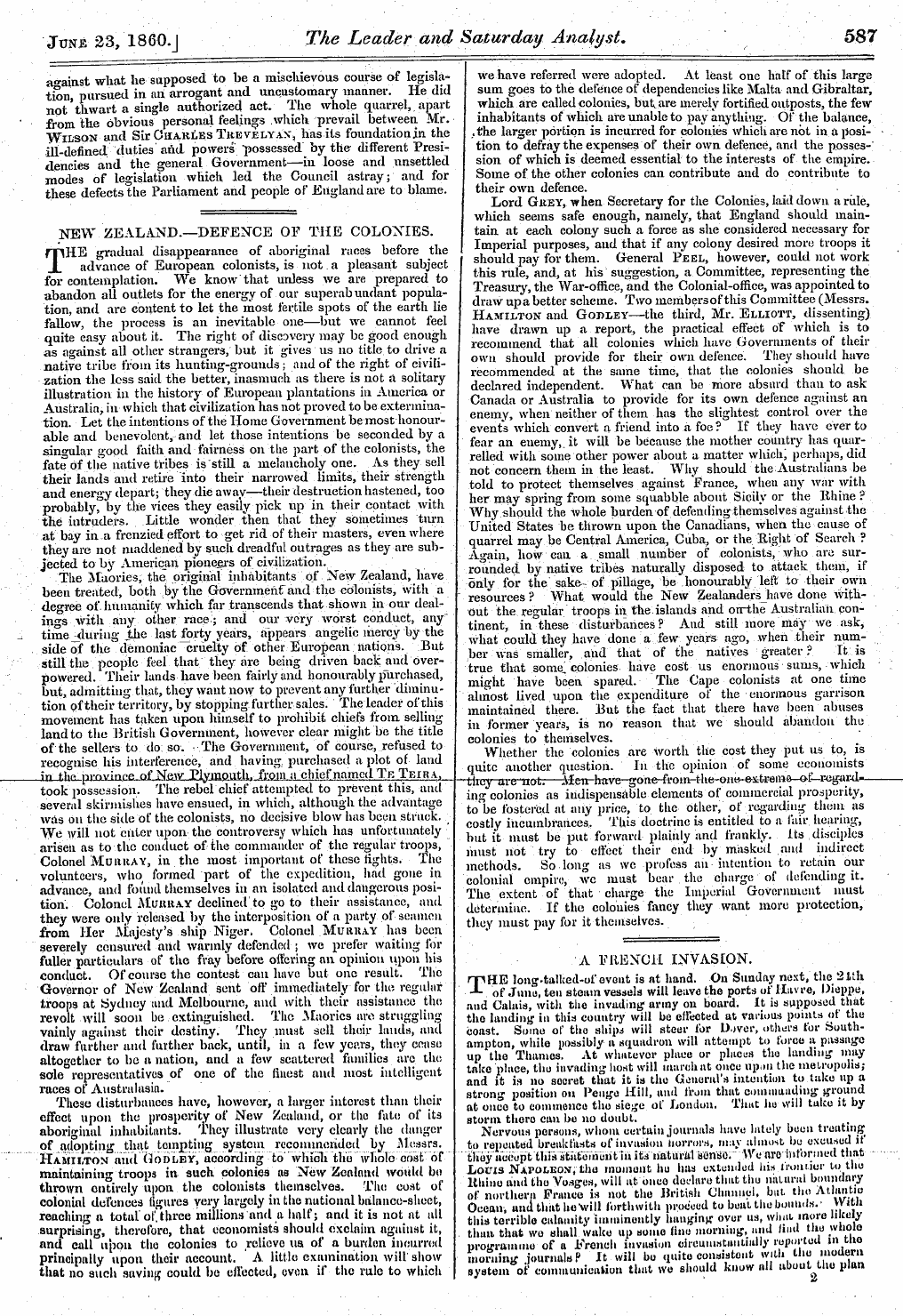
against what he- ¦ supposed to be a mischievous course of legislation , pursued in ail arrogant and uncustomary manner . He did not ' thwart a single authorized act . The whole quarrel , apart from the obvious personal feelings .. which prevail between Mr . Wilson and Sir Charles Trevelyan * , has its foundation in the ill-defined duties and powers possessed by the different Presidencies and the general Government—in loose and unsettled modes of legislation which led the Council astray ; and for these defects the Parliament and people of England are to blame .
June 23, I860 J The Leader And Saturday ...
June 23 , I 860 J The Leader and Saturday Analyst . 587
New Zealand.—Defence Of The Colonies. Th...
NEW ZEALAND . —DEFENCE OF THE COLONIES . THE gradual disappearance of aboriginal races before the advance of European colonists , is not a pleasant subject for contemplation . We know that unless we are prepared to abandon all outlets for the energy of our superabundant population , and are . content to let the most fertile spots of the earth lie fallow , the process is an inevitable one—but we cannot feel quite easy about it . The right of discovery may be good enough as against all other strangers , but it gives us no title to drive a native tribe from its hunting-grounds ; and of the right of civilization the less said the better , inasmuch as there is not a solitary illustration in the history of European plantations in America or
Australia , in- which that civilization has not proved to be extermination . Let the intentions of the Home Government be most honourable and benevolent , and let those intentions be seconded by a singular good faith and fairness on the part of the colonists , the fate of the native tribes is still a melancholy one . As they sell their lands and retire into their narrowed limits , their strength and energy depart ; they die away—their destruction hastened , too ¦ probably , by the vices they easily pick up in their contact with the intruders . Little wonder then that they sometimes turn at bay in a frenzied effort to get rid of their masters , even where they are not maddened by such dreadful outrages as they are subjected to bv American pioneers of civilization .
The Maories , the original inhabitants of New Zealand , have been treated , both by the Governmenf and the colonists , with a degree of humanity which far transcends that shown in our dealings ' . with any other race ; and our very-worst conduct , any time . j < luriug Jthe last forty years , appears angelic mercy by the side of the demoniac " cruelty of other European nations . But still the people feel that they are being driven back-and ' overpowered . Their lands have been fairly and honourably purchased , but , admitting that , they want now to prevent any further diminution of their territory , by stopping further sales . The leader of this movement has taken upon himself to prohibit chiefs from selling land to the British Government , however clear might be the title of the sellers to do so . -The Government , of course , refused to recognise his interference , and having purchased a plot of land
volunteers , who formed part of the expedition , had gone in advance , and found themselves in an isolated and dangerous position " . Colonel Murray declined to go to their assistance , and they were only released by the interposition of a party of seamen from Her Majesty's ship Niger . Colonel Murk . vy has been severely censured and warmly defended ; we prefer waiting for fuller particulars of the fray before offering an opinion upon his conduct . Of course the contest can have but one result . The
in the province of . New , Plymouth , from a , chief named Te Teiha , took possession . The rebel chief attempted to prevent this , and several , skirmishes have ensued , in which , although the advantage was on the side of the colonists , no decisive blow has been struck . We \ yili not enter upon the controversy which has unfortunately arisen as to the conduct of the commander of the regular troops , Colonel Murray , in the most important of these tights . The
Governor of New Zealand sent off immediately for the regular troops at Sydney and Melbourne , and with their assistance the revolt will soou be extinguished . The Maorics are struggling vainly against their destiny . They must sell their lands , and draw further and further back , until , in a few years , they cease altogether to be a nation , and a few scattered families arc the sole representatives of one of the finest and most intelligent races of Australasia . These disturbances have , however , a larger interest than their effect upon the prosperity of New Zealand , or the fate of its
aboriginal inhabitants . They illustrate very clearly the danger of adopting that tempting system recommended by Messrs . Hamilton and God ley , acoording towhich the \ vliolb cost '" of maintaining troops in such colonies as New 'Zealand would bo thrown ontirely upon the colonists themselves . The cost of colonial defences ligures very largely in the nutional balance-sheet , reaching a total of , three millions and a half ; and it is not at all surprising , therefore , that economists should exclaim against it , and cull upon the colonies to relieve us . of a burden incurred principally upon thoir account . A little examination will show that no siicli savins ? could be effected , even if the rule to which
we have referred wei-e adopted . At least one half of this large sum goes to the defence of dependencies like Malta and Gibraltar , which are called colonies , but . are merely fortified outposts , the few inhabitants of which are unable to pay anything . Of the balance , the larger portion is incurred for colonies which are not in a position to defray the expenses of their own defence , and the possession of which is deemed essential to the interests of the empire . Some of the other colonies can contribute and do contribute to their own defence .
Lord Ghey , / when Secretary for the Colonies , laid down a rule , which seems safe enough , namely , that England should maintain at each colony such a force as she considered necessary for Imperial purposes , and that if any colony desired more troops it should pay for them . General Peel , however , could not work this rule , and , at his suggestion , a Committee , representing the Treasury , the War-office , and the Colonial-office , was appointed to draw upa better scheme . Two membersof this Committee ( Messrs . Hamilton and Goriey—the third , Mr . Elliott , dissenting ) have drawn up a report , the practical effect of which is to recommend that all colonies which have Governments of their
own should provide for their own defence . They should have recommended at the same time , that the colonies should be declared independent . What can be more absurd than to ask Canada or Australia to provide for its own defence against an enemy , when ' neither of them has the slightest control over the events which convert a friend into a foe ? If they have ever to fear an enemy , it will be because the mother country has quarrelled with some other power about a matter which ; perhaps , did not concern them in the least . Why should the Australians be told to protect themselves against France , when any war with her may spring from some squabble about Sicily or the Rhine ¦?
Why should the whole burden of defending themselves against the United States be thrown upon the Canadians , when the cause of quarrel may be Central America , Cuba , or the Right of Search ? Again , how can a small number of colonists , who arc surrounded by native tribes naturally disposed to attack them , if only for the sake- of pillage , be honourably left to their own resources ? What would the New Zealandersjiave done without the regular troops in the islands and orrthe Australian continent , in these disturbances ? And still more may we ask > what could they have done a few years ago , when their number was smaller , and that of the natives greater ? It . is true that some colonies have cost us enormous sums ,- 'which
might have been spared . The Cape colonists at one tune almost lived upon the expenditure of the enormous garrison maintained there . But the fact that there have been abuses in former years , is no reason that we should abandon the colonies to themselves . Whether the colonies are worth the cost they put us to , is quite another question . In the opinion of some economists - * ttrey--areTntot : —Meir-have-gone-from-t-he-onw-e-ifcreins-o ^ f ^ -reg-ar-d
ing colonies as indispensable elements of commercial prosperity , to be fostered at aiiy price , to the other , of ; regarding them as costly incuinbranees ; . This doctrine is entitled to a fair , hearing , but it must be put forward plainly and frankly . Its .. . disciples must not try to effect their end by masked and indirect methods . So long as we profess an intention to retain our colonial empire , we must bear the charge of defending it . The extent of that charge the Imperial Government must determine . If the colonies fancy they want more protection , they must pay for it themselves .
A French Invasion. T He Long-Tallced-Of ...
A FRENCH INVASION . T HE long-tallced-of event is at hand . On Sunday next , the 21 th of Juno , ten steam vessels will leave the ports of Havre , Dieppe , and Calais , with the invading * army ¦ on board . It is supposed that the landing- in this country will be effected at various points of the coast . Some of the shi pj will steer lor Dover , others for Southampton , while possibly a aquudron will attempt to force a passage up the Thames . At whatever place or plucks tho landing may take place , tho iuviiding host will march at once upon the metropolis ; and it is no socret that it is the General ' s intention to . take up a strong position on Pengo Hill , and from that commanding ground at once to commence the siege of London . Thut ho will take it by storm there can be no doubt .
Nervous persona , whom certain journals have lately been treating to repeated breakfasts of invasion horrors , may almost be excused it they accept this stuteinentiiuts natural sentJO . Wcaro infonned tlmt Lotus Napoleon , thu moment hu has extended his . iron tier to tho Rhino and tho Voages , will lit once declare that tho niiluntl boundary of northern Fnmeo is not the British Channel , but , tho Allan tie Ocean , and that he will forthwith proceed to beat the bounds . VVith this terrible calamity imminently hanging over us , whai more li ceiy than that wo ahull , wake up some Hue morning , mid hud the whole programme of u French inviwion circunwtimtiully reported in the morning journal * P It ¦ will be quite consistent will , the «»«« Jern system of ' communication that we should know all about the plan
-
-
Citation
-
Leader (1850-1860), June 23, 1860, page 7, in the Nineteenth-Century Serials Edition (2008; 2018) ncse.ac.uk/periodicals/l/issues/cld_23061860/page/7/
-
