On this page
-
Text (2)
-

538 The Leader and Saturday Analyst. [Ju...
-

THE PAPAL QUESTION SOLVED BY NAPOLEON TH...
Note: This text has been automatically extracted via Optical Character Recognition (OCR) software. The text has not been manually corrected and should not be relied on to be an accurate representation of the item.
-
-
Transcript
-
Note: This text has been automatically extracted via Optical Character Recognition (OCR) software. The text has not been manually corrected and should not be relied on to be an accurate representation of the item.
Additionally, when viewing full transcripts, extracted text may not be in the same order as the original document.
A French Invasion. T He Long-Tallced-Of ...
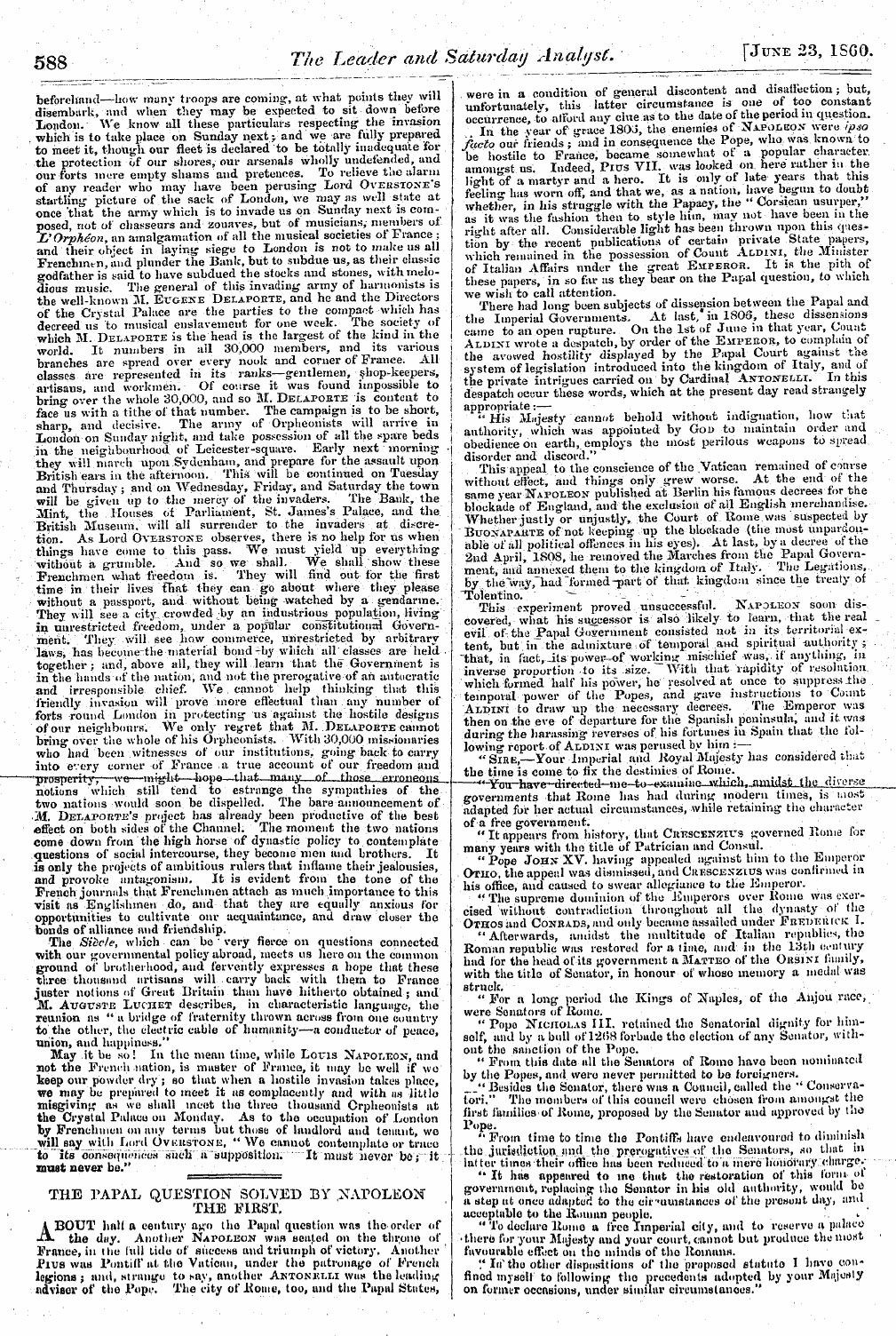
beforehand—how many troops are coming , at what points they will disembark , and when " they may be expected to sit down before "London . We know all these ' ¦ particulars respecting the invasion which is to take place on Sunday next ; and we are fully prepared to meet it , though our fleet is declared to be ¦ totally inadequate for the protection of our shores , our arsenals wholly undefended , and our forts mere empty shams and pretences . To relieve the alarm of any reader who may have been perusing- Lord Oveksto > 'e ' s startling ' picture of . the sack of London , we may as well state at once that the army which is to invade us on Sunday next is composed , not of chasseurs and zouaves , but of musicians , members of L'Orpheon , an amalgamation of all the musical societies of Fiance : and their object in laying siege to London is not to make us all
Frenchmen , and plunder the Bank , but to subdue us , as their classic godfather is said to have subdued the stocks and stones , with melodious music . The general of this invading army of harmonists is the well-known HI . Epgbke Delapokte , and he and the Directors of the Crystal Palace are the parties to the compact which has decreed us to musical enslavement for one week . The society of which M . Delapoete is the head is the largest of the kind in the world . It numbers in all 30 , 000 members , and its various branches are spread over every nook and corner of France . Ail classes are represented in its ranks—gentlemen , shop-keepers , artisansand workmen . - Of course it was found impossible to
, bring over the whole " 30 , 000 , and so M . Delapokte is content to face us with a tithe of that number . The campaign is to be short , sharp , and decisive . The army of ¦ Orph . eonhsts will arrive in London on Sunday night , and take possession of . all the spare beds in the neighbourhood of Leicester-square . Early next morning they will march iipon Sydeiiham , and prepare for the assault upon British ears in the afternoon . ThisTwill be continued on Tuesday and Thursday ; and on Wednesday , Friday , and Saturday the town wilt be given tip to the mercy of the invaders . The Bank , the Mint ,, the Houses of Parliament , St . James ' s Palace , and the British Museum , will all surrender to the invadersat
discretion . As Lord Ovebstoxe observes , there is no help for us when tilings have come to this pass . We . .. must yield up everything without a grumble . And so we shall . We shall show these Frenchmen what freedom is . They will find out for the first time in their lives ' { Tint they can go about where they please without a passport , and without being watched by a gendarme They will see a city ; crowded / by an industrious population , living in unrestricted freedom , under a popular constitutional Government * - ' . 'They ; - - \ vill . see . li . o . w commerce , unrestricted by arbitrary law Si hag become ^ the material bond - ^ by which all classes are held together ; and , above all , they will learn that the Government is in the 'bunds <> f tlte nation , and not the prerogative of ah autocratic and irresponsible chief . We cannot help thinking that this friendly invasion will provei ' . more effectual than any number of forts round London in protecting us against the hostile designs of our neighbours . - We only regret that M . Delapoete cannot
bring over the whole of his Orpheonists . With 30 , 000 missionaries who had been witnesses of our institutions , going back to carry into every corner of France a true account of our freedom and — "pTOspeTityT—we— -m-Jgflit—hope—Xhat ^ -maiLy ., —of . —tliose __ £ ixaneQjja notions " which still tend to estrange the sympathies of the two nations would soon be dispelled . The bare announcement of ill . Dexaportu ' s project has already been productive of the best effect on both sides of the Channel . The moment the two nations come down from the high horse of dynastic policy to contemplate questions of social intercourse , they become men and brothers . It is only the projects of ambitious rulers that inflame their jealousies , and provoke antagonism . It is evident from the tone of the French journals that Frenchmen attach as much importance to this visit as Englishmen do , and that they are equally anxious for opportunities to cultivate our acquaintance , and draw closer the bonds of alliance and friendship . .
The Sihcle , which can be ' very fierce on questions connected with our governmental policy abroad , meets us here on the common ground . of brotherhood , aud fervently expresses a hope that these three thousand artisans will , . carry . back with them to France juster notions of Great Britain than have hitherto obtained ; and M , Auguste Lucjiet describes , in characteristic language , the reunion as " a bridge of fraternity thrown across from one country to the other , the electric cable of humanity—a conductor of peace , union , and happiness . "
May it be so ! In the mean tune , while Lotus Napoleon , and not the French nation , is muster of liYiniee , it may bo well if we keep our powder dry ; so that when a hostile invasion takes place , we may be prepared to meet it us complacently and with us ¦ liLt ' lo misgiving as we ( shall meet the three thousand Orpheonists at the Crystal Palace- on Monday . As to the occupation of London by French 11 icn on any terms but those of landlord und tenant , wo will say with Lord Ovkustone , " Wo oiumot contemplate or trace to its boriKeqVio [ i (;( js siicli a " supposition . It must Jlevor bo ; it must never be . "
538 The Leader And Saturday Analyst. [Ju...
538 The Leader and Saturday Analyst . [ June 23 , 1 S 6 Q .
The Papal Question Solved By Napoleon Th...
THE PAPAL QUESTION SOLVED BY NAPOLEON THE FIRST , ABOUT half a century ago the Papal question was the order of the dny . Another Napoleon whs seated on the thr , otiu of Prance , in the lull tide of success and triumph of victory . Another Pius was Pontiff ut . the Vatican , under the patronage of French legions ; and , strungo to hay , another Antonelli wuh the lending udvisor of the Popr . The city of Home , too , und the Pupul fStntcw ,
were in a condition of general discontent and disaffection ; but , unibrtunatelv , this latter circumstance is one of too constant occurrence , to afford any clue as to the date of the period in question . In the vear of grace 180 o , the enemies of Napoleon- were ipso facto our fiiends ; ' and in consequence the Pope , who was known to be hostile to France , became somewhat of a popular character . amongst us . Indeed , Pius VII . was looked on here rather in . the Ho-bt of a martyr and a hero . It is only of late years that this feelin < - has worn off , and that we , as a nation , have begun to doubt whether , in his struggle with the Papacy , the " Corsican usurper , ' as it was the fashion then to style him , may not have been m the ri « -ht aftor all . Considerable light has been thrown upon this question by the recent publications of certain private State papers , which remained in the possession of Count Aldixi , the Minister of Italian Affairs under the great Eaiperor . It is the pith of these papers , in so far as they bear on the Papal question , to which
we wish to call attention . There had long been subjects of dissension between the Papal and the Imperial Governments . At last , in 1806 , these dissensions came to an open rupture . On the 1 st of June in that year , Count Aldixi wrote a despatch , by order of the Empeeok , to complain , of the avowed hostility displayed by the Papal Court against the system of legislation introduced into the kingdom of Italy , and of the private intrigues carried on by Cardinal AsrTOJfEfcLi . In this despatch occur these words , which at the present day read strang-ely appropriate : — , " His Majesty cannot behold without indignation , how tnat authority , which was appointed by God -to ' maintain order und obedience on earth , employs the most perilous weapons to spread disorder and discord . "
This appeal to the conscience of the Vatican remained of course without effect , and things only grew worse . At the end of the same year Napoleon published at Berlin his famous decrees - for the blockade of England , and the exclusion of all English-merchandise Whether justly or unjustly ,, the Court of Rome was suspected by BtTO ^ APAiiTE of not keeping up the blockade ( the most unpardonable of all political -offence ' s i" his eyes ) . At last , by a decree' of the 2 nd April , 1808 , he ¦ . removed the Marches from the Pap ; il Government / and annexed them to the kingdom of Italy . The Legations , by the \ % Viiy , " had *" fbrinedT ) art of that kingdom since the treaty of "T olentino . ~~ - - ' .:
This experiment proved unsuccessful . Napoleon" soon discovered , what his successor is also likely to learn , that the real evil of-the Papal Government consisted not in its territorial extent , but in the admixture of teniporal and spiritual authority ; that , in fact ,-its powei ~ ofworking mischief wus if anything , m inverse proportion -to its size . With that rapidity of res . olntio . which formed half his power , he resolved at once to suppressihe temporal power of the Popes , and gave instructions to Count Ai / piNl to draw up the necessary decrees . The Emperor was then on the eve of departure for the Spanish peninsula ; and it was during the harassing reverses ' of . his fortunes in Spain that the following report of Aldixi was perused by him : — "Sire , —Your Imperial . and- Royal Majesty has considered that the time is come to fix the destinies of Borne . - ^^^ n ^ aT ^^^^^''^^^"^ - ^ > - ^^»» J » P--iviiiiCli . amidst the diverge
governments that Rome has had during modern times , is nicsfc adapted for her actual circumstances , while retaining the character of a free government . " It appears from hisfory , that Cukscenzius governed ltonie lor many years with tho title of Patrician and Consul . "Pope JOHN XV . having appealed against him to the Emperor Otho , the appeal was dismissed , and Crkscicxzius was confirmed in his office , and caused to swear allegiance to the Emperor . "The supreme dominion of the Emperors over Rome was exercised without contradiction throughout all the dynasty of the OTHO 9 and Conrads , und only became assailed under FREmcuieic I . "Afterwards , amidst the multitude of Italian republics , tho Roman republic was restored for a time , and in tho 13 th Ci-mury had lor the head of its government a Ma . tteo of the Oksini family . with the title of Senator , in honour of whose memory a medal-was struck . ,. . '¦¦ . ' .
"For a long period the Kings of Naples , of the Ahjou race , were Senators of Rome . "Pope Nicholas III . retained tho Senatorial dignity for himself , and by a bull of 12 ( 58 forbade tho election of any Senator , without tho saihction of the Pope . " From this date all the Senators of Rome have been nominated by the Popes , and were never permitted to be foreigners . " Besides the Sonator , there was a Council , called the " Consorvatori . " Tho members of this council wero chosen from amongst the first families'of Home , proposed by tho Senator and approved by the l ' ope .
. ... " From time to time the Pontiffs have endeavoured to diminish the jurisdiction ami ..... the prerogativort of the Senators , . so that in latter times their office has been reduced toi'ii mereTlioiiorjiry . ( tbiirgfe ; . "It has appeared to me thut tho rcntoration of this form ol government , replacing tho Senator in his old authority , would be a step at once adapted to tho cir'uuistunces ol' tho present day , nml acceptable to the Roman people . ' . " To declare Rome a free Imperial city , and to reserve u palace there for your Miy « . sty and your court , cannot but pruduce the moat favourable effect on the minds of tho Romans .
\* In tho other dispositions of tho proposed stiititto I have confined rnyaoU to following tho precedent adopted by your Mnjonly on former occasions , under Biinilar circumstances . "
-
-
Citation
-
Leader (1850-1860), June 23, 1860, page 8, in the Nineteenth-Century Serials Edition (2008; 2018) ncse.ac.uk/periodicals/l/issues/cld_23061860/page/8/
-