On this page
-
Text (3)
-

Untitled Article
-

Untitled Article
-

Untitled Article
Note: This text has been automatically extracted via Optical Character Recognition (OCR) software. The text has not been manually corrected and should not be relied on to be an accurate representation of the item.
-
-
Transcript
-
Note: This text has been automatically extracted via Optical Character Recognition (OCR) software. The text has not been manually corrected and should not be relied on to be an accurate representation of the item.
Additionally, when viewing full transcripts, extracted text may not be in the same order as the original document.
Untitled Article
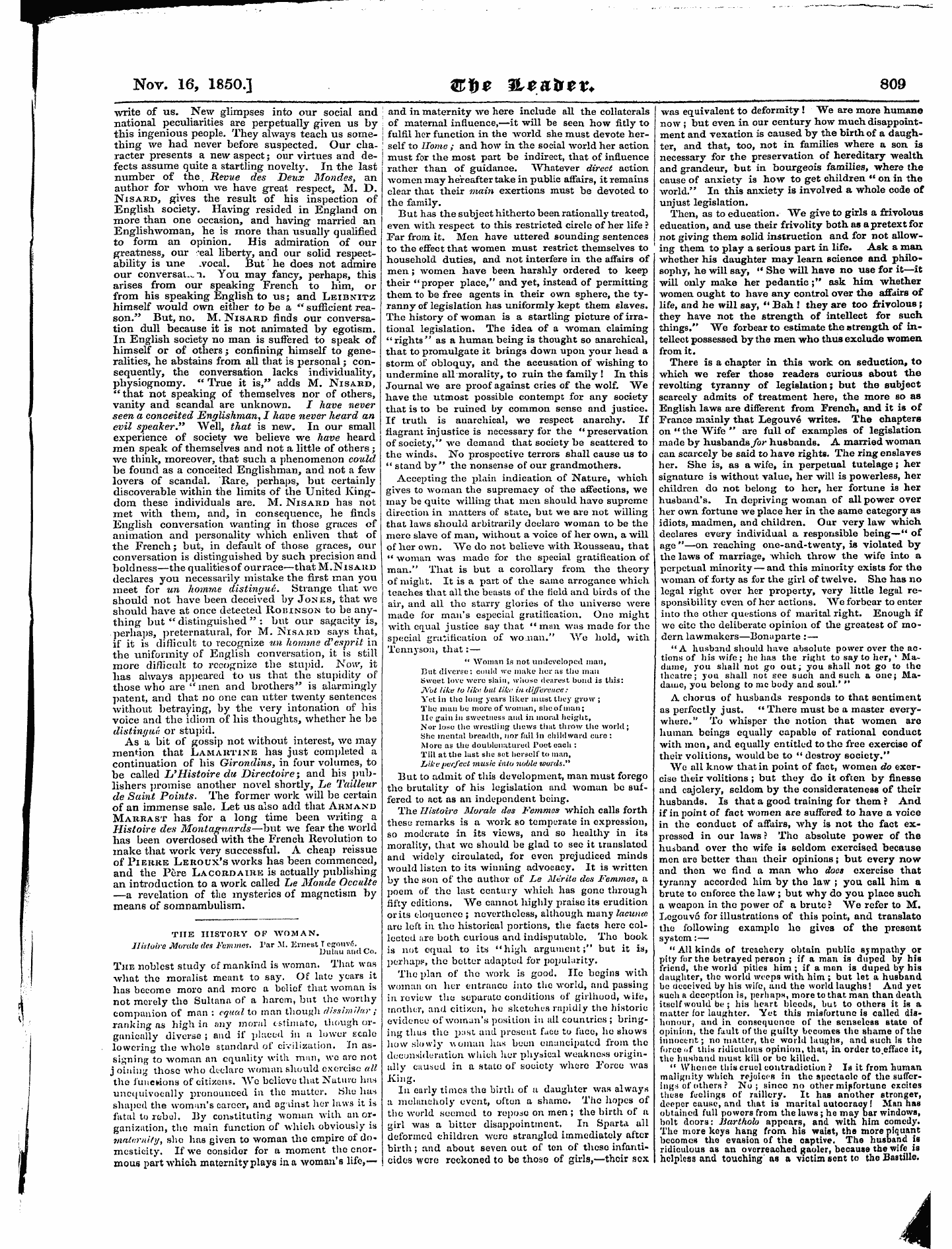
write of us . New glimpses into our social and national peculiarities are perpetually given us by this ingenious people . They always teach us something we had never before suspected . Our character presents a new aspect ; our virtues and defects assume quite a startling novelty . In the last number of the . Revue des Deux Mondes , an author for whom we have great respect , M . D . Nisabd , gives the result of his inspection of English society . Having resided in England on more than one occasion , and having married an
Englishwoman , he is more than usually qualified to form an opinion . His admiration of our greatness , our * eal liberty , and our solid respectability is une . vocal . But' he does not admire our conversat . v . i . You may fancy , perhaps , this arises from our speaking French to him , or from his speaking English to us ; and Leibnitz himself would own . either to be a " sufficient reason . " But , no . M . Nisard finds our conversation dull because it is not animated by egotism . In English society no man is suffered to speak of himself or of others ; confining himself to generalities , he abstains from all that is personal j
consequently , the conversation lacks individuality , physiognomy . " True it is , " adds M . Nisard , " that not speaking of themselves nor of others , vanity and scandal are unknown . J have never seen a conceited Englishman , I have never heard an evil speaker . " Well , that is new . In our small experience of society we believe we have heard men speak of themselves and not a little of others ; we think , moreover , that such a phenomenon could be found as a conceited Englishman , and not a few lovers of scandal . Rare , perhaps , but certainly discoverable within the limits of the United Kingdom these individuals are . M . Nisard has not
met with them , and , in consequence , he finds English conversation wanting in those graces of animation and personality which enliven that of the French ; but , in default of those graces , our conversation is distinguished by such precision and boldness—the qualities of our race—that M . Nisaud declares you necessarily mistake the first man you meet for un Jiomme distingue . Strange that we should not have been deceived by Jones , that we should have at once detected Robinson to be
anything but distinguished " : but our sagacity is , perhaps , preternatural , for M . Nisard says that , if it is difficult to recognize un homme d" esprit in the uniformity of English conversation , it is still more difficult to recognize the stupid . Now , it has always appeared to us that the stupidity of those who are " men and brothers" is alarmingly patent , and that no one can utter twenty sentences without betraying , by the very intonation of his voice and the idiom of his thoughts , whether he be distinaur . or stupid .
As a bit of gossip not without interest , we may mention that Lamautine has just completed a continuation of his Girondins , in four volumes , to be called L'Histoire du Directoire ; and his publishers promise another novel shortly , Le Tailleur de Saint Points . The former work will be certain of an immense sale . Let us also add that Arm and Maurast has for a long time been writing a Histoire des Montagnards—but we fear the world has been overdosed with the French Revolution to
make that work very successful . A cheap reissue of Pierre Leroux ' s works has been commenced , and the Pere Lacordaire is actually publishing an introduction to a work called Le Monde Occulte —a revelation of the mysteries of magnetism by means of somnambulism .
Untitled Article
THE HISTORY OF WOMAN . Jlhtoire Morale des Famines , l ' ar M . Ernest T esouvtf . Duluu aim Co . The noblest study cf mankind is woman . That was what the moralist meant to say . Of late years it has become more and more a belief that woman is not merely the Sultana of a harem , but the worthy companion of man ; equal to man though dissimilar ' , ranking as high in imy moral estimate , though organically diverse ; and if placed in a lower scale
lowering the whole standard of civilization . In assigning to woman an equality with man , we arc not j oining those who declare woman should exorcise all the functions of citizens . We believe that Nature has unequivocally pronounced in the mutter , She has shaped the woman ' s career , and ag-tinat her laws it is fatal to rebel . By constituting woman with an organization , the main function of which obviously is maternity , she has given to woman the empire of domesticity . If we considor for a moment the enormous part which maternity plays in a woman ' s life , —
and in maternity we here include all the collaterals of maternal influence , —it will be seen how fitly to fulfil her function in the world she must devote herself to Home ; and how in . the social world her action must for the most part be indirect , that of influence rather than of guidance . Whatever direct action women may hereafter take in public affairs , it remains clear that their main exertions must be devoted to the family . But has the subject hitherto been rationally treated , even with respect to this restricted circle of her life ? Far from it . Men have uttered sounding sentences to the effect that women must restrict themselves to household duties , and not interfere in the affairs of men ; women have been harshly ordered to keep their " proper place , " and yet , instead of permitting them to be free agents in their own sphere , the tyranny of legislation has uniformly kept them slaves . The history of woman is a startling picture of irrational legislation . The idea of a woman claiming " rights" as a human being is thought so anarchical , that to promulgate it brings down upon your head a storm of obloquy , and the accusation of wishing to undermine air morality , to ruin the family ! In . this Journal we are proof against cries of the wolf . We have the utmost possible contempt for any society that is to be ruined by common sense and justice . If truth is anarchical , we respect anarchy . If flagrant injustice is necessary for the " preservation of society , " we demand that society be scattered to the winds . No prospective terrors shall cause us to " stand by" the nonsense of our grandmothers . Accepting the plain indication of Nature , which gives to woman the supremacy of the affections , we may be quite willing that men should have supreme direction in matters of state , but we are not willing that laws should arbitrarily declare woman to be the mere slave of man , without a voice of her own , a will of her own . We do not believe with Housseau , that
" woman was made for the special gratification of man . " That is but a corollary from the theory of might . It is a part of the same arrogance which teaches that all the beasts of the field and birds of the air , and all the starry glories of the universe were made for man ' s especial gratification . One might with equal justice say that " man was made for the special gratification of wo nan . " We hold , with Tennyson , that : — " Woman is not undeveloped man , But diverse : could we make her as tlie man Sweet love wei'e slain , whose dearest bond is this : J \'' ul like to tiki ' - but like in difference : Yut in the lon-j years liker must they grow ; The man be more of woman , sheofman ; He gain in sweetness and in moral height , Nor lose the wrestling thews thitt throw the world ; She mental breadth , nor fail in child ward care : More as the doublenaturecl Poet each : Till at the last she set herself to man , Like perfect music into noble words . "
But to admit of this development , man must forego the brutality of his legislation and woman be suffered to act as an independent being . The Histoire Morale des Femmes which calls forth these remarks is a work ao temperate in expression , so moderate in its views , and so healthy in its morality , that we should be glad to sec it translated and widely circulated , for even prejudiced minds
would listen to its winning advocacy . It is written by the son of the author of Le Merita des Femmes , a poem of the last century which has gone through fifty editions . We cannot highly praise its erudition or its eloquence ; nevertheless , although many lacunto aro loft iu the historical portions , the facts hero collected are both curious and indisputable . The book is not equal to its "high , argument ; " but it is , perhaps , the bettor adapted for popularity .
The plan of the work is good . lie begins with woman on her entrance into the world , and passing in review the separate conditions of girlhood , wife , mother , and citizen , ho sketches rapidly the historic evidence of woman's position in all countries ; bringing thus the i >; tst and present face to face , ho shows how slowly woman has been emancipated from the decunsideration which her physical weakness originally caused in a state of society whore Force was King .
In early times the birth of a daughter was always a melancholy event , often a shame . The hopes of the world seemed to repose on men ; the birth of a girl was a bitter disapjjointment . In Sparta all deformed children were strangled immediately after birth ; and about seven out of ten of these infanticides were reckoned to be those of girls , —their sex
Untitled Article
was equivalent to deformity ! We are more humane now ; but even in our century how much disappointment and vexation is caused by the birth of a daughter , and that , too , not in families where a son is necessary for the preservation of hereditary wealth and grandeur , but in bourgeois families , where the cause of anxiety is how to get children " on in the world . " In this anxiety is involved a whole code of unjust legislation .
Then , as to education . We give to girls a frivolous education , and use their frivolity both as a pretext for not giving them solid instruction and for not allowing them to play a serious part in life . Ask a man whether his daughter may learn science and philosophy , he will say , •« She will have no use for it—it will only make her pedantic ; " ask him , whether women ought to have any control over the affairs of life , and he will say , " Bah ! they are too frivolous ; they have not the strength of intellect for such things . " We forbear to estimate the strength of intellect possessed by the men who thus exclude women from
it-There is a chapter in this work on seduction , to which we refer those readers curious about the revolting tyranny of legislation ; but the subject scarcely admits of treatment here , the more so as English laws are different from French , and it is of France mainly that Legouve writes . The chapters on the Wife " are full of examples of legislation made by husbands for husbands . A married woman can scarcely be said to have rights . The ring enslaves her . She is , as a wife , in perpetual tutelage ; her signature is without value , her will is powerless , her children do not belong to her , her fortune is her
husband ' s . In depriving woman of all power over her own fortune we place her in the same category as idiots , madmen , and children . Our very law which declares every individual a responsible being— " age "—on reaching one-and-twenty , is violated by the laws of marriage , which throw the wife into a perpetual minority—and this minority exists for the woman of forty as for the girl of twelve . She has no legal right over her property , very little legal responsibility even of her actions . We forbear to enter into the other questions of marital right . Enough if we cite the deliberate opinion of the greatest of modern lawmakers—Bonaparte : —
"A husband should have absolute power over the actions of his wife ; he has the right to say to her , ' Madame , you shall not go out ; you shall not go to the theatre ; you shall not see such and such a one ; Madame , you belong to me body and soul . ' " A chorus of husbands responds to that sentiment as perfectly just . " There must be a master everywhere . " To whisper the notion that women are human beings equally capable of rational conduct with men , and equally entitled to the free exercise of their volitions , would be to ?• destroy society . "
We all know that in point of fact , women do exercise their volitions ; but they do it often by finesse and cajolery , seldom by the considcrateness of their husbands . Is that a good training for them ? And if in point of fact women are suffered to have a voice in the conduct of affairs , why is not the fact expressed in our laws ? The absolute power of the husband over the wife is seldom exercised because men are better than their opinions ; but every now and then wo find a man who docs exercise that
tyranny accorded lnm by the law ; you call him a brute to enforce the law ; but why do you place such a weapon in the power of a brute ? We refer to M . Legouve for illustrations of this point , and translate the following example he gives of the present system : — " All kinds of treachery obtain public sympathy or pity for the betrayed person ; if a man is duped by his friend , the world pities him ; if a man is duped by his daughter , the world weeps with him ; but let a husband
be ueceived by his wife , and the world , laughs ! And yet such a deception is , perhaps , more to that man than death itself would be ; his heart bleeds , but to others it is a matter for laughter . Yut this misfortune is called dishonour , and in consequence ! of the senseless state of opinion , the fault of the guilty becomes the shame of the innocent ; no matter , the world laughs , and such is the force << f this ridiculous opinion , that , in order to efface it , the husband must kill or be killed .
" whence this cruel contradiction ? la it from human malignity which rejoices in the spectacle of the sufferings of others ? No ; since no other mi s fortune excites these feelings of raillery . It has another stronger , deeper cause , and that is marital autocracy ! Man has obtained full powers from the laws ; he may bar windows , bolt doors : Jiartholo appears , and with him comedy . The more keys hang from , his waist , the more piquant becomes the evasion of the captive . The husband is ridiculous as an overreached gaoler , because the wife is helpless and touching as a victim sent to the Bastille .
Untitled Article
Nov . 16 , 1850 . ] &t ) e 3 leaiitV + 809
-
-
Citation
-
Leader (1850-1860), Nov. 16, 1850, page 809, in the Nineteenth-Century Serials Edition (2008; 2018) ncse.ac.uk/periodicals/l/issues/vm2-ncseproduct1859/page/17/
-