On this page
-
Text (1)
-

Untitled Article
Note: This text has been automatically extracted via Optical Character Recognition (OCR) software. The text has not been manually corrected and should not be relied on to be an accurate representation of the item.
-
-
Transcript
-
Note: This text has been automatically extracted via Optical Character Recognition (OCR) software. The text has not been manually corrected and should not be relied on to be an accurate representation of the item.
Additionally, when viewing full transcripts, extracted text may not be in the same order as the original document.
Untitled Article
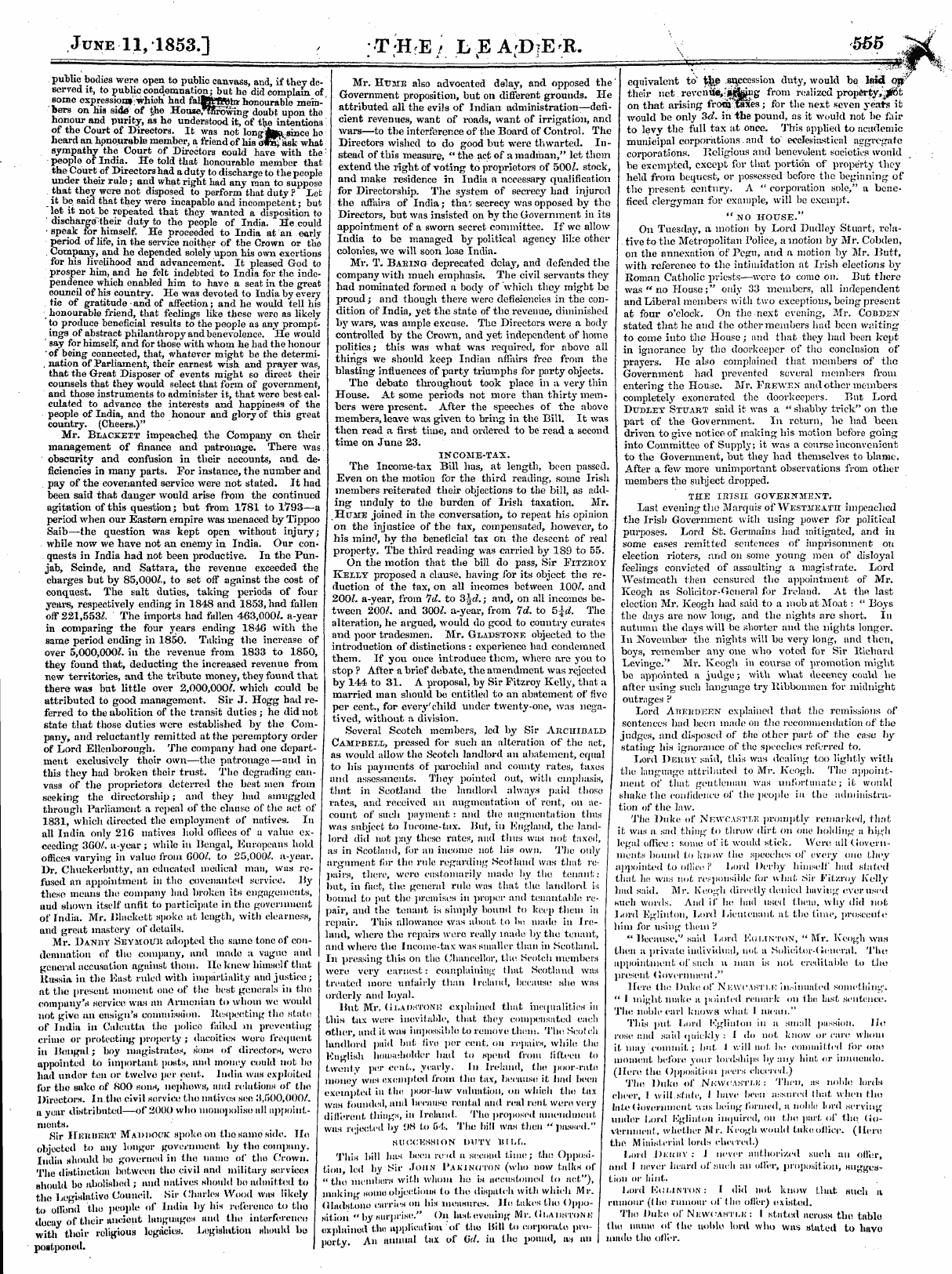
public bodies were open to public canvass , and , if they deserved it , to public condemnation ; but he did complain of some expression : whioh had falMW » Jm- honourable members on his site of the House * tnrbwing doub t upon the honour and purity , as ho understoo d it , of tb . e intentions of the Court of Directors . It was not long-jjte ^ since ho heard an honourable member , a friend of his ofSpisk what sympathy the Court of Directors could have with the people of India . He told that honourable member that the Court of Directors had a duty to discharge to the people under their rule ; and what right had any man to suppose that they were not disposed to perform that duty ? Lot
it be said that they were incapable and incompetent ; but let it not be repeated that they wanted a disposition to discharge ' their duty to the people of India . He could speak for himself . He proceeded to India at an early period of life , in the service neither of the Crown or the Company , and he depended solely upon his own exertions for his livelihood and advancement . It pleased God to prosper him , and he felt indebted to India for the independence which enabled him to have a seat in the great council of his country . He was devoted to India by every tie of gratitude ¦ and of affection ; and he would tell his
honourable friend , that feelings like these were as likely to produce beneficial results to the people as any promptings of abstract philanthropy and benevolence . He would say for himself , and for those with whom he had the honour of being connected , that , whatever might be the determination of Parliament , their earnest wish and prayer was , that the Great Disposer of events might so direct their counsels that they would select that form of government , and those instruments to administer it , that were best calculated to advance the interests and happiness of the people of India , and the honour and glory of this great country . ( Cheers . )"
Mr . Blackett . impeached the Company on their management of finance and patronage . There was obscurity and confusion in their accounts , and deficiencies in many parts . For instance , the number and pay of the covenanted service were not stated . It had been said that danger would arise from the continued agitation of this question ; but from 1781 to 1793—a period when our Eastern empire was menaced by Tippoo Saib—the question was kept open without injury ; while now we have not an enemy in India . Our conquests in India had not been productive . In the Punjab , Scinde , and Sattara , the revenue exceeded the
charges but by 85 , 000 / ., to set off against the cost of conquest . The salt duties , taking periods of four years , respectively ending in 1848 and 1853 , had fallen off 221 . 553 J . The imports had fallen 463 , 000 / . a-year in comparing the four years ending 1846 with the same period ending in 1850 . Taking the increase of over 5 , 000 , 000 / . in the revenue from 1833 to 1850 , they found that , deducting the increased revenue from new territories , and the tribute money , they found that there was but little over 2 , 000 , 000 / . which could be attributed to good management . Sir J . Hogg had referred to the abolition of the transit duties : he did not
state that those duties were established by the Company , and reluctantly remitted at the peremptory ordei of Lord Ellenborough . The company had one department exclusively their own—the patronage—and in this they had broken their trust . The degrading canvass of the proprietors deterred the best men from seeking the directorship ; and they hud smuggled through Parliament a repeal of the clause of the act of 1831 , which directed the employment of natives . In
all India only 216 natives hold offices of a value exceeding 360 / . a-year ; while in Bengal , Europeans hold offices varying in value from 600 / . to 25 , 000 / . n-yoar . Dr . Chuckerbutty , an educated medical man , was refused nn appointment in the covenanted service . By these means the company hud broken its engagements , and shown itself unfit to participate in the government of India . Mr . Bluokett spoke at length , with clearness , and great mastery of details .
Mr . Danby Seymouh adopted the same tone of condemnation of tho company , and made a vague and general accusution against them . He knew himself that Russia in the East ruled with impartiality and justice ; at tho present moment one of the best generals in the company ' s service was un Armenian to whom we would not givo an ensign ' s commission . Inspecting the state of India in Calcutta tho polico failed m preventing crime or protecting- property ; dacoities wore frequent in Bengal ; boy magistrates , sons of directors , were appointed to important posts , and money could not bo had undor ten or twelve per cent , India was exploited for tho sake of 800 sons , nephews , and relations of tho Directors . In the civil service the natives see 3 , 500 , 000 / .
a year distributed—of 200 O who monopolise all appointments . Sir Hewjeht Maddook spoke on tho saino side . lit ) objected to any longer government by tho company . India should bo governed in the name of tho Crown . Tho distinction between tho civil and military services should | > 0 abolished ; and natives should be admitted to tho Legislative Council . Sir Charles Wood was likely to oilbnd the people of India by his reference to tho decay of their undent languages and the interference with thoir religious legacies . Legislation should bo postponed .
Mr . Hume also advocated delay , and opposed the Government proposition , but on different grounds . He attributed all the evils of Indian administration—deficient revenues , want of roads , want of irrigation , and wars—to the interference of the Board of Control . The Directors wished to do good but were thwarted . Instead of this measure * " the act of a madman , " let them extend the right of voting to proprietors of 500 Z . stock , and make residence in India a necessary qualification for Directorship . The system of secrecy had injured the affairs of India ; tha ; secrecy was opposed by the Directors , but was insisted on by the Government in its appointment of a sworn secret committee . If we allow India to be managed by political agency like other colonies , we will soon lose India .
Mr . T . Baring deprecated delay , and defended the company with much emphasis . The civil servants they had nominated formed a body of Which they might be proud ; and though there were deficiencies in the condition of India , yet the state of the revenue , diminished by wars , was ample excuse . The Directors were a body controlled by the Crown , and yet independent of home politics ; this was what was required , for above all things we should keep Indian affairs free from the blasting influences of party triumphs for party objects .
The debate throughout took place in a very thin House . At some periods not more than thirty members were present . After the speeches of the above members , leave was given to bring in the Bill . It was then read a first time , and ordered to be read a second time on June 23 .
INCOME-TAX . The Income-tax Bill has , at length , been passed . Even on the motion for the third reading , some Irish members reiterated their objections to the bill , as . add ing unduly to the burden of Irish taxation . Mr . Hume joined in the conversation , to repeat his opinion on the injustice of the tax , compensated , however , to his mind , by the beneficial tax on the descent of real property . The third reading was carried by 189 to 55 . On the motion that the bill do pass , Sir Fitzkoy Kelly proposed a clause , having for its object the
reduction of the tax , on all incomes between 100 / . and 200 / . a-year , from 7 d . to 3 § eZ . ; and , on all incomes between 200 / . and 300 Z . a-year , from 7 d . to 5 ± d . The alteration , he argued , would do good to country curates and poor tradesmen . Mr . Gladstone objected to the introduction of distinctions : experience had condemned them . If you once introduce them , where are you to stop ? After a brief debate , the amendment was rejected by 144 to 31 . A proposal , by Sir Fitzroy Kelly , that a married man should be entitled to an abatement of five per cent ., for every ' child under twenty-one , was negatived , without a division .
Several Scotch members , led by Sir Archibald Campbell , pressed for such an alteration of the act , as would allow the Scotch landlord an abatement , equal to his payments of parochial and county rates , taxes and assessments . They pointed out , with emphasis , that in Scotland the landlord always paid those rates , and received an augmentation of rent , on account of such payment : and the augmentation thus was subject to Income-tux . But , in England , the landlord did not pay these rates , and thus was not taxed , as in Scotland , for an income not his own . The only
argument for the rule regarding Scotland was that repuirs , there , wore customarily made by the tenant but , in fact , the general rule was that the landlord is bound to put the premises in proper and tenantablc repair , and the tenant is simply bound to keep them in repair . This allowance was about to he made ; in Ireland , where the repairs were really made by the tenant ,, and where the Income-tax was smaller than in Scotland . In pressing this on the Chancellor , the Scotch members were very earnest : complaining that Scotland wan treated more unfairly than Ireland , because she was orderly nnd loyal .
But Mr . Gladstone explained that inequalities in this tax were inevitable , that they compensated each other , and it was impossible to remove them . The Scotch landlord paid but fivo per cent , on repairs , while the English householder had to upend from fifteen to twenty P ( 11 > cent ., yearly . In Ireland , the poor-rate money was exempted from the tax , because it had been exempted in tho poor-law valuation , on which the tax was founded , and because rental and real rent were very dillerent , tilings , in Ireland . Tho proposed amendment wns rejected l > y i ) H to 54 . The bill was then " passed . " SUCCKSHION DUTY HILX .
This bill has been rend a second time ; tho Opposition led by Sir John I ' akinuton ( who now talks of " the mcinbors vviMi whom ho is accustomed to act" ) , making sonio objections to the dispatch with which Mr . ( jhulst . ono carries on hi . s measures . Ho lakes tho Opposition " by surprise . " On last evening Mr . GliA ' DMTONK explained fchi > application of tho Bill to corporate proporty . An annual tax of 0 d . in tho pound , an an
equivalent to" 1 s 3 bjp . succession duty , would be laid Ql * their net revcinfefl |^ wug from realized propertyy ^ t on that arising froro taxes ; for the next seven yeats it would be only 3 d . in ihe pound , as it would not be fair to levy the full tax at once . This applied to academic municipal corporations . and to ecclesiastical aggregate corporations . Religious and benevolent societies would be exempted , except for that portion of property they held from bequest , or possessed before the beginning of the present century . A " corporation sole , " a beneficecl clergyman for example , will be exempt . " NO HOUSE . "
On Tuesday , a motion by Lord Dudley Stuart , relative to the Metropolitan Police , a motion by Mr . Cobden , on the annexation of Pegu , and a motion by Mr . Butt , with reference to the intimidation at Irish elections by Roman Catholic priests—were to come on . But there was no House ; " only 33 members , all independent and Liberal members with two exceptions , being present at four o ' clock . On the next evening , Mr . Cobden stated that he and the other members had been waiting to come into the House ; and that they had been kept in ignorance by the doorkeeper of the conclusion of
prayers . He also complained that members of the Government had prevented several members from entering the House . Mr . Prewex and other members completely exonerated the doorkeepers . But Lord Dudley Stuart said it was a " shabby trick" on the part of the Government . In return , lie had been driven to give notice of making his motion before going into Committee of Supply ; it was a course inconvenient to the Government , but they had themselves to blame . After a few more unimportant observations from other members the subject dropped .
THE IRISH GOVEKN 3 IEXT . Last evening the Marquis of Westhieatit impeached the Irish Government with using power for political purposes . Lord St . Germains had mitigated , and in some cases remitted sentences of imprisonment on election rioters , nnd on some young" men of disloyal feelings convicted of assaulting a magistrate . Lord Westmeath then censured the appointment of Mr . Keogh as Solicitor-General for Ireland . At the last
election Mr . Keogh had said to a mob at Moat : " Boys the days are now long , and the nights are short . In autumn the days will be shorter and the nights longer . In November the nights will he very long , and then , boys , remember any one who voted for Sir Itichard Levinge . " Mr . Kcogh in course of promotion might "be appointed a judge ; with what decency could he after using such language try llihbonmcn for midnight outrasres ?
Lord Aberdeen explained that the remissions of sentences had been made on the recommendation of the judges , and disposed of the other part of the case by stating his ignorance of the speeches referred to . Lord Dehby said , this was dealing too lightly with the language attributed to Mr . Keogh . The appointment of that gentleman was unfortunate ; it would shake the confidence of the people in the administration of the law .
The Duke of Newcastle promptly remarked , that it was ji sad thing to throw dirt on one holding a ln ' gli legal office : Koine of it would stick . Wen ; all Governments IjouihI to know the speeches of every one they appointed to oflice ? Lord Derby himself had slated that he was not responsible for what ; Sir Fitzroy Kelly had said . Mr . Keogh directly denied having overused Mich words . And if he had used them , why did not Lord Kglinton , Lord Lieutenant at the time , prosecute him for using them ? " Because , " said Lord Kwunton , " Mr . Keogh was then a private individual , not a Solicitor-General . The appointment of such u man is not creditable to tho present Government . " Here the Duke of Nkwcaktmo insinuated soinefliinir .
" I might make a pointed remark on tho last sentence The noble carl knows what I mean . " This put Lord Kglinton in a small passion . lit rose i ' . nd said quickly : I do not know or care whom it may ' commit , ; but , I will not 1 >»; committed for one moment before your lordships by any hint or innuendo . ( Here tho Opposition peers cheered . ) The Duke of Nkwcastik : Then , as noble lords cheer , I will . state , I have ; been assured that when the late Government -. v : is being formed , a nohlo lord serving under Lord Kglinton inquired , on the part of the Government , whether Mr . Keogh would Lake oilier . ( Here the Ministerial lords cheered . )
Lord Di-itnv : I never authorized such an ofl ' er , mid I never heard of such an ofl ' er , proposition , suggestion or hint . Lord IOumnton : I did not know that such a rumour ( the rumour of the oll ' er ) existed . The Duke of Nkwoahtuc : 1 stated across the table 1 . 1 m name of the noble lord who was stated to have mailo tho oiler .
Untitled Article
June 11 , 1853 . ] , . T ; HfE ; LEA DjER . ; 56 fr ^
-
-
Citation
-
Leader (1850-1860), June 11, 1853, page 555, in the Nineteenth-Century Serials Edition (2008; 2018) ncse.ac.uk/periodicals/l/issues/vm2-ncseproduct1990/page/3/
-