On this page
-
Text (2)
-

Untitled Article
-

Untitled Article
Note: This text has been automatically extracted via Optical Character Recognition (OCR) software. The text has not been manually corrected and should not be relied on to be an accurate representation of the item.
-
-
Transcript
-
Note: This text has been automatically extracted via Optical Character Recognition (OCR) software. The text has not been manually corrected and should not be relied on to be an accurate representation of the item.
Additionally, when viewing full transcripts, extracted text may not be in the same order as the original document.
Untitled Article
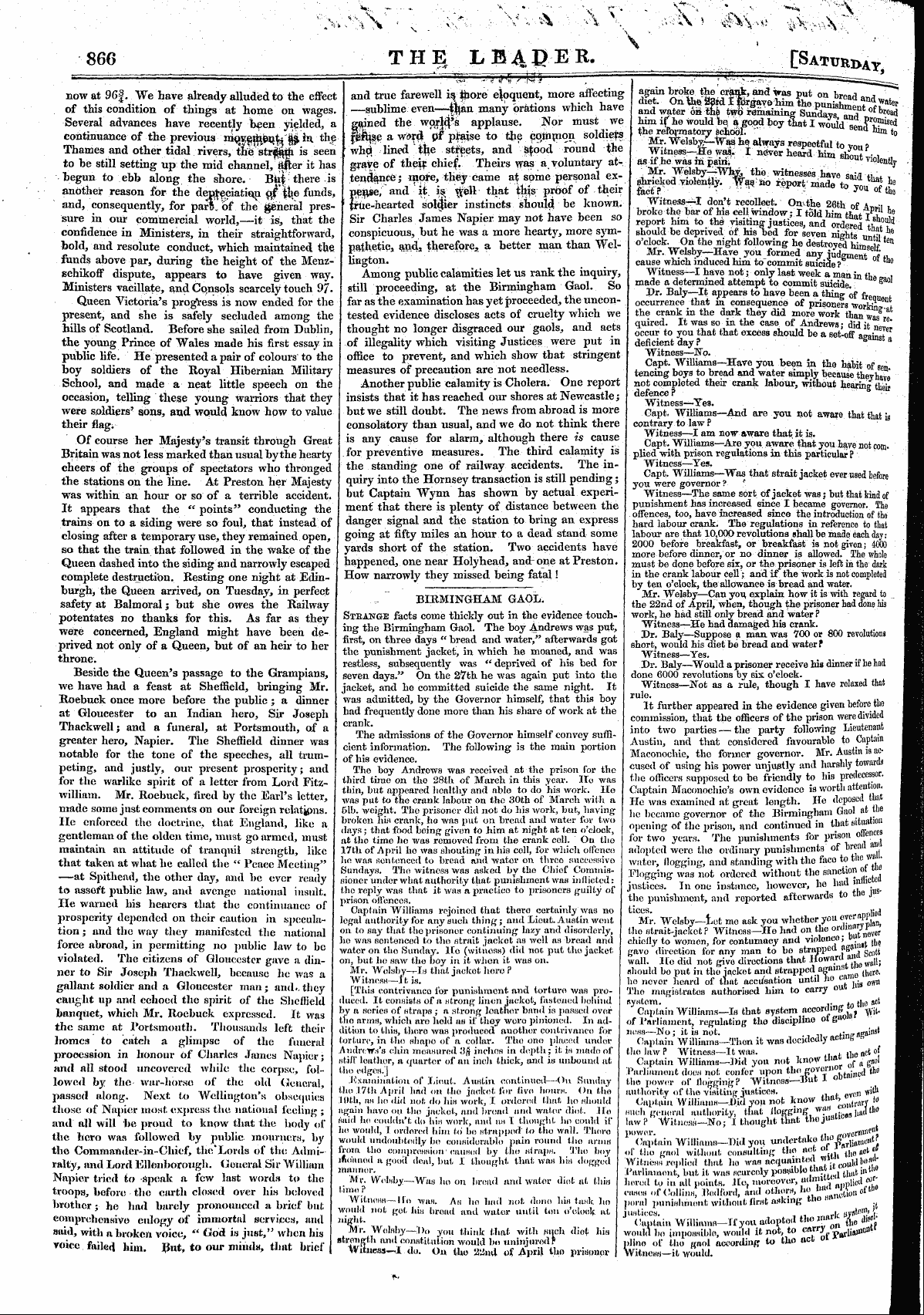
now at 96 f . We have already alluded to the effect of this condition of things at home on wages . Several advances have recently Ixeen yielded , a continuance of the previous nio ^ Q&fenti M H the Thames and other tidal rivers , tlfe Wr&ra ( i is seen to he still setting up the mid channel , ftfter it has begun to ebb along the shore . Btjf there is another reason for the depreciation $ \ he funds , and , consequently , for par ! of the general pressure in our commercial world , — -it is , that the confidence in Ministers , in their straightforward , bold , and resolute conduct , which maintained the
funds above par , during the height of the Menzschikoff dispute , appears to have given way . Ministers vacillate , andCqnsols scarcely touch 97 . Queen Victoria ' s progress is now ended for the present , and she is safely secluded among the hills of Scotland . Before she sailed from Dublin , the young Prince of Wales made his first essay in public life . He presented a pair of colours to the boy soldiers of the Royal Hibernian Military School , and made a neat little speech on the occasion , telling these young warriors that they were soldiers' sons , and would know how to value their flag ;
Of course her Majesty ' s transit through Great Britain was not less marked than usual by the hearty cheers of the groups of spectators who thronged the stations on the line . At Preston her Majesty was within an hour or so of a terrible accident . It appears that the " points" conducting the trains on to a siding were so foul , that instead of closing after a temporary use , they remained open ,
so that the train that followed in the Wake of the Queen dashed into the siding and narrowly escaped complete destruction . Resting one night at Edinburgh , the Queen arrived , on Tuesday , in perfect safety at Balmoral ; but she owes the Railway potentates no thanks for this . As far as they were concerned , England might have been deprived not only of a Queen , but of an heir to her throne .
Beside the Queen ' s passage to the Grampians , we have had a feast at Sheffield , bringing Mr . Roebuck once more before the public ; a dinner at Gloucester to an Indian hero , Sir Joseph Thackwellj and a funeral , at Portsmouth , of a greater hero , Napier . The Sheffield dinner was notable for the tone of the speeches , all trumpeting , and justly , our present prosperity ; and for the warlike spirit of a letter from Lord
Fitzwilliam . Mr . Roebuck , fired by the Earl ' s letter , made some just comments on our foreign relations . He enforced the doctrine , that England , like a gentleman of the olden time , must go armed , must maintain an attitude of tranquil strength , like that taken at what he called the " Peace Meeting " —at Spithead , the other day , and he ever ready to assert public law , and avenge national insult . He warned his hearers that the continuance of
prosperity depended on their caution in speculation ; and the way they manifested the national force abroad , in permitting no public law to be violated . The citizens of Gloucester gave a dinner to Sir Joseph Thackwell , because he was a gallant soldier and a Gloucester man ; and .. they caught up and echoed the spirit of the Sheffield banquet , which Mr . Roebuck expressed . It was the same at Portsmouth . Thousands left their
liomca to catch a glimpse of the funeral procession in honour of Oharles James Napier ; and all stood uncovered while the corpse , followed by the war-hor . se of the old ( Jencral , passed along . Next to Wellington ' s obsequies those of Nupier most express the national feeling ; and all will be proud to know that the body of the hero was followed by public mourner *) , by
the Commander-in-Chief , the Lords of the Admiralty , and Lord Ellenborough . General . Sir Willia m Napier tried to speak a few last word . * t <» the troops , before the earth closed over hiu beloved brother ; he had barely pronounced a brief but comprehensive eulopy of immortal services , and said , with a broken voice , " God is just , " when his voice failed him . But , to our niimla , that brief
and true farewell is / $ faore eloquent , more affecting —sublime '; even— -iflan many orations which have gained the wofrW's applause . Nor must we pltyse a wfcrcl 0 f praise to the common soldiers whd lined flfie . stifsets , and Sfood round the graVe of their , chief . Theirs was a voluntary attendance ; more , they came at some personal expense , and it . is ; $ ell that ihjs ; prdof of their irue-hearted soldier instincts should be known . Sir Charles James Napier may not have been so conspicuous , but he was a more hearty , more sympathetic , and a therefore , a better man . than Wellington . |
Among public calamities let us rank the inquiry , still proceeding , at the Birmingham Gaol . So far as the examination has yet proceeded , the uncontested evidence discloses acts of cruelty which we thought no longer disgraced our gaols , and acts of illegality which visiting Justices were put in office to prevent , and which show that stringent measures of precaution are not needless . Another public calamity is Cholera . One report insists that it has reached our shores at Newcastle ;
but we still doubt . The news from abroad is more consolatory than usual , and we do not think there is any cause for alarm , although there is cause for preventive measures . The third calamity is the standing one of railway accidents . The inquiry into the Hornsey transaction is still pending ; but Captain Wynn has shown by actual experiment that there is plenty of distance between the danger signal and the station to bring an express going at fifty miles an hour to a dead stand some yards short of the station . Two accidents have happened , one near Holyhead , ant one at Preston . How narrowly they missed being fatal !
Untitled Article
BIRMINGHAM GAOL . Steange facts come thickly out in the evidence -touching the Birmingham Gaol . The boy Andrews was put , first , on three days " bread and water / ' afterwards gat the punishment jacket , in which he moaned , and was restless , subsequently was " deprived of his bed for seven days . " On the 27 th he was again put into the jacket , and he committed suicide the same night . It was admitted , by the Governor himself , that this boy had frequently done more than his share of work at the crank . The admissions of the Governor himself convey sufficient information . The following is the main portion of his evidence .
The boy Andrews was received at the prison for the third time on tlio 28 tli of March in this year . Ho was thin , but appeared healthy and able to do hia work . ITo was put to the crank labour on the 30 th of March with a 51 b . weight . The prisoner did not do his work , but ; , having broken bis crank , ho was put on bread and water for two days ; that food being given to him at night at ten o ' clock , at the time ho was removed from the crank coll . On tho 17 th of April ho was shouting in his coll , for which offence ho waa sentenced to bread and water on three successive
Sundays . Tho witness was asked by tho Chief Commissioner under what authority that punishment was inflicted : tho reply was that it was n , practice to prisoners guilty of prison offences . Captain Williams rejoined that thoro certainly was no logal authority for any such thing ; and Lieut . Austin wont on to say that tho prisoner continuing lazy and disorderly , ho was sontoncod to tho strait jacket as well as broad and water on tho Sunday . Ho ( witness ) did not put tho jacket on , but ho saw tho boy in it when it was on . Mr . Wolaby—r-Is that jacket lioro ? " Witness—J ' t is .
[ Thin contrivance- for punishment and torture- was produced . It consists of a strong linen jackot , fastened hohind by a series of straps ; a strong leather band is passed over tho arms , which aro hold as if they wore pinioned . In addition to this , there was produced another contrivance for torture , in tho shape of a collar- Tho ono placed under A ndrfwa ' s chin measured 3 $ inches in depth ; it is made of stiff leather , a quarter of an inch thick , and is unbound at the edges . 1
Kxainmation of Lieut . Austin continued—On Sunday tho 17 th April hhd on tho jacket ; for five hours . On tho JOtli , as ho did not do his work , I ordered that ; ho should again have ou tho jacket , and broad and water diet ; . I To fiaid he couldn't do his work , and as I thought bo could ii he would , I ordered him to be strapped to tho wall . Thero would undoubtedly bo considerable pain round the arms from tho compression caused by tho straps . The boy mounod a good deal , but I thought that was bin dogged xruuinor .
M v , VVclnby— - Was ho on broad and water diet at this time ? WitnesH—llo wrh . As ho had not done his task ho would not got his broad and water until ton o ' clock at night . Mr . Wolsby—Do you think that with such diet his strength and constitution would bo uninjured F Witness— , 1 do . On tho 2 'JnU of April tho primmer
again broke the crank , and yr&s put on bread *~ a diet . On % e 23 * d ffrgavehim W puifcE ^ J *» and water on tty twfc > remaining Sundays knrl . * & him if he would be , a good boy that I would s&J ^^ the reformatory |< &ool . sena him to Mr . Welsbg-Wte halways reapectful to you ? Witness—He wail . I never heard him shout it i , as if he was m pain ; - ™ snout violentl y Mr . Welsby—Wfcr , the witnesses have saM « \ | biieked violently . . Ifa ^ ho report made to vou „)> fact r ¦ ¦ ¦¦ - . J u 0 I tae Witneas--I don't recollect . Onvthe 26 th of A « -i , broke the bar of his cell window : I told him « , „*?? viva . *; vuo i ™ w aho veu wuiuuw , X VJiXX Him taat T I
report him to the * visiting justices , and ordered thatT should be deprived of his bed for seven niehts nrin * o'clock . On the night following he destroy ed 43 teu Mr . Welsby—Have you formed any jud gment nf « . cause which induced him to commit suicide ? Witness—I have not ; only last week a man in the •» i made a determined attempt to commit suicide . Dr . Baly—It appears to have been a thing of fremiA f occurrence that in consequence of prisoners workmt t the crank in the dark they did more work than was . quired . It was so in the case of Andrews ; did it np occur to you that that excess should be a set-off arointf deficient day ? & a Witness—No .
Capt . Williams—Have you been m the habit of sen tencing boys to bread and water simply because they have not completed their crank labour , without iearin' / to defence ? , B WB Witness—Yea . Capt . Williams—And are you not aware that that ig contrary to law P Witness—I am now aware that it is . Capt . Williams—Are . you aware that you have not co © . plied with prison regulations in thisparticular ? Witness—Yes .
Capt . Williams—Was that strait jacket ever used before you were governor ? ' . Witness—The same sort of jacket was ; but that kind of punishment has increased since I became governor . The offences , too , have increased since the introduction of the hard labour crank . The regulations in reference to that labour are that 10 , 000 revolutions shall be made each , day : 2000 before breakfast , or breakfast is not given ; 4000 more before dinner , or no dinner is allowed . The whole must be done before six , or the prisoner is left in the dark
in the crank labour cell j . and if the work is not completed by ten o'clock , the allowance is bread and water . Mr . Welsby—Can you , explain how it is with regard to the 22 nd of April , when , though the prisoner had done Ms j work , he had still only bread and water P I Witness—He had damaged hia crank . Dr . Baly—Suppose a man waa 700 or 800 revolutions short , would his diet be bread and water f
Witness—Yes . Dr . Baly—Would a prisoner receive his dinner if he had done 6000 revolutions by six o ' clock-Witness—Not as a rule , though I have relaxed that rule . It further appeared in the evidence g iven before tho commission , that the officers of the prison were divided into two parties —the party following Lieutenant Austin , and that considered favourable to Captain Maconocbie , the former governor . Mr . Austin is
accused of using his power unjustly and harshly towards the officers supposed to be friendly to bis predecessor . Captain Maconochie ' s own evidence is worth attention . He was examined at great length . Ho deposed that he became governor of the Birmingham Gaol at the opening of the prison , and continued in that situation for two years . The punishments for prison offences adopted were the ordinary punishments of bread am water , Hogging , and standing with the face to tho wbu . Flogging was not ordered without tho sanction ot tn ^ justices . In one instance , however , he bad , ¦ . the punishment , and reported afterwards to tlio J *
tices . i | 0 ( | Mr . Welsby—tot mo ask you whether you ™ r PP tho strait-jacket P Witness—Ho had on the ordl "Hever chiefly to women , for contumacy and violonce ; P » ^ gave direction for any man to bo strapped jiga w wall . Ho did not give directions that Howard ami ^ nhould bo put in tho jnckot and strapped ag mnsl " ti , flro . ho never heard of that accusation until ho c » " o fffl Tho magistrates authorised him to carry out system . ,. fo fl , 0 act Captain Williams—Is that system according w . ^ of Parliament , regulating tho discipline ot GttQia ness—No ; it is not . ^ fineflff a ' ' Captain Williams—Than it was decidedly ac «» h b the law ? Witness—It was . . » . » i , o net ° f Captain Williams—Did you not knpv tllfll l () f ft gaol Parliament does not confer upon the govern <* . j tho the power of Hogging ? Witness—B" « * authority of tho visiting justice *) . , von with Captain Williams—Did you not know that * , 0
sneh general authority , that Hogging ™» " , lllUi tin > law P Witness-No ; X thought that tho j » 8 «<» power . , rrovorfl 11 ^ » Captain Williams—Did you undertake ! » ° . i jjftm oii t of tho gaol without consulting tho net oi , t ]( 0 flCt or Witness replied that ho was acquainted ijij- jjaboj * ' Parliament , but it was Hcuxcoly possible «»« , i ] uit \ n bored to in all points , lto , moreover , udim i < licd cof cihos of Collins , Bedford , And otiiortf , he llH " ^ 10 ll of « ' ° poral punishment without first artking tlio m juHticcs . _ ,, „ .. ][ hv ^ H' i ; Captain Willianifl—If you adopted tho iniu K ^ (] l 9 i would bo nni ) OHsiblo , would it not , to cony j ^ m aO " plino of tho gaol actwding to tho ace oi Witno « H—it would .
Untitled Article
866 THE LB 4 PER . lSATuRm Y
-
-
Citation
-
Leader (1850-1860), Sept. 10, 1853, page 866, in the Nineteenth-Century Serials Edition (2008; 2018) ncse.ac.uk/periodicals/l/issues/vm2-ncseproduct2003/page/2/
-