On this page
-
Text (2)
-

Untitled Article
-

Untitled Article
Note: This text has been automatically extracted via Optical Character Recognition (OCR) software. The text has not been manually corrected and should not be relied on to be an accurate representation of the item.
-
-
Transcript
-
Note: This text has been automatically extracted via Optical Character Recognition (OCR) software. The text has not been manually corrected and should not be relied on to be an accurate representation of the item.
Additionally, when viewing full transcripts, extracted text may not be in the same order as the original document.
Untitled Article
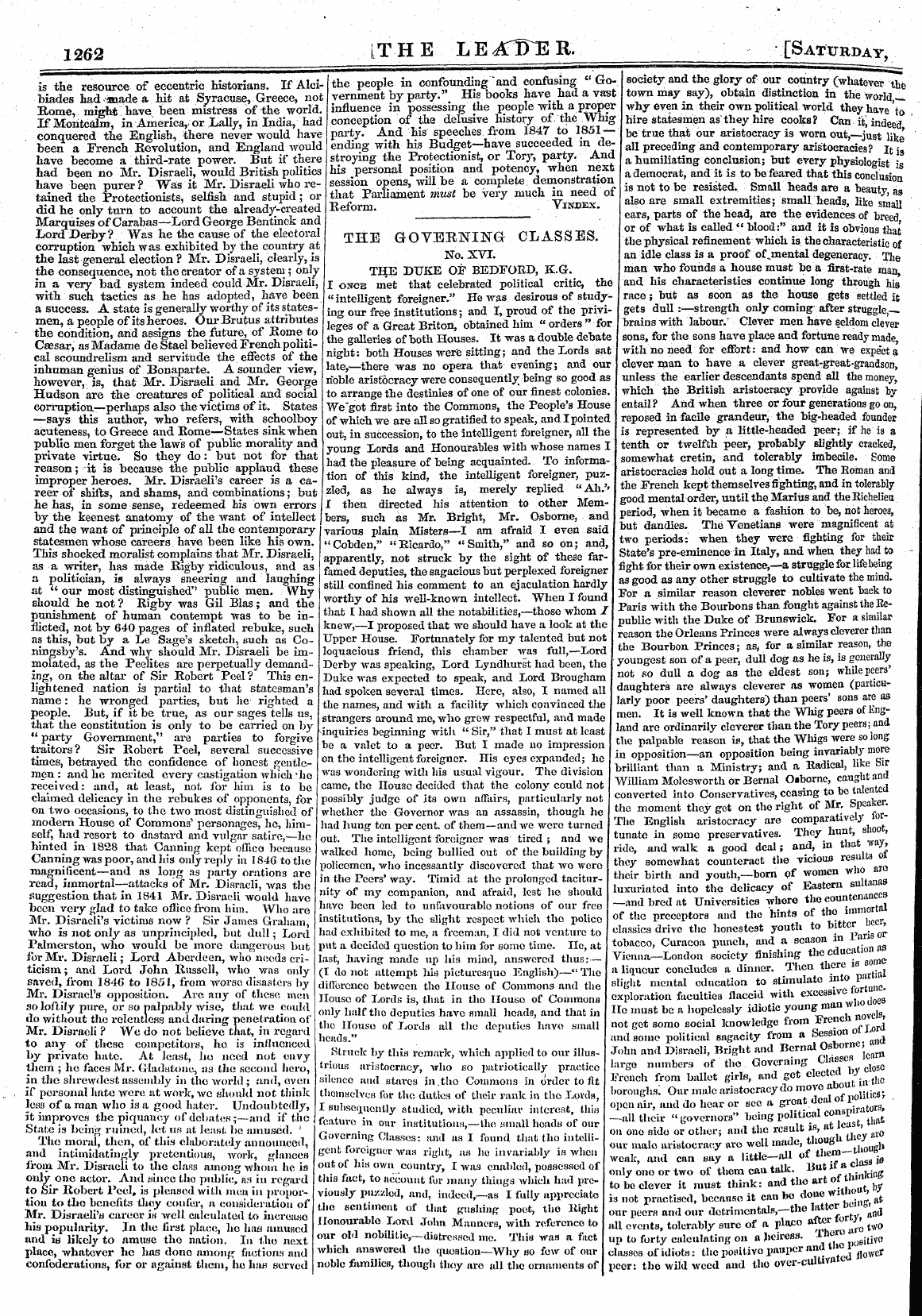
is the resource of eccentric historians . If Alcibiades had asaade a hit at Syracuse , Greece , not Rome , might have been mistress of the world . If Montcalm , in America , or LaUy , in India , had conquered the English , there never would have been a French Revolution , and England would have become a third-rate power . But if there had been no Mr . Disraeli , would British politics have been purer ? Was it Mr . Disraeli who retained the Protectionists , selfish and stupid ; or did he only turn to account the already-created
Marquises of Carabas—Lord George Bentinck and Lord Derby ? "Was he the cause of the electoral corruption which was exhibited by the country at the last general election ? Mr . Disraeli , clearly , is the consequence , not the creator of a system ; only in a very bad system indeed could Mr . Disraeli , with such tactics as he has adopted , have been a success . A state is generally worthy of its statesmen , a people of its heroes . Our Brutus attributes the condition , and assigns the future , of Rome to Caesar , as Madame de Stael believed Erench political scoundrelism and servitude the effects of the
inhuman genius of Bonaparte . A sounder view , however , is , that Mr . Disraeli and Mr . George Hudson are the creatures of political and social corruption—perhaps also the victims of it . States —says this author , who refers , with schoolboy acuteness , to Greece and Rome—States sink when public men forget the laws of public morality and private virtue . So they do : but not for that reason ; it is because the public applaud these improper heroes . Mr . Disraeli ' s career is a career of shifts , and shams , and combinations ; but he has , in some sense , redeemed his own errors by the keenest anatomy of the want of intellect and the want of principle of all the contemporary statesmen whose careers have been like his own .
This shocked moralist complains that Mr . Disraeli , as a writer , has made Rigby ridiculous , and as a politician , is always sneering and laughing at " our most distinguished" public men . Why should he not ? Rigby was Gil Bias ; and the punishment of human contempt was to be inflicted , not by 640 pages of inflated rebuke , such as this , but by a Le Sage ' s sketch , such as Coningsby ' s . And why should Mr . Disraeli be immolated , as the Peelites are perpetually demanding , on the altar of Sir Robert Peel ? This enlightened nation is partial to that statesman ' s
name : he wronged parties , but lie righted a people . But , if it be true , as our sages tells us , that the constitution is only to be carried on by " party Government , " are parties to forgive traitors ? Sir Robert Peel , several successive times , betrayed the confidence of honest gentlemen : and he merited every castigation which he received : and , at least , not for him is to be claimed delicacy in the rebukes of opponents , for on two occasions , to the two most distinguished of modern House of Commons personages , he , himself , had l-esort to dastard and vulgar satire , —he
hinted in 1828 that Canning kept offieo because Canning was poor , and his only reply in 184 G to the magnificent—and as long as party orations are read , immortal—attacks of Mr . Disraeli , was the suggestion that in 1841 Mr . Disraoli would have been very glad to take office from him . Who are Mr . Disraeli ' s victims now ? Sir James Graham , who is not only as unprincipled , but dull ; Lord Palmcrston , who would be more dangerous but for Mr . Disraeli ; Lord Aberdeen , who needs criticism ; and Lord John Russell , who was only saved , from 1846 to 1851 , from worse disasters by
Mr . Disrael ' s opposition . Are any of these men so lofllly pure , or so p alpably wise , that we could do without the relentless and daring penetration of Mr . Disraeli ? We do not believe that , in regard to any of these competitors , ho is influenced by private hate . At least , ho need not envy them ; he faces Mr . Gladstone , as the second hero , in the shrewdest assembly in the world ; and , oven if personal hate were at work , wo should not think less of a man who is a good hater . Undoubtedly , it improves the p iquancy of dcbaten ;—and if the State is being ruined , let us at least be amused . '
The moral , then , of tbi . s elaborately announced , and intimidatingly pretentious , work , glances from Mr . Disraeli to the class among whom he is only one actor . And wince the public , as in regard to Sir Robert Peel , is pleased with men in proportion to the benefits they confer , n consideration of Mr . Disraeli ' s career in well calculated to increase his popularity . In the iirat place , ho has amused and is likely to amuse the nation . In the next place , whatever lie has done among factions and confederations , for or against them , ho Iuib served
the people in confounding and confusing " Government by party . " His books have had a vast influence in possessing the people with a proper conception of the delusive history of the Whig party . And his speeches from 1847 to 1851 — ending with his Budget—have succeeded in destroying the Protectionist , or Tory , party . And his personal position and potency , when next session opens , will be a complete demonstration that Parliament must be very much in need of Eeform . Vindex .
Untitled Article
THE GOVERNING CLASSES . No . XVI . TIJE DUKE OF BEDFORD , K . G . I once met that celebrated political critic , the "intelligent foreigner . " He was desirous of studying our free institutions ; and I , proud of the privileges of a Great Briton , obtained him " orders " for the galleries of both Houses . It was a double debate nigbt : both Houses were sitting ; and the Lords sat late , —there was no opera that evening ; and our noble aristocracy were consequently ; being so good as to arrange the destinies of one of our finest colonies . We ' got first into the Commons , the People ' s House of which we are all so gratified to speak , and I pointed out , in succession , to the intelligent foreigner , all the young Lords and Honourables with whose names I had the pleasure of being acquainted . To information of this kind , the intelligent foreigner , puzzled , as he always is , merely replied " Ah . '' I then directed his attention to other Members , such , as Mr . Bright , Mr . Osborne , and
various plain Misters—I am afraid I even said " Cobden , " " Ricardo , " " Smith , " and so on ; and , apparently , not struck by the sight of these farfamed deputies , the sagacious but perplexed foreigner still confined his comment to an ejaculation hardly worthy of his well-known intellect . When I found that I had shown all the notabilities , —those whom I knew , —I proposed that we should have a look at the Upper House . Fortunately for my talented but not loquacious friend , this chamber was full , —Lord
Derby was speaking , Lord Lyndhurst had been , the Duke was expected to speak , and Lord Brougham had spoken several times . Here , also , I named all the names , and with a facility which convinced the strangers around me , who grew respectful , and made inquiries beginning with " Sir , " that I must at least be a valet to a peer . But I made no impression on the intelligent foreigner . His eyes expanded ; he was wondering with his usual vigour . The division
came , the House decided that the colony could not possibly judge of its own affairs , particularly not whether the Governor was an assassin , though he had hung ten per cent , of them—and -wo were turned out . The intelligent foreigner was tired ; and we walked home , being bullied out of the building by policemen , who incessantly discovered that we were in the Peers' way . Timid at the prolonged taciturnity of my companion , and afraid , lest he should have been led to unfavourable notions of our free
institutions , by the slight respect winch the police bad exhibited to me , a freeman , I did not venture to pvit a decided question to him for some time . He , at last , having made up his mind , answered thus : — ( I do not attempt his picturesquo English)— " The difference- between the House of Commons and the House of Lords is , that in tho House of Commons only half tho deputies have small heads , and that in tho House of Lords all the deputies have small beads . "
Struck by this remark , which applied to our illuatrious aristocracy , who so patriotically practice silence and stares in . tho Commons in order to fit themselves for the duties of their rank in tho Lords , I subsequently studied , with peculiar interest , this feature in our institutions , —the small beads of our Governing Classes : and as I found that tho intelligent foreigner was right , as bo invariably is when
out of his own country , I was enabled , possessed of this fact , to account for many things which bad previously puzzled , and , indeed , —as 1 fully appreciate the sentiment of that gushing poet , the Right Honourable Lord John Manners , with refcronco to our old nobilitie , —diatrcsHcd me . This was a fact which answered tho question—Why ho few of our noble families , though they are all the ornaments of
society and the glory of our country ( whatever the town may say ) , obtain distinction in the world — why even in their own political world they have to hire statesmen as they hire cooks ? Can it , indeed be true that our aristocracy is worn out , — -just like all preceding and contemporary aristocracies ? It j s a humiliating conclusion ; but every ph ysiologist is a democrat , and it is to be feared that this conclusion is not to be resisted . Small heads are a beauty as also are small extremities ; small heads , like small
ears , parts of the head , are the evidences of breed or of what is called ¦ " blood : " and it is obvious that the physical refinement which is the characteristic of an idle class is a proof of ^ mental degeneracy . The man who founds a house must be a first-rate man , and his characteristics continue long through his race ; but as soon as the house gets settled it gets dull : —strength only coming ; after struggle , — - brains with labour . " Clever men have seldom clever sons , for the sons have place and fortune ready made , with no need for effort : and how can we expect a clever man to have a clever great-great-grandson ,
unless the earlier descendants spend all the money which the British , aristocracy provide against by entail ? And when three or four generations go on , reposed in facile grandeur ^ the big-headed founder is represented by a little-headed peer ; if he is a tenth or twelfth peer , probably slightly cracked , somewhat cretin , and tolerably imbecile . Some aristocracies hold out a longtime . The Roman and the French , kept themselves fighting , and in tolerably good mental order , until the Mariiis and the Richelieu period , when it became a fashion to be , not heroes , but dandies . The Venetians were magnificent at
two periods : when they were fighting for their State ' s pre-eminence in Italy , and when they had to fight for their own existence , —a struggle for life being as good as any other struggle to cultivate the mind . For a similar reason cleverer nobles went back to Paris with the Bourbons than fought against the Republic with the Duke of Brunswick . For a similar reason the Orleans Princes were always cleverer than the Bourbon Princes ; as , for a similar reason , the youngest son of a peer , dull dog as he is , is generally
not so dull a dog as the eldest son ; while peers daughters are always cleverer as women ( particularly poor peers' daughters ) than peers' sons are as men . It is well known that the Wing peers of England are ordinarily cleverer than the Tory peers ; and the palpable reason is , that the Whigs were so long in opposition—an opposition being invariably more brilliant than a Ministry ; and a Radical , like Sir William Molesworth or Bernal Oiborne , caught and converted into Conservatives , ceasing to be talented
the moment they get on t he right of Mr . Speaker . The English aristocracy are comparatively fortunate in some preservatives . They hunt , shoot , ride , and walk a good deal ; and , in that way , they somewhat counteract the vicious results ox their birth and youth , —born pf women who are luxuriated into the delicacy of Eastern sultanas —and bred at Universities whore the countenances of the preceptors and tho hints of the immortal classics drive the honestest youth to bitter bee , l 8
tobacco , Curacoa punch , and a season in an Vienna—London society finishing the education w a liqueur concludes a dinner . Then there is son slight mental education to stimulate into pa exploration faculties flaccid with excessive lortui * Ho must be a hopelessly idiotic young man wJio uu not got somo social knowledge from French now , and some political sagacity from a Session oi j John and Disraeli , Bright and Bornal Osborne ,, largo numbers of the Gover ning C lasses French from ballet girls , and get elected by boroughs ; Our male aristocracy do move about deal ol
open air , and do bear or see a groat l \ —all their « governors" being political conspi * ^ oa one side or other ; and tho result is , at leas , ^ our male aristocracy are well made , tliougn j weak , and can say a little-all of the . ™^ fl j 9 only ono or two of them can talk . But tf » ^ to bo clever it must think : and tho art ° ? " by is not practised , because it can bo done wl l . ' ttt our peers and our detrimentals , — the latter d ^ all events , tolerably sure of a place after to j ^ ^ up to forty calculating on a Jieircss . Im * oS itivo classes of idiots : the positive pauper awl tM f poor : the wild weed and the ovcr-culUvaw-
Untitled Article
1262 jTHE LEi ^ E R . [ S AfTrRD AY ,
-
-
Citation
-
Leader (1850-1860), Dec. 31, 1853, page 1262, in the Nineteenth-Century Serials Edition (2008; 2018) ncse.ac.uk/periodicals/l/issues/vm2-ncseproduct2019/page/14/
-