On this page
-
Text (3)
-
Untitled Article
-

Untitled Article
-

Untitled Article
Note: This text has been automatically extracted via Optical Character Recognition (OCR) software. The text has not been manually corrected and should not be relied on to be an accurate representation of the item.
-
-
Transcript
-
Note: This text has been automatically extracted via Optical Character Recognition (OCR) software. The text has not been manually corrected and should not be relied on to be an accurate representation of the item.
Additionally, when viewing full transcripts, extracted text may not be in the same order as the original document.
Untitled Article
S ^ prSfe « ad-partiaKty . MlU Italy for the Italians , and ^ EtaiiaBa lor Italy V that is a isummary of their © pinions . One great t > rga * iza « io » is spreading from -the central states , northwards and southwards , so exten-8 iv . e , that it may be said to embrace the larger part of the Italian manhood , and so secretly worked , that concentrations of the Austrian troops frequently take place at points where no real activity prevails . The Capuan
fortress -strengthened by the engineering skill of two Russian generals , the Papal prisons fuU of the proscribed , the Austrian police in Tuscany , the Austrian troops in Parma and Modejff * , the Austrian army watching the Central Congregations in Iiombardo-Verietia , the Austrian teachers compelling their Italian pupils to learn and speak the German lanit demonstr
guage , the political and milary ation against Piedmont , all prove that repression is not order , and that a cowp d ^ etat is the worst sort of salvation for society . How will this end ? We want no prophet , but a plain reasoner , to answer the question . It cannot end , except in a successful revolution , whether constitutional or democratic , which shall restore the natural relations of
governors and subjects . No permanent systems are established by the code of oppression . The opposing parties—the despotic governments , and the disaffected nationsare preparing , on one side for attack , on the other for resistance . Whence it may be concluded , that both parties cannot remain for ever in the same attitude . One must surrender , or draw the other into an engagement . „ _ _ to
We suppose that England may be said have an interest in the political condition of the Continent . The question is , what course should that interest dictate to our diplomatists and statesmen . If England has anything to gain—if , indeed , she does not lose , in a moral and material sense , to an incalculable degree , by the prevalence of absolute and barbarous authority , we are much deceived . We think it possible to show that England has a direct and palpable interest in the freedom of France and Italy .
Untitled Article
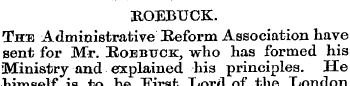
ROEBUCK . The Administrative Reform Association have sent for Mr . Roebuck , who has formed his Ministry and explained his principles . He himself is to be [ First Lord of the London Tavern , Messrs . Tbavebs , Mobxey , and Gassiot are to be his Secretaries of State . The Conservative , Samuel Bbown , disappears— -very properly , too- ^ and the Association announces itself in readiness to act as the BcaUblding of a new party in Parliament .
In Parliament , as actually constituted . The proposal carries with it a suggestion of failure . t ) epend upon it , the present Parliament is the best you can get from the present constituencies , and the present Ministry is the best you can get from the present Parliament . 5 Tou may correspond with the electors ; you may penetrate the secrets of influence and agency ; you may watch the intercourse that takes place between an independent member and a government in want of supporters ;
you may stand at the doors of the public offices , and examine the credentials of the candidates , but the political caste will have its < way > : landlords will chock the votes of their tenantry ; tradesmen will be intimidated by their customers ; pertinacious applicants , who can work a petty local interest , will have situations in the excise ; parliamentary loaders -will provide for their friends ; the army will continuo to bo what it is—the asylum ot younger sons , tho property of the Equestrian order .
Because you expect to make a bad macbiae work well . 3 Tou may , indeed , regulate the movements , and mend the gear , so that matters may not go from bad to worse . ; but , really to improve your system , you must improve the political organization of the country . At the ; apex of our parliamentary constitution stands the prime minister ; at the base th e constituencies are grouped , in irregular masses ; you must widen and strengthen the foundations , if you would ennoble the structure .
Plainly , nearly every man who sits in the House of C ommons represents some special interest , which has sent him there . Not the interest of the Cabinet only , or of the aristocracy , but the interest of the aristocracy and the Cabinet mixed up and identified with other interests , equally narrow and partial , which , are not those of the nation at large . Without
counteracting this power that encloses the Legislature , and determines all its Acts , it is hopeless to expect administrative purity , the exercise of patronage on high principles , the conduct of public business with exclusive reference to the public interests . That can never be until the nation . at large determines that it shall be , and possesses itself of the means , to enforce its will .
Can we confide the issue to the Administrative Reform Association—even though Mr . Samttet * MobIiEY , who could not have faced another general meeting , has resigned the chair to John Arthur Roebuck , member for Sheffield , an earnest and an honest man , on whose name will fall a ray of English history ? No ; if all he means is contained in his programme .
The members of the Council of the Administrative Association were empowered , we may infer , to dethrone Mr . Moelet , and to appoint Mr . Roebuck , who will probably find the post more congenial to his faculties and to his habits than the chairmanship of the Metropolitan Board of Works . But already some of the subscribers are asking upon whose authority is the Portfolio of Correspondence entrusted to Mr . Mobley , the Portfolio of Finance to Mr . Tbavebs , and the Portfolio of Statistics to Mr . Gassiot ? The circular affords no information on this point . It has , inthis respect , all the brevity and all the absolutism of a decree . It has
occurred to many persons , who have a right to speak on these subjects , that the political sections throughout the country will not feel that they are called upon to adopt Mr . MoRiiEY as their London agent . Indeed , with Mr . Roebuck in the chair , the contrast becomes more painful between the genuiiio politician and the eager but unpolitical reformer . It is not a question of politics ,
the City Reformers say , but a question of business . They want the public business and the private business of th « country to be conducted on tho same principles . It would be dangerous to extend tho parallel too far . This idea , if it means anything , means that the British merchant , as a merchant , carries out his transactions with more ease and effect than tho
Government -as a Government . Perhaps it would be as well , however , to remember that n Government is not a merchant , or even a contractor . In tho civil and military administration of a great empire , ' many qualities of intellect and of practical capacity are required totally and essentially distinct from
those which enable a shipowner to complete his contracts , or . a-tea-merchant to manage . « thousand clerks , to ainasa a million , to bay Etruscan villa , and to look contemptuously on tho break-down of tho public dopartmerits . Ho is quite right to look contemptuously on tho break-down . But is ho right iu
supposing that governments . so simple an aflair as the London Tavern . Reformers pretend ? We , for our own part , expect little amelioration in the conduct of public business until our Reformers have arrived , at ; a higher appreciation of state duties , and of the capacities essential to their performance . Ho doubt , if Mr . Roebuck ' s plan be carried out some good practical results may be obtained ?
As Lord Palmerston took care to distance the Association under the MoiiiiEx chairmanship , so he may endeavour to keep ahead of Mr . Roebuck and his three secretaries . Yet it is not to be concealed that the City Association has been a deplorable , and not a very creditable failure ; and we feel sincere regret in avowing that not much more is to be anticipated from it in its new form .
The point at which it is connected with the real political interests of the country is that suggested by Mr . Roebuck—the formation and support of a Liberal party in the House of Commons . But on what basis ? The basis of Administrative Reform , technically and in detail . The first political society that arises with powerful leaders and large objects will sweep it out of sight . Even were a general election to take place , what would be the aim of the Association ? To return such men as Mr . Tite , Mr . Ingram , Mr . Joseph Paxton—useful in their own station , but , except as 'votes , utterly lifeless and insignificant in the House of Commons .
It seems to us that if Government stands in need of Reform , Reform stands in need of Renovation .
Untitled Article
- HOW TO KEEP UP THE MILITIA . Among the benefits we have derived from the war has been the revival of the old constitutional force of the country—the Militia . One of the possible , we will not yet say probable , disadvantages which attend the greater blessing of peace , is the dissolution of that force . What is only possible , it is our duty to prevent from becoming even probable , and to do our utmost to retain the great benefit which has accrued from the war .
The characteristic of the struggle , so far as we are concerned , has been that we have carried it on with volunteers . While other countries rely on conscriptions and forced levies , England has relied upon the willing agency of her citizens to vindicato her policy . The result of that reliance has shown tho power of voluntary service . The Militia not only gave 30 , 000 meu to the Queen ' s army , but every embodied regiment wns prepared to enter on service beyond the limits of Great
Britain . To these constitutional corps wo entrusted in great part our home and foreign garrisons ; and those not so employed formed the bulk of the camps of instruction established by tho Government . If the full force of the Militia , as voted by Parliament , was never raised , we must trace that to thenovelty of the voluntary system , and to the fact that tho people had been bo long , unacin aib
customed to thorr military duties , " banding tho Militia regiments , the Government act on a perfectly sound princip le , because it is never intended , nor is it noeossary , that those regiments should be permanently embodied . Their future sorvico ia aecured , provided that an adequate staff bo retained , and that tho regiments are invariably called out for training every year , and that they ue kept rocruitedup to their duo comp lement oi
men . . ..., In order to keep up tho Militia , it will uthovo their loaders , tho territorial aristocrac y , to sustain tho military ttpirit iu ovory wit y i to promote an esprit dc corps among i > " ? n > ° when disembodied by encouraging thon wuticipatiou in athletic sports ; to provide- iol tho contingencies of tho recruitment by " »
Untitled Article
^ g- jTBE LEAPil . [ No . 32 £ ^ Arra&A : ] r ,
-
-
Citation
-
Leader (1850-1860), June 14, 1856, page 566, in the Nineteenth-Century Serials Edition (2008; 2018) ncse.ac.uk/periodicals/l/issues/vm2-ncseproduct2145/page/14/
-