
On this page
-
Text (3)
-

Untitled Article
-
Untitled Article
-

Untitled Article
Note: This text has been automatically extracted via Optical Character Recognition (OCR) software. The text has not been manually corrected and should not be relied on to be an accurate representation of the item.
-
-
Transcript
-
Note: This text has been automatically extracted via Optical Character Recognition (OCR) software. The text has not been manually corrected and should not be relied on to be an accurate representation of the item.
Additionally, when viewing full transcripts, extracted text may not be in the same order as the original document.
Untitled Article
the field . Algeria can always be held . by 25 , 000 men 7 and , deducting 120 , 000 men jor depots , tie * £ t of the army is at the free disposal of the Emperor , besides a reserve of 150 , 000 men , drawn from old hou-commissioned officers who have served their time , and conscripts whom it has not been considered necessary to . call out . This army is drawn from a population of 36 , 000 , 000 , speaking the same language and imbued with . the- same national feelings . Ihe empire of France is centralised in Paris , a fact decidedly advantageous to perfect military government . In no other European army are the troops influenced by the . same universal spirit . A trench regiment does not bear the name of a varying possessor , nor the appellation of a province or a town , but merely a simple number . 1 his number , however , is permanent , and has its appointed place in the history of the army . The gi-eat strength of the French army lies in its promotion from the ranks . .
The French soldier is rendered intelligent , active , and independent ; lie is treated very strictly , and is obliged to exercise—no matter the state of the weather- —for six or eight hours in the barrackyard . The greatest possible variety is sought after , and he is even taught to dance and fence . According to law he is ol Jliged to serve seven years ; and even in times of the deepest peace he must serve continuously at least fpiir years and a half . The discipline he is placed under is very strict , arid the punishments for offences are very severe . A French court-martial orders the punishment of death where we should order penal servitude ; and imprisonment for three days is very common in cases where an English soldier would get off with a reprimand .
" It cannot be denied , however , that this severe . discipline of the French troops , which depends more on their militarv intelligence'than on their mechanical obedience to" their officers , possesses its dangerous aspect . This is more especially the case when the army has , through-unexpected reverses , lost / all con- ^ jBdence in the leaders , and the soldiers themselves have yielded up the hope that their bravery can give a successful turn to affairs . The history of the French army supplies iis with repeated instances that , after the loss of a campaign , it becomes more demoralised , and the bands of discipline and military order are more thoroughly dissolved , than was ever Austrian armiesLike
the case in the Russian or . every man of sanguine temperament ,. the Frenchman soon grows desponding , and when this has once occurred , and the ambition which urges him on has lost its elasticity , he becomes the very worst soldier in the world . AH the difficulties which he endured with a smile when advancing appear , to him doubly heavy on a retreat , and as he feels no fear of his Superiors , he no longer obeys their orders with such precision as is found , in those armies where discipline . founded on severity is maintained . Hence we are firmly convinced that , although French tropps would always defeat an equal number of Russians , unless the accidents of terrain -were too unfavourable , and
that a French officer "ivliQ allowed himself to be beaten would deserve to bo tried by courtrinartial , still we hardly fancy that Frenchmen would have defended Hebastopol with that admirable perseverance which the troops under 1 ' rince GortschakofF undoubtedly displayed . " One very excellent regulation is , that all brigar dier-generals above sixty-two years of age , and generals of division over nixty-fivo , are-, transferred to what is called the 2 nd Section , ' or reserve force , and cm only bo ' employed , on active service within the frontiers upon half-pay . The- French army happily knows nothing , of aged officers who cannot mount their horses without assistance .
Next follows the Russian airmy ; and here our author confesses himself to be stranded for want of authentic figures . The million of armed men which the autocrat is said to have at his disposal must bo looked upon us n fable , in the absence of reliable information ; though , at tho battle of Waterloo , ( 500 , 000 Russians wore on the march to the Rhine , and must have crushed Napoloon had ¦ not Wellington saved thorn tho trouble .
Tho grout animating features of tho Russian nrnvy are passive obedience and religious fervour . They fight for their God and their Czaiv The worst feature of tho private soldier ' s lift ) is the arbitrary manner in wliioU ho its treated . Every man ' s hand jh raisod against him ,, and ho- has no chance of redress ! Nothing but a medal , gained « n a campai gn will keep him inviolate from a blow , and proouro him tho protection of the law . " Anotherpeoultor organization in Russia is that
of the Military Colonies , fo ' sitdecL by the Emperor Alexander I ., on the termination of the war with France . Count Arafctschiyeff drew up the original scheme Tvhich immediately received the Imperial assent . The objects proposed were—that the soldier should partly support himself by cultivating the land increasing the reserve by means of the Crown peasants : providing a house for the soldier s family in the event of war ; and , lastly , populating districts where a Want of hands was perceptible . These colonies were founded on the frontiers of Poland , Austria , and Turkey , thus enabling Russia to assemble a numerous corns d ' armde in the south-west chosen for the
in a very short time . The villages experiment were inhabited by crown serfs , who were freed from all taxation , but in return had to receive the colonists . Their cabins were pulled down , and houses were built in regular streets . All the serfs above fifty years of age were chosen as master colonists , each receiving about forty acres of land , on which to support a soldier and his family and a horse , if the village was occupied by a cavalry regiment . The soldier , in return , assisted the colonist in cultivating his land , whenever his military duties did ot occupy his time . The commandant had the Option of selecting the soldiers to be quartered on If he had several the
the master colonists . sons , eldest became his assistant ; the second belonged to the reserve ; the third could become a military peasant while the others were regarded as military pupils . The colonists of Southern Russia , at the present time , occupy 380 villages in the governments of Kherson , Charcov , and Yekaterinoslav , and amount to 80 , 000 men . These military districts are watched so jealously , that no person can enter them without a special pass from the military , . authorities . The great . advantage Russia derives from this institution is , that she possesses in these colonies an inexhaustible resource . for strengthening her army , which is constantl y supplied with recruits accustomed to the use of arms from their earliest youth . "
The Russian army suffers , like the Austrian , from being eom 2 > osed of heterogeneous elements . There are G ermans and Great Russians , "White Russians , Lettonians , Sarmatiaris , Tartars , Cossacks , and Finns . Jews arc compelled to serve , but are only used-as workmen . Out ot ' c £ 5 or 70 millions of men subject to the Czar , 40 millions to 45 millions ( of whom 34 millions are Great Russians ) are liable to the conscription . All the Great Russians are most peaceable men , and unanimous in their honour of the military profession . The great defect of the Russian army is , that it is composed of tyro classes , —men who are naturally pacific , and men who are forced into the ranks , and take no pleasure in doing their duty .
The present available force is 637 , 000 men , with 1 , 436 guns , and 316 pontoons . We wind up with the British army , upon which little need be said . The systems of purchase , and army clothing ; the force of tradition and official obstinacy ; the spasmodic attempts at reform , and the establishment of amateur Camps , like Aldershott and Ohobham , where the officers play at soldiers in the morning and run up to the Opera at night ; the lavish expenditure of money , and the unsatisfactory results ; to say nothing of our lamentable mistakes in the Crimea , are all familiar —too sadly familiar—to the public mind . In no European state is so much wealth bestowed upon this branch of the ' national service , with so little
return of . which we may be proud . ^ The old courage , endurance , and physical stamina of the soldier win our battles , and not our military organisation . The greatest enemy he has to fight against is tlic system under which he works . Our present disposable establishment , in any ofi ' ensive wnr , may be taken at 120 , 000 infantry , 12 , 000 cavalry , 300 guns , and 2 , 000 engineers . Our defensive army consists of 120 , 000 meii in tho militia ; 12 , 000 volunteer cavalry ; tlijo Royal Dockyard Battalion , consisting of 10 , 000 powerful workmen trained to the use of arms ; and G 0 , 000 pensioners , one half of whom would bo available for home sorvioo ; besides nine infantry regiments in tho Channel Islands' Militia ; several artillery companies , and the Honorable Artillory ' of London . The booU concludes with an appendix concerning tho Turkish and Sardinian armies , tho latter of which shows a disposable force of 120 , 600 men .
Tho information that our author is enabled to lay before liia readers , though only perhaps an approximation to tho truth , is particularly valuable at tho prosont time ,
Untitled Article
OC 1 SOLA . ' Ofeola . By Captain Mayne Bold . 3 vols . Hurst and Blackett . Captain limn is . not of tho broad « und-buttur
school of novelists . He spices Ids lucubrations highly , and uses the literary cayenne so unsparingly , that none but the strongest stomachs can do full homage to his specialty . OLn this threevplume banquet the condiments are all of the highest and most pungent flavor . Murders , battles , . and duels are mere entre e ; the pieces de resistance are concatenations of three-piled horrors ^ -the wind-up being a climax to be worked out only by calling in the aid of a rattlesnake of the largest dimensions . The story—as may be antici-Indiansof Indiawarfare ¦'_"' - L- — ¦ ' — - . * A '» « ¦ * V . . A _ M' .
pated—is one of , n , Indian oppression , Indian heroism , and Indian vengeance , interspersed with pale-faced villany and virtue . This field , one would think , was pretty well exhausted ; but Captain Reid has shown that some unnoticed gleanings were yet unappropr ated , and , to do him justice , he has made the most of his materials . There is one noticeable circumstance , that the interest rises as the tale proceeds , and that the closing scene is the fitting ape " x to a pyramid of literary wonders .
Untitled Article
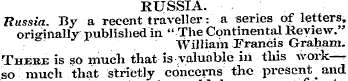
RUSSIA . Russia By a recent traveller : a series of letters , originally published in " The Continental Review . " William Francis Graham . There is so much that is valuable in this work— -r so much that strictly concerns the present and ' future of Russia—that it would be very unfair to pass it over with a merely cursory notice . A correspondent of " The Continental Review ,. ' the author is a man of extraordinary intelligence , who has recently visited Russia , and in these pages presents us with a record of his actual experience .
He visited Russia in a moment of transition—m . a moment when old traditions are vanishing , and a new era of liberty of thought and discussion is commencing . Such is the author s statement , and it obviously " adds interest and value to his book . The press " was comparatively free ; the Sovereign was engaged in the task of reformation ; and the country * was in an-attitude-of visibl y progression . Much seems to have dietl with the Emperor JSTicholas ; and much that existed as the " the hidden life " of his epoch , awakened and i-evealecl itself since his death . The gossip of St .
Petersburg , which is the commonest sotirce of inforinatioifto the English papers , is not at all to be relied on ; notwithstanding all it " may assert , serf-eniau ^ cipation is a fact , and Austria dreads the growth of a liberty which already threatens to revolutionise her Slavonic provinces : "It in possible , " continues our author , " that the present Emperor mav not have inherited the iron will of Ins father ; but it is certain that lie has never wavered hitherto in his main purpose , and that all his intentions are o-ood . " It is also " important to observe that the movement does not depend on a single life .
Not only is the Grand Duke his brother ' s zealous and efficient supporter , but the necessity of a total reform has become a . conviction with the nation at lar <* e . That conviction- —they begin to admit itis chielly the result of the hint war . The experiment of isolation has been tried for thirty years ; in compensation for many evils it was-thought to have given Russia an invincible army , and m one year that army had been three times beaten , and its stronghold taken . If we did not restore the fallen throne of the East , or secure tho sympathies of believers in Delhi and Jeddah , we have at least conquered freedom for the Russian serf , and free thought and speech for generations yet unborn . Our soldiers did . not die for nothing at
bebastopol . " That the serft arc not fit for freedom our authoi regards as an idle objection . If the argument applies to natural , capacity , it is refuted by tho numerous instances of natives who have rh- < on from tho ranks , under the worst circuniHtancOH , to become tradesmen and merchants . Tho ease with which the Russian adapts hinwulf . t » ft . change ot position is , in fact , one of hfn most sinking tiJuirau-; oristics . Also , with tho same blood in thou- veins , hlcivilised
tho middle classes nro now as higy as tho nobles were under rotor the Great , or oven under Catherine . They are , it is soundly wwertcd by our intolliiruiifc traveller , im fit for freedom as the Pnliiw . and Dnlgoroukis wore for government . Among them , moreover , a few may not desire to bo freed , for certain obvioua reasons \ but for the mass , tho general enthusiasm with which they look up to tho Czar , i » proof sufliclont that they wish for liborty . A now system has , in fact , gradually grown up .
Untitled Article
TSfo , 466 Febbdarv 26 , 1859 . 1 THE LEADER . 269 . ¦—_^^^^^^^ , ^^^^^^ m ^^ J^^^^^^^^»^^^^^^^^^^^^^^^^^^^—^ . —^—^^ . —^ . ^^^^^^^^ i ^^ M ^^ M ^^ Mj ^^^^^^^^^^^^^^^^^^^^^^^^^^^^^^^^^^^^ Ti " . ' "
-
-
Citation
-
Leader (1850-1860), Feb. 26, 1859, page 269, in the Nineteenth-Century Serials Edition (2008; 2018) ncse.ac.uk/periodicals/l/issues/vm2-ncseproduct2283/page/13/
-